
READING CIRCLE Roles in a reading circle Discussion
- Slides: 11
READING CIRCLE
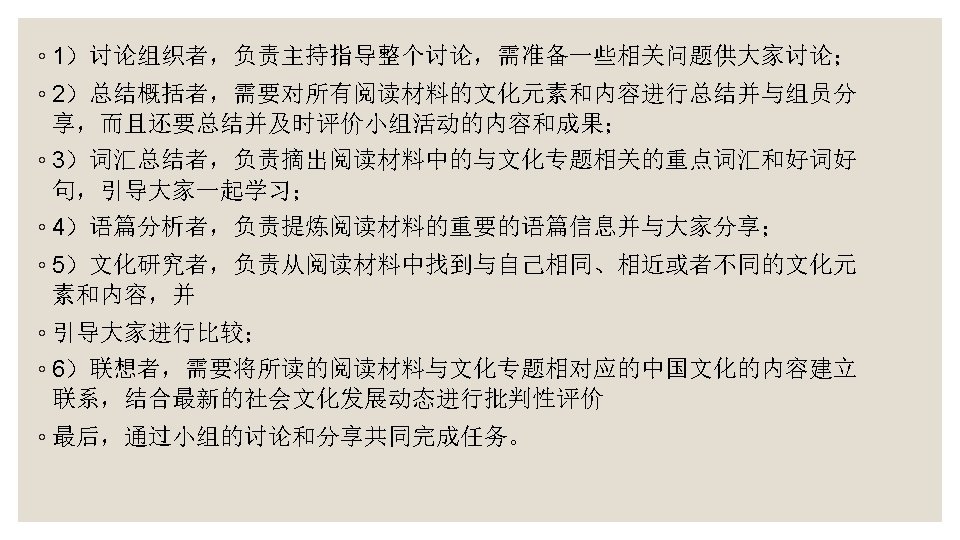
◦ Roles in a reading circle : ◦ Discussion leader, ◦ Summarizer, ◦ Connector, ◦ Word master, ◦ Passage person, ◦ Culture collector
◦ Discussion leader, whose job was to keep the group on task, help the group understand the reading, ask good detail questions as well as general questions, listen intently to the group members and respond to ideas, and make sure everyone participates. ◦ Think of some general questions about the text to start the discussion and keep the discussion interesting. ◦ Make sure that everyone has a chance to speak and join in the discussion. ◦ Think about who you would like to invite to speak first - the Illustrator? The Highlighter? The Researcher? You need to decide what would be the most useful thing to talk about first. ◦ Usually the best questions come from your own thoughts, feelings and questions as you read. They could be about the main ideas, confusing parts, or anything that interests you! Think about planning our reading: What do I know about this topic? What would I like to know about it? Did I find the answers to my questions? What did I learn from reading this? ◦ Make a list of 5 questions to bring to the discussion.
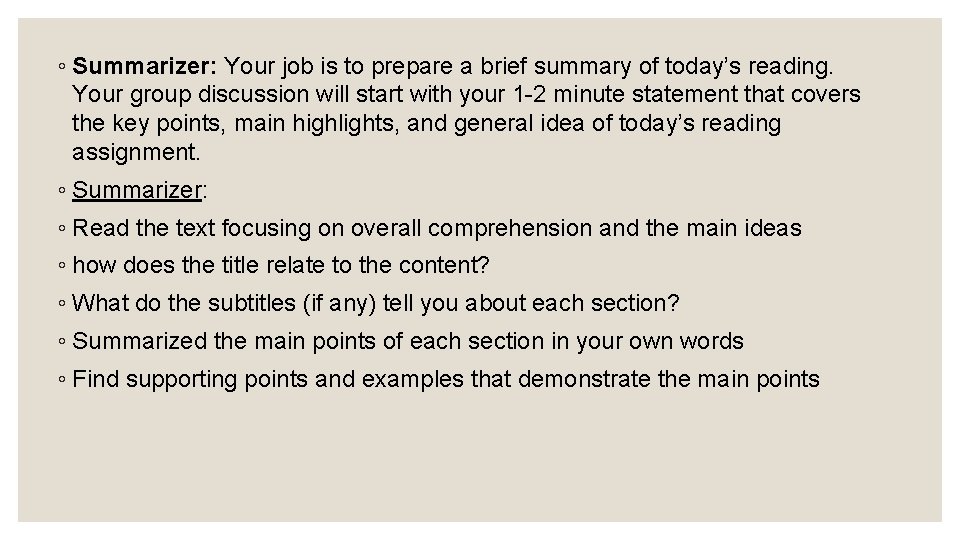
◦ Summarizer: Your job is to prepare a brief summary of today’s reading. Your group discussion will start with your 1 -2 minute statement that covers the key points, main highlights, and general idea of today’s reading assignment. ◦ Summarizer: ◦ Read the text focusing on overall comprehension and the main ideas ◦ how does the title relate to the content? ◦ What do the subtitles (if any) tell you about each section? ◦ Summarized the main points of each section in your own words ◦ Find supporting points and examples that demonstrate the main points
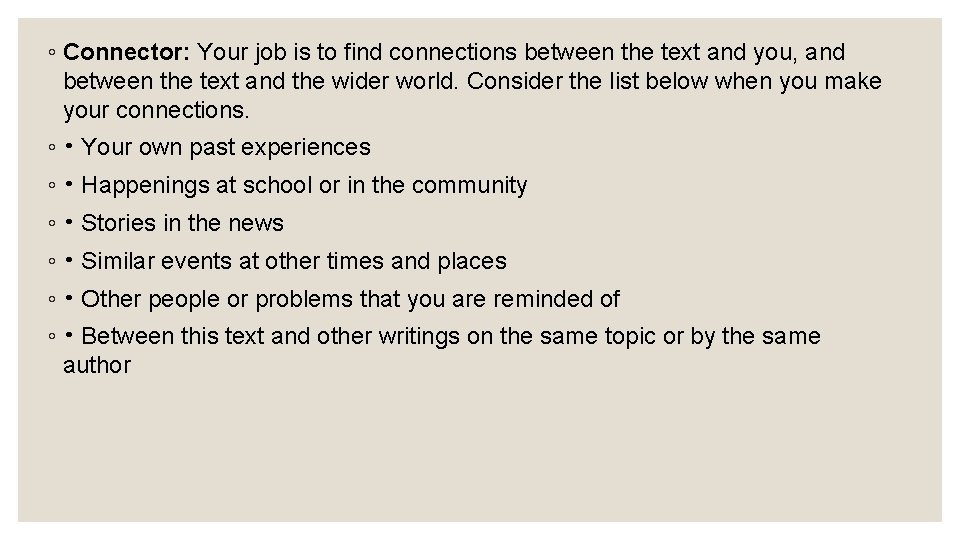
◦ Connector: Your job is to find connections between the text and you, and between the text and the wider world. Consider the list below when you make your connections. ◦ • Your own past experiences ◦ • Happenings at school or in the community ◦ • Stories in the news ◦ • Similar events at other times and places ◦ • Other people or problems that you are reminded of ◦ • Between this text and other writings on the same topic or by the same author
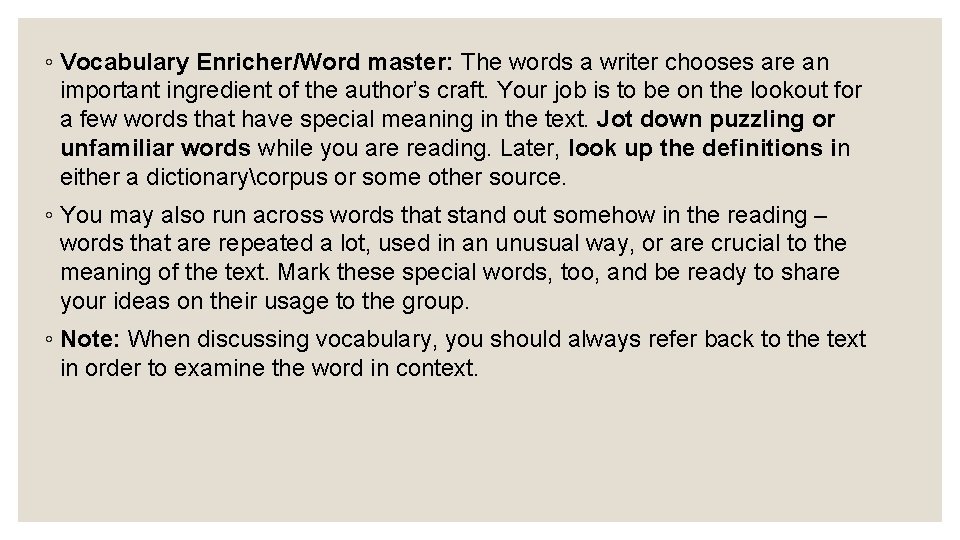
◦ Vocabulary Enricher/Word master: The words a writer chooses are an important ingredient of the author’s craft. Your job is to be on the lookout for a few words that have special meaning in the text. Jot down puzzling or unfamiliar words while you are reading. Later, look up the definitions in either a dictionarycorpus or some other source. ◦ You may also run across words that stand out somehow in the reading – words that are repeated a lot, used in an unusual way, or are crucial to the meaning of the text. Mark these special words, too, and be ready to share your ideas on their usage to the group. ◦ Note: When discussing vocabulary, you should always refer back to the text in order to examine the word in context.
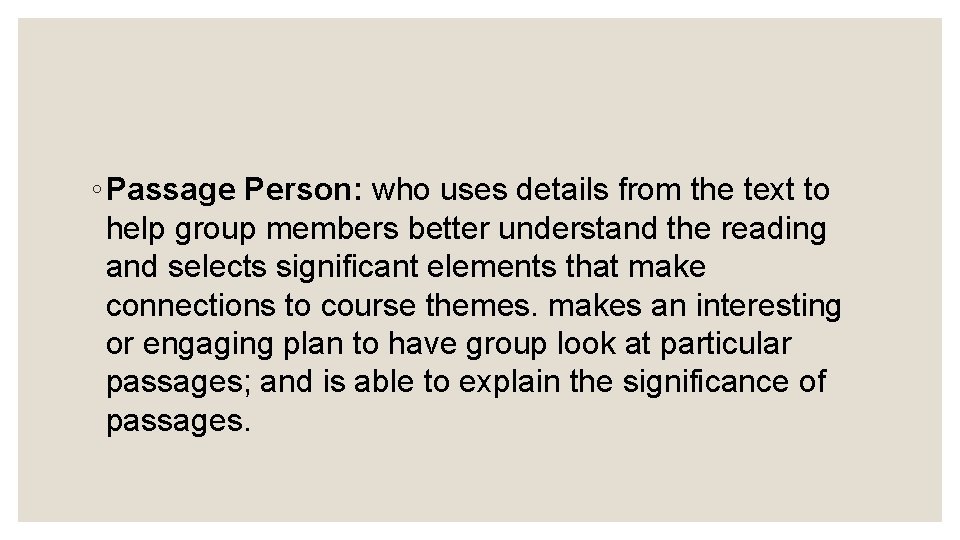
◦ Passage Person: who uses details from the text to help group members better understand the reading and selects significant elements that make connections to course themes. makes an interesting or engaging plan to have group look at particular passages; and is able to explain the significance of passages.
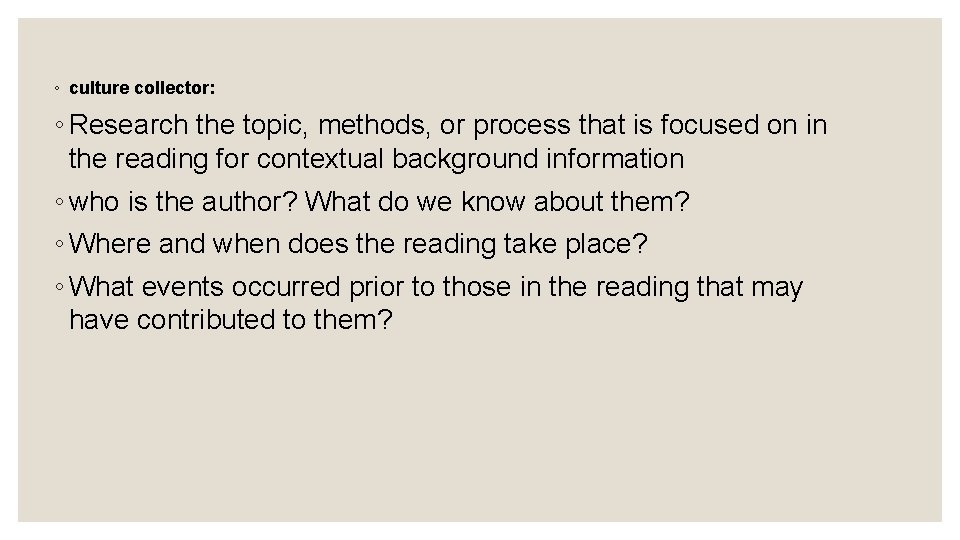
◦ culture collector: ◦ Research the topic, methods, or process that is focused on in the reading for contextual background information ◦ who is the author? What do we know about them? ◦ Where and when does the reading take place? ◦ What events occurred prior to those in the reading that may have contributed to them?
By taking on a different ‘role’ for each session, you should develop awareness of the variety of tasks involved in truly engaging ‘critically ’ with a text you are asked to read. It is hoped that you will be able to manage completing all the tasks at once when it comes to reading texts on your course!