
Reading Act 1 An Inspector Calls JB Priestley
Reading Act 1 An Inspector Calls – JB Priestley
Research Option: Computer Room Research - Context You will need to research and write up your findings on on the following topics. • Background information on JB Priestley • Edwardian England including: – the roles of men and women – Employment and the Welfare System • Political Revolution and Change – Socialism • What is Capitalism?
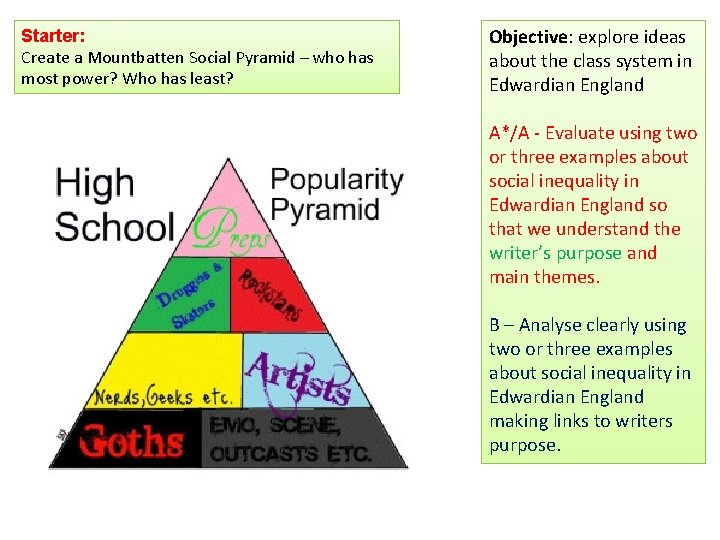
Starter: Create a Mountbatten Social Pyramid – who has most power? Who has least? Objective: explore ideas about the class system in Edwardian England A*/A - Evaluate using two or three examples about social inequality in Edwardian England so that we understand the writer’s purpose and main themes. B – Analyse clearly using two or three examples about social inequality in Edwardian England making links to writers purpose.

Edwardian Social Structure
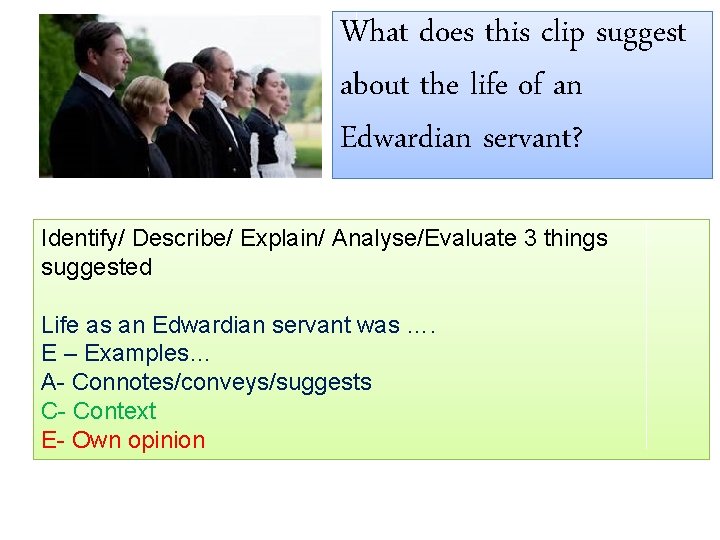
What does this clip suggest about the life of an Edwardian servant? Identify/ Describe/ Explain/ Analyse/Evaluate 3 things suggested Life as an Edwardian servant was …. E – Examples… A- Connotes/conveys/suggests C- Context E- Own opinion
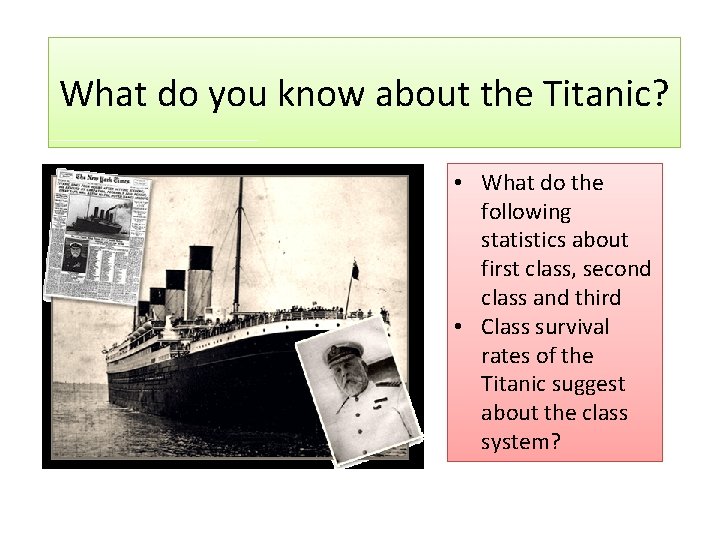
What do you know about the Titanic? • What do the following statistics about first class, second class and third • Class survival rates of the Titanic suggest about the class system?
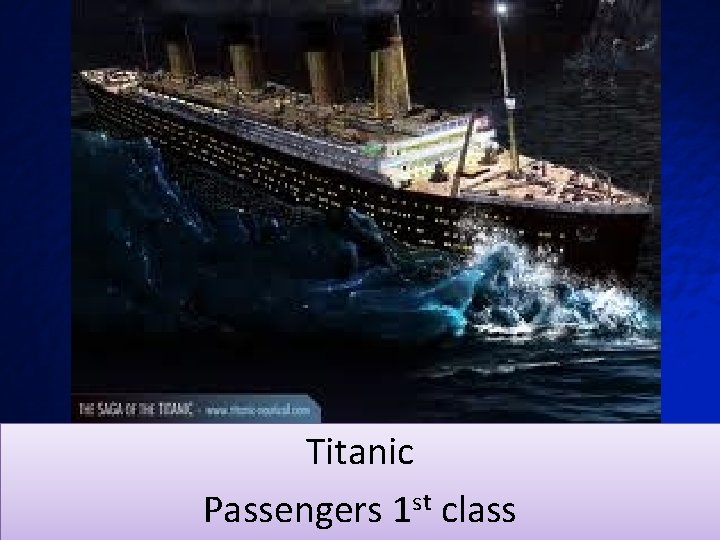
Titanic Passengers 1 st class
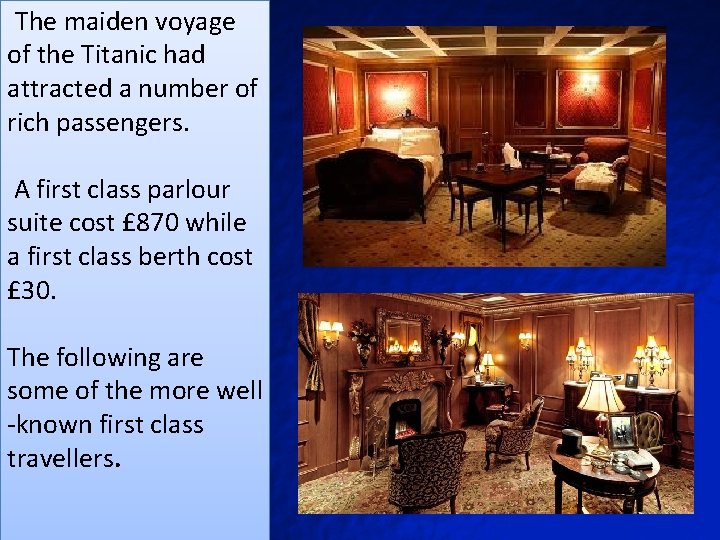
The maiden voyage of the Titanic had attracted a number of rich passengers. A first class parlour suite cost £ 870 while a first class berth cost £ 30. The following are some of the more well -known first class travellers.
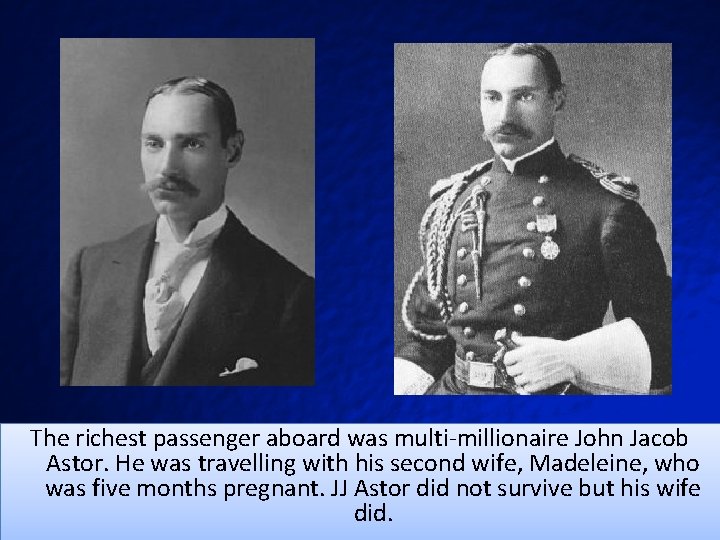
The richest passenger aboard was multi-millionaire John Jacob Astor. He was travelling with his second wife, Madeleine, who was five months pregnant. JJ Astor did not survive but his wife did.
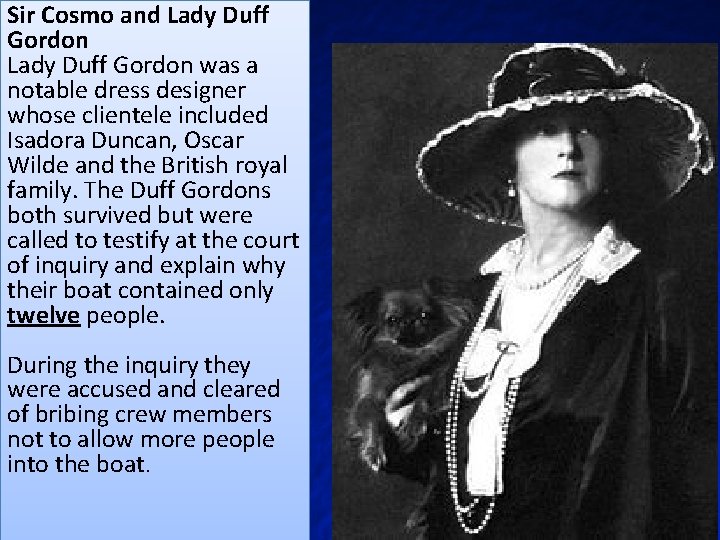
Sir Cosmo and Lady Duff Gordon was a notable dress designer whose clientele included Isadora Duncan, Oscar Wilde and the British royal family. The Duff Gordons both survived but were called to testify at the court of inquiry and explain why their boat contained only twelve people. During the inquiry they were accused and cleared of bribing crew members not to allow more people into the boat.
Statistics – First Class passengers • There were 325 first class passengers on board • 202 first class passengers survived • 175 men • 57 men • 144 women • 140 women • 6 children • 5 children
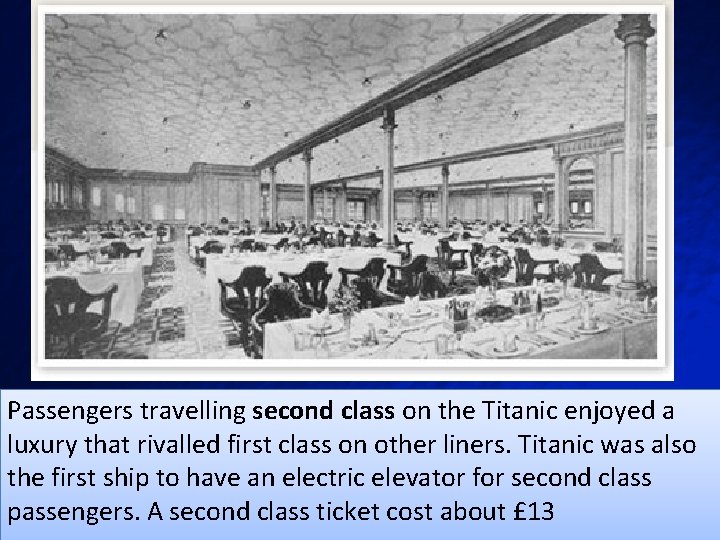
Passengers travelling second class on the Titanic enjoyed a luxury that rivalled first class on other liners. Titanic was also the first ship to have an electric elevator for second class passengers. A second class ticket cost about £ 13
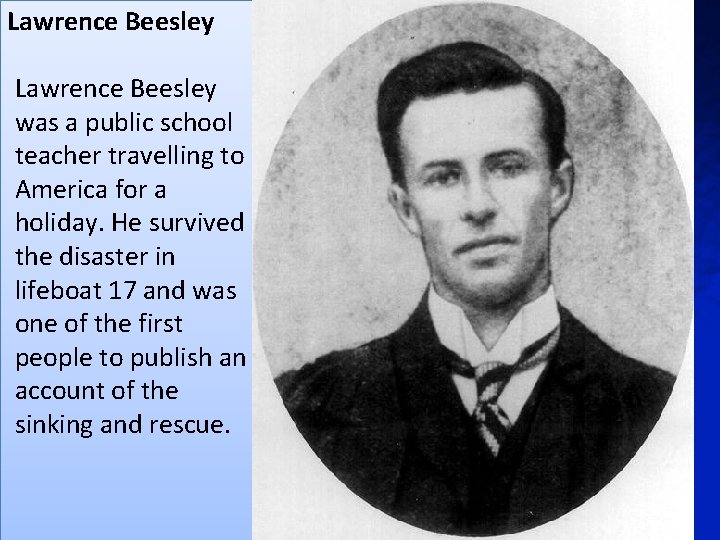
Lawrence Beesley was a public school teacher travelling to America for a holiday. He survived the disaster in lifeboat 17 and was one of the first people to publish an account of the sinking and rescue.
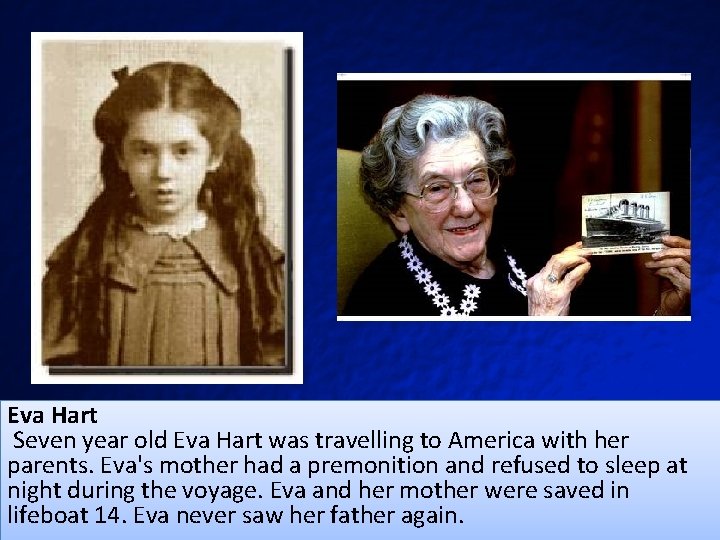
Eva Hart Seven year old Eva Hart was travelling to America with her parents. Eva's mother had a premonition and refused to sleep at night during the voyage. Eva and her mother were saved in lifeboat 14. Eva never saw her father again.
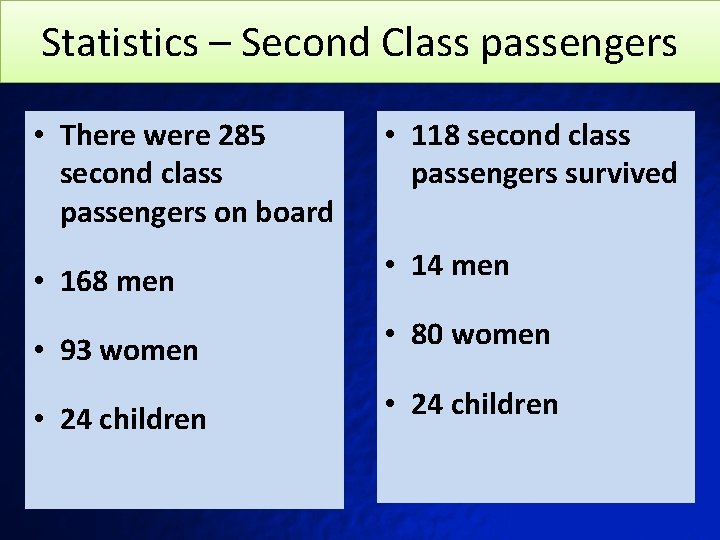
Statistics – Second Class passengers • There were 285 second class passengers on board • 118 second class passengers survived • 168 men • 14 men • 93 women • 80 women • 24 children
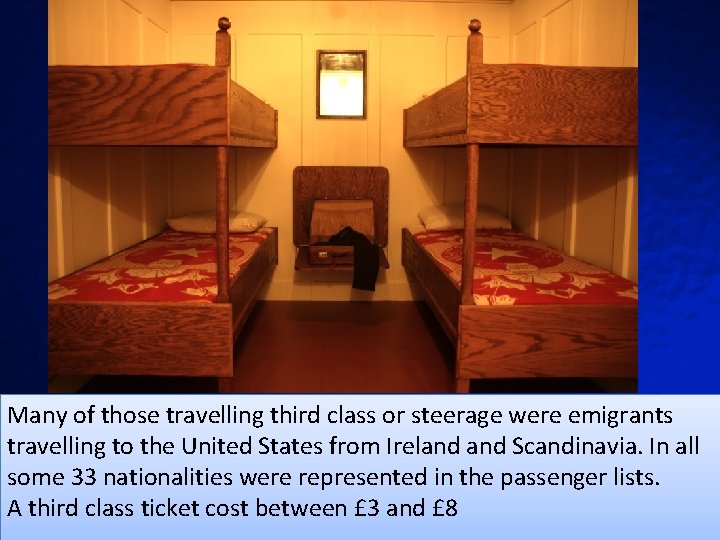
Many of those travelling third class or steerage were emigrants travelling to the United States from Ireland Scandinavia. In all some 33 nationalities were represented in the passenger lists. A third class ticket cost between £ 3 and £ 8
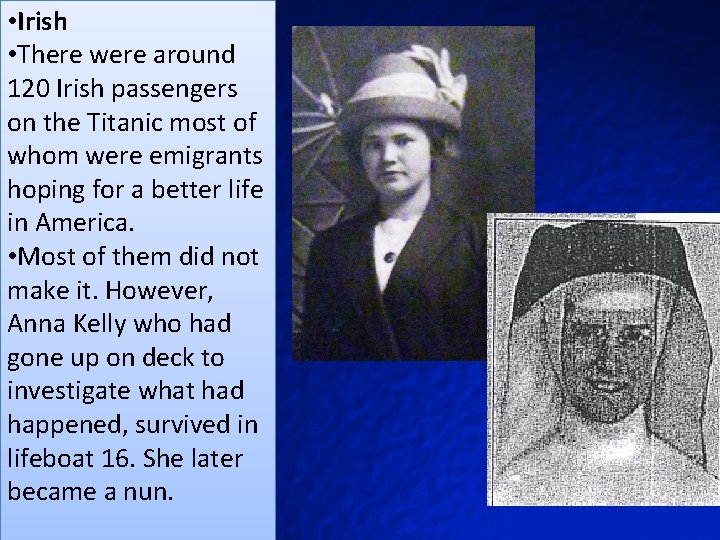
• Irish • There were around 120 Irish passengers on the Titanic most of whom were emigrants hoping for a better life in America. • Most of them did not make it. However, Anna Kelly who had gone up on deck to investigate what had happened, survived in lifeboat 16. She later became a nun.
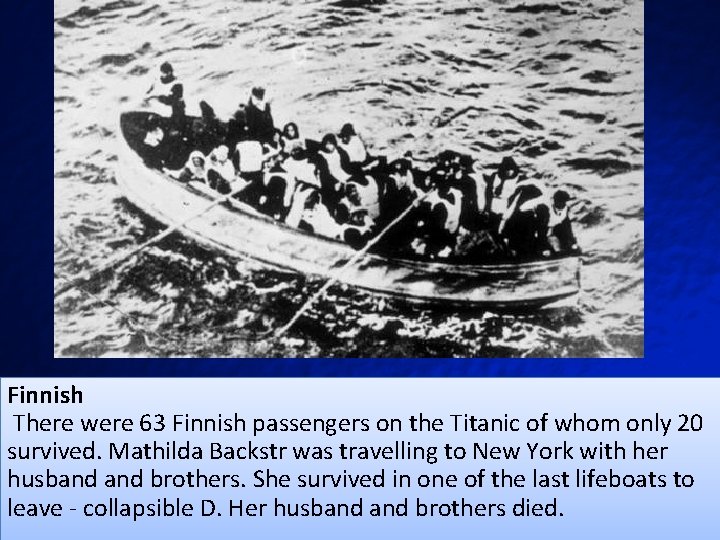
Finnish There were 63 Finnish passengers on the Titanic of whom only 20 survived. Mathilda Backstr was travelling to New York with her husband brothers. She survived in one of the last lifeboats to leave - collapsible D. Her husband brothers died.
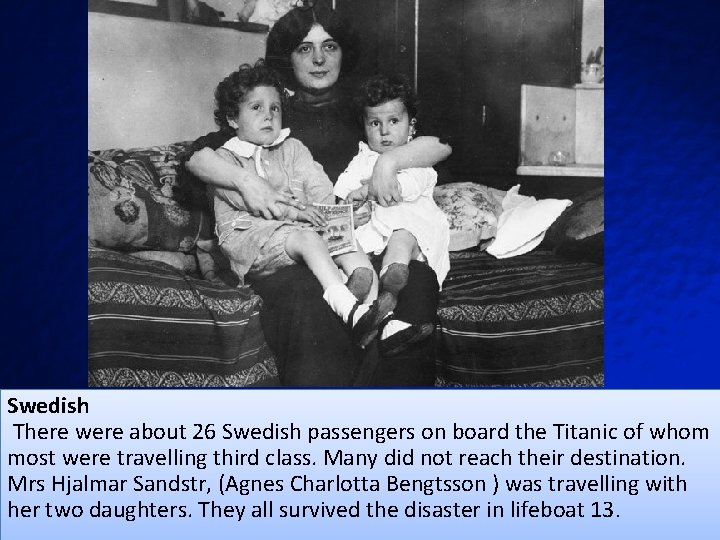
Swedish There were about 26 Swedish passengers on board the Titanic of whom most were travelling third class. Many did not reach their destination. Mrs Hjalmar Sandstr, (Agnes Charlotta Bengtsson ) was travelling with her two daughters. They all survived the disaster in lifeboat 13.
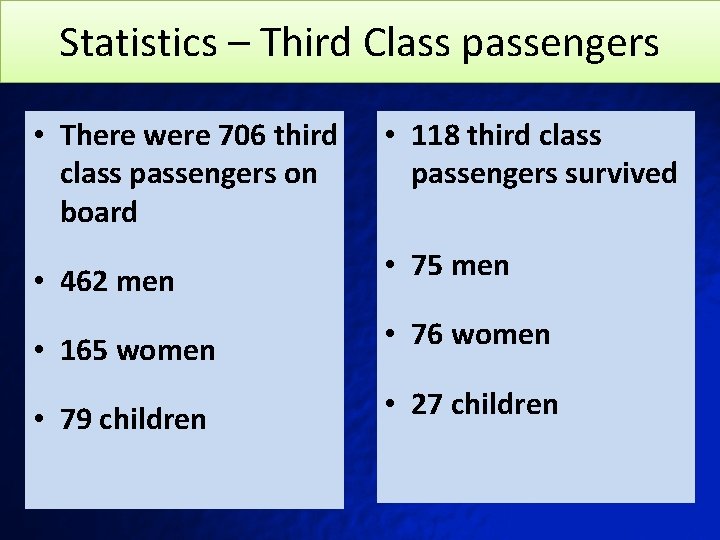
Statistics – Third Class passengers • There were 706 third class passengers on board • 118 third class passengers survived • 462 men • 75 men • 165 women • 76 women • 79 children • 27 children
Objective: explore ideas about the class system in Edwardian England What do the statistics about first class, second class and third Class survival rates of the Titanic suggest about the class system of the day? A*/A - Evaluate using two or three examples about social inequality in Edwardian England so that we understand the writer’s purpose and main themes. B – Analyse clearly using two or three examples about social inequality in Edwardian England making links to writers purpose.
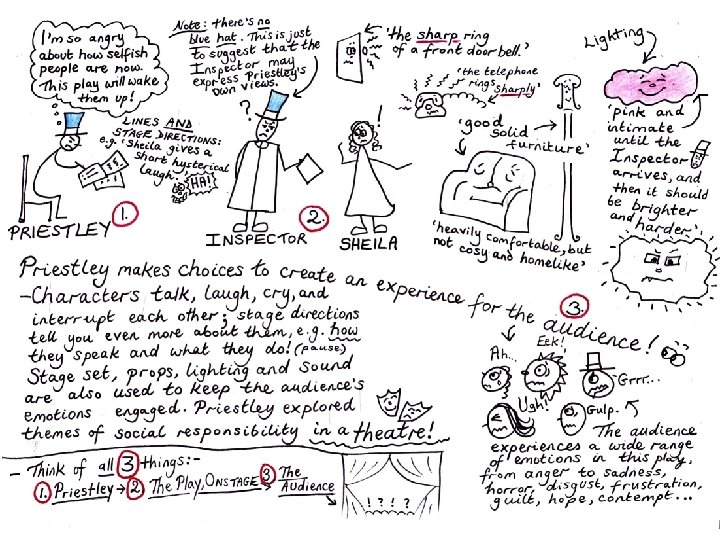
Stage Directions • What are stage directions? • A stage direction is an instruction in the text of a play indicating the movement, position, or tone of an actor, or the sound effects and lighting. Objectives: To understand how to study a drama text. A*- To make perceptive evaluations of the writers use of a play as opposed to a novel. A – To evaluate the writers use of a play as opposed to a novel. B – To analyse the writers use of a play rather than a novel.
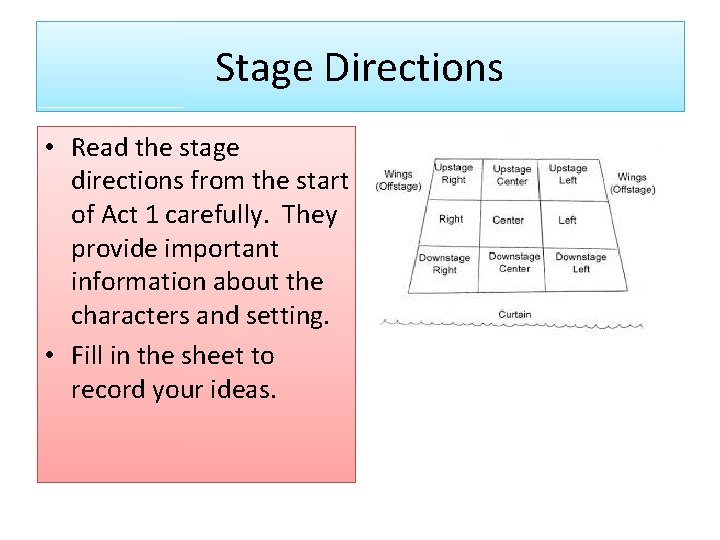
Stage Directions • Read the stage directions from the start of Act 1 carefully. They provide important information about the characters and setting. • Fill in the sheet to record your ideas.
Analysing the Stage Directions • Look carefully at the stage directions. • Zoom in on the detail, exploring the connotations of the stage directions. • What can you infer about the characters?
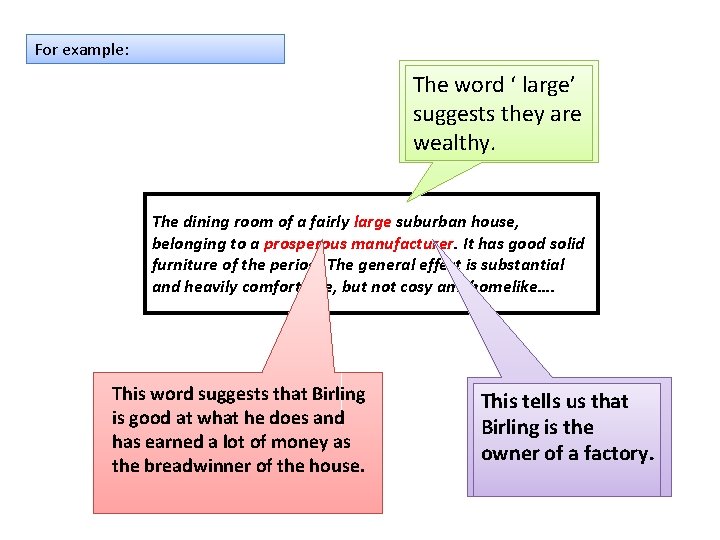
For example: The word ‘ large’ suggests they are wealthy. The dining room of a fairly large suburban house, belonging to a prosperous manufacturer. It has good solid furniture of the period. The general effect is substantial and heavily comfortable, but not cosy and homelike…. This word suggests that Birling is good at what he does and has earned a lot of money as the breadwinner of the house. This tells us that Birling is the owner of a factory.
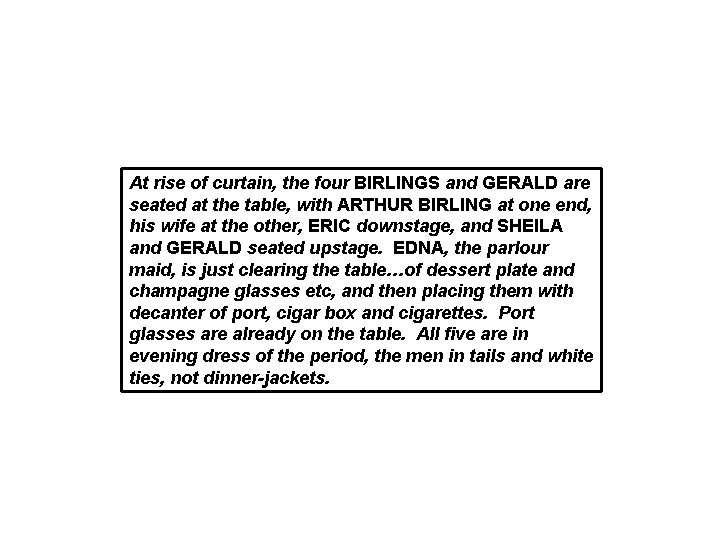
At rise of curtain, the four BIRLINGS and GERALD are seated at the table, with ARTHUR BIRLING at one end, his wife at the other, ERIC downstage, and SHEILA and GERALD seated upstage. EDNA, the parlour maid, is just clearing the table…of dessert plate and champagne glasses etc, and then placing them with decanter of port, cigar box and cigarettes. Port glasses are already on the table. All five are in evening dress of the period, the men in tails and white ties, not dinner-jackets.
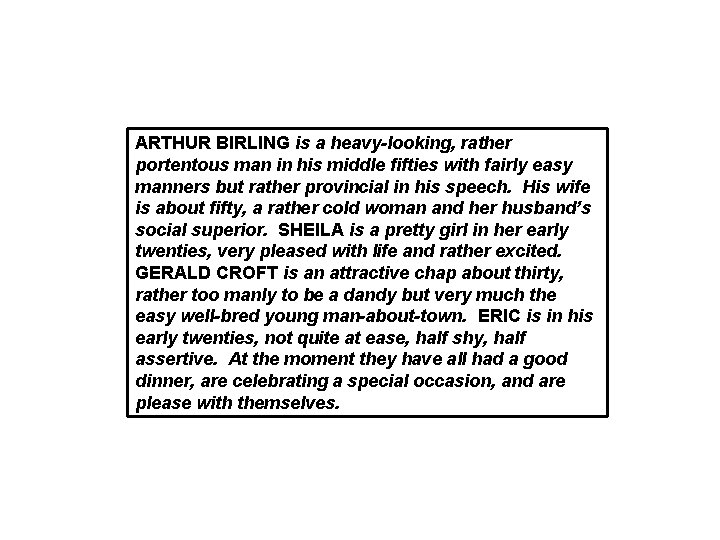
ARTHUR BIRLING is a heavy-looking, rather portentous man in his middle fifties with fairly easy manners but rather provincial in his speech. His wife is about fifty, a rather cold woman and her husband’s social superior. SHEILA is a pretty girl in her early twenties, very pleased with life and rather excited. GERALD CROFT is an attractive chap about thirty, rather too manly to be a dandy but very much the easy well-bred young man-about-town. ERIC is in his early twenties, not quite at ease, half shy, half assertive. At the moment they have all had a good dinner, are celebrating a special occasion, and are please with themselves.
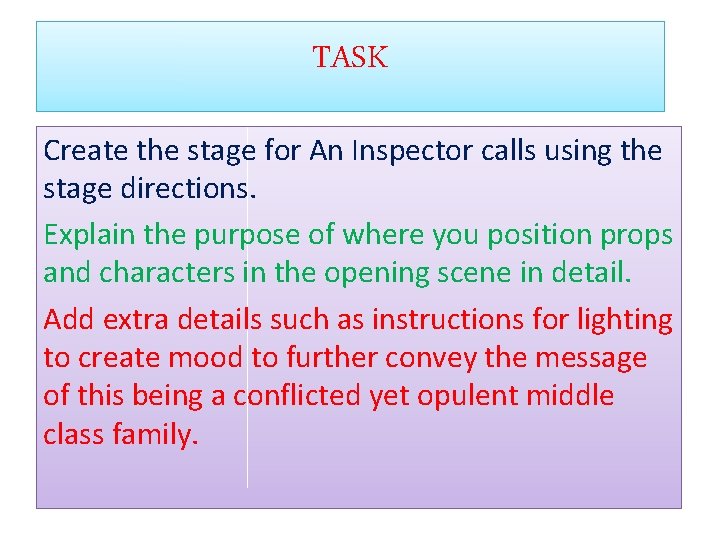
TASK Create the stage for An Inspector calls using the stage directions. Explain the purpose of where you position props and characters in the opening scene in detail. Add extra details such as instructions for lighting to create mood to further convey the message of this being a conflicted yet opulent middle class family.
Task Objectives: To understand how to EOY TARGET B: study a drama text. What does the quotation below A*- To make perceptive suggest about the Birlings? evaluations of the ‘The general effect is substantial writers use of a play as and heavily comfortable but not opposed to a novel. cosy and homelike. ’ A – To evaluate the EOY TARGET A: writers use of a play as How does Priestley use stage opposed to a novel. directions to explore the Birlings’ social status? B – To analyse the writers use of a play EOY TARGET A*: How does Priestley explore the idea rather than a novel. of social class from the opening stage directions?
Peer Critique WWW/EBI? Objectives: To understand how to study a drama text. A*- To make perceptive evaluations of the writers use of a play as opposed to a novel. A – To evaluate the writers use of a play as opposed to a novel. B – To analyse the writers use of a play rather than a novel.
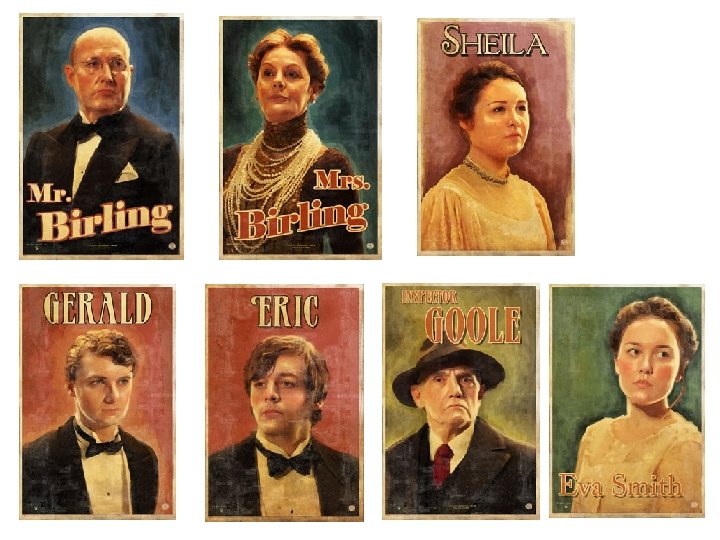
Reading Act 1 • As we read the text, make notes on the characters as you read. Consider: • What they do and how they behave. • How they are described. • How they react to other things. • What their involvement is in the story. Create a separate notes page for each of the following characters: • Mr Arthur Birling • Mrs Birling • Sheila Birling • Eric Birling • Gerald Croft • Eva Smith • Inspector Goole
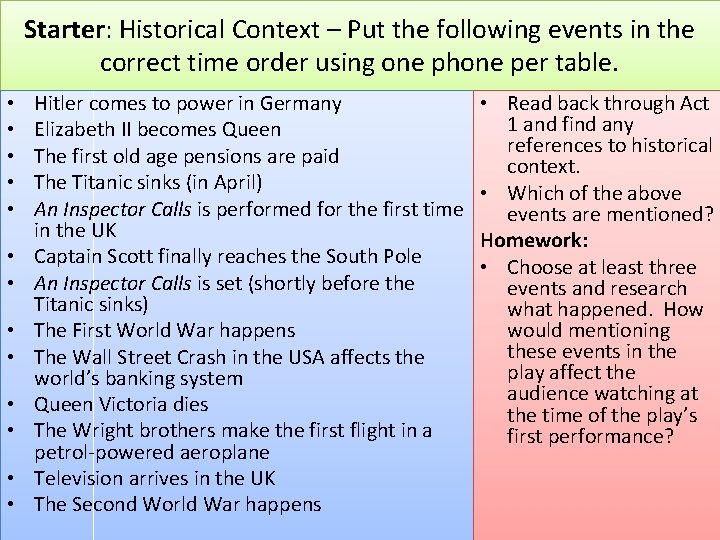
Starter: Historical Context – Put the following events in the correct time order using one phone per table. • • • • Hitler comes to power in Germany Elizabeth II becomes Queen The first old age pensions are paid The Titanic sinks (in April) An Inspector Calls is performed for the first time in the UK Captain Scott finally reaches the South Pole An Inspector Calls is set (shortly before the Titanic sinks) The First World War happens The Wall Street Crash in the USA affects the world’s banking system Queen Victoria dies The Wright brothers make the first flight in a petrol-powered aeroplane Television arrives in the UK The Second World War happens • Read back through Act 1 and find any references to historical context. • Which of the above events are mentioned? Homework: • Choose at least three events and research what happened. How would mentioning these events in the play affect the audience watching at the time of the play’s first performance?
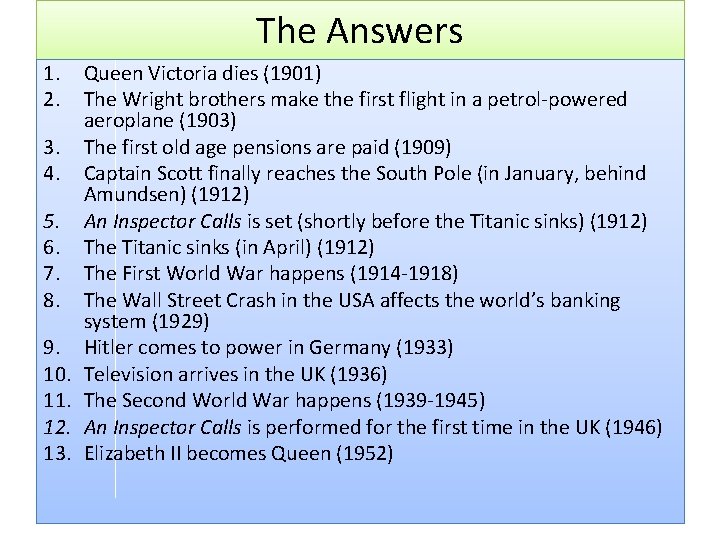
The Answers 1. 2. 3. 4. 5. 6. 7. 8. 9. 10. 11. 12. 13. Queen Victoria dies (1901) The Wright brothers make the first flight in a petrol-powered aeroplane (1903) The first old age pensions are paid (1909) Captain Scott finally reaches the South Pole (in January, behind Amundsen) (1912) An Inspector Calls is set (shortly before the Titanic sinks) (1912) The Titanic sinks (in April) (1912) The First World War happens (1914 -1918) The Wall Street Crash in the USA affects the world’s banking system (1929) Hitler comes to power in Germany (1933) Television arrives in the UK (1936) The Second World War happens (1939 -1945) An Inspector Calls is performed for the first time in the UK (1946) Elizabeth II becomes Queen (1952)
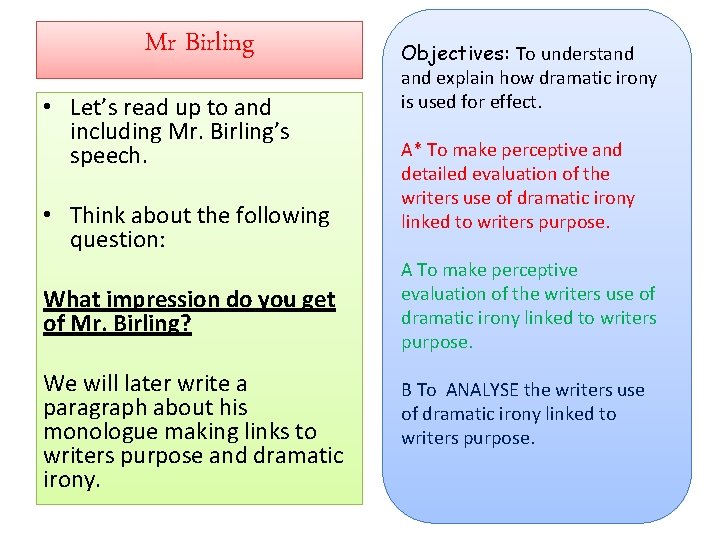
Mr Birling • Let’s read up to and including Mr. Birling’s speech. • Think about the following question: What impression do you get of Mr. Birling? We will later write a paragraph about his monologue making links to writers purpose and dramatic irony. Objectives: To understand explain how dramatic irony is used for effect. A* To make perceptive and detailed evaluation of the writers use of dramatic irony linked to writers purpose. A To make perceptive evaluation of the writers use of dramatic irony linked to writers purpose. B To ANALYSE the writers use of dramatic irony linked to writers purpose.
Read Act 1 - Focusing on Mr Birling • What does Sheila's engagement mean to Mr Birling? • What is Birling’s attitude to the future and the progress he foresees? • What are we meant to think of this attitude? Why? Objectives: To understand explain how dramatic irony is used for effect. A* To make perceptive and detailed evaluation of the writers use of dramatic irony linked to writers purpose. A To make perceptive evaluation of the writers use of dramatic irony linked to writers purpose. B To ANALYSE the writers use of dramatic irony linked to writers purpose. • How does the tone change when the men are alone? • What outlook on life had Birling learnt in the ‘good hard school of experience’? KEY WORD Tone: Mood/ atmosphere in the room.
Mr Birling • What impression do you get of Mr Birling? • How have you come to that decision? Objectives: To understand explain how dramatic irony is used for effect. A* To make perceptive and detailed evaluation of the writers use of dramatic irony linked to writers purpose. A To make perceptive evaluation of the writers use of dramatic irony linked to writers purpose. B To ANALYSE the writers use of dramatic irony linked to writers purpose.
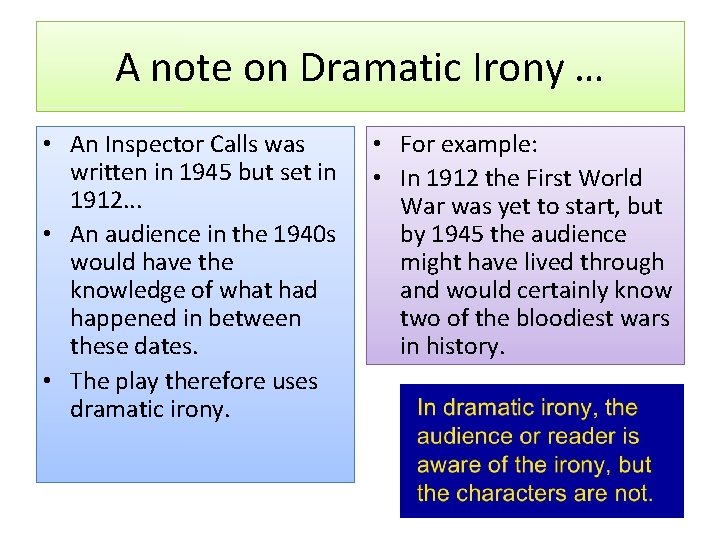
A note on Dramatic Irony … • An Inspector Calls was written in 1945 but set in 1912. . . • An audience in the 1940 s would have the knowledge of what had happened in between these dates. • The play therefore uses dramatic irony. • For example: • In 1912 the First World War was yet to start, but by 1945 the audience might have lived through and would certainly know two of the bloodiest wars in history.
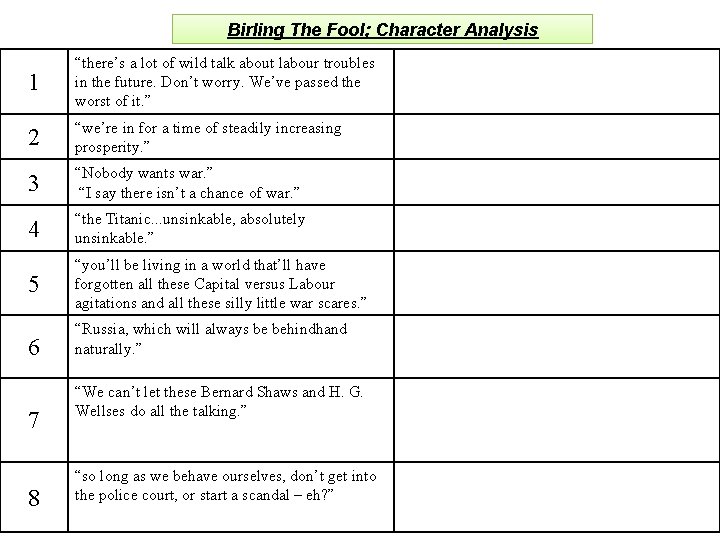
Birling The Fool; Character Analysis 1 “there’s a lot of wild talk about labour troubles in the future. Don’t worry. We’ve passed the worst of it. ” 2 “we’re in for a time of steadily increasing prosperity. ” 3 “Nobody wants war. ” “I say there isn’t a chance of war. ” 4 “the Titanic. . . unsinkable, absolutely unsinkable. ” 5 “you’ll be living in a world that’ll have forgotten all these Capital versus Labour agitations and all these silly little war scares. ” 6 7 8 “Russia, which will always be behindhand naturally. ” “We can’t let these Bernard Shaws and H. G. Wellses do all the talking. ” “so long as we behave ourselves, don’t get into the police court, or start a scandal – eh? ”
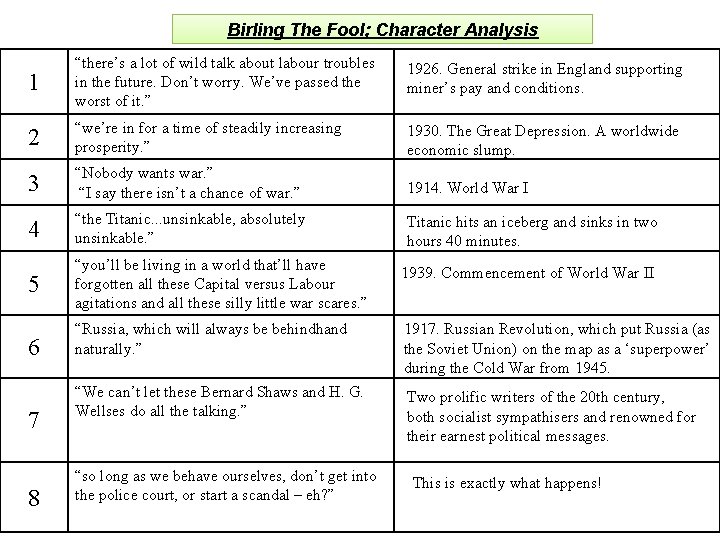
Birling The Fool; Character Analysis 1 “there’s a lot of wild talk about labour troubles in the future. Don’t worry. We’ve passed the worst of it. ” 1926. General strike in England supporting miner’s pay and conditions. 2 “we’re in for a time of steadily increasing prosperity. ” 1930. The Great Depression. A worldwide economic slump. 3 “Nobody wants war. ” “I say there isn’t a chance of war. ” 1914. World War I 4 “the Titanic. . . unsinkable, absolutely unsinkable. ” Titanic hits an iceberg and sinks in two hours 40 minutes. 5 “you’ll be living in a world that’ll have forgotten all these Capital versus Labour agitations and all these silly little war scares. ” 6 7 8 1939. Commencement of World War II “Russia, which will always be behindhand naturally. ” 1917. Russian Revolution, which put Russia (as the Soviet Union) on the map as a ‘superpower’ during the Cold War from 1945. “We can’t let these Bernard Shaws and H. G. Wellses do all the talking. ” Two prolific writers of the 20 th century, both socialist sympathisers and renowned for their earnest political messages. “so long as we behave ourselves, don’t get into the police court, or start a scandal – eh? ” This is exactly what happens!
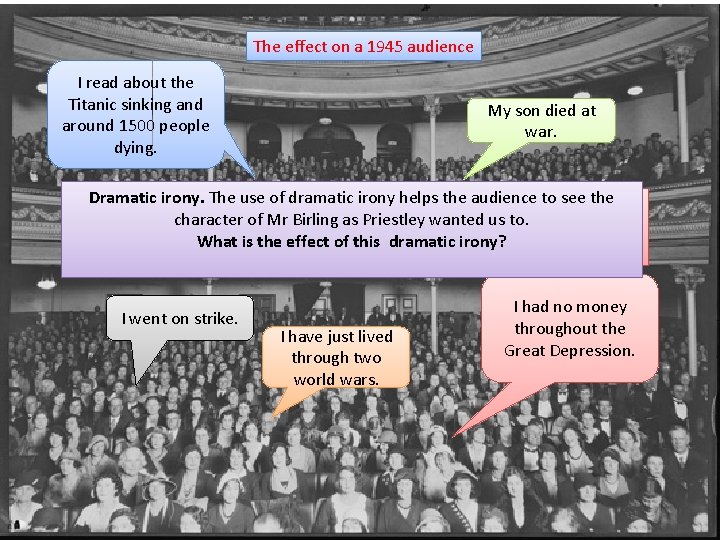
The effect on a 1945 audience I read about the Titanic sinking and around 1500 people dying. My son died at war. Dramatic irony. Thea use dramaticdislike irony helps audience to see the Why might 1945 ofaudience Birlingthe from this point? The audiencecharacter know all of things that Mr Birling does not know. What is ofthese Mr Birling Priestley wanted What would theyasthink of him? Why? us to. theeffect nameofofthis device? irony? What is the What is Priestleydramatic saying? I went on strike. I have just lived through two world wars. I had no money throughout the Great Depression.
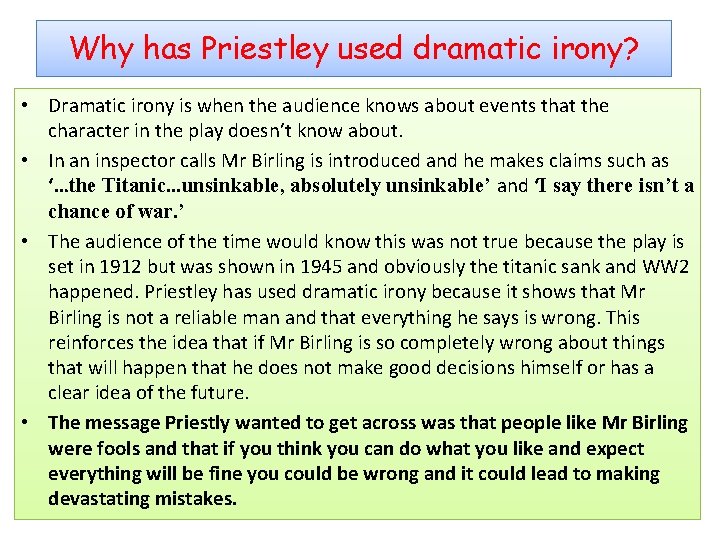
Why has Priestley used dramatic irony? • Dramatic irony is when the audience knows about events that the character in the play doesn’t know about. • In an inspector calls Mr Birling is introduced and he makes claims such as ‘…the Titanic. . . unsinkable, absolutely unsinkable’ and ‘I say there isn’t a chance of war. ’ • The audience of the time would know this was not true because the play is set in 1912 but was shown in 1945 and obviously the titanic sank and WW 2 happened. Priestley has used dramatic irony because it shows that Mr Birling is not a reliable man and that everything he says is wrong. This reinforces the idea that if Mr Birling is so completely wrong about things that will happen that he does not make good decisions himself or has a clear idea of the future. • The message Priestly wanted to get across was that people like Mr Birling were fools and that if you think you can do what you like and expect everything will be fine you could be wrong and it could lead to making devastating mistakes.
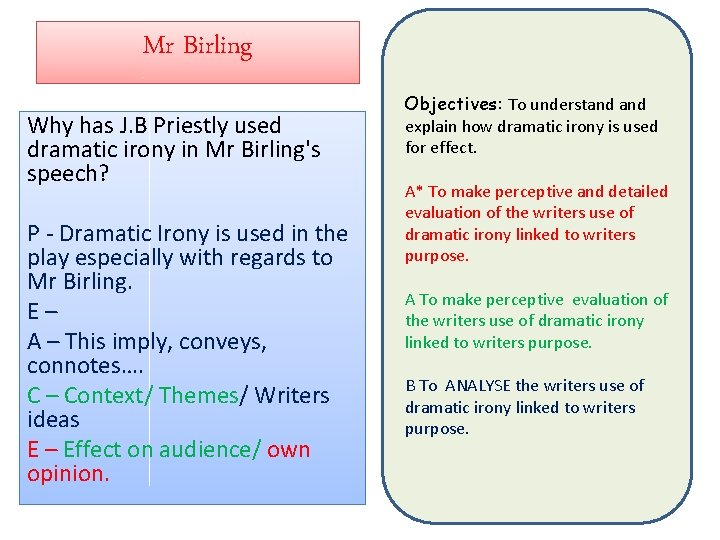
Mr Birling Why has J. B Priestly used dramatic irony in Mr Birling's speech? P - Dramatic Irony is used in the play especially with regards to Mr Birling. E– A – This imply, conveys, connotes…. C – Context/ Themes/ Writers ideas E – Effect on audience/ own opinion. Objectives: To understand explain how dramatic irony is used for effect. A* To make perceptive and detailed evaluation of the writers use of dramatic irony linked to writers purpose. A To make perceptive evaluation of the writers use of dramatic irony linked to writers purpose. B To ANALYSE the writers use of dramatic irony linked to writers purpose.
The Enquiry Begins … • Starter: Write down three bullet points of what you have learnt so far. • Link your bullet points to writer’s intentions, themes and the effect on the reader. • Challenge: In what ways does Priestley present Mr Birling as being closer to Gerald Croft that his own daughter? How might this link to socialist or capitalist beliefs? Objectives: To understand how themes are presented through characters by exploring the purpose of Inspector. A* To make perceptive and detailed evaluation of the writers use of themes and how these are used through the Inspector. Links are made to the effect on the audience and how a play has amplified the writer’s beliefs. A To make an evaluation of the writers use of themes and the effect on the audience. What is the inspector there to show? B To analyse the writer’s use of the inspector and detailed links are made to themes.
Read the text from when the Inspector is introduced. Things to think about: What are your first impressions of The Inspector? What key words justify your ideas? How is Priestley effective at showing his beliefs to the audience? • Objectives: To understand how themes are presented through characters by exploring the purpose of Inspector. • A* To make perceptive and detailed evaluation of the writers use of themes and how these are used through the Inspector. Links are made to the effect on the audience and how a play has amplified the writer’s beliefs. • A To make an evaluation of the writers use of themes and the effect on the audience. What is the inspector there to show? • B To analyse the writer’s use of the inspector and detailed links are made to themes.
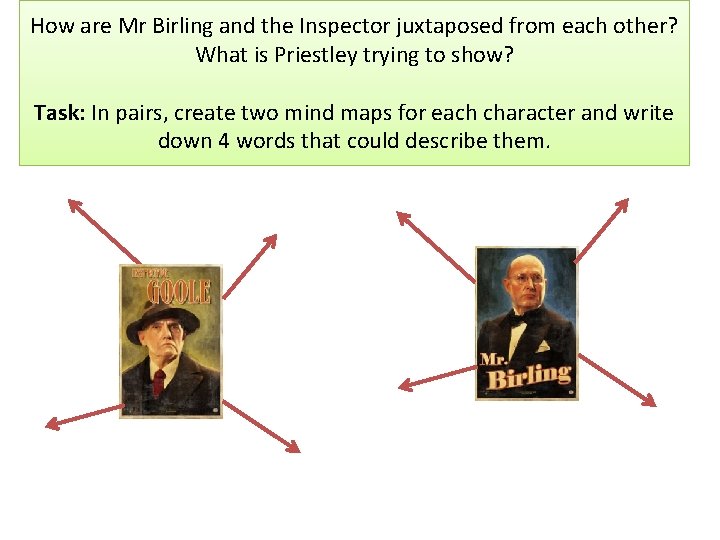
How are Mr Birling and the Inspector juxtaposed from each other? What is Priestley trying to show? Task: In pairs, create two mind maps for each character and write down 4 words that could describe them.
Links to irony What does irony mean? Note: Birling’s views on society, “community and all that nonsense” are challenged by the arrival of the Inspector. The family’s attitude of complete self-satisfaction and “a man has to take care of himself and his own” link with the arrival of the Inspector. This is ironic since the Inspector is there to try and teach them about what real responsibility is. Therefore, irony, morality and social messages are important themes in An Inspector Calls (you can also explore your knowledge of capitalism and socialism!). Can you think of any other parts of the play so far that link to morality, social messages and irony? What might the effect on the audience be? How effective is Priestley at showing ?
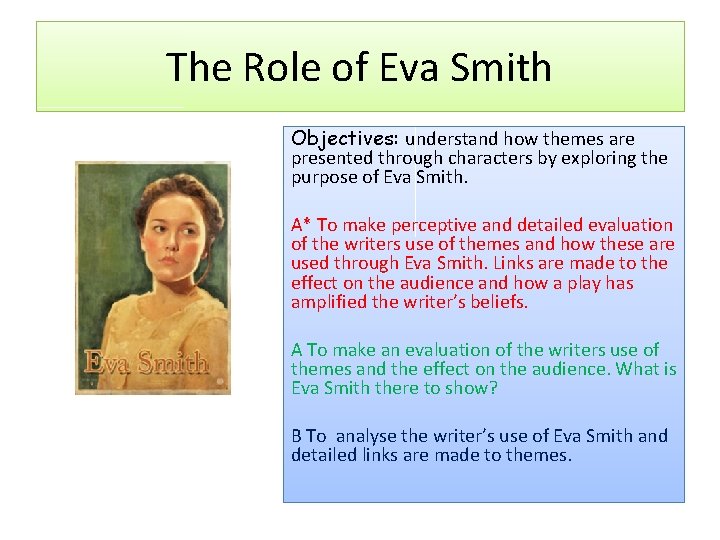
The Role of Eva Smith Objectives: understand how themes are presented through characters by exploring the purpose of Eva Smith. A* To make perceptive and detailed evaluation of the writers use of themes and how these are used through Eva Smith. Links are made to the effect on the audience and how a play has amplified the writer’s beliefs. A To make an evaluation of the writers use of themes and the effect on the audience. What is Eva Smith there to show? B To analyse the writer’s use of Eva Smith and detailed links are made to themes.
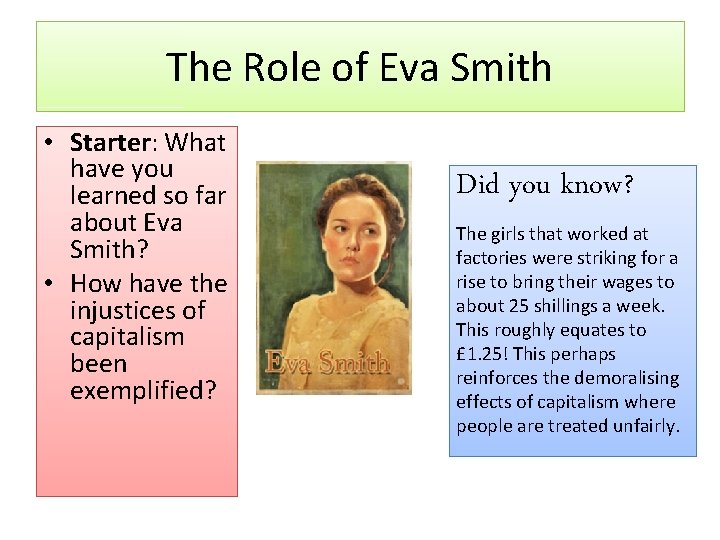
The Role of Eva Smith • Starter: What have you learned so far about Eva Smith? • How have the injustices of capitalism been exemplified? Did you know? The girls that worked at factories were striking for a rise to bring their wages to about 25 shillings a week. This roughly equates to £ 1. 25! This perhaps reinforces the demoralising effects of capitalism where people are treated unfairly.
What could Eva Smith represent? Task: in pairs, think of four ideas be prepared to be asked to justify your ideas. Objectives: To understand how themes are presented through characters by exploring the purpose of Eva Smith A* To make perceptive and detailed evaluation of the writers use of themes and how these are used through Eva Smith. Links are made to the effect on the audience and how a play has amplified the writer’s beliefs. A To make an evaluation of the writers use of themes and the effect on the audience. What is Eva Smith there to show? B To analyse the writer’s use of Eva Smith and detailed links are made to themes.
The role of Eva Smith Although Eva does not appear in the play, she is central to it. She has left a diary and a letter which are evidence for the Inspector. It is ironic that Birling sacked Eva Smith for showing qualities of leadership – the same qualities which he was prepared to promote her for. Since Priestley pleads her case through the Inspector, who is a sympathetic character, the audience are lead to believe that Priestley is sympathetic towards her. Is Birling indicated as someone who has loyalty towards his workers? How does this link to capitalism? What do you think Priestley’s argument is? Challenge: Could Eva’s death possibly be a metaphor (symbol) for anything? • • Objectives: To understand how themes are presented through characters by exploring the purpose of Eva Smith A* To make perceptive and detailed evaluation of the writers use of themes and how these are used through Eva Smith. Links are made to the effect on the audience and how a play has amplified the writer’s beliefs. • A To make an evaluation of the writers use of themes and the effect on the audience. What is Eva Smith there to show? • B To analyse the writer’s use of Eva Smith and detailed links are made to themes.
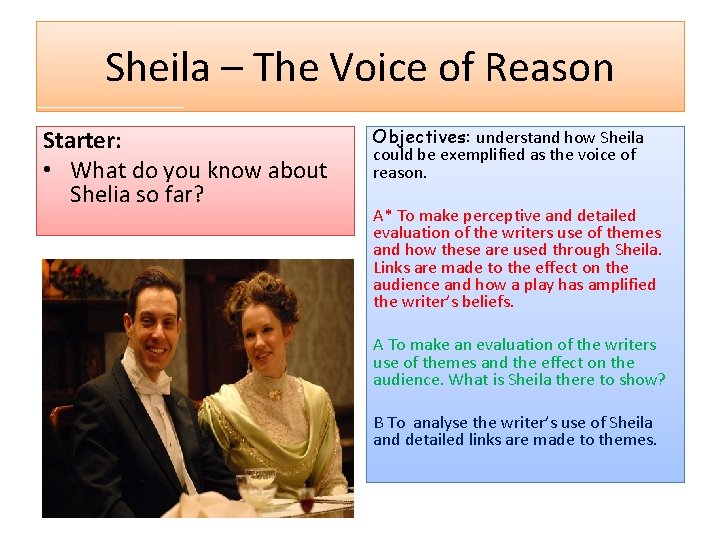
Sheila – The Voice of Reason Starter: • What do you know about Shelia so far? Objectives: understand how Sheila could be exemplified as the voice of reason. A* To make perceptive and detailed evaluation of the writers use of themes and how these are used through Sheila. Links are made to the effect on the audience and how a play has amplified the writer’s beliefs. A To make an evaluation of the writers use of themes and the effect on the audience. What is Sheila there to show? B To analyse the writer’s use of Sheila and detailed links are made to themes.
Shelia • Reading from when Sheila returns back to the room. • What is her initial reaction? • How do you know? Sheila rightly points out that workers like Eva Smith “aren’t just labour - they are people”. What words could you use to describe Sheila’s response? How has Priestley created conflict?
The Inspector’s comment, “a nasty mess somebody’s made of it’ reinforces his moralistic tone. Furthermore, “if it was left up to me” shows that Priestley has set him up as a judge and gives him authority. How might this lead to Sheila’s confession of knowing Eva? Challenge: Sheila only recognises her when she recognises that she worked in a shop. What links might Priestley be making to social inequality and the capitalist mind set? In what ways might Sheila’s treatment of Eva Smith be more cruel than Mr Birling’s?
How does the summary that the Inspector gives reveal Sheila’s involvement? Answer either of these questions in your book. Does Sheila have an understanding of the power of the Inspector? Analyse or evaluate this in detail. Or How have Sheila’s feelings changed throughout this Act? Think about her reaction of the death, her attitude towards Birling, Gerald and the Inspector? Objectives: understand how Sheila could be exemplified as the voice of reason. A* To make perceptive and detailed evaluation of the writers use of themes and how these are used through Sheila. Links are made to the effect on the audience and how a play has amplified the writer’s beliefs. A To make an evaluation of the writers use of themes and the effect on the audience. What is Sheila there to show? B To analyse the writer’s use of Sheila and detailed links are made to themes.
Plenary Using a Purple Pen, check for literacy errors and self-assess yourself against the Success Criteria. Extension: Predict three ideas of what you think Gerald Croft’s relationship was with Eva Smith. In the next lesson we will be analysing his character in more depth. Objectives: understand how Sheila could be exemplified as the voice of reason. Success Criteria: A* To make perceptive and detailed evaluation of the writers use of themes and how these are used through Sheila. Links are made to the effect on the audience and how a play has amplified the writer’s beliefs. A To make an evaluation of the writers use of themes and the effect on the audience. What is Sheila there to show? B To analyse the writer’s use of Sheila and detailed links are made to themes.
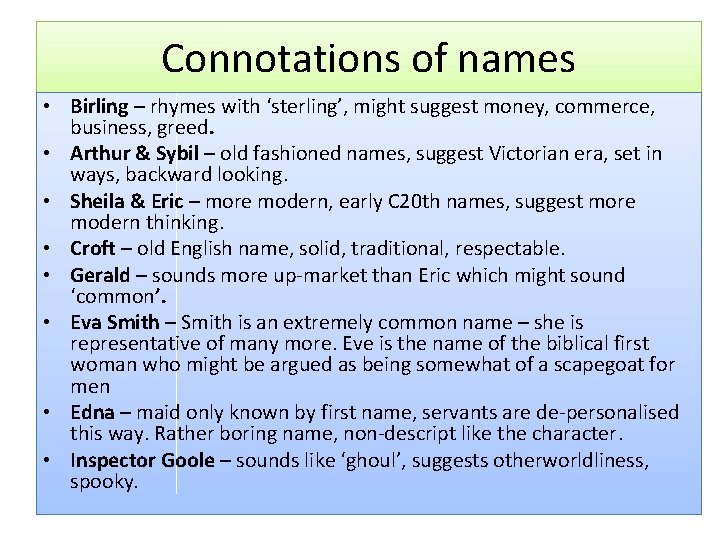
Connotations of names • Birling – rhymes with ‘sterling’, might suggest money, commerce, business, greed. • Arthur & Sybil – old fashioned names, suggest Victorian era, set in ways, backward looking. • Sheila & Eric – more modern, early C 20 th names, suggest more modern thinking. • Croft – old English name, solid, traditional, respectable. • Gerald – sounds more up-market than Eric which might sound ‘common’. • Eva Smith – Smith is an extremely common name – she is representative of many more. Eve is the name of the biblical first woman who might be argued as being somewhat of a scapegoat for men • Edna – maid only known by first name, servants are de-personalised this way. Rather boring name, non-descript like the character. • Inspector Goole – sounds like ‘ghoul’, suggests otherworldliness, spooky.
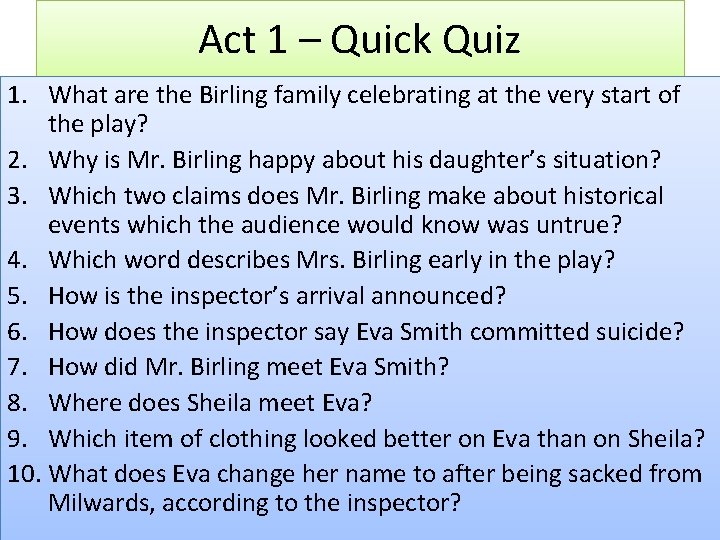
Act 1 – Quick Quiz 1. What are the Birling family celebrating at the very start of the play? 2. Why is Mr. Birling happy about his daughter’s situation? 3. Which two claims does Mr. Birling make about historical events which the audience would know was untrue? 4. Which word describes Mrs. Birling early in the play? 5. How is the inspector’s arrival announced? 6. How does the inspector say Eva Smith committed suicide? 7. How did Mr. Birling meet Eva Smith? 8. Where does Sheila meet Eva? 9. Which item of clothing looked better on Eva than on Sheila? 10. What does Eva change her name to after being sacked from Milwards, according to the inspector?
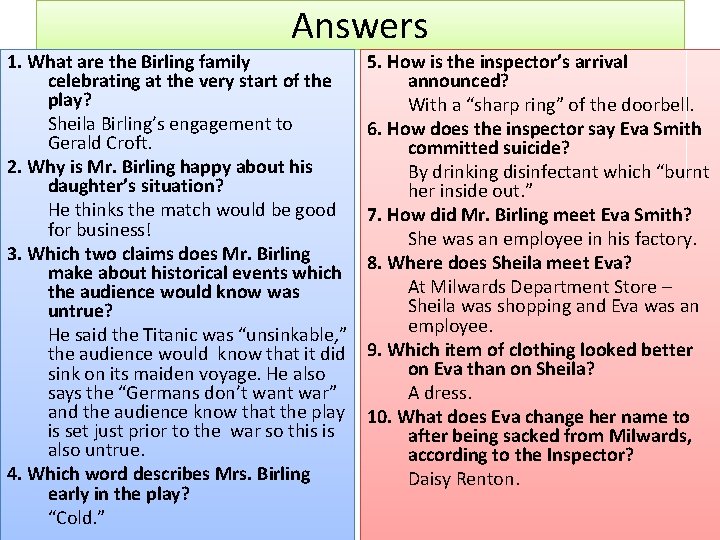
Answers 1. What are the Birling family celebrating at the very start of the play? Sheila Birling’s engagement to Gerald Croft. 2. Why is Mr. Birling happy about his daughter’s situation? He thinks the match would be good for business! 3. Which two claims does Mr. Birling make about historical events which the audience would know was untrue? He said the Titanic was “unsinkable, ” the audience would know that it did sink on its maiden voyage. He also says the “Germans don’t want war” and the audience know that the play is set just prior to the war so this is also untrue. 4. Which word describes Mrs. Birling early in the play? “Cold. ” 5. How is the inspector’s arrival announced? With a “sharp ring” of the doorbell. 6. How does the inspector say Eva Smith committed suicide? By drinking disinfectant which “burnt her inside out. ” 7. How did Mr. Birling meet Eva Smith? She was an employee in his factory. 8. Where does Sheila meet Eva? At Milwards Department Store – Sheila was shopping and Eva was an employee. 9. Which item of clothing looked better on Eva than on Sheila? A dress. 10. What does Eva change her name to after being sacked from Milwards, according to the Inspector? Daisy Renton.
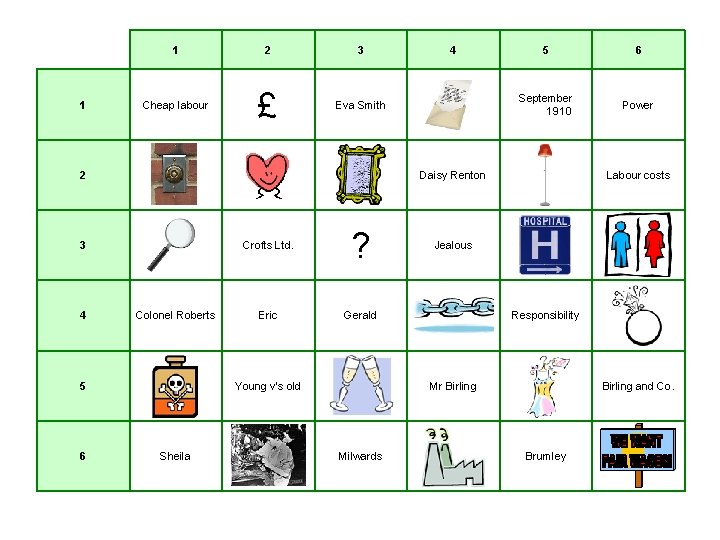
1 1 2 3 Cheap labour £ Eva Smith 2 Colonel Roberts 5 6 September 1910 Power Daisy Renton 3 4 4 Crofts Ltd. ? Eric Gerald Young v’s old Sheila Labour costs Jealous Responsibility Mr Birling Milwards Birling and Co. Brumley
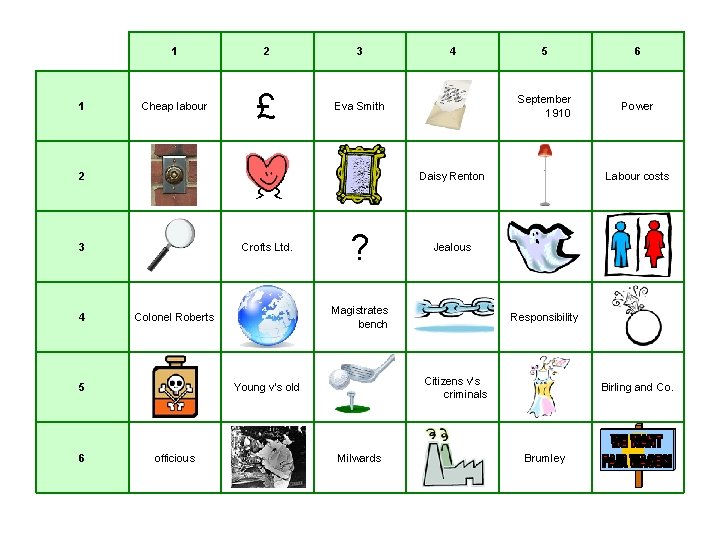
1 1 2 3 Cheap labour £ Eva Smith 2 Crofts Ltd. ? 6 September 1910 Power Responsibility Citizens v’s criminals Young v’s old officious Labour costs Jealous Magistrates bench Colonel Roberts 5 6 5 Daisy Renton 3 4 4 Milwards Birling and Co. Brumley
- Slides: 63