
Reading 2 Asthma 1 Title What is Asthma

- Slides: 7
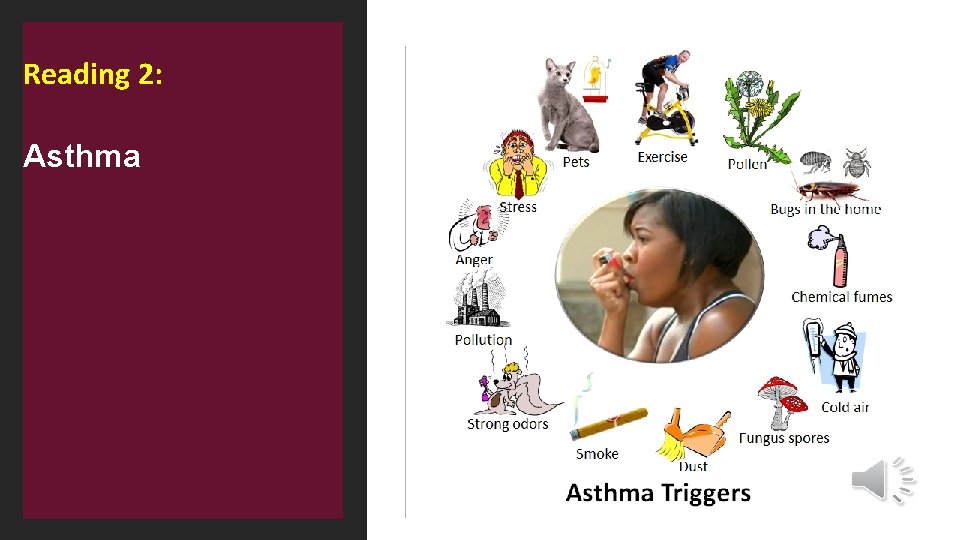
Reading 2: Asthma 1
Title: What is Asthma? Paragraph 1 markedly (adv): to an extent which is clearly noticeable; significantly Asthma is a syndrome characterized by airflow obstruction spontaneously (adv): happening by itself; without apparent external cause or stimulus ﺧﻮﺩﺟﻮﺵ / ﺧﻮﺩ ﺑﺨﻮﺩ harbor (v): keep ; carry Asthmatics harbor a special type of inflammation in the wheeze(v): breathe with a whistling or rattling sound in the chest ﺧﺲ ﺧﺲ ﻛﺮﺩﻥ with consequent reduced airflow and symptomatic wheezing that varies markedly, both spontaneously and with treatment. airways that makes them more responsive than nonasthmatics to a wide range of triggers, leading to excessive narrowing and dyspnea. Narrowing of the airways is usually reversible, reversible (adj): capable of returning to previous state or but in some patients with chronic asthma there may be an element of irreversible airflow obstruction. The increasing situation burden (n): a duty or misfortune that causes hardship, anxiety, or grief / worry or strain global prevalence of asthma, the large burden it now imposes on patients, and the high health care costs have led to extensive research into its mechanisms and treatment. . 2
Title: Prevalence of Asthma urbanization (n): making an area more urban, that is building a lot of houses, factories, shops, offices, etc atopy (n): the genetic tendency to develop allergic diseases systemic (adj): affecting the entire body Paragraph 2 (Prevalence) Asthma is one of the most common chronic diseases globally and currently affects ~300 million people. The prevalence of asthma has risen in affluent countries over the last 30 years but now appears to have stabilized, with ~10– 12% of adults and 15% of children affected by the disease. In developing countries where the prevalence of asthma had been much lower, there is a rising incidence that appears to be associated with increased urbanization. The prevalence of atopy confined (adj): limited; restricted and other allergic diseases has also increased over the same time, liable(adj): likely rather than confined to the lungs. This epidemiologic observation predisposition (n): tendency atopic /ˌeɪˈtɑpɪk/ (adj): the adjective of atopy house dust mite (n): microscopic arachnids suggesting that the reasons for the increase are likely to be systemic suggests that there is a maximum number of individuals in the community who are liable to be affected by asthma, likely by genetic predisposition. Most patients with asthma in affluent countries are atopic, with allergic sensitization to the house dust mite, dermatophagoides, pteronyssinus, and other environmental allergens. . 3
Title: Asthma: Ratio & Duration Paragraph 3 Asthma is both common and frequently complicated by the effects of smoking on the lungs; hence, it is difficult to be certain about the twice as many males as females are asthmatic : there natural history of the disease in adults. Asthma can present at any age are two male asthmatics for every female asthmatic; with a peak age of 3 years. In childhood, twice as many males as males outnumber females twofold females are asthmatic, but by adulthood the sex ratio has equalized. The commonly held belief that children “grow out of their asthma” is ratio (n): the quantitative relation between two amounts justified to some extent. Long-term studies that have followed ﻧﺴﺒﺖ children until they reach the age of 40 years suggest that many with justified (adj): logical and verified children “grow out of their asthma”: as children grow up into adulthood, their asthma will go away; the older they get, the more likely their asthma disappears permanently (adv): always; for a long time asthma become asymptomatic during adolescence but that asthma returns in some during adult life, particularly in children with persistent symptoms and severe asthma. Adults with asthma, including those with onset during adulthood rarely become permanently asymptomatic. The severity of asthma does not vary significantly within a given patient; those with mild asthma rarely progress to more severe disease, whereas those with severe asthma usually have severe disease at the onset. 4
Title: Mortality Rate of Asthma Paragraph 4 steadily(adv): continuing without stopping; continuously Deaths from asthma are uncommon and have been steadily decline (v): decrease / become fewer asthma mortality seen in several countries during the 1960 s was declining in many affluent countries over the last decade. A rise in associated with increased use of short-acting β 2 -adrenergic agonists (n): AKA adrenergic β₂ receptor agonists are a class of drugs that act on the β₂ adrenergic agonists (as rescue therapy), but there is now compelling evidence that the more widespread use of inhaled corticosteroids (ICSs) in receptor. Like other β adrenergic agonists, they cause smooth muscle relaxation patients with persistent asthma is responsible for the decrease in compelling (adj): convincing; making you certain mortality in recent years. Major risk factors for asthma deaths are poorly (adv): inadequately; weakly inhalers, lack of corticosteroid therapy, and previous admissions near-fatal asthma (n): NFA is described as acute asthma associated with a respiratory arrest or arterial CO 2 tension greater than 50 mm. Hg, requiring mechanical ventilation to the hospital with near-fatal asthma. poorly controlled disease with frequent use of bronchodilator . 5
Title: Difficulty Arises When Defining Asthma accurate (adj): correct in all details; exact Paragraph 5 SYNONYM= Precise It has proved difficult to agree on a definition of asthma, but there is good agreement on the description of the clinical syndrome and disease pathology. Until the etiologic mechanisms of the disease are better understood, it will be difficult to provide an accurate definition. . 6
7