
Reading 101 A Professional Development Workshop for Paraprofessionals

- Slides: 32
Reading 101 A Professional Development Workshop for Paraprofessionals
Classroom Instruction • Some classrooms use a program which would include a scope and sequence, lessons, and ideas to extend them for enrichment and for struggling readers. Usually these classrooms have a basal reader or anthology purchased by the district which corresponds to the programs. • Other classrooms use a trade books – children’s books published by mainstream publishers. • These classrooms might use a Reader’s Workshop model which would include a minilesson on a comprehension skill, independent reading with the teacher conferencing and seeing how the student practices the skill and a sharing time.
The Components of Reading Instruction • • Phonemic Awareness Phonics Vocabulary Comprehension Fluency Spelling and Grammar Writing
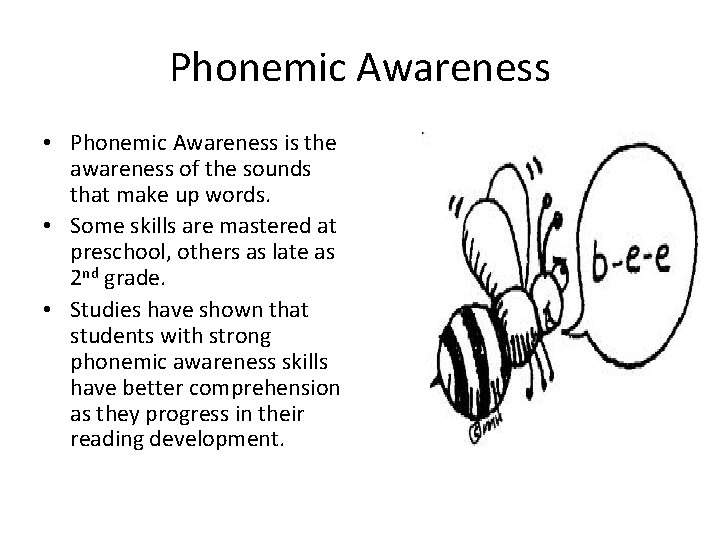
Phonemic Awareness • Phonemic Awareness is the awareness of the sounds that make up words. • Some skills are mastered at preschool, others as late as 2 nd grade. • Studies have shown that students with strong phonemic awareness skills have better comprehension as they progress in their reading development.
Phonemic Awareness Skills (and when they are typically mastered) • Sentence segmentationpreschool • Rhyme recognition – preschool • Rhyme completion – preschool/kindergarten • Rhyme production – kindergarten • Syllable blending – preschool/kindergarten • Syllable segmentation -Kindergarten Syllable deletion – kindergarten Phoneme isolation of initial sound – kindergarten Phoneme isolation of final sound – kindergarten/1 st grade Phoneme blending (onset and rime) – 1 st grade Phoneme blending (all phonemes) – 1 st grade Phoneme segmentation – 1 st grade
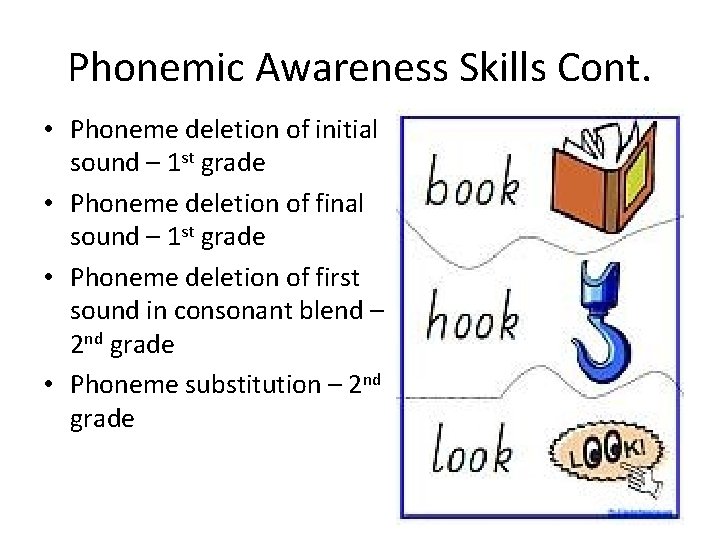
Phonemic Awareness Skills Cont. • Phoneme deletion of initial sound – 1 st grade • Phoneme deletion of final sound – 1 st grade • Phoneme deletion of first sound in consonant blend – 2 nd grade • Phoneme substitution – 2 nd grade
Phonemic Awareness Resources • Assess for Phonemic Awareness using a test such as the PAST test found in Sounds in Action: Phonological Awareness Activities and Assessment (K -2) by Yvette Zgonc. Use the activities in that book and others. • Use whole group, small group and individual instruction to teach skills that students need to master. • http: //www. fcrr. org/Curricu lum/student. Center. Activities. shtm • Phonemic Awareness Activities for Early Reading Success (K-2) by Wiley Bevins • Phonemic Awareness: Playing with Sounds to Strengthen Beginning Reading Skills by Jo Fitzpatrick
Phonics • Phonics is using the relationship between letters and sounds to blend words when reading and writing. • Phonics instruction is particularly beneficial for children at risk for learning difficulties • Students who have good phonics skills are better at comprehending then poor decoders. • Students need many strategies to figure out unfamiliar words.
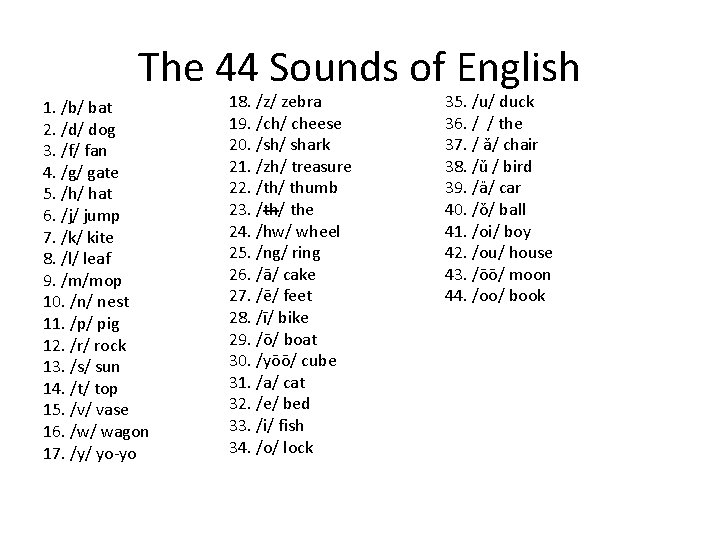
The 44 Sounds of English 1. /b/ bat 2. /d/ dog 3. /f/ fan 4. /g/ gate 5. /h/ hat 6. /j/ jump 7. /k/ kite 8. /l/ leaf 9. /m/mop 10. /n/ nest 11. /p/ pig 12. /r/ rock 13. /s/ sun 14. /t/ top 15. /v/ vase 16. /w/ wagon 17. /y/ yo-yo 18. /z/ zebra 19. /ch/ cheese 20. /sh/ shark 21. /zh/ treasure 22. /th/ thumb 23. /th/ the 24. /hw/ wheel 25. /ng/ ring 26. /ā/ cake 27. /ē/ feet 28. /ī/ bike 29. /ō/ boat 30. /yōō/ cube 31. /a/ cat 32. /e/ bed 33. /i/ fish 34. /o/ lock 35. /u/ duck 36. / / the 37. / a / chair 38. /u / bird 39. /ä/ car 40. /o / ball 41. /oi/ boy 42. /ou/ house 43. /ōō/ moon 44. /oo/ book
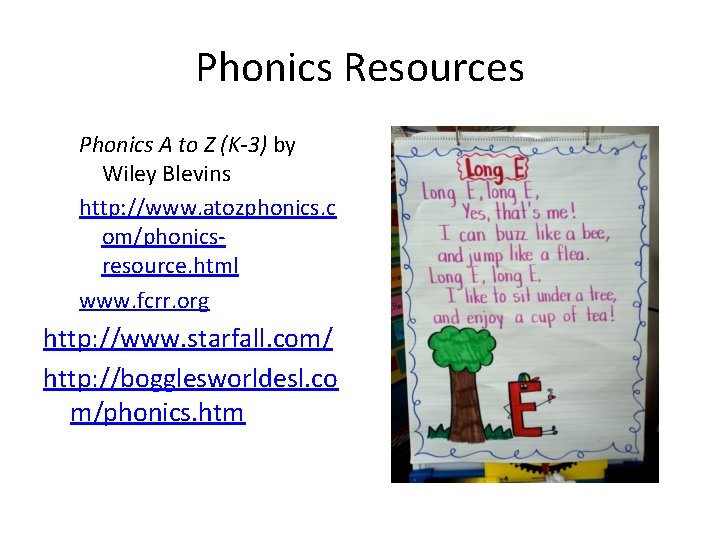
Phonics Resources Phonics A to Z (K-3) by Wiley Blevins http: //www. atozphonics. c om/phonicsresource. html www. fcrr. org http: //www. starfall. com/ http: //bogglesworldesl. co m/phonics. htm
Vocabulary • • • Vocabulary is the ability to go from the printed word to its meaning. Inadequate vocabulary causes problems with students’ comprehension. Resources for vocabulary instruction include ideas in Locating and Correcting Reading Difficulties Bringing Words To Life: Robust Vocabulary Instruction by Isabel Beck, etc. al. www. fcrr. org http: //www. readwritethink. org/searc h/? resource_type=6&sort_order=rele vance&q=vocabulary&srchgo. x=0&sr chgo. y=0&old_q=&srchwhere=fullsite Stages of vocabulary knowledge: 1. A student has no recognition of a word. 2. A student has heard the word, recognizes it, but doesn’t know the meaning. 3. A student recognizes the world in context and has a vague understanding of its meaning 4. A student knows well the meaning of the word in context. 5. A student knows the multiple meanings of the word and uses it accurately in thinking, speaking, and writing. (Adapted from Locating and Correcting Read Difficulties by James Shanker and Ward Cockrum. •
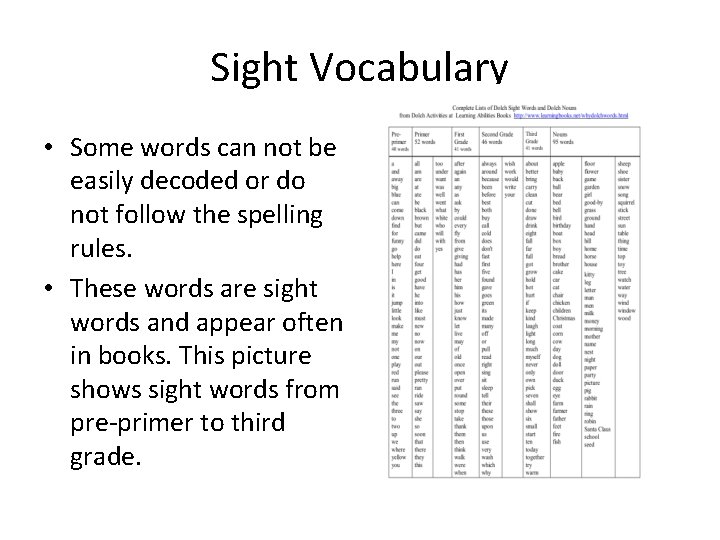
Sight Vocabulary • Some words can not be easily decoded or do not follow the spelling rules. • These words are sight words and appear often in books. This picture shows sight words from pre-primer to third grade.
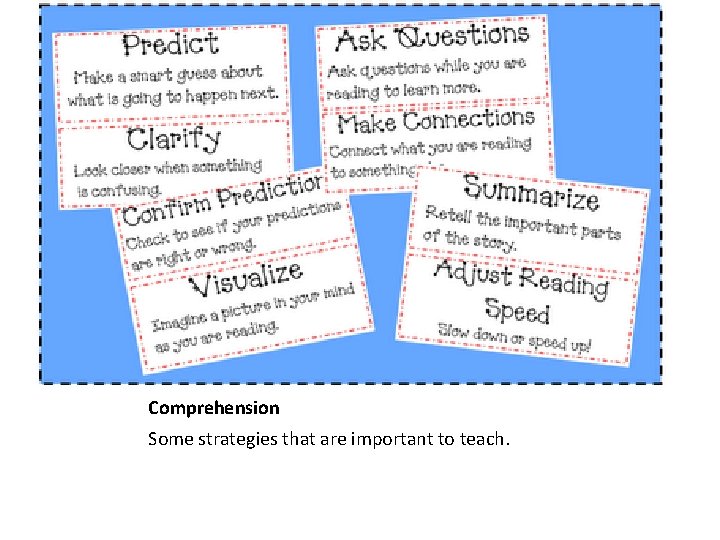
Comprehension Some strategies that are important to teach.
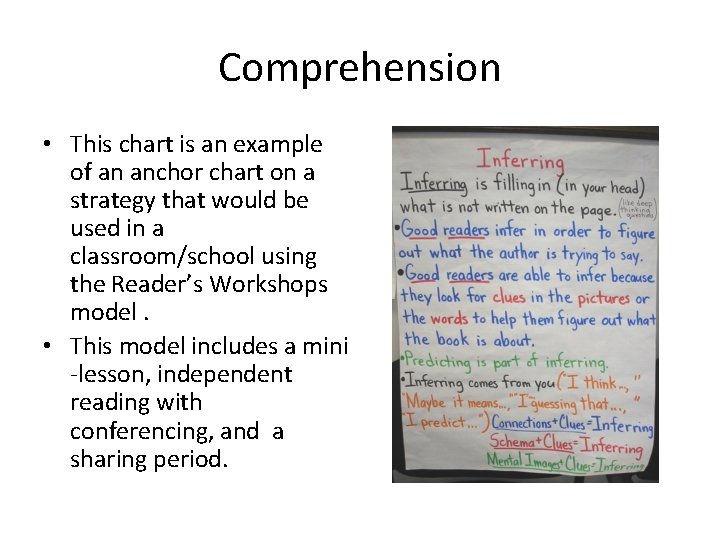
Comprehension • This chart is an example of an anchor chart on a strategy that would be used in a classroom/school using the Reader’s Workshops model. • This model includes a mini -lesson, independent reading with conferencing, and a sharing period.
Fluency • Fluency is the ability to read smoothly and easily with proper speed, accuracy, and phrasing. • It is like learning a sport or an instrument and must be practiced until it can be performed without much effort. • Younger readers develop fluency as they read. Older, struggling readers need direct instruction. • Ideas for increasing students’ fluency: • Read poems and song lyrics. See http: //kids. niehs. nih. gov/games/s ongs/index. htm for songs to print • Provide opportunities to re-read, partner read, choral read. • Model reading with fluency and expression, than have child practice. • Have students read along as they listen to books on tape. • Have students participate in Reader’s Theater. • Activities at fcrr. org for fluency at grades K/1, 2/3, 4/5
The Stages of Reading Early Emergent Literacy (pre-school) Emergent Literacy (Kindergarten and 1 st grade) Beginning Reading and Writing (1 st and 2 nd) Almost Fluent Reading and Writing (can begin as early as the end of 2 nd grade and continue into 5 th grade or more depending on the child) • Fluent Reading and Writing (can begin as early as 4 th or 5 th grades and not develop until much later in children with reading disabilities. This stage continues throughout life. ) • •
Early Emergent Literacy Children at this stage will do the following: *Recognize logos and signs *Scribble and use invented spellings. *Memorize and/or retell favorite stories which have been read aloud *Rhyme and play word games *Tell stories and ask questions – oral language is very important at this stage. *Develop concepts of print
Books at the Early Emergent Stage Will Have: • • • Strong picture support Carefully controlled text Repetitive patterns Controlled, repeated vocabulary Natural language Large print Wide letter spacing Familiar concepts Limited text on a page
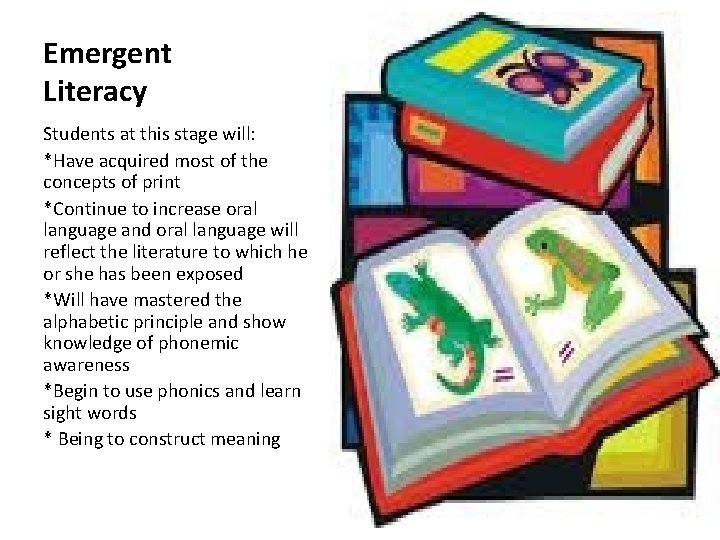
Emergent Literacy Students at this stage will: *Have acquired most of the concepts of print *Continue to increase oral language and oral language will reflect the literature to which he or she has been exposed *Will have mastered the alphabetic principle and show knowledge of phonemic awareness *Begin to use phonics and learn sight words * Being to construct meaning
With Writing the Child in the Emergent Stage Will: • Know and write his or her name and some letters • Begin to learn about capitalization rules and end punctuation • Use phonemic awareness and phonics in writing • Know the purposes for writing • Construct meaning with his or her writing
Books at the Emergent stage will have: • Increasingly more lines of print per page • More complex sentence structure • Less dependency on repetitive pattern and pictures • Familiar topics but greater depth
Beginning Reading and Writing The child will: • Have a growing vocabulary and facility with oral language • Know letters and many sight words • Use sound/symbol relationship when decoding • Use context to figure out meanings of words • Begin to use comprehension skills such as visualizing, predicting, questioning, etc. • Show confidence about reading • Show growth using writing conventions and learning the rules of spelling CVC words
Books at the Beginning Stage Will Have: • • More pages Longer sentences More text per page Richer vocabulary Greater variation in sentence pattern Less reliance on pictures More formal and descriptive language
Almost Fluent Reading and Writing The student will: *Show growth in his or her oral and listening vocabulary *Show increasing fluency and use of word recognition strategies *Continue to construct meaning or increase comprehension *Read for a variety of purposes *Learn research skills *Write for a variety of purposes *Show growth in mechanics and conventions of writing *Show pleasure and confidence in writing *Connect reading and writing
Books at the Almost Fluent Stage Will Have: • • • More text Less familiar, more varied topics Challenging vocabulary More complex sentences Varied writing styles More description
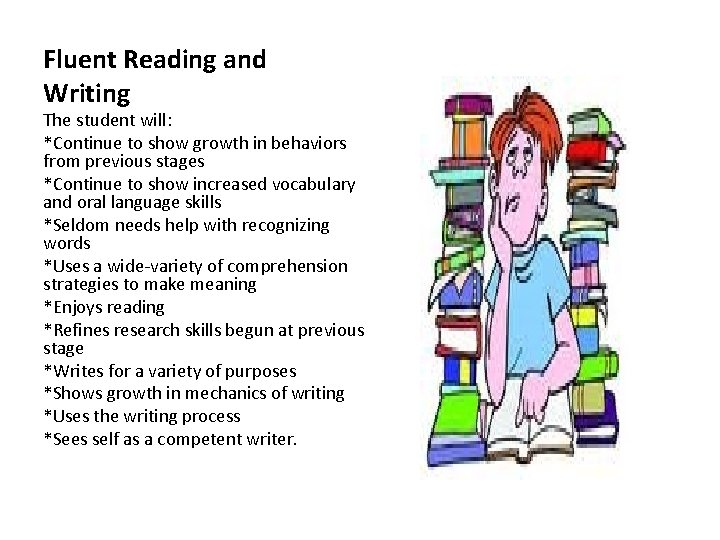
Fluent Reading and Writing The student will: *Continue to show growth in behaviors from previous stages *Continue to show increased vocabulary and oral language skills *Seldom needs help with recognizing words *Uses a wide-variety of comprehension strategies to make meaning *Enjoys reading *Refines research skills begun at previous stage *Writes for a variety of purposes *Shows growth in mechanics of writing *Uses the writing process *Sees self as a competent writer.
Stages of Spelling Development
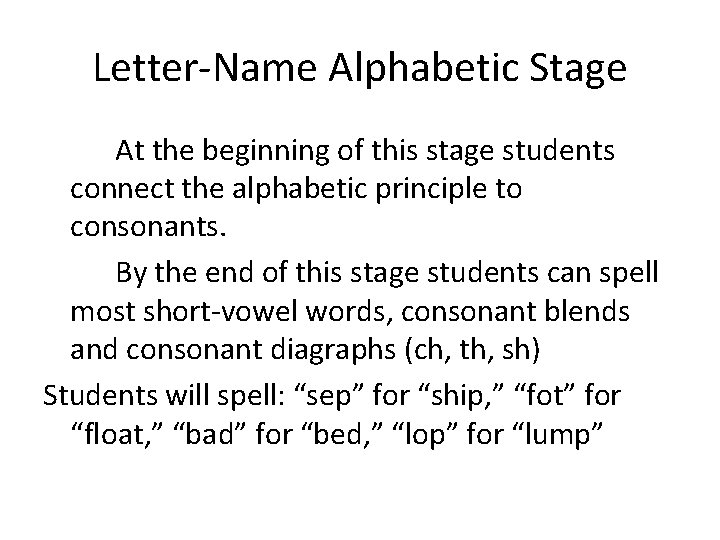
Letter-Name Alphabetic Stage At the beginning of this stage students connect the alphabetic principle to consonants. By the end of this stage students can spell most short-vowel words, consonant blends and consonant diagraphs (ch, th, sh) Students will spell: “sep” for “ship, ” “fot” for “float, ” “bad” for “bed, ” “lop” for “lump”
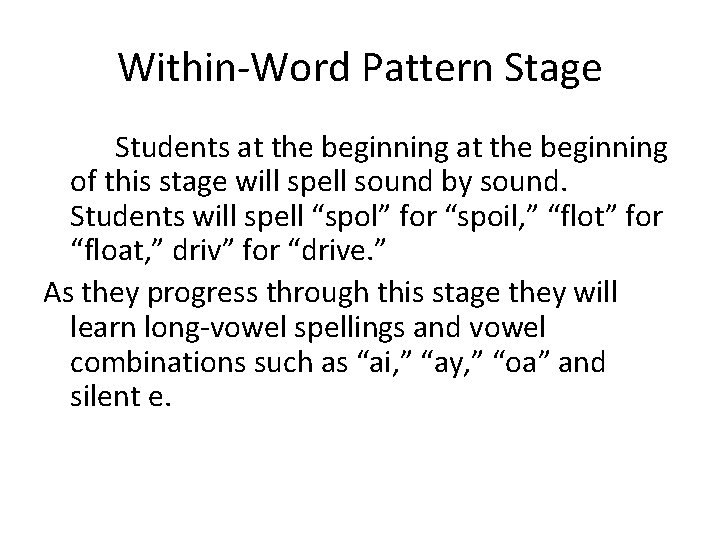
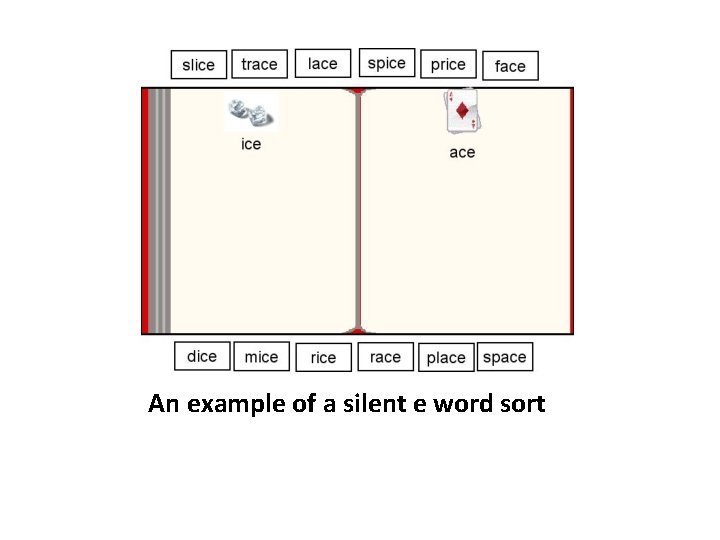
Within-Word Pattern Stage Students at the beginning of this stage will spell sound by sound. Students will spell “spol” for “spoil, ” “flot” for “float, ” driv” for “drive. ” As they progress through this stage they will learn long-vowel spellings and vowel combinations such as “ai, ” “ay, ” “oa” and silent e.
An example of a silent e word sort
Syllables and Affixes/Derivational Stages • Syllables and Affixes Students at this stage can spell most one syllable short vowel and long vowel words correctly. The focus is on multisyllabic words, prefixes and suffixes. Some examples are, “sellar” for “cellar, ” damige” for damage, ” and “fortunet” for “fortunate” • Derivational Spellings Students at this stage spell most words correctly, but learn to sort words by pattern and meaning. They continue to learn prefixes and suffixes and examine the origins of words. Some examples of students at this stage are “faverite” for “favorite, ” “diffrent” for “different, ” and “ingredence” for “ingredient. ”
Conclusions • Each child is unique and will not progress through the stages of reading and spelling at the same rate. • Students need to be assessed in all areas of reading, spelling and writing and those assessments should drive instruction. • It is always good to have more activities planned if needed, than too few. • There a lot of great resources in books and online. • Ask the classroom teacher, reading specialist or case manager if you need help with a particular student or aspect of reading instruction.