
ReaderResponse Criticism By Gisselle Gutierrez Jelissa Jose Jenny
Reader-Response Criticism By: Gisselle Gutierrez, Jelissa Jose, Jenny Nguyen, and Fateemaa Sohani
Reader-Response Criticism Definition: A form of literary criticism focused on the reader’s response to a text. - Started in US and Germany - A dialogue between the reader and the text that has its own meaning.
Continued. . . - Various approaches to explain the diversity of reader’s responses to literary works - Text interpretation often depends on time and/or occasion when work is read. - Readers can interpret different meanings from the text, often depending on their own life experiences
More About Reader Response ● Started in 1960 s ● Still present ● Most influential 1970’s and early 1980’s - Each reader has his/her own perspective on the text, so his/her personal experiences influence the way that he/she views the text.
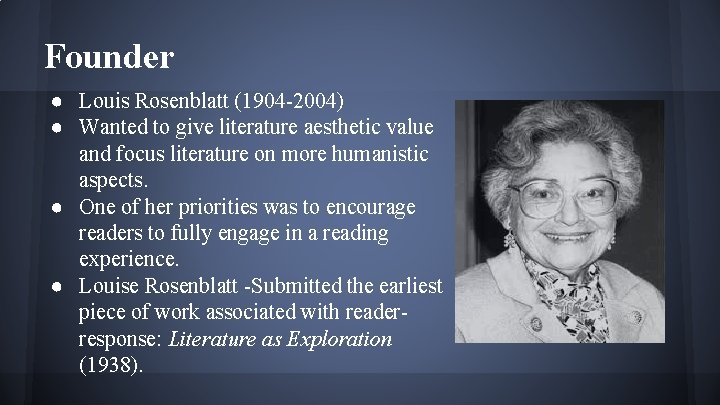
Founder ● Louis Rosenblatt (1904 -2004) ● Wanted to give literature aesthetic value and focus literature on more humanistic aspects. ● One of her priorities was to encourage readers to fully engage in a reading experience. ● Louise Rosenblatt -Submitted the earliest piece of work associated with readerresponse: Literature as Exploration (1938).

Critics/Authors Associated ● Peter Rabinowitz - Before Reading, 1987 ● Norman Holland - The Dynamics of Literary Response, 1968 ● Elizabeth Freund - The Return of the Reader: Reader-Response Criticism, 1987 ● Wolfgang Iser - The Implied Reader: Patterns of Communication in Prose Fiction from Bunyan to Beckett, 1974 ● Stanley Fish - Is There a Text in This Class? -The Authority of Interpretive Communities, 1980
Basic Tenets of Belief Reader-Response Theory: - In literary interpretation, the reader is the most important component. - There isn’t text unless there is a reader. - Readers actively create the meaning of a literary text (subjective rather than objective). - The reader and text work together.
Types of Reader Response - Transactional Reader Response: Actual text or basically the blueprint is transformed into a poem. - Physiological Reader Response: Taking the text and interpreting the writer's feelings. - Social Reader Response: Taking the text literal and connecting to it.
Questions Reader Response Critics ask ● “How does the interaction between the text and I create meaning? ” ● “Do the sounds/shapes of the words as they appear on the page remind me of anything? ” ● And the most important question: “How does this writing piece relate to me? ” - These questions help critics find their personal feelings in more depth - Reader response arose as a reaction to more formal criticisms.
Bibliography ● ● ● https: //owl. english. purdue. edu/owl/resource/722/06/ http: //bcs. bedfordstmartins. com/virtualit/poetry/critical_define/crit_reader. html https: //owl. english. purdue. edu/owl/resource/722/06/ http: //www. wisegeek. org/what-is-reader-response-criticism. htm http: //www. merriam-webster. com/dictionary/reader-response%20 criticism http: //utminers. utep. edu/omwilliamson/engl 0310 link/readerresponse. htm https: //owl. english. purdue. edu/owl/resource/722/06/ http: //public. wsu. edu/~delahoyd/reader. crit. html http: //www. shmoop. com/stanley-fish/ http: //www. enotes. com/topics/reader-response-criticism http: //faculty. goucher. edu/eng 215/reader_response_terms. htm http: //docs. lib. purdue. edu/cgi/viewcontent. cgi? article=1046&context=eandc
- Slides: 10