
ReadCopyUpdate Synchronization in the Linux Kernel David Ferry

- Slides: 14
Read-Copy-Update Synchronization in the Linux Kernel David Ferry, Chris Gill CSE 522 S - Advanced Operating Systems Washington University in St. Louis, MO 63143 1
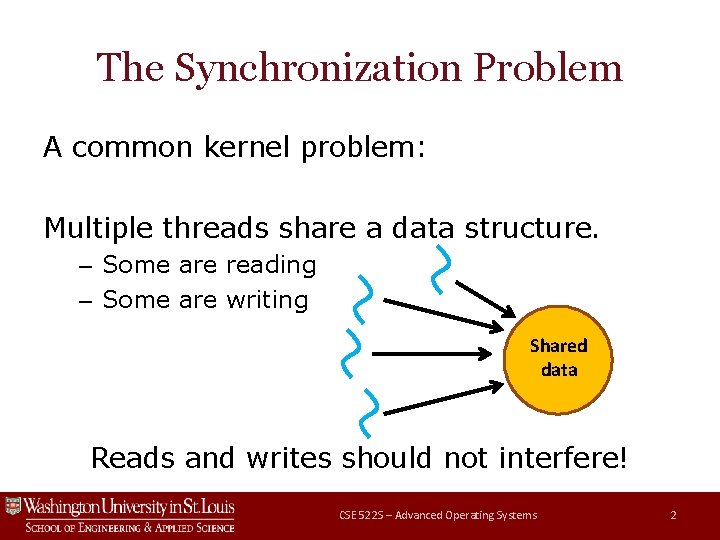
The Synchronization Problem A common kernel problem: Multiple threads share a data structure. – Some are reading – Some are writing Shared data Reads and writes should not interfere! CSE 522 S – Advanced Operating Systems 2
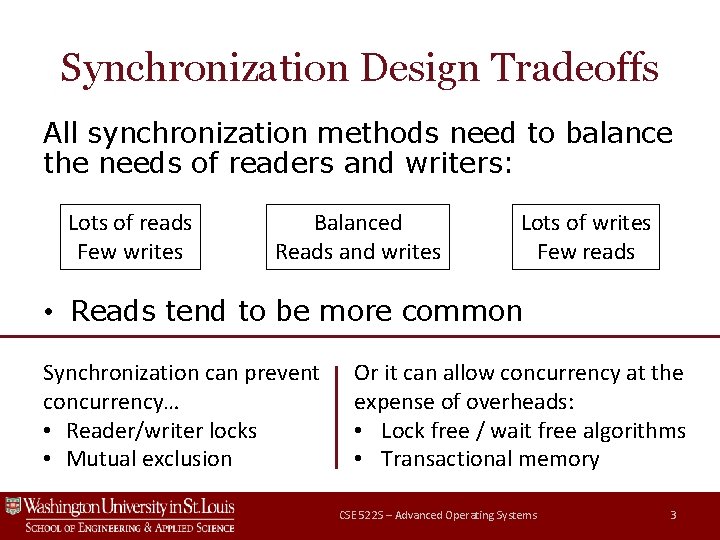
Synchronization Design Tradeoffs All synchronization methods need to balance the needs of readers and writers: Lots of reads Few writes Balanced Reads and writes Lots of writes Few reads • Reads tend to be more common Synchronization can prevent concurrency… • Reader/writer locks • Mutual exclusion Or it can allow concurrency at the expense of overheads: • Lock free / wait free algorithms • Transactional memory CSE 522 S – Advanced Operating Systems 3
RCU Philosophy Under RCU: – Concurrent reads are synchronization-free (which means scalability!) – Writers must guarantee that all readers only ever see a consistent view of memory – Similar to a publish-subscribe model Before the details, let’s look at the API… CSE 522 S – Advanced Operating Systems 4
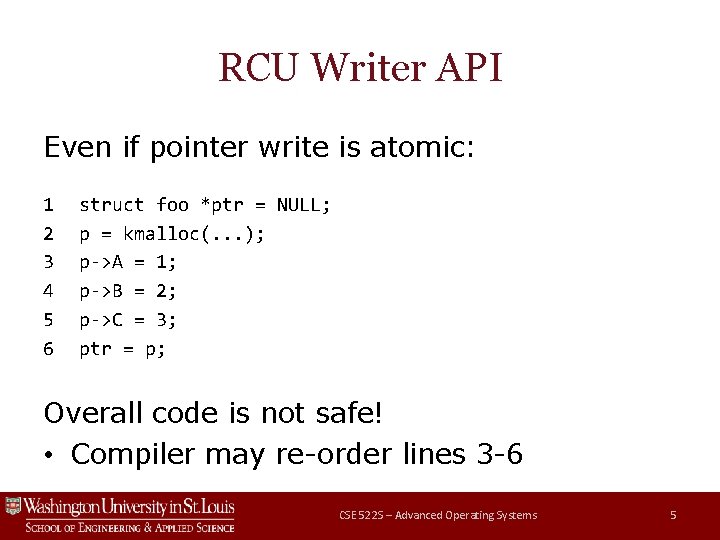
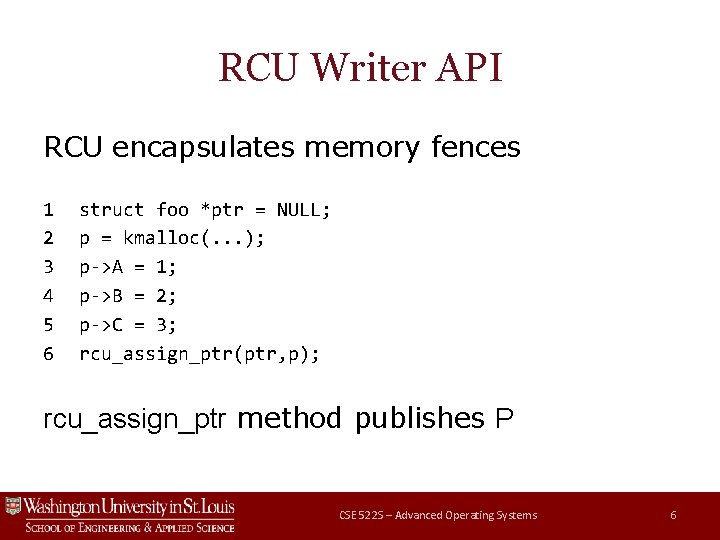
RCU Writer API Even if pointer write is atomic: 1 2 3 4 5 6 struct foo *ptr = NULL; p = kmalloc(. . . ); p->A = 1; p->B = 2; p->C = 3; ptr = p; Overall code is not safe! • Compiler may re-order lines 3 -6 CSE 522 S – Advanced Operating Systems 5
RCU Writer API RCU encapsulates memory fences 1 2 3 4 5 6 struct foo *ptr = NULL; p = kmalloc(. . . ); p->A = 1; p->B = 2; p->C = 3; rcu_assign_ptr(ptr, p); rcu_assign_ptr method publishes P CSE 522 S – Advanced Operating Systems 6
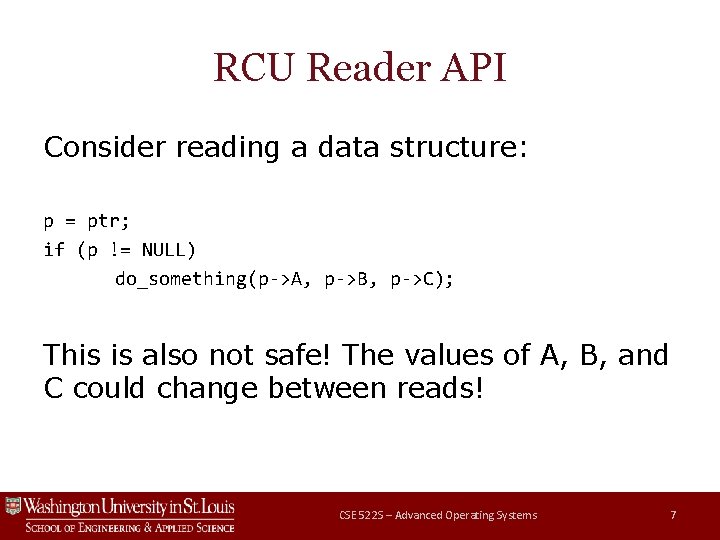
RCU Reader API Consider reading a data structure: p = ptr; if (p != NULL) do_something(p->A, p->B, p->C); This is also not safe! The values of A, B, and C could change between reads! CSE 522 S – Advanced Operating Systems 7
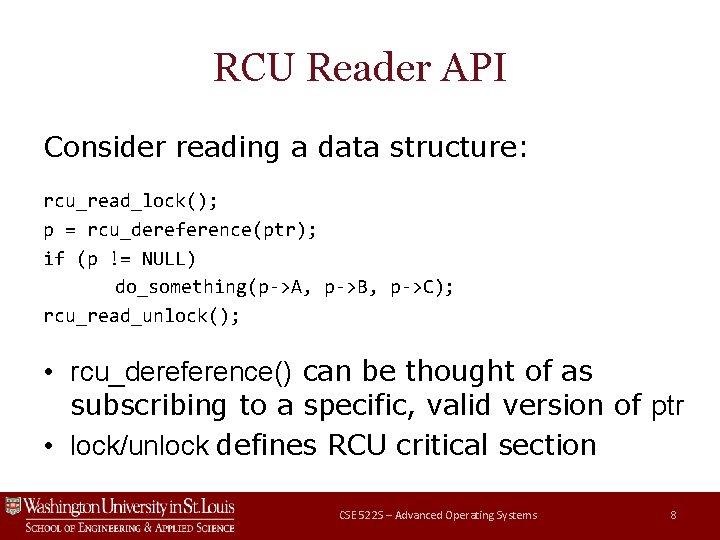
RCU Reader API Consider reading a data structure: rcu_read_lock(); p = rcu_dereference(ptr); if (p != NULL) do_something(p->A, p->B, p->C); rcu_read_unlock(); • rcu_dereference() can be thought of as subscribing to a specific, valid version of ptr • lock/unlock defines RCU critical section CSE 522 S – Advanced Operating Systems 8
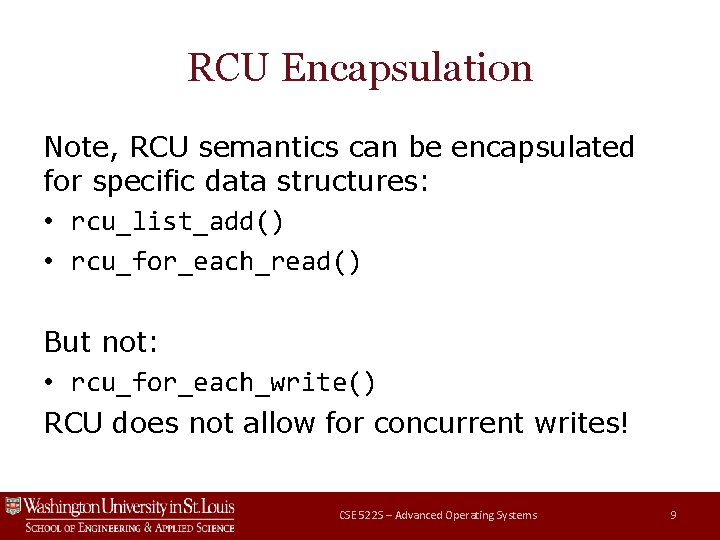
RCU Encapsulation Note, RCU semantics can be encapsulated for specific data structures: • rcu_list_add() • rcu_for_each_read() But not: • rcu_for_each_write() RCU does not allow for concurrent writes! CSE 522 S – Advanced Operating Systems 9
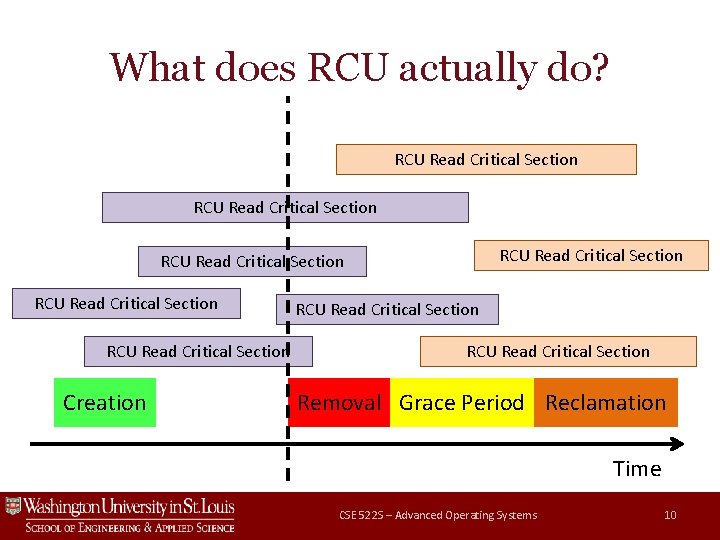
What does RCU actually do? RCU Read Critical Section RCU Read Critical Section Creation RCU Read Critical Section Removal Grace Period Reclamation Time CSE 522 S – Advanced Operating Systems 10
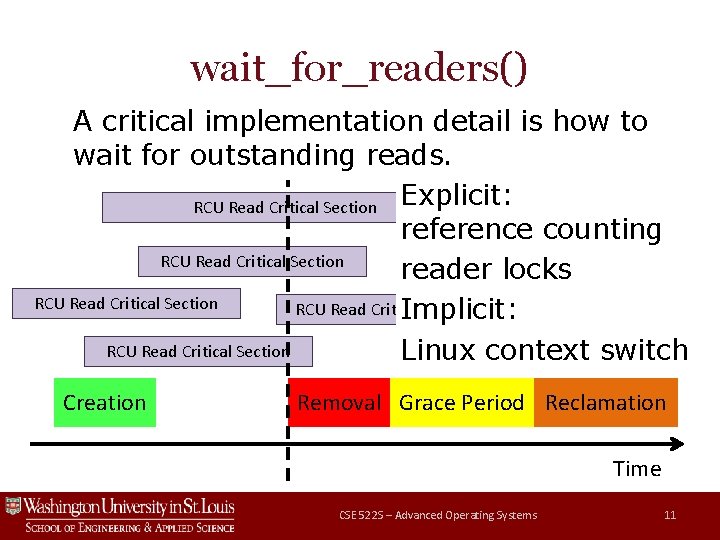
wait_for_readers() A critical implementation detail is how to wait for outstanding reads. RCU Read Critical Section Explicit: reference counting RCU Read Critical Section reader locks RCU Read Critical Section Implicit: RCU Read Critical Section Linux context switch Creation Removal Grace Period Reclamation Time CSE 522 S – Advanced Operating Systems 11
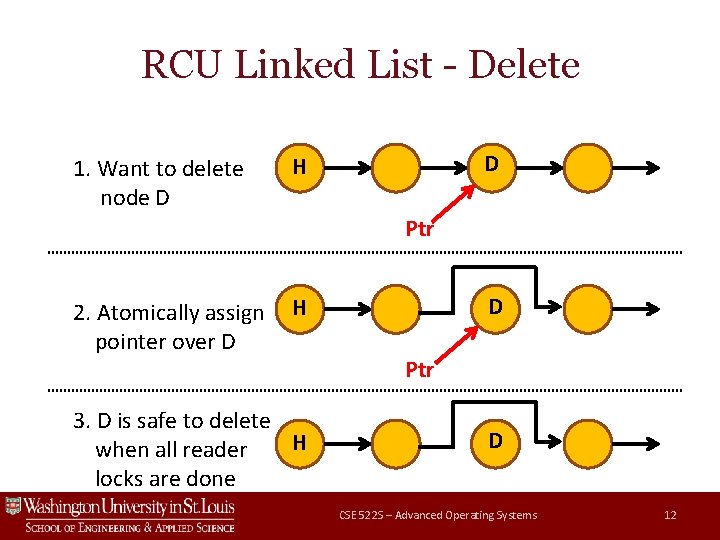
RCU Linked List - Delete 1. Want to delete node D D H Ptr 2. Atomically assign pointer over D D H 3. D is safe to delete H when all reader locks are done Ptr D CSE 522 S – Advanced Operating Systems 12
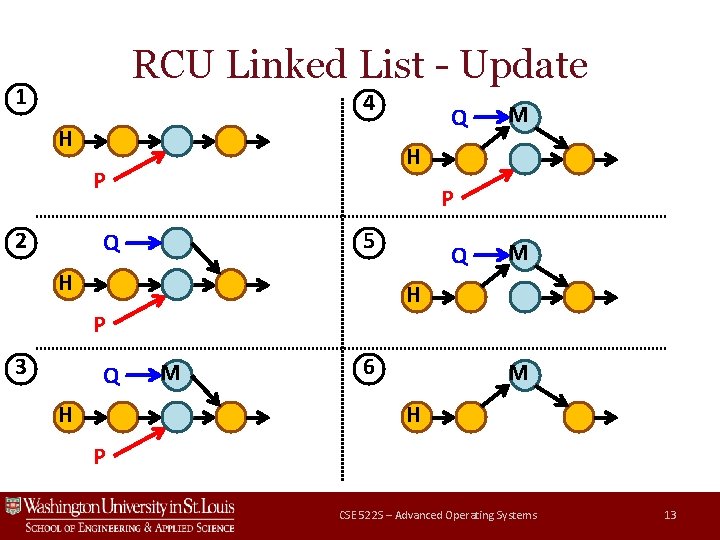
RCU Linked List - Update 1 4 H M H P 2 Q P 5 Q H Q M H P 3 Q H M 6 M H P CSE 522 S – Advanced Operating Systems 13
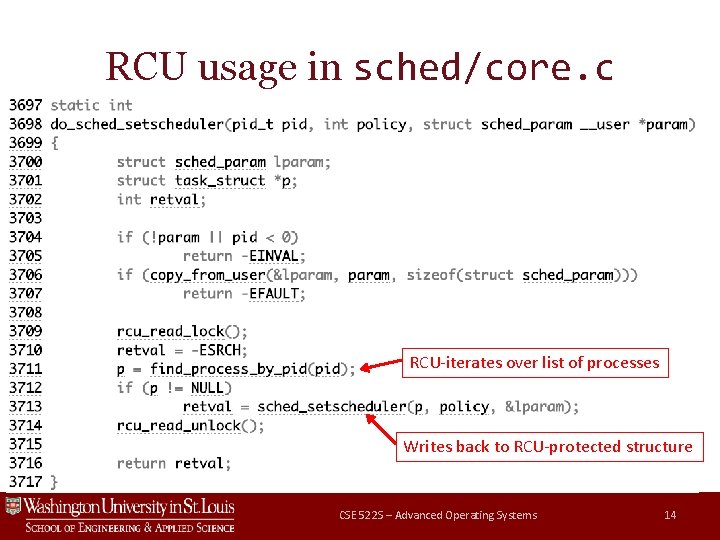
RCU usage in sched/core. c RCU-iterates over list of processes Writes back to RCU-protected structure CSE 522 S – Advanced Operating Systems 14