
Read like a detective write like a reporter
- Slides: 17
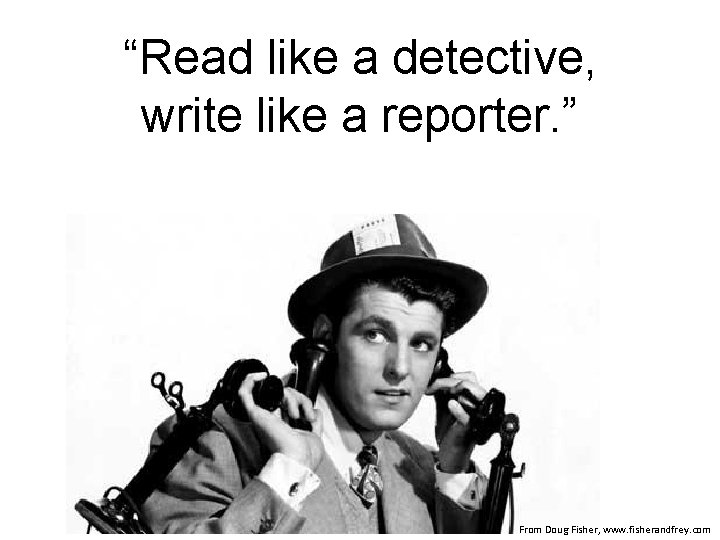
“Read like a detective, write like a reporter. ” From Doug Fisher, www. fisherandfrey. com
“Reading Texts Rhetorically” “The book defines ‘reading rhetorically’ as attending to a writer’s purposes within a rhetorical situation by examining both what the author says and how he or she says it” (Bean, Chappell, Gilliam, Reading Rhetorically, xii). The following credited to Micah Jendian micah. jendian@gcccd. edu �Grossmont College Associate Professor of English
“Text” "By reading. . . we mean something more than simply lifting information out of books and articles. To read a text or event is to do something to it, to make sense out of its signals and clues. . Reading is thus not something we do to books alone. Or, to put it another way, books and other printed surfaces are not the only texts we read. Rather, a ‘text’ is anything that can be interpreted, that we can make meaning out of or assign value to. In this sense, all culture is a text and all culture can be read. " ~ Joseph Harris and Jay Rosen, eds The Media Journal From Micah Jendian, Grossmont College
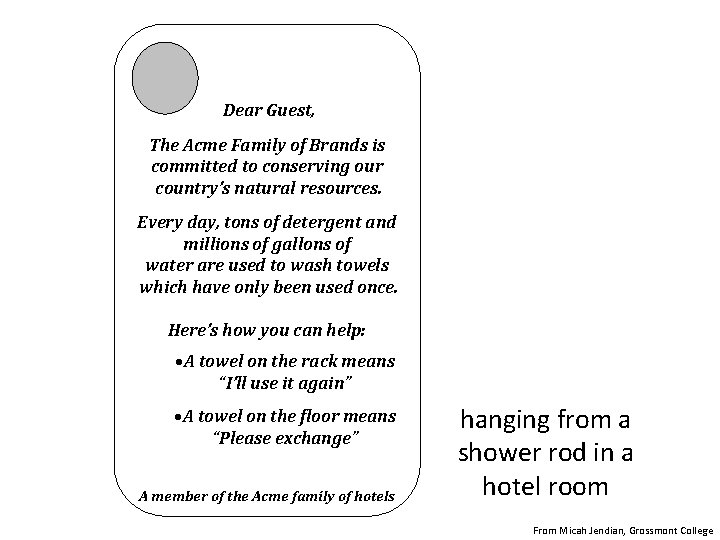
Dear Guest, The Acme Family of Brands is committed to conserving our country’s natural resources. Every day, tons of detergent and millions of gallons of water are used to wash towels which have only been used once. Here’s how you can help: ·A towel on the rack means “I’ll use it again” ·A towel on the floor means “Please exchange” A member of the Acme family of hotels hanging from a shower rod in a hotel room From Micah Jendian, Grossmont College
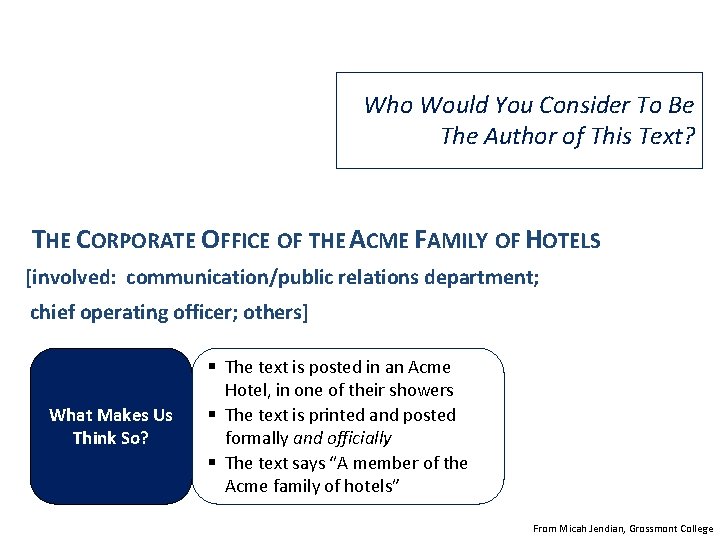
Who Would You Consider To Be The Author of This Text? Cal-PASS THE CORPORATE OFFICE OF THE ACME FAMILY OF HOTELS [involved: communication/public relations department; chief operating officer; others] What Makes Us Think So? § The text is posted in an Acme Hotel, in one of their showers § The text is printed and posted formally and officially § The text says “A member of the Acme family of hotels” From Micah Jendian, Grossmont College
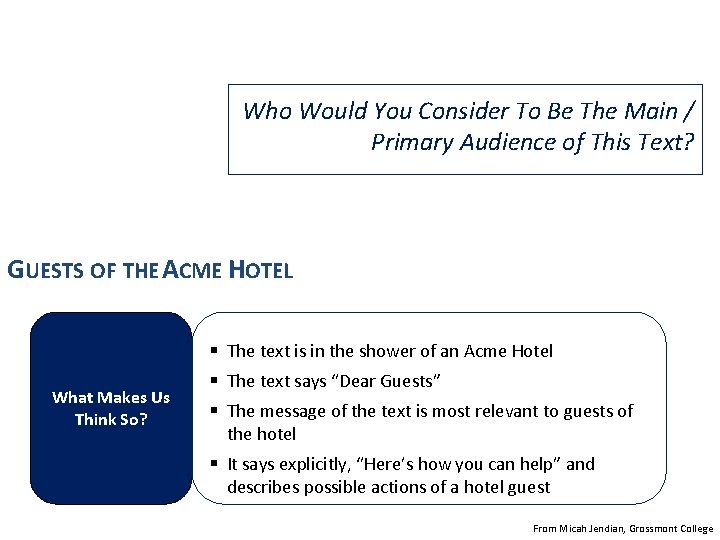
Who Would You Consider To Be The Main / Cal-PASS Primary Audience of This Text? GUESTS OF THE ACME HOTEL § The text is in the shower of an Acme Hotel What Makes Us Think So? § The text says “Dear Guests” § The message of the text is most relevant to guests of the hotel § It says explicitly, “Here’s how you can help” and describes possible actions of a hotel guest From Micah Jendian, Grossmont College
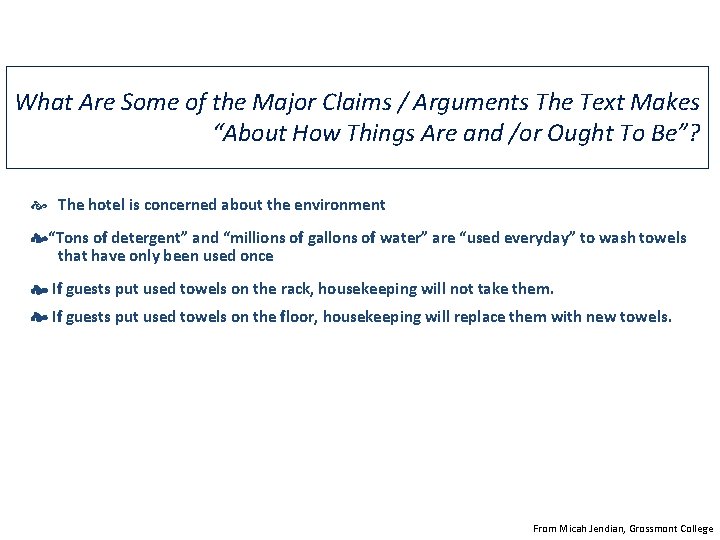
What Are Some of the Major Claims / Arguments The Text Makes Cal-PASS “About How Things Are and /or Ought To Be”? The hotel is concerned about the environment “Tons of detergent” and “millions of gallons of water” are “used everyday” to wash towels that have only been used once If guests put used towels on the rack, housekeeping will not take them. If guests put used towels on the floor, housekeeping will replace them with new towels. From Micah Jendian, Grossmont College
What is the text’s central/main claim? central claim? What appears to be the main outcome that the text is trying to achieve with/on its readers? From Micah Jendian, Grossmont College
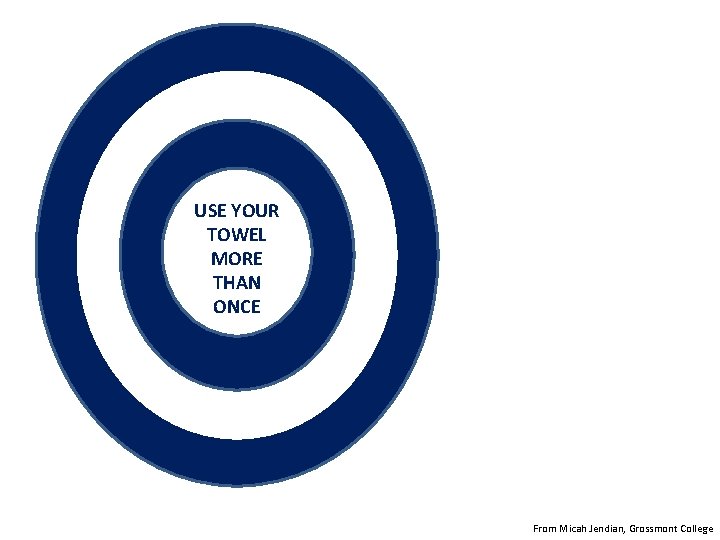
USE YOUR TOWEL MORE THAN ONCE From Micah Jendian, Grossmont College
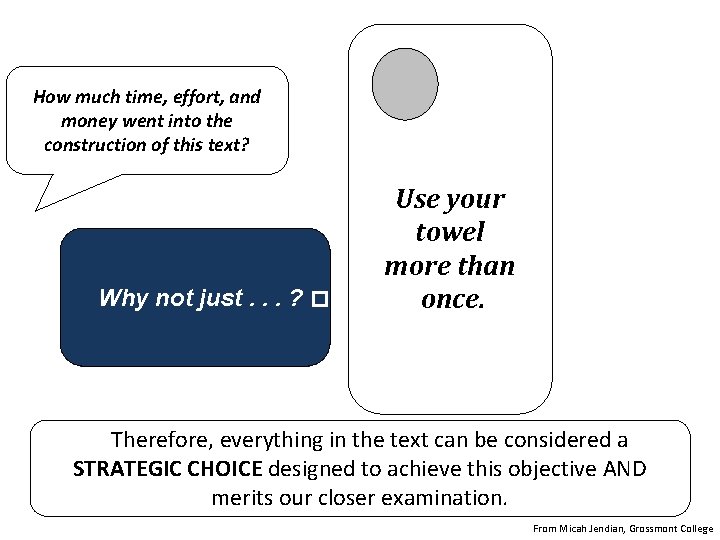
How much time, effort, and money went into the construction of this text? Why not just. . . ? � Use your towel more than once. Therefore, everything in the text can be considered a STRATEGIC CHOICE designed to achieve this objective AND merits our closer examination. From Micah Jendian, Grossmont College
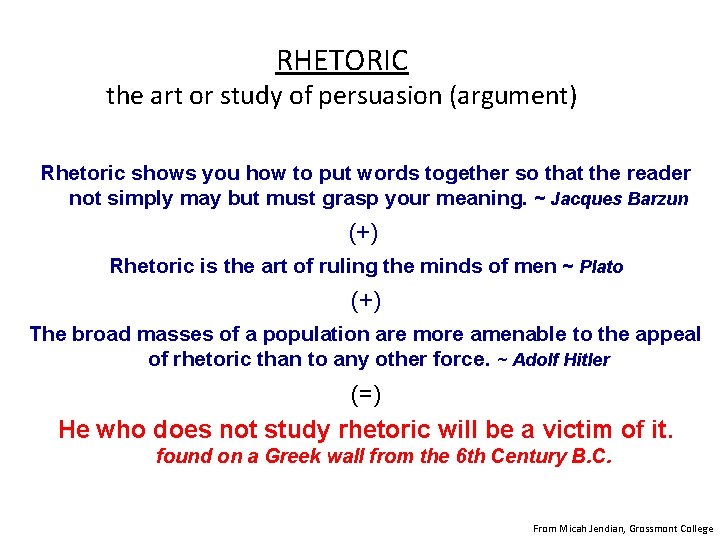
RHETORIC the art or study of persuasion (argument) Rhetoric shows you how to put words together so that the reader not simply may but must grasp your meaning. ~ Jacques Barzun (+) Rhetoric is the art of ruling the minds of men ~ Plato (+) The broad masses of a population are more amenable to the appeal of rhetoric than to any other force. ~ Adolf Hitler (=) He who does not study rhetoric will be a victim of it. found on a Greek wall from the 6 th Century B. C. From Micah Jendian, Grossmont College
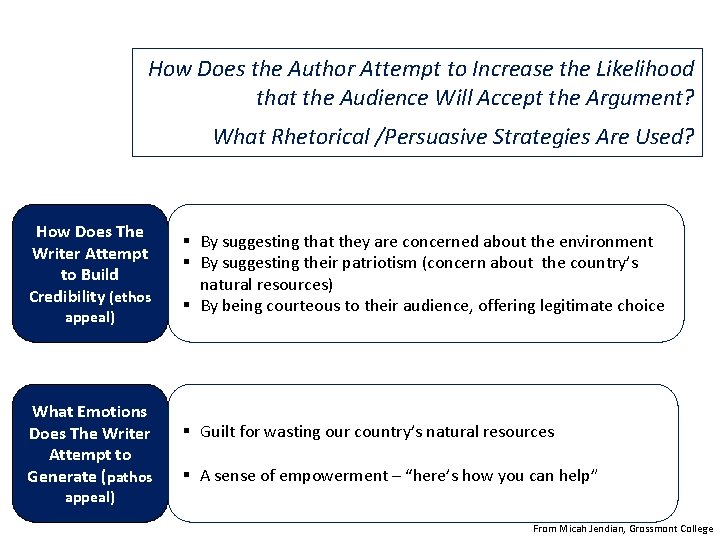
How Does the Author Attempt to Increase the Likelihood that the Audience Will Accept the Argument? Cal-PASS What Rhetorical /Persuasive Strategies Are Used? How Does The Writer Attempt to Build Credibility (ethos appeal) What Emotions Does The Writer Attempt to Generate (pathos § By suggesting that they are concerned about the environment § By suggesting their patriotism (concern about the country’s natural resources) § By being courteous to their audience, offering legitimate choice § Guilt for wasting our country’s natural resources § A sense of empowerment – “here’s how you can help” appeal) From Micah Jendian, Grossmont College
“In most cases, a writer’s goal is to change a reader’s understanding of a topic in some way. . and their efforts to do so involve both direct and indirect means. . Because writers try to persuade their intended audiences to adopt their perspective, they select and arrange evidence, choose examples, include or omit material, and select words and images to best support their perspective. As a rhetorical reader, you have to be aware of how a text is constructed to persuade its intended audience (and you may not be part of its intended audience at all). . your ability to recognize the persuasive strategies built into a text grants you considerable power in deciding how you will respond to an author’s views” (Reading Rhetorically, 18 -19). From Micah Jendian, Grossmont College
NOW, we are ready move more deeply into conversation with the text AND to carefully evaluate the argument. We could, for example, inquire into and consider the following: What do the authors of this argument have at stake? What are their interests? What might be the hotel’s ultimate objective? How much of the “tons of detergent” and “millions of gallons” used to wash towels that have only been used once are from this hotel? What is the economic cost of using my towel only once before it is washed? What is the environmental cost of using my towel only once? What are the economic benefits for the Acme family of hotels if I use my towel more than once? To what extent are any economic benefits going to be shared by the consumer? From Micah Jendian, Grossmont College
Potential Writing Tasks • What could we ask students to do with this text that demonstrates their critical reading of it? 1. Explain two of the subtle rhetorical / persuasive strategies the authors’ use in order to get readers to accept this argument. 2. Create a sign to post in the cafeteria that would encourage students to recycle their bottles. Considering your audience, what argument(s) would be most effective? 3. From Micah Jendian, Grossmont College
Important Note: • As adult learners and expert readers, we can engage a text like this; many, if not all, of our students will need this kind of work to be scaffolded through explicit instruction. • That would include prereading, introducing key concepts, introducing key vocabulary, and offering other structured / guided activities. • These skills and abilities are best developed gradually, sequentially, and with multiple opportunities to develop mastery. Reflection: l Comments or questions about what we’ve just done? l What did you notice about yourself as a reader as you engaged in this reading rhetorically experience? From Micah Jendian, Grossmont College