
Reactors used for catalytic hydrogenation Three types of
- Slides: 3
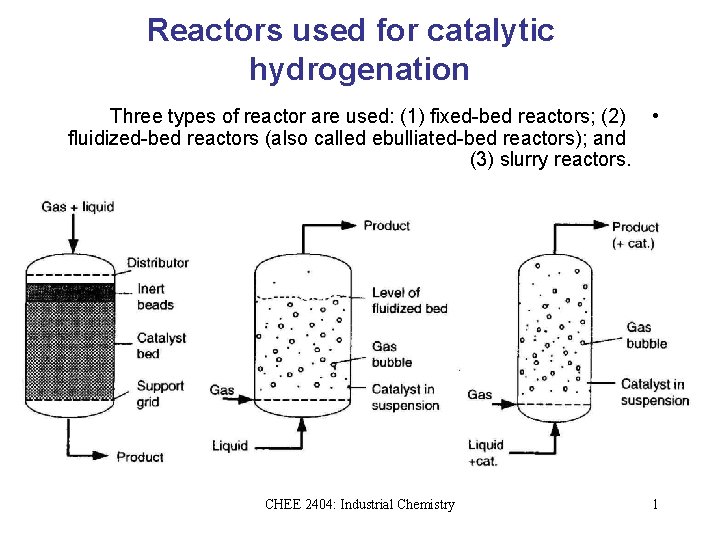
Reactors used for catalytic hydrogenation Three types of reactor are used: (1) fixed-bed reactors; (2) • fluidized-bed reactors (also called ebulliated-bed reactors); and (3) slurry reactors. CHEE 2404: Industrial Chemistry 1
Processes with slurry reactors Slurry processes for residue processing are normally designed with the objective of maximizing residue conversion. Downstream reactors are then used to treat the liquid products for S and N removal. Examples of the slurry process are the Veba Combi-Cracking and CANMET process. Conversion of residual feed takes place in the liquid phase in a slurry reactor. After separation the residue from the products they are further hydro-treated in a fixed-bed reactor containing an HDS catalyst. A cheap, once-through catalyst is used which ends up in the residue. CHEE 2404: Industrial Chemistry 2
TREATMENT OF REFINERY GASES Removal of H 2 S from gases is usually performed by absorption in the liquid phase. The concentrated H 2 S is frequently converted to elemental sulphur by the “Claus” process (partial oxidation of H 2 S) In the Claus process 95 -97% of the H 2 S is converted. H 2 S is often removed with solvents that can be regenerated, usually alkanolamines: e. g. CH 2(OH)CH 2 NH 2 MEA (mono-ethanolamine). These amines are highly water soluble with low volatility and their interaction with H 2 S is much faster than with CO 2 so that the amount of absorbed CO 2 can be limited by selecting appropriate conditions. CHEE 2404: Industrial Chemistry 3