
Reactor simulation and design The Necsa OSCAR5 system

- Slides: 21
Reactor simulation and design The Necsa OSCAR-5 system and its application to reactor analysis Necsa, South Africa Date: Nov 2019 Rian Prinsloo HEAD: OSCAR development team
Outline Necsa R&TD/RRT section background OSCAR-5 system and features OSCAR-5 application and reactor database Latest developments
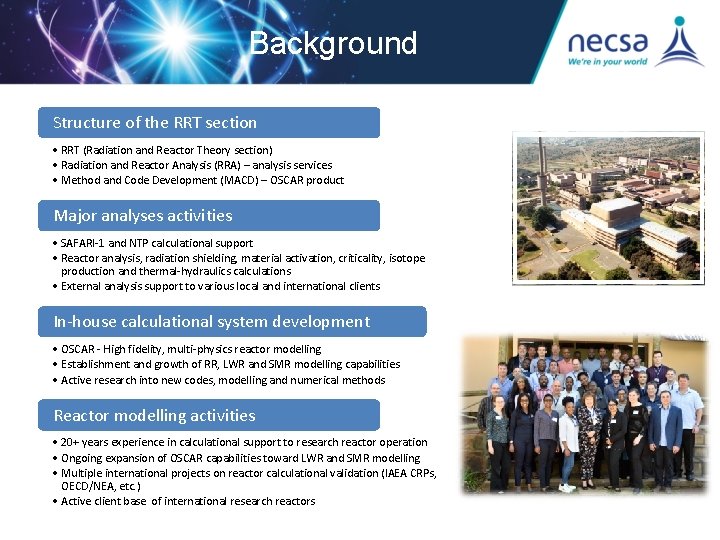
Background Structure of the RRT section • RRT (Radiation and Reactor Theory section) • Radiation and Reactor Analysis (RRA) – analysis services • Method and Code Development (MACD) – OSCAR product Major analyses activities • SAFARI-1 and NTP calculational support • Reactor analysis, radiation shielding, material activation, criticality, isotope production and thermal-hydraulics calculations • External analysis support to various local and international clients In-house calculational system development • OSCAR - High fidelity, multi-physics reactor modelling • Establishment and growth of RR, LWR and SMR modelling capabilities • Active research into new codes, modelling and numerical methods Reactor modelling activities • 20+ years experience in calculational support to research reactor operation • Ongoing expansion of OSCAR capabilities toward LWR and SMR modelling • Multiple international projects on reactor calculational validation (IAEA CRPs, OECD/NEA, etc. ) • Active client base of international research reactors
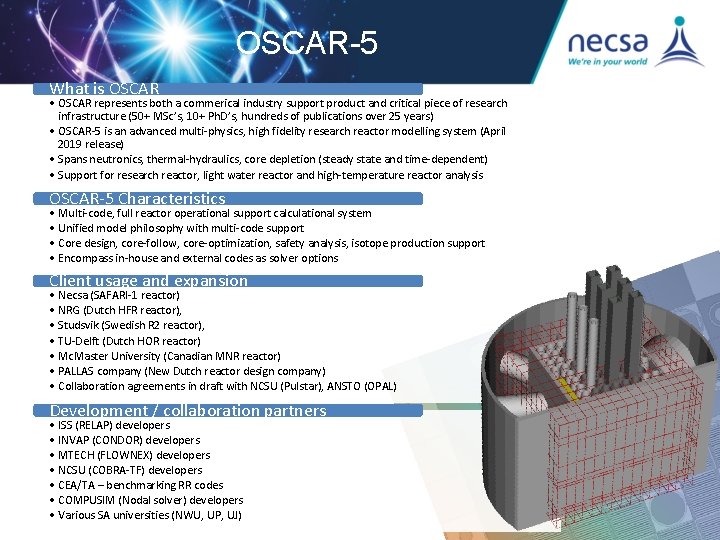
OSCAR-5 What is OSCAR • OSCAR represents both a commerical industry support product and critical piece of research infrastructure (50+ MSc’s, 10+ Ph. D’s, hundreds of publications over 25 years) • OSCAR-5 is an advanced multi-physics, high fidelity research reactor modelling system (April 2019 release) • Spans neutronics, thermal-hydraulics, core depletion (steady state and time-dependent) • Support for research reactor, light water reactor and high-temperature reactor analysis OSCAR-5 Characteristics • Multi-code, full reactor operational support calculational system • Unified model philosophy with multi-code support • Core design, core-follow, core-optimization, safety analysis, isotope production support • Encompass in-house and external codes as solver options Client usage and expansion • Necsa (SAFARI-1 reactor) • NRG (Dutch HFR reactor), • Studsvik (Swedish R 2 reactor), • TU-Delft (Dutch HOR reactor) • Mc. Master University (Canadian MNR reactor) • PALLAS company (New Dutch reactor design company) • Collaboration agreements in draft with NCSU (Pulstar), ANSTO (OPAL) Development / collaboration partners • ISS (RELAP) developers • INVAP (CONDOR) developers • MTECH (FLOWNEX) developers • NCSU (COBRA-TF) developers • CEA/TA – benchmarking RR codes • COMPUSIM (Nodal solver) developers • Various SA universities (NWU, UP, UJ)
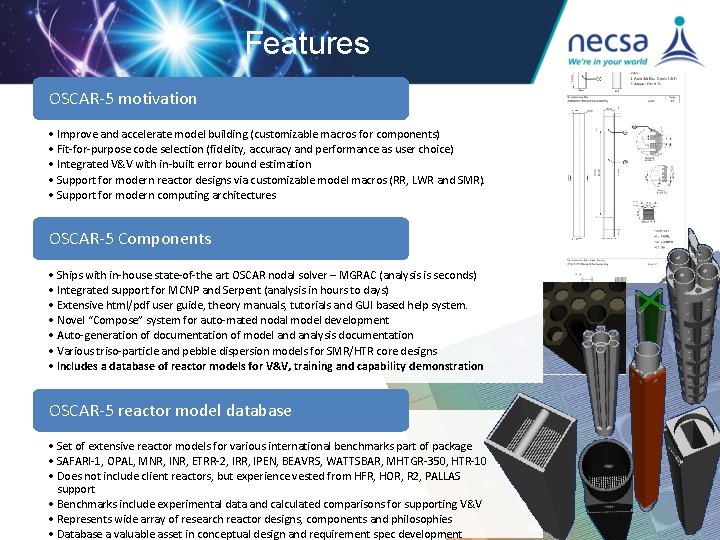
Features OSCAR-5 motivation • Improve and accelerate model building (customizable macros for components) • Fit-for-purpose code selection (fidelity, accuracy and performance as user choice) • Integrated V&V with in-built error bound estimation • Support for modern reactor designs via customizable model macros (RR, LWR and SMR). • Support for modern computing architectures OSCAR-5 Components • Ships with in-house state-of-the art OSCAR nodal solver – MGRAC (analysis is seconds) • Integrated support for MCNP and Serpent (analysis in hours to days) • Extensive html/pdf user guide, theory manuals, tutorials and GUI based help system. • Novel “Compose” system for auto-mated nodal model development • Auto-generation of documentation of model and analysis documentation • Various triso-particle and pebble dispersion models for SMR/HTR core designs • Includes a database of reactor models for V&V, training and capability demonstration OSCAR-5 reactor model database • Set of extensive reactor models for various international benchmarks part of package • SAFARI-1, OPAL, MNR, INR, ETRR-2, IRR, IPEN, BEAVRS, WATTSBAR, MHTGR-350, HTR-10 • Does not include client reactors, but experience vested from HFR, HOR, R 2, PALLAS support • Benchmarks include experimental data and calculated comparisons for supporting V&V • Represents wide array of research reactor designs, components and philosophies • Database a valuable asset in conceptual design and requirement spec development
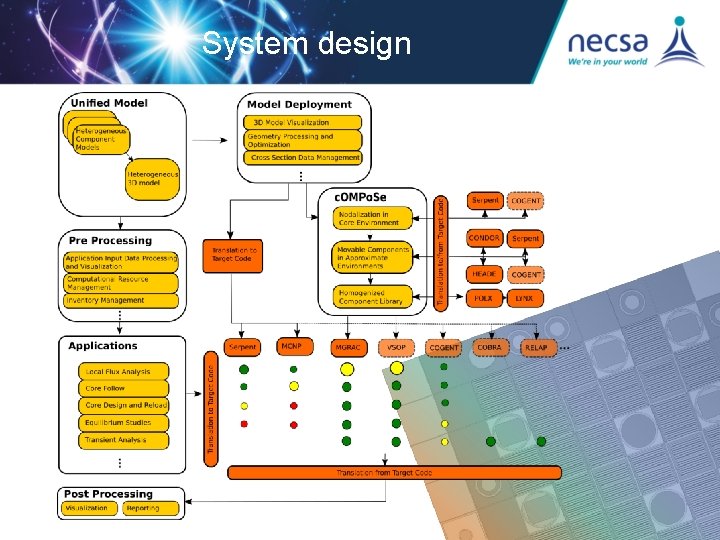
System design
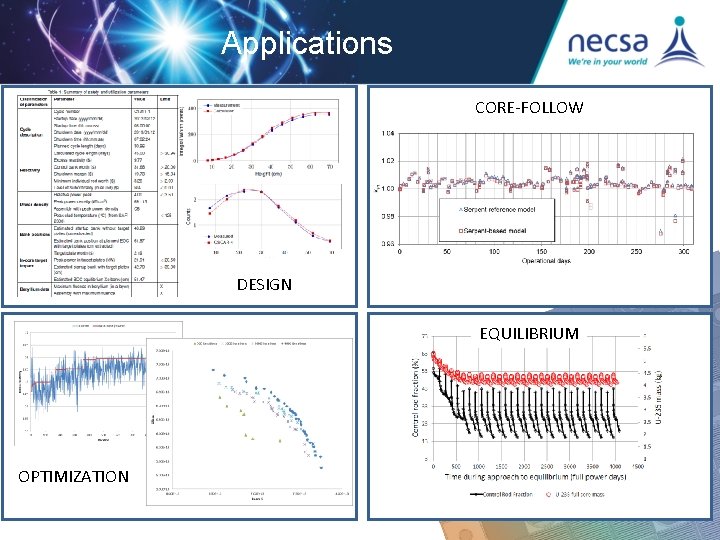
Applications CORE-FOLLOW DESIGN EQUILIBRIUM OPTIMIZATION
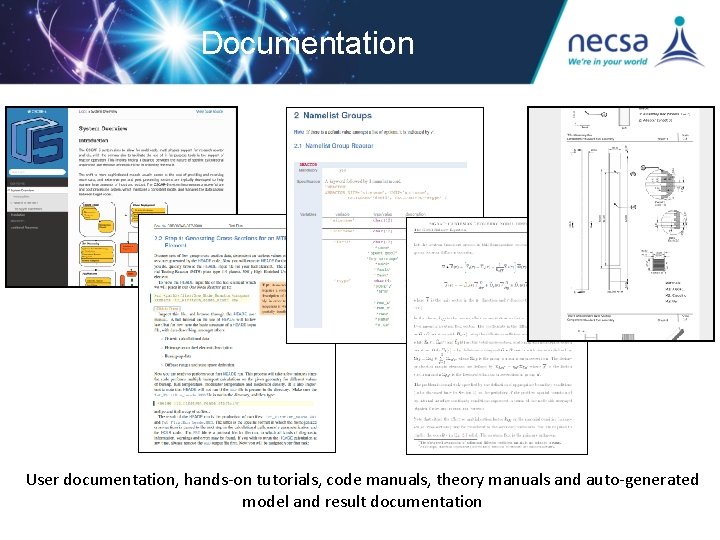
Documentation User documentation, hands-on tutorials, code manuals, theory manuals and auto-generated model and result documentation
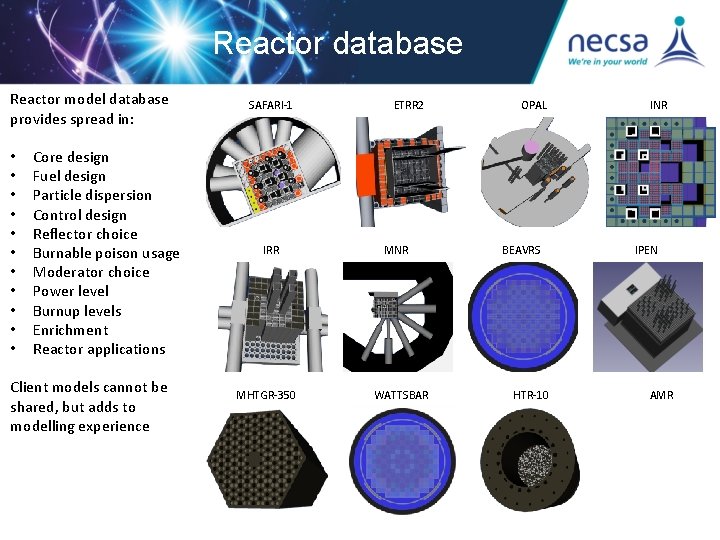
Reactor database Reactor model database provides spread in: • • • Core design Fuel design Particle dispersion Control design Reflector choice Burnable poison usage Moderator choice Power level Burnup levels Enrichment Reactor applications Client models cannot be shared, but adds to modelling experience SAFARI-1 IRR MHTGR-350 ETRR 2 MNR WATTSBAR OPAL BEAVRS HTR-10 INR IPEN AMR
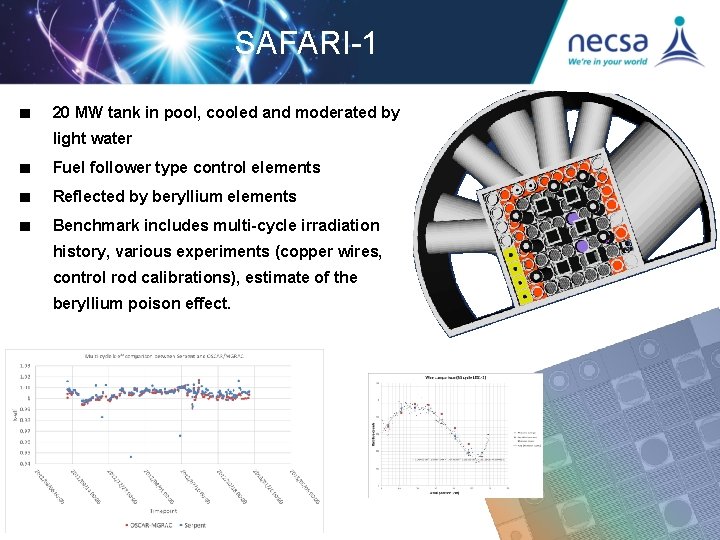
SAFARI-1 ■ 20 MW tank in pool, cooled and moderated by light water ■ ■ ■ Fuel follower type control elements Reflected by beryllium elements Benchmark includes multi-cycle irradiation history, various experiments (copper wires, control rod calibrations), estimate of the beryllium poison effect.
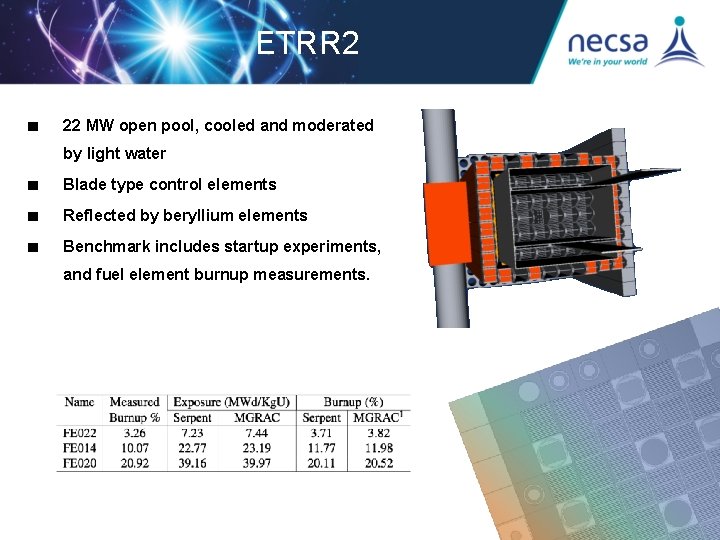
ETRR 2 ■ 22 MW open pool, cooled and moderated by light water ■ Blade type control elements ■ Reflected by beryllium elements ■ Benchmark includes startup experiments, and fuel element burnup measurements.
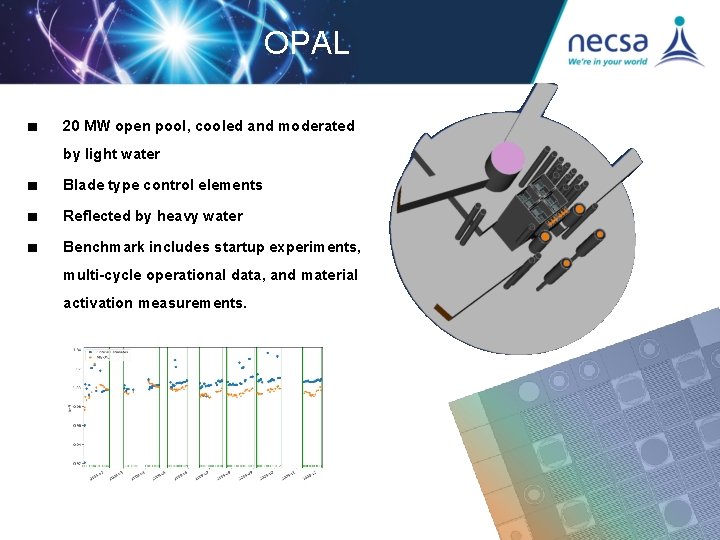
OPAL ■ 20 MW open pool, cooled and moderated by light water ■ Blade type control elements ■ Reflected by heavy water ■ Benchmark includes startup experiments, multi-cycle operational data, and material activation measurements.
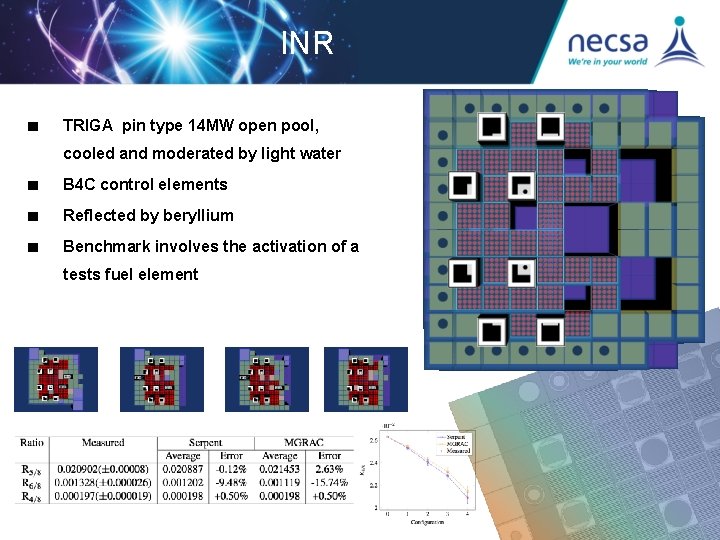
INR ■ TRIGA pin type 14 MW open pool, cooled and moderated by light water ■ B 4 C control elements ■ Reflected by beryllium ■ Benchmark involves the activation of a tests fuel element Experi ments
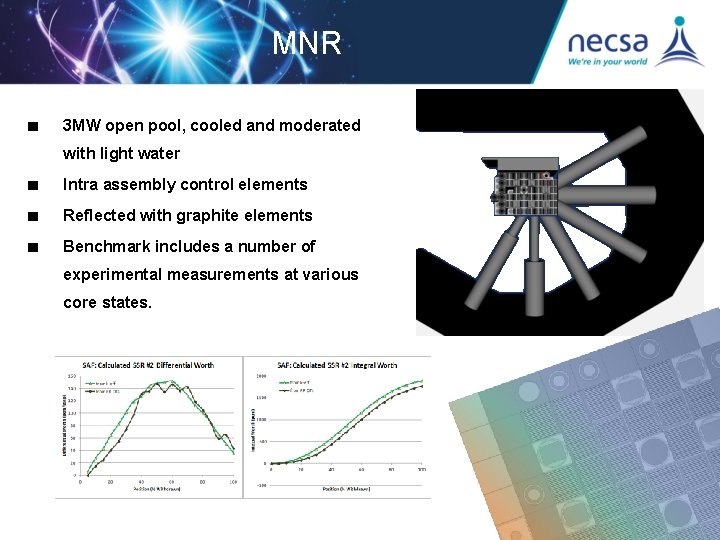
MNR ■ 3 MW open pool, cooled and moderated with light water ■ Intra assembly control elements ■ Reflected with graphite elements ■ Benchmark includes a number of experimental measurements at various core states.
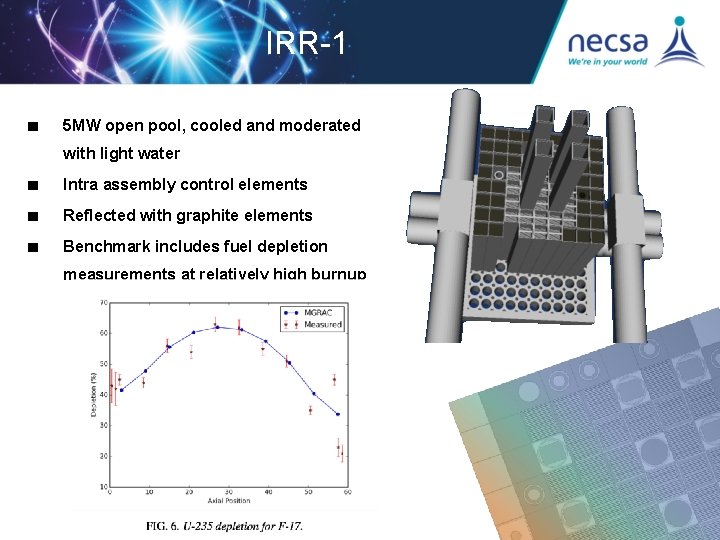
IRR-1 ■ 5 MW open pool, cooled and moderated with light water ■ Intra assembly control elements ■ Reflected with graphite elements ■ Benchmark includes fuel depletion measurements at relatively high burnup
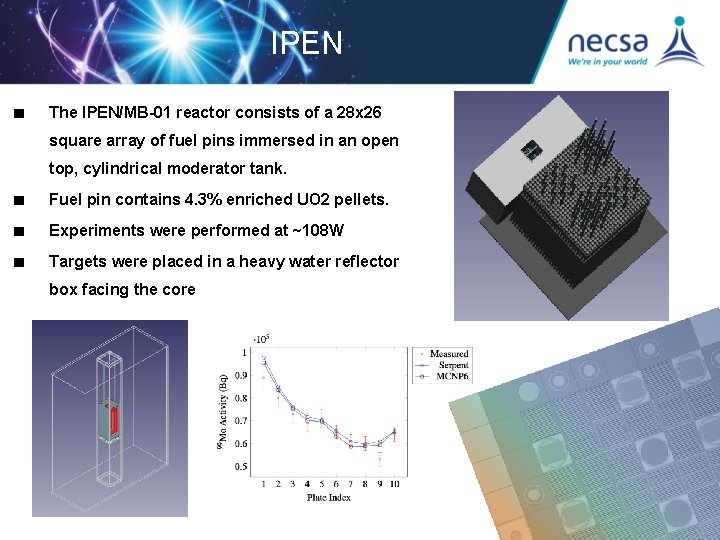
IPEN ■ The IPEN/MB-01 reactor consists of a 28 x 26 square array of fuel pins immersed in an open top, cylindrical moderator tank. ■ Fuel pin contains 4. 3% enriched UO 2 pellets. ■ Experiments were performed at ~108 W ■ Targets were placed in a heavy water reflector box facing the core
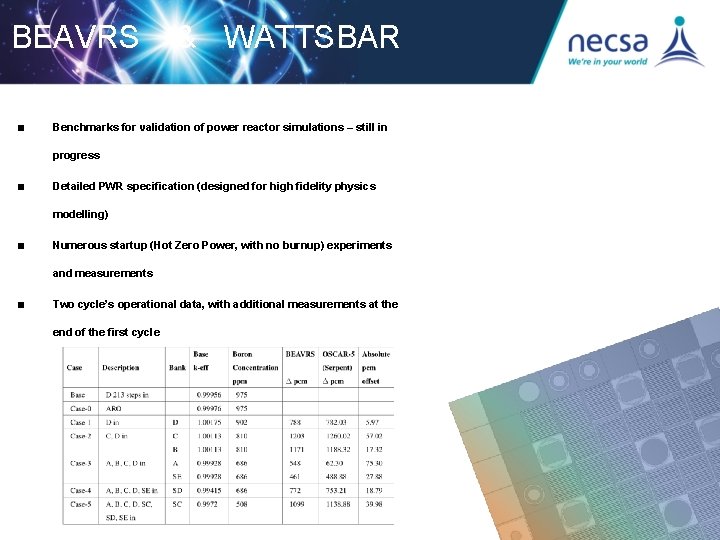
BEAVRS ■ & WATTSBAR Benchmarks for validation of power reactor simulations – still in progress ■ Detailed PWR specification (designed for high fidelity physics modelling) ■ Numerous startup (Hot Zero Power, with no burnup) experiments and measurements ■ Two cycle’s operational data, with additional measurements at the end of the first cycle
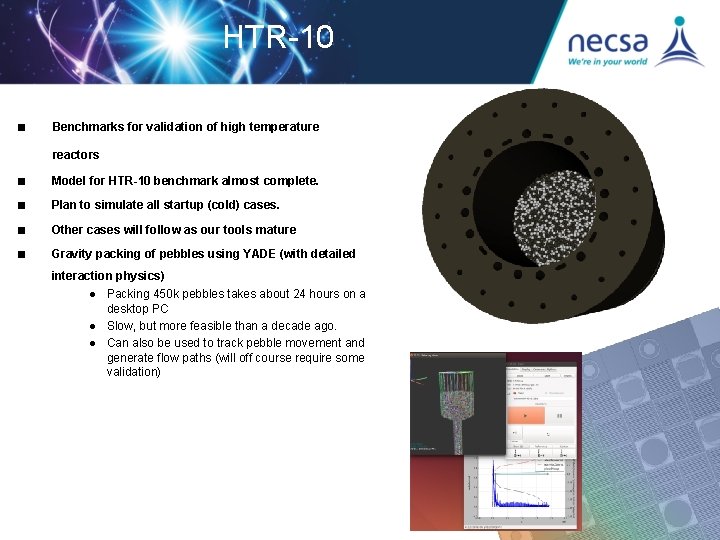
HTR-10 ■ Benchmarks for validation of high temperature reactors ■ Model for HTR-10 benchmark almost complete. ■ Plan to simulate all startup (cold) cases. ■ Other cases will follow as our tools mature ■ Gravity packing of pebbles using YADE (with detailed interaction physics) ● Packing 450 k pebbles takes about 24 hours on a desktop PC ● Slow, but more feasible than a decade ago. ● Can also be used to track pebble movement and generate flow paths (will off course require some validation)
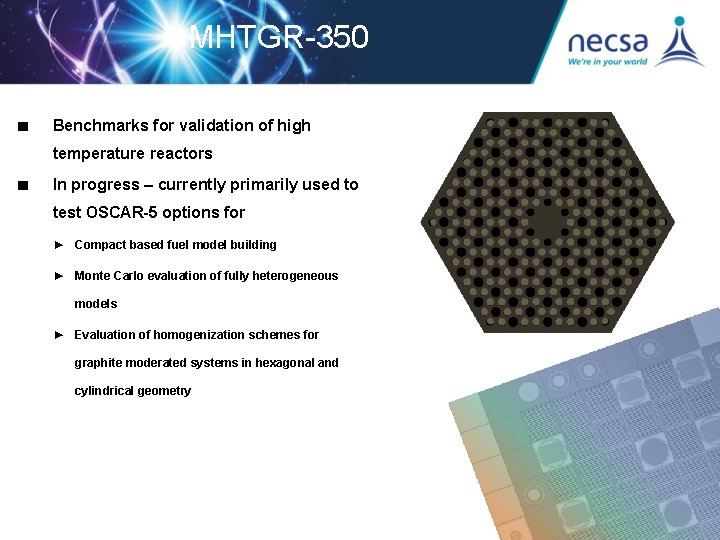
MHTGR-350 ■ Benchmarks for validation of high temperature reactors ■ In progress – currently primarily used to test OSCAR-5 options for ► Compact based fuel model building ► Monte Carlo evaluation of fully heterogeneous models ► Evaluation of homogenization schemes for graphite moderated systems in hexagonal and cylindrical geometry
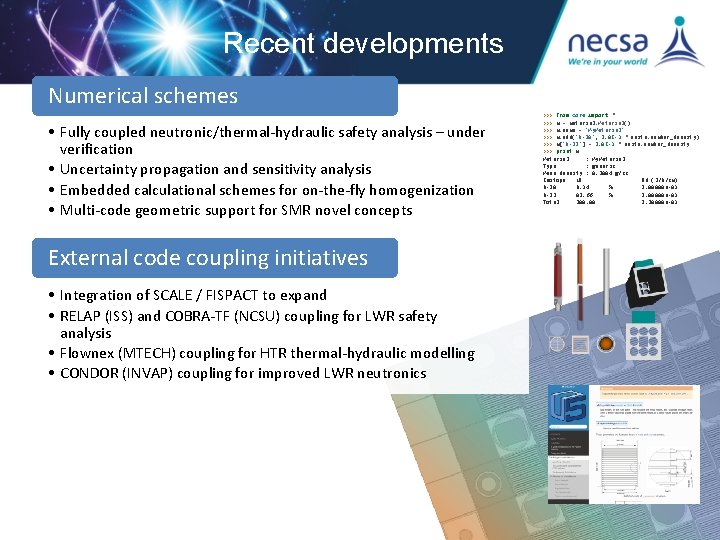
Recent developments Numerical schemes • Fully coupled neutronic/thermal-hydraulic safety analysis – under verification • Uncertainty propagation and sensitivity analysis • Embedded calculational schemes for on-the-fly homogenization • Multi-code geometric support for SMR novel concepts External code coupling initiatives • Integration of SCALE / FISPACT to expand • RELAP (ISS) and COBRA-TF (NCSU) coupling for LWR safety analysis • Flownex (MTECH) coupling for HTR thermal-hydraulic modelling • CONDOR (INVAP) coupling for improved LWR neutronics >>> from core import * >>> m = material. Material() >>> m. name = 'My. Material' >>> m. add('B-10', 1. 0 E-3 * units. number_density) >>> m['B-11'] = 1. 0 E-2 * units. number_density >>> print m Material : My. Material Type : generic Mass density : 0. 1994 g/cc Isotope Wt Nd (1/b/cm) B-10 8. 34 % 1. 00000 e-03 B-11 91. 66 % 1. 00000 e-02 Total 100. 00 1. 10000 e-02
Questions?