
Reactive pattern matching for F Part of Variations
- Slides: 22
Reactive pattern matching for F# Part of “Variations in F#” research project Tomáš Petříček, Charles University in Prague http: //tomasp. net/blog tomas@tomasp. net Don Syme, Microsoft Research Cambridge
The key theme of the talk Languages support (overly) rich libraries for encoding concurrent and reactive programs In practice, used in modes or design patterns such as tasks, threads, active objects, etc. Languages can provide better support for concurrent and reactive programming We don’t have to commit the language to one specific mode or design pattern
Agenda Background Asynchronous programming in F# Reactive programming Writing user interface control logic Pattern matching on events Programming with event streams Concurrency Pattern matching and concurrency
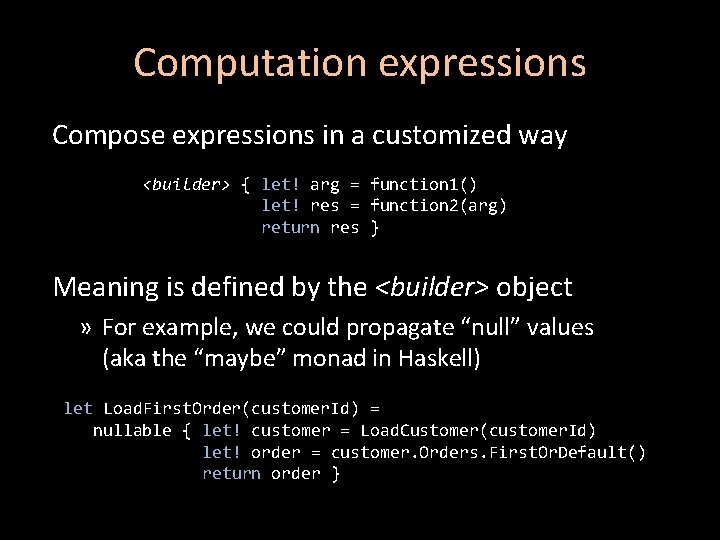
Computation expressions Compose expressions in a customized way <builder> { let! arg = function 1() let! res = function 2(arg) return res } Meaning is defined by the <builder> object » For example, we could propagate “null” values (aka the “maybe” monad in Haskell) let Load. First. Order(customer. Id) = nullable { let! customer = Load. Customer(customer. Id) let! order = customer. Orders. First. Or. Default() return order }
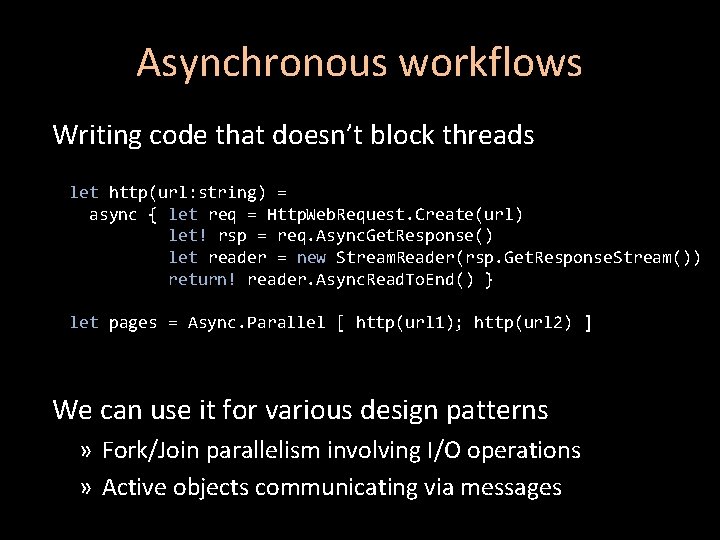
Asynchronous workflows Writing code that doesn’t block threads let http(url: string) = async { let req = Http. Web. Request. Create(url) let! rsp = req. Async. Get. Response() let reader = new Stream. Reader(rsp. Get. Response. Stream()) return! reader. Async. Read. To. End() } let pages = Async. Parallel [ http(url 1); http(url 2) ] We can use it for various design patterns » Fork/Join parallelism involving I/O operations » Active objects communicating via messages
Agenda Background Asynchronous programming in F# Reactive programming Writing user interface control logic Pattern matching on events Programming with event streams Concurrency Pattern matching and concurrency
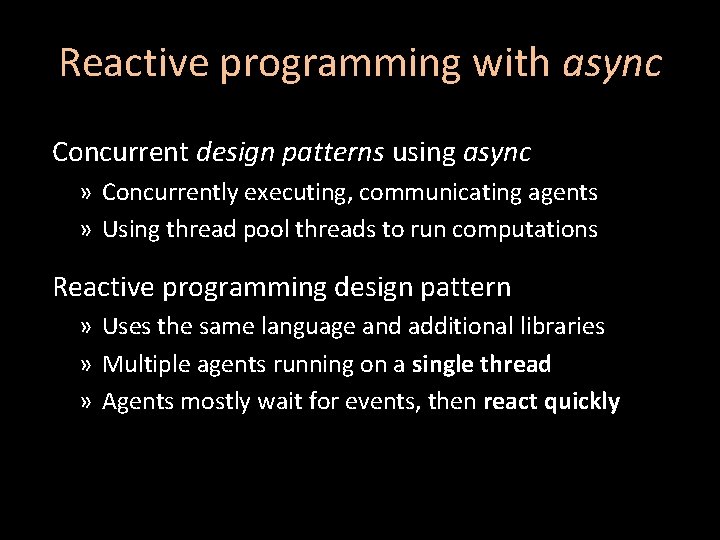
Reactive programming with async Concurrent design patterns using async » Concurrently executing, communicating agents » Using thread pool threads to run computations Reactive programming design pattern » Uses the same language and additional libraries » Multiple agents running on a single thread » Agents mostly wait for events, then react quickly
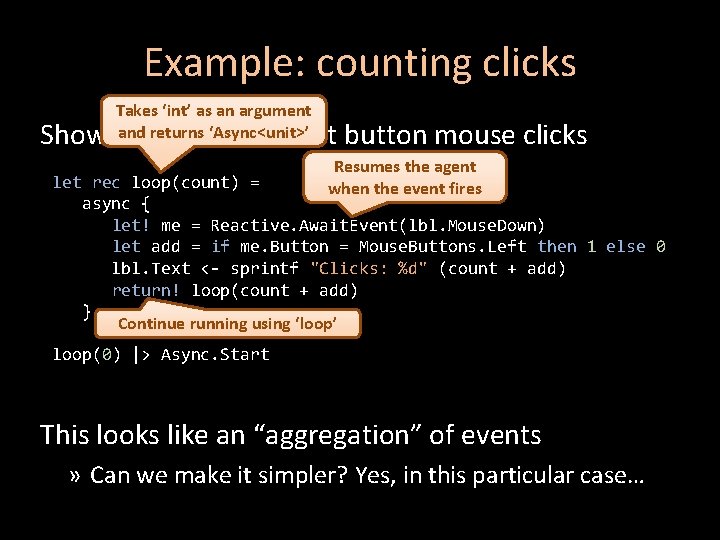
Example: counting clicks Takes ‘int’ as an argument and returns ‘Async<unit>’ Show the number of left button mouse clicks Resumes the agent let rec loop(count) = when the event fires async { let! me = Reactive. Await. Event(lbl. Mouse. Down) let add = if me. Button = Mouse. Buttons. Left then 1 else 0 lbl. Text <- sprintf "Clicks: %d" (count + add) return! loop(count + add) } Continue running using ‘loop’ loop(0) |> Async. Start This looks like an “aggregation” of events » Can we make it simpler? Yes, in this particular case…
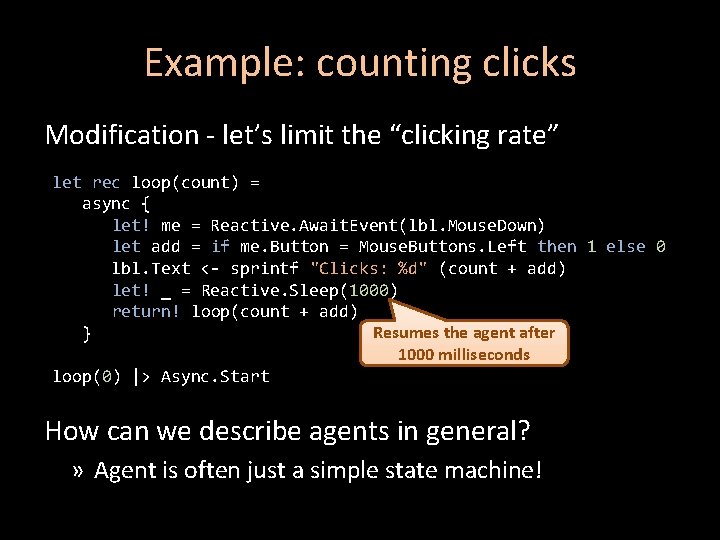
Example: counting clicks Modification - let’s limit the “clicking rate” let rec loop(count) = async { let! me = Reactive. Await. Event(lbl. Mouse. Down) let add = if me. Button = Mouse. Buttons. Left then 1 else 0 lbl. Text <- sprintf "Clicks: %d" (count + add) let! _ = Reactive. Sleep(1000) return! loop(count + add) Resumes the agent after } 1000 milliseconds loop(0) |> Async. Start How can we describe agents in general? » Agent is often just a simple state machine!
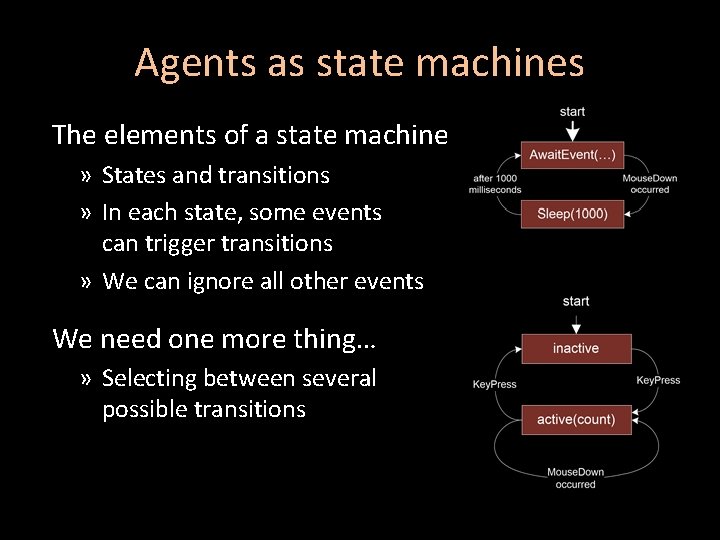
Agents as state machines The elements of a state machine » States and transitions » In each state, some events can trigger transitions » We can ignore all other events We need one more thing… » Selecting between several possible transitions
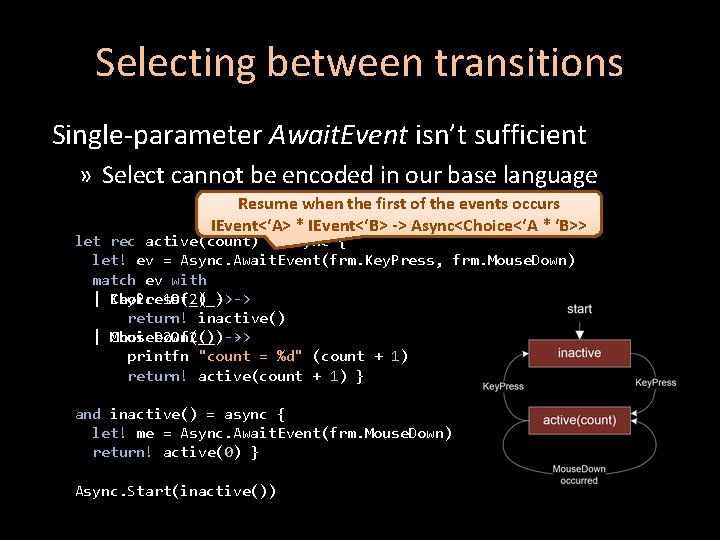
Selecting between transitions Single-parameter Await. Event isn’t sufficient » Select cannot be encoded in our base language Resume when the first of the events occurs IEvent<‘A> * IEvent<‘B> -> Async<Choice<‘A * ‘B>> let rec active(count) = async { let! ev = Async. Await. Event(frm. Key. Press, frm. Mouse. Down) match ev with | Choice 1 Of 2(_) Key. Press(_) ->-> return! inactive() | Choice 2 Of 2(_) Mouse. Down(_) -> -> printfn "count = %d" (count + 1) return! active(count + 1) } and inactive() = async { let! me = Async. Await. Event(frm. Mouse. Down) return! active(0) } Async. Start(inactive())
Agenda Background Asynchronous programming in F# Reactive programming Writing user interface control logic Pattern matching on events Programming with event streams Concurrency Pattern matching and concurrency
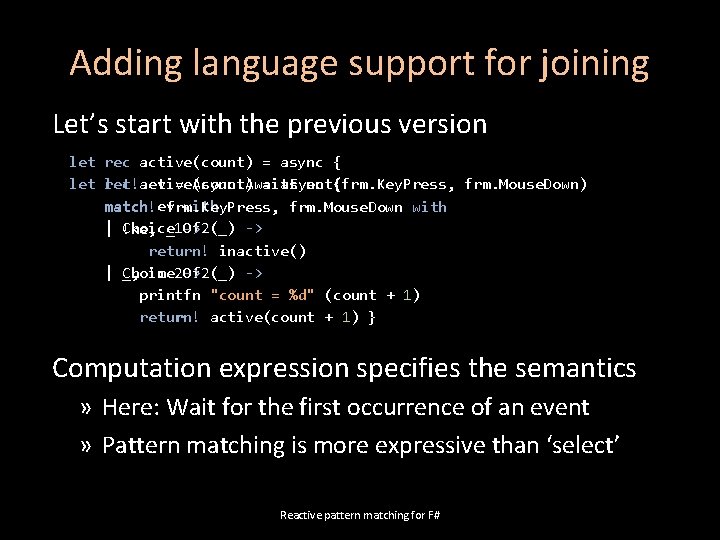
Adding language support for joining Let’s start with the previous version let rec active(count) = async { let!active(count) ev = Async. Await. Event(frm. Key. Press, frm. Mouse. Down) let rec = async { match with match!ev frm. Key. Press, frm. Mouse. Down with Choice 1 Of 2(_) -> | !ke, _ -> return! inactive() Choice 2 Of 2(_) -> | _, !me -> printfn "count = %d" (count + 1) return! active(count + 1) } Computation expression specifies the semantics » Here: Wait for the first occurrence of an event » Pattern matching is more expressive than ‘select’ Reactive pattern matching for F#
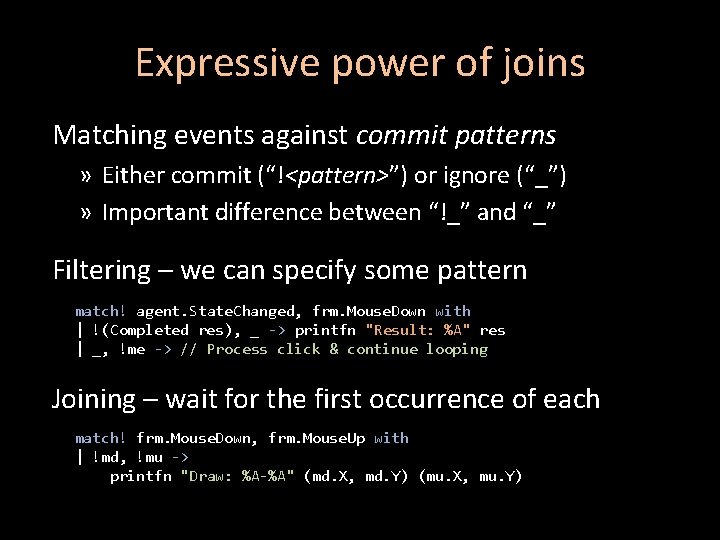
Expressive power of joins Matching events against commit patterns » Either commit (“!<pattern>”) or ignore (“_”) » Important difference between “!_” and “_” Filtering – we can specify some pattern match! agent. State. Changed, frm. Mouse. Down with | !(Completed res), _ -> printfn "Result: %A" res | _, !me -> // Process click & continue looping Joining – wait for the first occurrence of each match! frm. Mouse. Down, frm. Mouse. Up with | !md, !mu -> printfn "Draw: %A-%A" (md. X, md. Y) (mu. X, mu. Y)
Agenda Background Asynchronous programming in F# Reactive programming Writing user interface control logic Pattern matching on events Programming with event streams Concurrency Pattern matching and concurrency
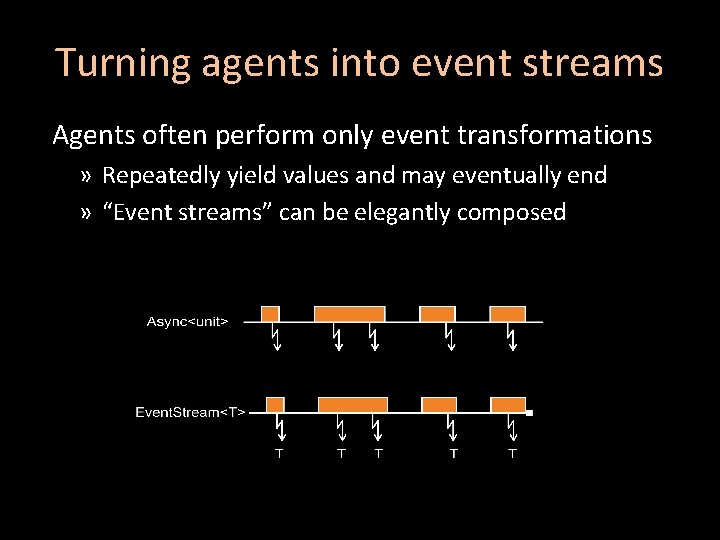
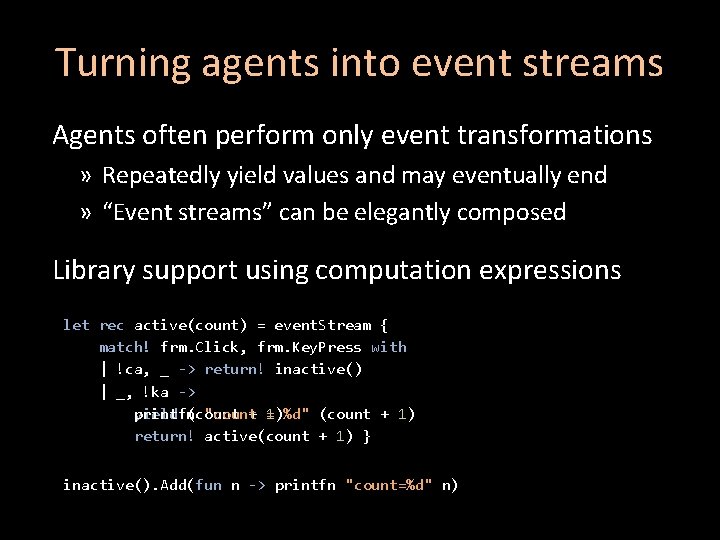
Turning agents into event streams Agents often perform only event transformations » Repeatedly yield values and may eventually end » “Event streams” can be elegantly composed
Turning agents into event streams Agents often perform only event transformations » Repeatedly yield values and may eventually end » “Event streams” can be elegantly composed Library support using computation expressions let rec active(count) = event. Stream { match! frm. Click, frm. Key. Press with | !ca, _ -> return! inactive() | _, !ka -> yield (count + = 1)%d" (count + 1) printfn "count return! active(count + 1) } inactive(). Add(fun n -> printfn "count=%d" n)
Agenda Background Asynchronous programming in F# Reactive programming Writing user interface control logic Pattern matching on events Programming with event streams Concurrency Pattern matching and concurrency
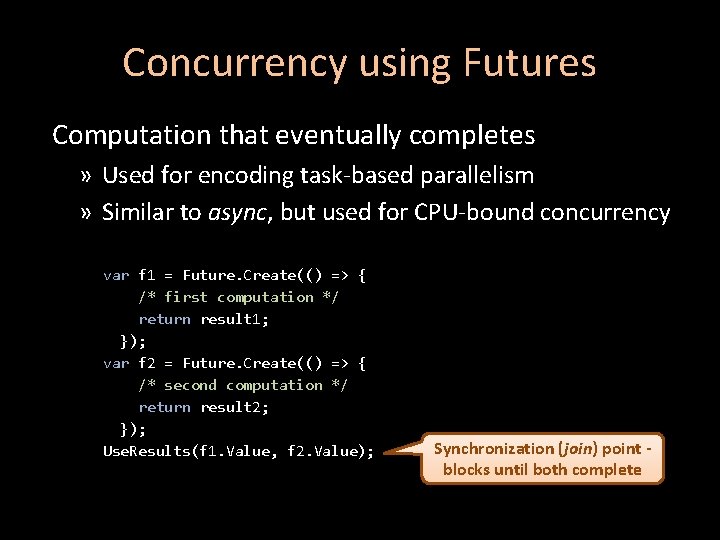
Concurrency using Futures Computation that eventually completes » Used for encoding task-based parallelism » Similar to async, but used for CPU-bound concurrency var f 1 = Future. Create(() => { /* first computation */ return result 1; }); var f 2 = Future. Create(() => { /* second computation */ return result 2; }); Use. Results(f 1. Value, f 2. Value); Synchronization (join) point blocks until both complete
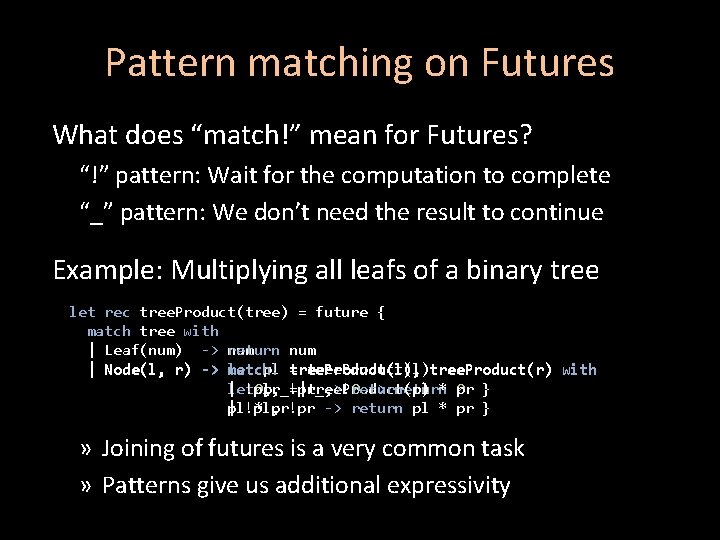
Pattern matching on Futures What does “match!” mean for Futures? “!” pattern: Wait for the computation to complete “_” pattern: We don’t need the result to continue Example: Multiplying all leafs of a binary tree let rec tree. Product(tree) = future { match tree with | Leaf(num) -> return num | Node(l, r) -> match! let pl = tree. Product(l), tree. Product(l)tree. Product(r) with | let !pl, pr_!pr =|tree. Product(r) ->!0 return pl * pr !0, _, -> return 0 } pl!pl, * pr!pr -> return pl * pr } | » Joining of futures is a very common task » Patterns give us additional expressivity
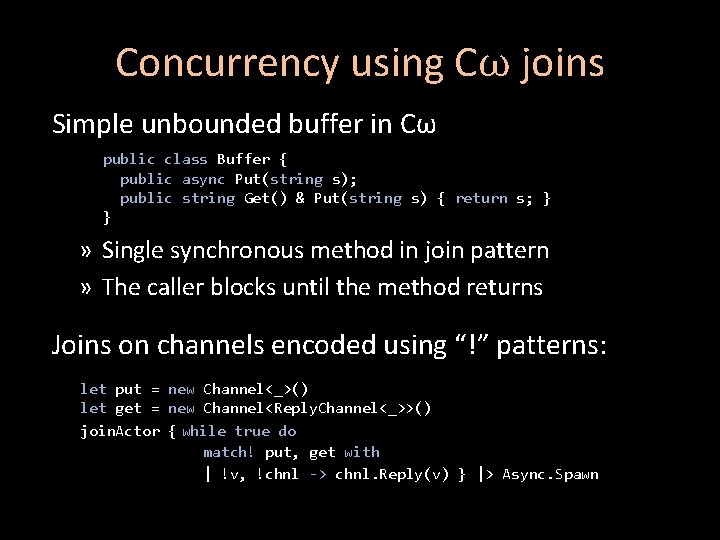
Concurrency using Cω joins Simple unbounded buffer in Cω public class Buffer { public async Put(string s); public string Get() & Put(string s) { return s; } } » Single synchronous method in join pattern » The caller blocks until the method returns Joins on channels encoded using “!” patterns: let put = new Channel<_>() let get = new Channel<Reply. Channel<_>>() join. Actor { while true do match! put, get with | !v, !chnl -> chnl. Reply(v) } |> Async. Spawn
Time for questions & suggestions! » Many components could be single threaded » Direct way for encoding state machine is essential » Language features can/should be generally useful Thanks to: » Don Syme, Claudio Russo, Simon Peyton Jones, James Margetson, Wes Dyer, Erik Meijer For more information: » Everything is work in progress » Feel free to ask: tomas@tomasp. net