
REACTIONS OF WATER AT THE MOLECULAR LEVEL PROTONATED
- Slides: 20
REACTIONS OF WATER AT THE MOLECULAR LEVEL: PROTONATED WATER CLUSTERS YUNUS KAYA ULUDAG UNIVERSITY BURSA, TURKEY 15 th RD 51 Collaboration Meeting, CERN, (16 -20 March 2015) 1
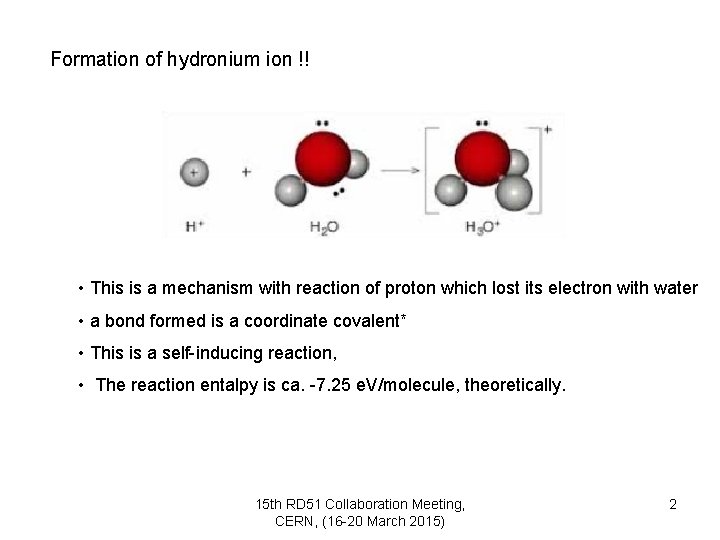
Formation of hydronium ion !! • This is a mechanism with reaction of proton which lost its electron with water • a bond formed is a coordinate covalent* • This is a self-inducing reaction, • The reaction entalpy is ca. -7. 25 e. V/molecule, theoretically. 15 th RD 51 Collaboration Meeting, CERN, (16 -20 March 2015) 2
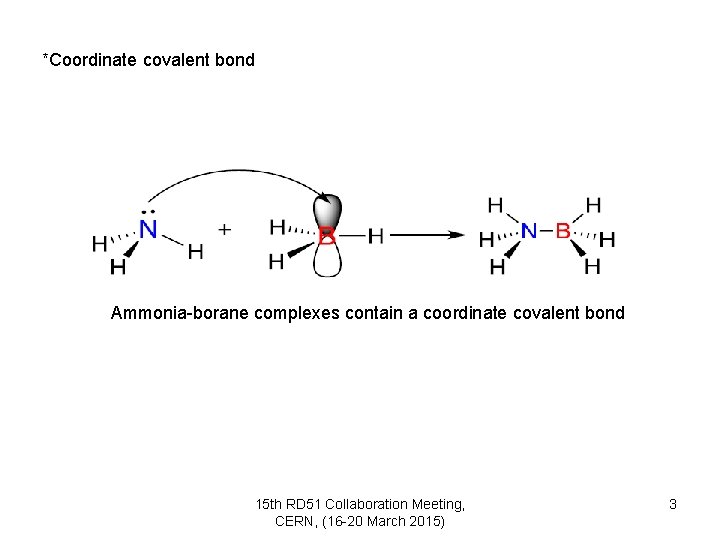
*Coordinate covalent bond Ammonia-borane complexes contain a coordinate covalent bond 15 th RD 51 Collaboration Meeting, CERN, (16 -20 March 2015) 3
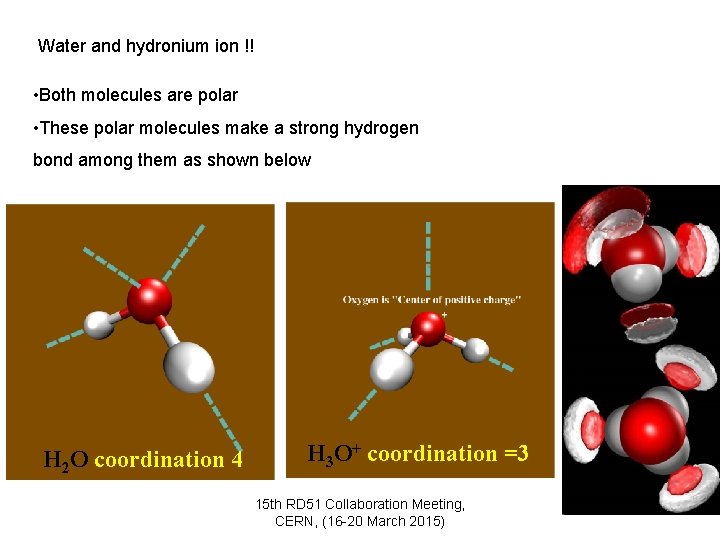
Water and hydronium ion !! • Both molecules are polar • These polar molecules make a strong hydrogen bond among them as shown below H 2 O coordination 4 H 3 O+ coordination =3 15 th RD 51 Collaboration Meeting, CERN, (16 -20 March 2015) 4
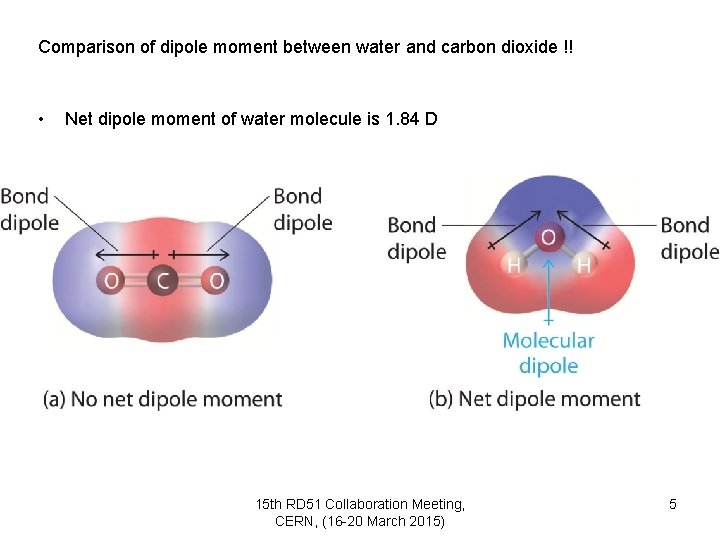
Comparison of dipole moment between water and carbon dioxide !! • Net dipole moment of water molecule is 1. 84 D 15 th RD 51 Collaboration Meeting, CERN, (16 -20 March 2015) 5
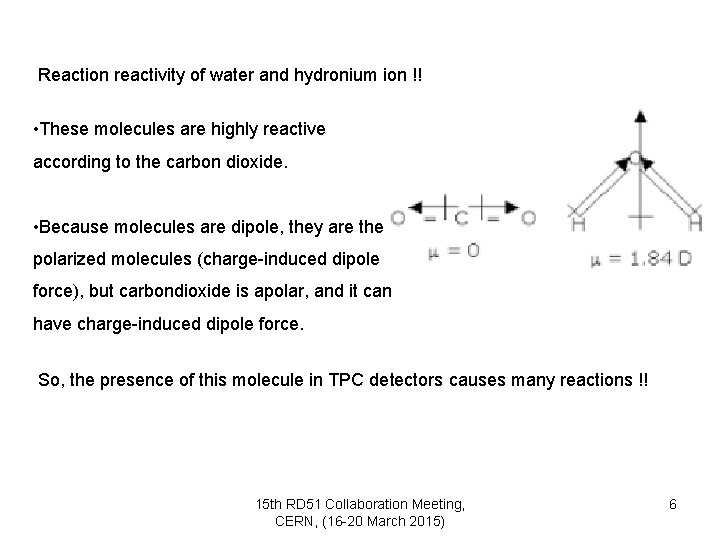
Reaction reactivity of water and hydronium ion !! • These molecules are highly reactive according to the carbon dioxide. • Because molecules are dipole, they are the polarized molecules (charge-induced dipole force), but carbondioxide is apolar, and it can have charge-induced dipole force. So, the presence of this molecule in TPC detectors causes many reactions !! 15 th RD 51 Collaboration Meeting, CERN, (16 -20 March 2015) 6
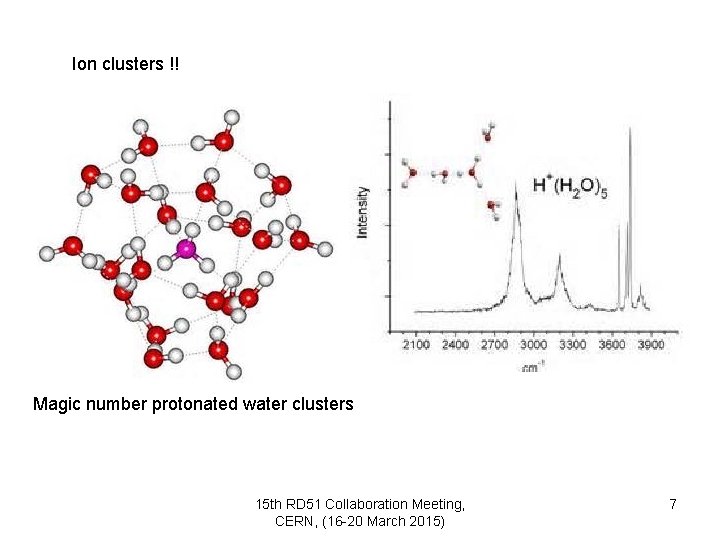
Ion clusters !! Magic number protonated water clusters 15 th RD 51 Collaboration Meeting, CERN, (16 -20 March 2015) 7
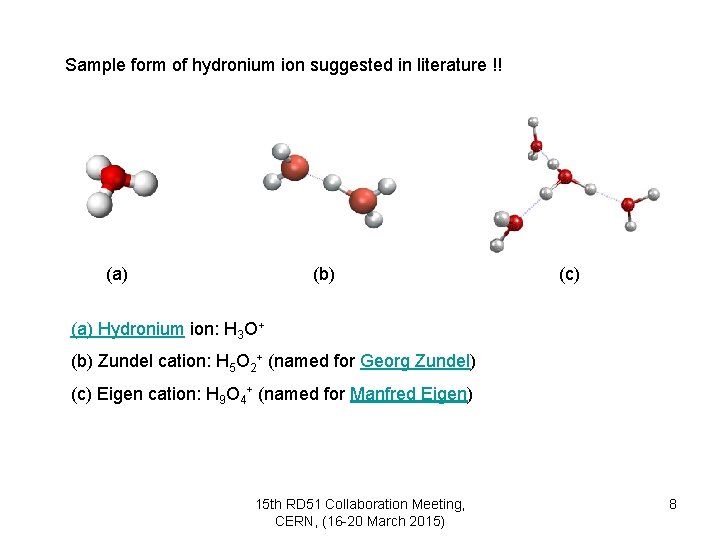
Sample form of hydronium ion suggested in literature !! (a) (b) (c) (a) Hydronium ion: H 3 O+ (b) Zundel cation: H 5 O 2+ (named for Georg Zundel) (c) Eigen cation: H 9 O 4+ (named for Manfred Eigen) 15 th RD 51 Collaboration Meeting, CERN, (16 -20 March 2015) 8
ü Why shapes and sizes of protonated water clusters are important? Cluster size is related to directly ion mobility, as the size of clusters higher, the mobility is slower, ü We need to know that what is the cluster size in the operating conditions of detector commanly in atmospheric pressure and 298 K 15 th RD 51 Collaboration Meeting, CERN, (16 -20 March 2015) 9
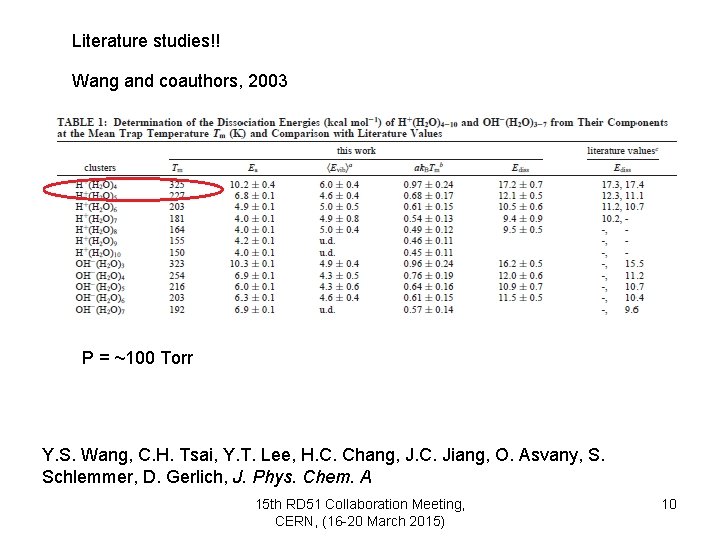
Literature studies!! Wang and coauthors, 2003 P = ~100 Torr Y. S. Wang, C. H. Tsai, Y. T. Lee, H. C. Chang, J. C. Jiang, O. Asvany, S. Schlemmer, D. Gerlich, J. Phys. Chem. A 15 th RD 51 Collaboration Meeting, CERN, (16 -20 March 2015) 10
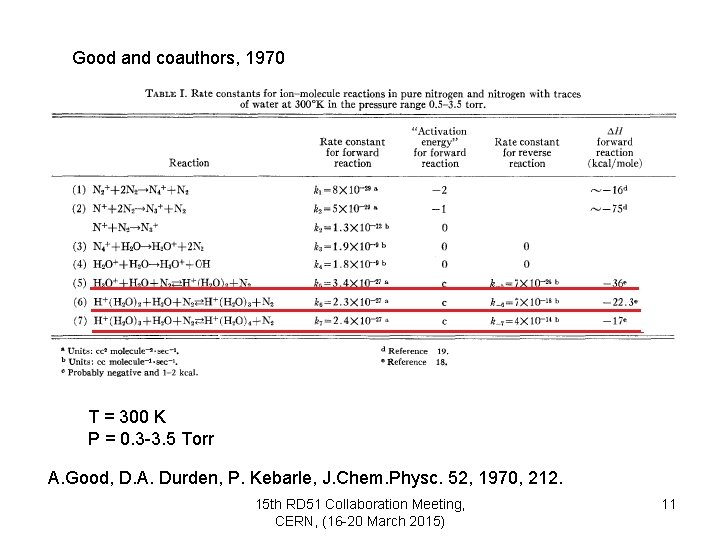
Good and coauthors, 1970 T = 300 K P = 0. 3 -3. 5 Torr A. Good, D. A. Durden, P. Kebarle, J. Chem. Physc. 52, 1970, 212. 15 th RD 51 Collaboration Meeting, CERN, (16 -20 March 2015) 11
Zamith and coauthors, 2012 They experiments at 25 K, and n = 30 Mark and coauthors, 2012, Castleman and coauthor, 1986 and Viggiano and coauthors, 1988; They measured cluster size, n = 22 at 120 K and atmospheric pressure S. Zamith, P. Labastie, J. L'Hermite, Journal of Chemical Physics, 136, 2012, 214 -301. Mark, T. D. ; Castleman, A. W. , Jr. Ado. Atom. Mol. Phys. 20, 1984, 65. Castleman, A. W. , Jr. ; Keesee, R. G. Chem. Rev. 86, 1986, 589. Viggiano, A. A, ; Dale, F. ; Paulson, J. F. J. Chem. Phys. 88, 1988, 2469. 15 th RD 51 Collaboration Meeting, CERN, (16 -20 March 2015) 12
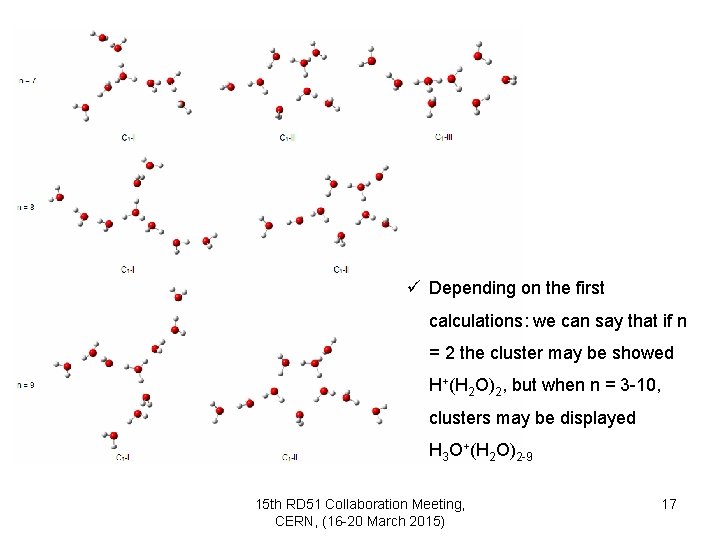
Theoretical studies!! ü We study on shapes and sizes of protonated water cluster!! ü We make model of H+(H 2 O)n clusters (n = 1 -10) with Gaussian 09 programme. ü We use Density Functional Theory* (DFT) and 6 -311++G(d, p) basis set. ü We suggest different isomers for each cluster and so entalpies, entropies and Gibbs free energies can be calculated. ü Our suggested isomers of H+(H 2 O)n clusters are given in the next slide. 15 th RD 51 Collaboration Meeting, CERN, (16 -20 March 2015) 13
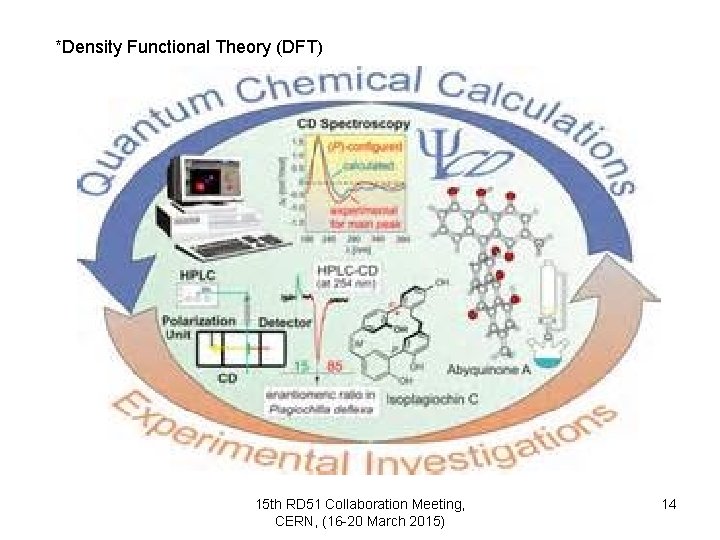
*Density Functional Theory (DFT) 15 th RD 51 Collaboration Meeting, CERN, (16 -20 March 2015) 14
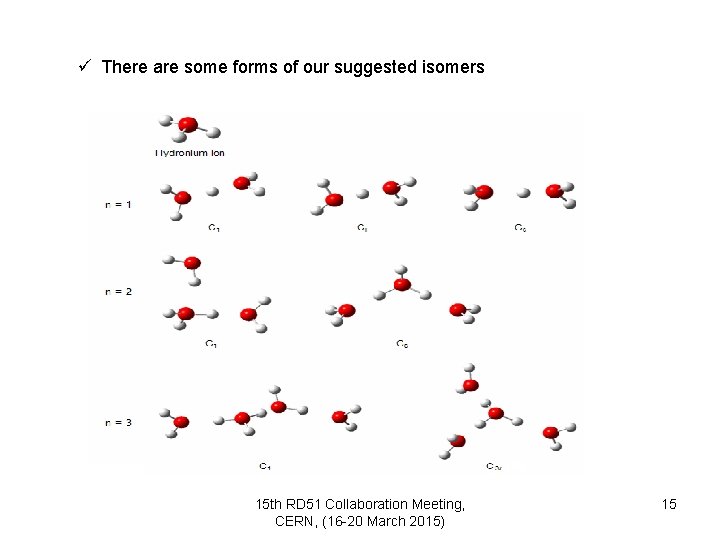
ü There are some forms of our suggested isomers 15 th RD 51 Collaboration Meeting, CERN, (16 -20 March 2015) 15
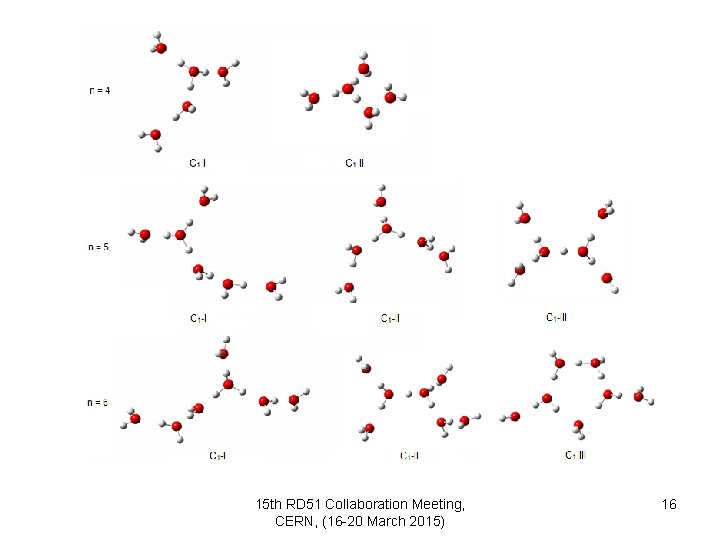
15 th RD 51 Collaboration Meeting, CERN, (16 -20 March 2015) 16
ü Depending on the first calculations: we can say that if n = 2 the cluster may be showed H+(H 2 O)2, but when n = 3 -10, clusters may be displayed H 3 O+(H 2 O)2 -9 15 th RD 51 Collaboration Meeting, CERN, (16 -20 March 2015) 17
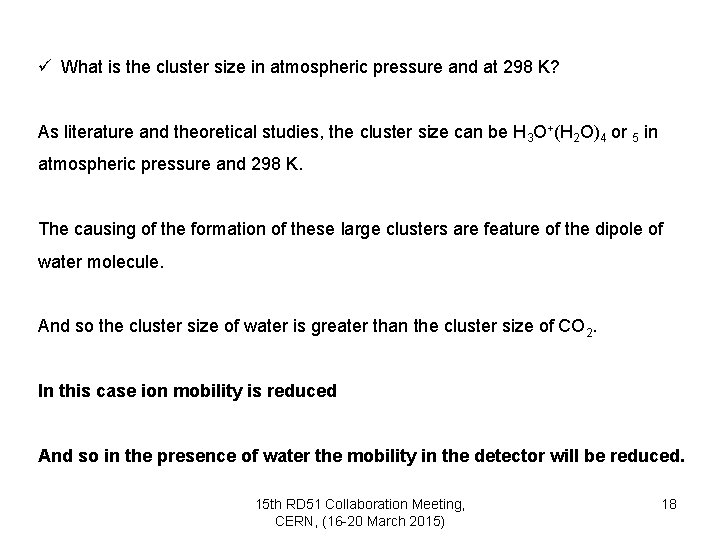
ü What is the cluster size in atmospheric pressure and at 298 K? As literature and theoretical studies, the cluster size can be H 3 O+(H 2 O)4 or 5 in atmospheric pressure and 298 K. The causing of the formation of these large clusters are feature of the dipole of water molecule. And so the cluster size of water is greater than the cluster size of CO 2. In this case ion mobility is reduced And so in the presence of water the mobility in the detector will be reduced. 15 th RD 51 Collaboration Meeting, CERN, (16 -20 March 2015) 18
Now, we wonder that: • Is there any other reactions of water? (Out of the hydronium ion) • Of course, Yes • Gases in the detector can be Ar, Ne, CO 2, CH 4, H 2 O. . • And also, so many reactions may be occured in detectors. 15 th RD 51 Collaboration Meeting, CERN, (16 -20 March 2015) 19
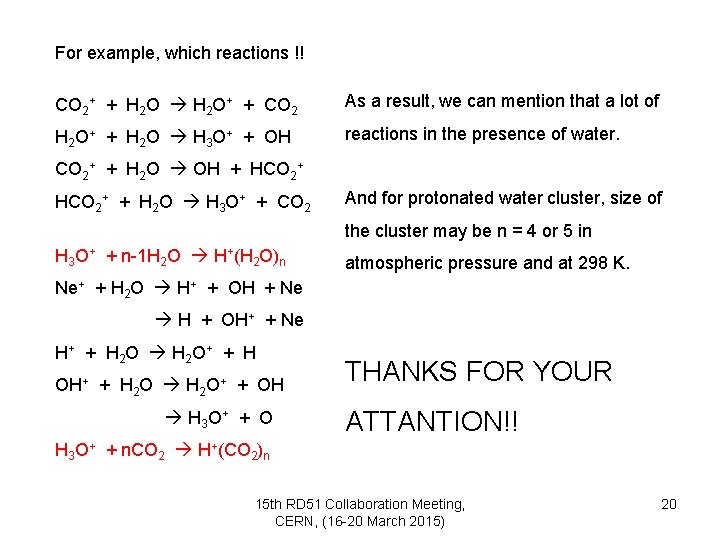
For example, which reactions !! CO 2+ + H 2 O+ + CO 2 As a result, we can mention that a lot of H 2 O+ + H 2 O H 3 O+ + OH reactions in the presence of water. CO 2+ + H 2 O OH + HCO 2+ + H 2 O H 3 O+ + CO 2 And for protonated water cluster, size of the cluster may be n = 4 or 5 in H 3 O+ + n-1 H 2 O H+(H 2 O)n atmospheric pressure and at 298 K. Ne+ + H 2 O H+ + OH + Ne H + OH+ + Ne H+ + H 2 O + + H OH+ + H 2 O+ + OH H 3 O+ + O THANKS FOR YOUR ATTANTION!! H 3 O+ + n. CO 2 H+(CO 2)n 15 th RD 51 Collaboration Meeting, CERN, (16 -20 March 2015) 20