
Reactions of period 3 elements with chlorine oxygen
- Slides: 13
Reactions of period 3 elements with chlorine, oxygen and water Also acid-base behaviour of period 3 oxides/hydroxides and properties of period 3 oxides and chlorides
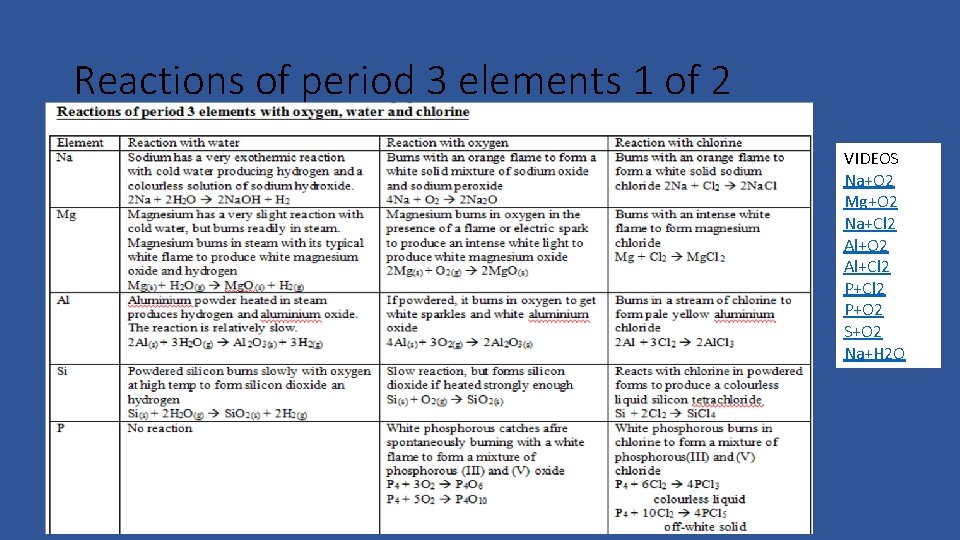
Reactions of period 3 elements 1 of 2 VIDEOS Na+O 2 Mg+O 2 Na+Cl 2 Al+O 2 Al+Cl 2 P+O 2 S+O 2 Na+H 2 O
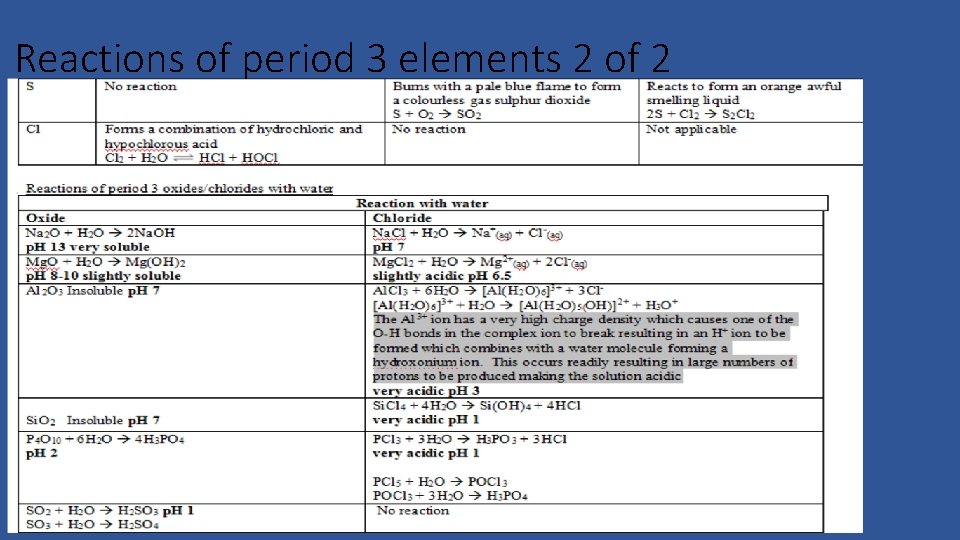
Reactions of period 3 elements 2 of 2
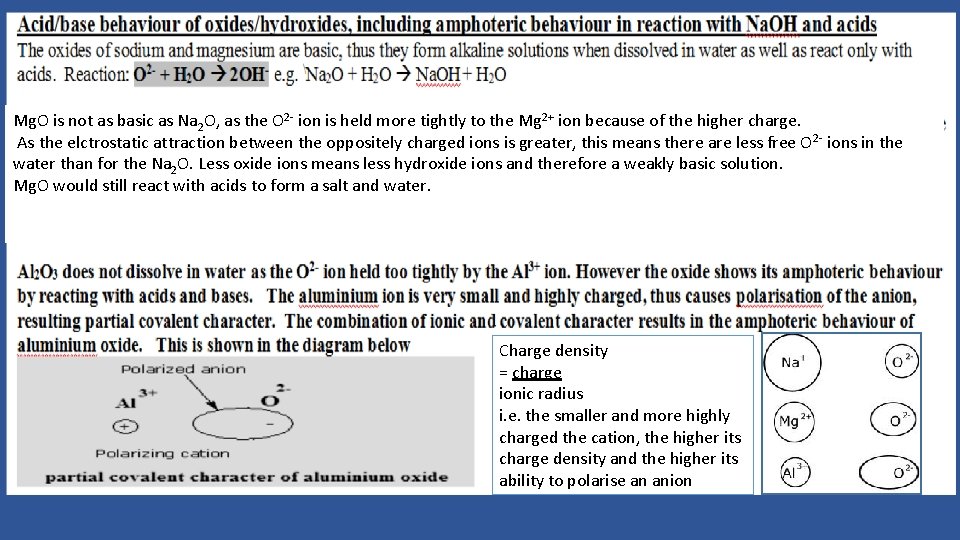
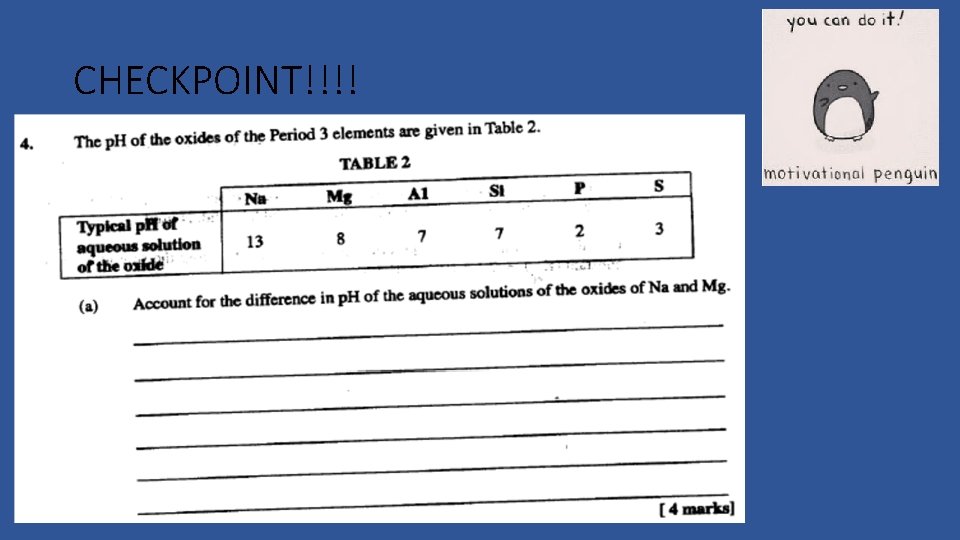
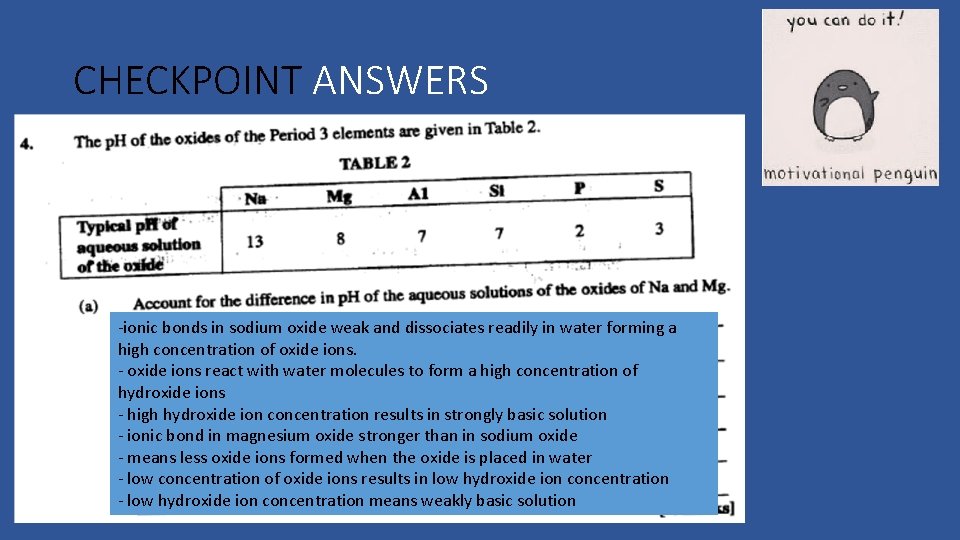
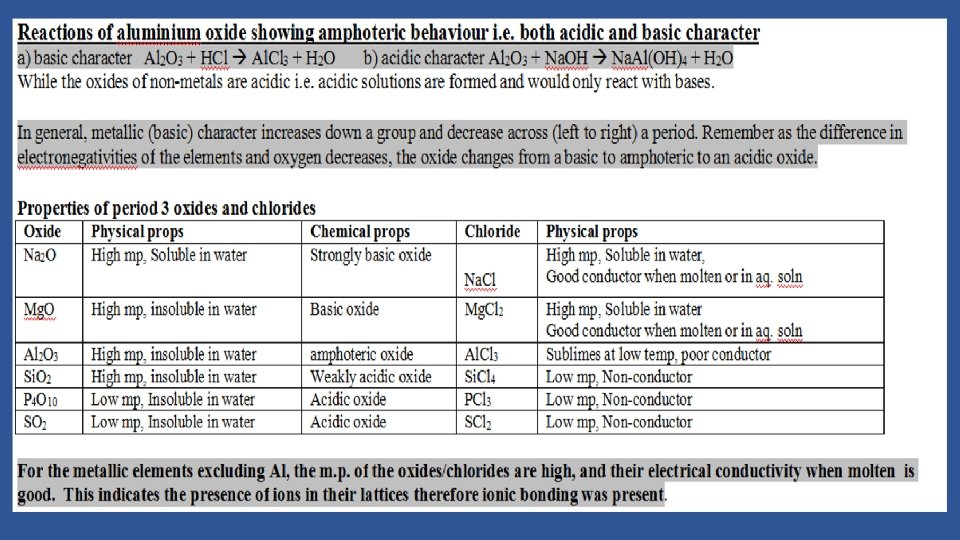
Mg. O is not as basic as Na 2 O, as the O 2 - ion is held more tightly to the Mg 2+ ion because of the higher charge. As the elctrostatic attraction between the oppositely charged ions is greater, this means there are less free O 2 - ions in the water than for the Na 2 O. Less oxide ions means less hydroxide ions and therefore a weakly basic solution. Mg. O would still react with acids to form a salt and water. Charge density = charge ionic radius i. e. the smaller and more highly charged the cation, the higher its charge density and the higher its ability to polarise an anion
CHECKPOINT!!!!
CHECKPOINT ANSWERS -ionic bonds in sodium oxide weak and dissociates readily in water forming a high concentration of oxide ions. - oxide ions react with water molecules to form a high concentration of hydroxide ions - high hydroxide ion concentration results in strongly basic solution - ionic bond in magnesium oxide stronger than in sodium oxide - means less oxide ions formed when the oxide is placed in water - low concentration of oxide ions results in low hydroxide ion concentration - low hydroxide ion concentration means weakly basic solution
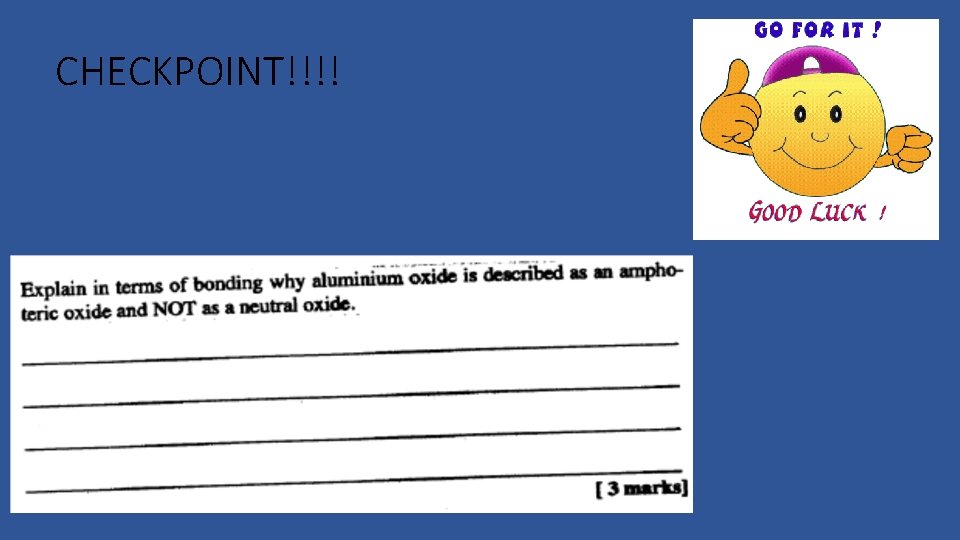
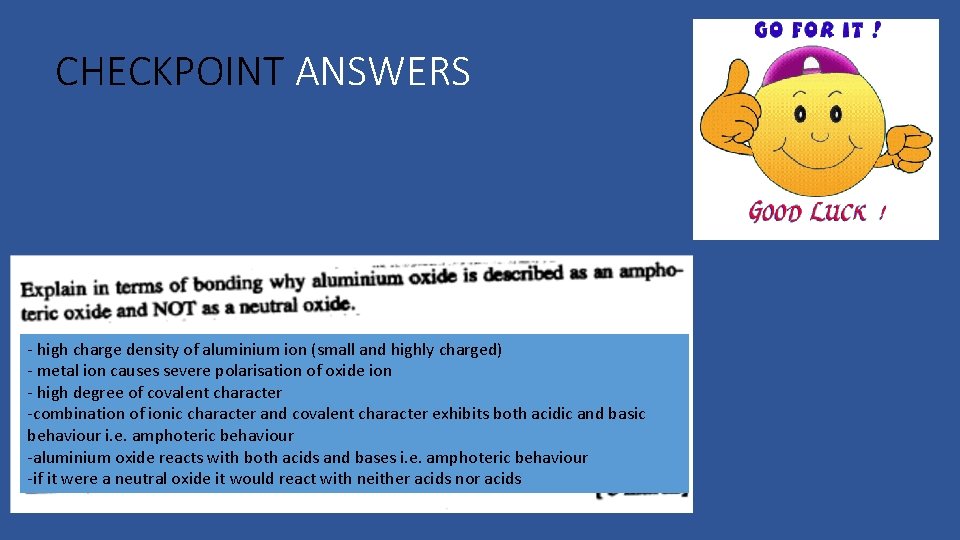
CHECKPOINT!!!!
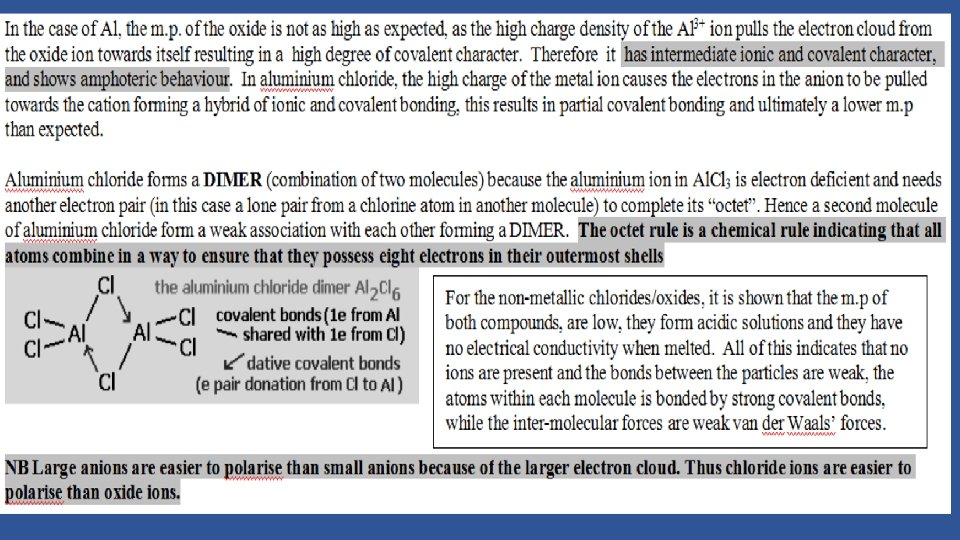
CHECKPOINT ANSWERS - high charge density of aluminium ion (small and highly charged) - metal ion causes severe polarisation of oxide ion - high degree of covalent character -combination of ionic character and covalent character exhibits both acidic and basic behaviour i. e. amphoteric behaviour -aluminium oxide reacts with both acids and bases i. e. amphoteric behaviour -if it were a neutral oxide it would react with neither acids nor acids
CHECKPOINT!!
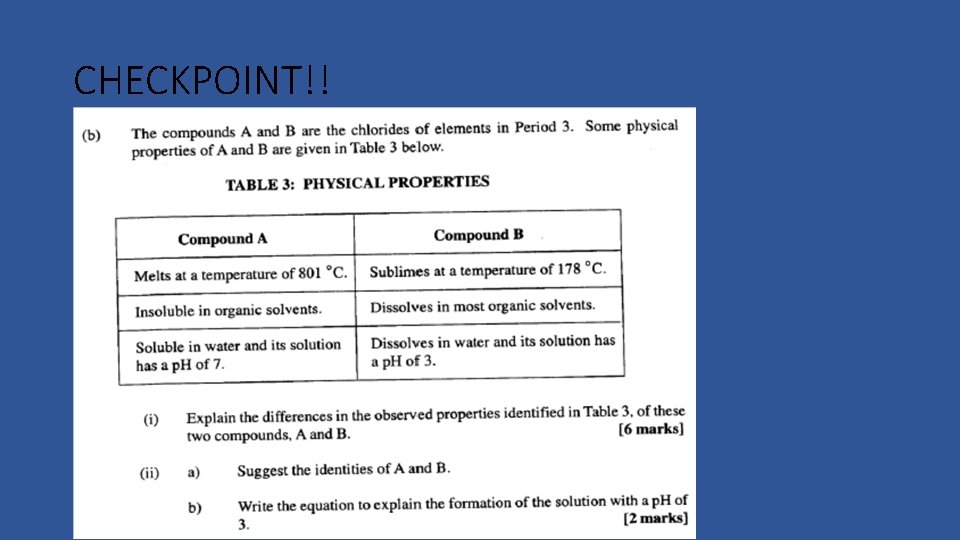
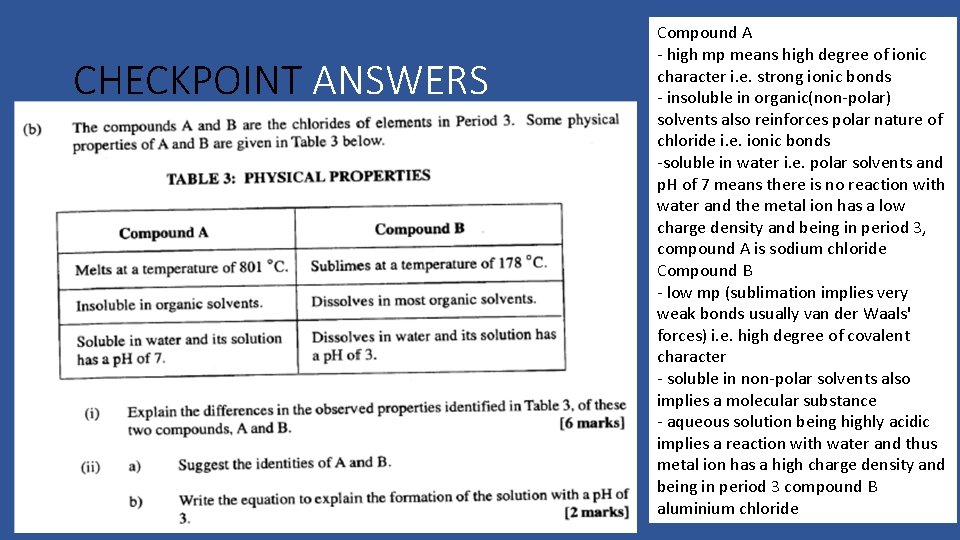
CHECKPOINT ANSWERS Compound A - high mp means high degree of ionic character i. e. strong ionic bonds - insoluble in organic(non-polar) solvents also reinforces polar nature of chloride i. e. ionic bonds -soluble in water i. e. polar solvents and p. H of 7 means there is no reaction with water and the metal ion has a low charge density and being in period 3, compound A is sodium chloride Compound B - low mp (sublimation implies very weak bonds usually van der Waals' forces) i. e. high degree of covalent character - soluble in non-polar solvents also implies a molecular substance - aqueous solution being highly acidic implies a reaction with water and thus metal ion has a high charge density and being in period 3 compound B aluminium chloride
Summary of period 3 elements • Central theme: - gradation of physical and chemical properties across period e. g. metallic to non-metallic, ionic to covalent, basic to acidic • Variation in atomic/ionic radii, melting point, electrical conductivity, density and electronegativity related to structure and bonding in the elements • large cation i. e. low charge density and difficult to polarise an anion thus no or low covalent character or small cation i. e. high charge density and can easily polarise an anion thus high covalent character