
REACTIONS OF ALKYL HALIDES Alkyl halides RX undergo
- Slides: 18
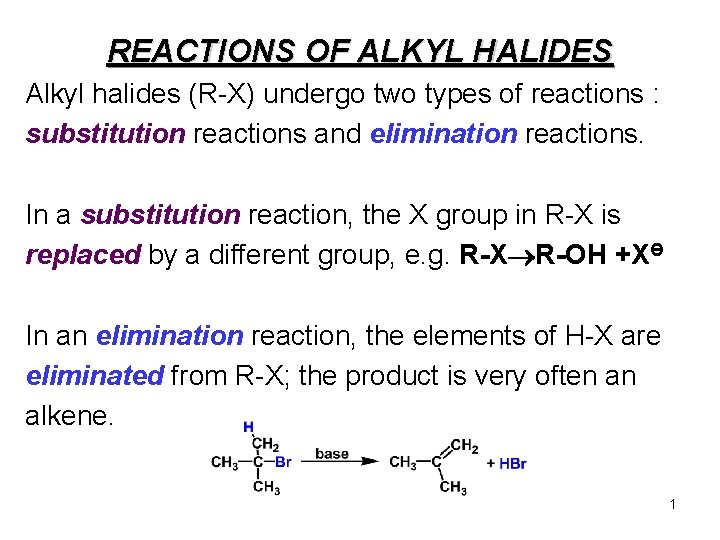
REACTIONS OF ALKYL HALIDES Alkyl halides (R-X) undergo two types of reactions : substitution reactions and elimination reactions. In a substitution reaction, the X group in R-X is replaced by a different group, e. g. R-X R-OH +XӨ In an elimination reaction, the elements of H-X are eliminated from R-X; the product is very often an alkene. 1
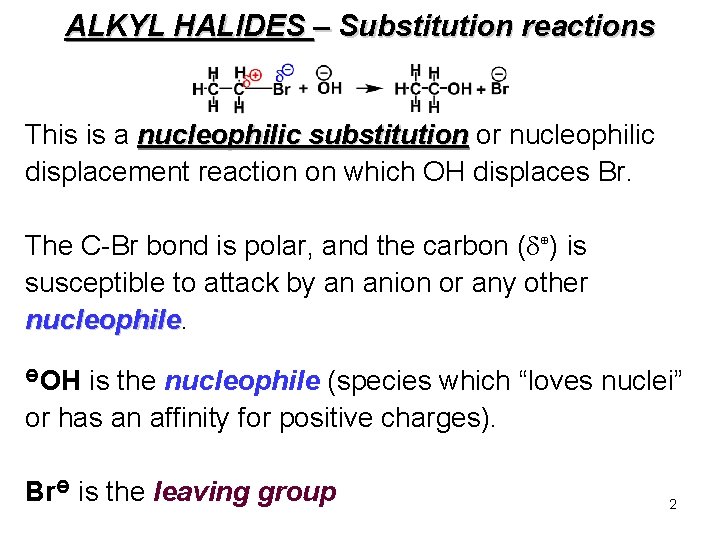
ALKYL HALIDES – Substitution reactions This is a nucleophilic substitution or nucleophilic displacement reaction on which OH displaces Br. The C-Br bond is polar, and the carbon ( ⊕) is susceptible to attack by an anion or any other nucleophile ӨOH is the nucleophile (species which “loves nuclei” or has an affinity for positive charges). BrӨ is the leaving group 2
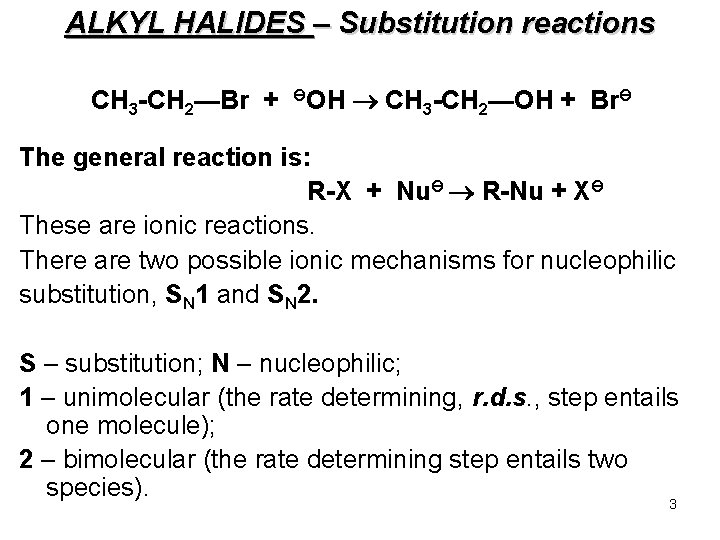
ALKYL HALIDES – Substitution reactions CH 3 -CH 2—Br + ӨOH CH 3 -CH 2—OH + BrӨ The general reaction is: R-X + NuӨ R-Nu + XӨ These are ionic reactions. There are two possible ionic mechanisms for nucleophilic substitution, SN 1 and SN 2. S – substitution; N – nucleophilic; 1 – unimolecular (the rate determining, r. d. s. , step entails one molecule); 2 – bimolecular (the rate determining step entails two species). 3
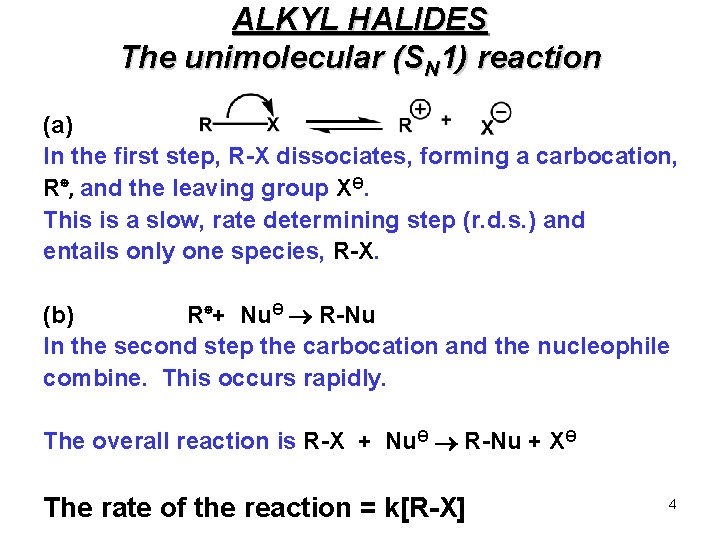
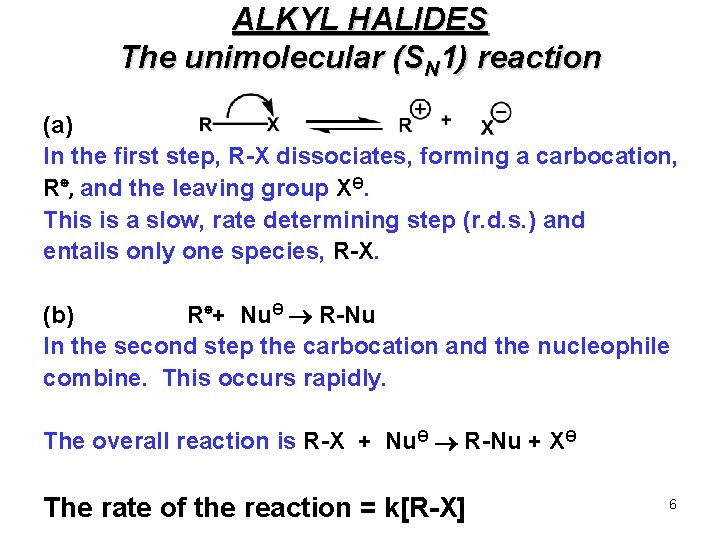
ALKYL HALIDES The unimolecular (SN 1) reaction (a) In the first step, R-X dissociates, forming a carbocation, R⊕, and the leaving group XӨ. This is a slow, rate determining step (r. d. s. ) and entails only one species, R-X. (b) R⊕+ NuӨ R-Nu In the second step the carbocation and the nucleophile combine. This occurs rapidly. The overall reaction is R-X + NuӨ R-Nu + XӨ The rate of the reaction = k[R-X] 4
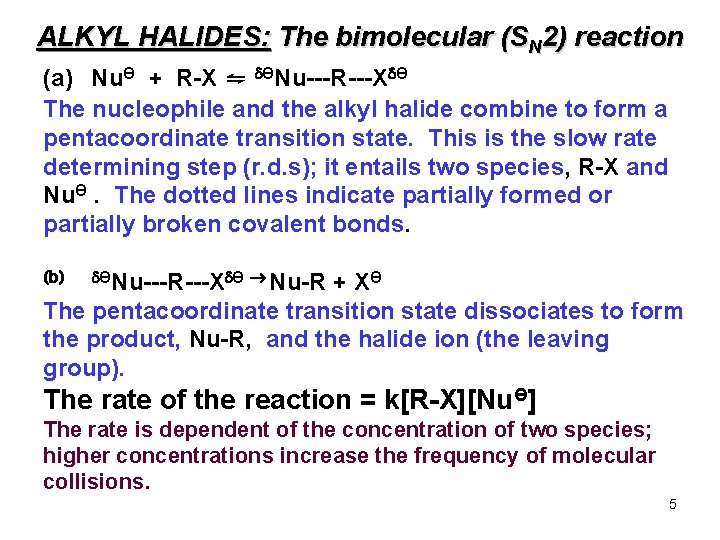
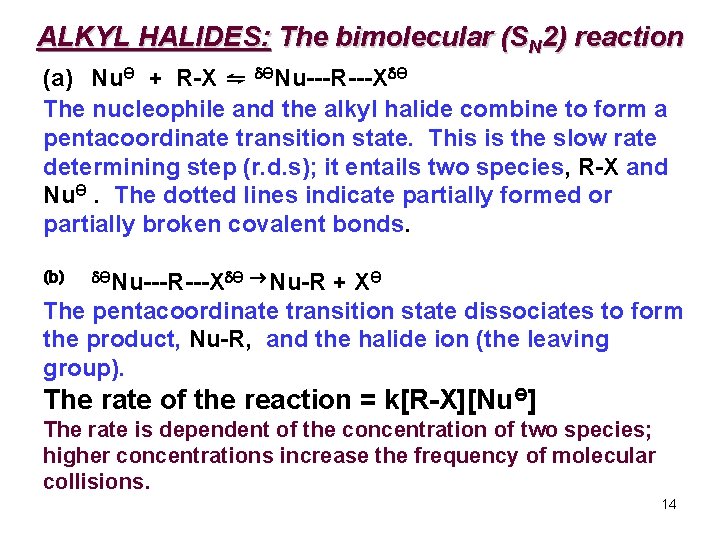
ALKYL HALIDES: The bimolecular (SN 2) reaction (a) NuӨ + R-X ⇋ ӨNu---R---X Ө The nucleophile and the alkyl halide combine to form a pentacoordinate transition state. This is the slow rate determining step (r. d. s); it entails two species, R-X and NuӨ. The dotted lines indicate partially formed or partially broken covalent bonds. (b) ӨNu---R---X Ө Nu-R + XӨ The pentacoordinate transition state dissociates to form the product, Nu-R, and the halide ion (the leaving group). The rate of the reaction = k[R-X][NuӨ] The rate is dependent of the concentration of two species; higher concentrations increase the frequency of molecular collisions. 5
ALKYL HALIDES The unimolecular (SN 1) reaction (a) In the first step, R-X dissociates, forming a carbocation, R⊕, and the leaving group XӨ. This is a slow, rate determining step (r. d. s. ) and entails only one species, R-X. (b) R⊕+ NuӨ R-Nu In the second step the carbocation and the nucleophile combine. This occurs rapidly. The overall reaction is R-X + NuӨ R-Nu + XӨ The rate of the reaction = k[R-X] 6
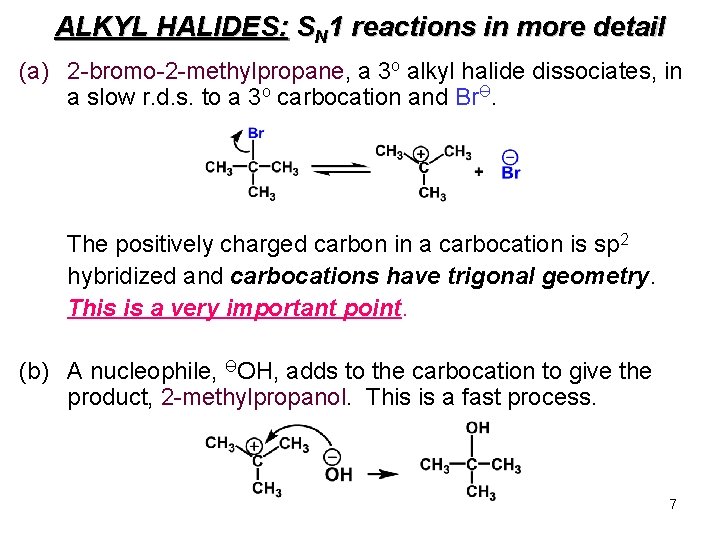
ALKYL HALIDES: SN 1 reactions in more detail (a) 2 -bromo-2 -methylpropane, a 3 o alkyl halide dissociates, in a slow r. d. s. to a 3 o carbocation and BrӨ. The positively charged carbon in a carbocation is sp 2 hybridized and carbocations have trigonal geometry. This is a very important point. (b) A nucleophile, ӨOH, adds to the carbocation to give the product, 2 -methylpropanol. This is a fast process. 7
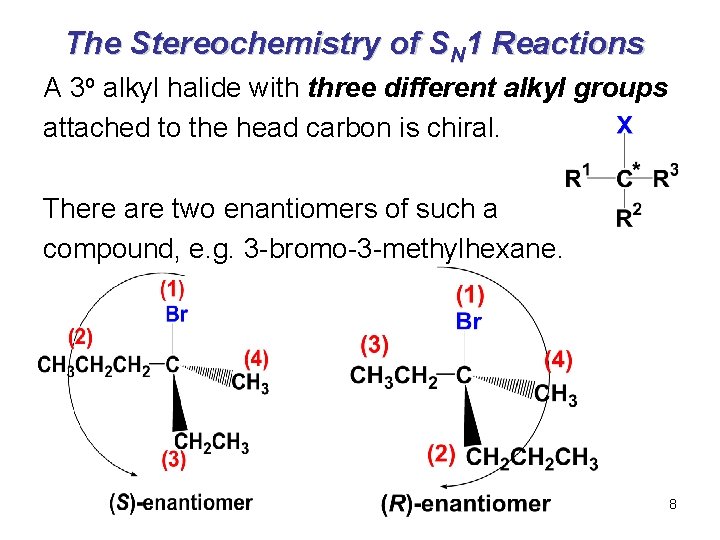
The Stereochemistry of SN 1 Reactions A 3 o alkyl halide with three different alkyl groups attached to the head carbon is chiral. There are two enantiomers of such a compound, e. g. 3 -bromo-3 -methylhexane. 8
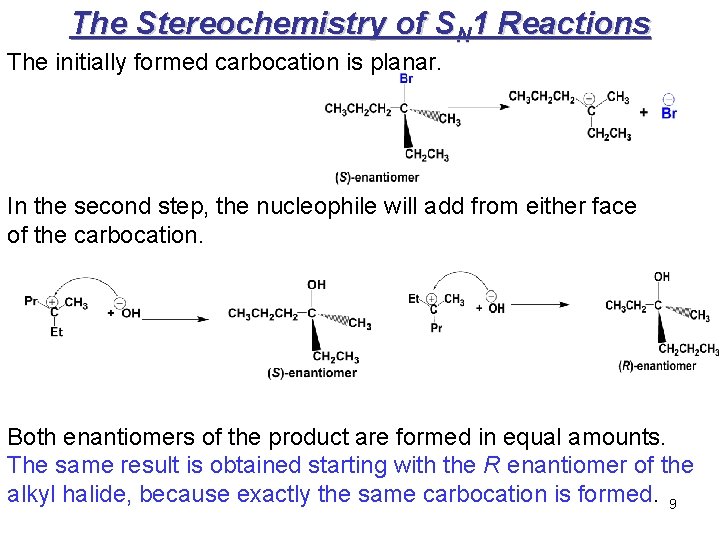
The Stereochemistry of SN 1 Reactions The initially formed carbocation is planar. In the second step, the nucleophile will add from either face of the carbocation. Both enantiomers of the product are formed in equal amounts. The same result is obtained starting with the R enantiomer of the alkyl halide, because exactly the same carbocation is formed. 9
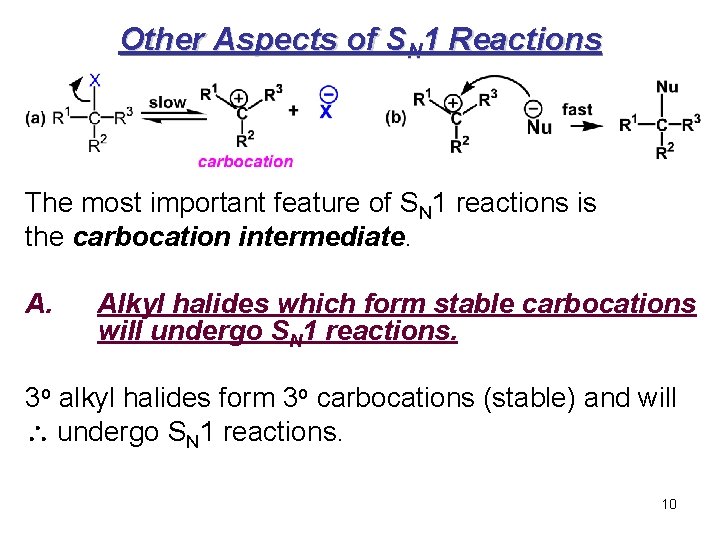
Other Aspects of SN 1 Reactions The most important feature of SN 1 reactions is the carbocation intermediate. A. Alkyl halides which form stable carbocations will undergo SN 1 reactions. 3 o alkyl halides form 3 o carbocations (stable) and will undergo SN 1 reactions. 10
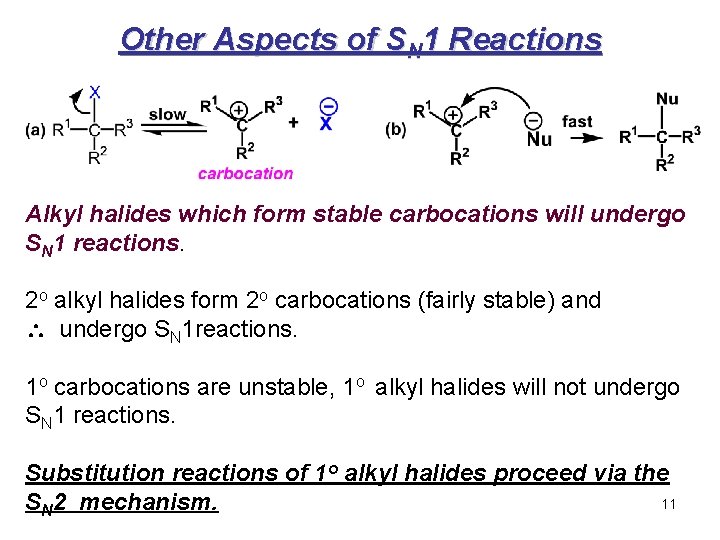
Other Aspects of SN 1 Reactions Alkyl halides which form stable carbocations will undergo SN 1 reactions. 2 o alkyl halides form 2 o carbocations (fairly stable) and undergo SN 1 reactions. 1 o carbocations are unstable, 1 o alkyl halides will not undergo SN 1 reactions. Substitution reactions of 1 o alkyl halides proceed via the 11 SN 2 mechanism.
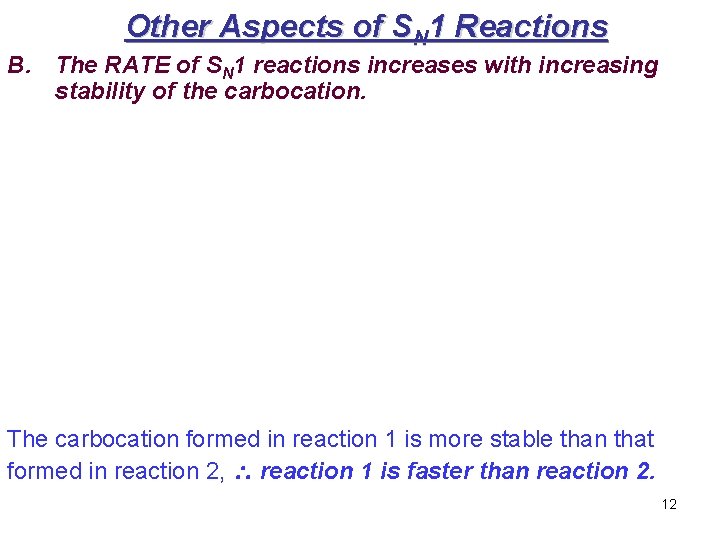
Other Aspects of SN 1 Reactions B. The RATE of SN 1 reactions increases with increasing stability of the carbocation. The carbocation formed in reaction 1 is more stable than that formed in reaction 2, reaction 1 is faster than reaction 2. 12
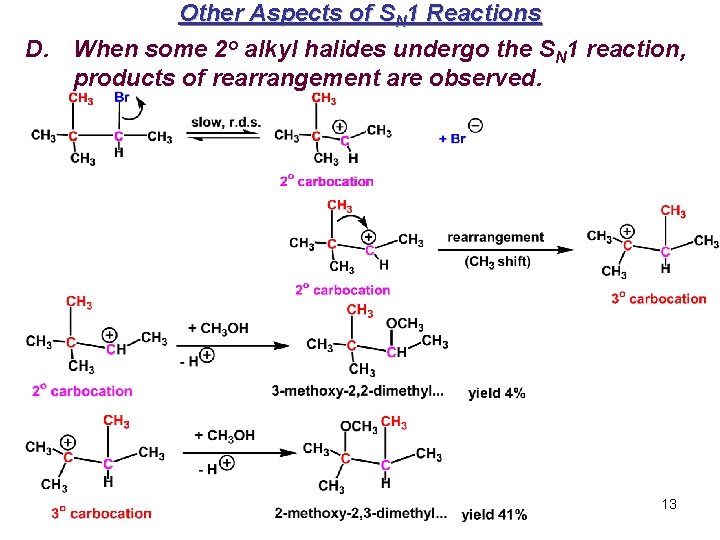
Other Aspects of SN 1 Reactions D. When some 2 o alkyl halides undergo the SN 1 reaction, products of rearrangement are observed. 13
ALKYL HALIDES: The bimolecular (SN 2) reaction (a) NuӨ + R-X ⇋ ӨNu---R---X Ө The nucleophile and the alkyl halide combine to form a pentacoordinate transition state. This is the slow rate determining step (r. d. s); it entails two species, R-X and NuӨ. The dotted lines indicate partially formed or partially broken covalent bonds. (b) ӨNu---R---X Ө Nu-R + XӨ The pentacoordinate transition state dissociates to form the product, Nu-R, and the halide ion (the leaving group). The rate of the reaction = k[R-X][NuӨ] The rate is dependent of the concentration of two species; higher concentrations increase the frequency of molecular collisions. 14
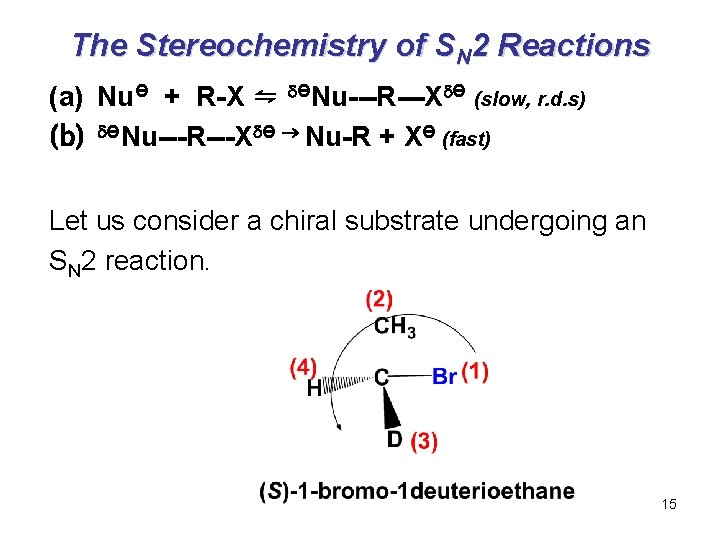
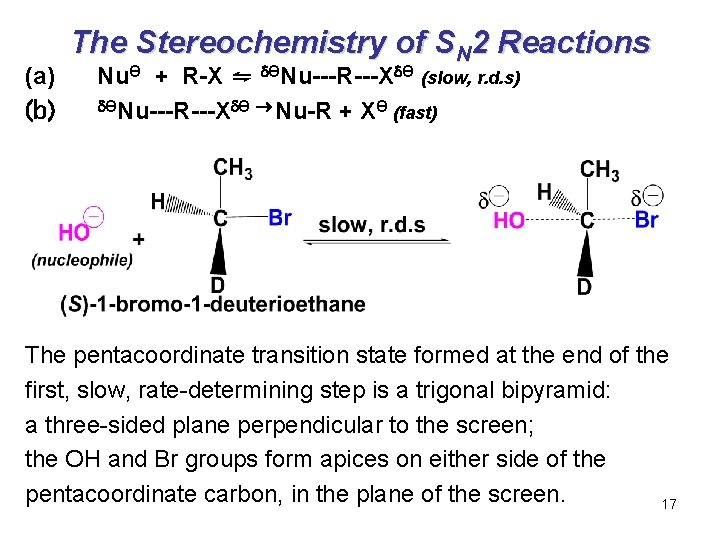
The Stereochemistry of SN 2 Reactions (a) NuӨ + R-X ⇋ ӨNu---R---X Ө (slow, r. d. s) (b) ӨNu---R---X Ө Nu-R + XӨ (fast) Let us consider a chiral substrate undergoing an SN 2 reaction. 15
The Stereochemistry of SN 2 Reactions 16
(a) (b) The Stereochemistry of SN 2 Reactions NuӨ + R-X ⇋ ӨNu---R---X Ө (slow, r. d. s) ӨNu---R---X Ө Nu-R + XӨ (fast) The pentacoordinate transition state formed at the end of the first, slow, rate-determining step is a trigonal bipyramid: a three-sided plane perpendicular to the screen; the OH and Br groups form apices on either side of the pentacoordinate carbon, in the plane of the screen. 17
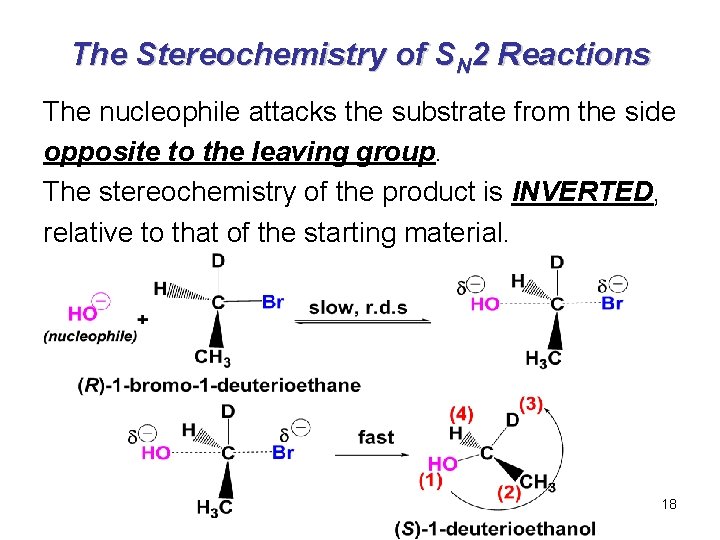
The Stereochemistry of SN 2 Reactions The nucleophile attacks the substrate from the side opposite to the leaving group. The stereochemistry of the product is INVERTED, relative to that of the starting material. 18