
Reactions in Aqueous Solution Objectives 1 Write and

Reactions in Aqueous Solution • Objectives: 1. Write and balance net ionic equations 2. Use solubility rules to predict the precipitate formed in double replacement reactions
Net Ionic Equations • Most ionic compounds dissociate, or separate, into cations and anions when they dissolve in water. • Write a complete ionic equation that shows dissolved ionic compounds as their free ions. • Eliminate ions that do not participate in the reaction by canceling ions that appear on both sides of the equation. These are called spectator ions.
• Ions that are not directly involved in a reaction are called spectator ions. • Rewrite the equation, leaving out the canceled spectator ions. • Balance the atoms and the charges of the ions. • A net ionic equation indicates only those particles that actually take part in the reaction.
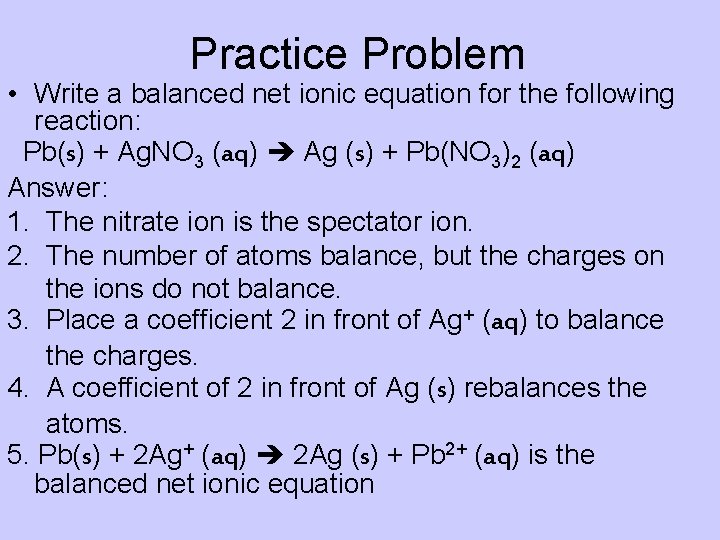
Practice Problem • Write a balanced net ionic equation for the following reaction: Pb(s) + Ag. NO 3 (aq) Ag (s) + Pb(NO 3)2 (aq) Answer: 1. The nitrate ion is the spectator ion. 2. The number of atoms balance, but the charges on the ions do not balance. 3. Place a coefficient 2 in front of Ag+ (aq) to balance the charges. 4. A coefficient of 2 in front of Ag (s) rebalances the atoms. 5. Pb(s) + 2 Ag+ (aq) 2 Ag (s) + Pb 2+ (aq) is the balanced net ionic equation
Predicting the Formation of a Precipitate • Use the general rules for solubility of ionic compounds. • Examples: 1. Sodium nitrite will not form a precipitate because alkali metal salts and nitrate salts are soluble (Rules 1 and 2) 2. Rule 3 (Exceptions) indicates that barium sulfate is insoluble and therefore will precipitate.
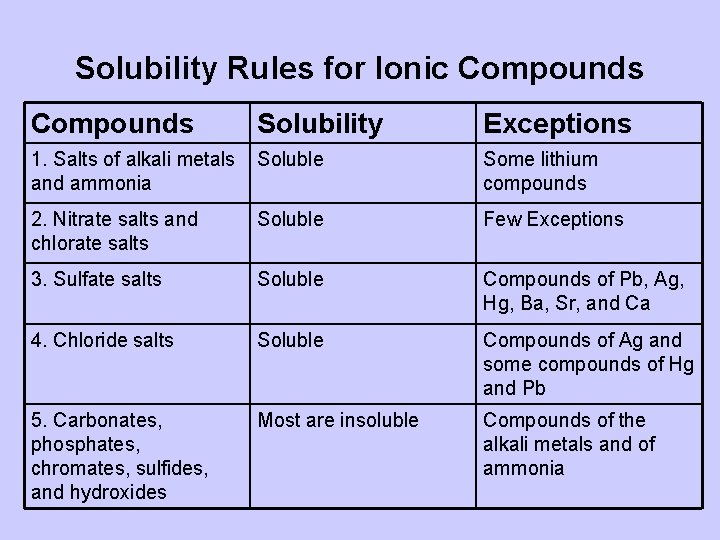
Solubility Rules for Ionic Compounds Solubility Exceptions 1. Salts of alkali metals and ammonia Soluble Some lithium compounds 2. Nitrate salts and chlorate salts Soluble Few Exceptions 3. Sulfate salts Soluble Compounds of Pb, Ag, Hg, Ba, Sr, and Ca 4. Chloride salts Soluble Compounds of Ag and some compounds of Hg and Pb 5. Carbonates, phosphates, chromates, sulfides, and hydroxides Most are insoluble Compounds of the alkali metals and of ammonia
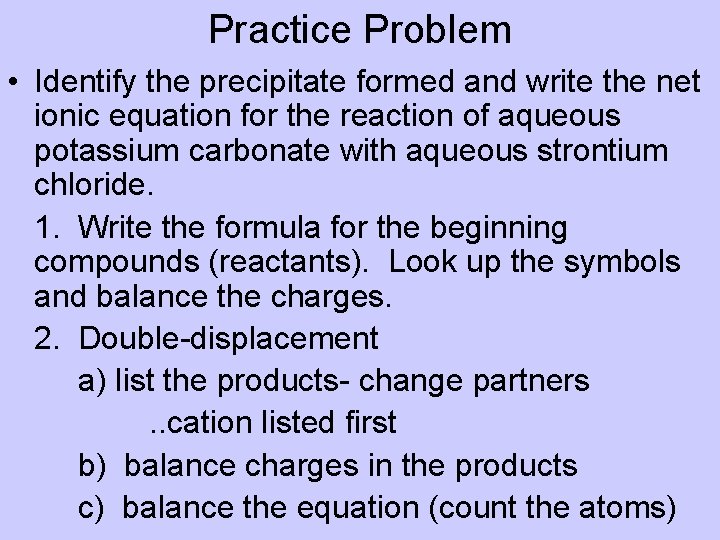
Practice Problem • Identify the precipitate formed and write the net ionic equation for the reaction of aqueous potassium carbonate with aqueous strontium chloride. 1. Write the formula for the beginning compounds (reactants). Look up the symbols and balance the charges. 2. Double-displacement a) list the products- change partners. . cation listed first b) balance charges in the products c) balance the equation (count the atoms)
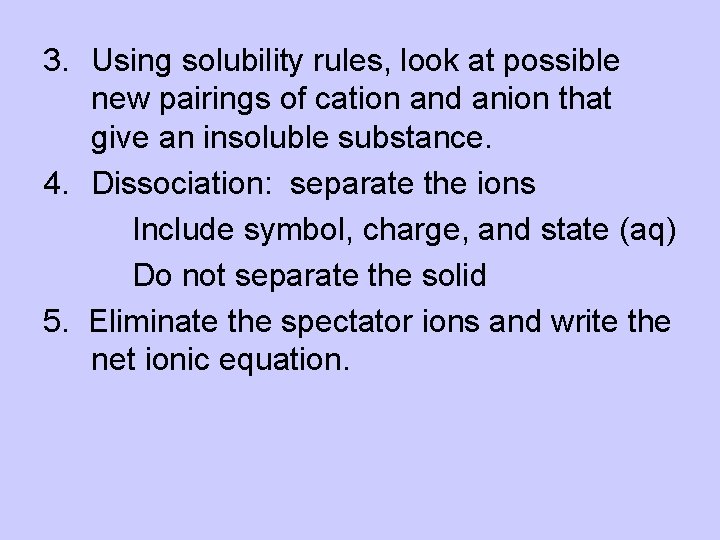
3. Using solubility rules, look at possible new pairings of cation and anion that give an insoluble substance. 4. Dissociation: separate the ions Include symbol, charge, and state (aq) Do not separate the solid 5. Eliminate the spectator ions and write the net ionic equation.
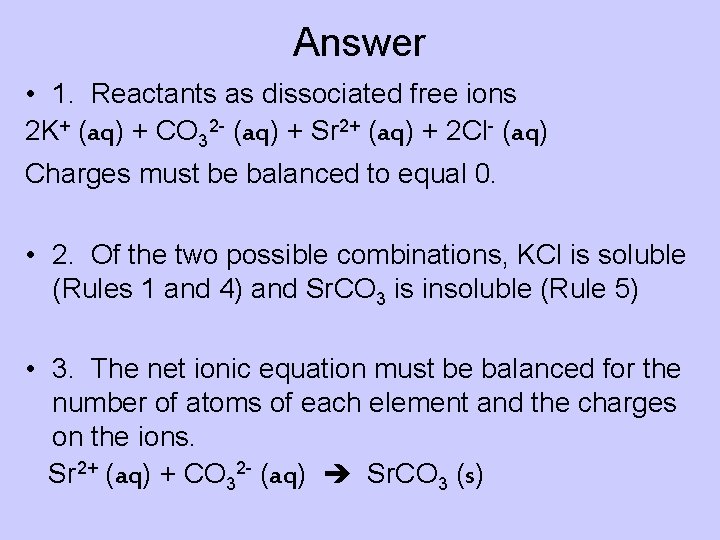
Answer • 1. Reactants as dissociated free ions 2 K+ (aq) + CO 32 - (aq) + Sr 2+ (aq) + 2 Cl- (aq) Charges must be balanced to equal 0. • 2. Of the two possible combinations, KCl is soluble (Rules 1 and 4) and Sr. CO 3 is insoluble (Rule 5) • 3. The net ionic equation must be balanced for the number of atoms of each element and the charges on the ions. Sr 2+ (aq) + CO 32 - (aq) Sr. CO 3 (s)
- Slides: 9