
Reaction Rates Factors Activation Energy Le Chateliers Principle
- Slides: 6
Reaction Rates Factors, Activation Energy, Le Chatelier’s Principle, Kinetic -Molecular Theory, Collisions Theory of Gases
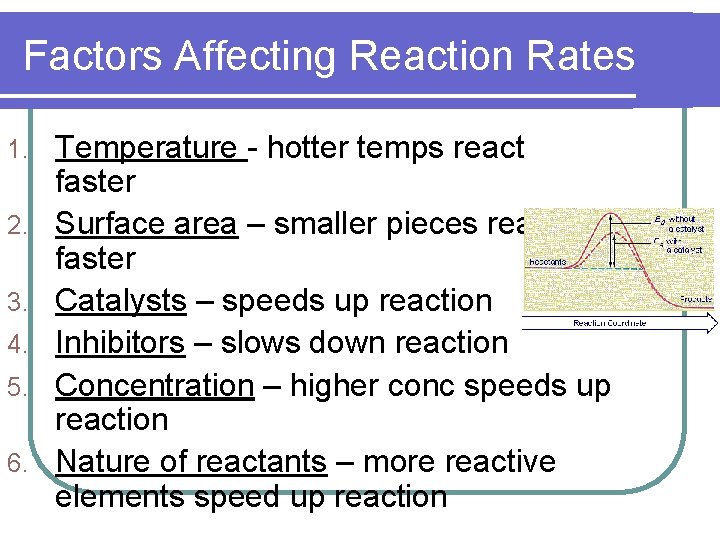
Factors Affecting Reaction Rates 1. 2. 3. 4. 5. 6. Temperature - hotter temps react faster Surface area – smaller pieces react faster Catalysts – speeds up reaction Inhibitors – slows down reaction Concentration – higher conc speeds up reaction Nature of reactants – more reactive elements speed up reaction
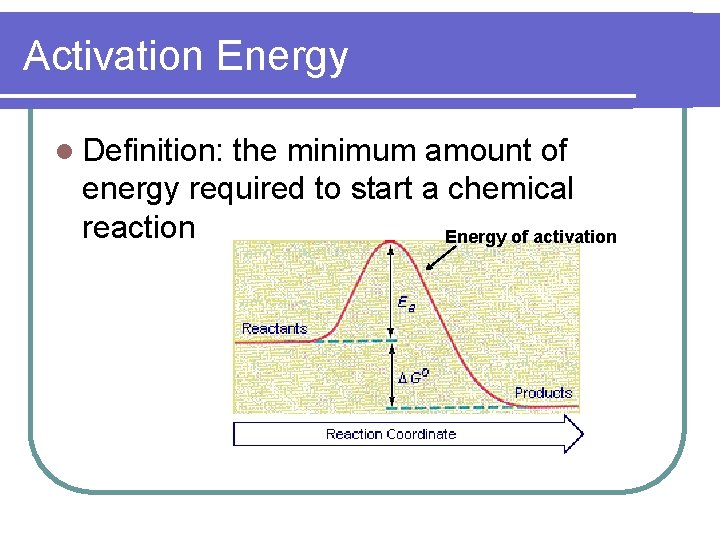
Activation Energy l Definition: the minimum amount of energy required to start a chemical reaction Energy of activation
Le. Chatelier’s Principle l Deifinition: when a system at equilibrium is subjected to a stress, the system will shift its equilibrium point in order to relieve the stress l Stresses include a change in: Pressure l Concentration l Temperature l
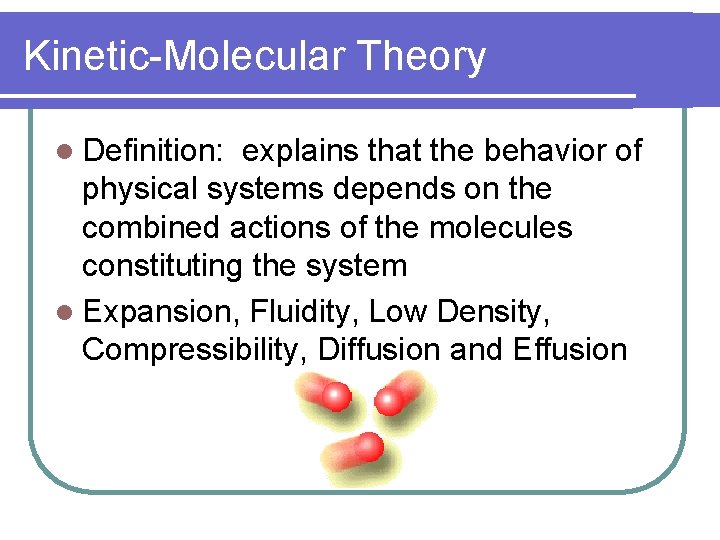
Kinetic-Molecular Theory l Definition: explains that the behavior of physical systems depends on the combined actions of the molecules constituting the system l Expansion, Fluidity, Low Density, Compressibility, Diffusion and Effusion
Collisions Theory of Gases l Definiton: the number of new compounds formed in a chemical reaction is equal to the number of molecules that collide, multiplied by a constant that corrects for low-energy collisions l Must be the right speed (activation energy requirement), and right orientation (direction)