
Reaction Rates and Equilibrium Rates of Reaction Essential
Reaction Rates and Equilibrium

Rates of Reaction Essential Question: How is the rate of a chemical change expressed, and what four factors influence the rate of a chemical reaction?

Reaction Rates • The speed of chemical reactions can vary from instantaneous to extremely slow. • A rate is a measure of the speed of any change per interval time. • Reaction rate = amount of reactant changing per unit time.
Collision Theory • Particles react when they collide with one another. • The collision must have sufficient kinetic energy to break existing bonds. • This minimum energy is called activation energy.
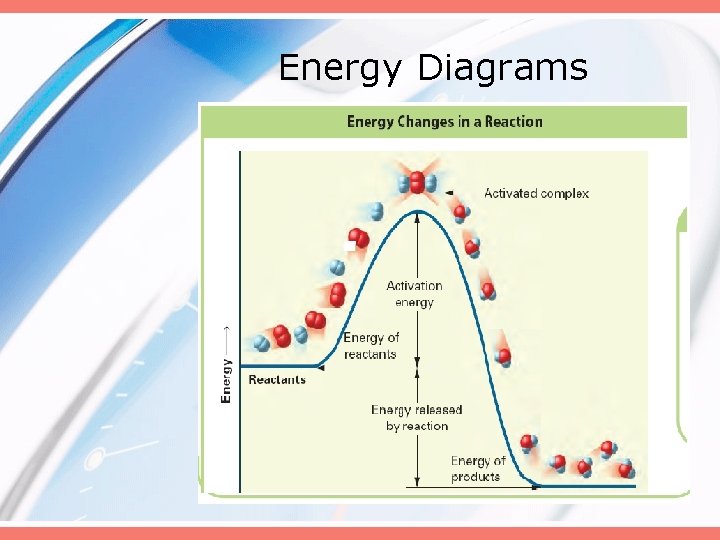
Energy Diagrams
Energy Diagrams • Activation Energy – minimum energy that colliding particles must have in order to react. • Activated Complex – unstable arrangement of atoms that forms momentarily • Transition State – synonym for the activated complex
Factors Affecting Reaction Rates • Temperature • Concentration • Particle Size • Presence of a catalyst (or inhibitor)
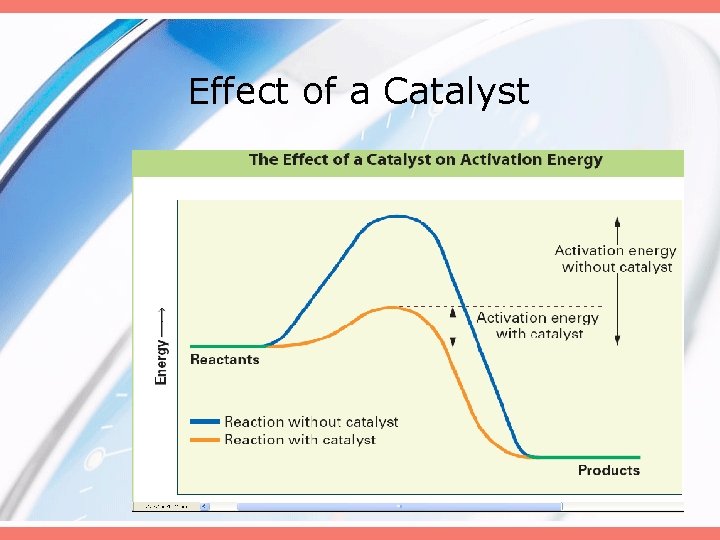
Effect of a Catalyst

Reversible Reactions and Equilibrium Essential Question • How do the amounts of reactants and products change at equilibrium, and what three stresses can cause a change in the equilibrium position?
At Chemical Equilibrium • Products are being formed… • …reactants are being formed… • …but no net change occurs in the actual amounts of either the reactants or products.
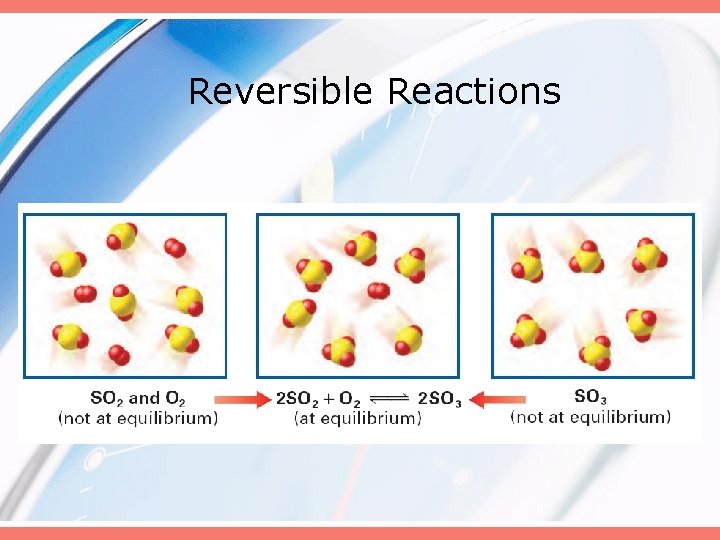
Reversible Reactions
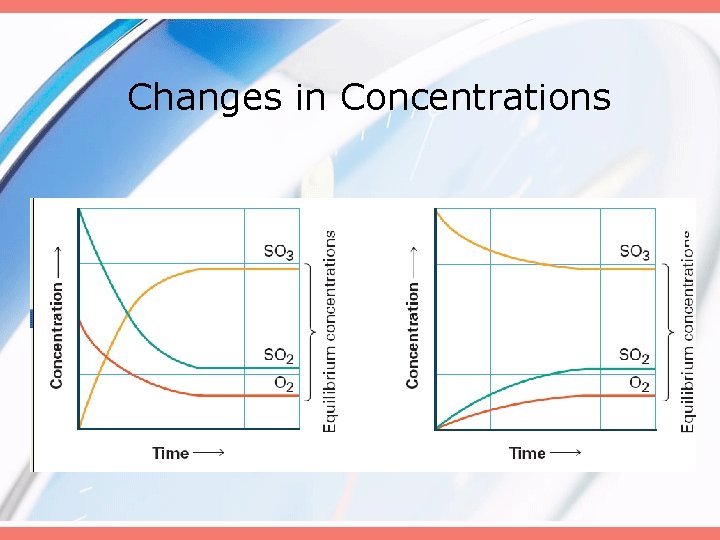
Changes in Concentrations
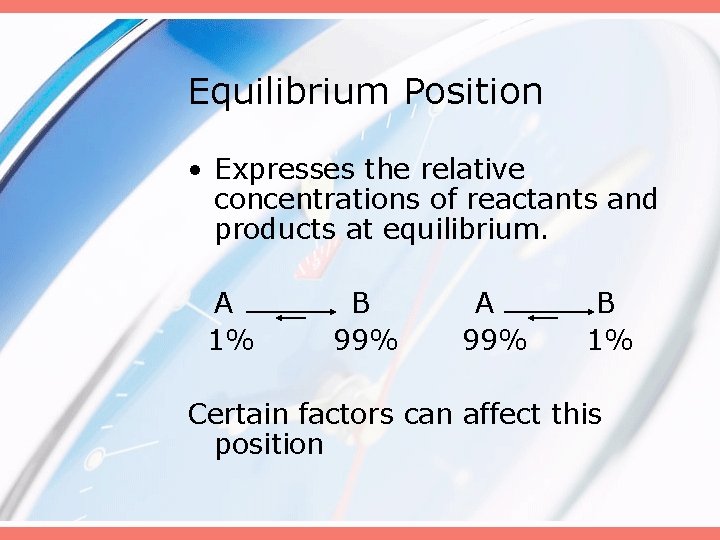
Equilibrium Position • Expresses the relative concentrations of reactants and products at equilibrium. A 1% B 99% A 99% B 1% Certain factors can affect this position
Le Châtelier’s Principle • “If a stress is applied to a system in dynamic equilibrium, the system changes in a way that relieves the stress. ”

Equilibrium Constants • The ratio of product concentrations to reactant concentrations at equilibrium • Each concentration is raised to a power equal to their coefficient in a balance chemical equation.
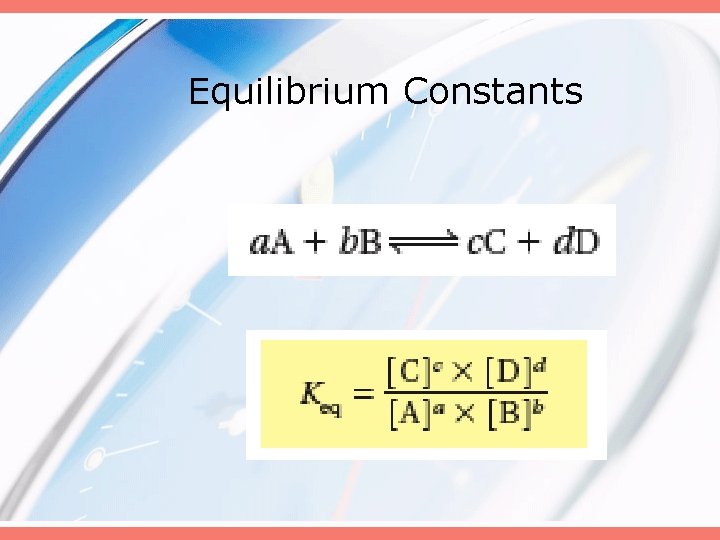
Equilibrium Constants
What Keq Tells Us • Keq greater than 1 means that products are favored • Keq less than 1 means that reactants are favored • Keq equal to 1 means that products and reactants are equally favored
Factors Affecting Equilibrium • Changes in concentration of reactants or products • Changes in temperature • Changes in pressure (of gases)
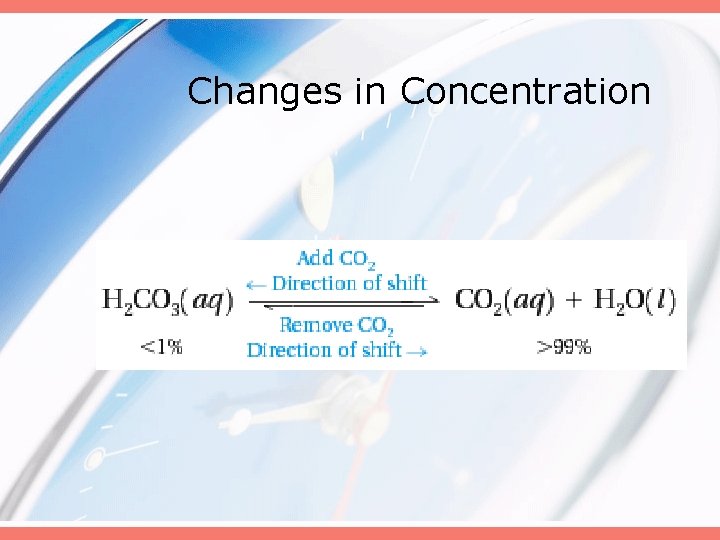
Changes in Concentration
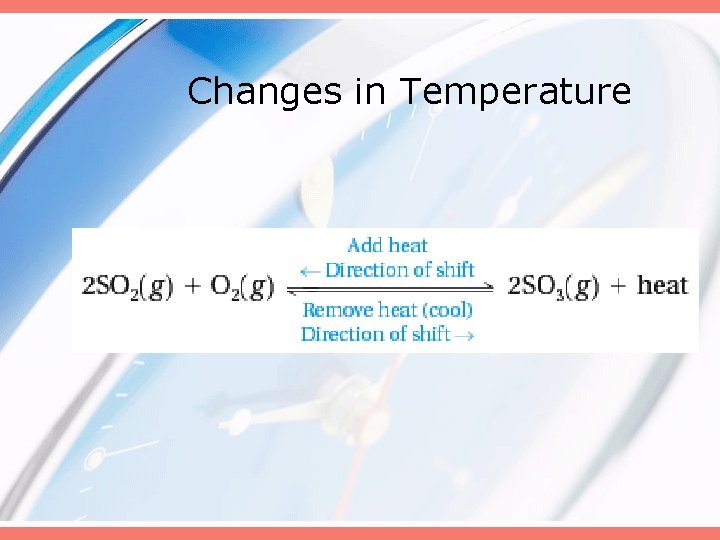
Changes in Temperature
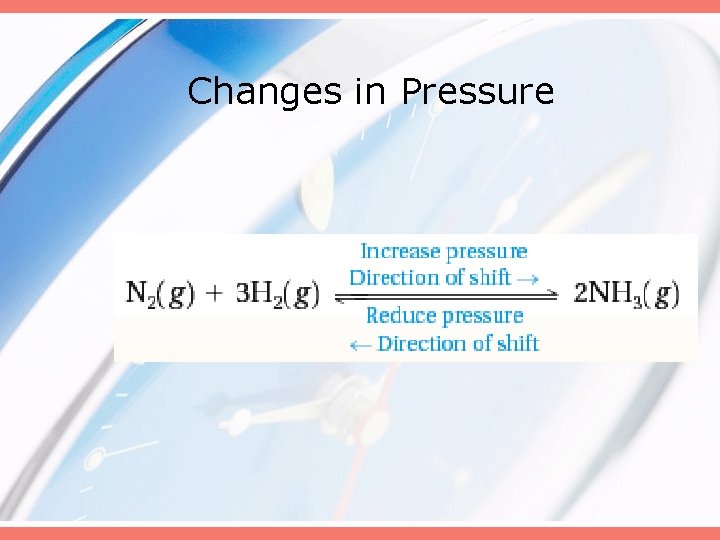
Changes in Pressure
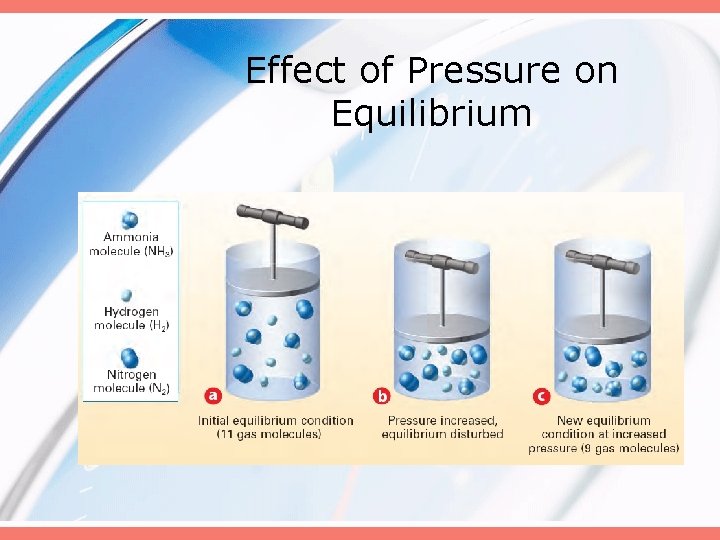
Effect of Pressure on Equilibrium
Solubility Equilibrium Essential Question • What does the solubility product constant tell you about the solubility of a compound, and how can you predict whether a precipitate will form when salt solutions are mixed?
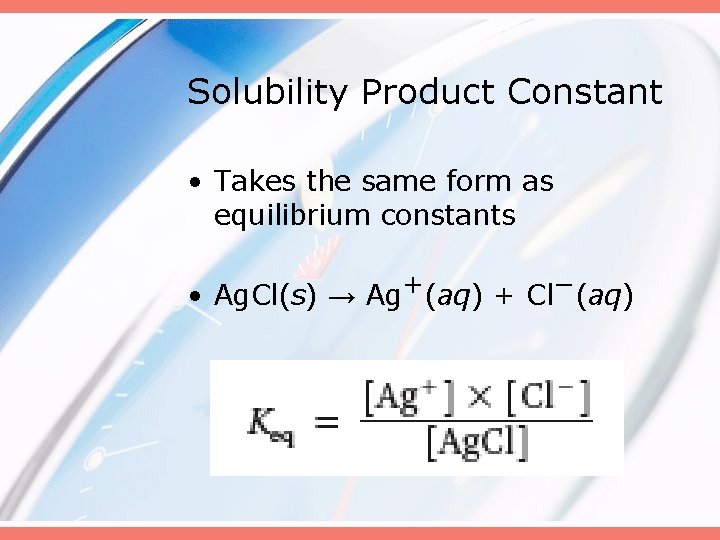
Solubility Product Constant • Takes the same form as equilibrium constants • Ag. Cl(s) → Ag+(aq) + Cl−(aq)
Common Ion Effect • Lowering the solubility of an ionic compound as a result of the addition of a common ion • If the product of the concentrations of two ions in the mixture is greater than Ksp of the compound formed from the ions, a precipitate will form.
Entropy and Free Energy Essential Question • What two factors determine the spontaneity of a reaction, and what are the characteristics of spontaneous reactions?
Spontaneous Reactions • Occur naturally and favor the formation of products • Produce substantial amounts of products at equilibrium
Nonspontaneous Reactions • Does not favor the formation of products • Do not produce substantial amounts of products at equilibrium • Note: Speed is NOT a factor
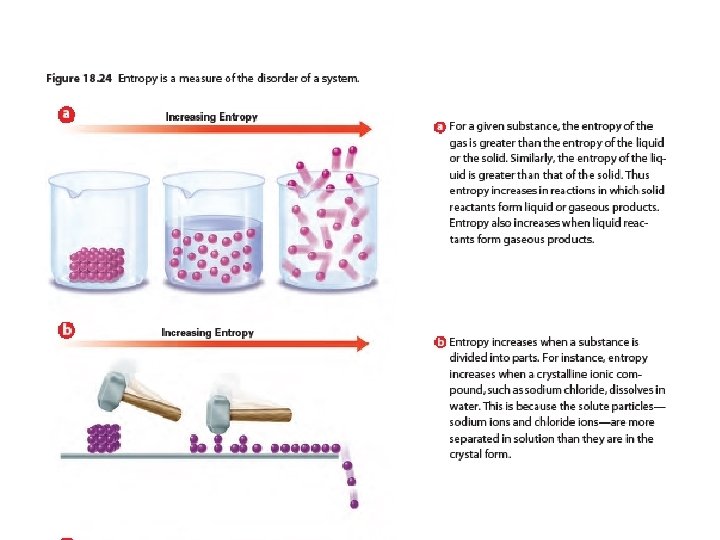
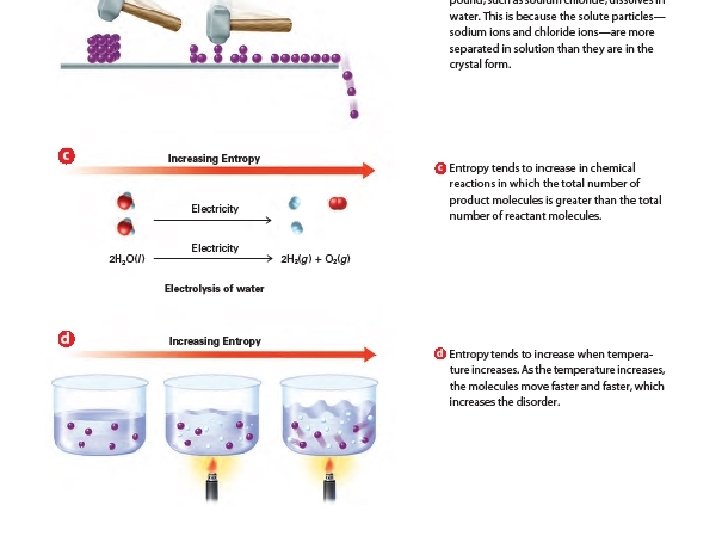
Entropy Changes • A measure of the disorder of a system • Law of Disorder: the natural tendency is for systems to move in the direction of maximum disorder or randomness • An increase in entropy favors spontaneous chemical reactions
Enthalpy Changes • The decrease in enthalpy (exothermic reactions) indicates a spontaneous reaction. • An increase in enthalpy (endothermic reactions) indicates a non-spontaneous reaction.
The Progress of Reactions Essential Question • What does the specific rate constant, k, communicate and how does one interpret a reaction progress curve?
Specific Rate Constant • The value of the specific rate constant, k, is large if the products form quickly • The value is small if the products form slowly.
- Slides: 34