
Reaction Mixture Stopping Criteria Analyzer Mol Orb Enumerator
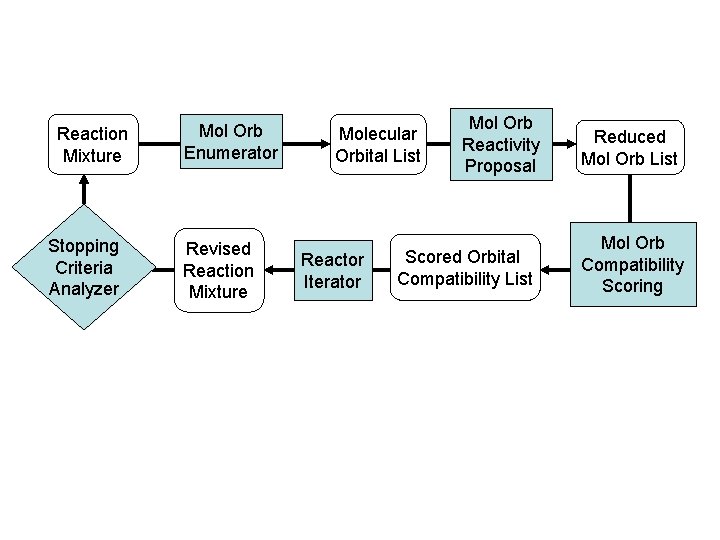
Reaction Mixture Stopping Criteria Analyzer Mol Orb Enumerator Revised Reaction Mixture Molecular Orbital List Reactor Iterator Mol Orb Reactivity Proposal Scored Orbital Compatibility List Reduced Mol Orb List Mol Orb Compatibility Scoring
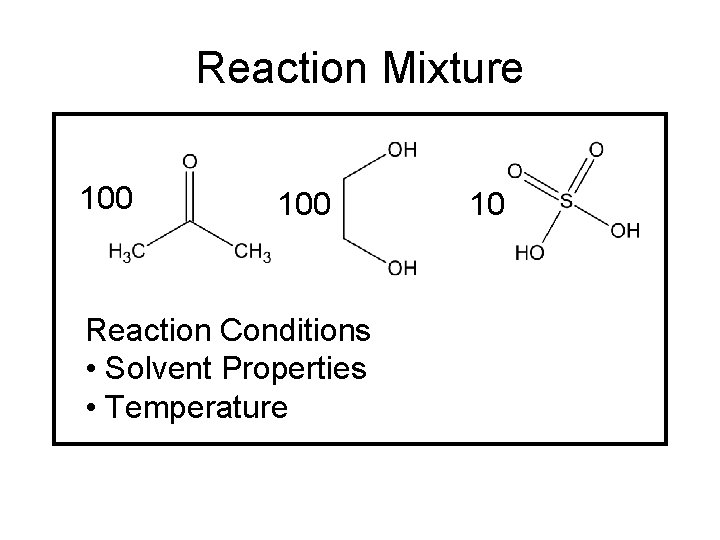
Reaction Mixture 100 Reaction Conditions • Solvent Properties • Temperature 10
Orbital Enumerator • Largely done for core atoms, but need extra logic to handle – S, P atoms (d orbitals) – Resonance structure enumerator – Extended orbital chaining (e. g. , E 2, Sn 2’) • Orbital Reactivity Proposal – Before full combinatorial reactivity compatibility check, pre-filter orbital list to exclude those are very unlikely to react
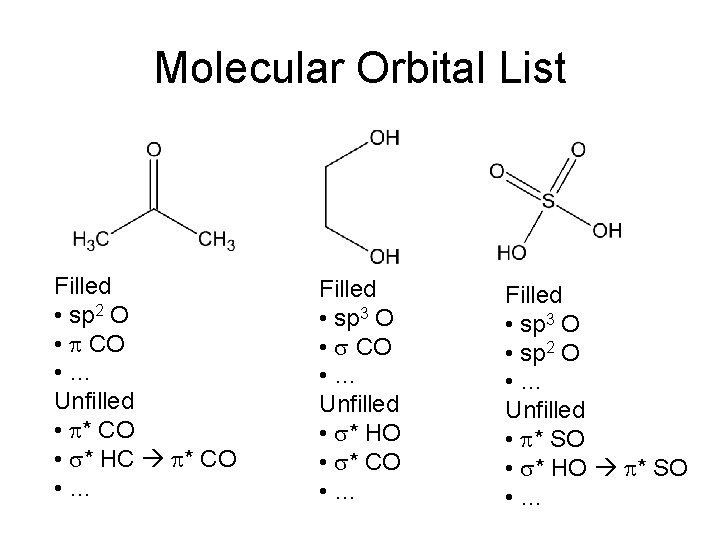
Molecular Orbital List Filled • sp 2 O • p CO • … Unfilled • p* CO • s* HC p* CO • … Filled • sp 3 O • s CO • … Unfilled • s* HO • s* CO • … Filled • sp 3 O • sp 2 O • … Unfilled • p* SO • s* HO p* SO • …
Orbital Reactivity / Compatibility • Core challenge (rest is mostly accounting) • Thermodynamic Scoring – Relative energy / stability of structures – Reaction conditions may influence (particularly stabilization of ions by solvation) – Components like bond energies, ring strain, entropy, aromaticity, conjugation and resonance, hyperconjugation, formal charges, octet rule
Orbital Reactivity / Compatibility • Kinetics / Transition State Scoring – Estimated barrier to structures to react based on proposed orbital interaction – Thermodynamic basis + Klopman-Salem components like sterics, ionic character vs. orbital coefficients (HOMO-LUMO energies) – Entropy considerations (number of molecules, rotatable bonds)
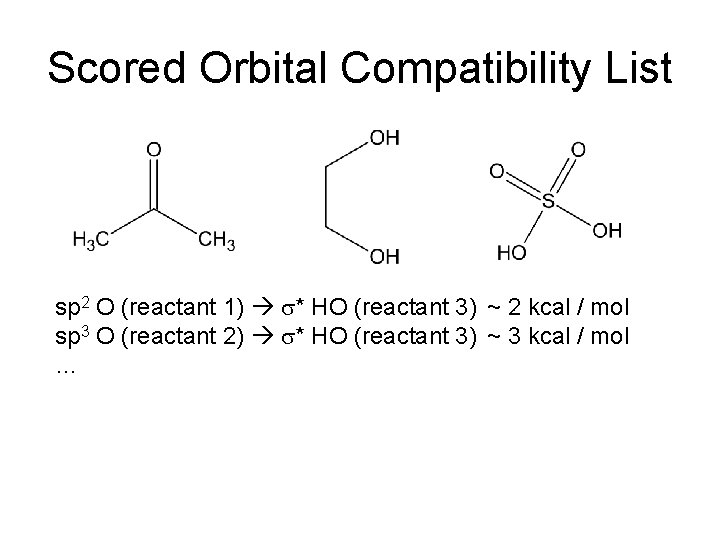
Scored Orbital Compatibility List sp 2 O (reactant 1) s* HO (reactant 3) ~ 2 kcal / mol sp 3 O (reactant 2) s* HO (reactant 3) ~ 3 kcal / mol …
Reactor Iterator • Orbital Interaction Applicator – Mostly done for core orbital interactions – Generate / translate to curved arrows – Need to implement stereospecificity logic • Concentration / Prevalence model – Use reactivity scores x concentrations to calculate probabilities on likely mechanistic steps (elementary reactions) – Apply mechanistic steps to update reaction mix, but limit achievable transition states by reaction temperature
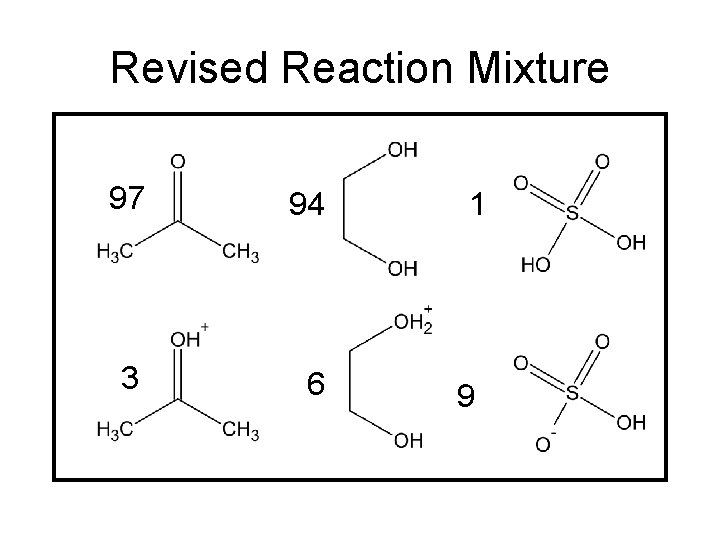
Revised Reaction Mixture 97 94 3 6 1 9
GUI • Input of reaction mixtures • Output of resulting reaction mixtures • Traceback of core mechanistic steps of major products • Qualitative free energy diagrams from tracebacks • Interactive exploration / explanation. Select mixtures or orbital combinations to see systems score report • Systems bio style tracking of molecule concentrations over time (iterations)
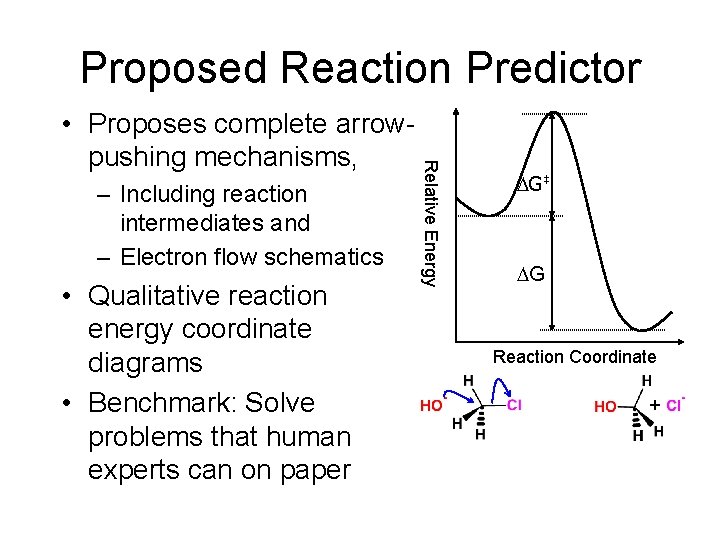
Proposed Reaction Predictor – Including reaction intermediates and – Electron flow schematics • Qualitative reaction energy coordinate diagrams • Benchmark: Solve problems that human experts can on paper Relative Energy • Proposes complete arrowpushing mechanisms, DG‡ DG Reaction Coordinate +
- Slides: 11