
Reaction Mechanisms Most reactions occur in a series
- Slides: 6
Reaction Mechanisms • Most reactions occur in a series of steps • Some products of a first step are used up as reactants in a second step and are not seen in an overall reaction (intermediate) • Individual reactions are called elementary steps – TWO REQUIREMENTS
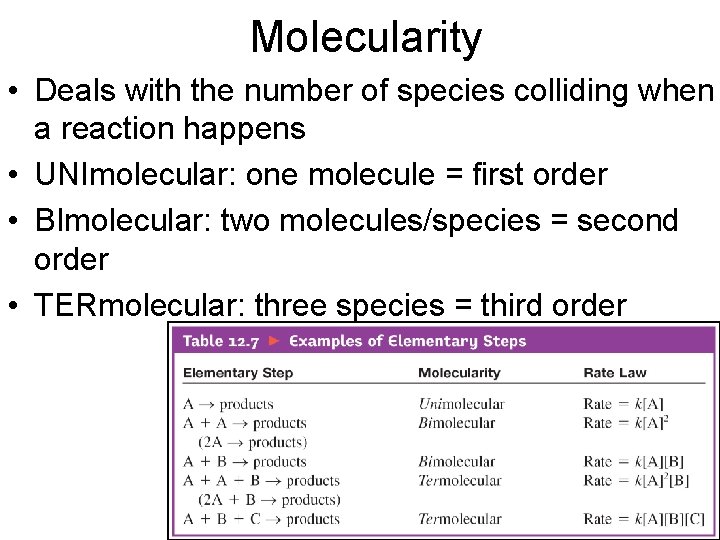
Molecularity • Deals with the number of species colliding when a reaction happens • UNImolecular: one molecule = first order • BImolecular: two molecules/species = second order • TERmolecular: three species = third order
Elementary Steps Requirements 1. Sum of elementary steps must give the overall balanced equation for the reaction 2. Mechanism must agree with the experimentally determined rate law
Rate-Determining Step • Helps confirm the #2 from the last slide • The intermediate step that is much slower than the other steps • This slower step determines the rate law used in calculations • After determining the rate law, the mechanism can be hypothesized
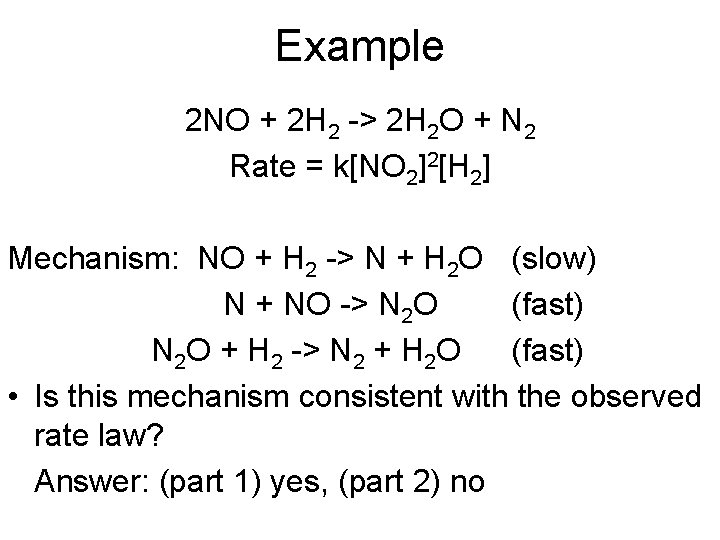
Example 2 NO + 2 H 2 -> 2 H 2 O + N 2 Rate = k[NO 2]2[H 2] Mechanism: NO + H 2 -> N + H 2 O (slow) N + NO -> N 2 O (fast) N 2 O + H 2 -> N 2 + H 2 O (fast) • Is this mechanism consistent with the observed rate law? Answer: (part 1) yes, (part 2) no
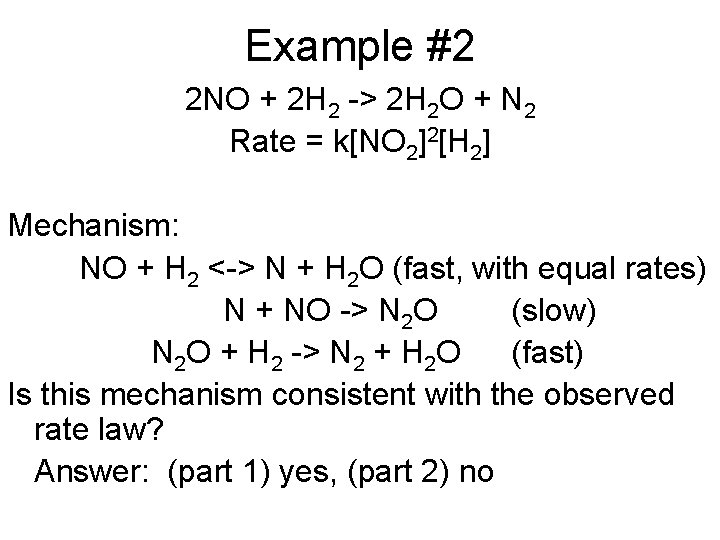
Example #2 2 NO + 2 H 2 -> 2 H 2 O + N 2 Rate = k[NO 2]2[H 2] Mechanism: NO + H 2 <-> N + H 2 O (fast, with equal rates) N + NO -> N 2 O (slow) N 2 O + H 2 -> N 2 + H 2 O (fast) Is this mechanism consistent with the observed rate law? Answer: (part 1) yes, (part 2) no