
REACTION MECHANISMS EQ What is the difference between
REACTION MECHANISMS EQ: What is the difference between a mechanism with the RDS in the first step versus one with the RDS in the second step?
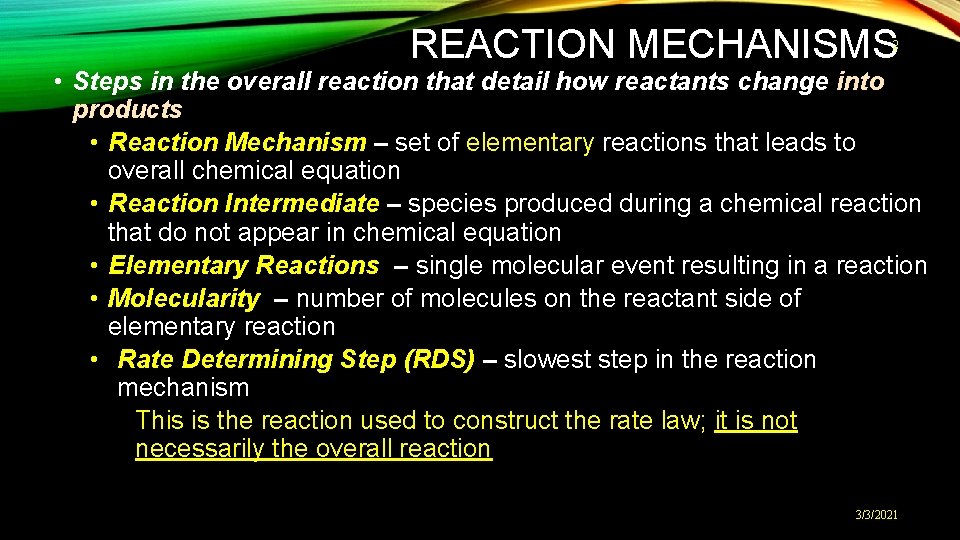
REACTION MECHANISMS 2 • Steps in the overall reaction that detail how reactants change into products • Reaction Mechanism – set of elementary reactions that leads to overall chemical equation • Reaction Intermediate – species produced during a chemical reaction that do not appear in chemical equation • Elementary Reactions – single molecular event resulting in a reaction • Molecularity – number of molecules on the reactant side of elementary reaction • Rate Determining Step (RDS) – slowest step in the reaction mechanism This is the reaction used to construct the rate law; it is not necessarily the overall reaction 3/3/2021
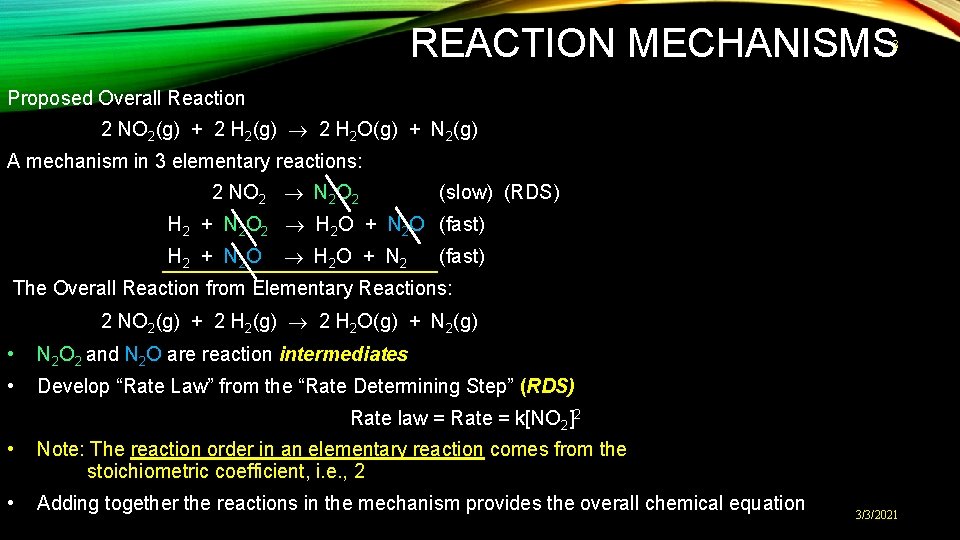
REACTION MECHANISMS 3 Proposed Overall Reaction 2 NO 2(g) + 2 H 2(g) 2 H 2 O(g) + N 2(g) A mechanism in 3 elementary reactions: 2 NO 2 N 2 O 2 (slow) (RDS) H 2 + N 2 O 2 H 2 O + N 2 O (fast) H 2 + N 2 O H 2 O + N 2 (fast) The Overall Reaction from Elementary Reactions: 2 NO 2(g) + 2 H 2(g) 2 H 2 O(g) + N 2(g) • N 2 O 2 and N 2 O are reaction intermediates • Develop “Rate Law” from the “Rate Determining Step” (RDS) Rate law = Rate = k[NO 2]2 • Note: The reaction order in an elementary reaction comes from the stoichiometric coefficient, i. e. , 2 • Adding together the reactions in the mechanism provides the overall chemical equation 3/3/2021
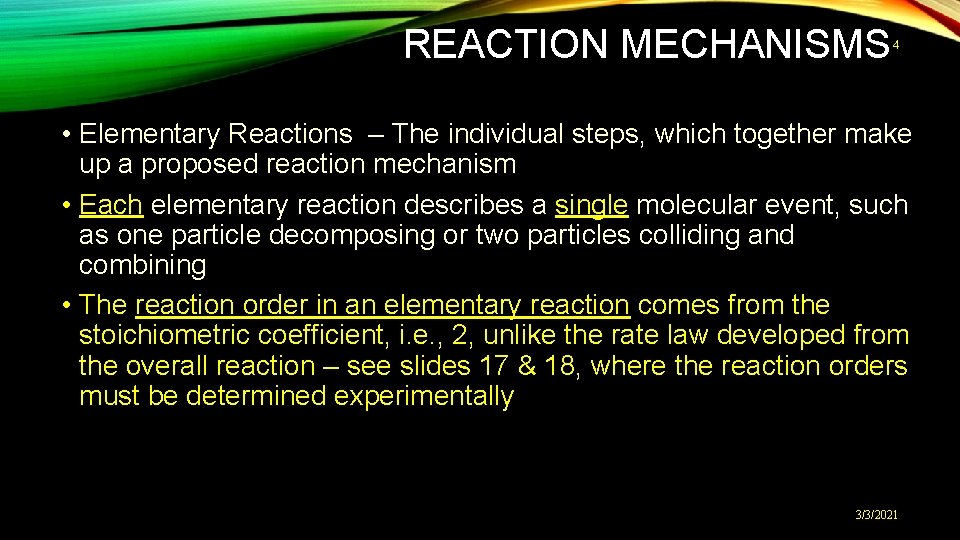
REACTION MECHANISMS 4 • Elementary Reactions – The individual steps, which together make up a proposed reaction mechanism • Each elementary reaction describes a single molecular event, such as one particle decomposing or two particles colliding and combining • The reaction order in an elementary reaction comes from the stoichiometric coefficient, i. e. , 2, unlike the rate law developed from the overall reaction – see slides 17 & 18, where the reaction orders must be determined experimentally 3/3/2021
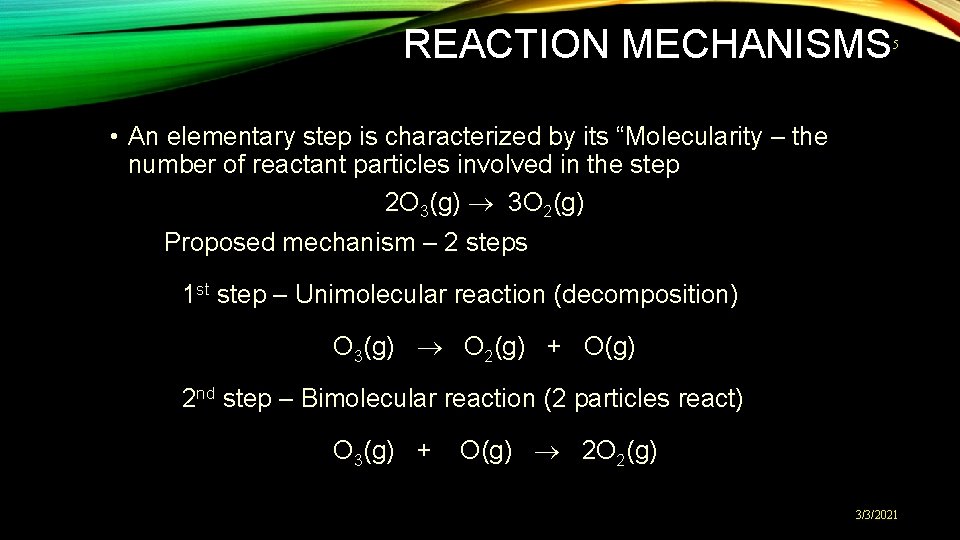
REACTION MECHANISMS 5 • An elementary step is characterized by its “Molecularity – the number of reactant particles involved in the step 2 O 3(g) 3 O 2(g) Proposed mechanism – 2 steps 1 st step – Unimolecular reaction (decomposition) O 3(g) O 2(g) + O(g) 2 nd step – Bimolecular reaction (2 particles react) O 3(g) + O(g) 2 O 2(g) 3/3/2021
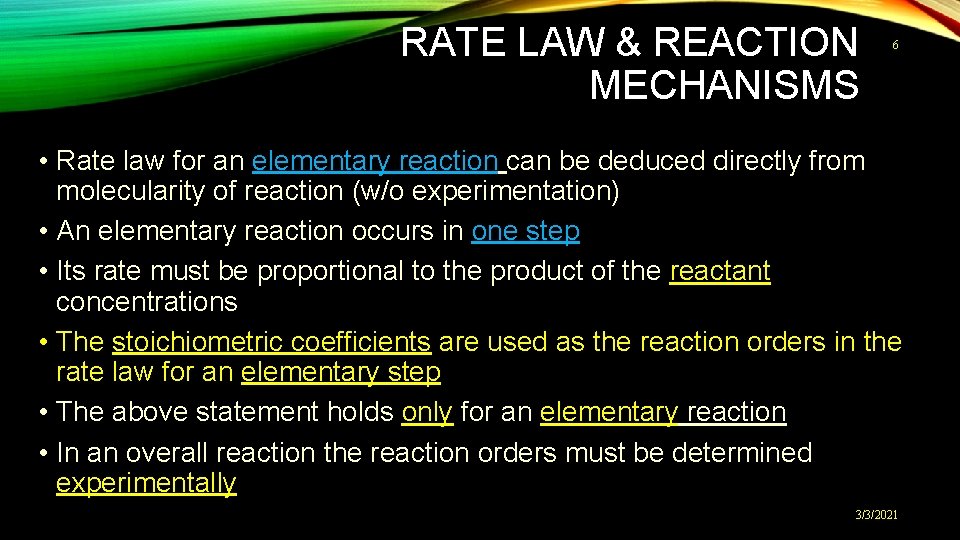
RATE LAW & REACTION MECHANISMS 6 • Rate law for an elementary reaction can be deduced directly from molecularity of reaction (w/o experimentation) • An elementary reaction occurs in one step • Its rate must be proportional to the product of the reactant concentrations • The stoichiometric coefficients are used as the reaction orders in the rate law for an elementary step • The above statement holds only for an elementary reaction • In an overall reaction the reaction orders must be determined experimentally 3/3/2021
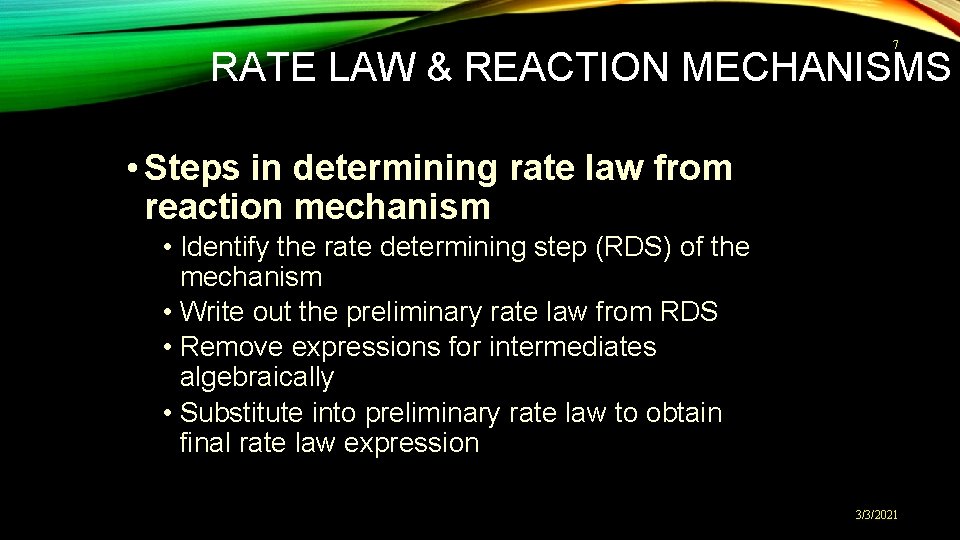
7 RATE LAW & REACTION MECHANISMS • Steps in determining rate law from reaction mechanism • Identify the rate determining step (RDS) of the mechanism • Write out the preliminary rate law from RDS • Remove expressions for intermediates algebraically • Substitute into preliminary rate law to obtain final rate law expression 3/3/2021
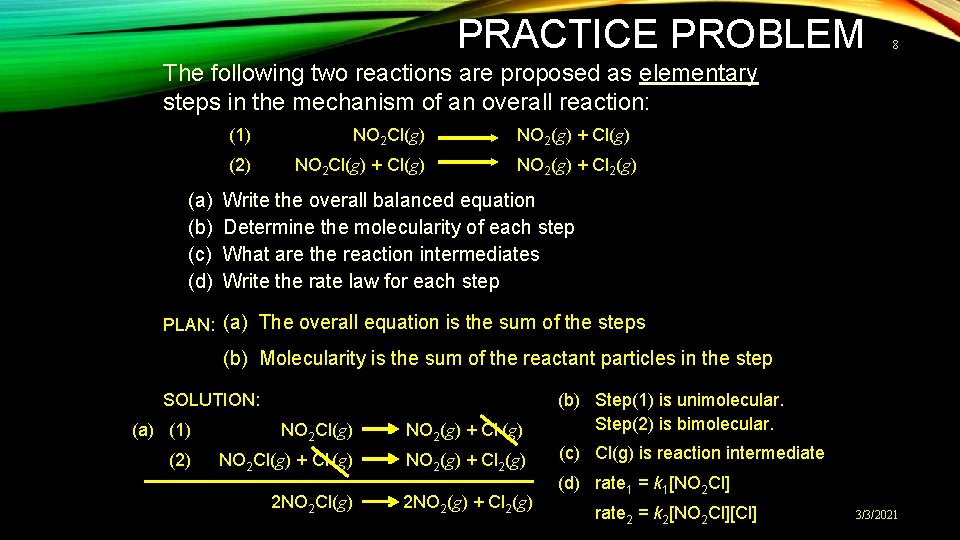
PRACTICE PROBLEM 8 The following two reactions are proposed as elementary steps in the mechanism of an overall reaction: (a) (b) (c) (d) (1) NO 2 Cl(g) (2) NO 2 Cl(g) + Cl(g) NO 2(g) + Cl 2(g) Write the overall balanced equation Determine the molecularity of each step What are the reaction intermediates Write the rate law for each step PLAN: (a) The overall equation is the sum of the steps (b) Molecularity is the sum of the reactant particles in the step SOLUTION: (a) (1) NO 2 Cl(g) NO 2(g) + Cl (g) (2) NO 2 Cl(g) + Cl (g) NO 2(g) + Cl 2(g) 2 NO 2 Cl(g) 2 NO 2(g) + Cl 2(g) (b) Step(1) is unimolecular. Step(2) is bimolecular. (c) Cl(g) is reaction intermediate (d) rate 1 = k 1[NO 2 Cl] rate 2 = k 2[NO 2 Cl][Cl] 3/3/2021
CORRELATING RATE LAW & MECHANISM 9 • Criteria required for proposed reaction mechanism • The elementary steps must add up to the overall balanced equation • The number of reactants and products in the elementary reactions must be consistent with the overall reaction • The elementary steps must be physically reasonable – they should involve one reactant (unimolecular) or at most two reactant particles (bimolecular) • The mechanism must correlate with the “rate law” – The mechanism must support the experimental facts shown by the rate law, not the other way around 3/3/2021
PRACTICE PROBLEM 10 If a slow step precedes a fast step in a two-step mechanism, do the substances in the fast step appear in the rate law? Ans: No, the overall rate law must contain reactants only (no intermediates) and is determined by the slow step If the first step in a reaction mechanism is slow, the rate law for that step is the overall rate law If a fast step precedes a slow step in a two-step mechanism, how is the fast step affected? Ans: If the slow step is not the first one, the faster preceding step produces intermediates that accumulate before being consumed in the slow step How is this effect used to determine the validity of the mechanism? Ans: Substitution of the intermediates into the rate law for the slow step will produce the overall rate law 3/3/2021
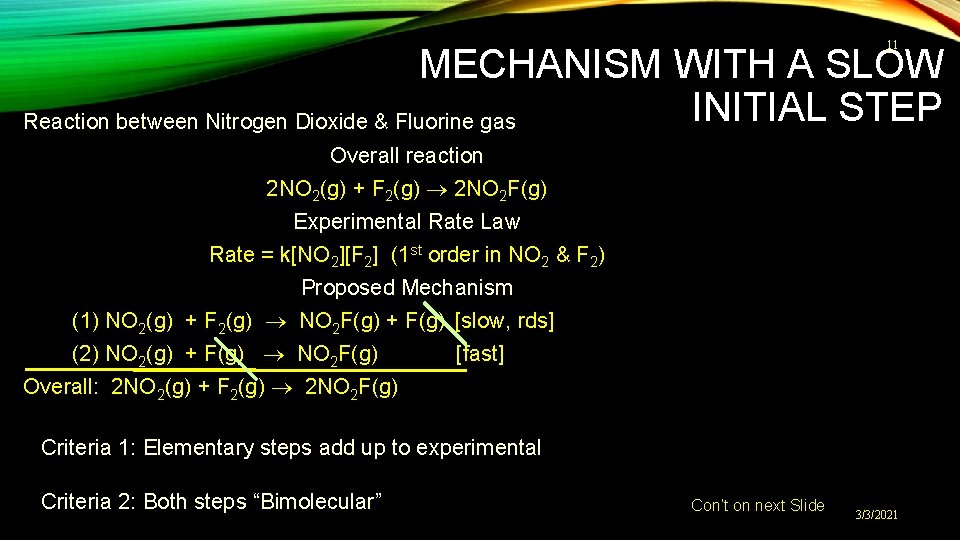
11 MECHANISM WITH A SLOW INITIAL STEP Reaction between Nitrogen Dioxide & Fluorine gas Overall reaction 2 NO 2(g) + F 2(g) 2 NO 2 F(g) Experimental Rate Law Rate = k[NO 2][F 2] (1 st order in NO 2 & F 2) Proposed Mechanism (1) NO 2(g) + F 2(g) NO 2 F(g) + F(g) [slow, rds] (2) NO 2(g) + F(g) NO 2 F(g) [fast] Overall: 2 NO 2(g) + F 2(g) 2 NO 2 F(g) Criteria 1: Elementary steps add up to experimental Criteria 2: Both steps “Bimolecular” Con’t on next Slide 3/3/2021
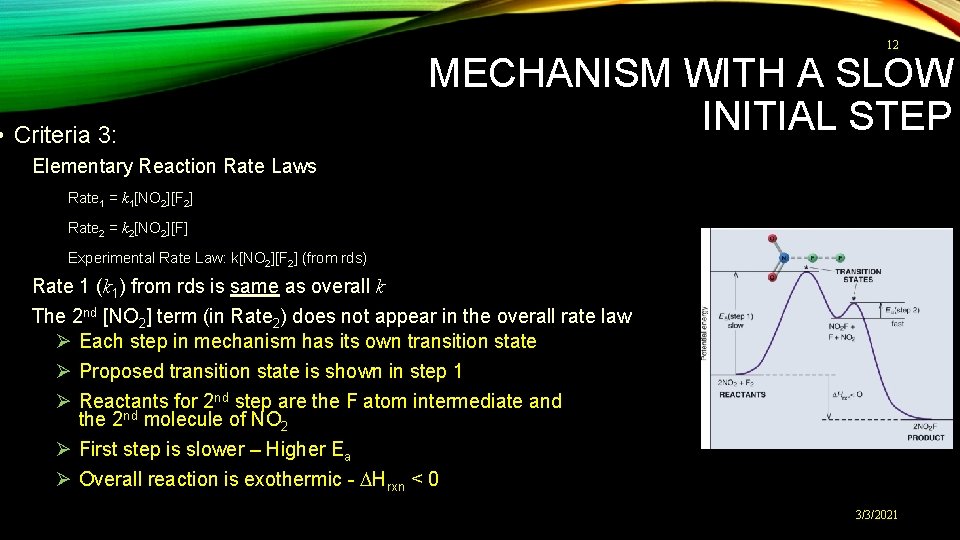
12 • Criteria 3: MECHANISM WITH A SLOW INITIAL STEP Elementary Reaction Rate Laws Rate 1 = k 1[NO 2][F 2] Rate 2 = k 2[NO 2][F] Experimental Rate Law: k[NO 2][F 2] (from rds) Rate 1 (k 1) from rds is same as overall k The 2 nd [NO 2] term (in Rate 2) does not appear in the overall rate law Ø Each step in mechanism has its own transition state Ø Proposed transition state is shown in step 1 Ø Reactants for 2 nd step are the F atom intermediate and the 2 nd molecule of NO 2 Ø First step is slower – Higher Ea Ø Overall reaction is exothermic - Hrxn < 0 3/3/2021
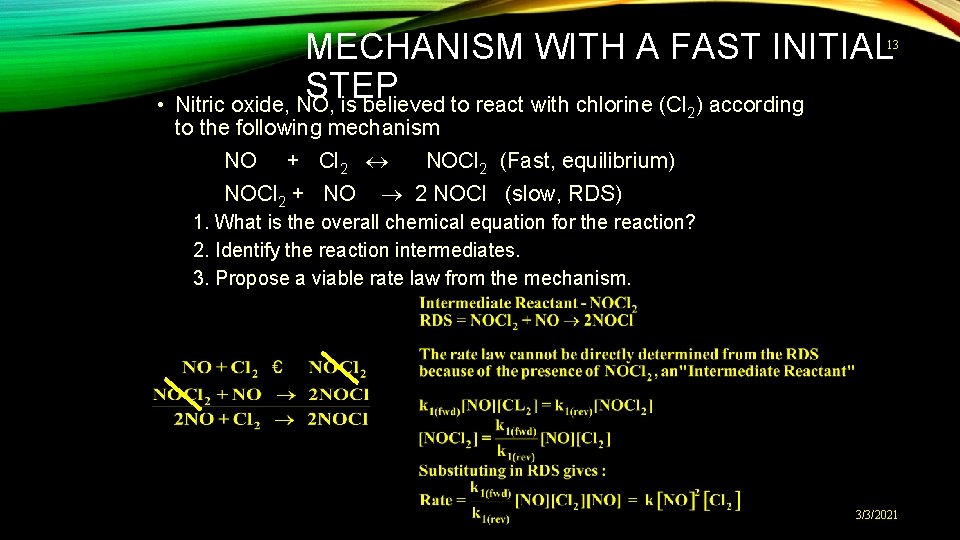
MECHANISM WITH A FAST INITIAL STEP • Nitric oxide, NO, is believed to react with chlorine (Cl ) according 13 to the following mechanism NO + Cl 2 NOCl 2 (Fast, equilibrium) NOCl 2 + NO 2 NOCl (slow, RDS) 2 1. What is the overall chemical equation for the reaction? 2. Identify the reaction intermediates. 3. Propose a viable rate law from the mechanism. 3/3/2021
14 CATALYSIS – SPEEDING UP REACTION • It is often necessary to “Speed up” a reaction in order to make it useful and in the case of industry, profitable • Approaches • More energy (heat) – could be expensive!! • Catalyst – Stoichiometrically small amount of a substance that increases the rate of a reaction; it is involved in the reaction, but ultimately is not consumed 3/3/2021
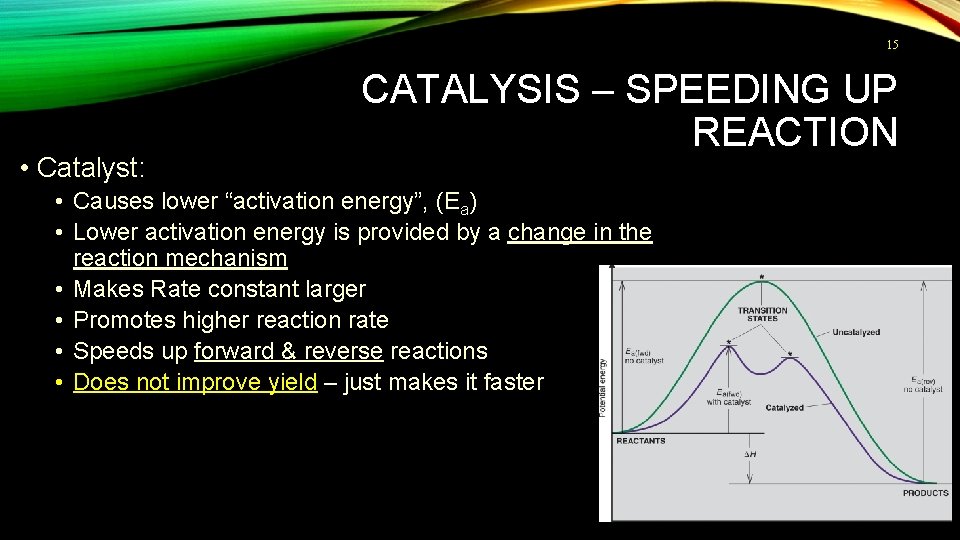
15 • Catalyst: CATALYSIS – SPEEDING UP REACTION • Causes lower “activation energy”, (Ea) • Lower activation energy is provided by a change in the reaction mechanism • Makes Rate constant larger • Promotes higher reaction rate • Speeds up forward & reverse reactions • Does not improve yield – just makes it faster 3/3/2021
16 HOMOGENEOUS CATALYSTS • Homogeneous Catalysts • Exist in “Solution” with the reactant mixture • All homogenous catalysts are gases, liquids, or “soluble” solids • Speeds up a reaction that occurs in a separate phase • Ex. A solid interacting with gaseous or liquid reactants • The solid would have extremely large surface area for contact • If the rate-determining step occurs on the surface of the catalyst, many reactions are zero order, because once the surface area is covered by the reactant, increasing the concentration has no effect on the rate 3/3/2021
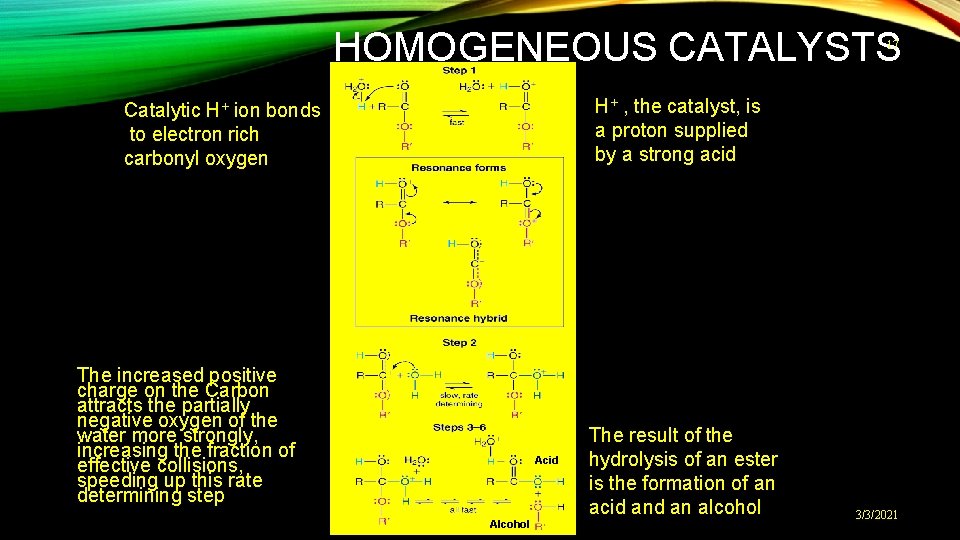
HOMOGENEOUS CATALYSTS 17 H+ , the catalyst, is a proton supplied by a strong acid Catalytic H+ ion bonds to electron rich carbonyl oxygen The increased positive charge on the Carbon attracts the partially negative oxygen of the water more strongly, increasing the fraction of effective collisions, speeding up this rate determining step Acid Alcohol The result of the hydrolysis of an ester is the formation of an acid an alcohol 3/3/2021
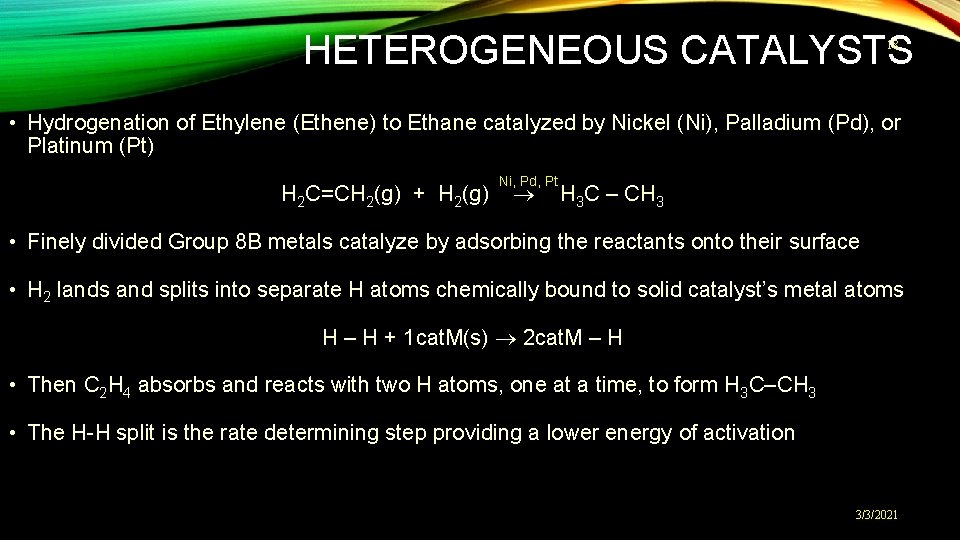
HETEROGENEOUS CATALYSTS 18 • Hydrogenation of Ethylene (Ethene) to Ethane catalyzed by Nickel (Ni), Palladium (Pd), or Platinum (Pt) H 2 C=CH 2(g) + H 2(g) Ni, Pd, Pt H 3 C – CH 3 • Finely divided Group 8 B metals catalyze by adsorbing the reactants onto their surface • H 2 lands and splits into separate H atoms chemically bound to solid catalyst’s metal atoms H – H + 1 cat. M(s) 2 cat. M – H • Then C 2 H 4 absorbs and reacts with two H atoms, one at a time, to form H 3 C–CH 3 • The H-H split is the rate determining step providing a lower energy of activation 3/3/2021
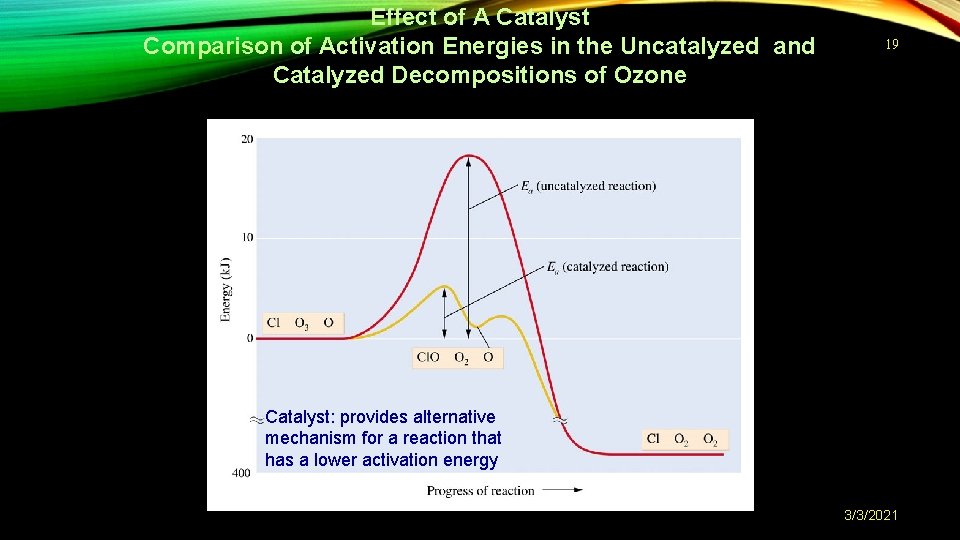
Effect of A Catalyst Comparison of Activation Energies in the Uncatalyzed and Catalyzed Decompositions of Ozone 19 Catalyst: provides alternative mechanism for a reaction that has a lower activation energy 3/3/2021
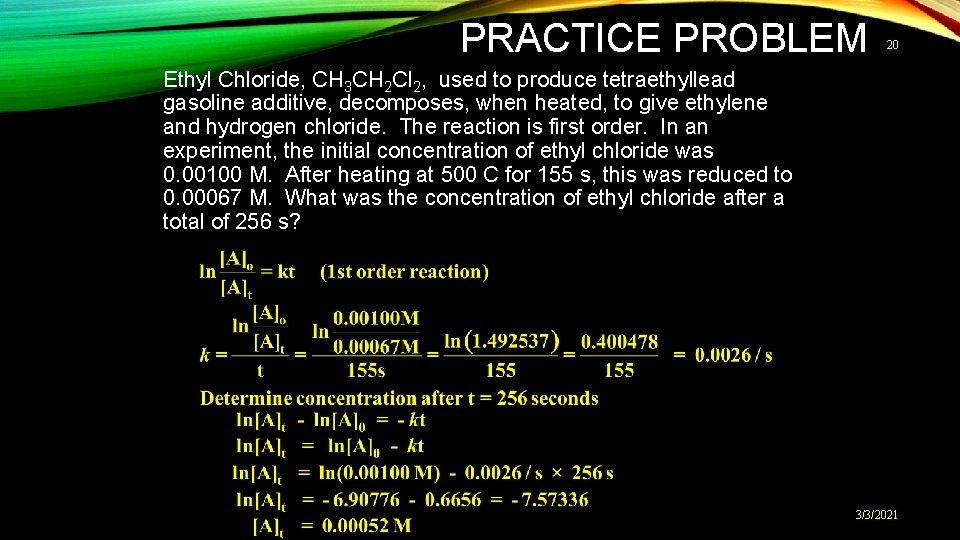
PRACTICE PROBLEM 20 Ethyl Chloride, CH 3 CH 2 Cl 2, used to produce tetraethyllead gasoline additive, decomposes, when heated, to give ethylene and hydrogen chloride. The reaction is first order. In an experiment, the initial concentration of ethyl chloride was 0. 00100 M. After heating at 500 C for 155 s, this was reduced to 0. 00067 M. What was the concentration of ethyl chloride after a total of 256 s? 3/3/2021
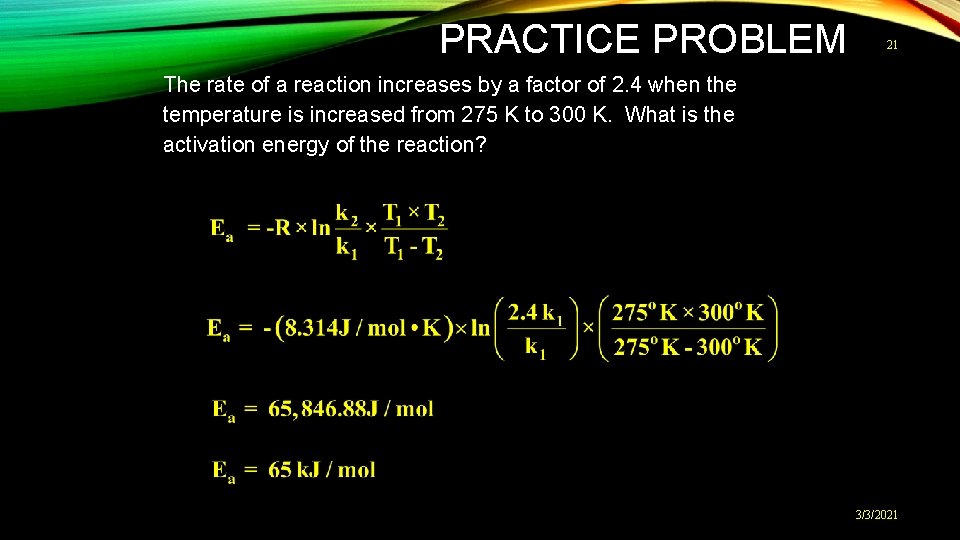
PRACTICE PROBLEM 21 The rate of a reaction increases by a factor of 2. 4 when the temperature is increased from 275 K to 300 K. What is the activation energy of the reaction? 3/3/2021
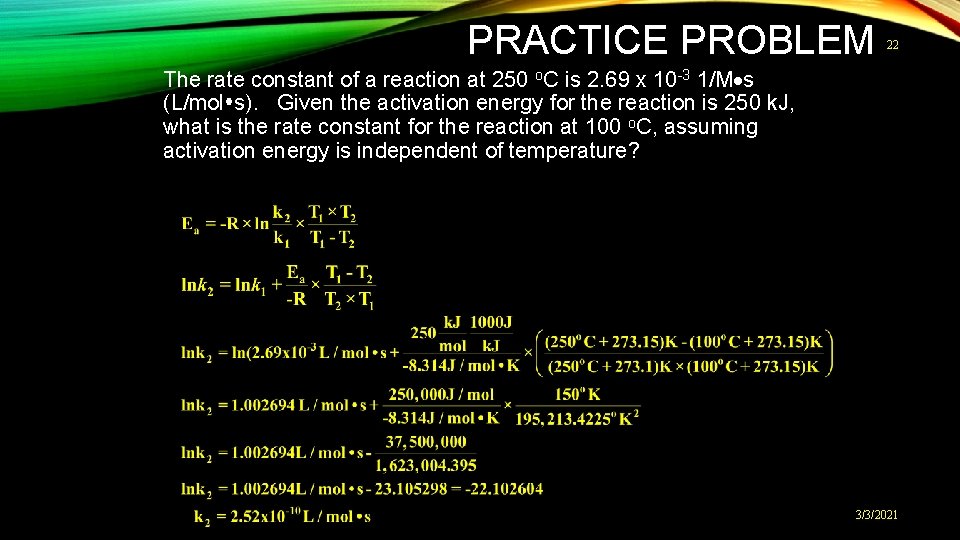
PRACTICE PROBLEM 22 The rate constant of a reaction at 250 o. C is 2. 69 x 10 -3 1/M s (L/mol s). Given the activation energy for the reaction is 250 k. J, what is the rate constant for the reaction at 100 o. C, assuming activation energy is independent of temperature? 3/3/2021
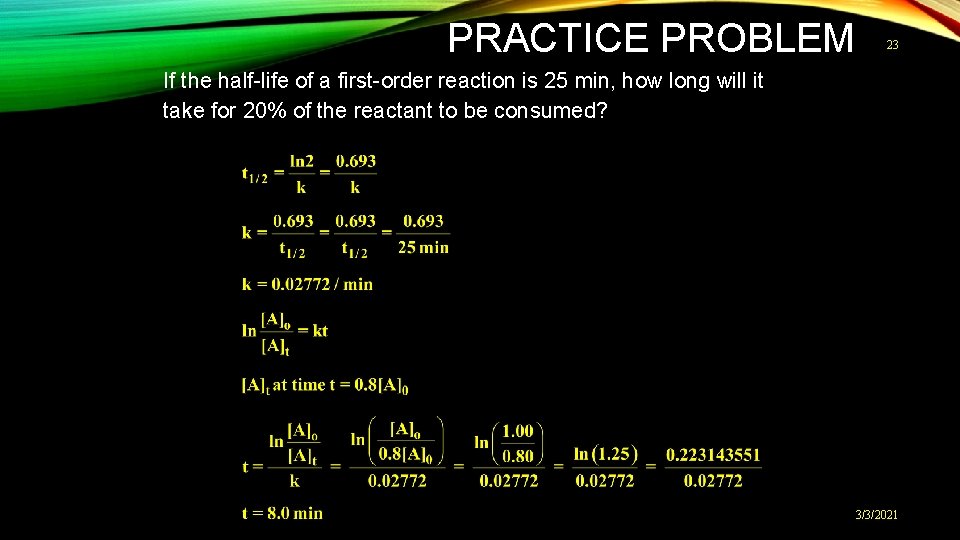
PRACTICE PROBLEM 23 If the half-life of a first-order reaction is 25 min, how long will it take for 20% of the reactant to be consumed? 3/3/2021
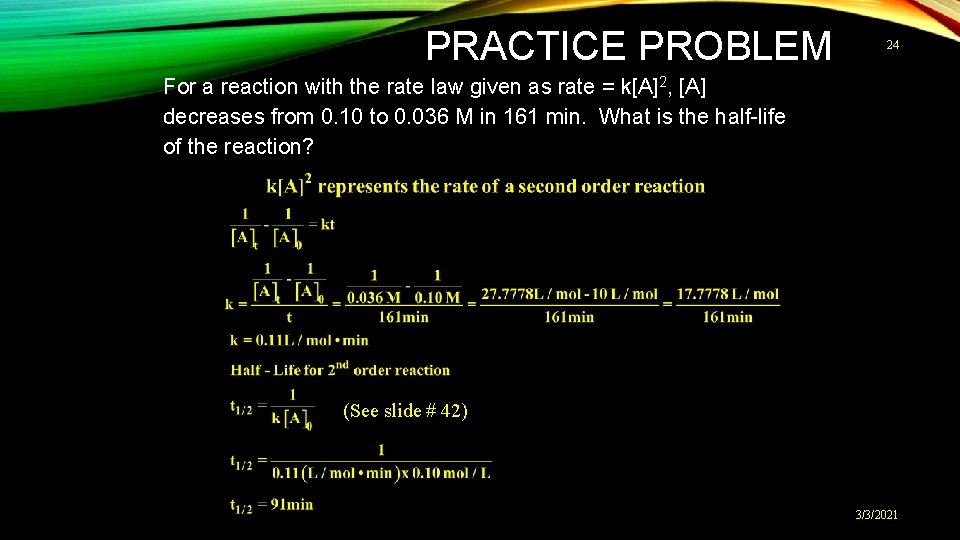
PRACTICE PROBLEM 24 For a reaction with the rate law given as rate = k[A]2, [A] decreases from 0. 10 to 0. 036 M in 161 min. What is the half-life of the reaction? (See slide # 42) 3/3/2021
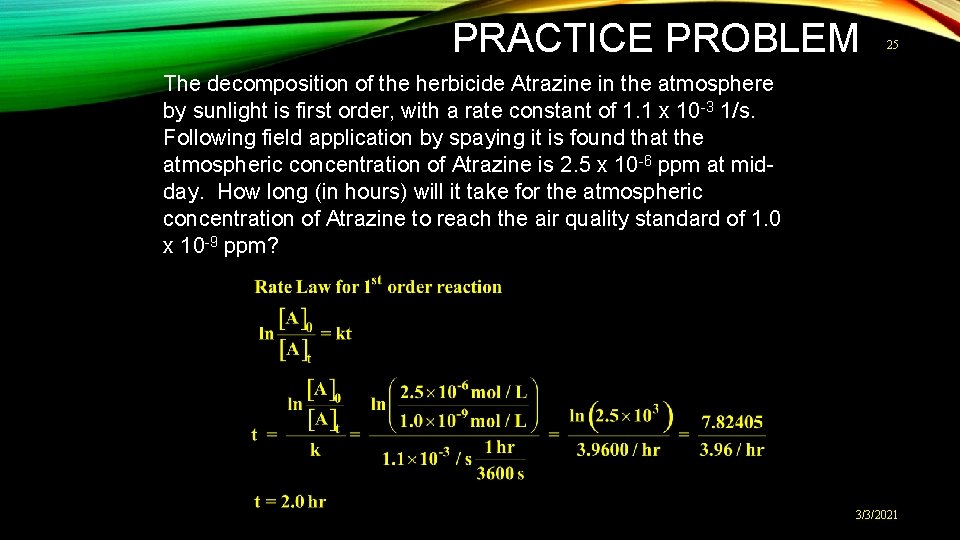
PRACTICE PROBLEM 25 The decomposition of the herbicide Atrazine in the atmosphere by sunlight is first order, with a rate constant of 1. 1 x 10 -3 1/s. Following field application by spaying it is found that the atmospheric concentration of Atrazine is 2. 5 x 10 -6 ppm at midday. How long (in hours) will it take for the atmospheric concentration of Atrazine to reach the air quality standard of 1. 0 x 10 -9 ppm? 3/3/2021
PRACTICE PROBLEM 26 The indirect photolysis of the pesticide Atrazine (Atr, C 8 H 14 Cl. N 5) in air by hydroxyl radical (OH) is shown below C 8 H 14 Cl. N 5 + OH C 8 H 13 Cl. N 5 + H 2 O The reaction is second order and follows the rate law: [Atr]/ t = kph[Atr][OH] The concentration of OH is at steady-state during daylight hours at ~1. 0 x 10 -18 M, and kph is 5. 0 x 1015 1/M s. How long (in min) will it take for Atr to decrease from 2. 5 x 10 -15 M to 1. 0 x 10 -18 M (the air quality criteria) following application to a golf course assuming pseudo-first-order kinetics during daylight? a. 26 b. 1. 8 c. 527 d. 4, 218 e. 119 Solution on next Slide 3/3/2021
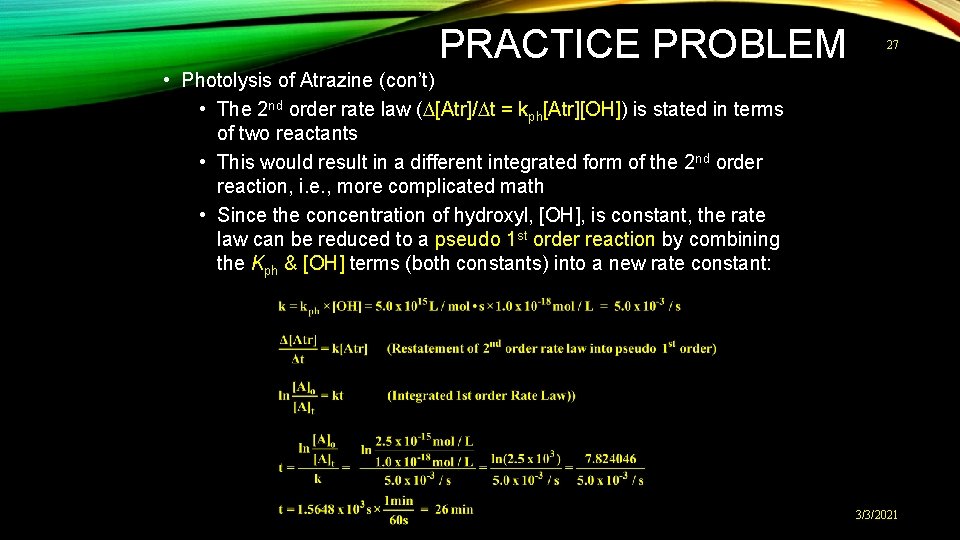
PRACTICE PROBLEM 27 • Photolysis of Atrazine (con’t) • The 2 nd order rate law ( [Atr]/ t = kph[Atr][OH]) is stated in terms of two reactants • This would result in a different integrated form of the 2 nd order reaction, i. e. , more complicated math • Since the concentration of hydroxyl, [OH], is constant, the rate law can be reduced to a pseudo 1 st order reaction by combining the Kph & [OH] terms (both constants) into a new rate constant: 3/3/2021
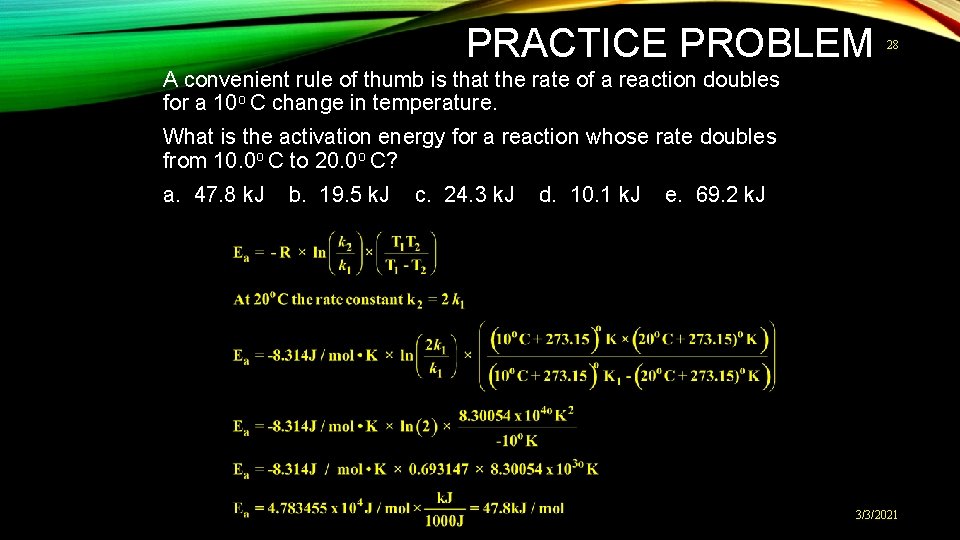
PRACTICE PROBLEM 28 A convenient rule of thumb is that the rate of a reaction doubles for a 10 o C change in temperature. What is the activation energy for a reaction whose rate doubles from 10. 0 o C to 20. 0 o C? a. 47. 8 k. J b. 19. 5 k. J c. 24. 3 k. J d. 10. 1 k. J e. 69. 2 k. J 3/3/2021
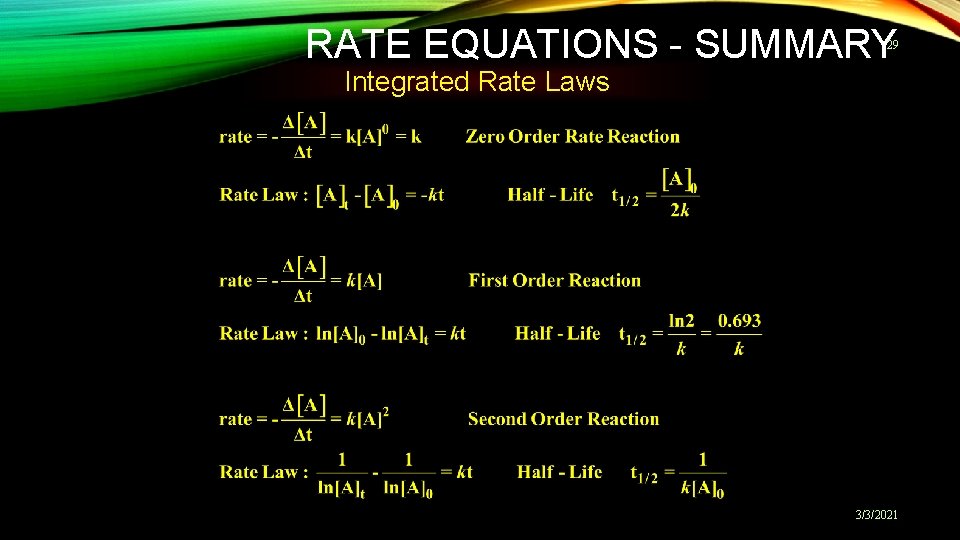
RATE EQUATIONS - SUMMARY 29 Integrated Rate Laws 3/3/2021
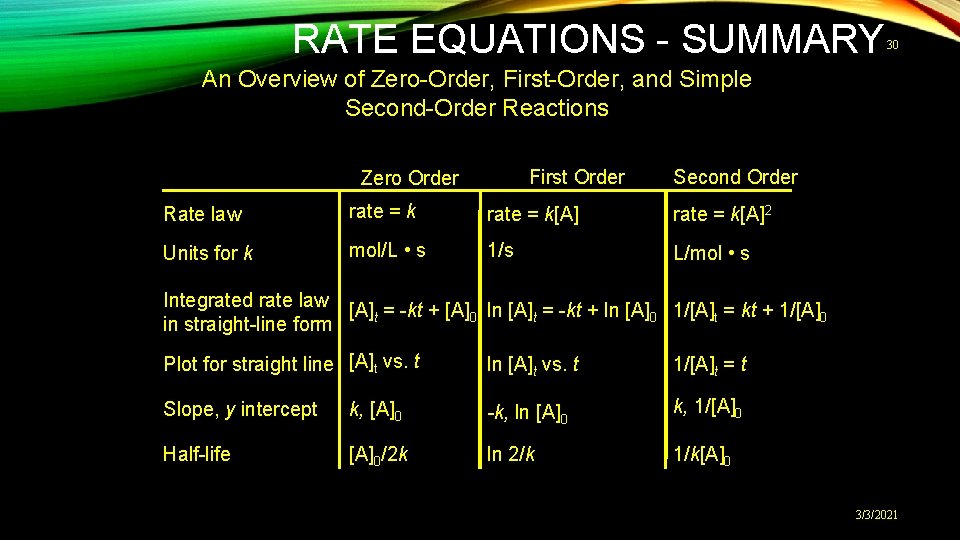
RATE EQUATIONS - SUMMARY 30 An Overview of Zero-Order, First-Order, and Simple Second-Order Reactions First Order Zero Order Second Order Rate law rate = k[A]2 Units for k mol/L • s 1/s L/mol • s Integrated rate law [A] = -kt + [A] ln [A] = -kt + ln [A] 1/[A] = kt + 1/[A] t 0 t 0 in straight-line form Plot for straight line [A]t vs. t ln [A]t vs. t 1/[A]t = t Slope, y intercept k, [A]0 -k, ln [A]0 k, 1/[A]0 Half-life [A]0/2 k ln 2/k 1/k[A]0 3/3/2021
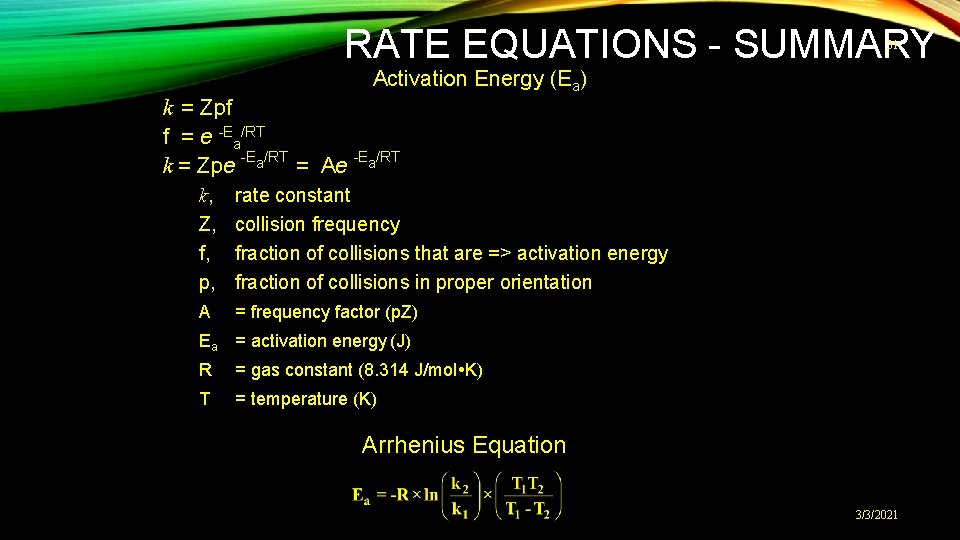
RATE EQUATIONS - SUMMARY 31 Activation Energy (Ea) k = Zpf f = e -Ea/RT k = Zpe -Ea/RT = Ae -Ea/RT k, Z, f, p, rate constant collision frequency fraction of collisions that are => activation energy fraction of collisions in proper orientation A = frequency factor (p. Z) Ea = activation energy (J) R = gas constant (8. 314 J/mol K) T = temperature (K) Arrhenius Equation 3/3/2021
- Slides: 31