
Reaction kinetics By A S Adebayo Ph D
Reaction kinetics By A. S. Adebayo, Ph. D. 9/9/2020 11: 39 AM 1
KINETICS l Applications l Chemical reactions such as decomposition of medicinal compounds l Processes of drug absorption, distribution and elimination from the body l Shelf life determination. 9/9/2020 11: 39 AM 2
Shelf life determination l l l In determining the shelf life of a preparation, tests are carried out on the active ingredient, the additives and the finished product to determine: Whether decomposition will occur The type of decomposition Factors that affect the rate of decomposition such as light, air, moisture, temperature, etc. The influence of formulation additives The rate at which breakdown occurs. 9/9/2020 11: 39 AM 3
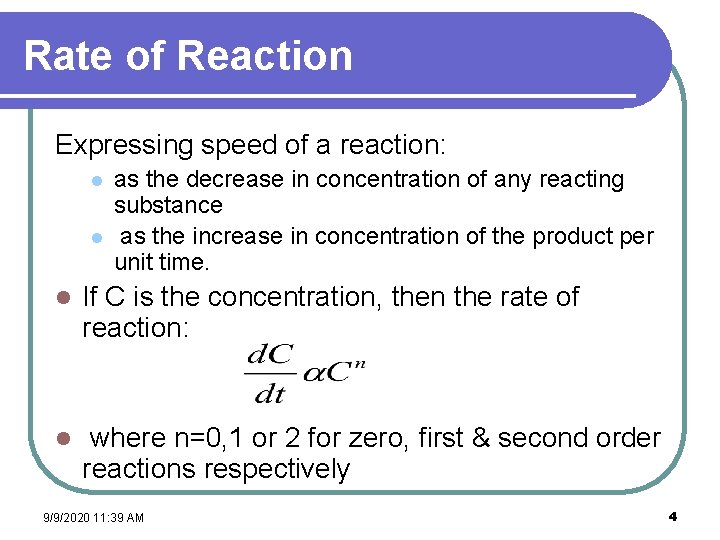
Rate of Reaction Expressing speed of a reaction: l l as the decrease in concentration of any reacting substance as the increase in concentration of the product per unit time. l If C is the concentration, then the rate of reaction: l where n=0, 1 or 2 for zero, first & second order reactions respectively 9/9/2020 11: 39 AM 4
Order of Reaction l Manner in which the rate of reaction varies with the concentration of the reactants l Most processes involving ADME can be treated as first- order processes l Some drug degradation processes can be treated as either First or zero order processes l Some drug substances obey Michaelis. Menten kinetic process 9/9/2020 11: 39 AM 5
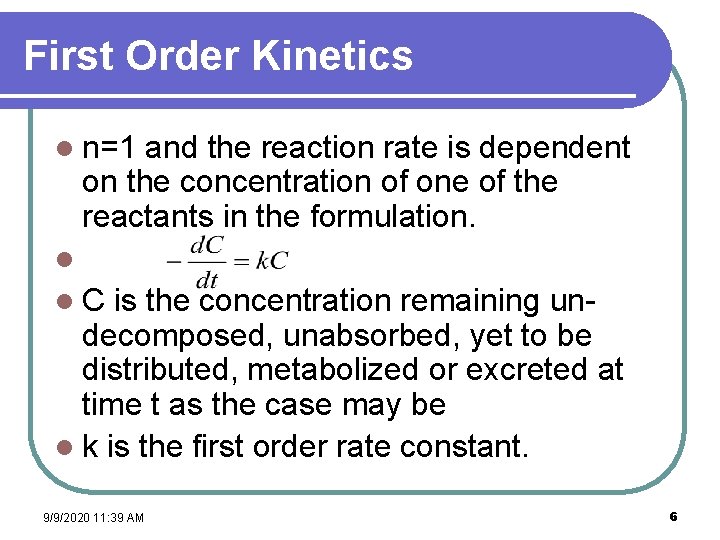
First Order Kinetics l n=1 and the reaction rate is dependent on the concentration of one of the reactants in the formulation. l l. C is the concentration remaining undecomposed, unabsorbed, yet to be distributed, metabolized or excreted at time t as the case may be l k is the first order rate constant. 9/9/2020 11: 39 AM 6
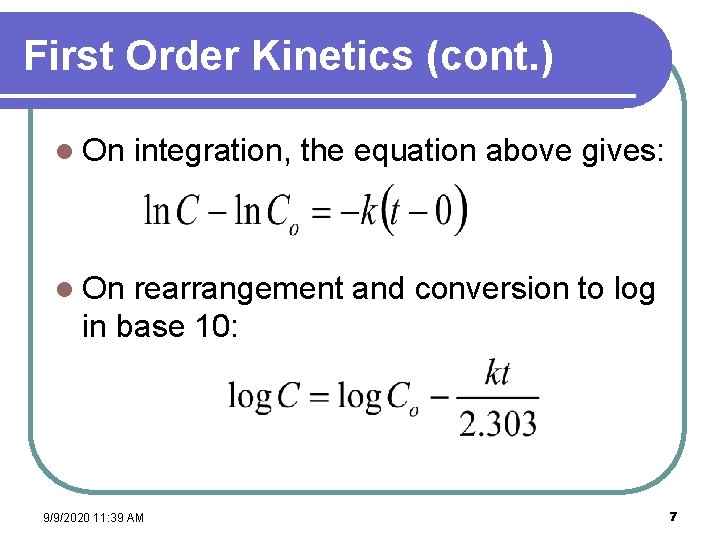
First Order Kinetics (cont. ) l On integration, the equation above gives: l On rearrangement and conversion to log in base 10: 9/9/2020 11: 39 AM 7
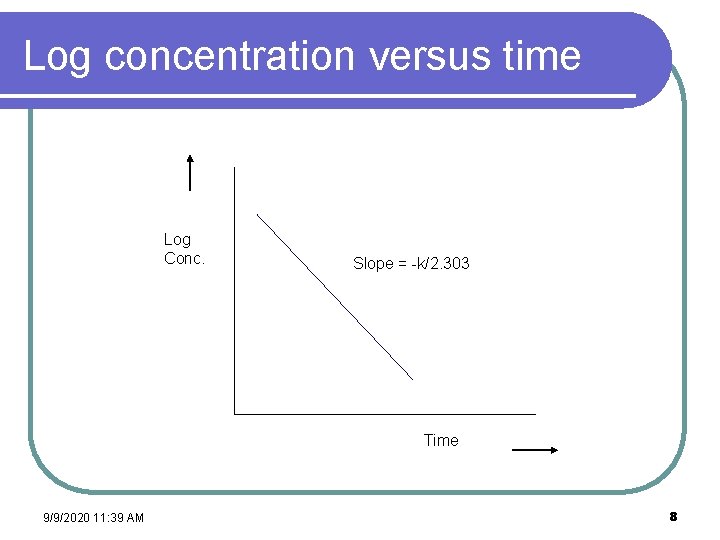
Log concentration versus time Log Conc. Slope = -k/2. 303 Time 9/9/2020 11: 39 AM 8
Exercises? ? l Determine the expression for rate constant, k l Determine the expression for process half-life, t 1/2 l Write the exponential forms of the equation in natural log and log in base 10. l What is the significance of process halflife? 9/9/2020 11: 39 AM 9
Zero order reaction l In this type of reaction, n=o and the reaction rate is independent of the concentration of the reacting substance. l The rate of change is constant. l Here, factors other than concentration of reactants constitute the limiting factor e. g. solubility or absorption of light (photochemical reactions). 9/9/2020 11: 39 AM 10
Zero order reaction (cont. ) l When solubility is the limiting factor, only the proportion of drug in solution undergoes degradation: As the drug is consumed in the degradative reaction, more drug goes into solution until all solid (C) has reacted. l Until this happened, the degradation process will not be dependent on the total conc. of drug but on the proportion in solution, thereby producing a zero order process. l 9/9/2020 11: 39 AM 11
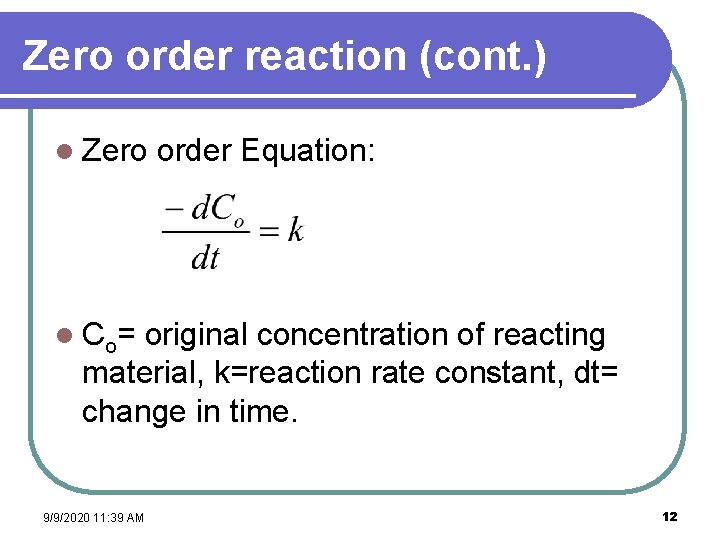
Zero order reaction (cont. ) l Zero order Equation: l C o= original concentration of reacting material, k=reaction rate constant, dt= change in time. 9/9/2020 11: 39 AM 12
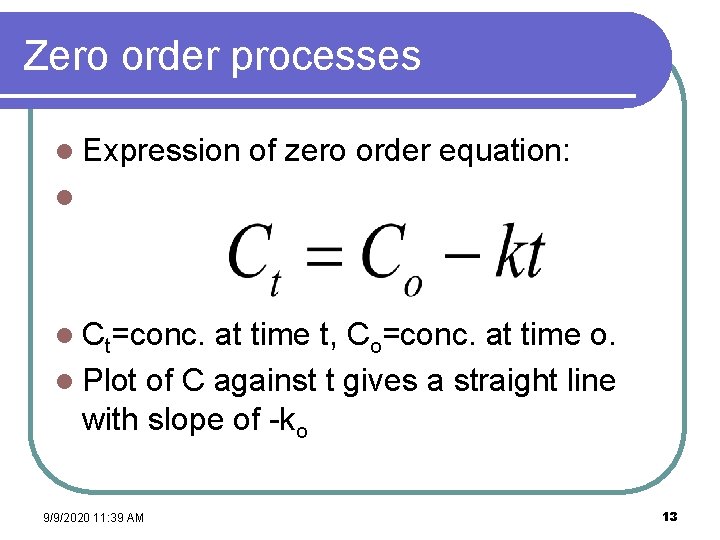
Zero order processes l Expression of zero order equation: l l Ct=conc. at time t, Co=conc. at time o. l Plot of C against t gives a straight line with slope of -ko 9/9/2020 11: 39 AM 13
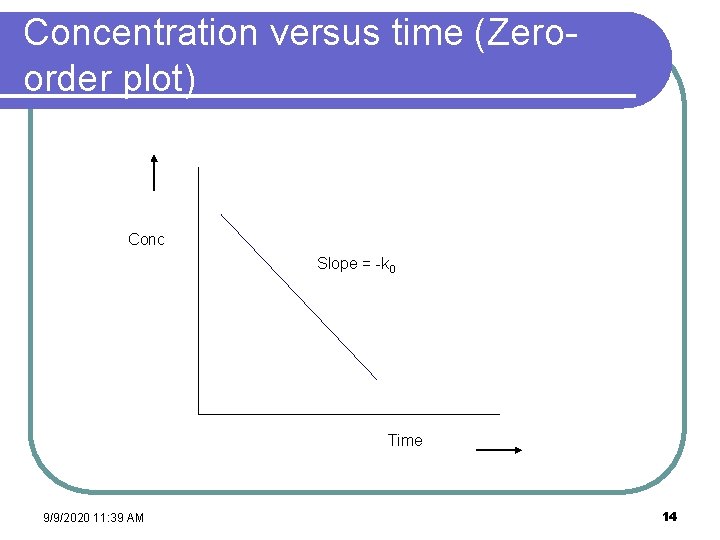
Concentration versus time (Zeroorder plot) Conc Slope = -k 0 Time 9/9/2020 11: 39 AM 14
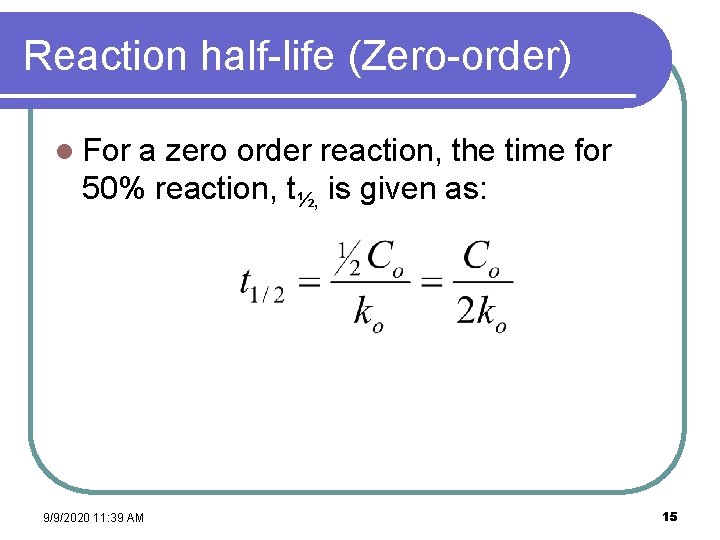
Reaction half-life (Zero-order) l For a zero order reaction, the time for 50% reaction, t½, is given as: 9/9/2020 11: 39 AM 15
Apparent Zero Order Reaction Kinetics Suspensions are a special case of zero order kinetics, in which the concentration of drug in solution depends on its solubility. l As the drug in solution decomposes, more of it is released from a reservoir of suspended particles thereby making the concentration in solution constant. l The effective concentration is the drug equilibrium solubility in the solvent of formulation at given temperatures l 9/9/2020 11: 39 AM 16
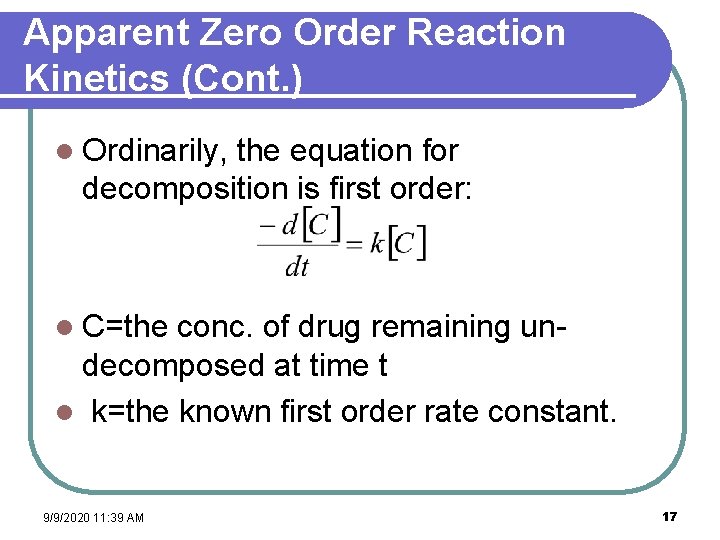
Apparent Zero Order Reaction Kinetics (Cont. ) l Ordinarily, the equation for decomposition is first order: l C=the conc. of drug remaining undecomposed at time t l k=the known first order rate constant. 9/9/2020 11: 39 AM 17
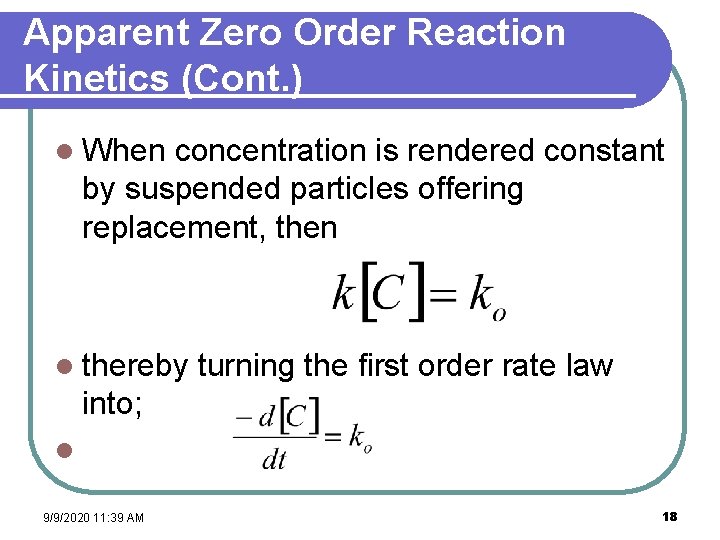
Apparent Zero Order Reaction Kinetics (Cont. ) l When concentration is rendered constant by suspended particles offering replacement, then l thereby turning the first order rate law into; l 9/9/2020 11: 39 AM 18
Chemical instability l Can present as; l l Loss of potency Accumulation of toxic degradative products Degrardation of excipient responsible for product stability e. g. emulsifying agents, preservatives Conspicuous colour change e. g. marked discoloration of adrenaline although very slight change in adrenaline content, is unacceptable to patients, pharmacists, physicians and the nurses. 9/9/2020 11: 39 AM 19
Solid state versus solution stability l Generally, chemical reactions proceed more readily in liquid state than in solid state l Serious stability problems are more commonly encountered in liquid medicines e. g. order of dosage form stability is generally: solution < suspension < tablet. 9/9/2020 11: 39 AM 20
Determination of Order of Reaction Use of rate equation – The data collected in a kinetic reaction should be substituted into the integrated form of equations of various orders. l l The process under test should be considered to be of that order where the calculated k value remains constant within limits of experimental error. 9/9/2020 11: 39 AM 21
Determination of Order of Reaction. . Half life method – For a zero order or pseudo first order reaction, t ½ is proportional to initial concentration of reactant (Co), l t½ for a first order reaction is independent of Co, . l Graphical method – For a zero order or pseudo first order reaction, plot of C vs. t is linear; for first order reaction, plot of log (Co-Ct) vs. t is linear. l 9/9/2020 11: 39 AM 22
Factors Affecting Rate of Reactions l The rate of reaction (degradation of pharmaceutical products) can be influenced l l l l temperature, moisture, solvent (p. H, dielectric constant, etc), light (radiation), catalysts, oxygen and concentration of reactant (s). 9/9/2020 11: 39 AM 23
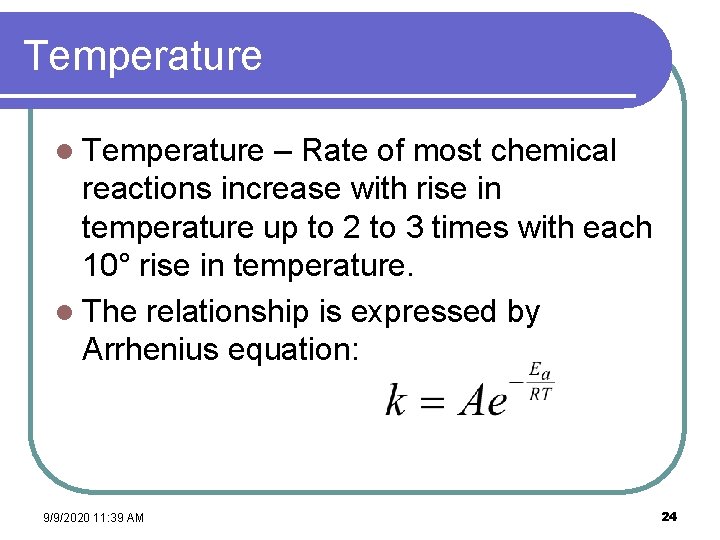
Temperature l Temperature – Rate of most chemical reactions increase with rise in temperature up to 2 to 3 times with each 10° rise in temperature. l The relationship is expressed by Arrhenius equation: 9/9/2020 11: 39 AM 24
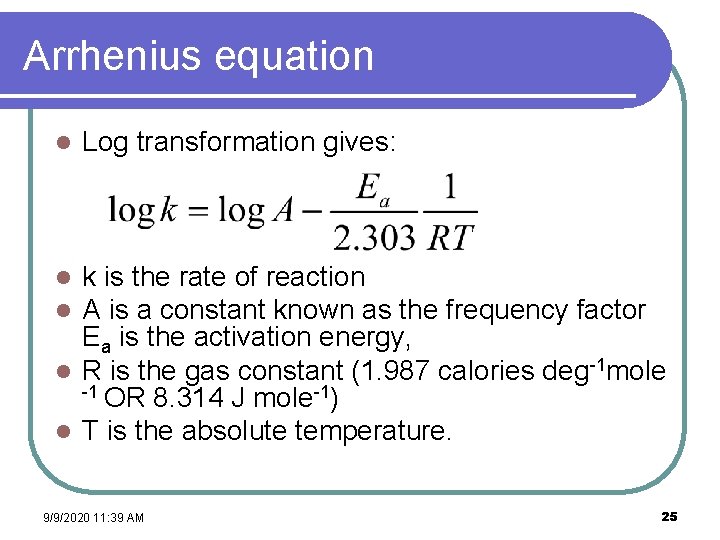
Arrhenius equation l Log transformation gives: k is the rate of reaction A is a constant known as the frequency factor Ea is the activation energy, l R is the gas constant (1. 987 calories deg-1 mole -1 OR 8. 314 J mole-1) l T is the absolute temperature. l l 9/9/2020 11: 39 AM 25
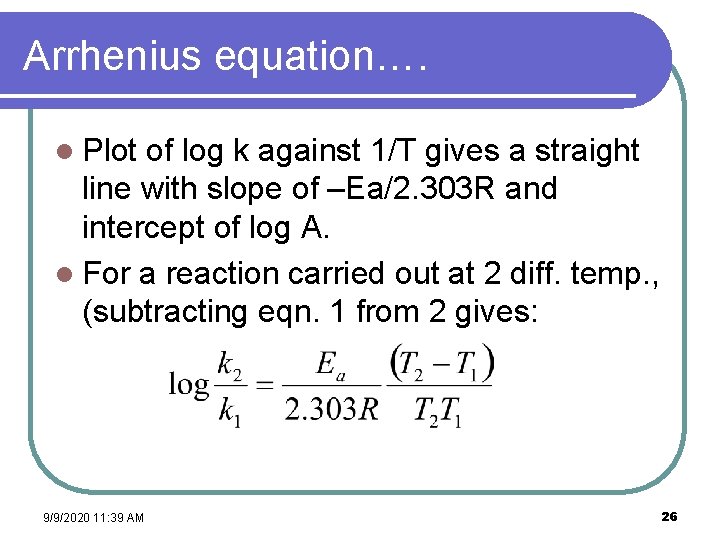
Arrhenius equation…. l Plot of log k against 1/T gives a straight line with slope of –Ea/2. 303 R and intercept of log A. l For a reaction carried out at 2 diff. temp. , (subtracting eqn. 1 from 2 gives: 9/9/2020 11: 39 AM 26
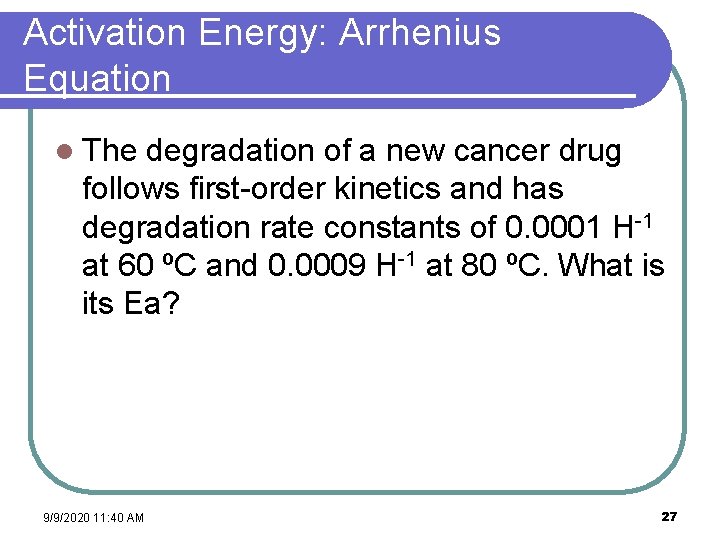
Activation Energy: Arrhenius Equation l The degradation of a new cancer drug follows first-order kinetics and has degradation rate constants of 0. 0001 H-1 at 60 ºC and 0. 0009 H-1 at 80 ºC. What is its Ea? 9/9/2020 11: 40 AM 27
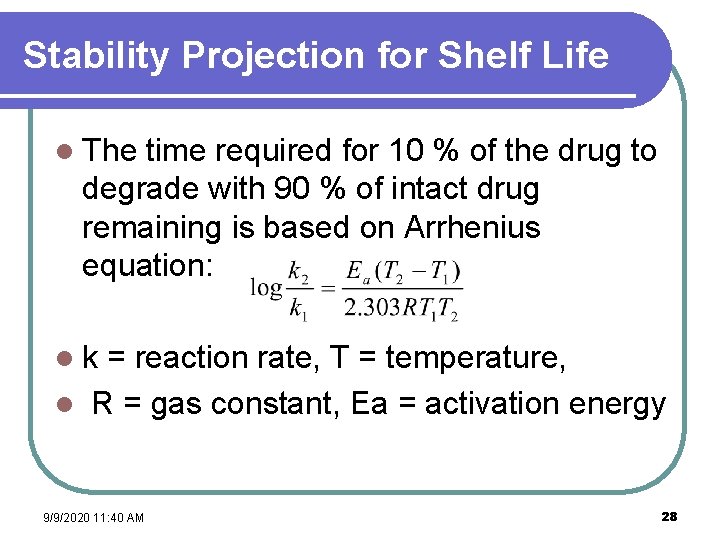
Stability Projection for Shelf Life l The time required for 10 % of the drug to degrade with 90 % of intact drug remaining is based on Arrhenius equation: lk = reaction rate, T = temperature, l R = gas constant, Ea = activation energy 9/9/2020 11: 40 AM 28
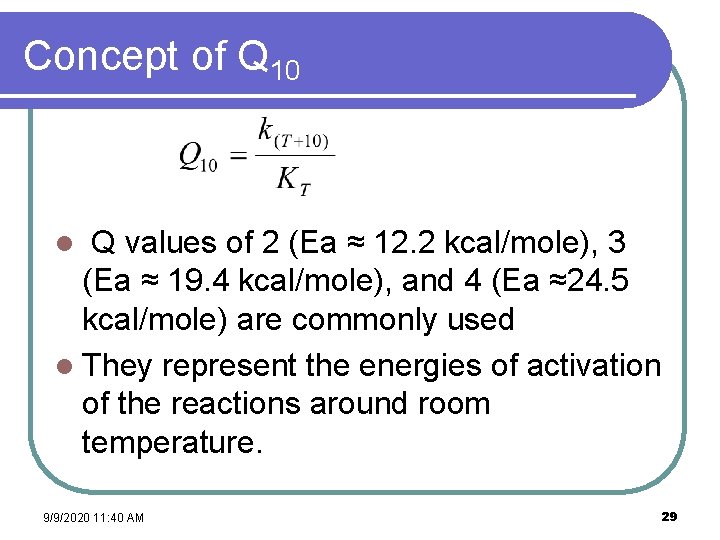
Concept of Q 10 Q values of 2 (Ea ≈ 12. 2 kcal/mole), 3 (Ea ≈ 19. 4 kcal/mole), and 4 (Ea ≈24. 5 kcal/mole) are commonly used l They represent the energies of activation of the reactions around room temperature. l 9/9/2020 11: 40 AM 29
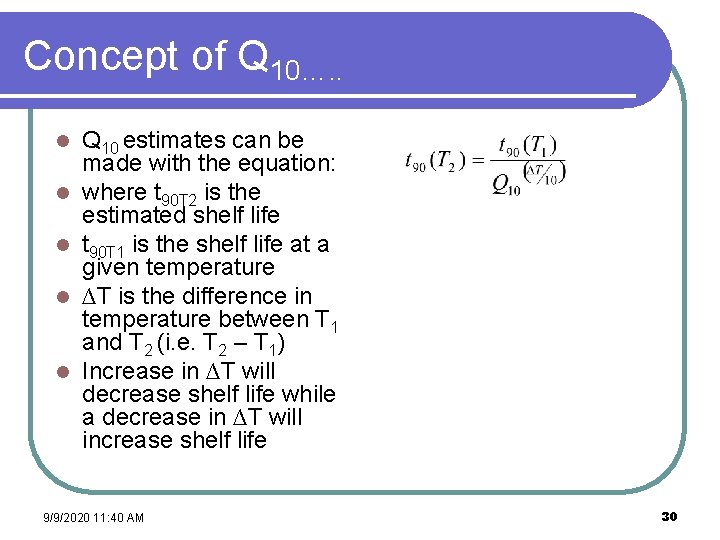
Concept of Q 10…. . l l l Q 10 estimates can be made with the equation: where t 90 T 2 is the estimated shelf life t 90 T 1 is the shelf life at a given temperature ∆T is the difference in temperature between T 1 and T 2 (i. e. T 2 – T 1) Increase in ∆T will decrease shelf life while a decrease in ∆T will increase shelf life 9/9/2020 11: 40 AM 30
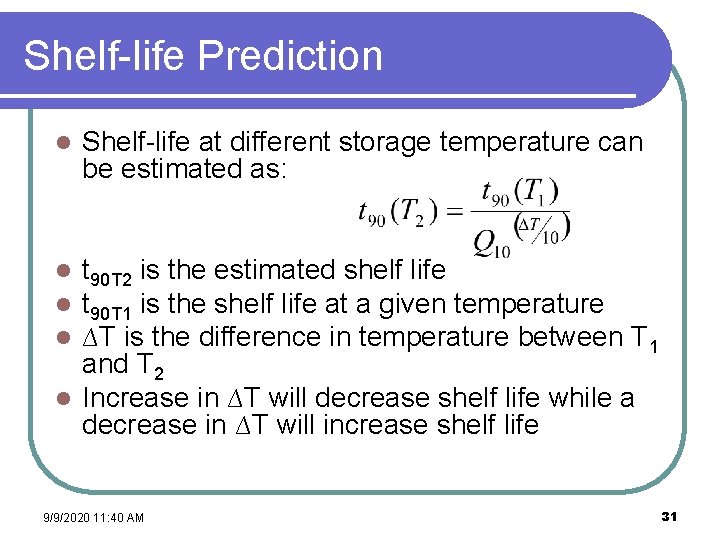
Shelf-life Prediction l Shelf-life at different storage temperature can be estimated as: l t 90 T 2 is the estimated shelf life l t 90 T 1 is the shelf life at a given temperature l ∆T is the difference in temperature between T 1 and T 2 l Increase in ∆T will decrease shelf life while a decrease in ∆T will increase shelf life 9/9/2020 11: 40 AM 31
TUTORIAL QUESTIONS 1 2 3 An ophthalmic solution has a shelf life of 6 hours at room temperature (25 °C). Calculate the estimated shelf-life in a refrigerator (5 °C) An antibiotic has a shelf life of 48 hours in the refrigerator (5 °C). What is its estimated shelf -life at room temperature (25 °C)? In what ways can chemical instability be manifested on formulated products? List and discuss four main types of reactions involved in chemical degradation. 9/9/2020 11: 40 AM 32
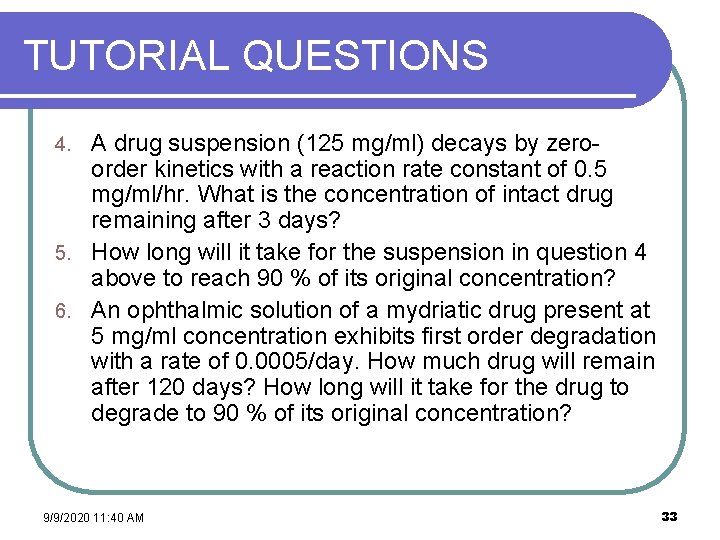
TUTORIAL QUESTIONS A drug suspension (125 mg/ml) decays by zeroorder kinetics with a reaction rate constant of 0. 5 mg/ml/hr. What is the concentration of intact drug remaining after 3 days? 5. How long will it take for the suspension in question 4 above to reach 90 % of its original concentration? 6. An ophthalmic solution of a mydriatic drug present at 5 mg/ml concentration exhibits first order degradation with a rate of 0. 0005/day. How much drug will remain after 120 days? How long will it take for the drug to degrade to 90 % of its original concentration? 4. 9/9/2020 11: 40 AM 33
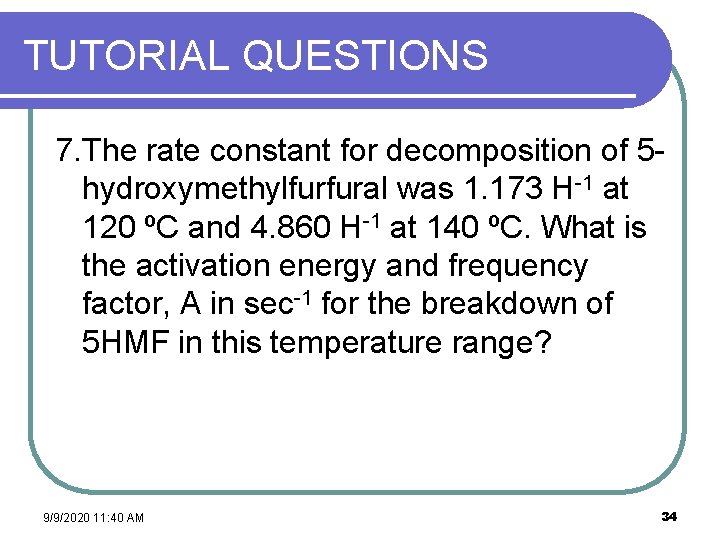
TUTORIAL QUESTIONS 7. The rate constant for decomposition of 5 hydroxymethylfurfural was 1. 173 H-1 at 120 ºC and 4. 860 H-1 at 140 ºC. What is the activation energy and frequency factor, A in sec-1 for the breakdown of 5 HMF in this temperature range? 9/9/2020 11: 40 AM 34
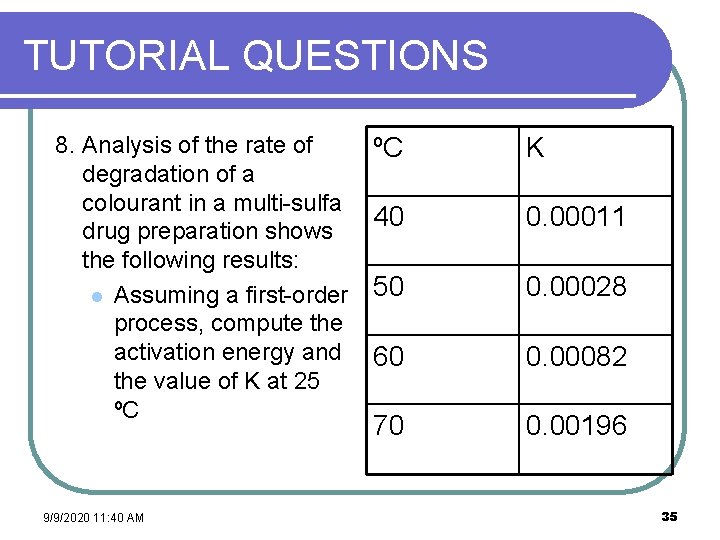
TUTORIAL QUESTIONS 8. Analysis of the rate of degradation of a colourant in a multi-sulfa drug preparation shows the following results: l Assuming a first-order process, compute the activation energy and the value of K at 25 ºC 9/9/2020 11: 40 AM ºC K 40 0. 00011 50 0. 00028 60 0. 00082 70 0. 00196 35
THANK YOU FOR YOUR ATTENTION 9/9/2020 11: 40 AM 36
- Slides: 36