
Reachability analysis Undecidability of Rectangular Hybrid Automata Sayan
Reachability analysis: Undecidability of Rectangular Hybrid Automata Sayan Mitra Verifying cyberphysical systems mitras@illinois. edu
![• Is this problem decidable? No • [Henz 95] Thomas Henzinger, Peter Kopke,](http://slidetodoc.com/presentation_image_h2/659f56ffbc9057e821b6f281b393f580/image-2.jpg "• Is this problem decidable? No • [Henz 95] Thomas Henzinger, Peter Kopke,")
• Is this problem decidable? No • [Henz 95] Thomas Henzinger, Peter Kopke, Anuj Puri, and Pravin Varaiya. What's Decidable About Hybrid Automata? . Journal of Computer and System Sciences, pages 373– 382. ACM Press, 1995. • We will see that the CSR problem for rectangular hybrid automata (RHA) is undecidable • This implies that automatic verification of invariants and safety properties is also impossible for this class of models • The result was shown by Henzinger et al. [1995] through a reduction from the Halting problem of two counter machines
Recall from review of computability theory •
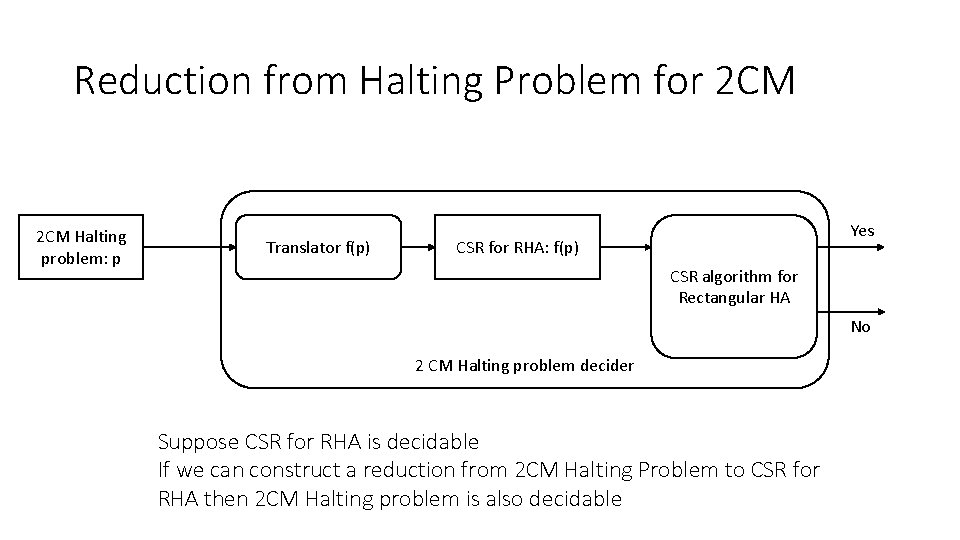
Reduction from Halting Problem for 2 CM Halting problem: p Translator f(p) Yes CSR for RHA: f(p) CSR algorithm for Rectangular HA No 2 CM Halting problem decider Suppose CSR for RHA is decidable If we can construct a reduction from 2 CM Halting Problem to CSR for RHA then 2 CM Halting problem is also decidable
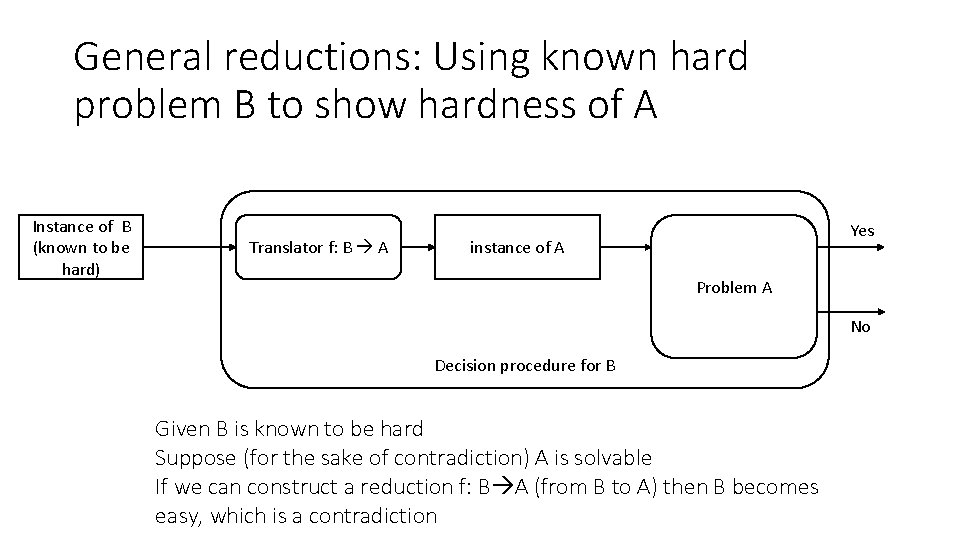
General reductions: Using known hard problem B to show hardness of A Instance of B (known to be hard) Translator f: B A Yes instance of A Problem A No Decision procedure for B Given B is known to be hard Suppose (for the sake of contradiction) A is solvable If we can construct a reduction f: B A (from B to A) then B becomes easy, which is a contradiction
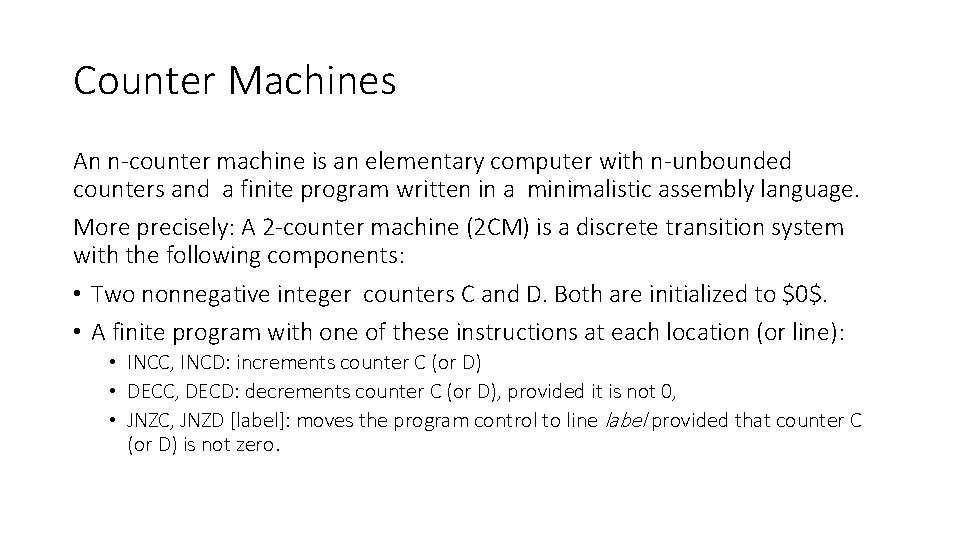
Counter Machines An n-counter machine is an elementary computer with n-unbounded counters and a finite program written in a minimalistic assembly language. More precisely: A 2 -counter machine (2 CM) is a discrete transition system with the following components: • Two nonnegative integer counters C and D. Both are initialized to $0$. • A finite program with one of these instructions at each location (or line): • INCC, INCD: increments counter C (or D) • DECC, DECD: decrements counter C (or D), provided it is not 0, • JNZC, JNZD [label]: moves the program control to line label provided that counter C (or D) is not zero.
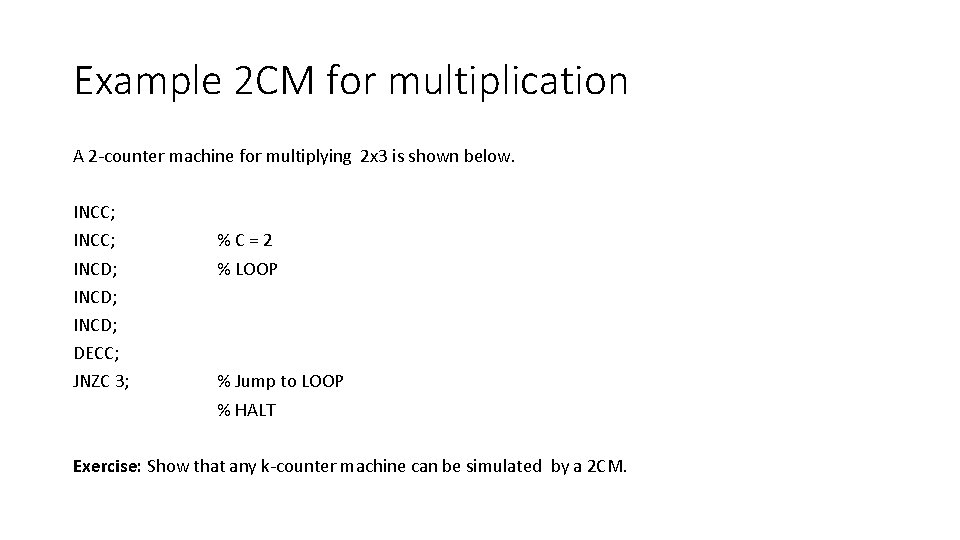
Example 2 CM for multiplication A 2 -counter machine for multiplying 2 x 3 is shown below. INCC; INCD; DECC; JNZC 3; %C=2 % LOOP % Jump to LOOP % HALT Exercise: Show that any k-counter machine can be simulated by a 2 CM.
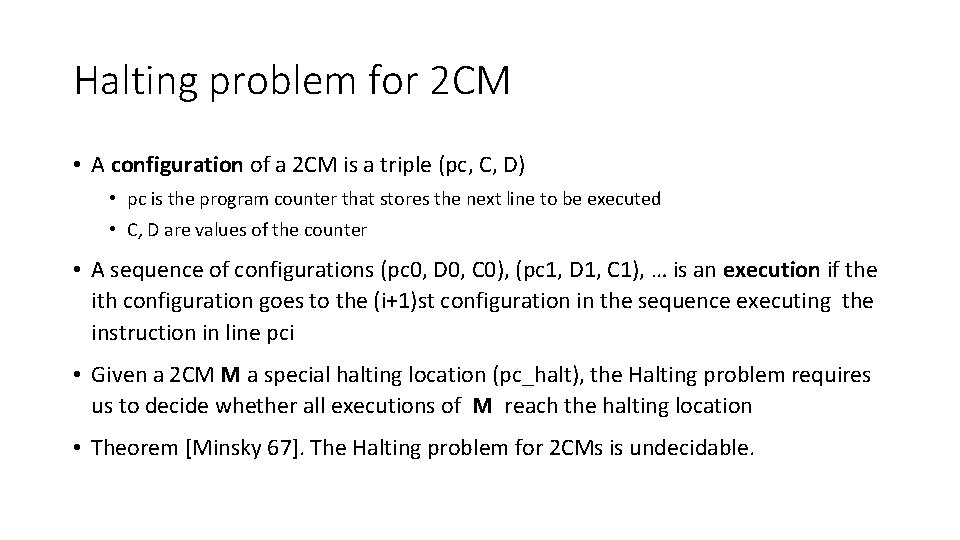
Halting problem for 2 CM • A configuration of a 2 CM is a triple (pc, C, D) • pc is the program counter that stores the next line to be executed • C, D are values of the counter • A sequence of configurations (pc 0, D 0, C 0), (pc 1, D 1, C 1), … is an execution if the ith configuration goes to the (i+1)st configuration in the sequence executing the instruction in line pci • Given a 2 CM M a special halting location (pc_halt), the Halting problem requires us to decide whether all executions of M reach the halting location • Theorem [Minsky 67]. The Halting problem for 2 CMs is undecidable.
Reduction from 2 CM to CSR-RHS We have to construct a function (reduction) that maps instances of 2 CM-Halt to instances of CSR-RHA
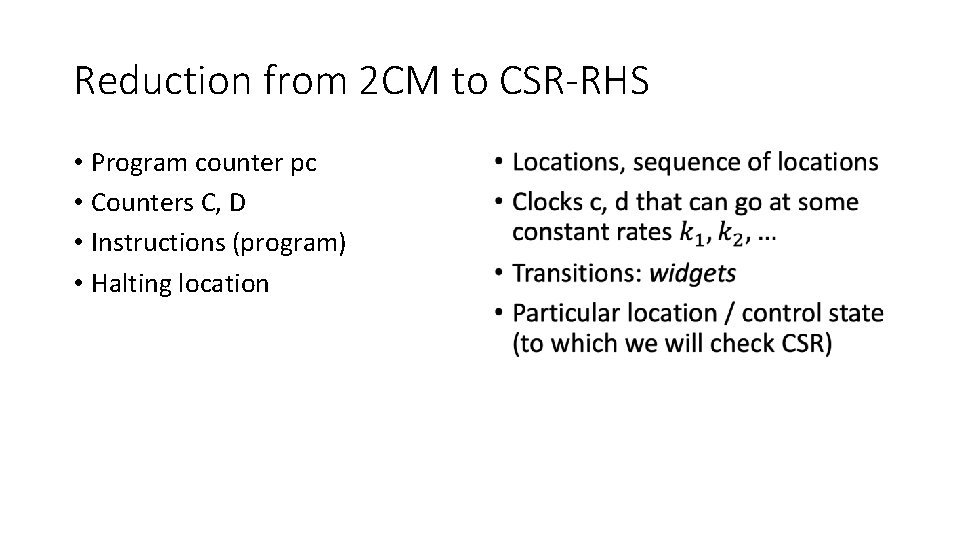
Reduction from 2 CM to CSR-RHS • Program counter pc • Counters C, D • Instructions (program) • Halting location •
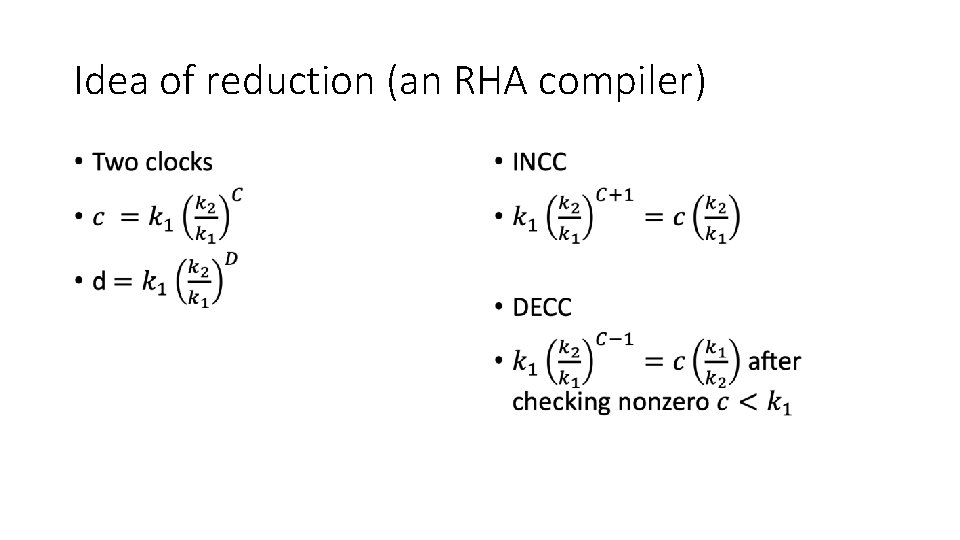
Idea of reduction (an RHA compiler) • •
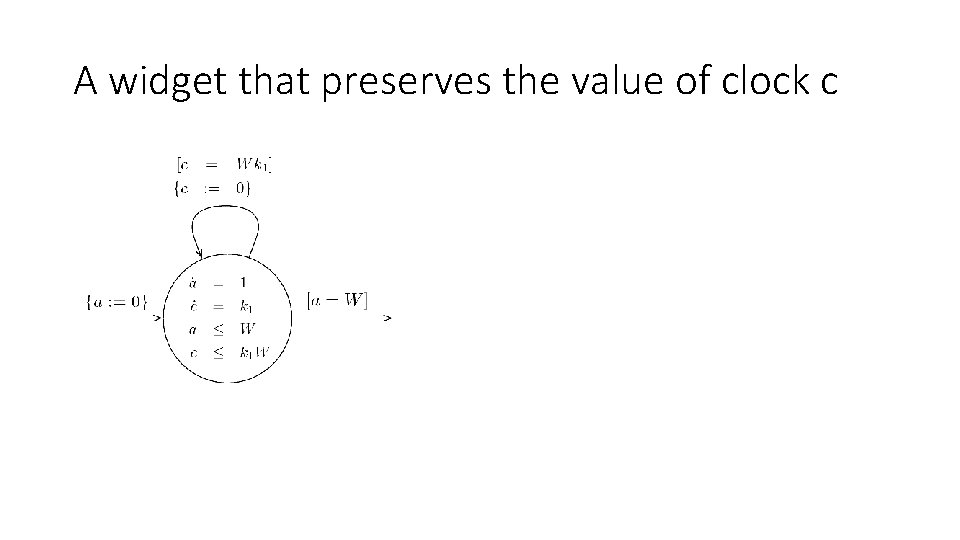
A widget that preserves the value of clock c
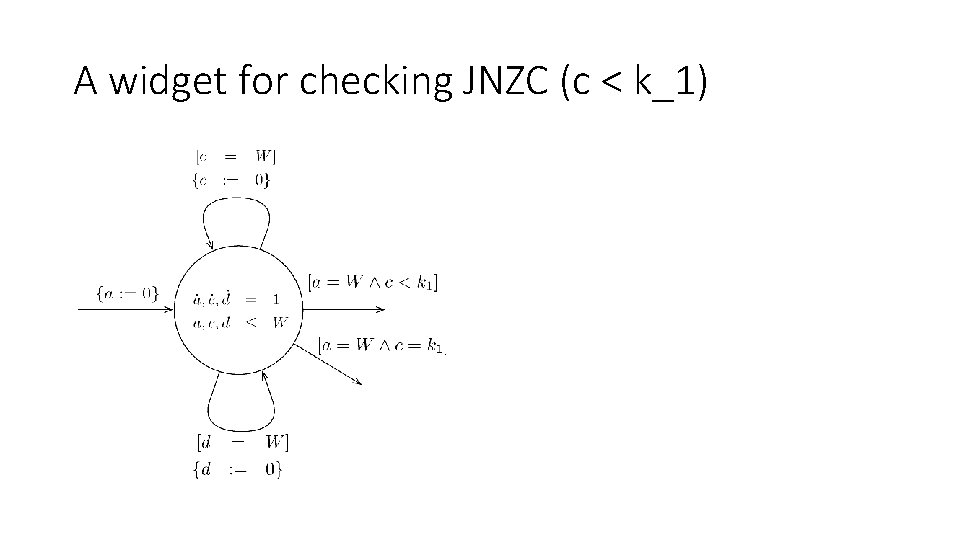
A widget for checking JNZC (c < k_1)
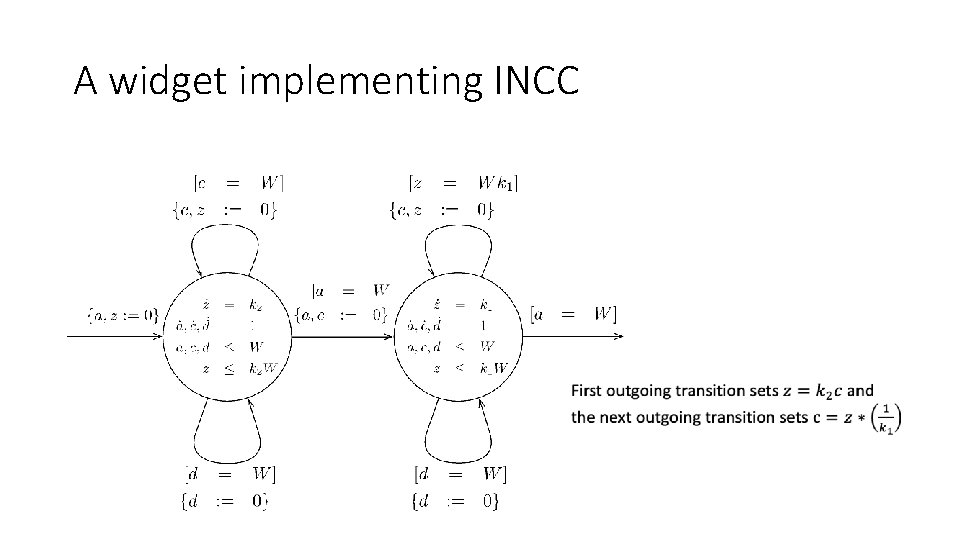
A widget implementing INCC
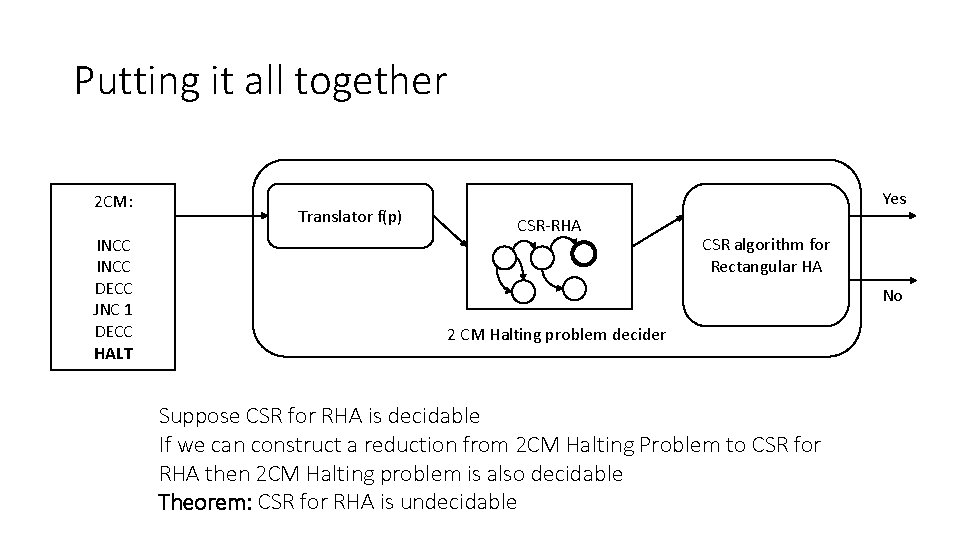
Putting it all together 2 CM: INCC DECC JNC 1 DECC HALT Translator f(p) Yes CSR-RHA CSR algorithm for Rectangular HA No 2 CM Halting problem decider Suppose CSR for RHA is decidable If we can construct a reduction from 2 CM Halting Problem to CSR for RHA then 2 CM Halting problem is also decidable Theorem: CSR for RHA is undecidable
- Slides: 15