
REA and Claim Essentials for the Small Business

REA and Claim Essentials for the Small Business Construction Contractor Presenter: Ed De. Lisle, Esq. 1

2
Request for Equitable Adjustment (REA) • • Is a request for time, money or both Based on a change to the contract arising during project performance • • Differing Site Condition Defective Specification Change(s) (Constructive or Express) Suspension of Work
Requests for Equitable Adjustment • • REAs lack the formality of claims Considered contract administration Initiated during project performance Designed to be negotiated • No deadlines
Requests for Equitable Adjustment Time for submittal: • At any time during contract performance or close out • 30 days of any written order that results in a change • Government prejudice?
Requests for Equitable Adjustment What should it look like? • No specific format • Typically a letter to the Contracting Officer, including: • • Cost information (See GSAM 48 C. F. R. 552 -243. 71) Correspondence between Contractor and Government Schedule updates or fragnets Change Order Requests
Requests for Equitable Adjustment What is recoverable? • Direct Costs (material, labor, equipment, shop drawings, delivery, subcontractors, bonding) • Markups (overhead, profit) • Proposal Preparation (legal, consulting, internal) • Time (days, costs associated with days)
Requests for Equitable Adjustment • Certification NOT required, unless Department of Defense contracts exceeding simplified acquisition threshold ($150, 000) • “I certify that the request is made in good faith, and that the supporting data are accurate and complete to the best of my knowledge and belief. ” DFARS 243. 204 -71 and 252. 243 -7002
Claims Contract Disputes Act of 1978
Claims • Governed by Contract Disputes Act (“CDA”), 41 USC 701 et seq. • Formal written request demanding adjustment of contract price or interpretation of a contract term, seeking other relief pursuant to a contract • First step in litigation process (ASBCA/CBCA, or U. S. Court of Federal Claims)
Certified Claims • While REAs tend to be informal, Claims are more formal • Require Certification in all cases • Not considered contract administration; first step on road to litigation • Negotiation not necessarily the point; a time for advocacy
Certified Claims • Must be filed within 6 years of claim accrual • Contractor must provide Contracting Officer with notice of claim prior to final payment • Claims should be filed within 30 days of cancellation of a stop-work order • Watch out for waivers and releases!
Certified Claims • • No specific format required. Must clearly place Contracting Officer on notice of basis, value and entitlement to time. Typically takes the form of a letter to Contracting Officer with exhibits: • • Cost information (See GSAM 48 C. F. R. 552 -243. 71) Correspondence between Contractor and Government Schedule updates or fragnets Change order requests
Certified Claims What is recoverable? • Direct Costs (material, labor, equipment, shop drawings, delivery, subcontractors, bonding) • Markups (overhead, profit) • Proposal Preparation (legal, consulting, internal) • Time (days, costs associated with days)
Certified Claims • Certification required for claims over $100, 000: • • • "I certify that the claim is made in good faith; that the supporting data are accurate and complete to the best of my knowledge and belief; that the amount accurately reflects the contract adjustment for which the contractor believes the Government is liable; and that I am duly authorized to certify the claim on behalf of the contractor. " 48 CFR 33. 207 Defective certification can be corrected, but this causes delay to the claim process Subcontractor claims to Government must be certified by Prime
Should I Submit an REA or a Certified Claim?
What to Submit
What to Submit When to file a REA: • Good working relationship with Contracting Officer • Agency clearly at fault • Agency indicates willingness to negotiate, but be careful… • Contractor desires to show it’s reasonable

19
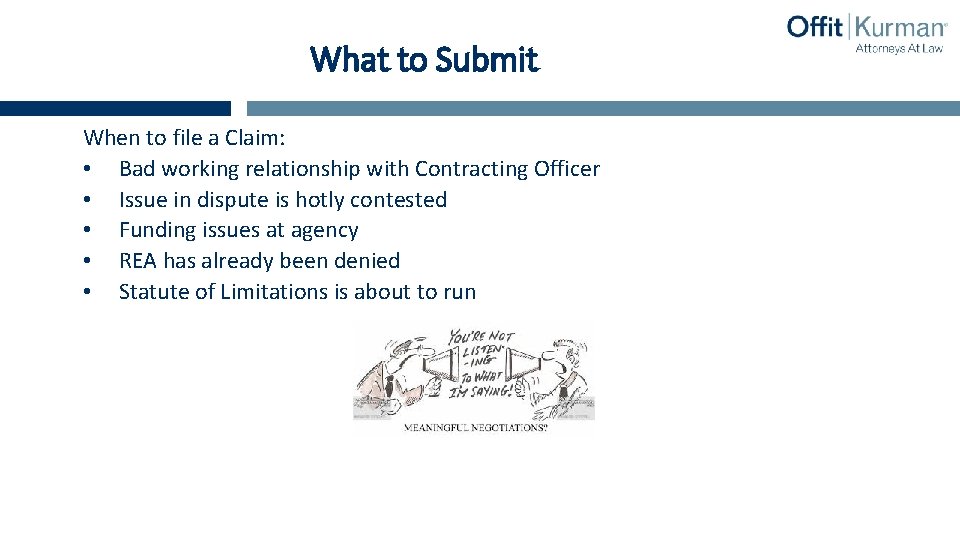
What to Submit When to file a Claim: • Bad working relationship with Contracting Officer • Issue in dispute is hotly contested • Funding issues at agency • REA has already been denied • Statute of Limitations is about to run
What to Submit
REAs v. Claims: Common Issues Common issues: • • • Differing Sit Conditions (FAR 52. 236 -2) Changes (Fixed Price) (FAR 52. 243 -1) Changes to Prevailing Wages (FAR 52. 222 -43) Variations in Estimated Quantity (FAR 52. 211 -18) Stop Work Order (FAR 52. 212 -13) Suspensions of Work (52. 242 -14) Terminations Excessive Punch List Delays Good Faith and Fair Dealing, Duty to Cooperate

23
Claims Process
Claims Process What happens after a claim is filed? FAR 33. 211 - When a claim by or against a contractor cannot be satisfied or settled by mutual agreement and a decision on the claim is necessary, the contracting officer shall: • • Review the facts pertinent to the claim Secure assistance from legal and other advisors Coordinate with the contract administration officer of contracting office, as appropriate Prepare a written decision
Claims Process The written decision shall include: • • • A description of the claim or dispute A reference to the pertinent contract terms A statement of the factual areas of agreement and disagreement A statement of the contracting officer’s decision, with supporting rationale Paragraphs explaining that the decision constitutes the final decision of the Contracting Officer, and explaining to the contractor their right to appeal, and the procedure for doing so Issued within 60 days of the date of submission (unless extended)
Claims Process Extended Review For Claims in excess of $100, 000 (or for claims below $100, 000, if Contractor does not ask for decision within 60 days) Contracting Officer shall issue a decision within a reasonable time thereafter, taking into account • • • The size and complexity of the claim The adequacy of the contractor’s supporting data Any other relevant factors (FAR 33. 211(c))
Appeals Contractor may appeal its claim to Board of Contract Appeals (Armed Services or Civilian, depending on the Agency involved with the Contract at issue) in two circumstances: • Contracting Officer issues a final decision (COFD) denying the claim • 90 days to appeal • Contracting Officer does not issue a decision • Appeal on a “deemed denial” basis
Appeals • Contractor may appeal claim to U. S. Court of Federal Claims within one year of COFD • Should I go to the Board or the COFC? • • COFC more formal; DOJ involvement Board mediation process works well After 90 days, you don’t have a choice Judges
30
Questions?
Questions? Ed De. Lisle edelisle@offitkurman. com
- Slides: 32