
Re Ser Vation Protocol RSVP Presented by Sundar
Re. Ser. Vation Protocol (RSVP) Presented by Sundar P Subramani UMBC
Overview n n n Background Working of protocol Messages Policies State maintenance Conclusion
Background n Best effort routing n n Point-to-point model routing n n insufficient for current applications Applications demand multipoint-tomultipoint Solution?
Resource reservation n n Reserve resources along path Two approaches n n n Sender initiated Receiver initiated Latter is better n n n Heterogeneous requests Scalable Stable – except at leaf nodes
Admission control n n Network has finite resources To maintain specified Qo. S guarantee n Admission control
RSVP n n Used to specify Qo. S by applications Not a routing protocol n n Internet control protocol Establish and maintain reservations
Working of RSVP n Traffic in RSVP defined in terms of Session n Filter Spec n Flow Spec n
Session n Defined n Destination IP address n n Unicast/Multicast Destination port number
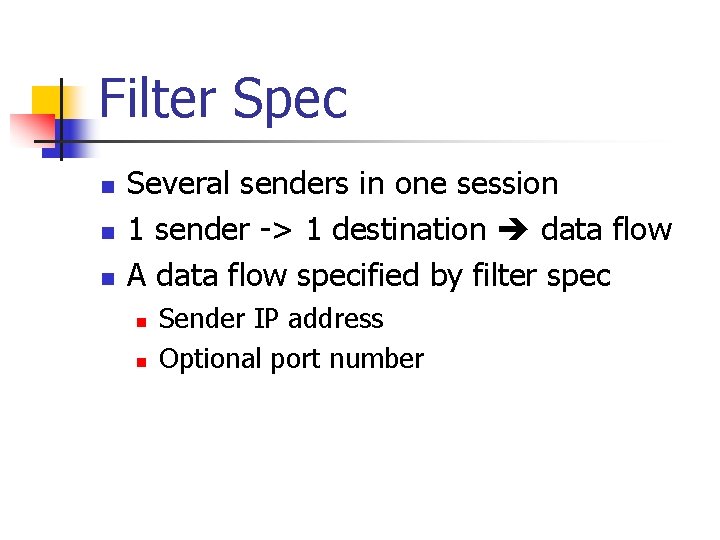
Filter Spec n n n Several senders in one session 1 sender -> 1 destination data flow A data flow specified by filter spec n n Sender IP address Optional port number
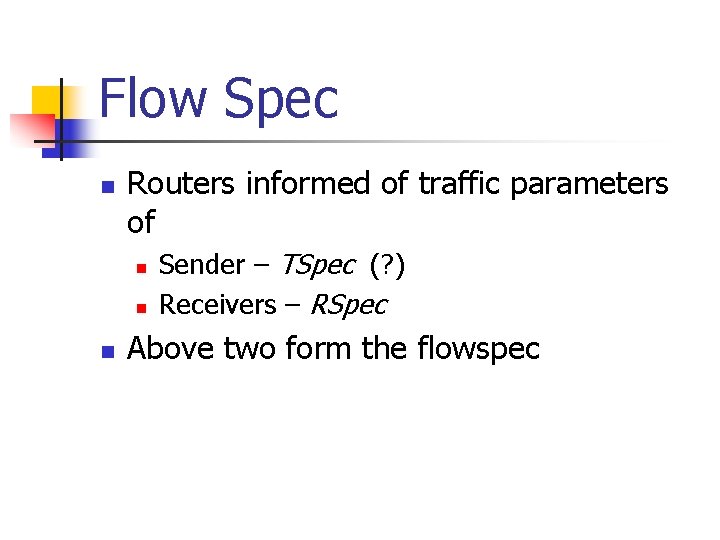
Flow Spec n Routers informed of traffic parameters of n n n Sender – TSpec (? ) Receivers – RSpec Above two form the flowspec
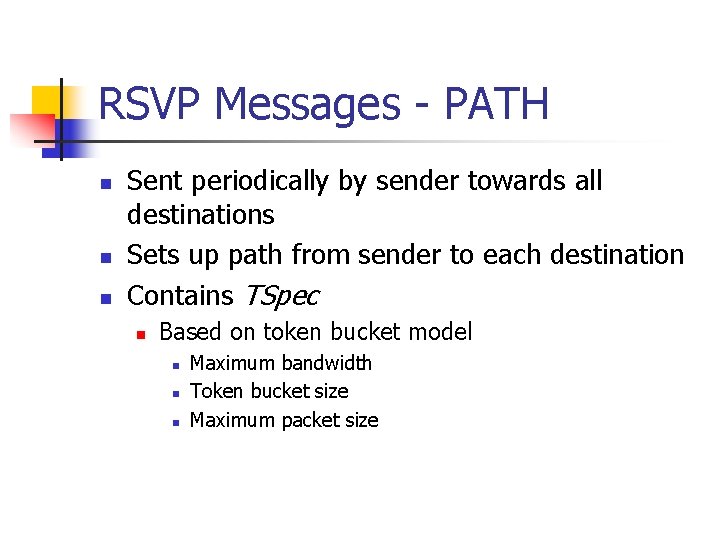
RSVP Messages - PATH n n n Sent periodically by sender towards all destinations Sets up path from sender to each destination Contains TSpec n Based on token bucket model n n n Maximum bandwidth Token bucket size Maximum packet size
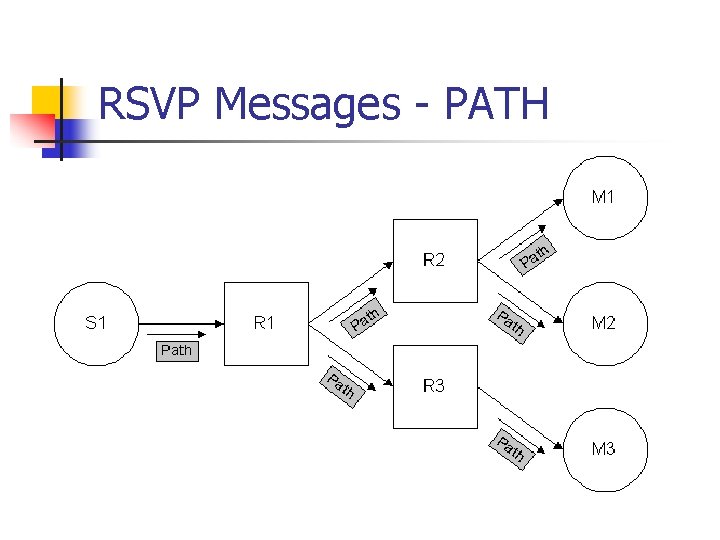
RSVP Messages - PATH
RSVP Messages - RESV n n Receivers request for resources using RESV message Sent upstream n Set by PATH messages n n if no senders no reservation could be made Merged as message proceeds upstream
RSVP Messages - RESV n RESV messages propagated upward only if n n Reservation at that particular router is less than requested Qo. S parameters Helps in conserving resources in a muticast setting
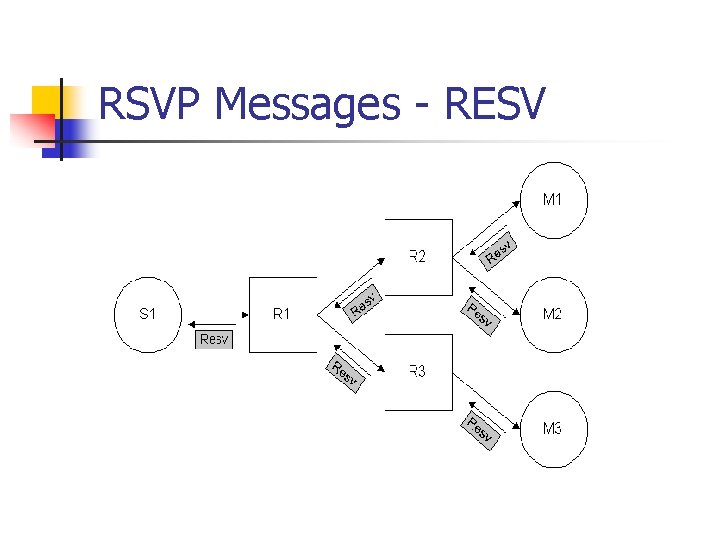
RSVP Messages - RESV
RSVP Messages - Teardown n Two types of tear down n pathtear n n Initiated by sender resvtear n Initiated by receiver
Policies n Two policies determine the reservation request acceptance n Admission control n n Does network have enough resources? Policy control n Does the element have permissions to make reservation?
Policies n If RESV accepted reservation made n n Else error message sent to the receiver Receiver could also request for confirmation in RESV message itself
Soft state § Routers along path would remove reservations based on timeouts § PATH and RESV sent periodically § Keeps the reservation alive § Advantage § Network resource not reserved forever in case of node failure § Disadvantage § Message overhead
RSVP TE n Establish LSP in MPLS networks n n n MPLS Multi. Protocol Label Switching LSP Label Switched Path Essentially enables source routing n n Once path specified incore routers route packets based on labels Used in optical networks
Implementation status n Implemented in n MAC OS Windows 2000, XP BSD
Conclusion n n RSVP helps to conserve network recourses for multicast traffic Periodic message transmission n n Increases network traffic Suggestion n Implicit signaling mechanism
References [1] L. Zhang, S. Deering, D. Estrin, S. Shenker, and D. Zappala, “RSVP: A new resource reservation protocol, ” IEEE Network, vol. 7, no. 5, September 1993. [2] http: //www. tml. hut. fi/Opinnot/Tik-110. 551/1997/rsvp. html [3]http: //nislab. bu. edu/sc 546/sc 441 Spring 2003/rsvp/RSVP. htm [4] http: //www. javvin. com/protocol. MPLS. html [5] http: //www. javvin. com/protocol. RSVPTE. html
- Slides: 23