
RE Religious Education Unit of work What do
- Slides: 17
RE (Religious Education) Unit of work – What do Christians believe about old and new covenants?
About this unit of work - RE This unit explores some of the different covenants between God and various key figures in the Bible in both the Old and New Testament, including Abraham, Moses, David and Jesus. It explores core beliefs of Christians regarding these covenants and their importance. It also makes comparisons to different faiths’ views of these people.
CONTRIBUTION TO SMSC DEVELOPMENT • Spiritual development comes from considering religious teachings, applying these and reflecting on their significance for themselves; • Moral development comes from considering how beliefs have implications for actions and evaluating the significance of these; • Social development comes from exploring questions together and working as a team; • Cultural development comes from engaging with different faith perspectives.
Project question - ‘What do Christians believe about old and new covenants? ’ Throughout this unit of work in the Summer term, you can choose how you would like to present your learning. We ask that you complete a project of RE work instead of doing specific tasks after each lesson. Here are some ideas of how you could present your project. You could start it today and add to it after each lesson with any new learning: - Create a presentation (poster, Power. Point, leaflet etc. ) demonstrating your learning from throughout the unit answering the project question ‘What do Christians believe about old and new covenants’? . - Extra task: you could also write your own poem explaining the importance of a covenant with God.
RE - Re-cap • What do we understand about the word ‘covenant’? • Why is Abraham important to Christians?
Can you remember what the word covenant means? A covenant is an agreement or a promise. For Christians, when God makes a covenant it is a lifelong promise that can never be broken.
RE – Lesson 3 • Can I understand that Christians and Jews believe Moses had a covenant with God? • Can I understand the importance of the Ten Commandments?
RE – Lesson 3 What do you remember about Moses through previous Judaism learning?
RE – Lesson 3 Re-cap your knowledge of Moses by watching the following video: • https: //www. bbc. co. uk/teach/class-clips-video/religious-studies-ks 1 the-jewish-story-of-moses/zmfp 382
The Story of Moses Baby Moses was found in a basket by the side of the River Nile. The King’s daughter found basket in the river. The baby went to live with the royal family and was taken care of until he grew up. When he had grown up Moses was looking after his sheep near Mount Sinai. God spoke to him from a burning bush. God said he was angry about how the Egyptians treated the people of Israel. God asked Moses and his brother to go and talk to the King about how unhappy God was. The King didn’t listen to them and he made the slaves work even harder. This made God very angry. God sent ten plagues to Egypt to show angry he was. After the first Passover meal the people of Israel gathered together to leave Egypt with Moses. God had punished the Egyptians by killing all the first-born males. When the People of God reached the Red Sea they were still being chased by the angry Egyptians. God told Moses to hold up his staff and the sea parted to let them escape. Once they got across, the sea came back together killing the Egyptians. The People of God then spent the next forty years wandering the desert. They got very hungry and thirsty. Moses asked for God’s help. He provided food and water. When they reached Mount Sinai Moses climbed up to talk to God again. Moses spent forty days up the mountain listening to God gave Moses two stone tablets containing the ten commandments. These were the rules that the people had to live by. The Ten Commandments are the rules that Jewish people follow each day. They are the most important part of the Torah, the Jewish holy book.
Read Exodus 3: 1 -10 Moses and the children of Israel were part of the people of God. Christians believe that Moses was a part of God’s promise to Abraham and that his ancestors would be blessed. Why was it important that God introduced himself to Moses as ‘the God of Abraham…’?
The story of the Exodus has inspired Jews and Christians for centuries. They believe that God did miraculous things to keep Moses safe and use him to free the Hebrew people from Egyptian slavery and that God will do amazing things for them if they trust and obey him.
Exodus 3: 1 -10 God rescued his people by retrieving them from Egypt and then makes a new covenant with them (the Ten Commandments). Why do you think that God helped them first then gave them the commandments rather than the other way around?
The Ten Commandments Can you remember the 10 commandments?
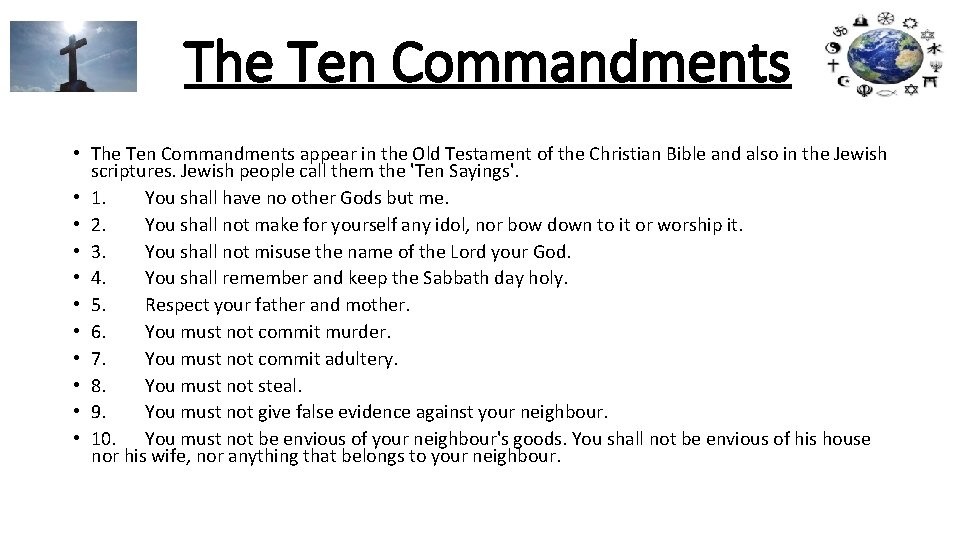
The Ten Commandments • The Ten Commandments appear in the Old Testament of the Christian Bible and also in the Jewish scriptures. Jewish people call them the 'Ten Sayings'. • 1. You shall have no other Gods but me. • 2. You shall not make for yourself any idol, nor bow down to it or worship it. • 3. You shall not misuse the name of the Lord your God. • 4. You shall remember and keep the Sabbath day holy. • 5. Respect your father and mother. • 6. You must not commit murder. • 7. You must not commit adultery. • 8. You must not steal. • 9. You must not give false evidence against your neighbour. • 10. You must not be envious of your neighbour's goods. You shall not be envious of his house nor his wife, nor anything that belongs to your neighbour.
The Ten Commandments Do you think they are still relevant today? Can you suggest reasons why the Ten Commandments are important for Jews and Christians?
Project question - ‘What do Christians believe about old and new covenants? ’ Throughout this unit of work in the Summer term, you can choose how you would like to present your learning. We ask that you complete a project of RE work instead of doing specific tasks after each lesson. Here are some ideas of how you could present your project. You could start it today and add to it after each lesson with any new learning: - Create a presentation (poster, Power. Point, leaflet etc. ) demonstrating your learning from throughout the unit answering the project question ‘What do Christians believe about old and new covenants’? . Extra task: you could also write your own poem explaining the importance of a covenant with God. Suggested activities from today: - You could add information to your project about Moses, his relationship with God and his important to Christianity and Judaism. - You could also add information about the 10 commandments.