
Re Port S A Simpler Intuitive Approach to

- Slides: 20
Re. Port. S: A Simpler, Intuitive Approach to Morpheme Induction Emily Pitler Samarth Keshava Yale University
Goals l Segment English words into morphemes l Simple algorithm l Minimize assumptions and “magic numbers”
Approach l Identify common morphemes in the language – l “prefix” and “suffix” lists Use these to segment the test words
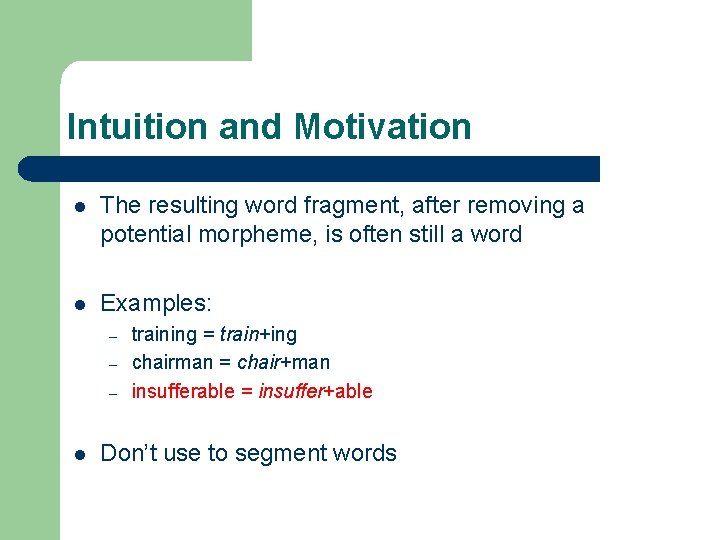
Intuition and Motivation l The resulting word fragment, after removing a potential morpheme, is often still a word l Examples: – – – l training = train+ing chairman = chair+man insufferable = insuffer+able Don’t use to segment words
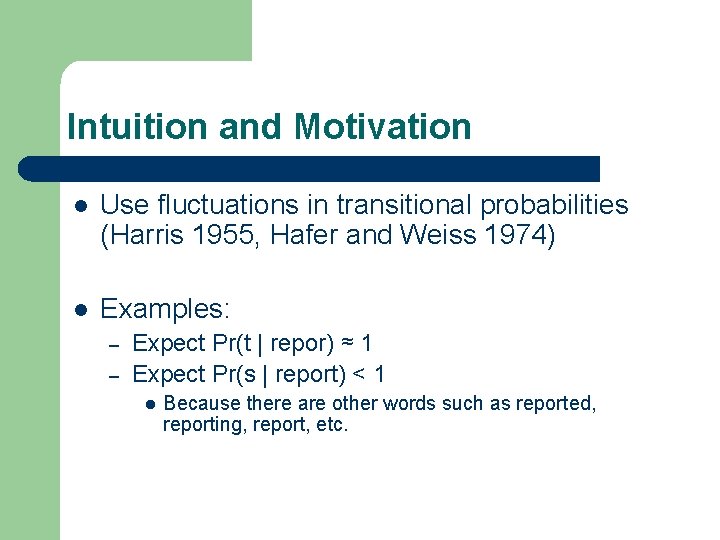
Intuition and Motivation l Use fluctuations in transitional probabilities (Harris 1955, Hafer and Weiss 1974) l Examples: – – Expect Pr(t | repor) ≈ 1 Expect Pr(s | report) < 1 l Because there are other words such as reported, reporting, report, etc.
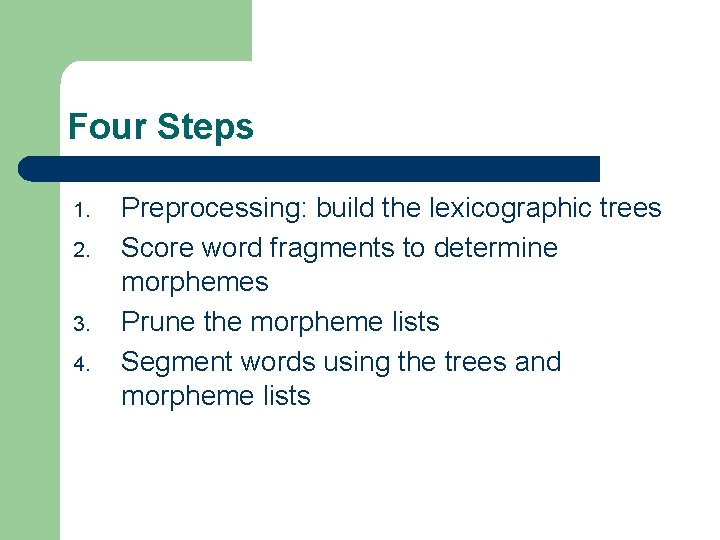
Four Steps 1. 2. 3. 4. Preprocessing: build the lexicographic trees Score word fragments to determine morphemes Prune the morpheme lists Segment words using the trees and morpheme lists
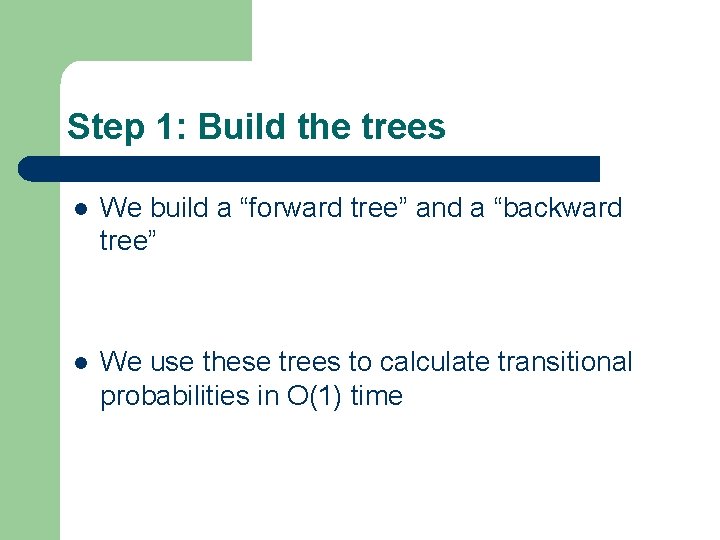
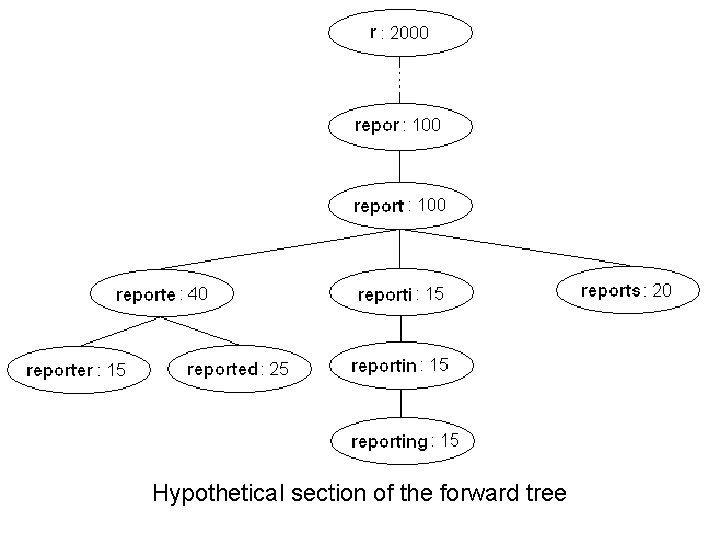
Step 1: Build the trees l We build a “forward tree” and a “backward tree” l We use these trees to calculate transitional probabilities in O(1) time
Hypothetical section of the forward tree
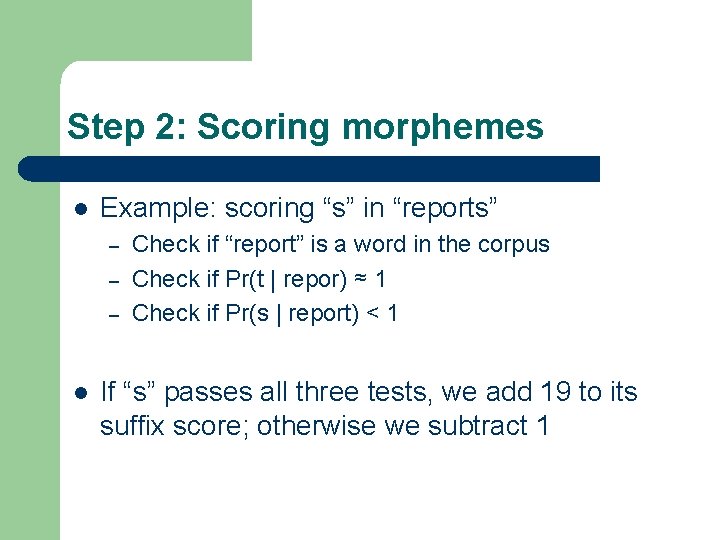
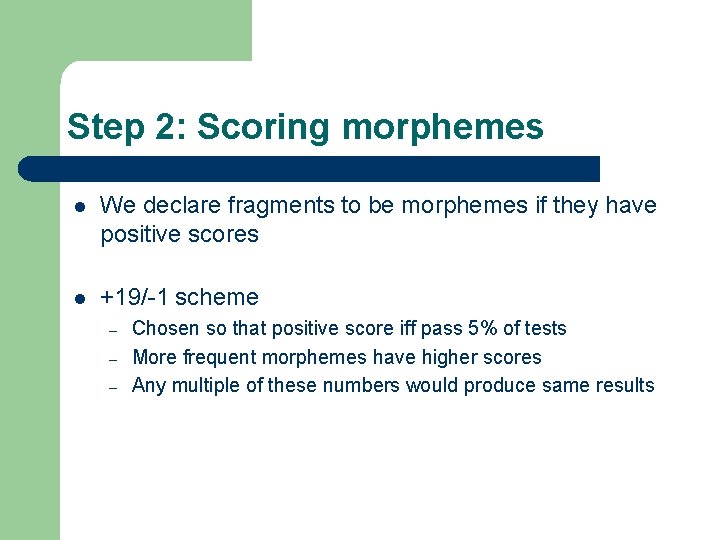
Step 2: Scoring morphemes l Example: scoring “s” in “reports” – – – l Check if “report” is a word in the corpus Check if Pr(t | repor) ≈ 1 Check if Pr(s | report) < 1 If “s” passes all three tests, we add 19 to its suffix score; otherwise we subtract 1
Step 2: Scoring morphemes l We declare fragments to be morphemes if they have positive scores l +19/-1 scheme – – – Chosen so that positive score iff pass 5% of tests More frequent morphemes have higher scores Any multiple of these numbers would produce same results
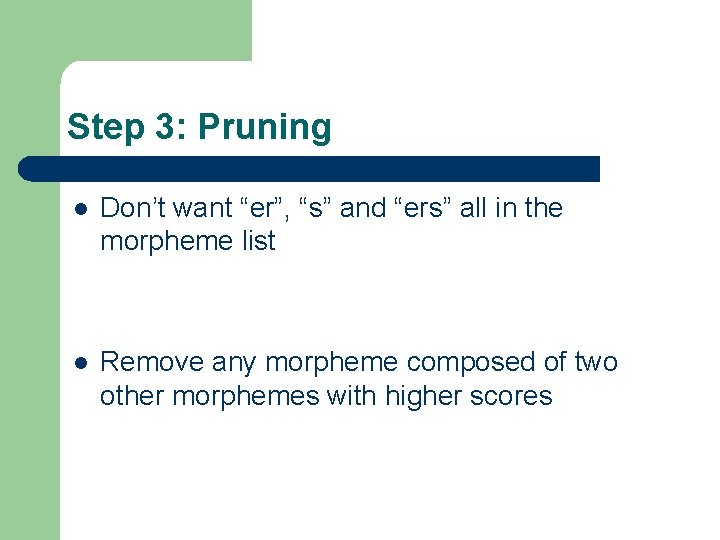
Step 3: Pruning l Don’t want “er”, “s” and “ers” all in the morpheme list l Remove any morpheme composed of two other morphemes with higher scores
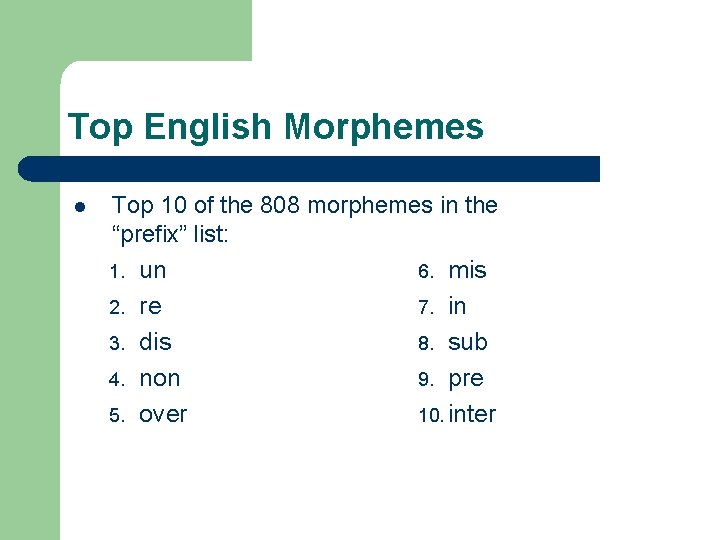
Top English Morphemes l Top 10 of the 808 morphemes in the “prefix” list: 1. un 6. mis 2. re 7. in 3. 4. 5. dis non over sub 9. pre 10. inter 8.
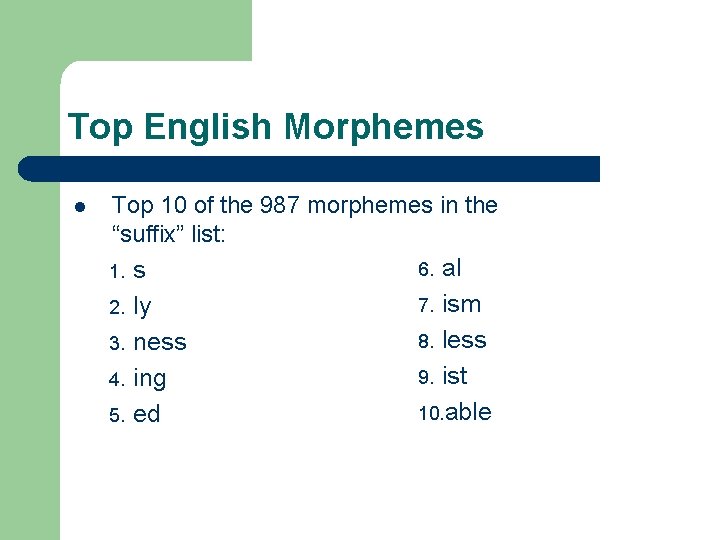
Top English Morphemes l Top 10 of the 987 morphemes in the “suffix” list: 6. al 1. s 7. ism 2. ly 8. less 3. ness 9. ist 4. ing 10. able 5. ed
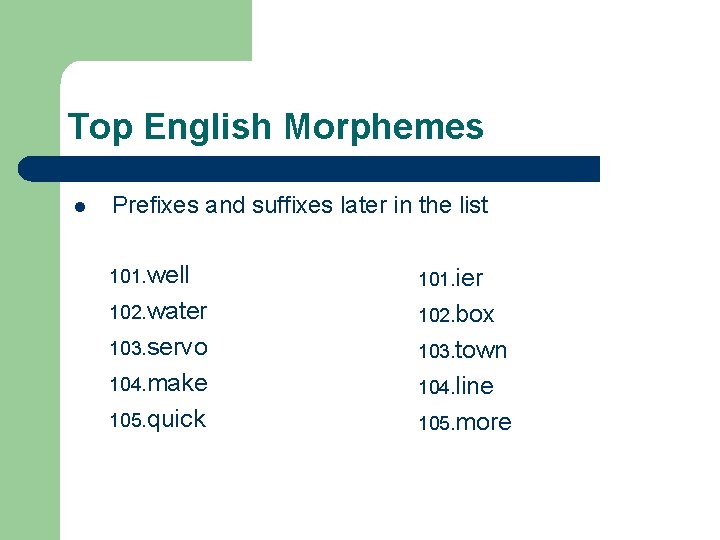
Top English Morphemes l Prefixes and suffixes later in the list 101. well 101. ier 102. water 102. box 103. servo 103. town 104. make 104. line 105. quick 105. more
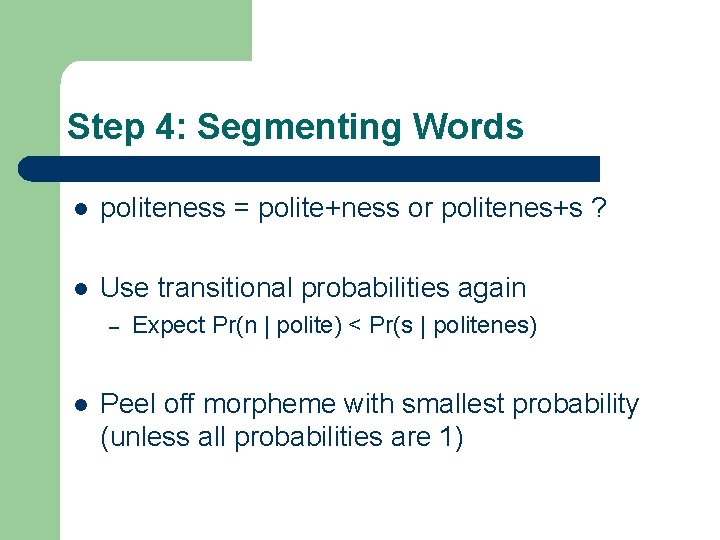
Step 4: Segmenting Words l politeness = polite+ness or politenes+s ? l Use transitional probabilities again – l Expect Pr(n | polite) < Pr(s | politenes) Peel off morpheme with smallest probability (unless all probabilities are 1)
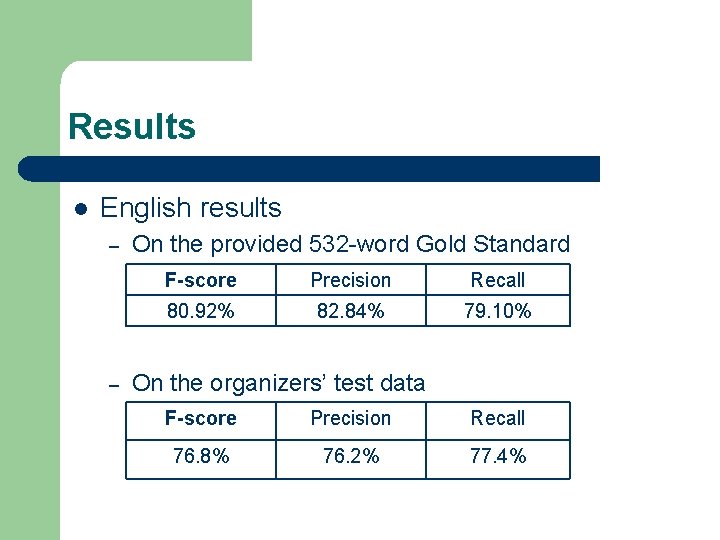
Results l English results – – On the provided 532 -word Gold Standard F-score Precision Recall 80. 92% 82. 84% 79. 10% On the organizers’ test data F-score Precision Recall 76. 8% 76. 2% 77. 4%
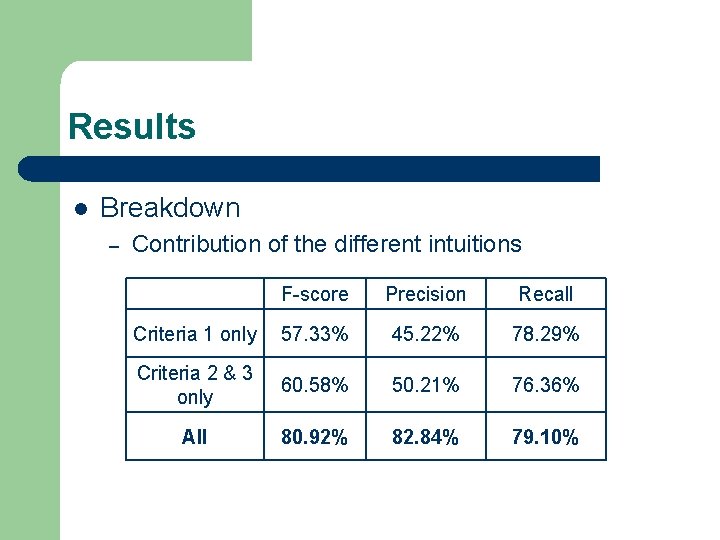
Results l Breakdown – Contribution of the different intuitions F-score Precision Recall Criteria 1 only 57. 33% 45. 22% 78. 29% Criteria 2 & 3 only 60. 58% 50. 21% 76. 36% All 80. 92% 82. 84% 79. 10%
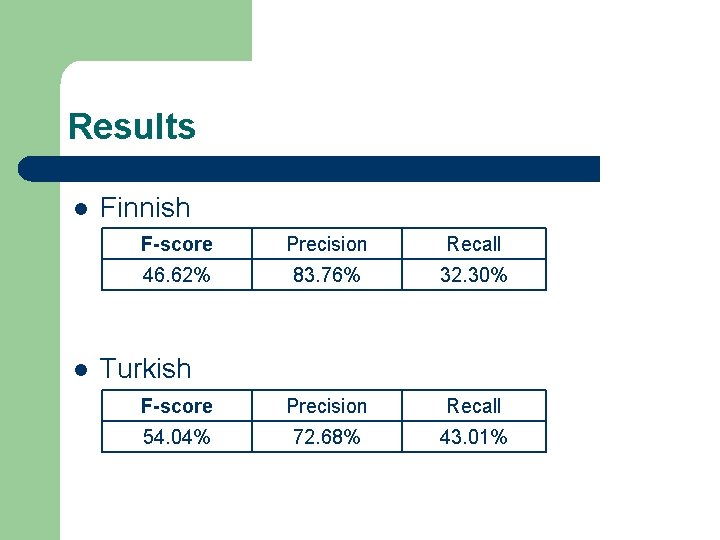
Results l l Finnish F-score Precision Recall 46. 62% 83. 76% 32. 30% F-score Precision Recall 54. 04% 72. 68% 43. 01% Turkish
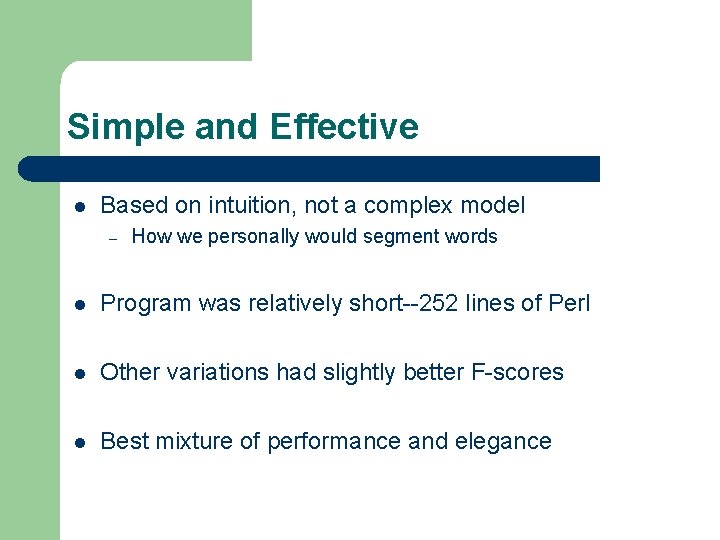
Simple and Effective l Based on intuition, not a complex model – How we personally would segment words l Program was relatively short--252 lines of Perl l Other variations had slightly better F-scores l Best mixture of performance and elegance
Thank you for listening. Emily Pitler Samarth Keshava