
RDMA over Commodity Ethernet at Scale Chuanxiong Guo
- Slides: 20
RDMA over Commodity Ethernet at Scale Chuanxiong Guo, Haitao Wu, Zhong Deng, Gaurav Soni, Jianxi Ye, Jitendra Padhye, Marina Lipshteyn ACM SIGCOMM 2016 August 24 2016
Outline • RDMA/Ro. CEv 2 background • DSCP-based PFC • Safety challenges • • RDMA transport livelock PFC deadlock PFC pause frame storm Slow-receiver symptom • Experiences and lessons learned • Related work • Conclusion 2
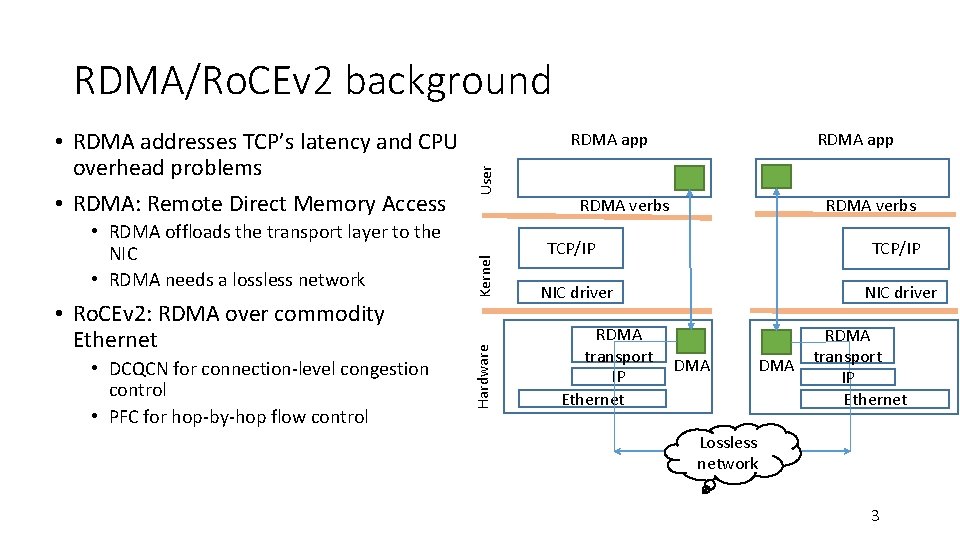
RDMA/Ro. CEv 2 background • Ro. CEv 2: RDMA over commodity Ethernet • DCQCN for connection-level congestion control • PFC for hop-by-hop flow control User Kernel • RDMA offloads the transport layer to the NIC • RDMA needs a lossless network RDMA app Hardware • RDMA addresses TCP’s latency and CPU overhead problems • RDMA: Remote Direct Memory Access RDMA app RDMA verbs TCP/IP NIC driver RDMA transport IP Ethernet NIC driver DMA RDMA transport IP Ethernet Lossless network 3
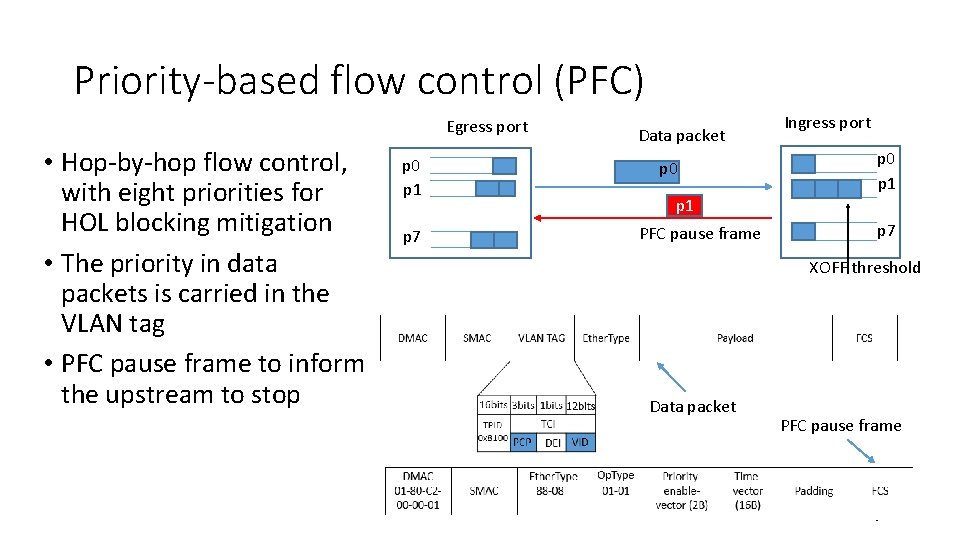
Priority-based flow control (PFC) Egress port • Hop-by-hop flow control, with eight priorities for HOL blocking mitigation • The priority in data packets is carried in the VLAN tag • PFC pause frame to inform the upstream to stop p 0 p 1 p 7 Data packet p 0 p 1 PFC pause frame Ingress port p 0 p 1 p 7 XOFF threshold Data packet PFC pause frame 4
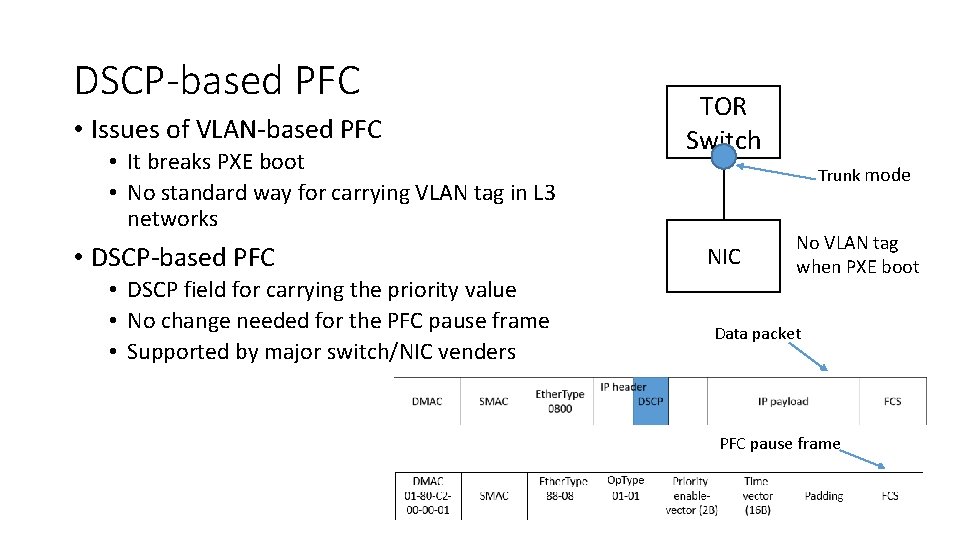
DSCP-based PFC • Issues of VLAN-based PFC • It breaks PXE boot • No standard way for carrying VLAN tag in L 3 networks • DSCP-based PFC • DSCP field for carrying the priority value • No change needed for the PFC pause frame • Supported by major switch/NIC venders TOR Switch Trunk mode NIC No VLAN tag when PXE boot Data packet PFC pause frame 5
Outline • RDMA/Ro. CEv 2 background • DSCP-based PFC • Safety challenges • • RDMA transport livelock PFC deadlock PFC pause frame storm Slow-receiver symptom • Experiences and lessons learned • Related work • Conclusion 6
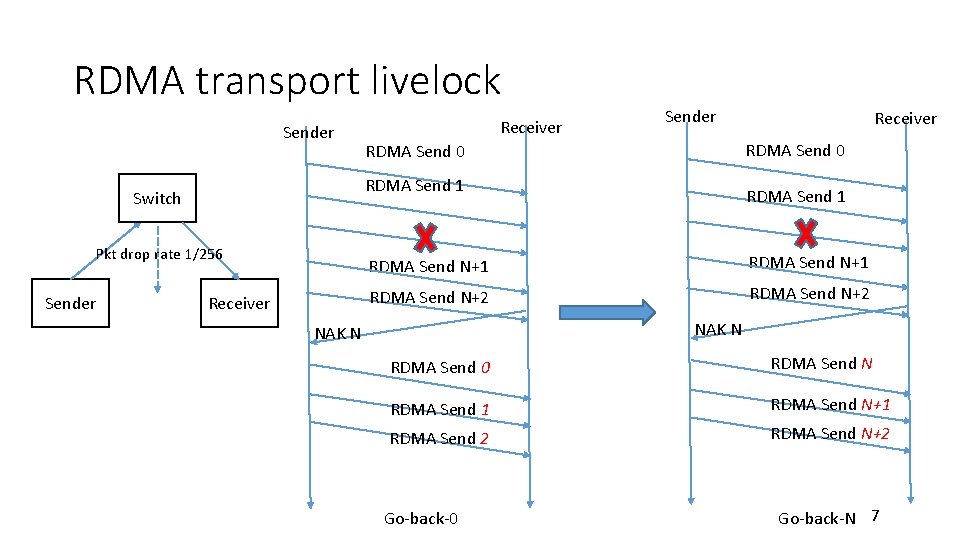
RDMA transport livelock Sender Pkt drop rate 1/256 Receiver RDMA Send 0 RDMA Send 1 Switch Sender Receiver RDMA Send 1 RDMA Send N+1 RDMA Send N+2 NAK N RDMA Send 0 RDMA Send N RDMA Send 1 RDMA Send N+1 RDMA Send 2 RDMA Send N+2 Go-back-0 Go-back-N 7
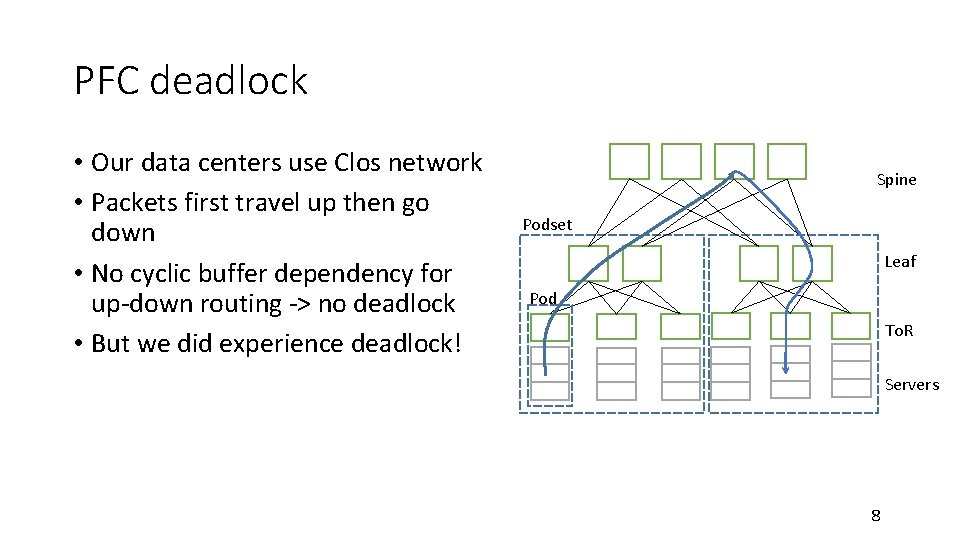
PFC deadlock • Our data centers use Clos network • Packets first travel up then go down • No cyclic buffer dependency for up-down routing -> no deadlock • But we did experience deadlock! Spine Podset Leaf Pod To. R Servers 8
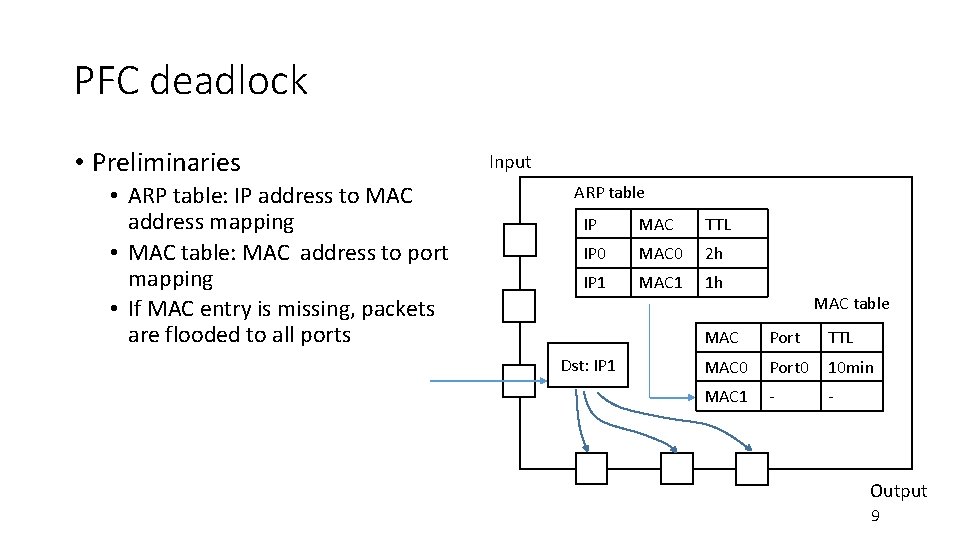
PFC deadlock • Preliminaries • ARP table: IP address to MAC address mapping • MAC table: MAC address to port mapping • If MAC entry is missing, packets are flooded to all ports Input ARP table IP MAC TTL IP 0 MAC 0 2 h IP 1 MAC 1 1 h Dst: IP 1 MAC table MAC Port TTL MAC 0 Port 0 10 min MAC 1 - - Output 9
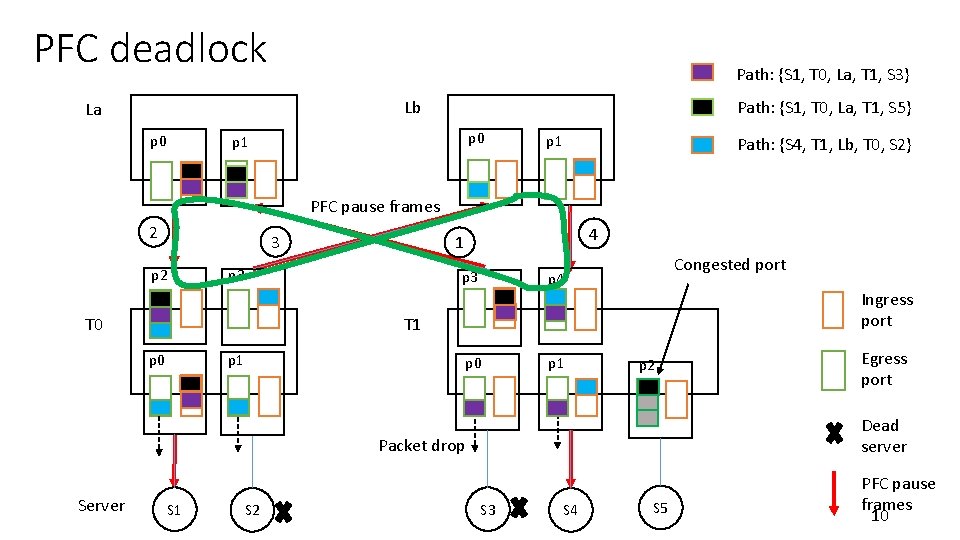
PFC deadlock Path: {S 1, T 0, La, T 1, S 3} Lb La p 0 Path: {S 1, T 0, La, T 1, S 5} p 0 p 1 Path: {S 4, T 1, Lb, T 0, S 2} PFC pause frames 2 3 p 2 4 1 p 3 Congested port p 4 Ingress port T 1 T 0 p 1 p 2 Dead server Packet drop Server S 1 S 2 Egress port S 3 S 4 S 5 PFC pause frames 10
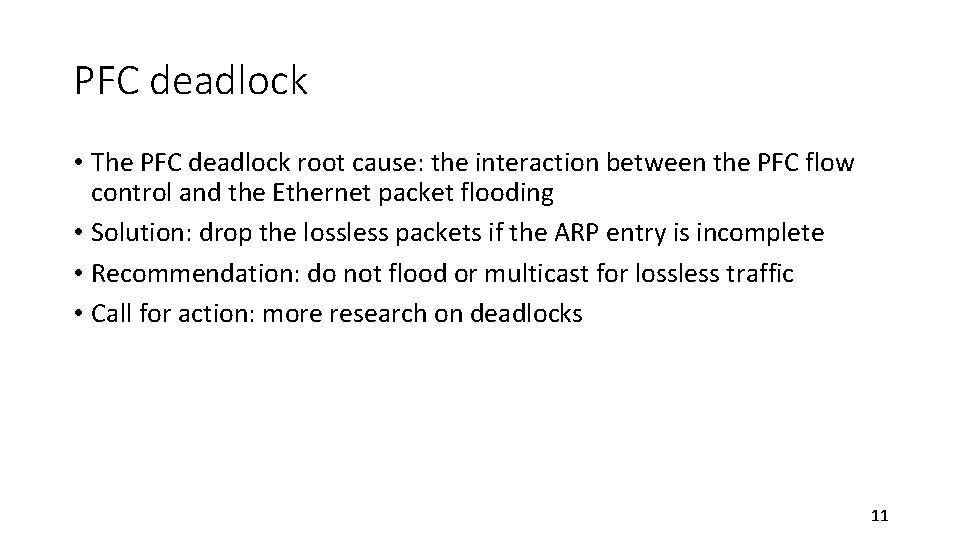
PFC deadlock • The PFC deadlock root cause: the interaction between the PFC flow control and the Ethernet packet flooding • Solution: drop the lossless packets if the ARP entry is incomplete • Recommendation: do not flood or multicast for lossless traffic • Call for action: more research on deadlocks 11
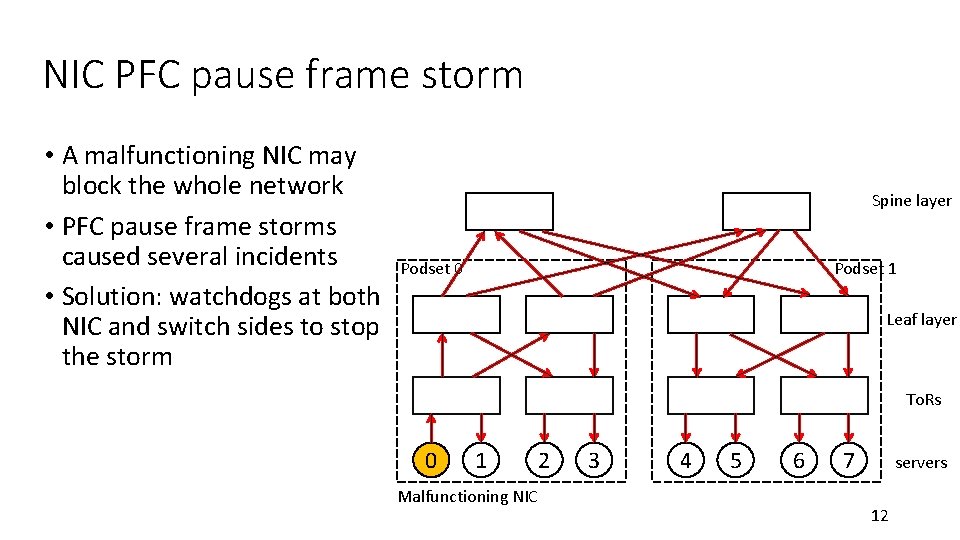
NIC PFC pause frame storm • A malfunctioning NIC may block the whole network • PFC pause frame storms caused several incidents • Solution: watchdogs at both NIC and switch sides to stop the storm Spine layer Podset 0 Podset 1 Leaf layer To. Rs 0 1 Malfunctioning NIC 2 3 4 5 6 7 servers 12
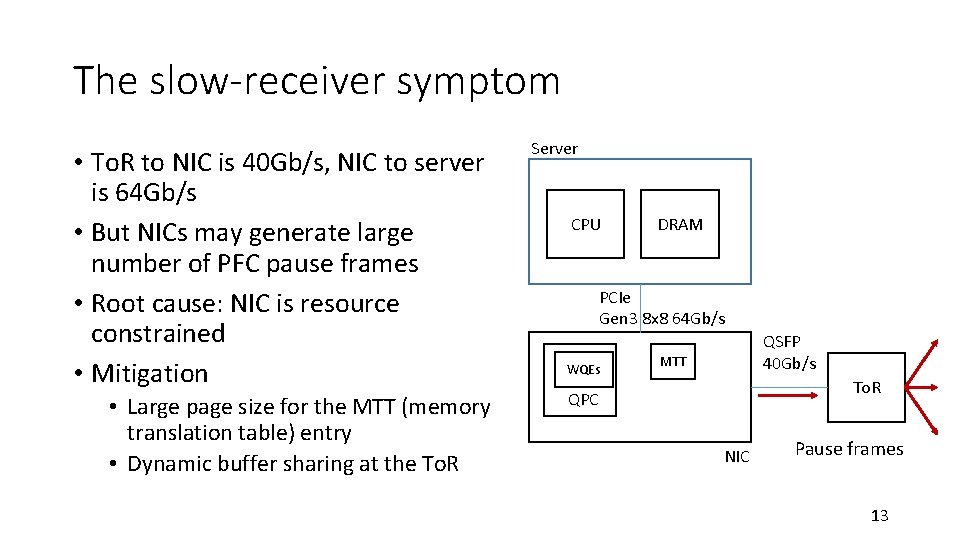
The slow-receiver symptom • To. R to NIC is 40 Gb/s, NIC to server is 64 Gb/s • But NICs may generate large number of PFC pause frames • Root cause: NIC is resource constrained • Mitigation • Large page size for the MTT (memory translation table) entry • Dynamic buffer sharing at the To. R Server CPU DRAM PCIe Gen 3 8 x 8 64 Gb/s WQEs QSFP 40 Gb/s MTT To. R QPC NIC Pause frames 13
Outline • RDMA/Ro. CEv 2 background • DSCP-based PFC • Safety challenges • • RDMA transport livelock PFC deadlock PFC pause frame storm Slow-receiver symptom • Experiences and lessons learned • Related work • Conclusion 14
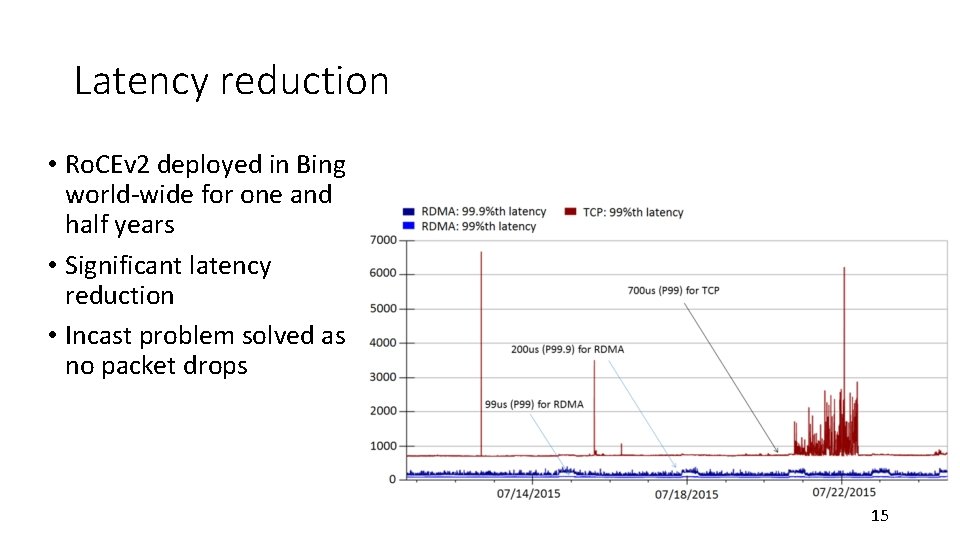
Latency reduction • Ro. CEv 2 deployed in Bing world-wide for one and half years • Significant latency reduction • Incast problem solved as no packet drops 15
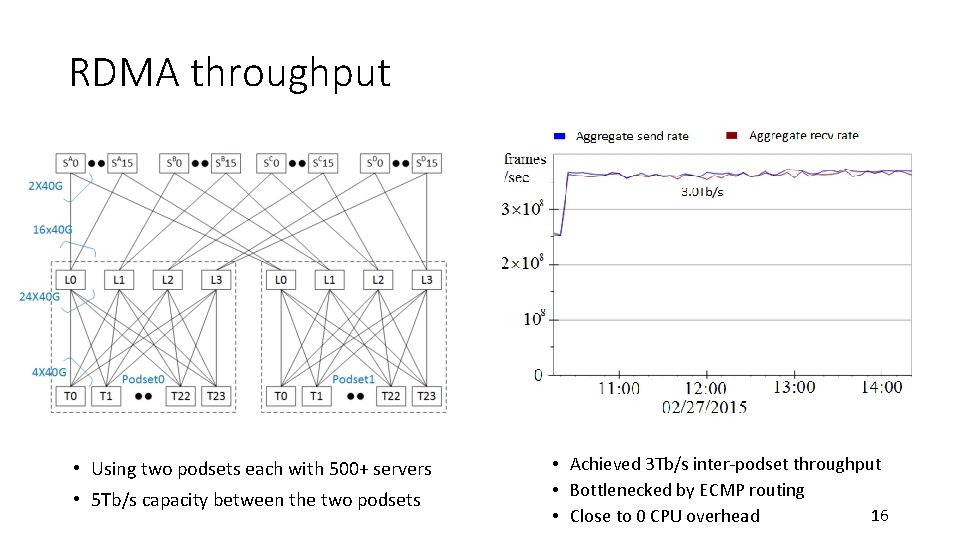
RDMA throughput • Using two podsets each with 500+ servers • 5 Tb/s capacity between the two podsets • Achieved 3 Tb/s inter-podset throughput • Bottlenecked by ECMP routing 16 • Close to 0 CPU overhead
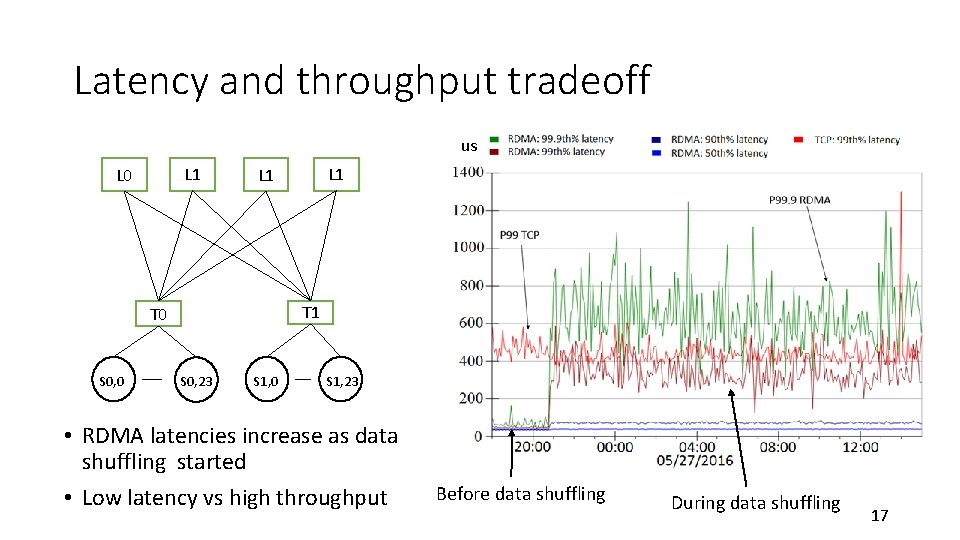
Latency and throughput tradeoff us L 1 L 0 T 1 T 0 S 0, 0 L 1 S 0, 23 S 1, 0 S 1, 23 • RDMA latencies increase as data shuffling started • Low latency vs high throughput Before data shuffling During data shuffling 17
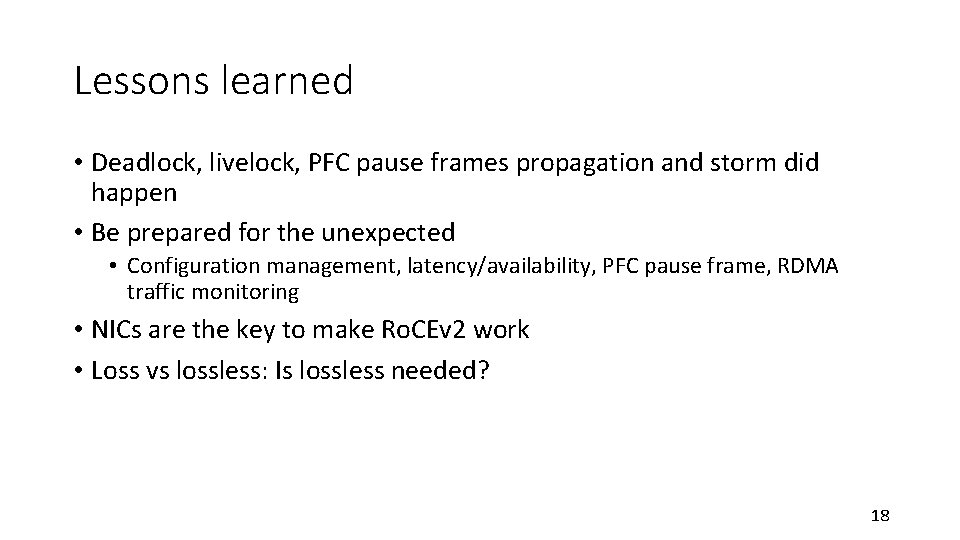
Lessons learned • Deadlock, livelock, PFC pause frames propagation and storm did happen • Be prepared for the unexpected • Configuration management, latency/availability, PFC pause frame, RDMA traffic monitoring • NICs are the key to make Ro. CEv 2 work • Loss vs lossless: Is lossless needed? 18
Related work • Infiniband • i. Warp • Deadlock in lossless networks • TCP perf tuning vs. RDMA 19
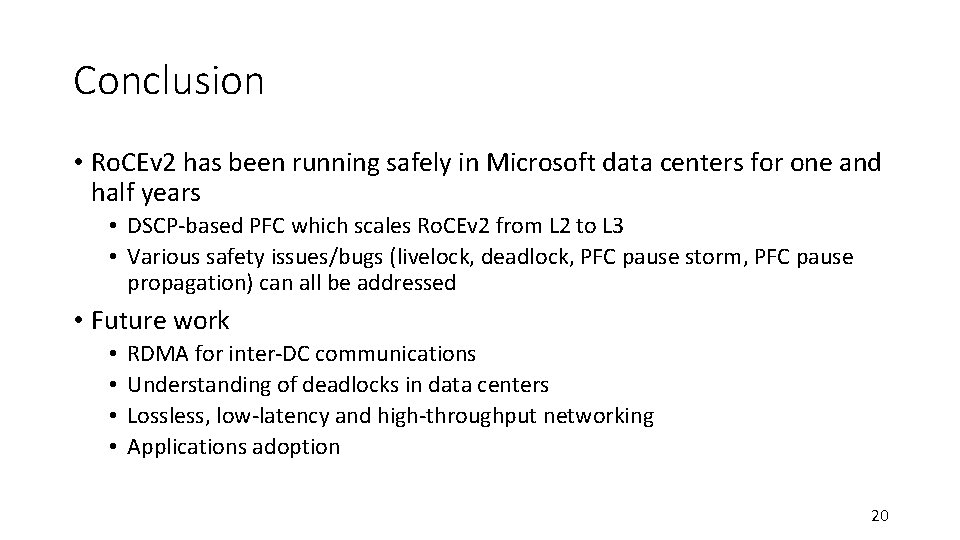
Conclusion • Ro. CEv 2 has been running safely in Microsoft data centers for one and half years • DSCP-based PFC which scales Ro. CEv 2 from L 2 to L 3 • Various safety issues/bugs (livelock, deadlock, PFC pause storm, PFC pause propagation) can all be addressed • Future work • • RDMA for inter-DC communications Understanding of deadlocks in data centers Lossless, low-latency and high-throughput networking Applications adoption 20