
RD status overview and prospects 1 GUY WORMSER
- Slides: 42
R(D*) status : overview and prospects 1 GUY WORMSER LAL, CNRS/IN 2 P 3 , PARIS SACLAY UNIVERSITY ON BEHALF OF THE BABAR AND LHCB COLLABORATIONS A Raphaël FPCP Conference, June 5 2017, Prague
Talk outline 2 �Introduction �The first BABAR measurement (2012) �Quick review of all other mesurements until now �The new R(D*) measurement from LHCb First public release here at FPCP 2017!! The normalization channel BR measurement from BABAR �Prospects and conclusion FPCP Conference, June 5 2017, Prague
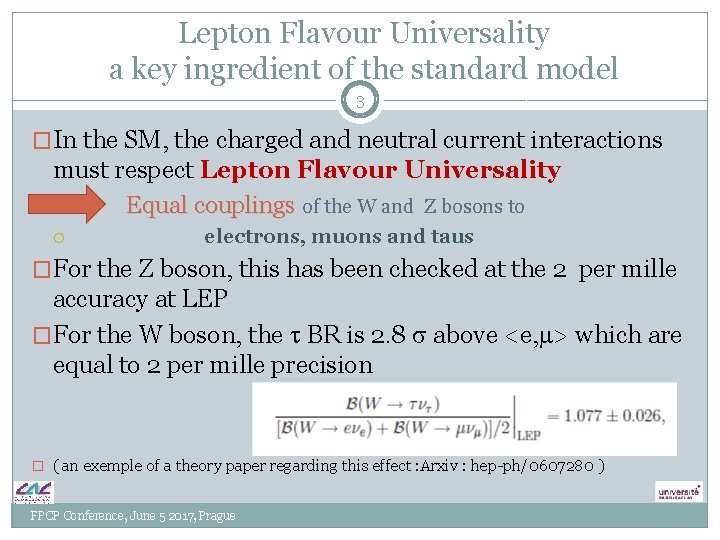
Lepton Flavour Universality a key ingredient of the standard model 3 �In the SM, the charged and neutral current interactions must respect Lepton Flavour Universality Equal couplings of the W and Z bosons to electrons, muons and taus �For the Z boson, this has been checked at the 2 per mille accuracy at LEP �For the W boson, the t BR is 2. 8 s above <e, m> which are equal to 2 per mille precision � ( an exemple of a theory paper regarding this effect : Arxiv : hep-ph/0607280 ) FPCP Conference, June 5 2017, Prague
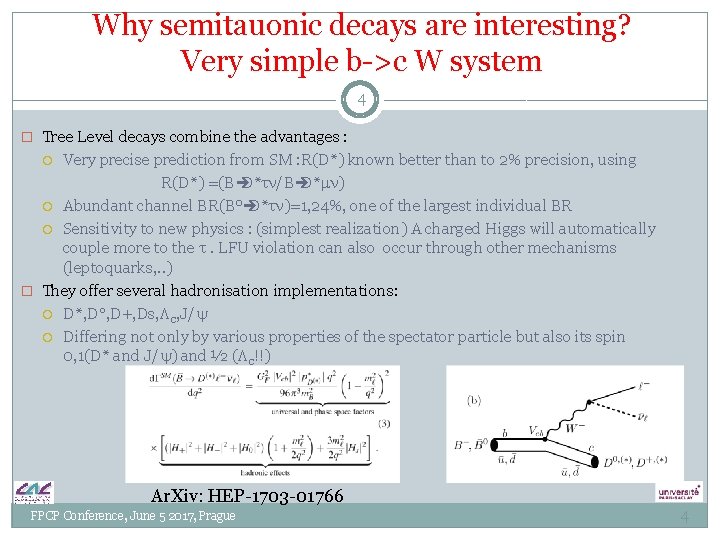
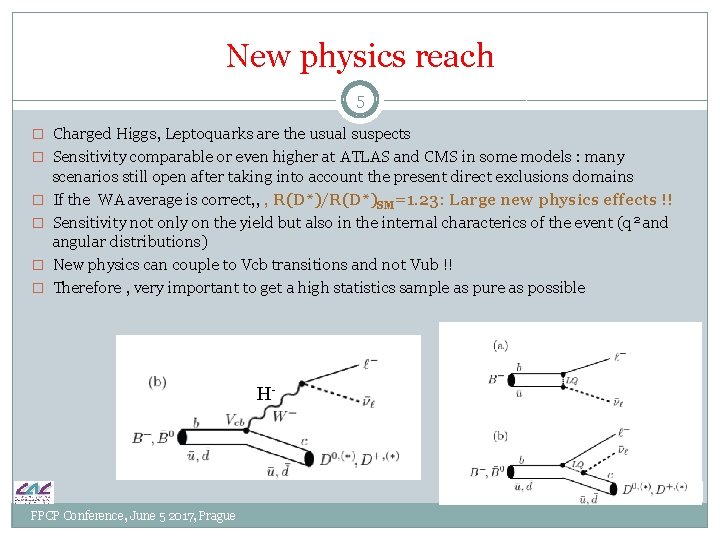
Why semitauonic decays are interesting? Very simple b->c W system 4 � Tree Level decays combine the advantages : Very precise prediction from SM : R(D*) known better than to 2% precision, using R(D*) =(BèD*tn/BèD*mn) Abundant channel BR(B 0è D*tn)=1, 24%, one of the largest individual BR Sensitivity to new physics : (simplest realization) A charged Higgs will automatically couple more to the t. LFU violation can also occur through other mechanisms (leptoquarks, . . ) � They offer several hadronisation implementations: D*, D°, D+, Ds, Lc, J/y Differing not only by various properties of the spectator particle but also its spin 0, 1(D* and J/y) and ½ (Lc!!) Ar. Xiv: HEP-1703 -01766 FPCP Conference, June 5 2017, Prague 4
New physics reach 5 � Charged Higgs, Leptoquarks are the usual suspects � Sensitivity comparable or even higher at ATLAS and CMS in some models : many � � scenarios still open after taking into account the present direct exclusions domains If the WA average is correct, , , R(D*)/R(D*)SM=1. 23: Large new physics effects !! Sensitivity not only on the yield but also in the internal characterics of the event (q 2 and angular distributions) New physics can couple to Vcb transitions and not Vub !! Therefore , very important to get a high statistics sample as pure as possible H- FPCP Conference, June 5 2017, Prague
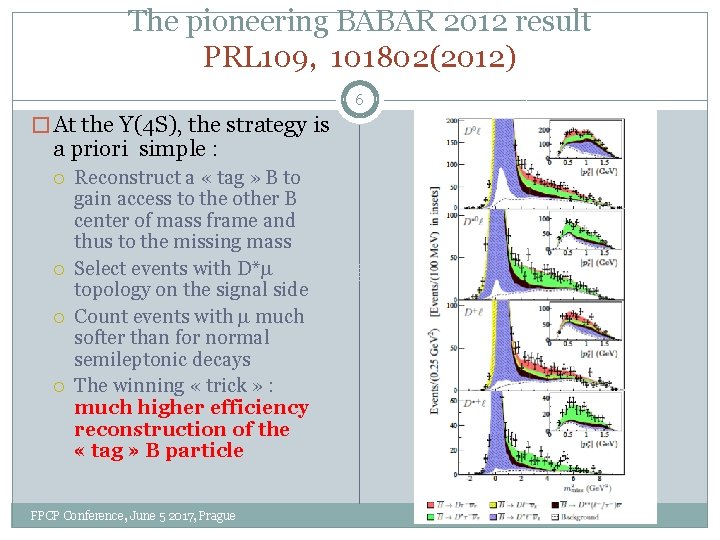
The pioneering BABAR 2012 result PRL 109, 101802(2012) 6 � At the Y(4 S), the strategy is a priori simple : Reconstruct a « tag » B to gain access to the other B center of mass frame and thus to the missing mass Select events with D*m topology on the signal side Count events with m much softer than for normal semileptonic decays The winning « trick » : much higher efficiency reconstruction of the « tag » B particle FPCP Conference, June 5 2017, Prague
Other R(D*) results up to now 7 � 3 new measurements by BELLE collaboration Hadronic tag as for BABAR-leptonic tau decay � PRD 92, 072014(2015) Semileptonic Tag , more statistics but worse CM and missing mass resolution-leptonic tau decay � PRD 94, 072007 (2015) Hadronic tag –hadronic tau decay in p/pp°. Important to access tau polarization information. Real challenge to fight hadronic background � PRL 118, 211801 (2017), ar. Xiv 1612. 00529 � 1 new mesurement from LHCb collaboration � PRL 115, 1183(2015) Muonic tau decay in a hadronic collider !!!! FPCP Conference, June 5 2017, Prague
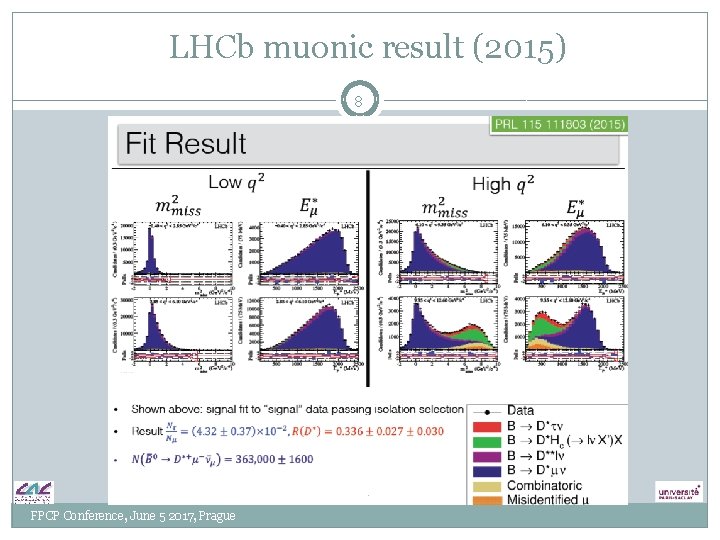
LHCb muonic result (2015) 8 4 FPCP Conference, June 5 2017, Prague
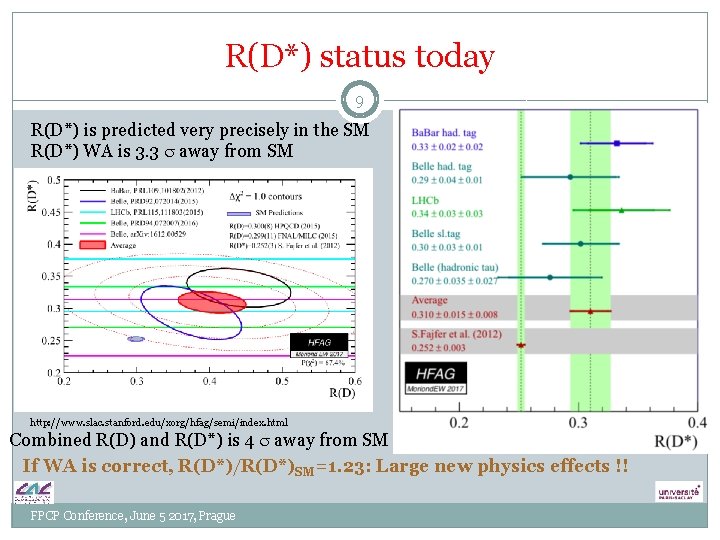
R(D*) status today 9 R(D*) is predicted very precisely in the SM R(D*) WA is 3. 3 s away from SM http: //www. slac. stanford. edu/xorg/hfag/semi/index. html Combined R(D) and R(D*) is 4 s away from SM If WA is correct, R(D*)/R(D*)SM=1. 23: Large new physics effects !! FPCP Conference, June 5 2017, Prague
The unusual features of the LHCb analysis D*tn; tè 3 p(p°) 10 �A semileptonic decay without (charged) lepton !!: ZERO background from normal semileptonic decays!!!! �In this analysis, it is the background that leads to nice mass peaks and not the signal !!! This provides key handle to control the various backgrounds �Only 1 neutrino emitted at the t vertex The complete event kinematics can be reconstructed with good precision �No sensitivity to t polarisation (ma 12 » 0. 5*mt 2) �Note : measure R(D*-) and not R(D*) as B Factories FPCP Conference, June 5 2017, Prague
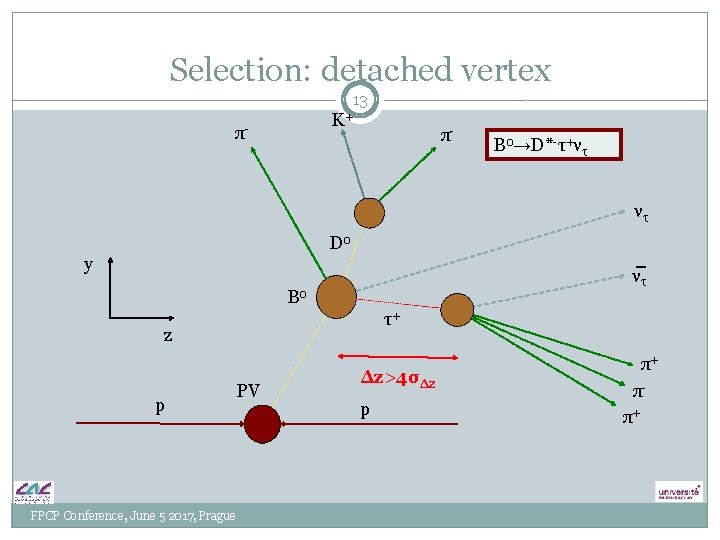
The initial very large background 11 �The D*tn decay, with t going into 3 pions (it can also be 3 p+p 0) leads to a D* 3 p(+X ) final state �Nothing is more common than a D*3 p (+X ) final state in a typical B decay : BR(B 0èD*3 p+X)/BR(B 0èD*tn; tè 3 p)SM~100 A very strong background suppression method is absolutely needed : The DETACHED VERTEX METHOD FPCP Conference, June 5 2017, Prague
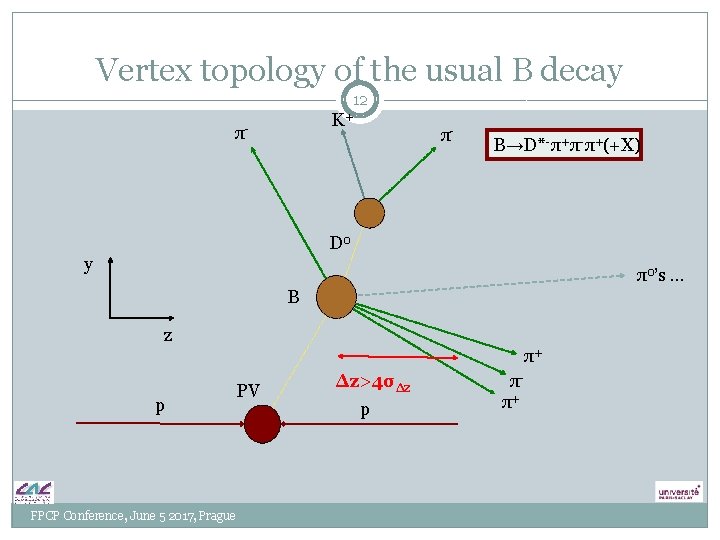
Vertex topology of the usual B decay 12 K+ π- π- B→D*-π+π-π+(+X) D 0 y π0’s … B z π+ p FPCP Conference, June 5 2017, Prague PV Δz>4σΔz p ππ+
Selection: detached vertex 13 K+ π- π- B 0→D*-τ+ντ ντ D 0 y ν τ B 0 τ+ z p FPCP Conference, June 5 2017, Prague PV Δz>4σΔz p π+ ππ+
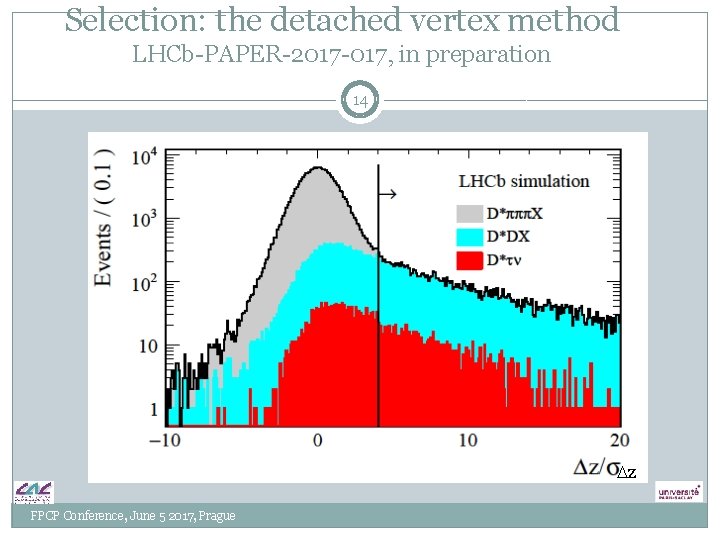
Selection: the detached vertex method LHCb-PAPER-2017 -017, in preparation 14 Dz FPCP Conference, June 5 2017, Prague
The second level of background 15 �After the 4 s cut in Dz/s. Dz , the prompt background is suppressed by ~3 orders of magnitude!!!!! �The second level of background consists of B decays where the 3 p vertex is transported away from the B 0 vertex by a charm carrier: Ds, D+ or D 0 (in that order of importance) �This background is smaller : BR(B 0 ->D* ’D’; ‘D’è 3 p. X)/ BR(B 0èD*tn; tè 3 p)SM~10 �… and we can suppress it strongly FPCP Conference, June 5 2017, Prague
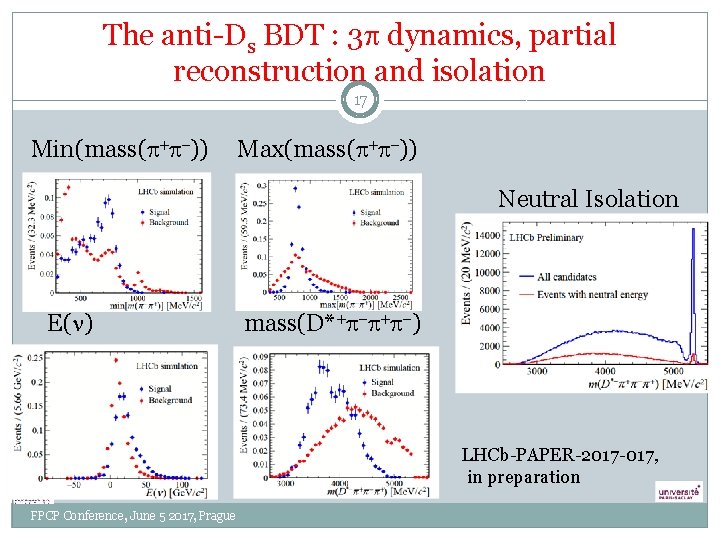
The inclusive Ds decays in 3 pions 16 � The Wè cs decays can produce a single meson Ds, very often in an excited state Ds*, Ds** or two particles D 0 K-, D+K 0, and their excited counterparts � Although the exclusive Ds è 3 p is small (1% BR), the Ds is an amazingly rich source of 3 p +X final states (~25%!) � We classify hadronic Ds decays into 3 pions in 4 categories hp. X (hp, hr) h’p. X(h’p, h’r) (f/w) p. X (f/w p, f/w r) M 3 p, where M can be n, K 0, h, h’, w, f � We do not have precise BR for all of these (some well measured, some poorly, some not at all) � The inclusive BR of Ds into 3 pions that could constraint all of these is not known either We extract these informations from LHCb data in a Ds enriched region (BDT<-0. 075) (~90% Ds) FPCP Conference, June 5 2017, Prague
The anti-Ds BDT : 3 p dynamics, partial reconstruction and isolation 17 Min(mass(p+p-)) Max(mass(p+p-)) Neutral Isolation E(n) mass(D*+p-p+p-) LHCb-PAPER-2017 -017, in preparation FPCP Conference, June 5 2017, Prague
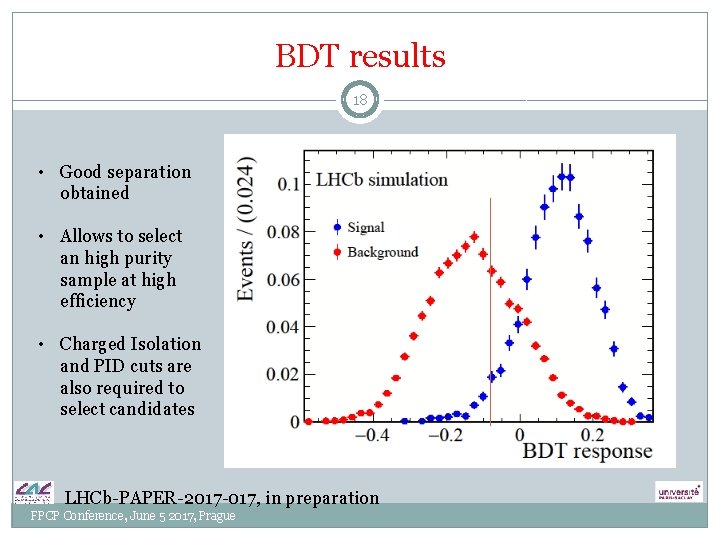
BDT results 18 • Good separation obtained • Allows to select an high purity sample at high efficiency • Charged Isolation and PID cuts are also required to select candidates LHCb-PAPER-2017 -017, in preparation FPCP Conference, June 5 2017, Prague
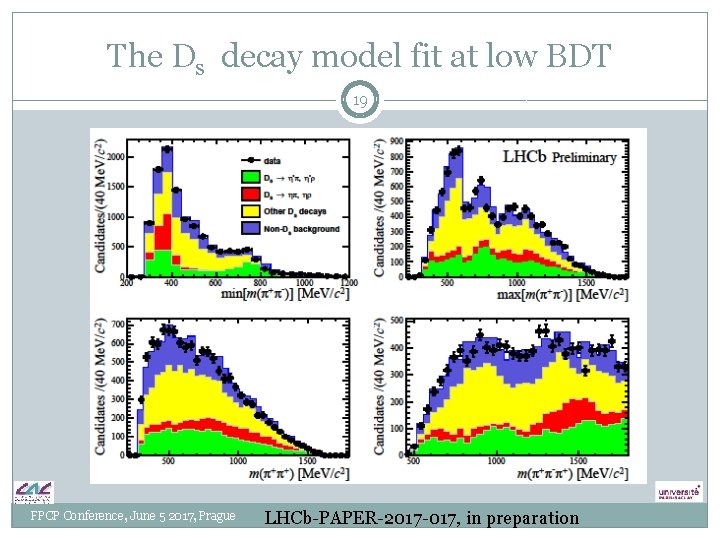
The Ds decay model fit at low BDT 19 FPCP Conference, June 5 2017, Prague LHCb-PAPER-2017 -017, in preparation
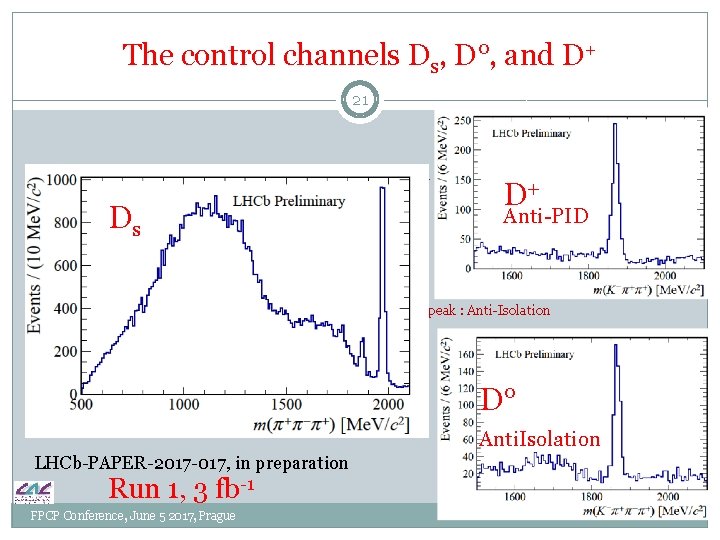
The inclusive D° and D+ decays in 3 pions 20 The situation is simpler in D+ and D° decays whose main 3 p decay mode is thru the K 3 p decay For the D°, the inclusive 4 prongs BR constrains strongly the rate of 3 p events Unfortunately, this constraint does not exist for the D+ mesons, K 3 pp° is poorly known, the inclusive BR is not measured � We let the D+ component float in the fit � (Note : For all these D decays, contacts have been established with BES-3 collaboration to measure these numbers in the near future) FPCP Conference, June 5 2017, Prague
The control channels Ds, D°, and D+ 21 D+Dèès D+ peak : Anti-PID cut Ds + D D Anti-PID + D+Anti-PID Ds D 0 peak : Anti-Isolation cut D° D° Anti-Isolation D° Anti. Isolation LHCb-PAPER-2017 -017, in preparation Run 1, 3 fb-1 FPCP Conference, June 5 2017, Prague
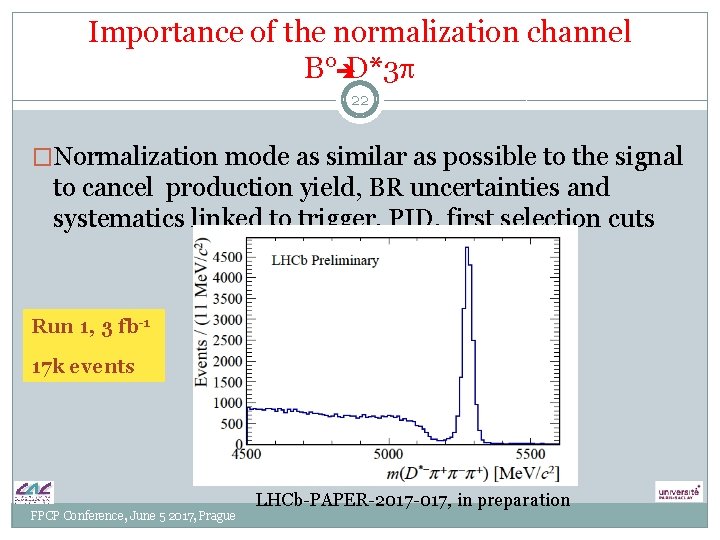
Importance of the normalization channel B°èD*3 p 22 �Normalization mode as similar as possible to the signal to cancel production yield, BR uncertainties and systematics linked to trigger, PID, first selection cuts Run 1, 3 fb-1 17 k events FPCP Conference, June 5 2017, Prague Run 1, 3 fb-1 18 k events LHCb-PAPER-2017 -017, in preparation
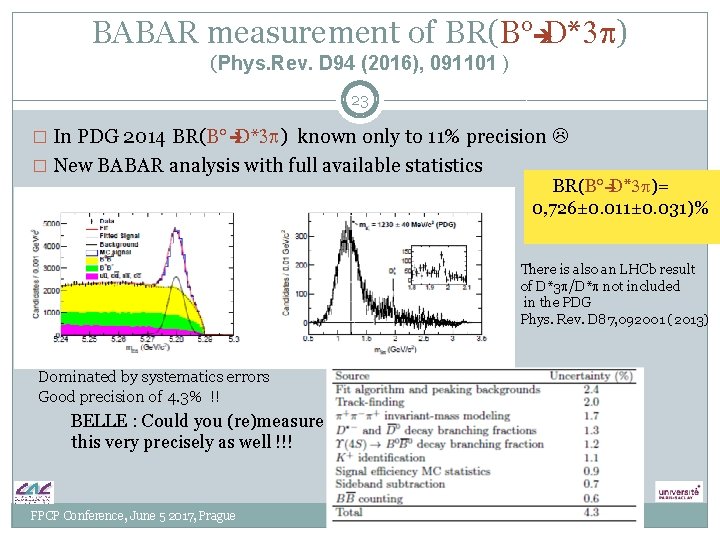
BABAR measurement of BR(B°èD*3 p) (Phys. Rev. D 94 (2016), 091101 ) 23 � In PDG 2014 BR(B°èD*3 p) known only to 11% precision � New BABAR analysis with full available statistics BR(B°èD*3 p)= 0, 726± 0. 011± 0. 031)% There is also an LHCb result of D*3 p/D*p not included in the PDG Phys. Rev. D 87, 092001 (2013) Dominated by systematics errors Good precision of 4. 3% !! BELLE : Could you (re)measure this very precisely as well !!! FPCP Conference, June 5 2017, Prague
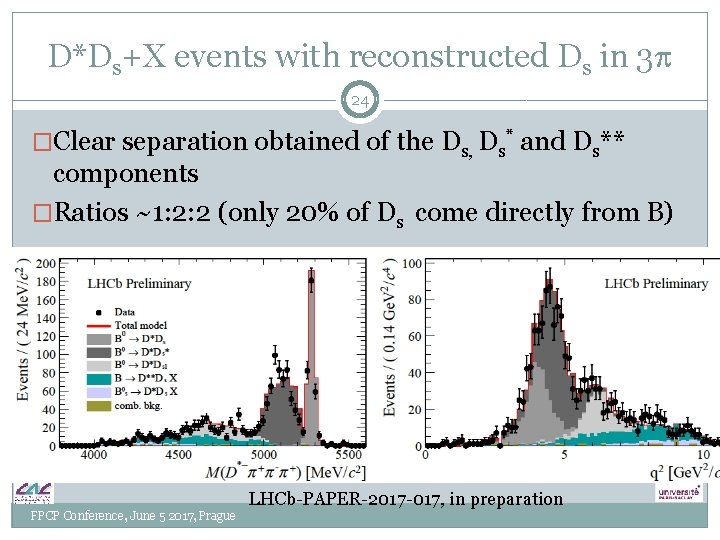
D*Ds+X events with reconstructed Ds in 3 p 24 �Clear separation obtained of the Ds, Ds* and Ds** components �Ratios ~1: 2: 2 (only 20% of Ds come directly from B) LHCb-PAPER-2017 -017, in preparation FPCP Conference, June 5 2017, Prague
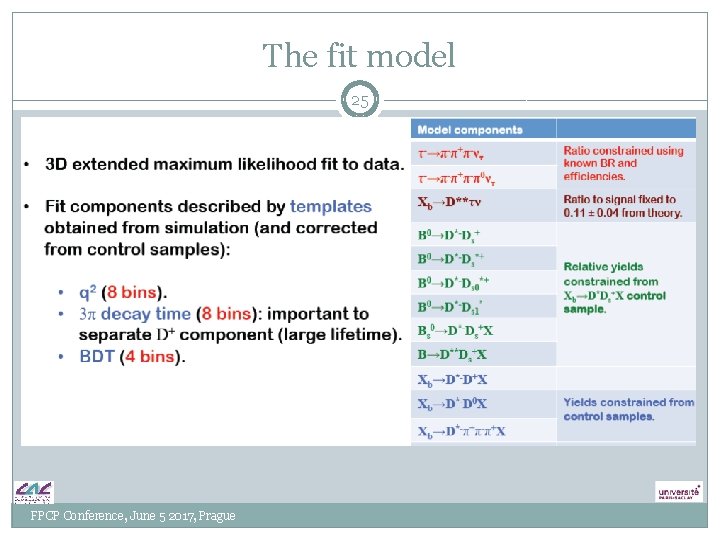
The fit model 25 FPCP Conference, June 5 2017, Prague
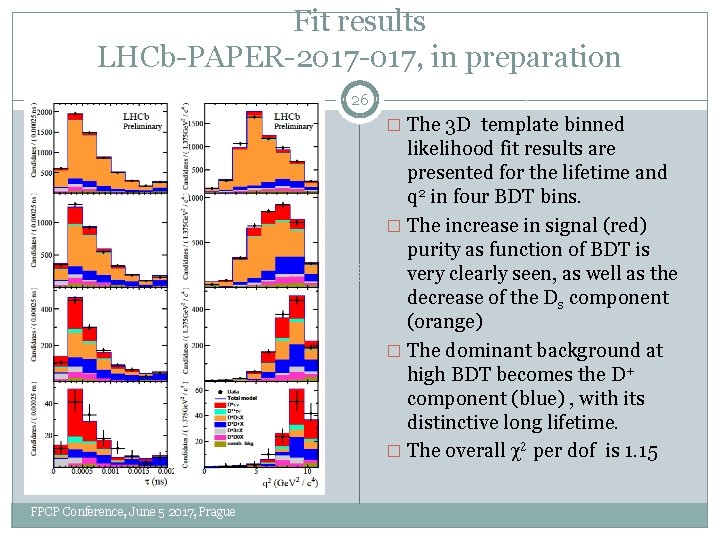
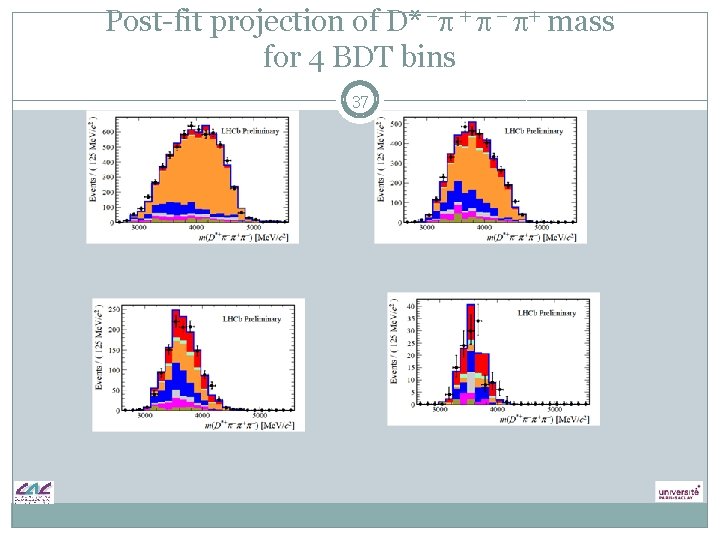
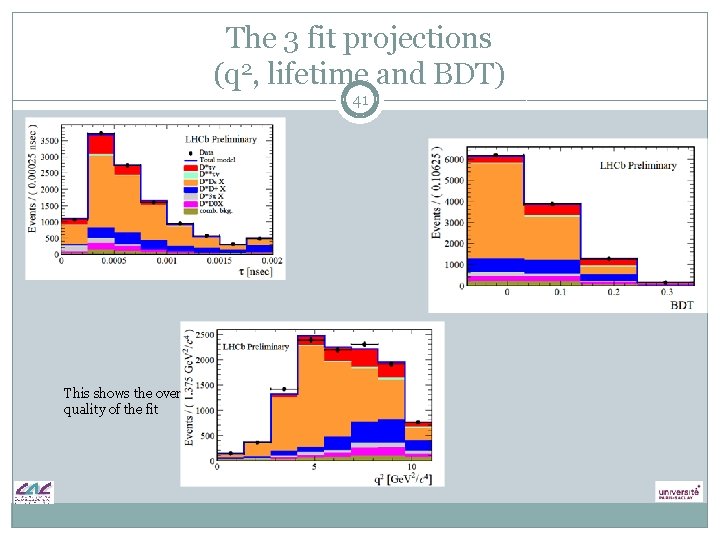
Fit results LHCb-PAPER-2017 -017, in preparation 26 � The 3 D template binned likelihood fit results are presented for the lifetime and q 2 in four BDT bins. � The increase in signal (red) purity as function of BDT is very clearly seen, as well as the decrease of the Ds component (orange) � The dominant background at high BDT becomes the D+ component (blue) , with its distinctive long lifetime. � The overall c 2 per dof is 1. 15 FPCP Conference, June 5 2017, Prague
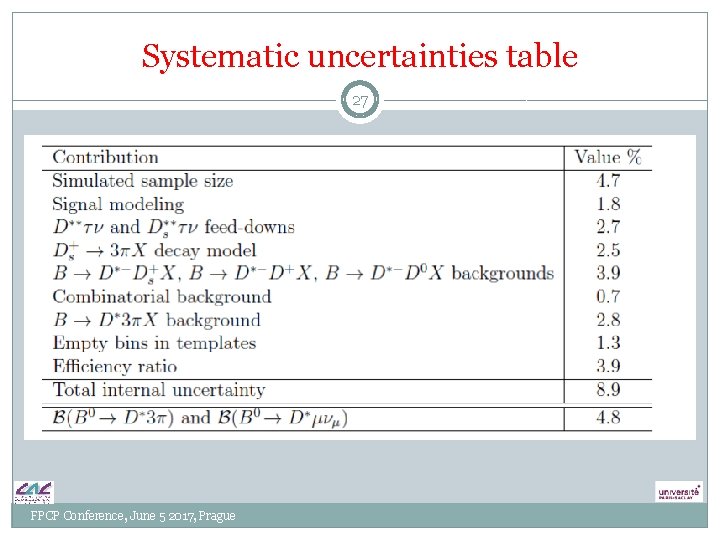
Systematic uncertainties table 27 FPCP Conference, June 5 2017, Prague
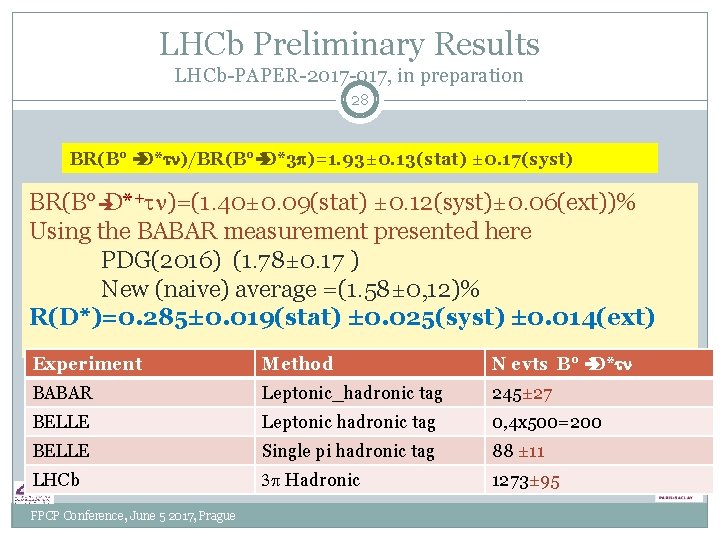
LHCb Preliminary Results LHCb-PAPER-2017 -017, in preparation 28 BR(B° è D*tn)/BR(B°è D*3 p)=1. 93± 0. 13(stat) ± 0. 17(syst) BR(B°èD*+tn)=(1. 40± 0. 09(stat) ± 0. 12(syst)± 0. 06(ext))% Using the BABAR measurement presented here PDG(2016) (1. 78± 0. 17 ) New (naive) average =(1. 58± 0, 12)% R(D*)=0. 285± 0. 019(stat) ± 0. 025(syst) ± 0. 014(ext) Experiment Method N evts B° è D*tn BABAR Leptonic_hadronic tag 245± 27 BELLE Leptonic hadronic tag 0, 4 x 500=200 BELLE Single pi hadronic tag 88 ± 11 LHCb 3 p Hadronic 1273± 95 FPCP Conference, June 5 2017, Prague
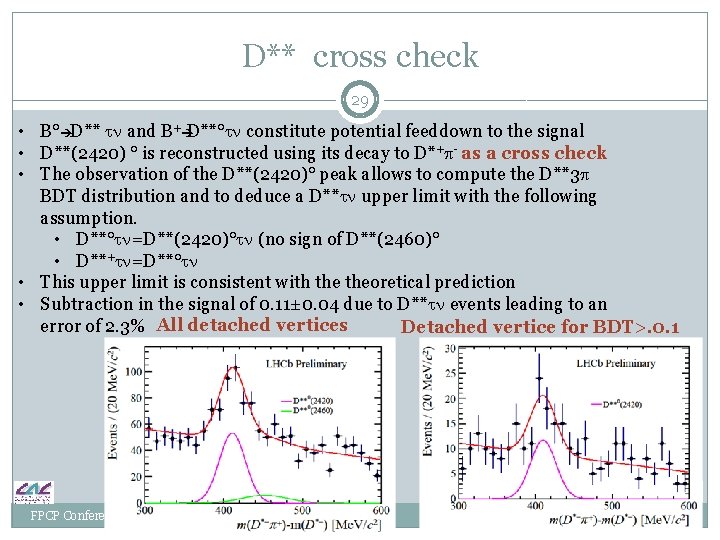
D** cross check 29 • B°è D** tn and B+èD**°tn constitute potential feeddown to the signal • D**(2420) ° is reconstructed using its decay to D*+p- as a cross check • The observation of the D**(2420)° peak allows to compute the D**3 p BDT distribution and to deduce a D**tn upper limit with the following assumption. • D**°tn=D**(2420)°tn (no sign of D**(2460)° • D**+tn=D**°tn • This upper limit is consistent with theoretical prediction • Subtraction in the signal of 0. 11± 0. 04 due to D**tn events leading to an error of 2. 3% All detached vertices Detached vertice for BDT>. 0. 1 FPCP Conference, June 5 2017, Prague
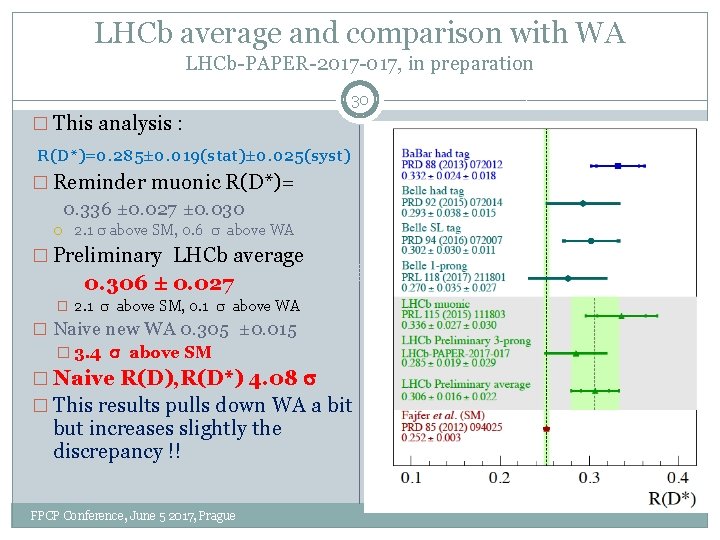
LHCb average and comparison with WA LHCb-PAPER-2017 -017, in preparation 30 � This analysis : R(D*)=0. 285± 0. 019(stat)± 0. 025(syst) � Reminder muonic R(D*)= 0. 336 ± 0. 027 ± 0. 030 2. 1 s above SM, 0. 6 s above WA � Preliminary LHCb average 0. 306 ± 0. 027 � 2. 1 s above SM, 0. 1 s above WA � Naive new WA 0. 305 ± 0. 015 � 3. 4 s above SM � Naive R(D), R(D*) 4. 08 s � This results pulls down WA a bit but increases slightly the discrepancy !! FPCP Conference, June 5 2017, Prague
Prospects 31 �For the hadronic R(D*) LHCb measurement, the inclusion of Run 2 data will allow to multiply the statistics by a factor 3 Higher bb cross section, better trigger If WA is correct, The discrepancy with SM could increase significanlty �Several Rs will be measured in the coming year: R(Lc), R(J/y), … �The details of the internal event structure will be scrutinized �Other R(D*) measurements from BABAR and BELLE still possible FPCP Conference, June 5 2017, Prague
Conclusions 32 � The analysis to measure the ratio BR(B° è D*tn)/BR(B°è D*3 p) using the 3 p hadronic decay of the t lepton has been performed at LHCb (Preliminary) R(D*)=0. 285± 0. 019(stat) ± 0. 025(syst) ± 0. 014(ext) New preliminary LHCb average of R(D*)=0. 306± 0. 027 � This analysis was made possible due to the unique LHCb capabilities for separating secondary and tertiary vertices with unprecedented precision � The R(D*) result, the first one to use 3 p final state, is one of the best single measurements, having the smallest statistical error. � It is compatible both with the SM prediction and with the present WA. However, it slightly increases the discrepancy of the WA wrt to the SM � This method paves the way for the measurements of R(D*) using the full Run 2 data with a goal of 3% statistical precision All other R(X), with R(Lc) and R(J/y) currently underway The detailed internal characteristics of the events due to the unique possibility to isolate a high statistics high purity sample of D*tn events FPCP Conference, June 5 2017, Prague
Backup 33 FPCP Conference, June 5 2017, Prague
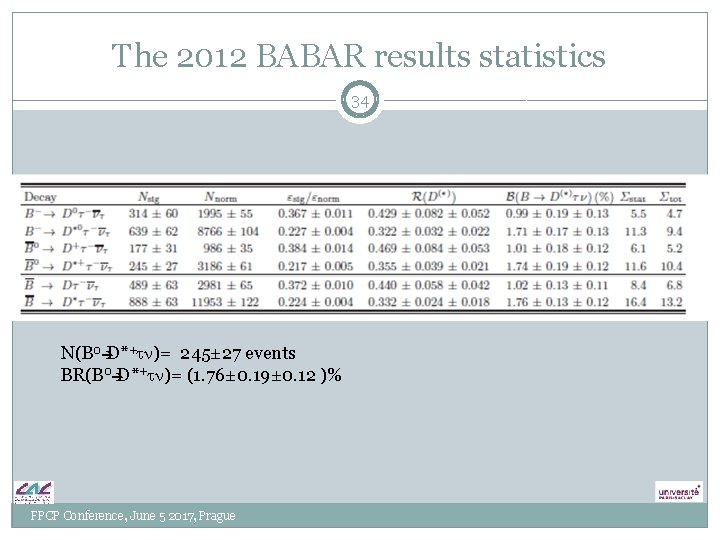
The 2012 BABAR results statistics 34 N(B 0èD*+tn)= 245± 27 events BR(B 0èD*+tn)= (1. 76± 0. 19± 0. 12 )% FPCP Conference, June 5 2017, Prague
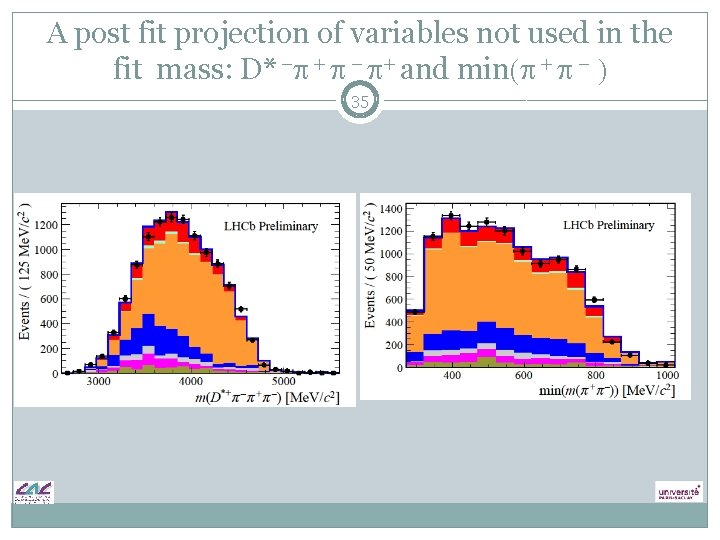
A post fit projection of variables not used in the fit mass: D* -p + p - p+ and min(p + p - ) 35
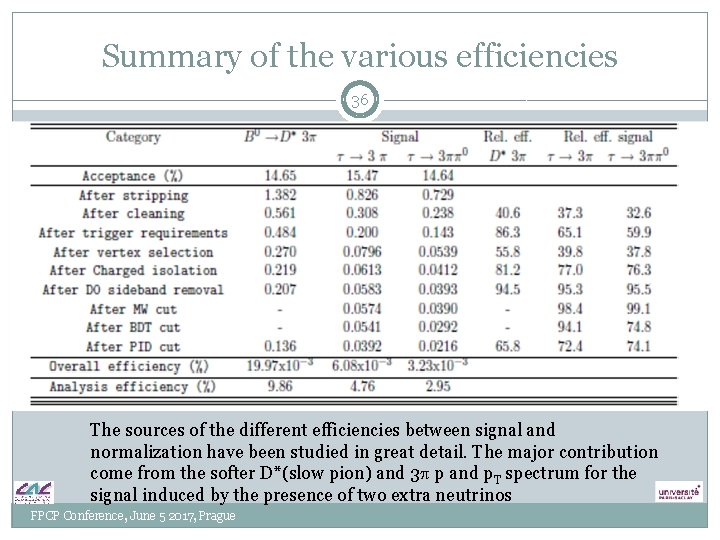
Summary of the various efficiencies 36 The sources of the different efficiencies between signal and normalization have been studied in great detail. The major contribution come from the softer D*(slow pion) and 3 p p and p. T spectrum for the signal induced by the presence of two extra neutrinos FPCP Conference, June 5 2017, Prague
Post-fit projection of D* -p + p - p+ mass for 4 BDT bins 37
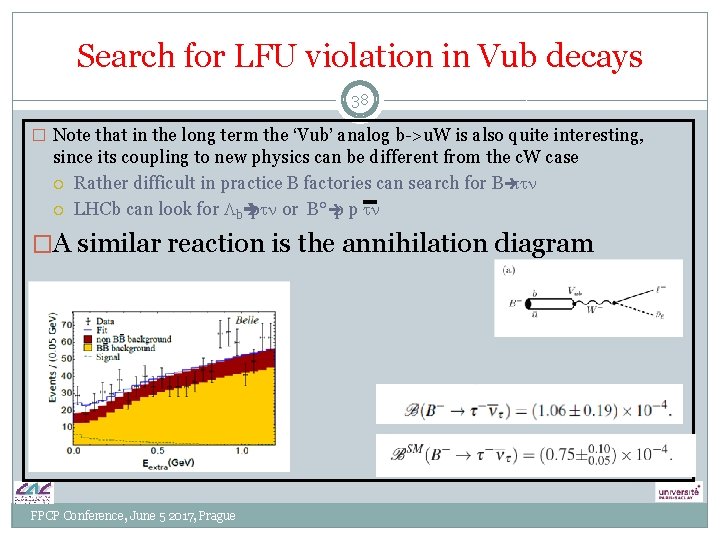
Search for LFU violation in Vub decays 38 � Note that in the long term the ‘Vub’ analog b->u. W is also quite interesting, since its coupling to new physics can be different from the c. W case Rather difficult in practice B factories can search for Bè ptn LHCb can look for Lbè ptn or B°èp p tn �A similar reaction is the annihilation diagram FPCP Conference, June 5 2017, Prague
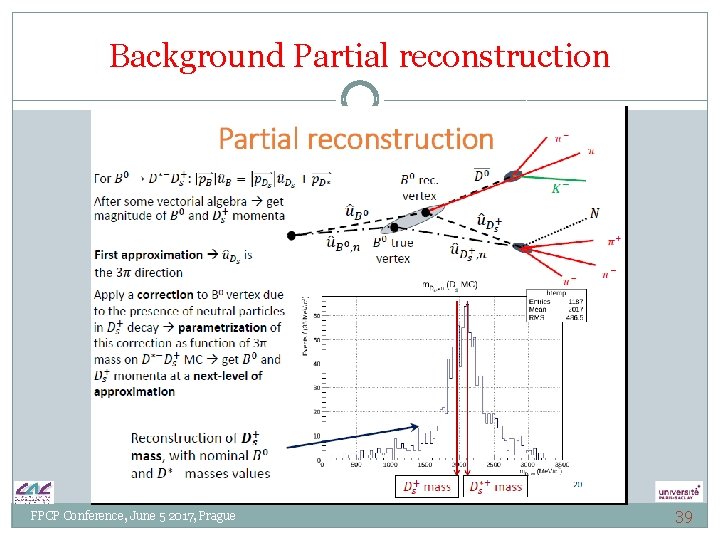
Background Partial reconstruction FPCP Conference, June 5 2017, Prague 39
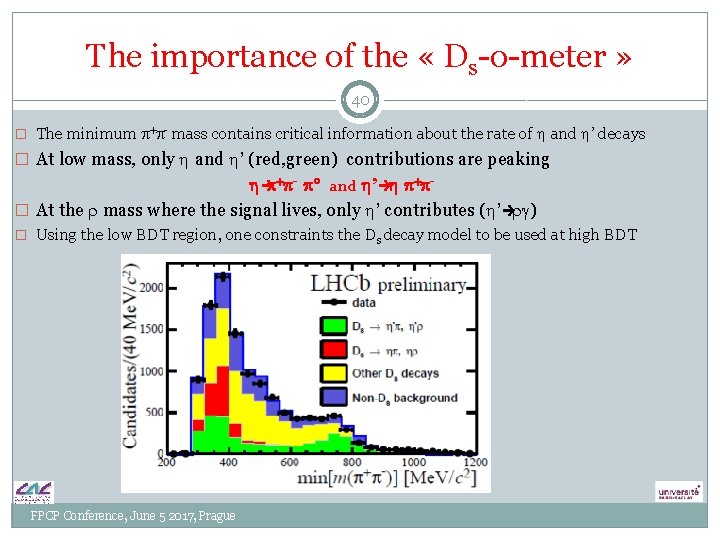
The importance of the « Ds-o-meter » 40 � The minimum p+p- mass contains critical information about the rate of h and h’ decays � At low mass, only h and h’ (red, green) contributions are peaking hèp+p- p° and h’è h p+p� At the r mass where the signal lives, only h’ contributes (h’è rg) � Using the low BDT region, one constraints the Ds decay model to be used at high BDT FPCP Conference, June 5 2017, Prague
The 3 fit projections (q 2, lifetime and BDT) 41 This shows the overall good quality of the fit
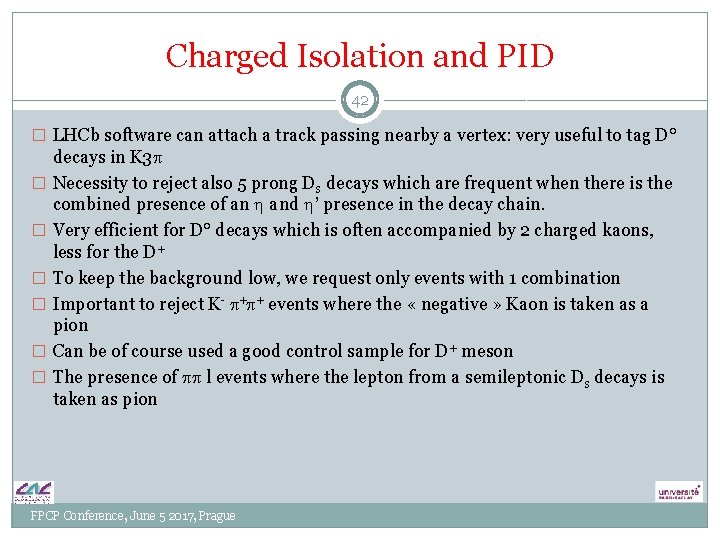
Charged Isolation and PID 42 � LHCb software can attach a track passing nearby a vertex: very useful to tag D° � � � decays in K 3 p Necessity to reject also 5 prong Ds decays which are frequent when there is the combined presence of an h and h’ presence in the decay chain. Very efficient for D° decays which is often accompanied by 2 charged kaons, less for the D+ To keep the background low, we request only events with 1 combination Important to reject K- p+p+ events where the « negative » Kaon is taken as a pion Can be of course used a good control sample for D+ meson The presence of pp l events where the lepton from a semileptonic Ds decays is taken as pion FPCP Conference, June 5 2017, Prague