
RD plans for 2019 The SPACALRD group 2019

- Slides: 24
R&D plans for 2019 The SPACAL-RD group 2019 -02 -15 R&D plans - 2019 1
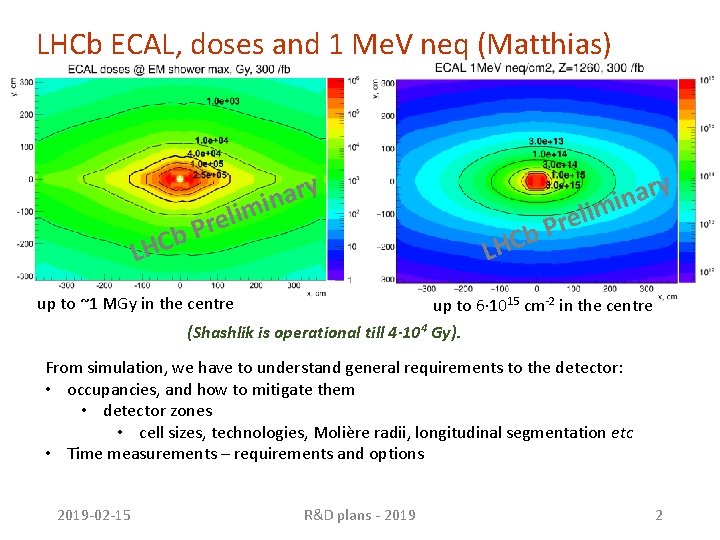
LHCb ECAL, doses and 1 Me. V neq (Matthias) y r a in b C H L m i l e Pr y r a n imi LHC l e r b. P up to ~1 MGy in the centre up to 6· 1015 cm-2 in the centre (Shashlik is operational till 4· 104 Gy). From simulation, we have to understand general requirements to the detector: • occupancies, and how to mitigate them • detector zones • cell sizes, technologies, Molière radii, longitudinal segmentation etc • Time measurements – requirements and options 2019 -02 -15 R&D plans - 2019 2
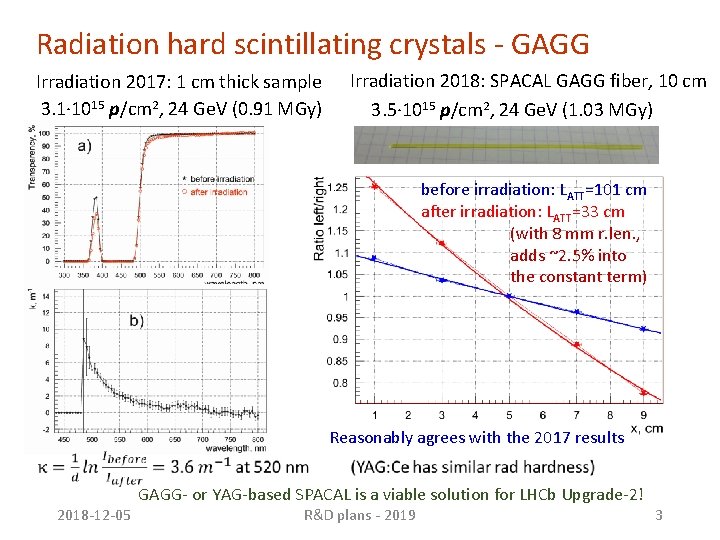
Radiation hard scintillating crystals - GAGG Irradiation 2017: 1 cm thick sample 3. 1· 1015 p/cm 2, 24 Ge. V (0. 91 MGy) Irradiation 2018: SPACAL GAGG fiber, 10 cm 3. 5· 1015 p/cm 2, 24 Ge. V (1. 03 MGy) before irradiation: LATT=101 cm after irradiation: LATT=33 cm (with 8 mm r. len. , adds ~2. 5% into the constant term) Reasonably agrees with the 2017 results GAGG- or YAG-based SPACAL is a viable solution for LHCb Upgrade-2! 2018 -12 -05 R&D plans - 2019 3
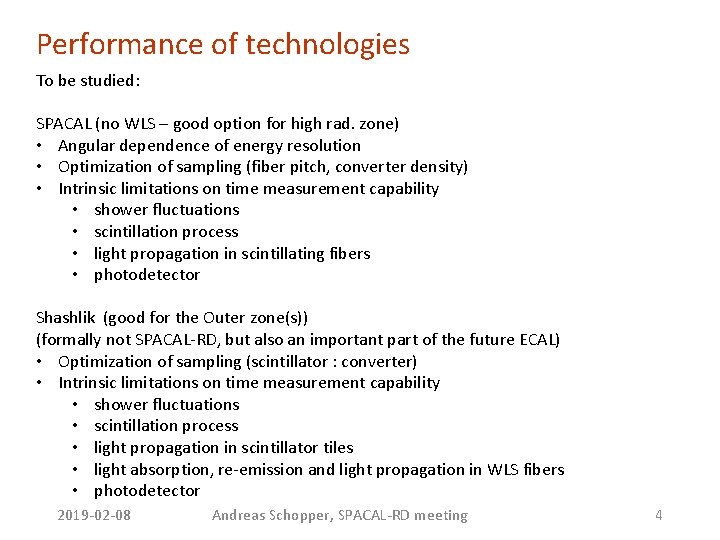
Performance of technologies To be studied: SPACAL (no WLS – good option for high rad. zone) • Angular dependence of energy resolution • Optimization of sampling (fiber pitch, converter density) • Intrinsic limitations on time measurement capability • shower fluctuations • scintillation process • light propagation in scintillating fibers • photodetector Shashlik (good for the Outer zone(s)) (formally not SPACAL-RD, but also an important part of the future ECAL) • Optimization of sampling (scintillator : converter) • Intrinsic limitations on time measurement capability • shower fluctuations • scintillation process • light propagation in scintillator tiles • light absorption, re-emission and light propagation in WLS fibers • photodetector 2019 -02 -08 Andreas Schopper, SPACAL-RD meeting 4
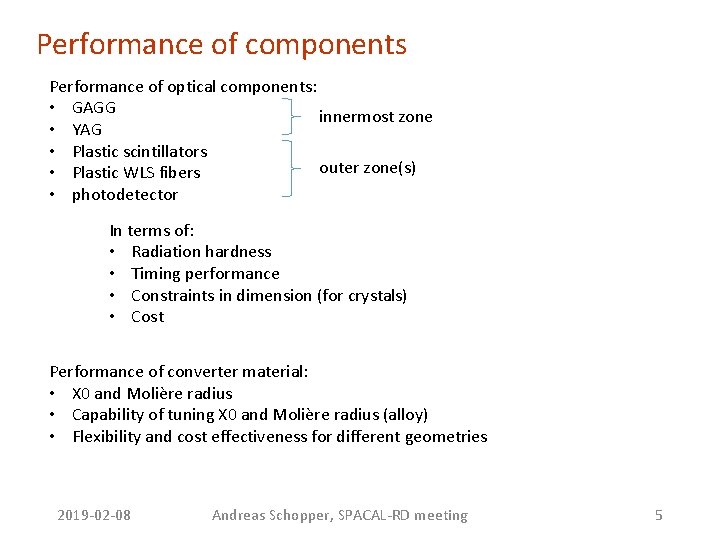
Performance of components Performance of optical components: • GAGG innermost zone • YAG • Plastic scintillators outer zone(s) • Plastic WLS fibers • photodetector In terms of: • Radiation hardness • Timing performance • Constraints in dimension (for crystals) • Cost Performance of converter material: • X 0 and Molière radius • Capability of tuning X 0 and Molière radius (alloy) • Flexibility and cost effectiveness for different geometries 2019 -02 -08 Andreas Schopper, SPACAL-RD meeting 5
Prototype studies • Validation of simulation of SPACAL energy resolution • as function of angle and energy • Performance of time measurement with SPACAL for electrons as function of • Scintillator type (GAGG or YAG) • Energy • Angle • longitudinal segmentation • Performance of time measurement with Shashlik 2019 -02 -08 Andreas Schopper, SPACAL-RD meeting 6
Component studies • Test bench measurements of GAGG and YAG • Light yield • Attenuation length • Scintillation kinetics (rise time, decay time) • Photodetector studies • including samples irradiated to 1 MGy in 2018 • Development of different alloys for • tuning of X 0 and Molière radius • Lead/W alloys • Cu/W alloys • Identifying best technology for integrating fibers 2019 -02 -08 Andreas Schopper, SPACAL-RD meeting 7
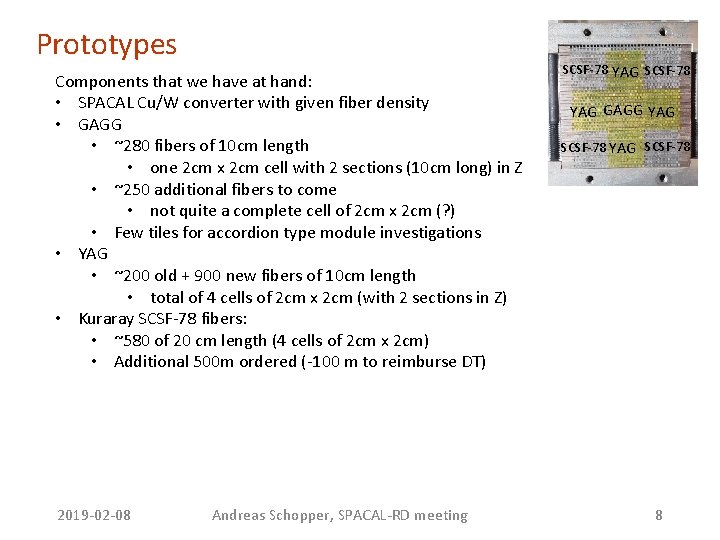
Prototypes Components that we have at hand: • SPACAL Cu/W converter with given fiber density • GAGG • ~280 fibers of 10 cm length • one 2 cm x 2 cm cell with 2 sections (10 cm long) in Z • ~250 additional fibers to come • not quite a complete cell of 2 cm x 2 cm (? ) • Few tiles for accordion type module investigations • YAG • ~200 old + 900 new fibers of 10 cm length • total of 4 cells of 2 cm x 2 cm (with 2 sections in Z) • Kuraray SCSF-78 fibers: • ~580 of 20 cm length (4 cells of 2 cm x 2 cm) • Additional 500 m ordered (-100 m to reimburse DT) 2019 -02 -08 Andreas Schopper, SPACAL-RD meeting SCSF-78 YAG GAGG YAG SCSF-78 8
Prototypes We could factorize different studies by use of different prototypes • the 20 cm long prototype filled with Kuraray fibers to study SPACAL energy resolution and angle dependence for the MC validation • 1 cell (2 x 2 cm 2) GAGG and YAG to study timing or • 3 cm x 3 cm proto with GAGG and/or YAG with smaller cell size (e. g. 1 cm? ) to study timing • 1 cell prototype (with smaller cell size? ) to test photodiodes and other photodetectors • Small prototype(s) to test different converter options Components that we would need to order: • GAGG? • YAG? • Pb/W converter for small prototype (3 cmx 3 cm)? • KURARAY WLS fibers (Y 11)? quantities are under discussion 2019 -02 -08 Andreas Schopper, SPACAL-RD meeting 9
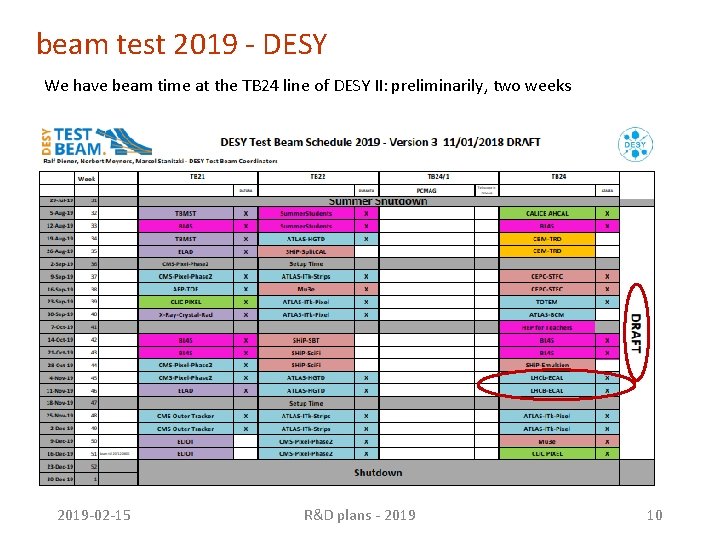
beam test 2019 - DESY We have beam time at the TB 24 line of DESY II: preliminarily, two weeks 2019 -02 -15 R&D plans - 2019 10
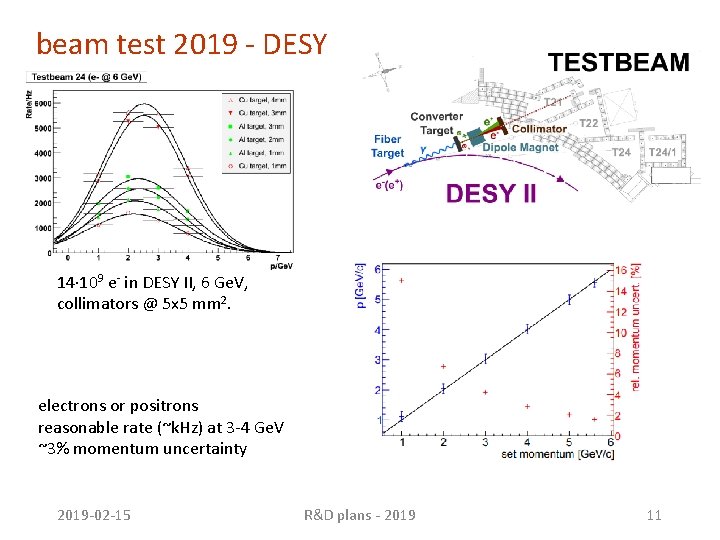
beam test 2019 - DESY 14· 109 e- in DESY II, 6 Ge. V, collimators @ 5 x 5 mm 2. electrons or positrons reasonable rate (~k. Hz) at 3 -4 Ge. V ~3% momentum uncertainty 2019 -02 -15 R&D plans - 2019 11
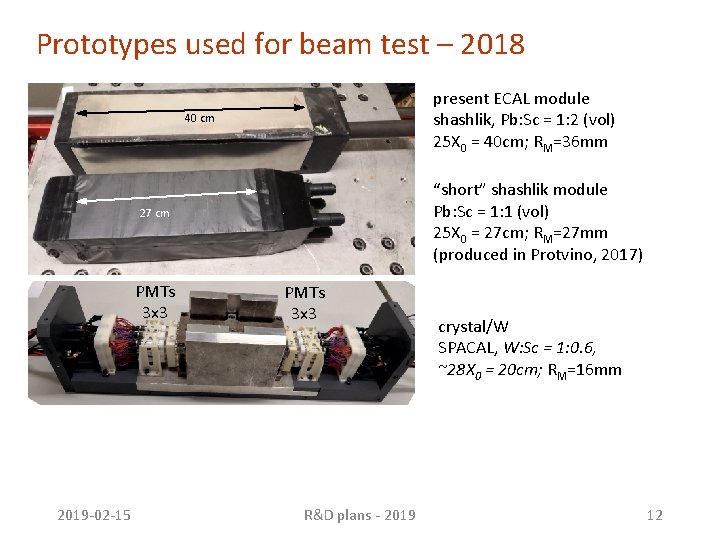
Prototypes used for beam test – 2018 present ECAL module shashlik, Pb: Sc = 1: 2 (vol) 25 X 0 = 40 cm; RM=36 mm 40 cm “short” shashlik module Pb: Sc = 1: 1 (vol) 25 X 0 = 27 cm; RM=27 mm (produced in Protvino, 2017) 27 cm PMTs 3 x 3 2019 -02 -15 PMTs 3 x 3 R&D plans - 2019 crystal/W SPACAL, W: Sc = 1: 0. 6, ~28 X 0 = 20 cm; RM=16 mm 12
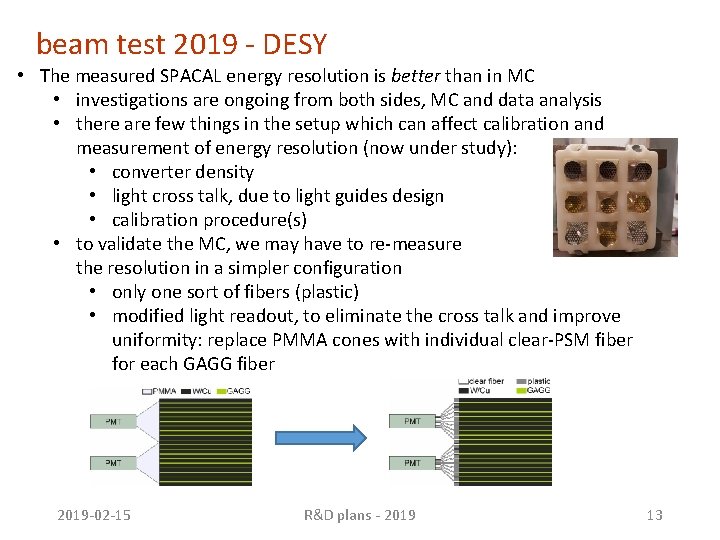
beam test 2019 - DESY • The measured SPACAL energy resolution is better than in MC • investigations are ongoing from both sides, MC and data analysis • there are few things in the setup which can affect calibration and measurement of energy resolution (now under study): • converter density • light cross talk, due to light guides design • calibration procedure(s) • to validate the MC, we may have to re-measure the resolution in a simpler configuration • only one sort of fibers (plastic) • modified light readout, to eliminate the cross talk and improve uniformity: replace PMMA cones with individual clear-PSM fiber for each GAGG fiber 2019 -02 -15 R&D plans - 2019 13
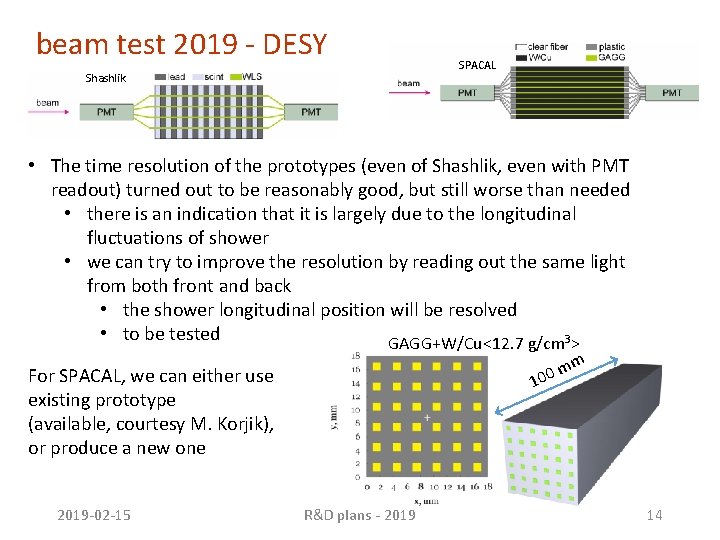
beam test 2019 - DESY Shashlik SPACAL • The time resolution of the prototypes (even of Shashlik, even with PMT readout) turned out to be reasonably good, but still worse than needed • there is an indication that it is largely due to the longitudinal fluctuations of shower • we can try to improve the resolution by reading out the same light from both front and back • the shower longitudinal position will be resolved • to be tested GAGG+W/Cu<12. 7 g/cm 3> m m 0 0 1 For SPACAL, we can either use existing prototype (available, courtesy M. Korjik), or produce a new one 2019 -02 -15 R&D plans - 2019 14
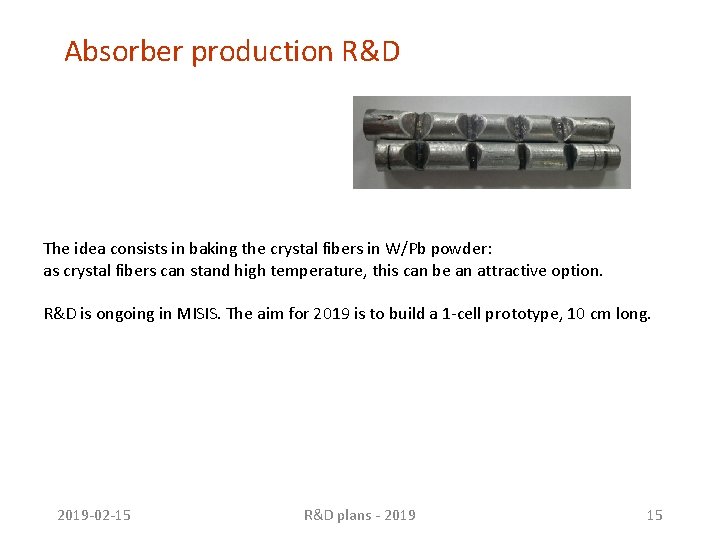
Absorber production R&D The idea consists in baking the crystal fibers in W/Pb powder: as crystal fibers can stand high temperature, this can be an attractive option. R&D is ongoing in MISIS. The aim for 2019 is to build a 1 -cell prototype, 10 cm long. 2019 -02 -15 R&D plans - 2019 15
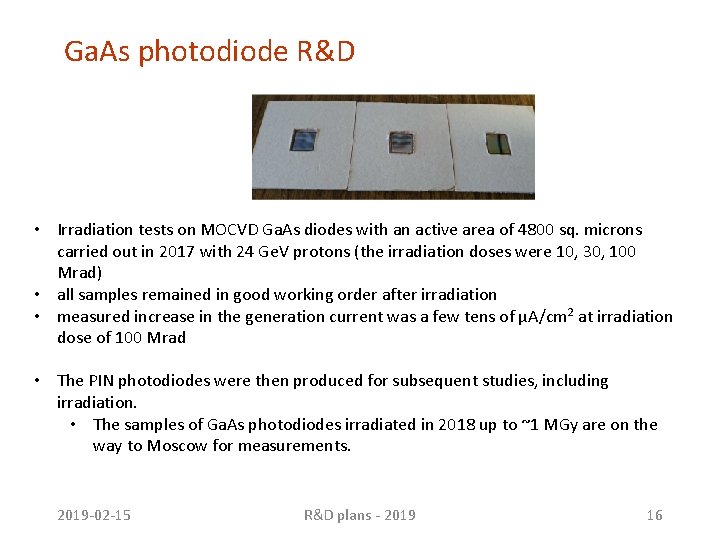
Ga. As photodiode R&D • Irradiation tests on MOCVD Ga. As diodes with an active area of 4800 sq. microns carried out in 2017 with 24 Ge. V protons (the irradiation doses were 10, 30, 100 Mrad) • all samples remained in good working order after irradiation • measured increase in the generation current was a few tens of µA/cm 2 at irradiation dose of 100 Mrad • The PIN photodiodes were then produced for subsequent studies, including irradiation. • The samples of Ga. As photodiodes irradiated in 2018 up to ~1 MGy are on the way to Moscow for measurements. 2019 -02 -15 R&D plans - 2019 16
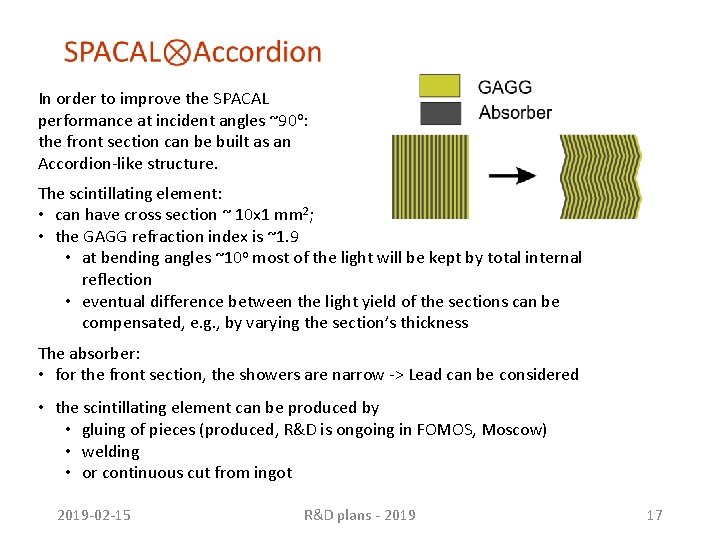
In order to improve the SPACAL performance at incident angles ~90 o: the front section can be built as an Accordion-like structure. The scintillating element: • can have cross section ~ 10 x 1 mm 2; • the GAGG refraction index is ~1. 9 • at bending angles ~10 o most of the light will be kept by total internal reflection • eventual difference between the light yield of the sections can be compensated, e. g. , by varying the section’s thickness The absorber: • for the front section, the showers are narrow -> Lead can be considered • the scintillating element can be produced by • gluing of pieces (produced, R&D is ongoing in FOMOS, Moscow) • welding • or continuous cut from ingot 2019 -02 -15 R&D plans - 2019 17
spares 2019 -02 -15 R&D plans - 2019 18
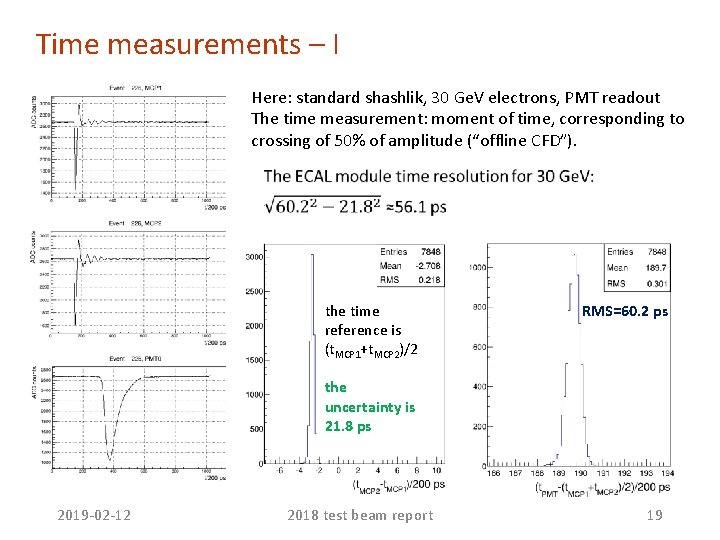
Time measurements – I Here: standard shashlik, 30 Ge. V electrons, PMT readout The time measurement: moment of time, corresponding to crossing of 50% of amplitude (“offline CFD”). the time reference is (t. MCP 1+t. MCP 2)/2 RMS=60. 2 ps the uncertainty is 21. 8 ps 2019 -02 -12 2018 test beam report 19
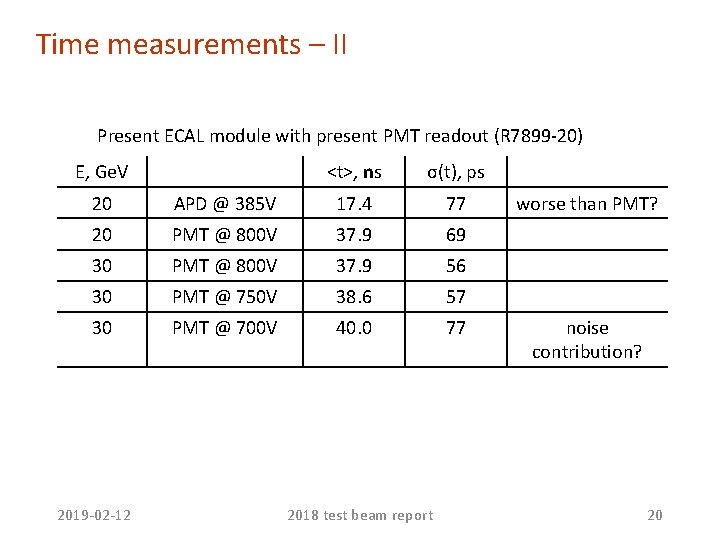
Time measurements – II Present ECAL module with present PMT readout (R 7899 -20) E, Ge. V <t>, ns σ(t), ps 20 APD @ 385 V 17. 4 77 20 PMT @ 800 V 37. 9 69 30 PMT @ 800 V 37. 9 56 30 PMT @ 750 V 38. 6 57 30 PMT @ 700 V 40. 0 77 2019 -02 -12 2018 test beam report worse than PMT? noise contribution? 20
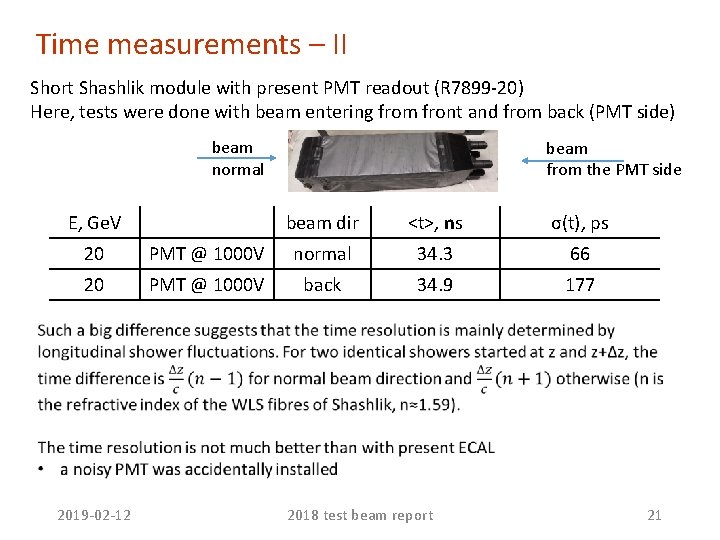
Time measurements – II Short Shashlik module with present PMT readout (R 7899 -20) Here, tests were done with beam entering from front and from back (PMT side) beam normal E, Ge. V beam from the PMT side beam dir <t>, ns σ(t), ps 20 PMT @ 1000 V normal 34. 3 66 20 PMT @ 1000 V back 34. 9 177 2019 -02 -12 2018 test beam report 21
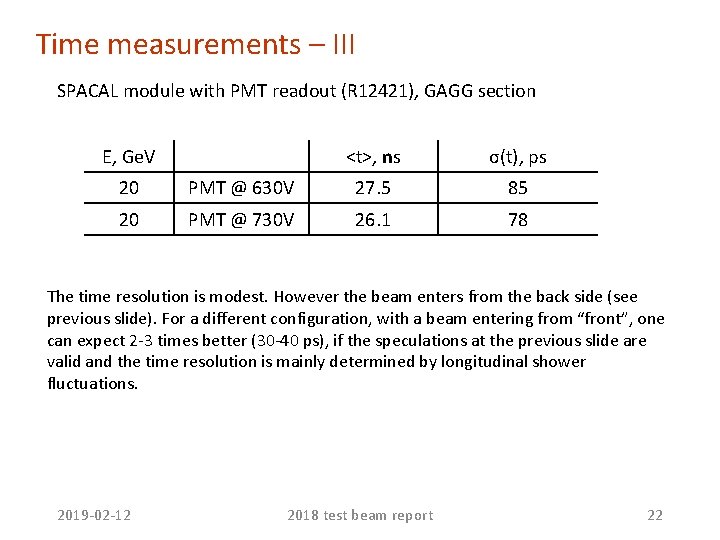
Time measurements – III SPACAL module with PMT readout (R 12421), GAGG section E, Ge. V <t>, ns σ(t), ps 20 PMT @ 630 V 27. 5 85 20 PMT @ 730 V 26. 1 78 The time resolution is modest. However the beam enters from the back side (see previous slide). For a different configuration, with a beam entering from “front”, one can expect 2 -3 times better (30 -40 ps), if the speculations at the previous slide are valid and the time resolution is mainly determined by longitudinal shower fluctuations. 2019 -02 -12 2018 test beam report 22
2019 -02 -12 2018 test beam report 23
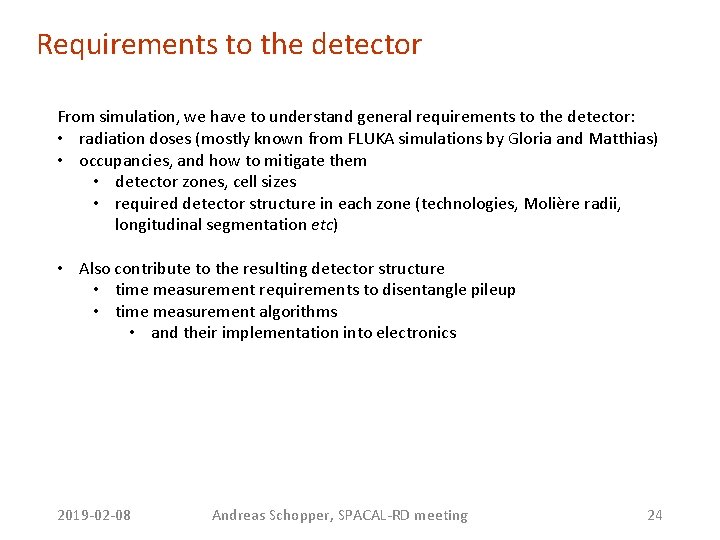
Requirements to the detector From simulation, we have to understand general requirements to the detector: • radiation doses (mostly known from FLUKA simulations by Gloria and Matthias) • occupancies, and how to mitigate them • detector zones, cell sizes • required detector structure in each zone (technologies, Molière radii, longitudinal segmentation etc) • Also contribute to the resulting detector structure • time measurement requirements to disentangle pileup • time measurement algorithms • and their implementation into electronics 2019 -02 -08 Andreas Schopper, SPACAL-RD meeting 24