
RD on Travelling Wave Accelerating Structures at IHEP
- Slides: 38
R&D on Travelling Wave Accelerating Structures at IHEP J. Zhang G. Pei Y. Chi C. Meng X. Li H. Wang Institute of High Energy Physics 2018 -6 -5 International Workshop on Breakdown Science and High Gradient Technology (HG 2018)
Outline 1 S-band Accelerating Structure R&D for CEPC 2 C-band Accelerating Structure Design and Fabrication 3 X-band Accelerating Structure Research 4 Summary International Workshop on Breakdown Science and High Gradient Technology (HG 2018) 2
Outline 1 S-band Accelerating Structure R&D for CEPC 2 C-band Accelerating Structure Design and Fabrication 3 X-band Accelerating Structure Research 4 Summary International Workshop on Breakdown Science and High Gradient Technology (HG 2018) 3
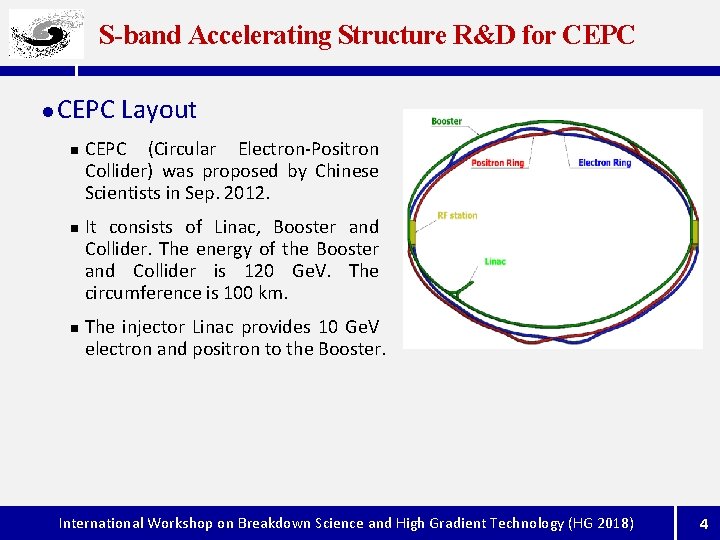
S-band Accelerating Structure R&D for CEPC l CEPC Layout n n n CEPC (Circular Electron-Positron Collider) was proposed by Chinese Scientists in Sep. 2012. It consists of Linac, Booster and Collider. The energy of the Booster and Collider is 120 Ge. V. The circumference is 100 km. The injector Linac provides 10 Ge. V electron and positron to the Booster. International Workshop on Breakdown Science and High Gradient Technology (HG 2018) 4
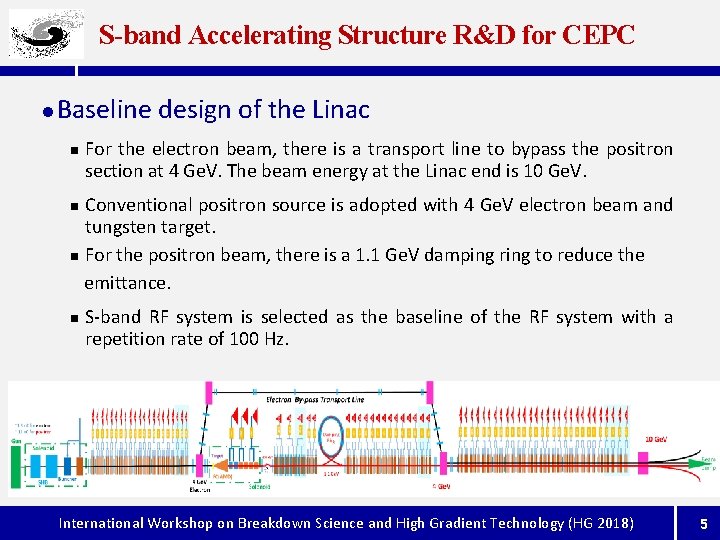
S-band Accelerating Structure R&D for CEPC l Baseline design of the Linac n For the electron beam, there is a transport line to bypass the positron section at 4 Ge. V. The beam energy at the Linac end is 10 Ge. V. Conventional positron source is adopted with 4 Ge. V electron beam and tungsten target. n For the positron beam, there is a 1. 1 Ge. V damping ring to reduce the emittance. n n S-band RF system is selected as the baseline of the RF system with a repetition rate of 100 Hz. International Workshop on Breakdown Science and High Gradient Technology (HG 2018) 5
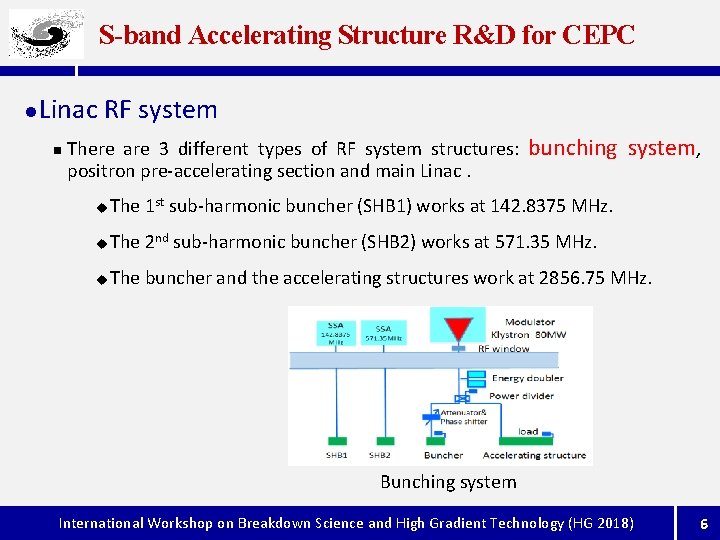
S-band Accelerating Structure R&D for CEPC l Linac RF system n There are 3 different types of RF system structures: positron pre-accelerating section and main Linac. bunching system, u The 1 st sub-harmonic buncher (SHB 1) works at 142. 8375 MHz. u The 2 nd sub-harmonic buncher (SHB 2) works at 571. 35 MHz. u The buncher and the accelerating structures work at 2856. 75 MHz. Bunching system International Workshop on Breakdown Science and High Gradient Technology (HG 2018) 6
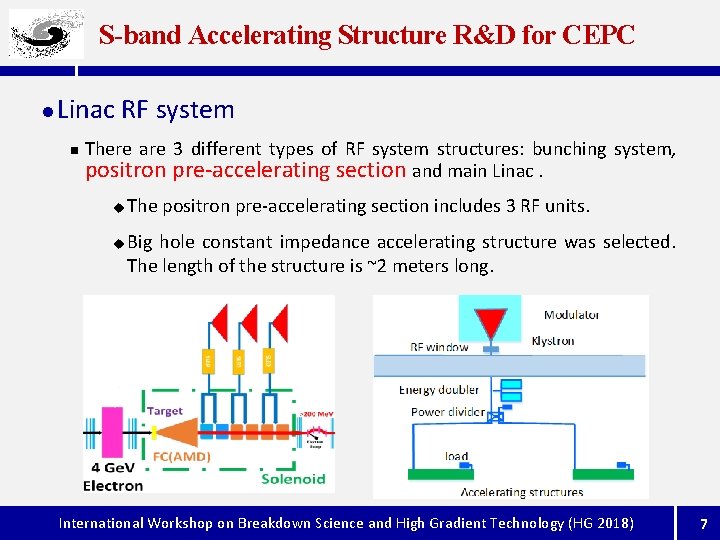
S-band Accelerating Structure R&D for CEPC l Linac RF system n There are 3 different types of RF system structures: bunching system, positron pre-accelerating section and main Linac. u u The positron pre-accelerating section includes 3 RF units. Big hole constant impedance accelerating structure was selected. The length of the structure is ~2 meters long. International Workshop on Breakdown Science and High Gradient Technology (HG 2018) 7
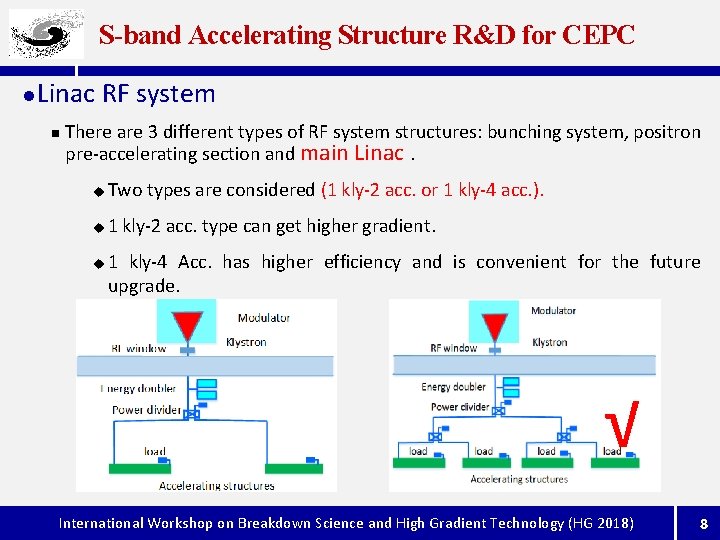
S-band Accelerating Structure R&D for CEPC l Linac RF system n There are 3 different types of RF system structures: bunching system, positron pre-accelerating section and main Linac. u Two types are considered (1 kly-2 acc. or 1 kly-4 acc. ). u 1 kly-2 acc. type can get higher gradient. u 1 kly-4 Acc. has higher efficiency and is convenient for the future upgrade. √ International Workshop on Breakdown Science and High Gradient Technology (HG 2018) 8
S-band Accelerating Structure R&D for CEPC l S-band accelerating structure design n The total energy of the main Linac is 14 Ge. V. n We are focusing on the main Linac accelerating structure design. n Goal: For the 3 meters long accelerating structure, more than 30 MV/m@1μS (without beam) is expected. International Workshop on Breakdown Science and High Gradient Technology (HG 2018) 9
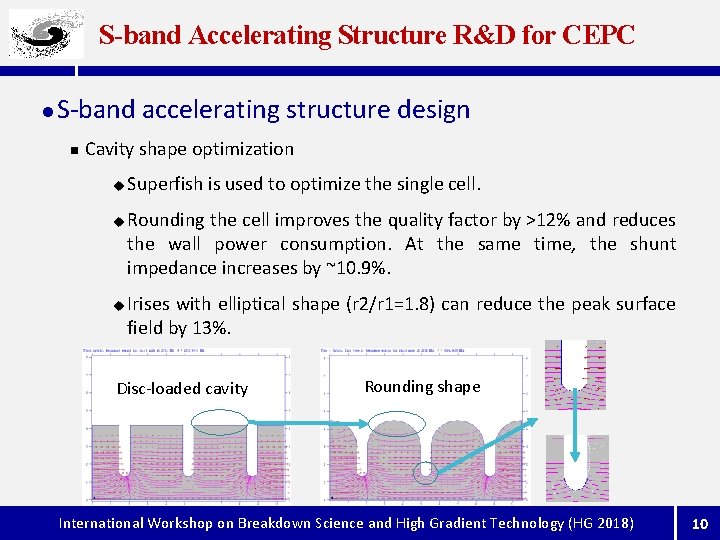
S-band Accelerating Structure R&D for CEPC l S-band accelerating structure design n Cavity shape optimization u u u Superfish is used to optimize the single cell. Rounding the cell improves the quality factor by >12% and reduces the wall power consumption. At the same time, the shunt impedance increases by ~10. 9%. Irises with elliptical shape (r 2/r 1=1. 8) can reduce the peak surface field by 13%. Disc-loaded cavity Rounding shape International Workshop on Breakdown Science and High Gradient Technology (HG 2018) 10
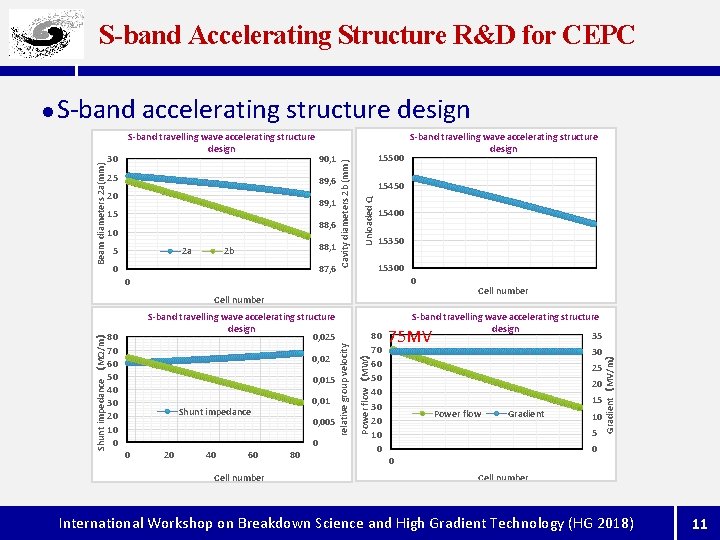
S-band Accelerating Structure R&D for CEPC 89, 6 20 89, 1 15 88, 6 10 5 2 a 88, 1 2 b 0 87, 6 15500 S-band travelling wave accelerating structure design 15450 15400 15350 15300 0 0 Cell number 0, 02 0, 015 0, 01 Shunt impedance 0, 005 0 0 20 40 60 Cell number 80 Power flow(MW) 80 70 60 50 40 30 20 10 0 relative group velocity S-band travelling wave accelerating structure design 0, 025 80 70 60 50 40 30 20 10 0 Cell number S-band travelling wave accelerating structure design 35 75 MV 30 25 20 15 Power flow Gradient 10 5 Gradient(MV/m) 25 90, 1 Unloaded Q 30 S-band travelling wave accelerating structure design Cavity diameters 2 b (mm) Beam diameters 2 a(mm) S-band accelerating structure design Shunt impedance (MΩ/m) l 0 0 Cell number International Workshop on Breakdown Science and High Gradient Technology (HG 2018) 11
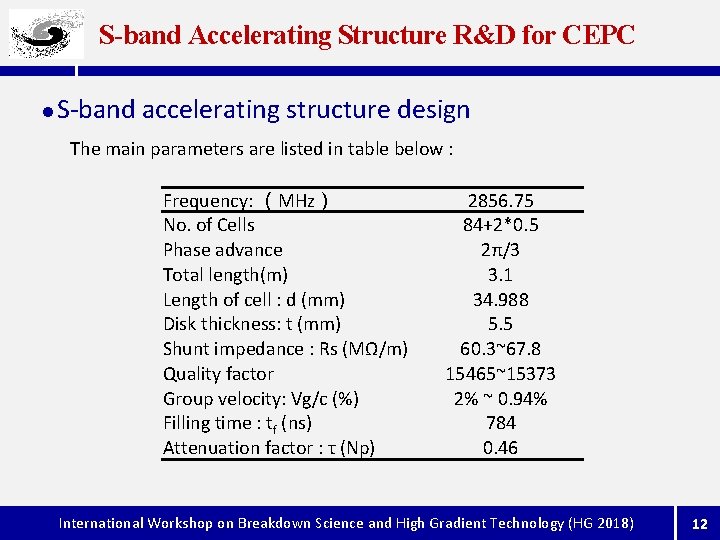
S-band Accelerating Structure R&D for CEPC l S-band accelerating structure design The main parameters are listed in table below : Frequency: (MHz) No. of Cells Phase advance Total length(m) Length of cell : d (mm) Disk thickness: t (mm) Shunt impedance : Rs (MΩ/m) Quality factor Group velocity: Vg/c (%) Filling time : tf (ns) Attenuation factor : τ (Np) 2856. 75 84+2*0. 5 2π/3 3. 1 34. 988 5. 5 60. 3~67. 8 15465~15373 2% ~ 0. 94% 784 0. 46 International Workshop on Breakdown Science and High Gradient Technology (HG 2018) 12
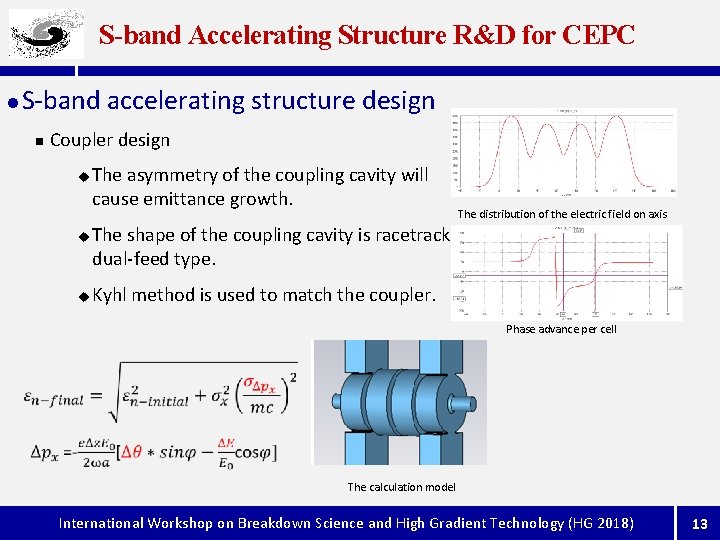
S-band Accelerating Structure R&D for CEPC l S-band accelerating structure design n Coupler design u u u The asymmetry of the coupling cavity will cause emittance growth. The distribution of the electric field on axis The shape of the coupling cavity is racetrack dual-feed type. Kyhl method is used to match the coupler. Phase advance per cell The calculation model International Workshop on Breakdown Science and High Gradient Technology (HG 2018) 13
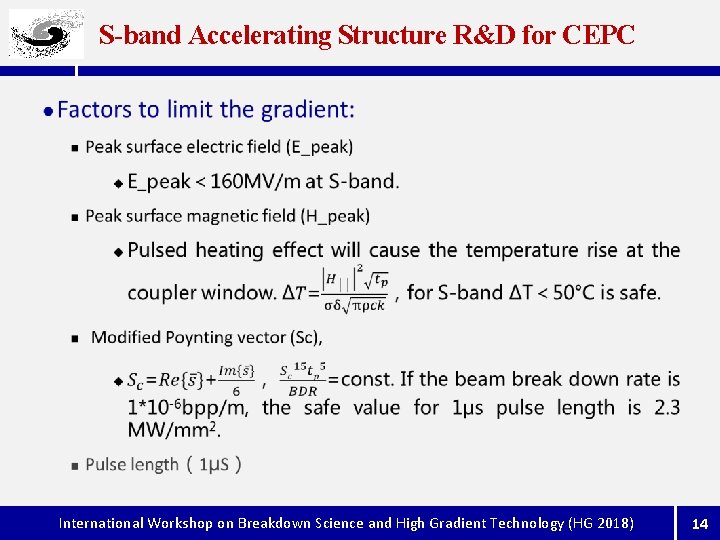
S-band Accelerating Structure R&D for CEPC l International Workshop on Breakdown Science and High Gradient Technology (HG 2018) 14
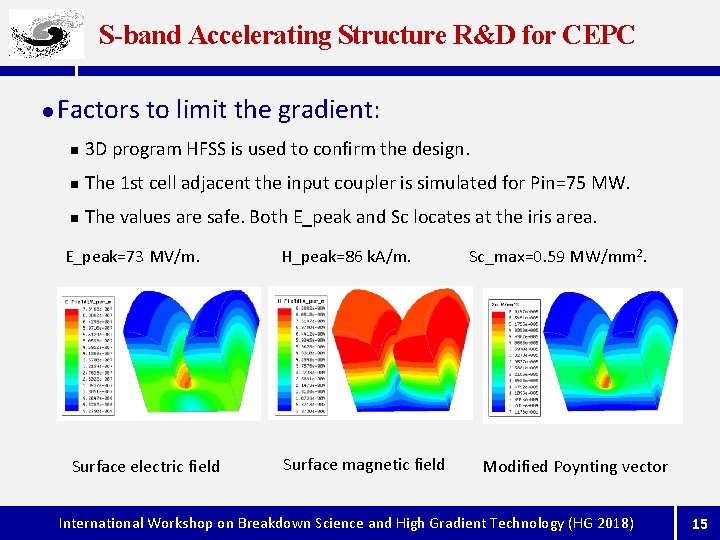
S-band Accelerating Structure R&D for CEPC l Factors to limit the gradient: n 3 D program HFSS is used to confirm the design. n The 1 st cell adjacent the input coupler is simulated for Pin=75 MW. n The values are safe. Both E_peak and Sc locates at the iris area. E_peak=73 MV/m. Surface electric field H_peak=86 k. A/m. Surface magnetic field Sc_max=0. 59 MW/mm 2. Modified Poynting vector International Workshop on Breakdown Science and High Gradient Technology (HG 2018) 15
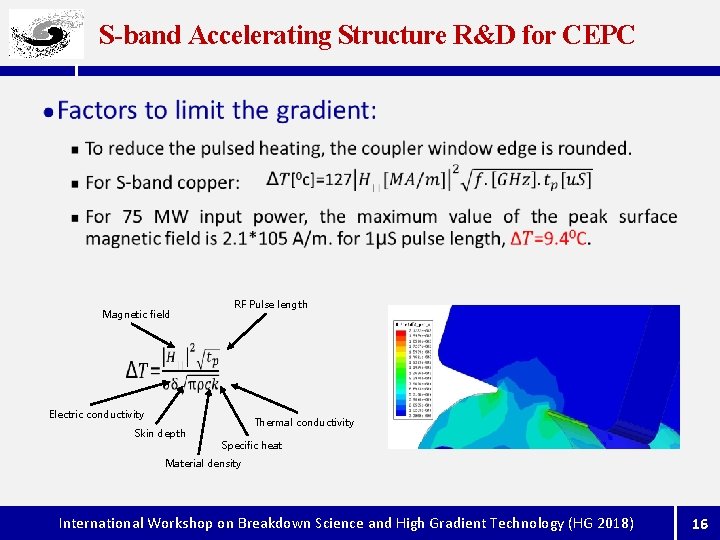
S-band Accelerating Structure R&D for CEPC l Magnetic field RF Pulse length Electric conductivity Skin depth Thermal conductivity Specific heat Material density International Workshop on Breakdown Science and High Gradient Technology (HG 2018) 16
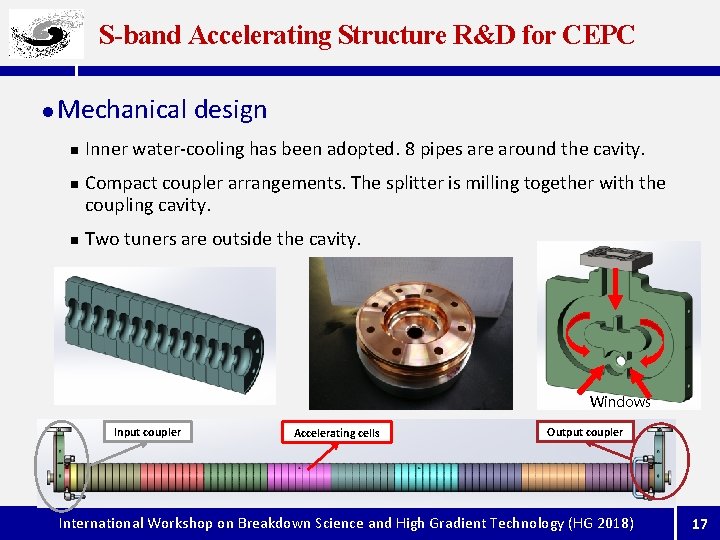
S-band Accelerating Structure R&D for CEPC l Mechanical design n Inner water-cooling has been adopted. 8 pipes are around the cavity. Compact coupler arrangements. The splitter is milling together with the coupling cavity. Two tuners are outside the cavity. Windows Input coupler Accelerating cells Output coupler International Workshop on Breakdown Science and High Gradient Technology (HG 2018) 17
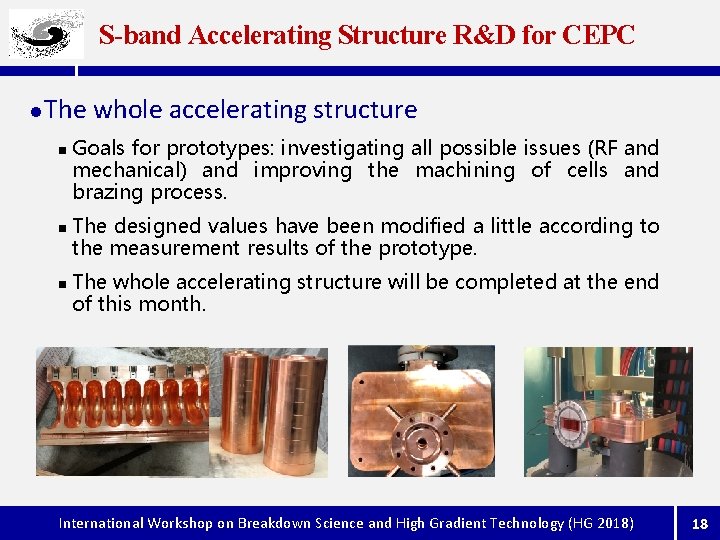
S-band Accelerating Structure R&D for CEPC l The whole accelerating structure n n n Goals for prototypes: investigating all possible issues (RF and mechanical) and improving the machining of cells and brazing process. The designed values have been modified a little according to the measurement results of the prototype. The whole accelerating structure will be completed at the end of this month. International Workshop on Breakdown Science and High Gradient Technology (HG 2018) 18
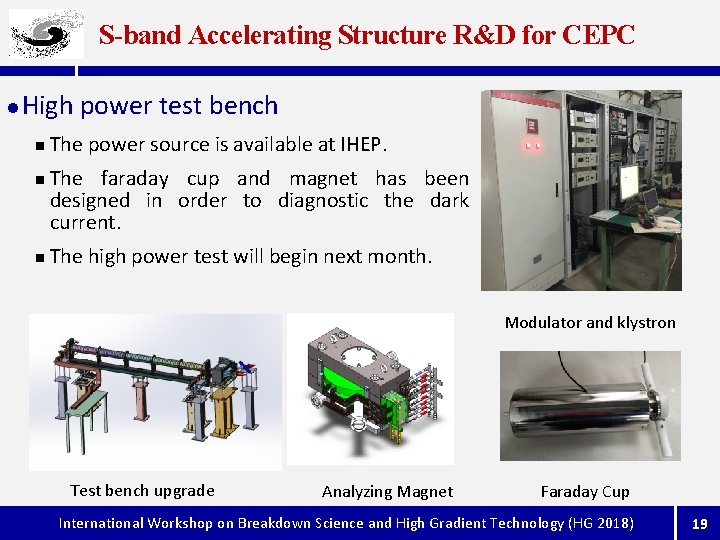
S-band Accelerating Structure R&D for CEPC l High power test bench n n n The power source is available at IHEP. The faraday cup and magnet has been designed in order to diagnostic the dark current. The high power test will begin next month. Modulator and klystron Test bench upgrade Analyzing Magnet Faraday Cup International Workshop on Breakdown Science and High Gradient Technology (HG 2018) 19
Outline 1 S-band Accelerating Structure R&D for CEPC 2 C-band Accelerating Structure Design and Fabrication 3 X-band Accelerating Structure Research 4 Summary International Workshop on Breakdown Science and High Gradient Technology (HG 2018) 20
C-band Accelerating Structure Design and Fabrication l Motivation As the frequency is higher, the gradient is also high. n The development of C band accelerating structure is supported by IHEP funds. n l Goal n The designed accelerating gradient is more than 40 MV/m. International Workshop on Breakdown Science and High Gradient Technology (HG 2018) 21
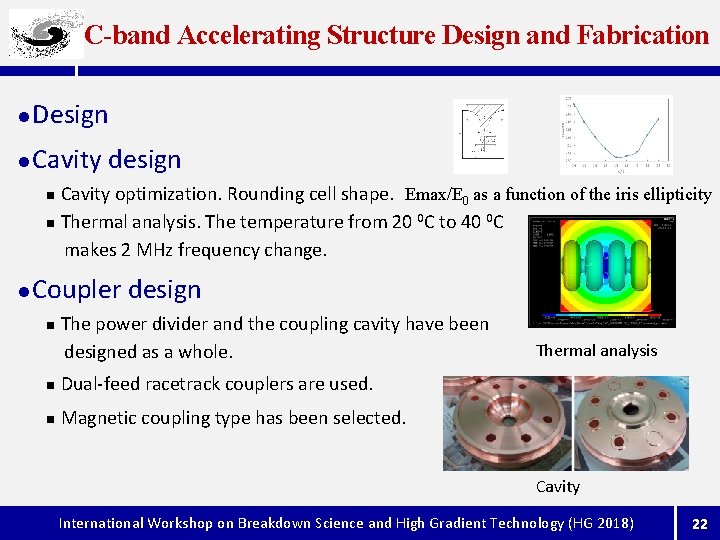
C-band Accelerating Structure Design and Fabrication l Design l Cavity design Cavity optimization. Rounding cell shape. Emax/E 0 as a function of the iris ellipticity n Thermal analysis. The temperature from 20 0 C to 40 0 C makes 2 MHz frequency change. n l Coupler design n The power divider and the coupling cavity have been designed as a whole. n Dual-feed racetrack couplers are used. n Magnetic coupling type has been selected. Thermal analysis Cavity International Workshop on Breakdown Science and High Gradient Technology (HG 2018) 22
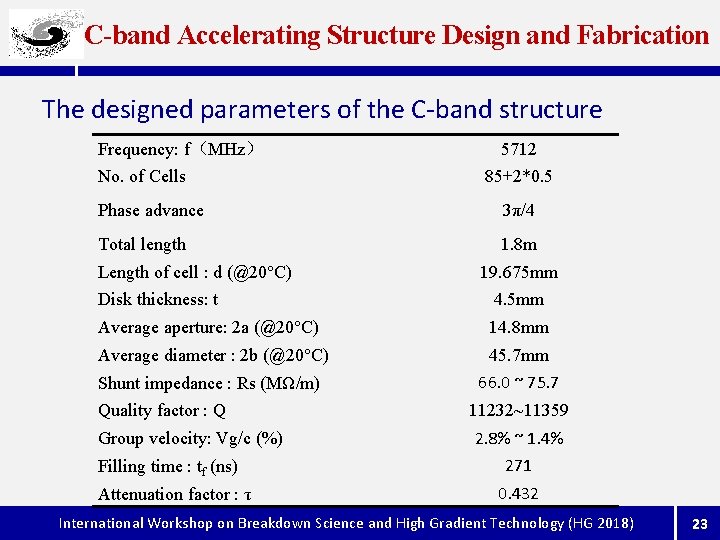
C-band Accelerating Structure Design and Fabrication The designed parameters of the C-band structure Frequency: f(MHz) No. of Cells 5712 85+2*0. 5 Phase advance 3π/4 Total length 1. 8 m Length of cell : d (@20°C) 19. 675 mm Disk thickness: t 4. 5 mm Average aperture: 2 a (@20°C) 14. 8 mm Average diameter : 2 b (@20°C) 45. 7 mm Shunt impedance : Rs (MΩ/m) 66. 0 ~ 75. 7 Quality factor : Q Group velocity: Vg/c (%) Filling time : tf (ns) Attenuation factor : τ 11232~11359 2. 8% ~ 1. 4% 271 0. 432 International Workshop on Breakdown Science and High Gradient Technology (HG 2018) 23
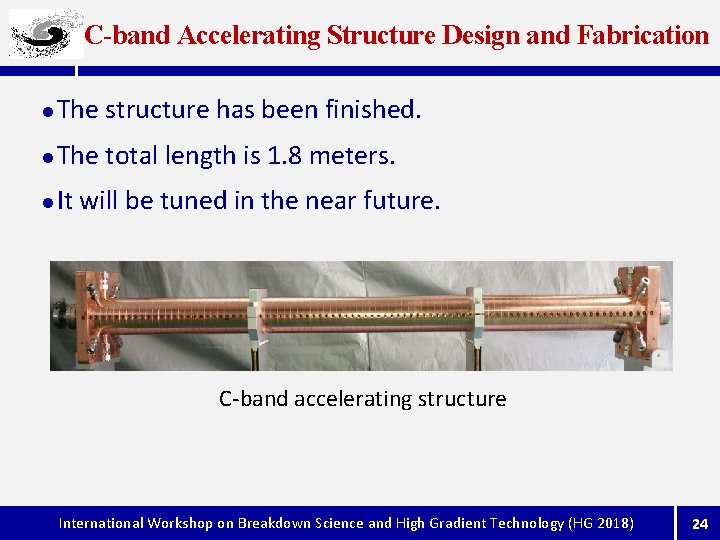
C-band Accelerating Structure Design and Fabrication l The structure has been finished. l The total length is 1. 8 meters. l It will be tuned in the near future. C-band accelerating structure International Workshop on Breakdown Science and High Gradient Technology (HG 2018) 24
Outline 1 S-band Accelerating Structure R&D for CEPC 2 C-band Accelerating Structure Design and Fabrication 3 X-band Accelerating Structure Research 4 Summary International Workshop on Breakdown Science and High Gradient Technology (HG 2018) 25
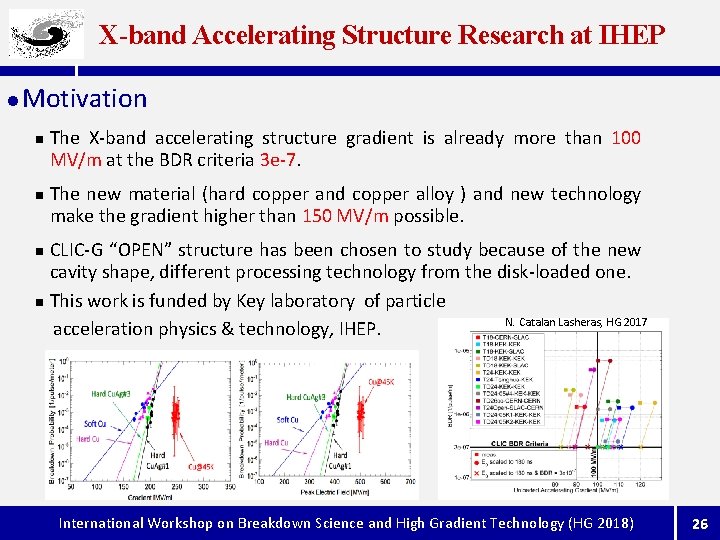
X-band Accelerating Structure Research at IHEP l Motivation n n The X-band accelerating structure gradient is already more than 100 MV/m at the BDR criteria 3 e-7. The new material (hard copper and copper alloy ) and new technology make the gradient higher than 150 MV/m possible. CLIC-G “OPEN” structure has been chosen to study because of the new cavity shape, different processing technology from the disk-loaded one. n This work is funded by Key laboratory of particle N. Catalan Lasheras, HG 2017 acceleration physics & technology, IHEP. n International Workshop on Breakdown Science and High Gradient Technology (HG 2018) 26
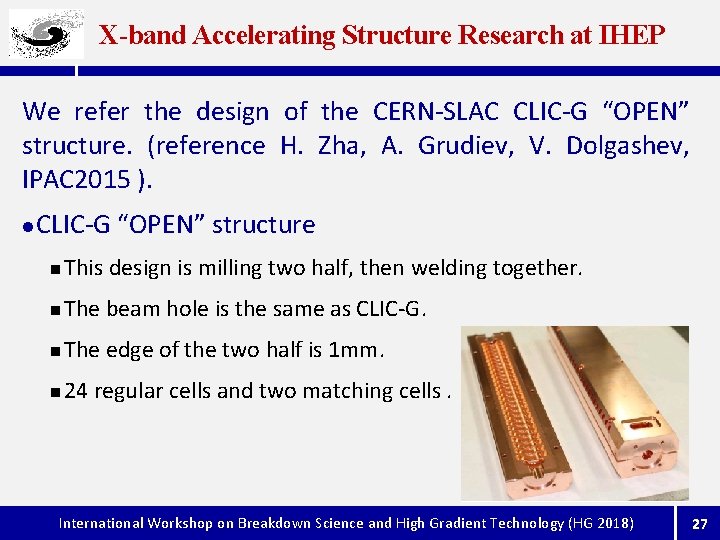
X-band Accelerating Structure Research at IHEP We refer the design of the CERN-SLAC CLIC-G “OPEN” structure. (reference H. Zha, A. Grudiev, V. Dolgashev, IPAC 2015 ). l CLIC-G “OPEN” structure n This design is milling two half, then welding together. n The beam hole is the same as CLIC-G. n The edge of the two half is 1 mm. n 24 regular cells and two matching cells. International Workshop on Breakdown Science and High Gradient Technology (HG 2018) 27
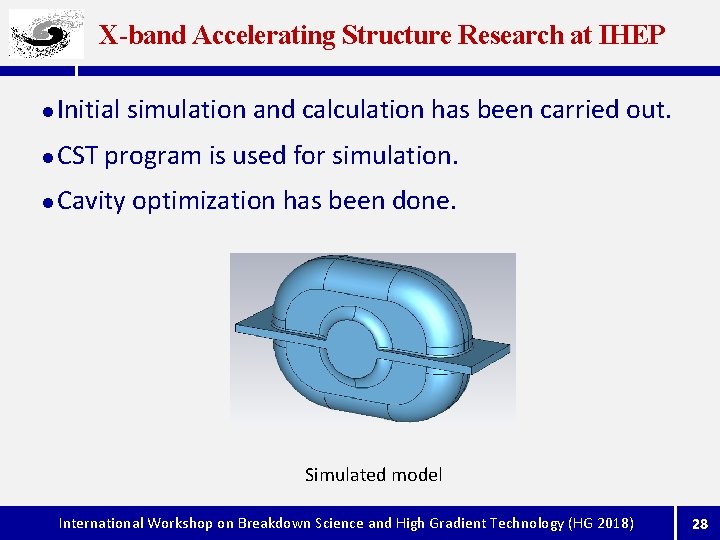
X-band Accelerating Structure Research at IHEP l Initial simulation and calculation has been carried out. l CST program is used for simulation. l Cavity optimization has been done. Simulated model International Workshop on Breakdown Science and High Gradient Technology (HG 2018) 28
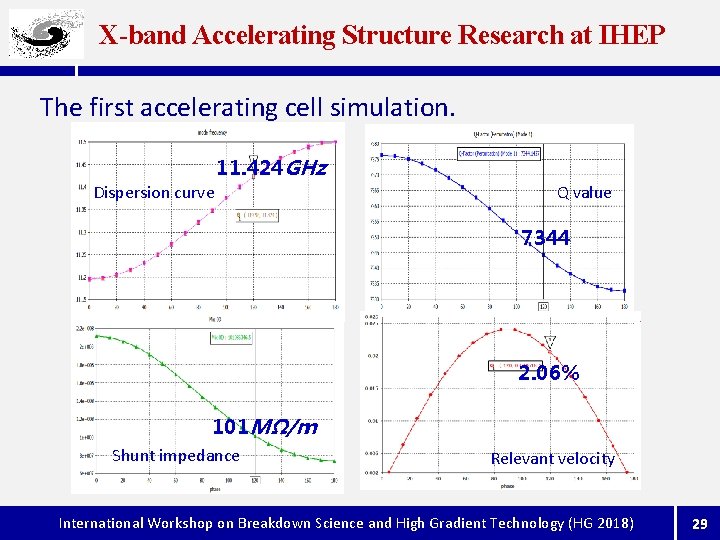
X-band Accelerating Structure Research at IHEP The first accelerating cell simulation. 11. 424 GHz Dispersion curve Q value 7344 2. 06% 101 MΩ/m Shunt impedance Relevant velocity International Workshop on Breakdown Science and High Gradient Technology (HG 2018) 29
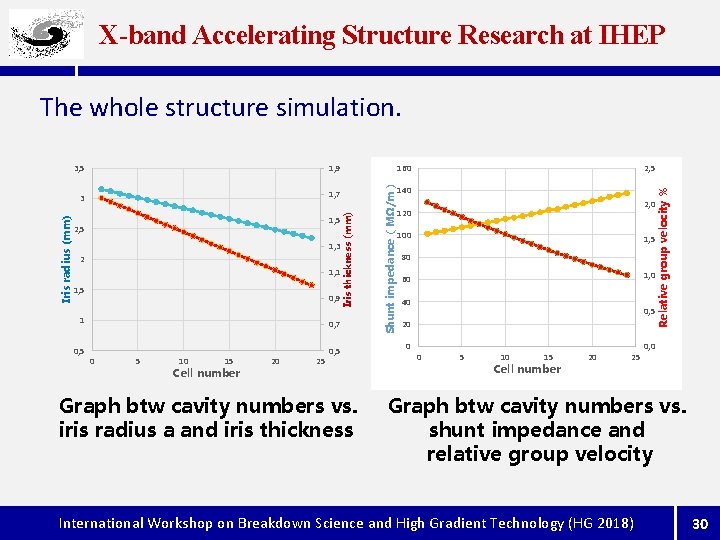
X-band Accelerating Structure Research at IHEP 3 1, 7 1, 5 2, 5 1, 3 2 1, 1 1, 5 0, 9 1 0, 7 0, 5 0 5 10 15 Cell number 20 25 160 Graph btw cavity numbers vs. iris radius a and iris thickness 2, 5 140 2, 0 120 100 1, 5 80 1, 0 60 40 0, 5 20 0 0 5 10 15 Cell number 20 25 Relative group velocity % 1, 9 Shunt impedance(MΩ/m) 3, 5 Iris thickness (mm) Iris radius (mm) The whole structure simulation. 0, 0 Graph btw cavity numbers vs. shunt impedance and relative group velocity International Workshop on Breakdown Science and High Gradient Technology (HG 2018) 30
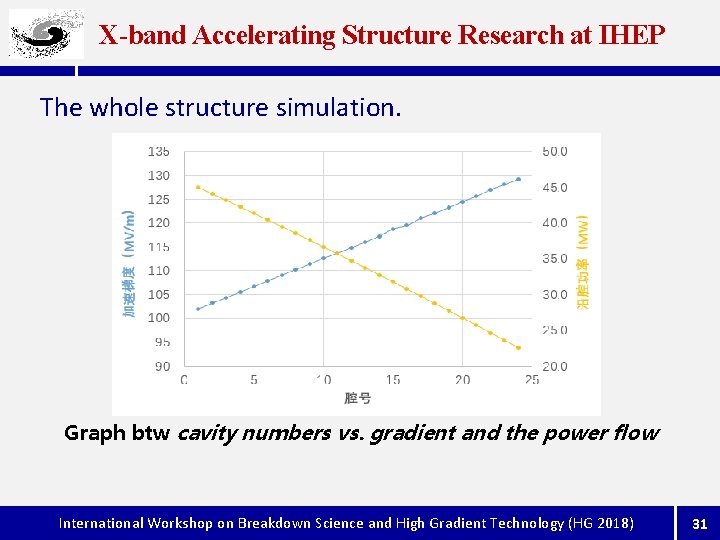
X-band Accelerating Structure Research at IHEP The whole structure simulation. Graph btw cavity numbers vs. gradient and the power flow International Workshop on Breakdown Science and High Gradient Technology (HG 2018) 31
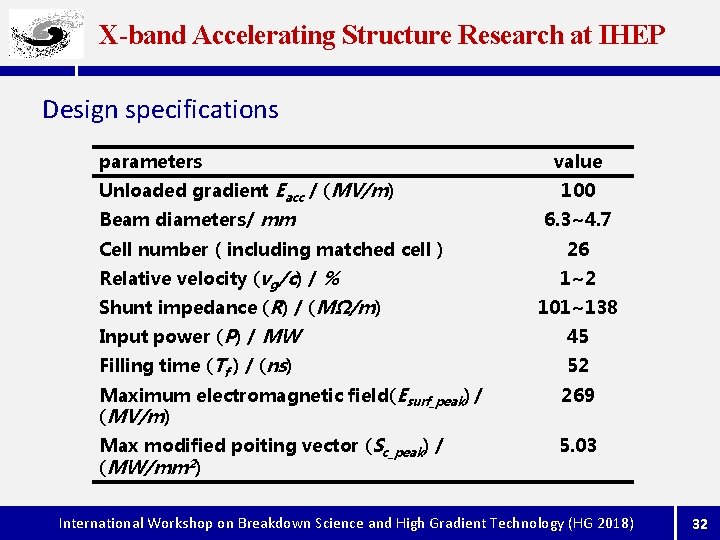
X-band Accelerating Structure Research at IHEP Design specifications parameters Unloaded gradient Eacc / (MV/m) Beam diameters/ mm Cell number(including matched cell) Relative velocity (vg/c) / % Shunt impedance (R) / (MΩ/m) value 100 6. 3~4. 7 26 1~2 101~138 Input power (P) / MW 45 Filling time (Tf ) / (ns) 52 Maximum electromagnetic field(Esurf_peak) / (MV/m) 269 Max modified poiting vector (Sc_peak) / (MW/mm 2) 5. 03 International Workshop on Breakdown Science and High Gradient Technology (HG 2018) 32
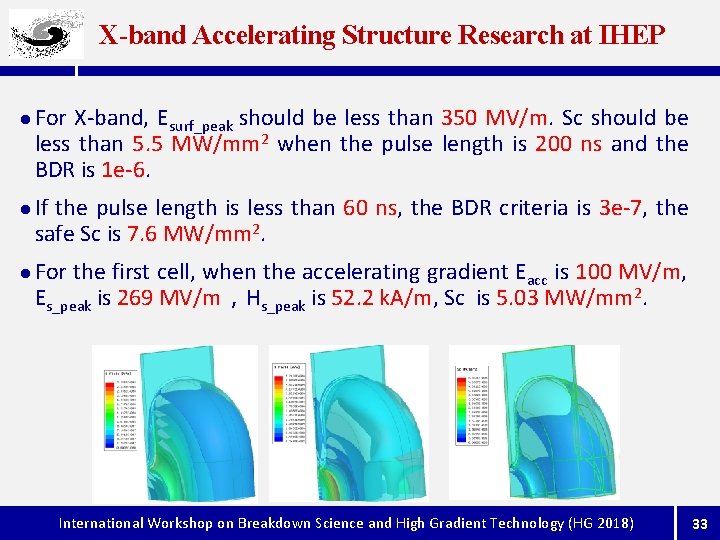
X-band Accelerating Structure Research at IHEP l l l For X-band, Esurf_peak should be less than 350 MV/m. Sc should be less than 5. 5 MW/mm 2 when the pulse length is 200 ns and the BDR is 1 e-6. If the pulse length is less than 60 ns, the BDR criteria is 3 e-7, the safe Sc is 7. 6 MW/mm 2. For the first cell, when the accelerating gradient Eacc is 100 MV/m, Es_peak is 269 MV/m,Hs_peak is 52. 2 k. A/m, Sc is 5. 03 MW/mm 2. International Workshop on Breakdown Science and High Gradient Technology (HG 2018) 33
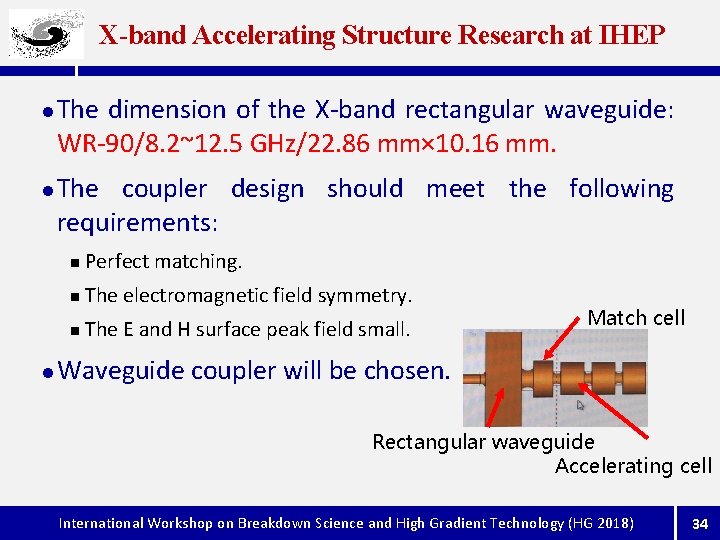
X-band Accelerating Structure Research at IHEP l l l The dimension of the X-band rectangular waveguide: WR-90/8. 2~12. 5 GHz/22. 86 mm× 10. 16 mm. The coupler design should meet the following requirements: n Perfect matching. n The electromagnetic field symmetry. n The E and H surface peak field small. Match cell Waveguide coupler will be chosen. Rectangular waveguide Accelerating cell International Workshop on Breakdown Science and High Gradient Technology (HG 2018) 34
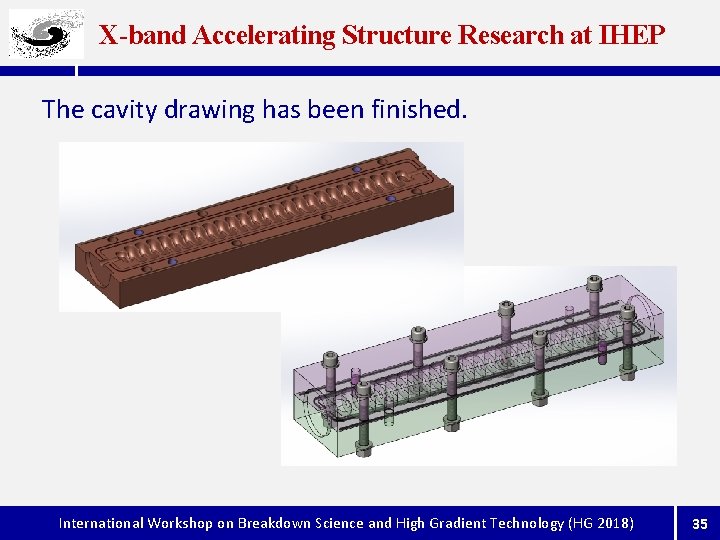
X-band Accelerating Structure Research at IHEP The cavity drawing has been finished. International Workshop on Breakdown Science and High Gradient Technology (HG 2018) 35
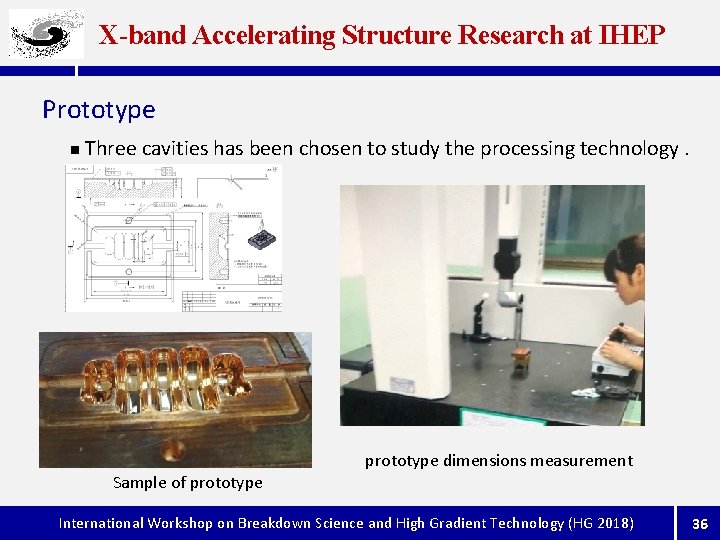
X-band Accelerating Structure Research at IHEP Prototype n Three cavities has been chosen to study the processing technology. prototype dimensions measurement Sample of prototype International Workshop on Breakdown Science and High Gradient Technology (HG 2018) 36
Summary l l l The manufacturing and processing of S-band travelling wave accelerating structure has been finished. The high power test will be done in July. Supported by the funds of IHEP, C-band travelling wave accelerating structure has been manufactured and fabricated. The whole tube will be matched and tuned in the near future. X-band travelling wave open accelerating structure has been simulated and a prototype is under milling. International Workshop on Breakdown Science and High Gradient Technology (HG 2018) 37
Thanks for your attention! International Workshop on Breakdown Science and High Gradient Technology (HG 2018) 38