
RD on a Future BaTagging Upgrade Using Electron

R&D on a Future Ba-Tagging Upgrade Using Electron Microscopy for Mickey Chiu
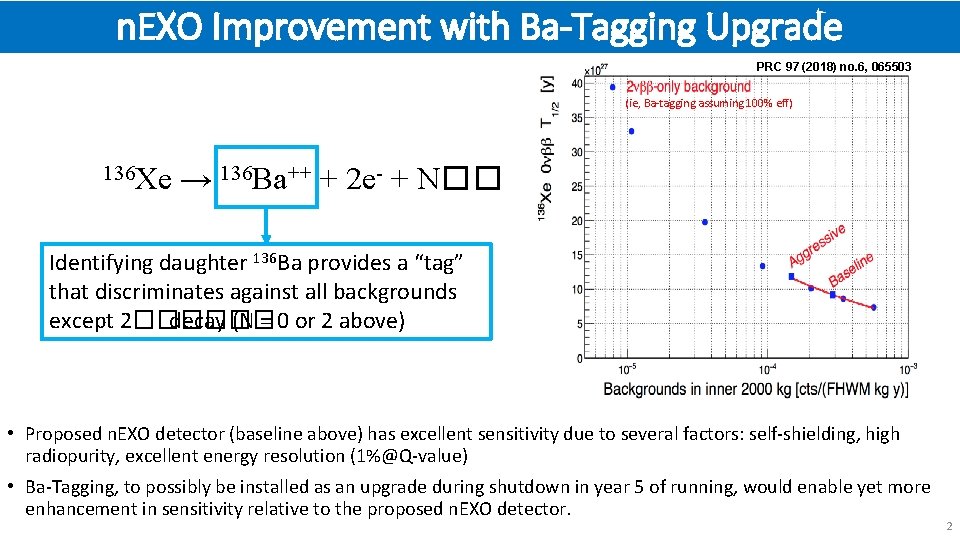
n. EXO Improvement with Ba-Tagging Upgrade PRC 97 (2018) no. 6, 065503 (ie, Ba-tagging assuming 100% eff) 136 Xe → 136 Ba++ + 2 e- + N�� Identifying daughter 136 Ba provides a “tag” that discriminates against all backgrounds except 2������ decay (N = 0 or 2 above) • Proposed n. EXO detector (baseline above) has excellent sensitivity due to several factors: self-shielding, high radiopurity, excellent energy resolution (1%@Q-value) • Ba-Tagging, to possibly be installed as an upgrade during shutdown in year 5 of running, would enable yet more enhancement in sensitivity relative to the proposed n. EXO detector. 2
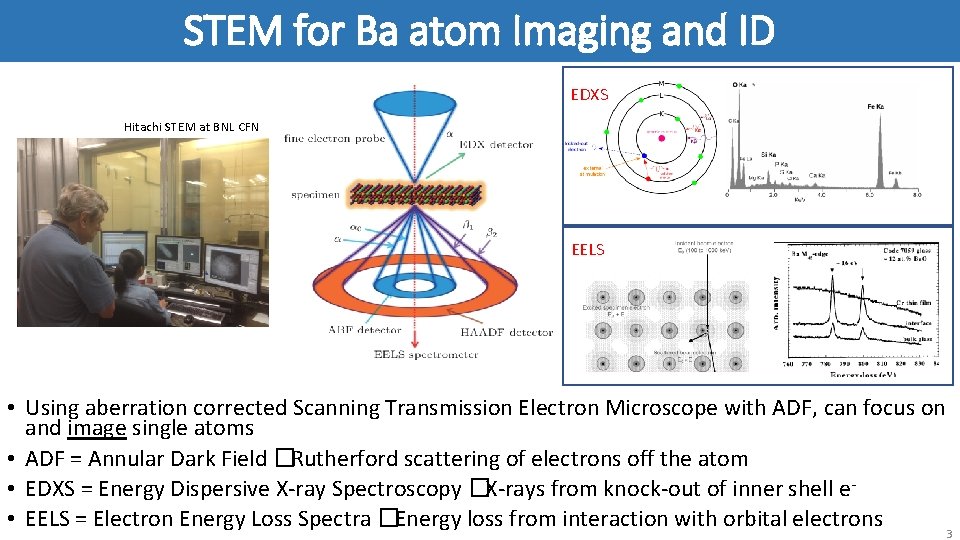
STEM for Ba atom Imaging and ID EDXS Hitachi STEM at BNL CFN EELS • Using aberration corrected Scanning Transmission Electron Microscope with ADF, can focus on and image single atoms • ADF = Annular Dark Field � Rutherford scattering of electrons off the atom • EDXS = Energy Dispersive X-ray Spectroscopy � X-rays from knock-out of inner shell e • EELS = Electron Energy Loss Spectra � Energy loss from interaction with orbital electrons 3
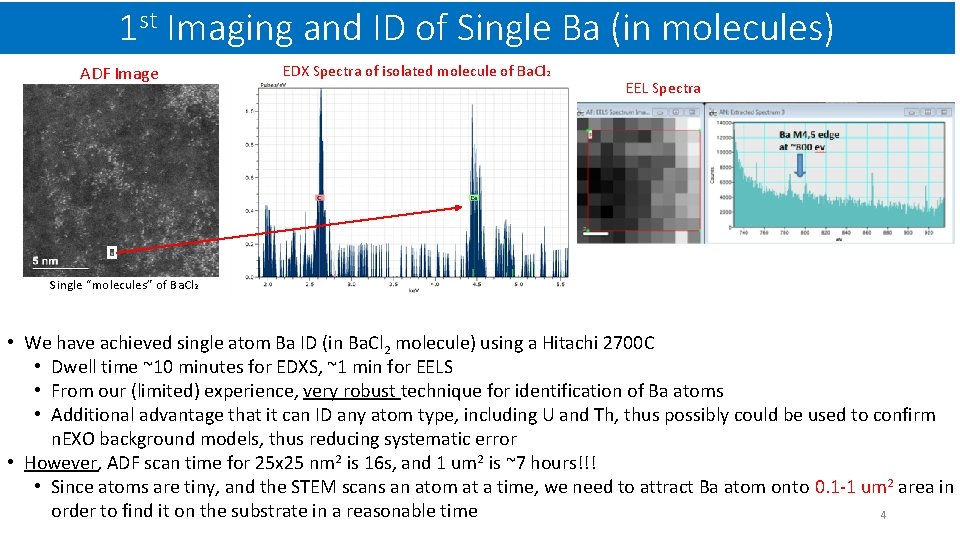
1 st Imaging and ID of Single Ba (in molecules) ADF Image EDX Spectra of isolated molecule of Ba. Cl 2 EEL Spectra Single “molecules” of Ba. Cl 2 • We have achieved single atom Ba ID (in Ba. Cl 2 molecule) using a Hitachi 2700 C • Dwell time ~10 minutes for EDXS, ~1 min for EELS • From our (limited) experience, very robust technique for identification of Ba atoms • Additional advantage that it can ID any atom type, including U and Th, thus possibly could be used to confirm n. EXO background models, thus reducing systematic error • However, ADF scan time for 25 x 25 nm 2 is 16 s, and 1 um 2 is ~7 hours!!! • Since atoms are tiny, and the STEM scans an atom at a time, we need to attract Ba atom onto 0. 1 -1 um 2 area in order to find it on the substrate in a reasonable time 4
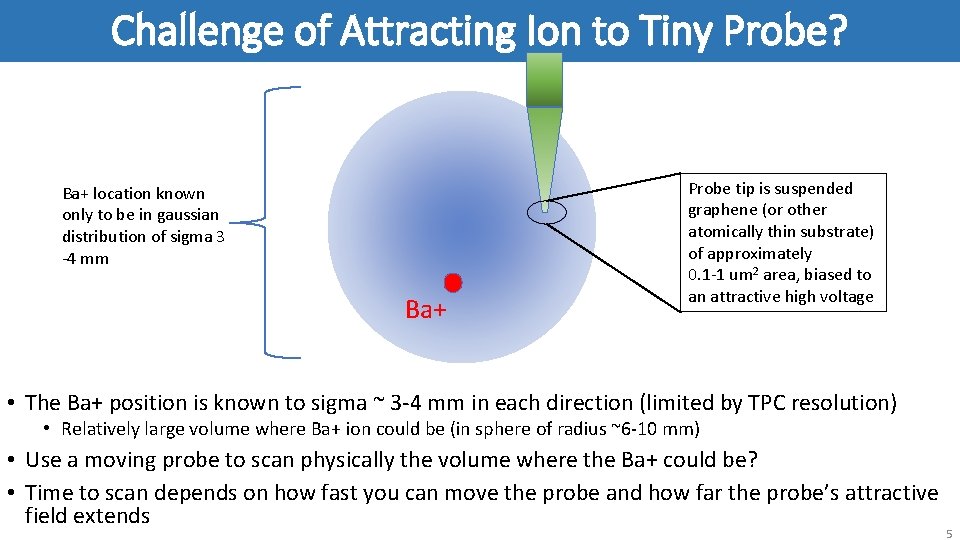
Challenge of Attracting Ion to Tiny Probe? Ba+ location known only to be in gaussian distribution of sigma 3 -4 mm Ba+ Probe tip is suspended graphene (or other atomically thin substrate) of approximately 0. 1 -1 um 2 area, biased to an attractive high voltage • The Ba+ position is known to sigma ~ 3 -4 mm in each direction (limited by TPC resolution) • Relatively large volume where Ba+ ion could be (in sphere of radius ~6 -10 mm) • Use a moving probe to scan physically the volume where the Ba+ could be? • Time to scan depends on how fast you can move the probe and how far the probe’s attractive field extends 5
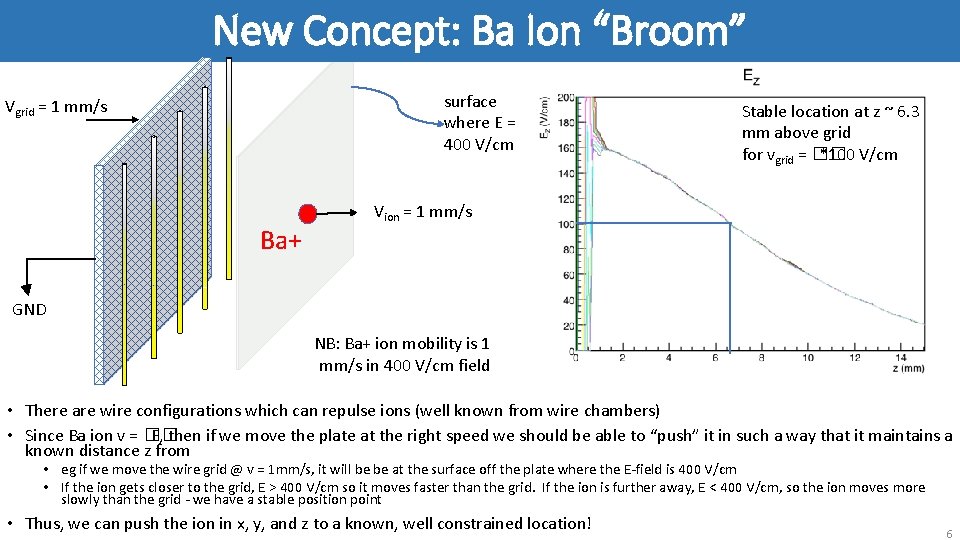
New Concept: Ba Ion “Broom” surface where E = 400 V/cm Vgrid = 1 mm/s Ba+ Stable location at z ~ 6. 3 mm above grid for vgrid = �� *100 V/cm Vion = 1 mm/s GND NB: Ba+ ion mobility is 1 mm/s in 400 V/cm field • There are wire configurations which can repulse ions (well known from wire chambers) • Since Ba ion v = �� E, then if we move the plate at the right speed we should be able to “push” it in such a way that it maintains a known distance z from • eg if we move the wire grid @ v = 1 mm/s, it will be be at the surface off the plate where the E-field is 400 V/cm • If the ion gets closer to the grid, E > 400 V/cm so it moves faster than the grid. If the ion is further away, E < 400 V/cm, so the ion moves more slowly than the grid - we have a stable position point • Thus, we can push the ion in x, y, and z to a known, well constrained location! 6
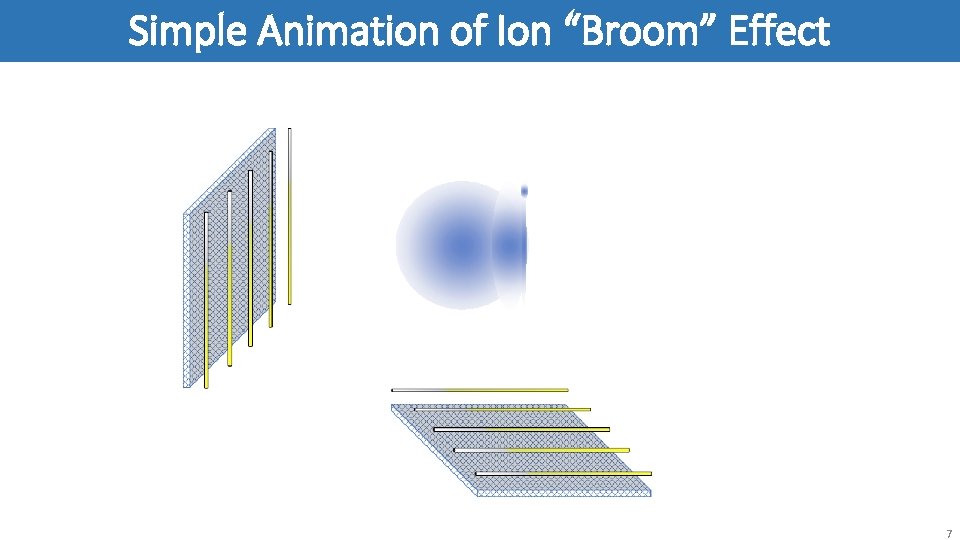
Simple Animation of Ion “Broom” Effect 7
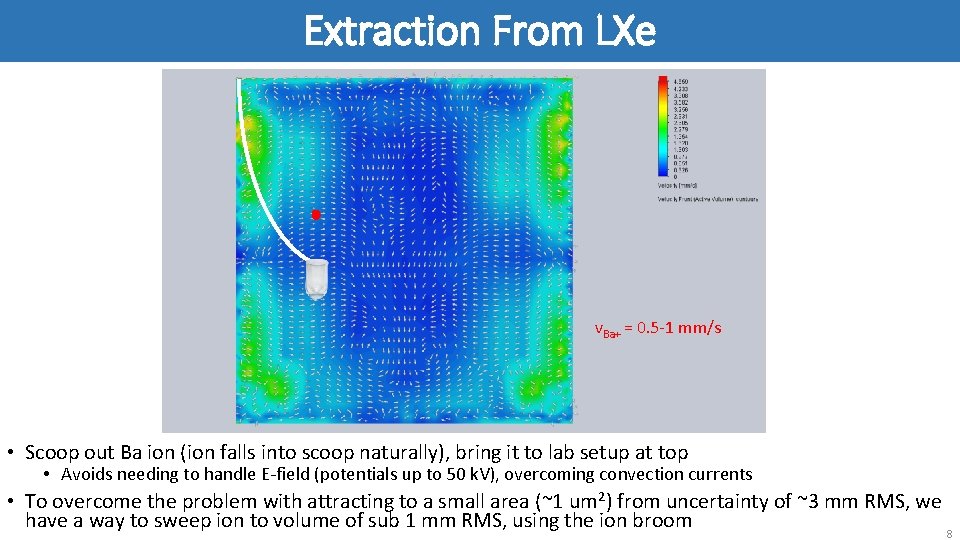
Extraction From LXe v. Ba+ = 0. 5 -1 mm/s • Scoop out Ba ion (ion falls into scoop naturally), bring it to lab setup at top • Avoids needing to handle E-field (potentials up to 50 k. V), overcoming convection currents • To overcome the problem with attracting to a small area (~1 um 2) from uncertainty of ~3 mm RMS, we have a way to sweep ion to volume of sub 1 mm RMS, using the ion broom 8
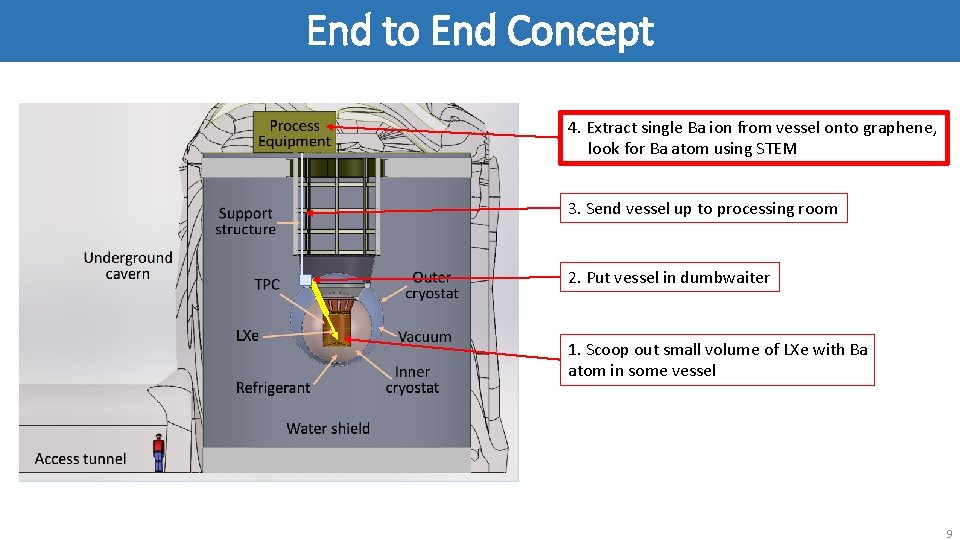
End to End Concept 4. Extract single Ba ion from vessel onto graphene, look for Ba atom using STEM 3. Send vessel up to processing room 2. Put vessel in dumbwaiter 1. Scoop out small volume of LXe with Ba atom in some vessel 9
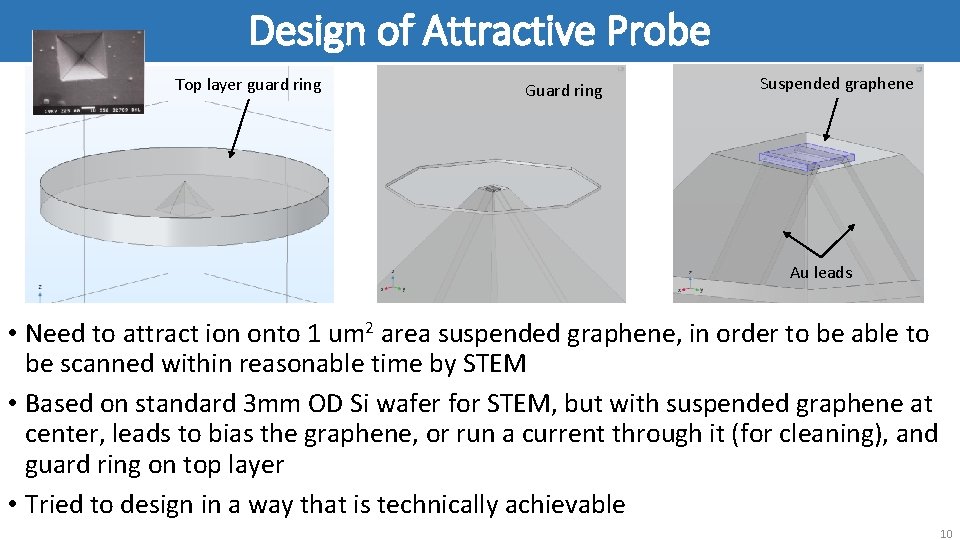
Design of Attractive Probe Top layer guard ring Guard ring Suspended graphene Au leads • Need to attract ion onto 1 um 2 area suspended graphene, in order to be able to be scanned within reasonable time by STEM • Based on standard 3 mm OD Si wafer for STEM, but with suspended graphene at center, leads to bias the graphene, or run a current through it (for cleaning), and guard ring on top layer • Tried to design in a way that is technically achievable 10
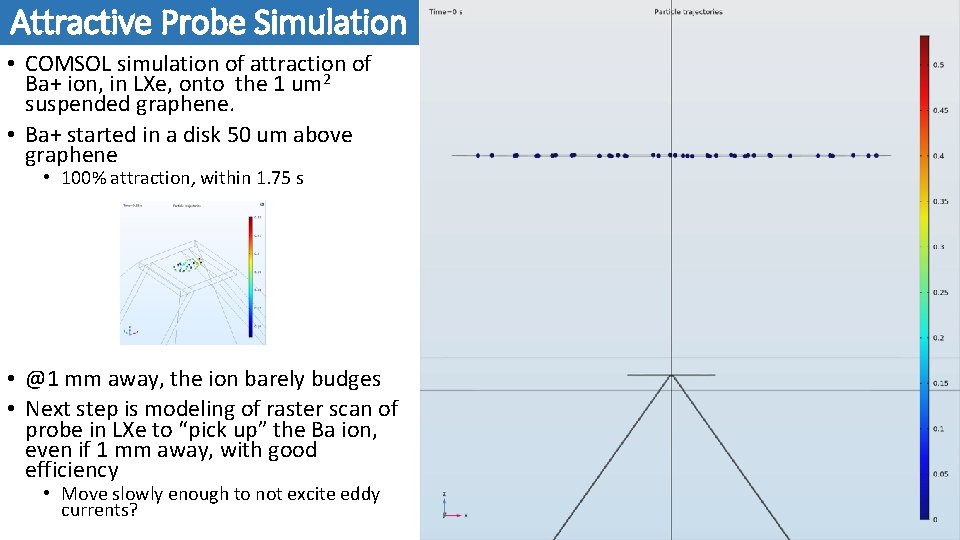
Attractive Probe Simulation • COMSOL simulation of attraction of Ba+ ion, in LXe, onto the 1 um 2 suspended graphene. • Ba+ started in a disk 50 um above graphene • 100% attraction, within 1. 75 s • @1 mm away, the ion barely budges • Next step is modeling of raster scan of probe in LXe to “pick up” the Ba ion, even if 1 mm away, with good efficiency • Move slowly enough to not excite eddy currents? 11
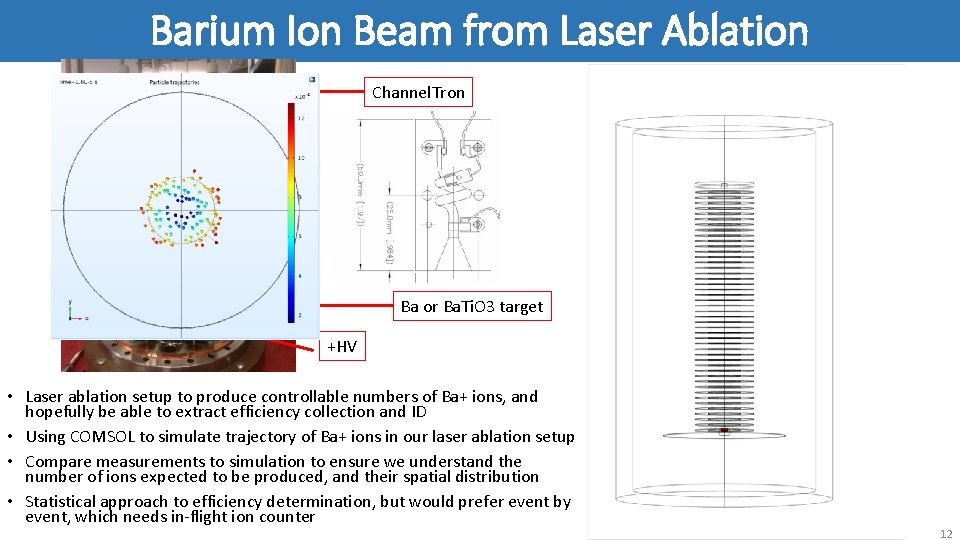
Barium Ion Beam from Laser Ablation Channel. Tron Laser Ba or Ba. Ti. O 3 target +HV • Laser ablation setup to produce controllable numbers of Ba+ ions, and hopefully be able to extract efficiency collection and ID • Using COMSOL to simulate trajectory of Ba+ ions in our laser ablation setup • Compare measurements to simulation to ensure we understand the number of ions expected to be produced, and their spatial distribution • Statistical approach to efficiency determination, but would prefer event by event, which needs in-flight ion counter 12
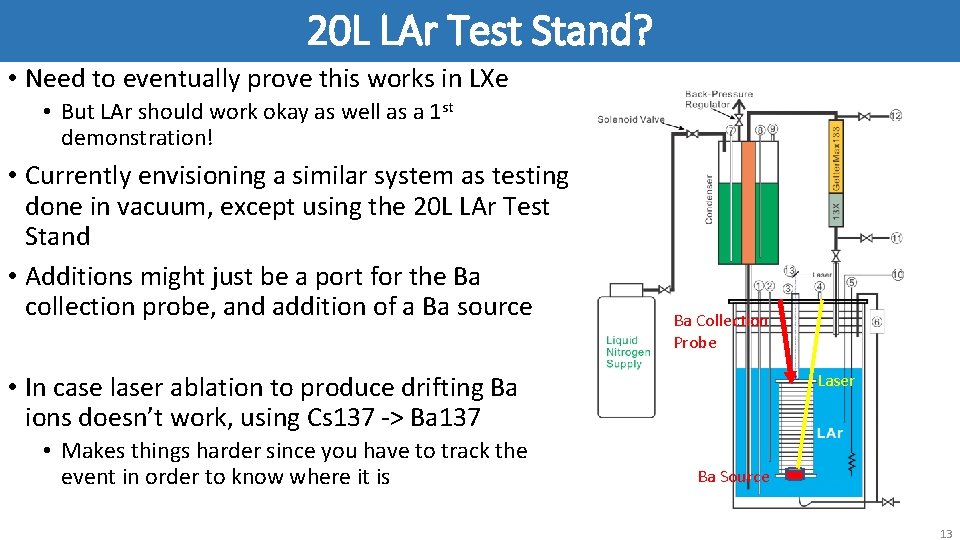
20 L LAr Test Stand? • Need to eventually prove this works in LXe • But LAr should work okay as well as a 1 st demonstration! • Currently envisioning a similar system as testing done in vacuum, except using the 20 L LAr Test Stand • Additions might just be a port for the Ba collection probe, and addition of a Ba source Ba Collection Probe • In case laser ablation to produce drifting Ba ions doesn’t work, using Cs 137 -> Ba 137 • Makes things harder since you have to track the event in order to know where it is Laser Ba Source 13
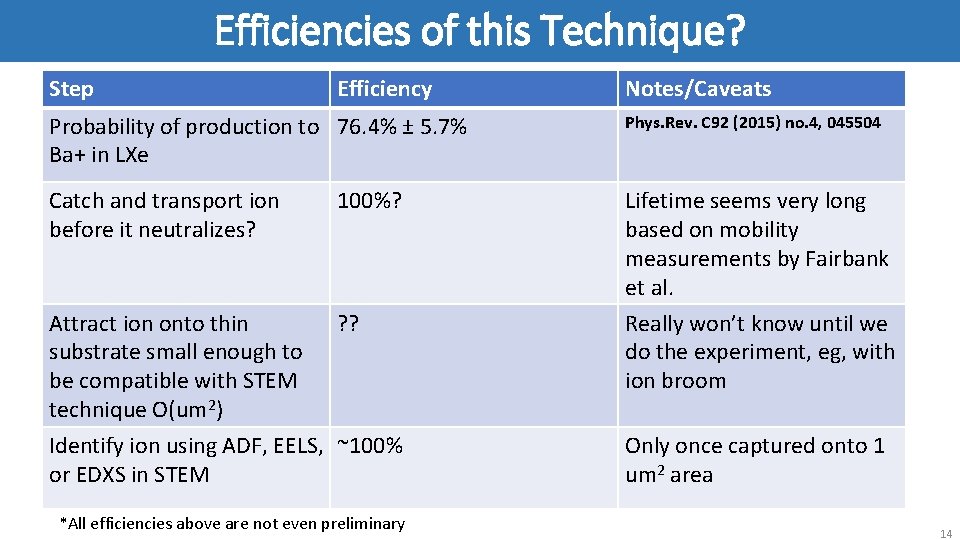
Efficiencies of this Technique? Step Efficiency Notes/Caveats Probability of production to 76. 4% ± 5. 7% Ba+ in LXe Phys. Rev. C 92 (2015) no. 4, 045504 Catch and transport ion before it neutralizes? 100%? Lifetime seems very long based on mobility measurements by Fairbank et al. Attract ion onto thin ? ? substrate small enough to be compatible with STEM technique O(um 2) Identify ion using ADF, EELS, ~100% or EDXS in STEM Really won’t know until we do the experiment, eg, with ion broom *All efficiencies above are not even preliminary Only once captured onto 1 um 2 area 14
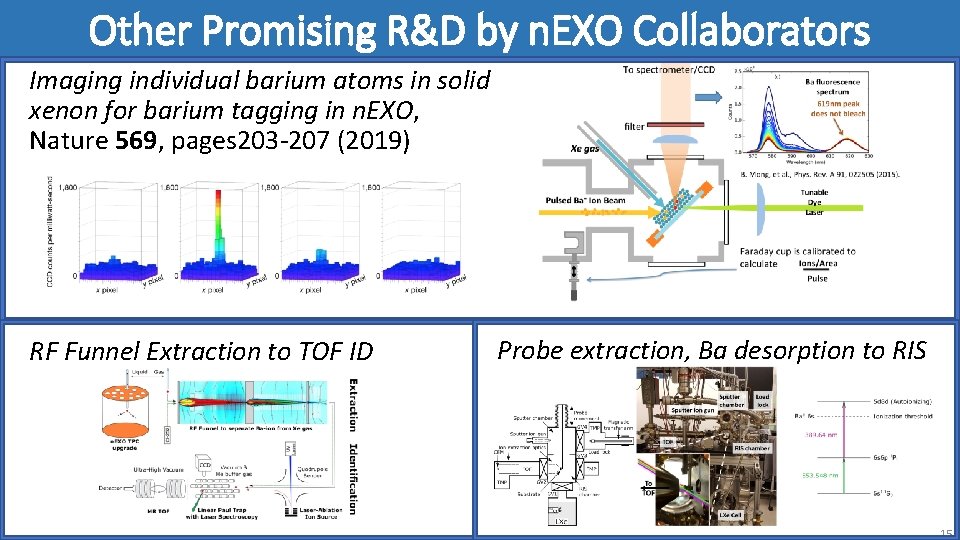
Other Promising R&D by n. EXO Collaborators Imaging individual barium atoms in solid xenon for barium tagging in n. EXO, Nature 569, pages 203 -207 (2019) RF Funnel Extraction to TOF ID Probe extraction, Ba desorption to RIS 15
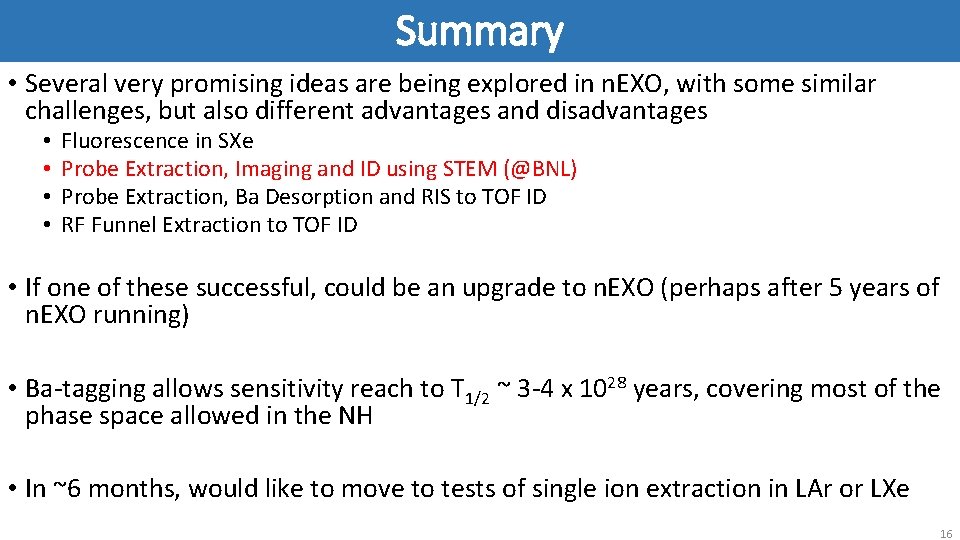
Summary • Several very promising ideas are being explored in n. EXO, with some similar challenges, but also different advantages and disadvantages • • Fluorescence in SXe Probe Extraction, Imaging and ID using STEM (@BNL) Probe Extraction, Ba Desorption and RIS to TOF ID RF Funnel Extraction to TOF ID • If one of these successful, could be an upgrade to n. EXO (perhaps after 5 years of n. EXO running) • Ba-tagging allows sensitivity reach to T 1/2 ~ 3 -4 x 1028 years, covering most of the phase space allowed in the NH • In ~6 months, would like to move to tests of single ion extraction in LAr or LXe 16
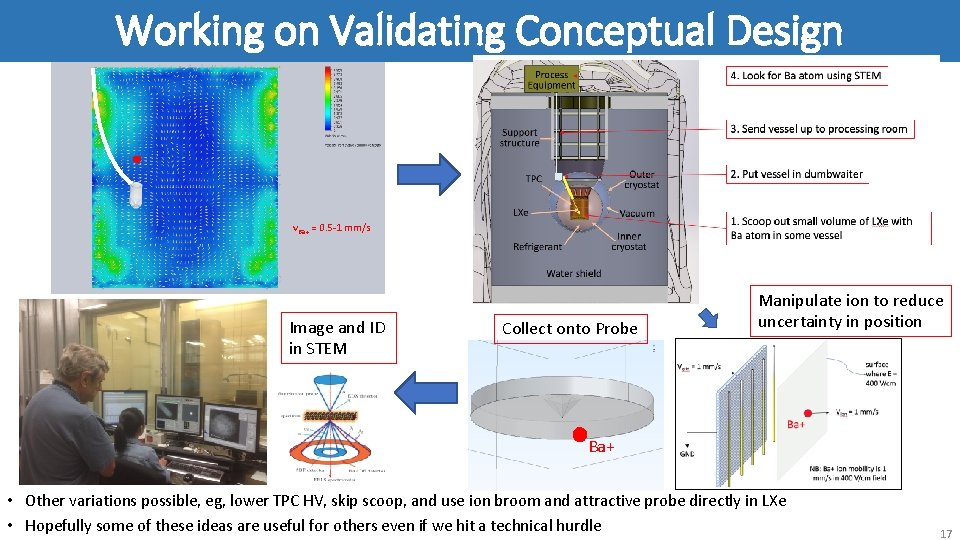
Working on Validating Conceptual Design v. Ba+ = 0. 5 -1 mm/s Image and ID in STEM Collect onto Probe Manipulate ion to reduce uncertainty in position Ba+ • Other variations possible, eg, lower TPC HV, skip scoop, and use ion broom and attractive probe directly in LXe • Hopefully some of these ideas are useful for others even if we hit a technical hurdle 17
- Slides: 17