
RCRA Corrective Action Inspection Training Office of Site
- Slides: 60
RCRA Corrective Action Inspection Training Office of Site Remediation Enforcement January 14, 2015 Webinar U. S. Environmental Protection Agency 1
Course Outline 1. 2. 3. 4. 5. 6. Introduction Typical Corrective Action (CA) Process Steps Preparing for a CA Inspection Conducting a CA Inspection Preparing a CA Inspection Report Developing the Case 01/14/15 Webinar U. S. Environmental Protection Agency 2
Section 1: Introduction What are the goals of this training? • Provide a fundamental understanding of the corrective action process • Describe how to inspect a facility to help ensure compliance with corrective action requirements 01/14/15 Webinar U. S. Environmental Protection Agency 3
Intro: Who is the Audience? • Corrective Action Project Managers (PMs) from EPA region or authorized state • RCRA regulatory and corrective action inspectors • Permit writers who have responsibility for corrective action • Attorneys who have responsibility for corrective action 01/14/15 Webinar U. S. Environmental Protection Agency 4
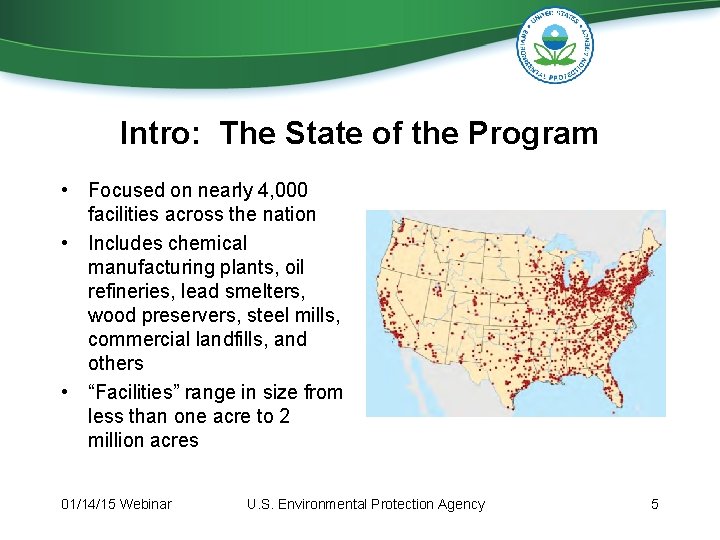
Intro: The State of the Program • Focused on nearly 4, 000 facilities across the nation • Includes chemical manufacturing plants, oil refineries, lead smelters, wood preservers, steel mills, commercial landfills, and others • “Facilities” range in size from less than one acre to 2 million acres 01/14/15 Webinar U. S. Environmental Protection Agency 5
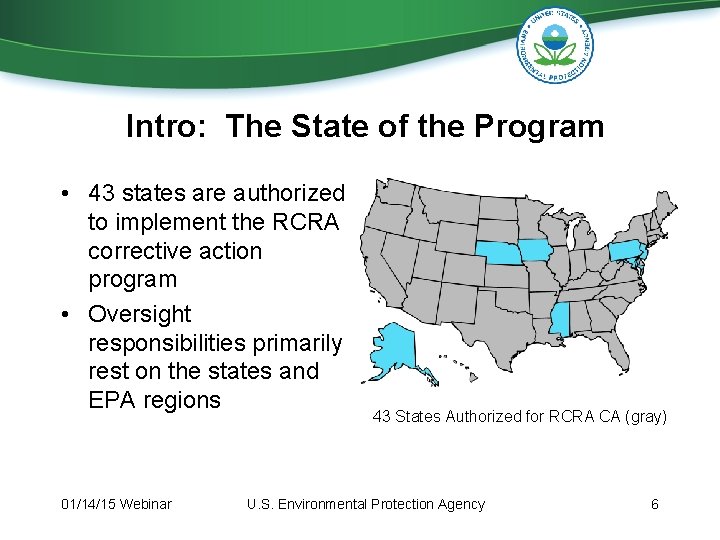
Intro: The State of the Program • 43 states are authorized to implement the RCRA corrective action program • Oversight responsibilities primarily rest on the states and EPA regions 01/14/15 Webinar 43 States Authorized for RCRA CA (gray) U. S. Environmental Protection Agency 6
Intro: Corrective Action Oversight Definition: management by the lead agency of all activities related to corrective action at the site § reviewing, commenting on, and approval or disapproval of required documents § visiting and inspecting facilities § tailored to site-specific circumstances 01/14/15 Webinar U. S. Environmental Protection Agency 7
Intro: Corrective Action Inspection Definition: an evaluation of a site’s compliance with the corrective action requirements of a permit or order. § also known as Corrective Action Compliance Evaluation (CAC) § is a component of corrective action oversight § may be conducted concurrently with other types of inspections 01/14/15 Webinar U. S. Environmental Protection Agency 8
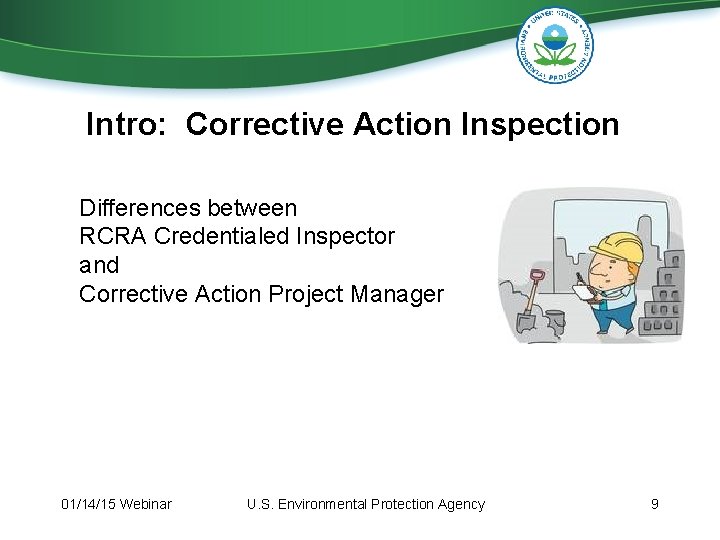
Intro: Corrective Action Inspection Differences between RCRA Credentialed Inspector and Corrective Action Project Manager 01/14/15 Webinar U. S. Environmental Protection Agency 9
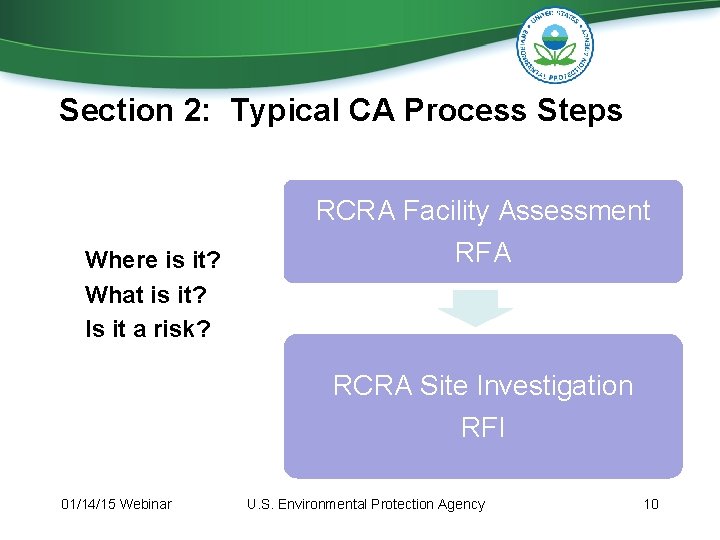
Section 2: Typical CA Process Steps RCRA Facility Assessment Where is it? What is it? Is it a risk? RFA RCRA Site Investigation RFI 01/14/15 Webinar U. S. Environmental Protection Agency 10
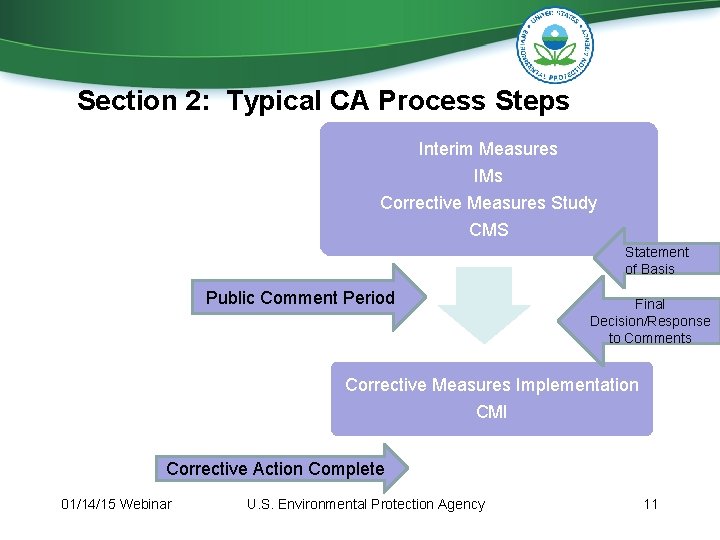
Section 2: Typical CA Process Steps Interim Measures IMs Corrective Measures Study CMS Statement of Basis Public Comment Period Final Decision/Response to Comments Corrective Measures Implementation CMI Corrective Action Complete 01/14/15 Webinar U. S. Environmental Protection Agency 11
Typical CA Process Step 1 • RCRA Facility Assessment (RFA) is an initial facility assessment that is used to identify: § Solid Waste Management Units (SWMUs) § Hazardous Waste Management Units (HWMUs) § Areas of Concern (AOCs) § All other readily available or observable information about environmental conditions at and from the facility 01/14/15 Webinar U. S. Environmental Protection Agency 12
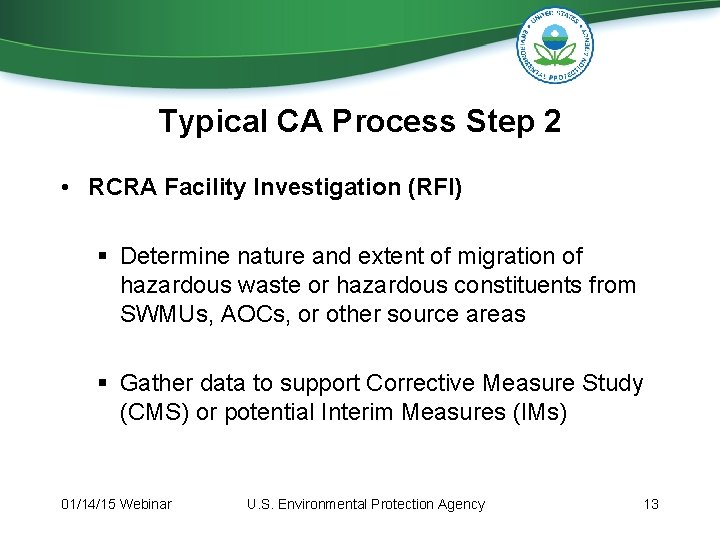
Typical CA Process Step 2 • RCRA Facility Investigation (RFI) § Determine nature and extent of migration of hazardous waste or hazardous constituents from SWMUs, AOCs, or other source areas § Gather data to support Corrective Measure Study (CMS) or potential Interim Measures (IMs) 01/14/15 Webinar U. S. Environmental Protection Agency 13
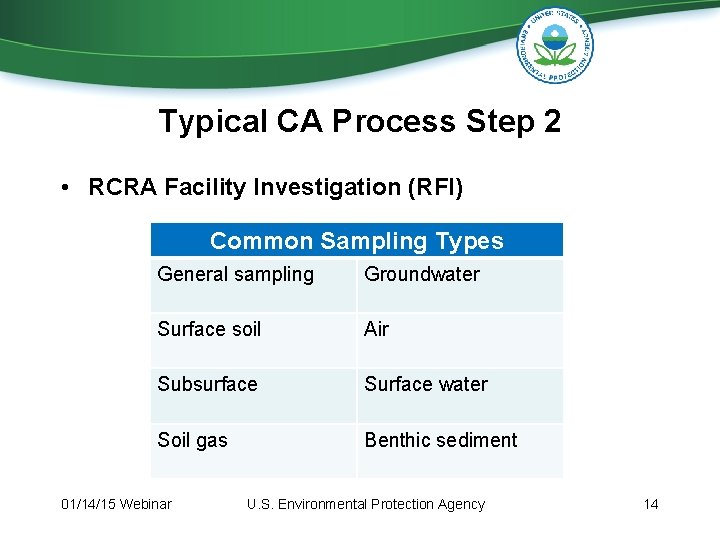
Typical CA Process Step 2 • RCRA Facility Investigation (RFI) Common Sampling Types General sampling Groundwater Surface soil Air Subsurface Surface water Soil gas Benthic sediment 01/14/15 Webinar U. S. Environmental Protection Agency 14
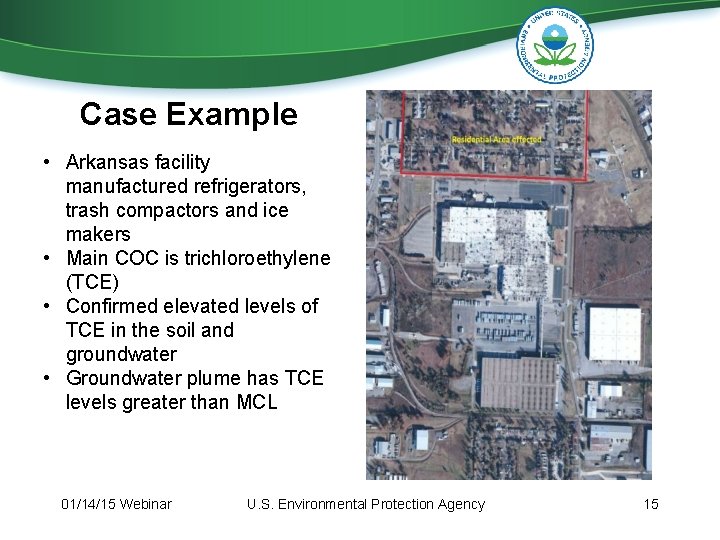
Case Example • Arkansas facility manufactured refrigerators, trash compactors and ice makers • Main COC is trichloroethylene (TCE) • Confirmed elevated levels of TCE in the soil and groundwater • Groundwater plume has TCE levels greater than MCL 01/14/15 Webinar U. S. Environmental Protection Agency 15
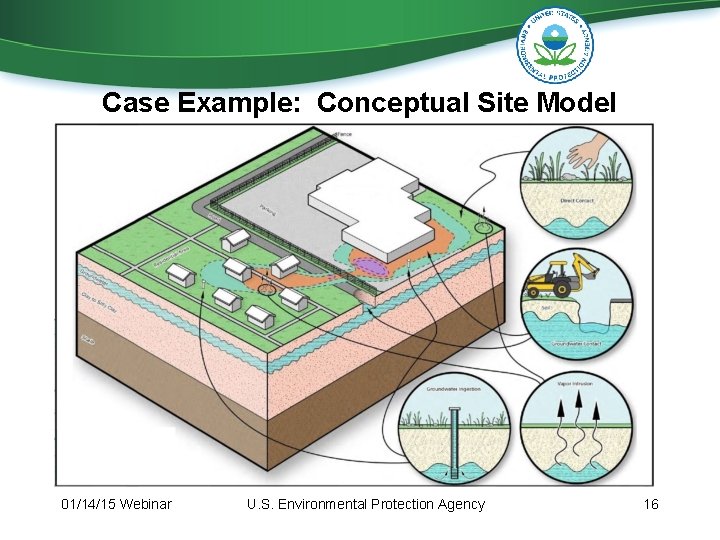
Case Example: Conceptual Site Model 01/14/15 Webinar U. S. Environmental Protection Agency 16
Typical CA Process Step 3 • Interim Measures (IMs) § Control or abate ongoing threats to human health or the environment § May become part of the final Corrective Measures 01/14/15 Webinar U. S. Environmental Protection Agency 17
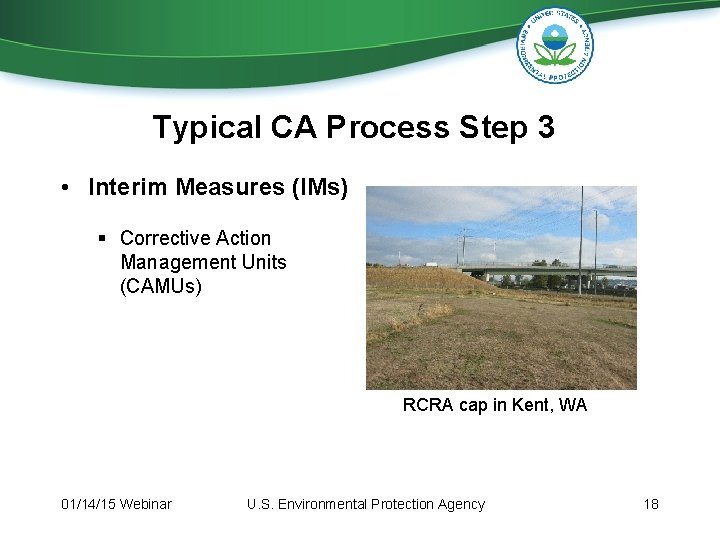
Typical CA Process Step 3 • Interim Measures (IMs) § Corrective Action Management Units (CAMUs) RCRA cap in Kent, WA 01/14/15 Webinar U. S. Environmental Protection Agency 18
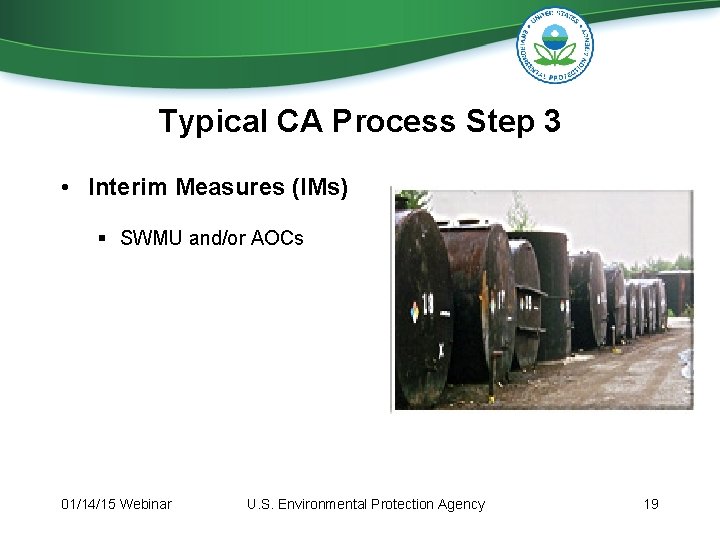
Typical CA Process Step 3 • Interim Measures (IMs) § SWMU and/or AOCs 01/14/15 Webinar U. S. Environmental Protection Agency 19
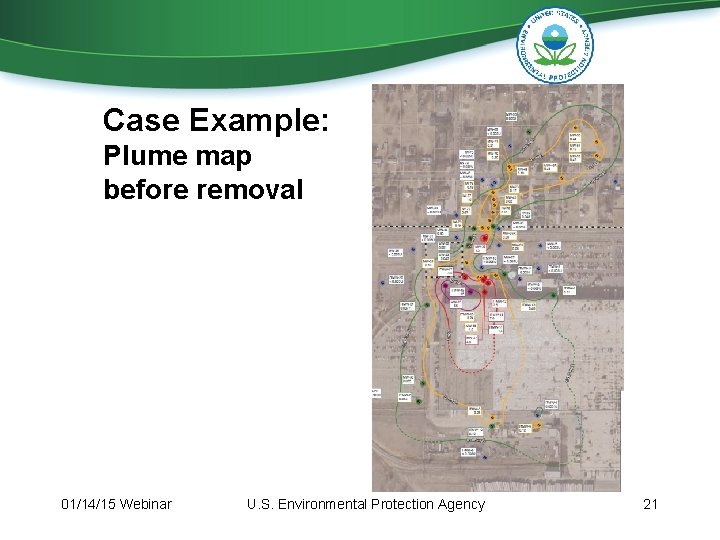
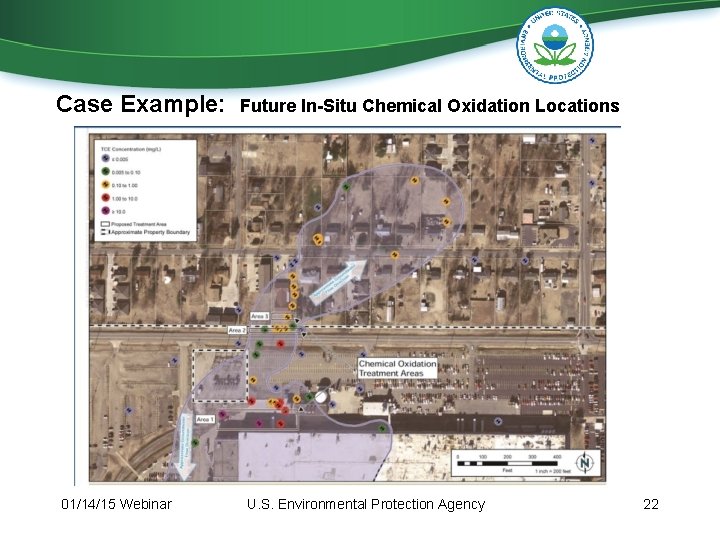
Case Example At the same site in Arkansas, interim measures involved “Hot Spot” removal of TCE contaminated soils on site with the intent to lower the concentration in the groundwater 01/14/15 Webinar U. S. Environmental Protection Agency 20
Case Example: Plume map before removal 01/14/15 Webinar U. S. Environmental Protection Agency 21
Case Example: 01/14/15 Webinar Future In-Situ Chemical Oxidation Locations U. S. Environmental Protection Agency 22
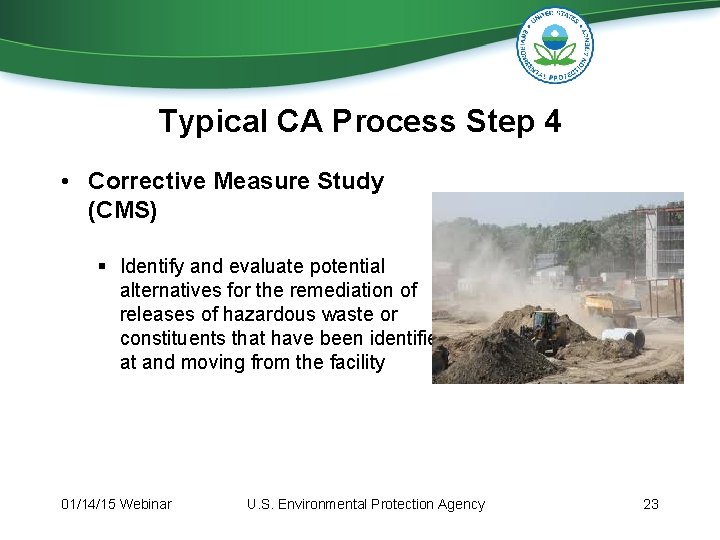
Typical CA Process Step 4 • Corrective Measure Study (CMS) § Identify and evaluate potential alternatives for the remediation of releases of hazardous waste or constituents that have been identified at and moving from the facility 01/14/15 Webinar U. S. Environmental Protection Agency 23
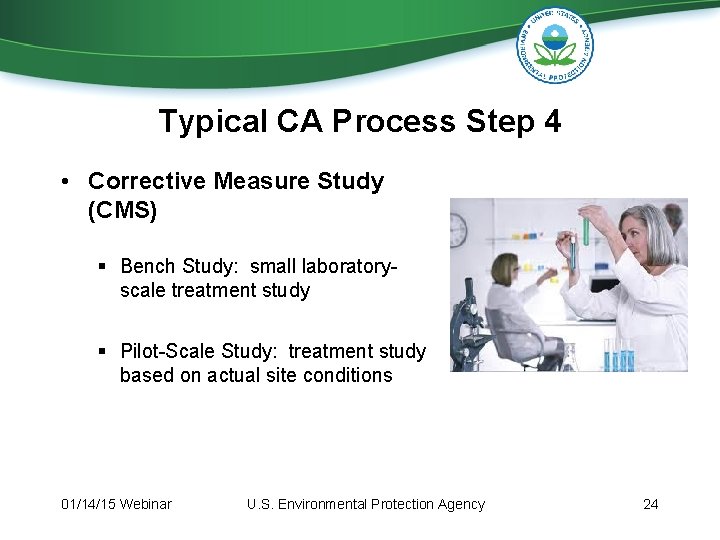
Typical CA Process Step 4 • Corrective Measure Study (CMS) § Bench Study: small laboratoryscale treatment study § Pilot-Scale Study: treatment study based on actual site conditions 01/14/15 Webinar U. S. Environmental Protection Agency 24
Case Example Pilot Tests On-site pilot test In Situ Chemical Oxidation (ISCO): • Effectiveness limited by aquifer transmission Off-site pilot test In Situ Chemical Oxidation (ISCO): • Effectiveness limited by aquifer transmission 01/14/15 Webinar U. S. Environmental Protection Agency 25
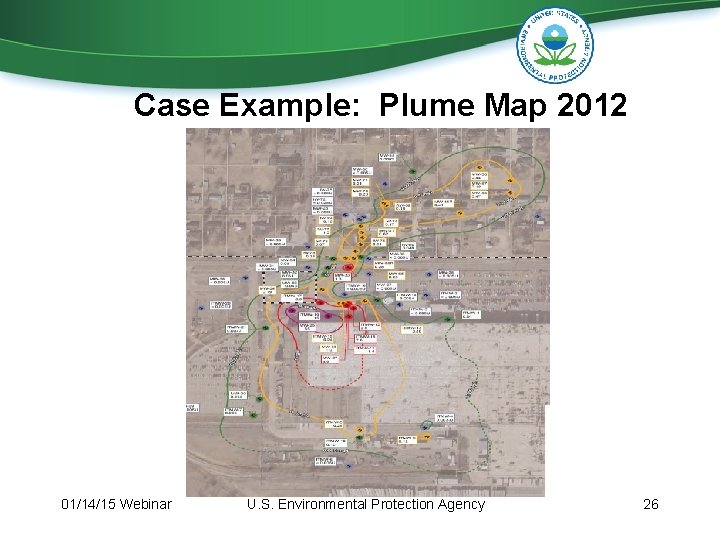
Case Example: Plume Map 2012 01/14/15 Webinar U. S. Environmental Protection Agency 26
Typical CA Process: Decision on Final Remedy • Statement of Basis • Public Comment Period • Decision on Final Remedy / Response to Comments 01/14/15 Webinar U. S. Environmental Protection Agency 27
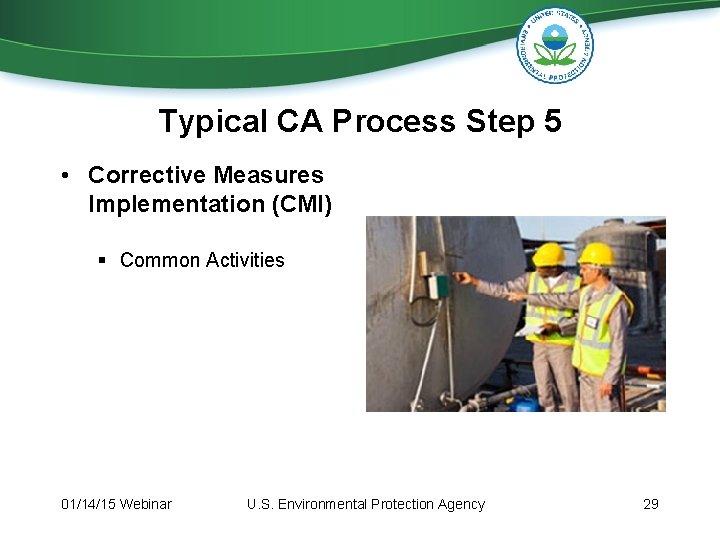
Typical CA Process Step 5 • Corrective Measures Implementation (CMI) § Implement chosen corrective measures: often a combination of treatment and disposal of remediation waste on and off of the facility, measures above and below the surface, and often involves engineering and institutional controls 01/14/15 Webinar U. S. Environmental Protection Agency 28
Typical CA Process Step 5 • Corrective Measures Implementation (CMI) § Common Activities 01/14/15 Webinar U. S. Environmental Protection Agency 29
Case Example Remedies Evaluated • • No Actions Institutional controls Soil: § Containment § Removal Groundwater: § Extraction § In situ chemical oxidation (ISCO) § Permeable texture beds § In situ enhanced bio degradation § Monitored natural attenuation (MNA) 01/14/15 Webinar U. S. Environmental Protection Agency 30
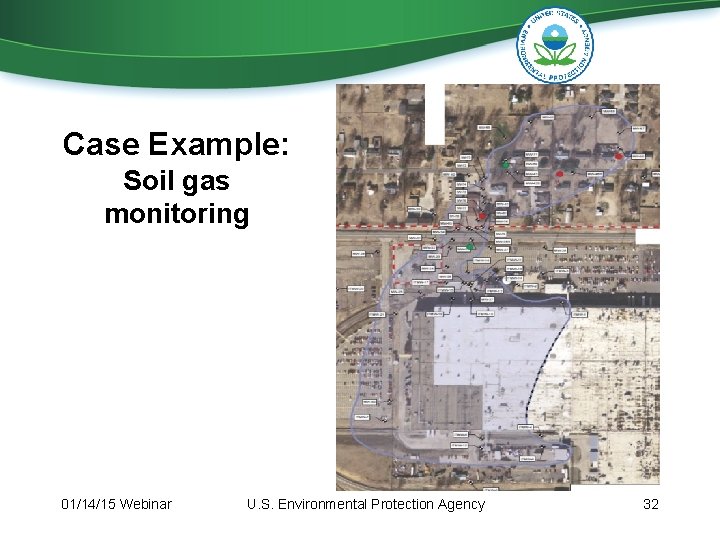
Case Example Chosen Remedy • • • Site-wide institutional controls (ICs) Soil with asphalt cover with soil gas monitoring Groundwater with in situ chemical oxidation (ISCO) and monitored natural attenuation (MNA) 01/14/15 Webinar U. S. Environmental Protection Agency 31
Case Example: Soil gas monitoring 01/14/15 Webinar U. S. Environmental Protection Agency 32
Section 3: Preparing for a CA Inspection • Begin with the end in mind. . . • Prepare early, at least 30 days before the inspection 01/14/15 Webinar U. S. Environmental Protection Agency 33
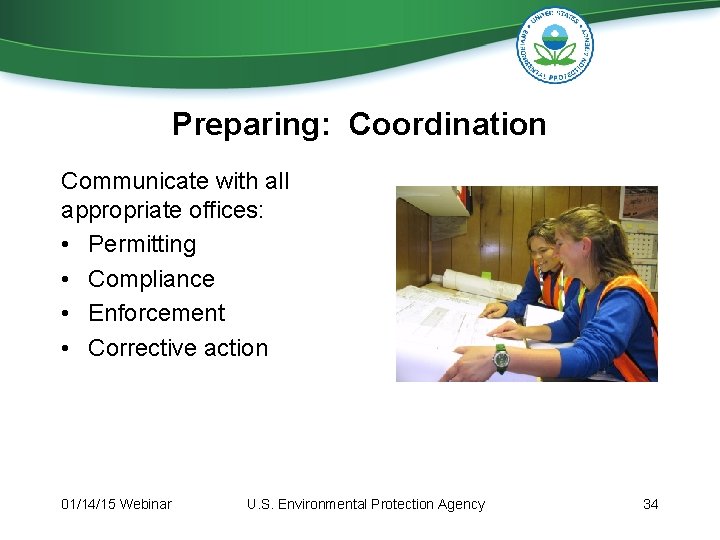
Preparing: Coordination Communicate with all appropriate offices: • Permitting • Compliance • Enforcement • Corrective action 01/14/15 Webinar U. S. Environmental Protection Agency 34
Preparing: Define Purpose and Scope • Determine inspection objectives • If not in 2020 CA Universe § Identify any releases § Check permit and order status of facility 01/14/15 Webinar U. S. Environmental Protection Agency 35
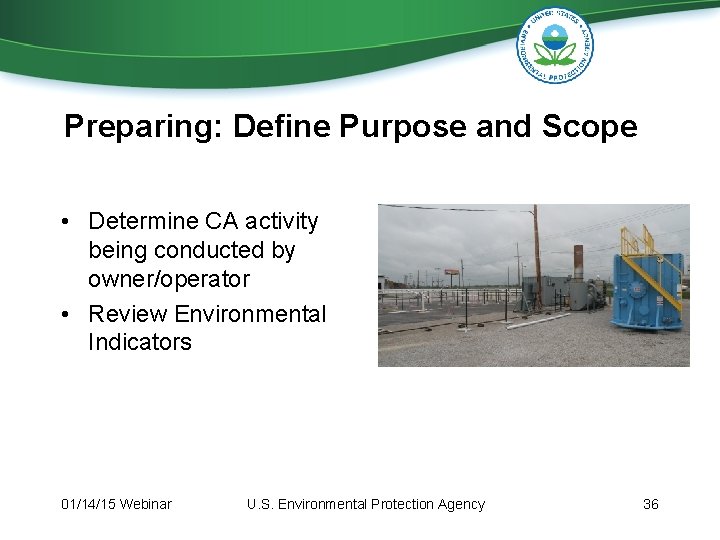
Preparing: Define Purpose and Scope • Determine CA activity being conducted by owner/operator • Review Environmental Indicators 01/14/15 Webinar U. S. Environmental Protection Agency 36
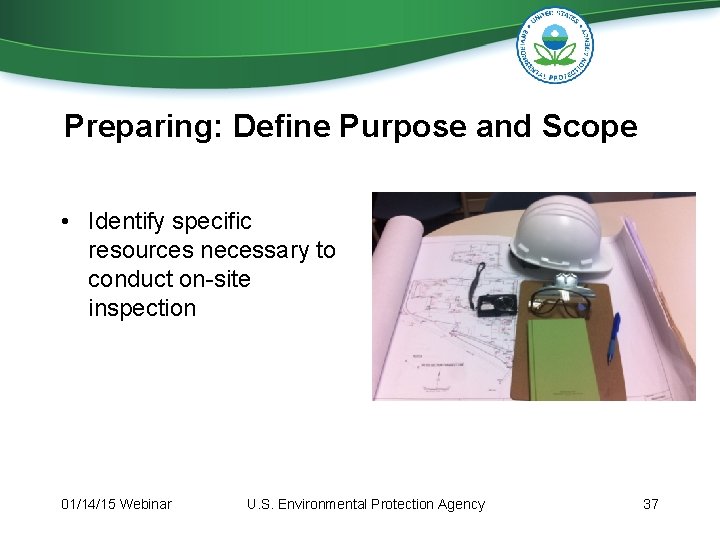
Preparing: Define Purpose and Scope • Identify specific resources necessary to conduct on-site inspection 01/14/15 Webinar U. S. Environmental Protection Agency 37
Preparing: Review Background Info The Inspector should be familiar with: § Regulatory / permitting / order status § Site uses § EPA tracking databases § Potential hazards at the facility 01/14/15 Webinar U. S. Environmental Protection Agency 38
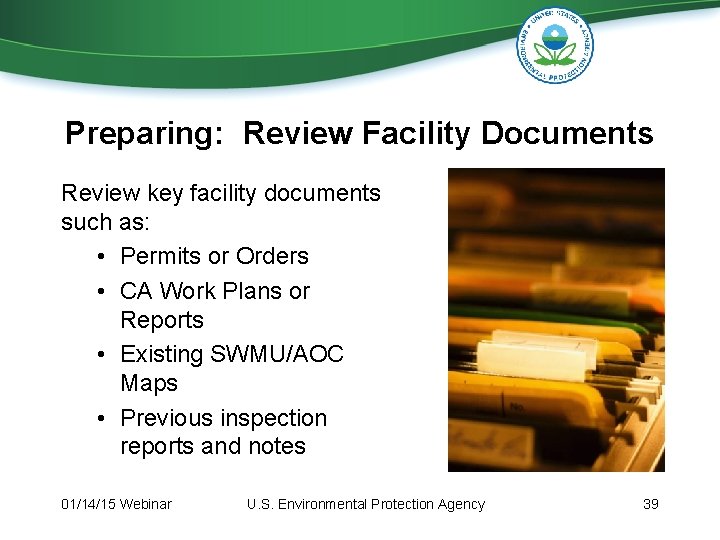
Preparing: Review Facility Documents Review key facility documents such as: • Permits or Orders • CA Work Plans or Reports • Existing SWMU/AOC Maps • Previous inspection reports and notes 01/14/15 Webinar U. S. Environmental Protection Agency 39
Preparing: Obtain Other Information • Contact other federal, tribal, state and local agencies • Use web-based search engines • Review reports and data submitted under other programs 01/14/15 Webinar U. S. Environmental Protection Agency 40
Preparing: Develop a Checklist ü Objectives of inspection ü Facility background ü Priority areas to review including operation and maintenance (O&M) areas ü Tasks to be performed ü Quality Assurance Project Plan (QAPP) ü Sampling Analysis Plan ü Health and Safety Plan ü Resources (personnel and equipment) ü Compliance Schedule ü Performance Monitoring ü Remedy Optimization ü Institutional controls (ICs) ü Financial assurance (FA) requirements 01/14/15 Webinar U. S. Environmental Protection Agency 41
Section 4: Conducting a CA Inspection • Accessing facility. . . • Checking records. . . • Inspecting / touring. . . • Documenting. . . 01/14/15 Webinar U. S. Environmental Protection Agency 42
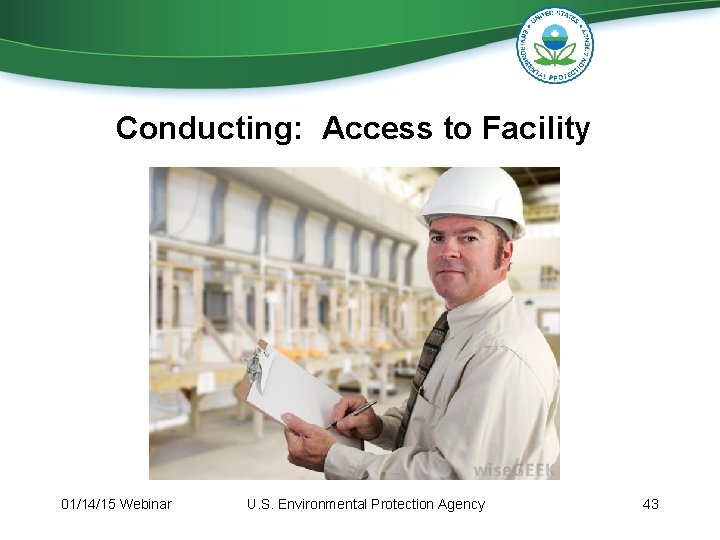
Conducting: Access to Facility 01/14/15 Webinar U. S. Environmental Protection Agency 43
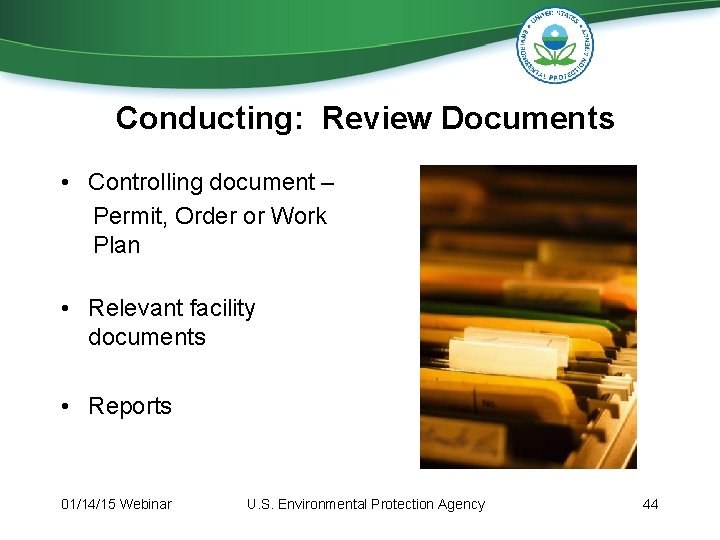
Conducting: Review Documents • Controlling document – Permit, Order or Work Plan • Relevant facility documents • Reports 01/14/15 Webinar U. S. Environmental Protection Agency 44
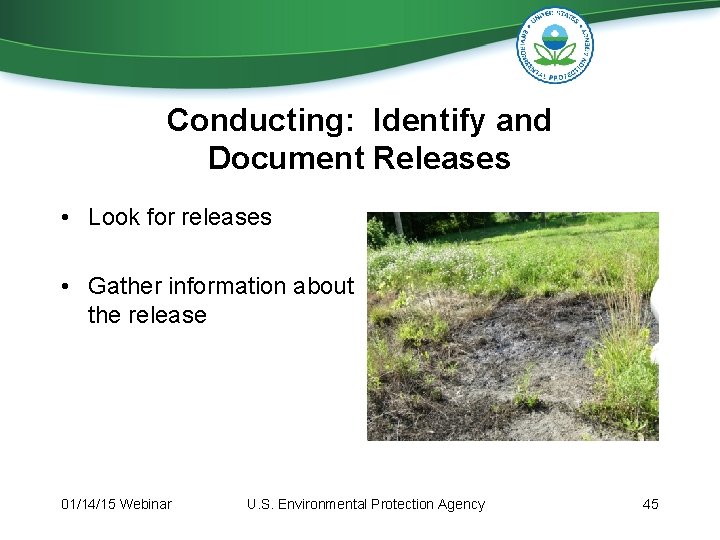
Conducting: Identify and Document Releases • Look for releases • Gather information about the release 01/14/15 Webinar U. S. Environmental Protection Agency 45
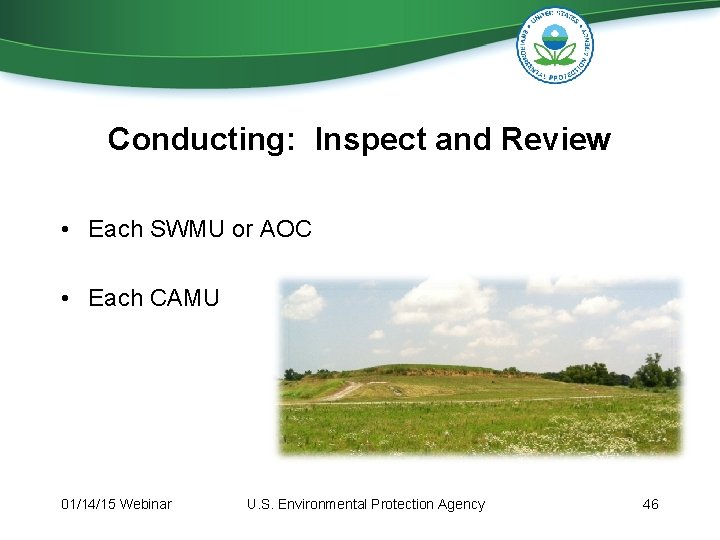
Conducting: Inspect and Review • Each SWMU or AOC • Each CAMU 01/14/15 Webinar U. S. Environmental Protection Agency 46
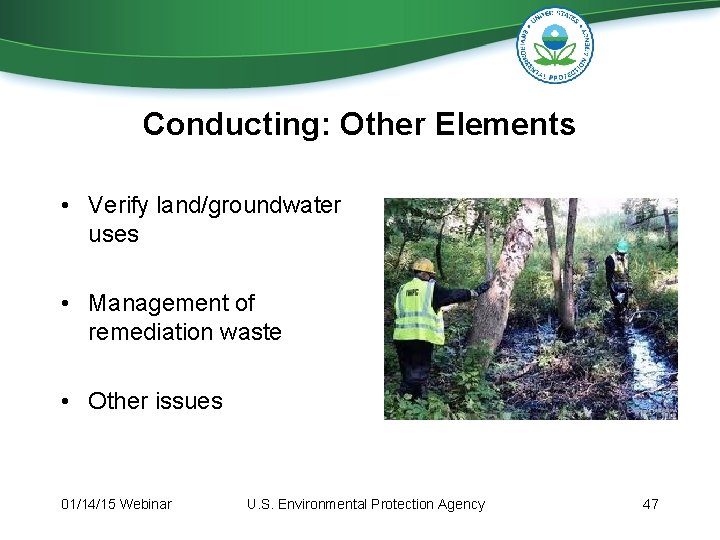
Conducting: Other Elements • Verify land/groundwater uses • Management of remediation waste • Other issues 01/14/15 Webinar U. S. Environmental Protection Agency 47
Conducting: Document …Document • • Be organized!!! Complete the checklist Keep detailed notes Collect evidence Maintain chain of custody Take accurate statements Copy pertinent documents 01/14/15 Webinar U. S. Environmental Protection Agency 48
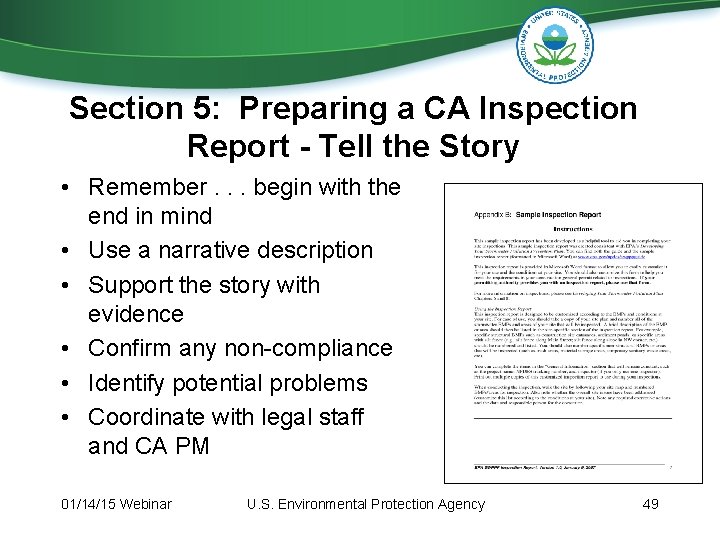
Section 5: Preparing a CA Inspection Report - Tell the Story • Remember. . . begin with the end in mind • Use a narrative description • Support the story with evidence • Confirm any non-compliance • Identify potential problems • Coordinate with legal staff and CA PM 01/14/15 Webinar U. S. Environmental Protection Agency 49
Reporting: Use an Outline Example Outline of Inspection Report A. B. C. D. General Information Narrative Summary of Inspection Identify Potential Problems Appendices 01/14/15 Webinar U. S. Environmental Protection Agency 50
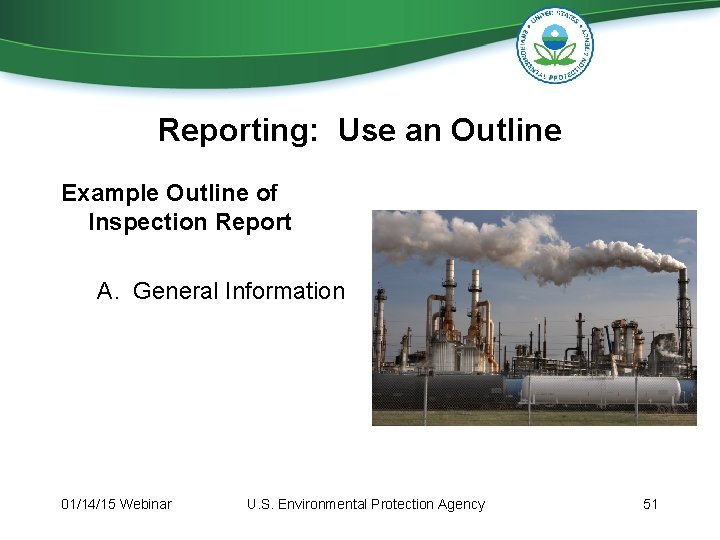
Reporting: Use an Outline Example Outline of Inspection Report A. General Information 01/14/15 Webinar U. S. Environmental Protection Agency 51
Reporting: Use an Outline Example Outline of Inspection Report B. Narrative Summary of Inspection 01/14/15 Webinar U. S. Environmental Protection Agency 52
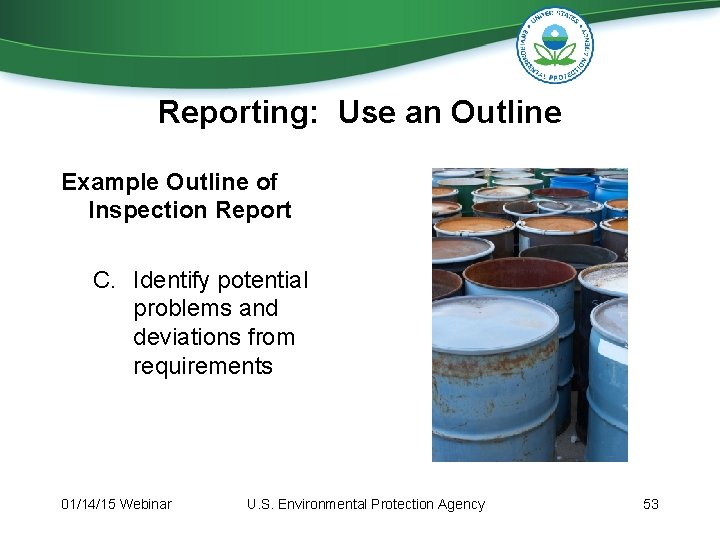
Reporting: Use an Outline Example Outline of Inspection Report C. Identify potential problems and deviations from requirements 01/14/15 Webinar U. S. Environmental Protection Agency 53
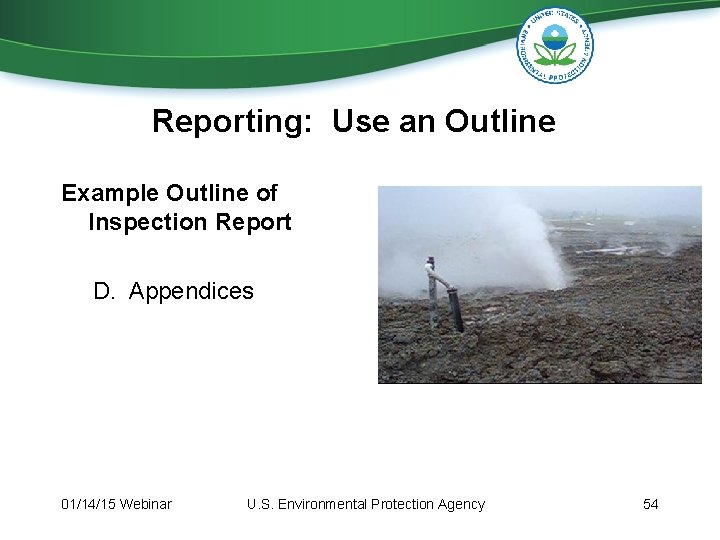
Reporting: Use an Outline Example Outline of Inspection Report D. Appendices 01/14/15 Webinar U. S. Environmental Protection Agency 54
Section 6: Developing the Case • Work closely with case attorney to develop enforcement case • Each violation needs to have supporting evidence to back it up 01/14/15 Webinar U. S. Environmental Protection Agency 55
Developing: Select the Best Tools • Determine if enforcement action is necessary • If necessary, select the best tools to ensure compliance 01/14/15 Webinar U. S. Environmental Protection Agency 56
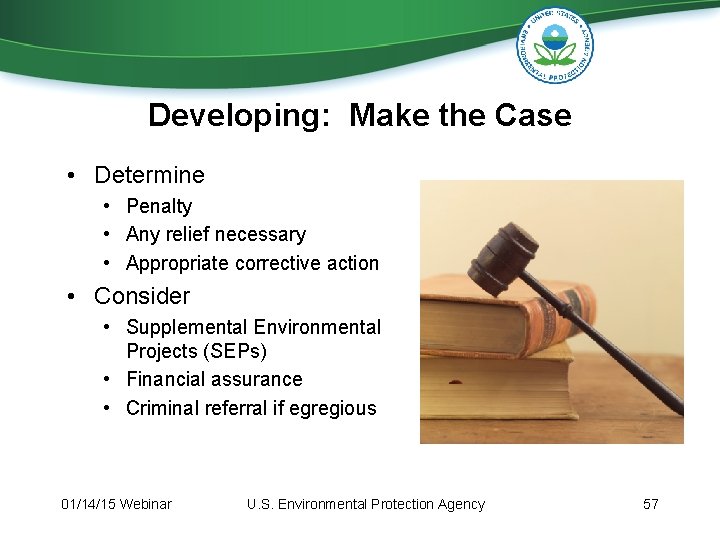
Developing: Make the Case • Determine • Penalty • Any relief necessary • Appropriate corrective action • Consider • Supplemental Environmental Projects (SEPs) • Financial assurance • Criminal referral if egregious 01/14/15 Webinar U. S. Environmental Protection Agency 57
Case Example Facility X was subject to a RCRA Section 3008(h) interim status corrective action order Ø Order required pumping and treating groundwater Ø Failed to maintain pumps Ø Led to drinking well contamination Ø Consent agreement final order with civil penalty for $650, 000 01/14/15 Webinar U. S. Environmental Protection Agency 58
Additional References • Groundwater Sampling Guidelines for Superfund and RCRA Project Managers (May 2002, EPA-542 -S-02 -001). [PDF file] • Handbook of Groundwater Protection and Cleanup Policies for RCRA Corrective Action (April 2004 updated, EPA/530/R 01/015 • Low-Flow (Minimal Drawdown) Groundwater Sampling Procedures (April 1996, EPA/540/S-95/504. [PDF file] • RCRA Ground-water Monitoring: Draft Technical Guidance [PDF, 2. 87 MB, 236 pages, About PDF] (November 1992) • Recommended Procedure for Low-Flow Purging and Sampling of Groundwater Monitoring Wells (October 15, 1997, Bulleting No. QAD 023 01/14/15 Webinar U. S. Environmental Protection Agency 59
Summary • Corrective action inspection process Ø Preparation Ø Inspection Ø Reporting Ø Developing case if necessary • Questions? 01/14/15 Webinar U. S. Environmental Protection Agency 60