
RCN Markets A Global Perspective Dr R K
RCN Markets – A Global Perspective Dr. R. K. Bhoodes Vice-Chairman, CEPCI
Glimpses of Global RCN Trade … § When cashew trees were introduced from Brazil to the rest of the world, it was meant for preventing soil erosion only. § Raw nut was a waste product just meant for reproduction only § Later on in the late 18 th century , cashew kernels found a way as a food item and was traded in the local markets in India § When Cashew kernels found an entry in the international trade, RCN were sourced locally. § It was India that nurtured cashew as an Industry and it was she who introduced cashew as a commodity in the international trade.
Glimpses of Global RCN Trade … § RCN attained the status of an international commodity in the mid 1960’s with shipments made from East Africa (Tanzania) to India. § RCN trade attained a new outlook after Liberalisation, Privatisation and Globalisation of trade during the 1990’s. § The increased consumption of Cashew Kernels all across the world demanded the supply of more raw nuts for processing, that ultimately resulted in processing countries importing bulk quantities of RCN for processing. § While the processing countries concentrated more in processing, the producing countries concentrated more in production (Theory of Comparative advantage) § Mechanisation and automation has brought in a feel of comfort for producing countries to step into processing
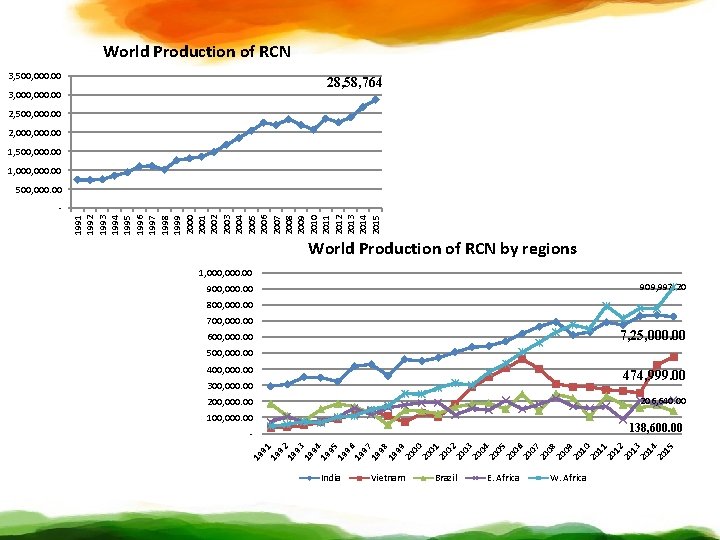
World Production of RCN 3, 500, 000. 00 28, 58, 764 3, 000. 00 2, 500, 000. 00 2, 000. 00 1, 500, 000. 00 1, 000. 00 500, 000. 00 1991 1992 1993 1994 1995 1996 1997 1998 1999 2000 2001 2002 2003 2004 2005 2006 2007 2008 2009 2010 2011 2012 2013 2014 2015 - World Production of RCN by regions 1, 000. 00 909, 997. 20 900, 000. 00 800, 000. 00 7, 25, 000. 00 600, 000. 00 500, 000. 00 474, 999. 00 300, 000. 00 206, 640. 00 200, 000. 00 138, 600. 00 19 91 19 92 19 93 19 94 19 95 19 96 19 97 19 98 19 99 20 00 20 01 20 02 20 03 20 04 20 05 20 06 20 07 20 08 20 09 20 10 20 11 20 12 20 13 20 14 20 15 - India Vietnam Brazil E. Africa W. Africa
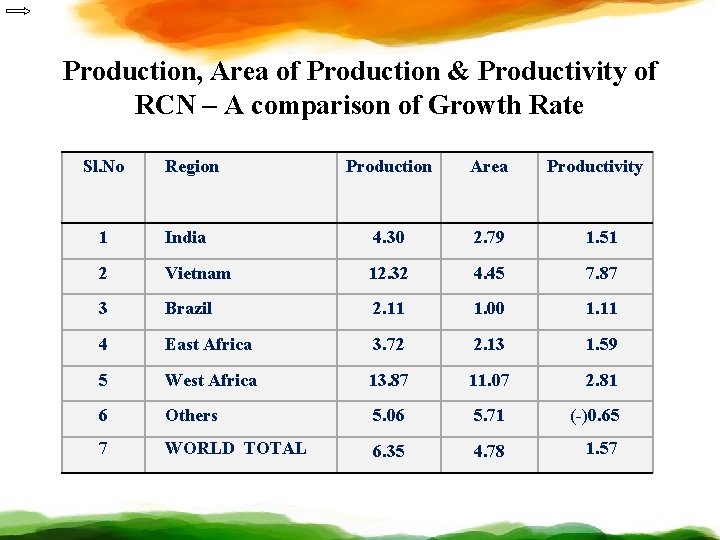
Production, Area of Production & Productivity of RCN – A comparison of Growth Rate Sl. No Region Production Area Productivity 1 India 4. 30 2. 79 1. 51 2 Vietnam 12. 32 4. 45 7. 87 3 Brazil 2. 11 1. 00 1. 11 4 East Africa 3. 72 2. 13 1. 59 5 West Africa 13. 87 11. 07 2. 81 6 Others 5. 06 5. 71 (-)0. 65 7 WORLD TOTAL 6. 35 4. 78 1. 57
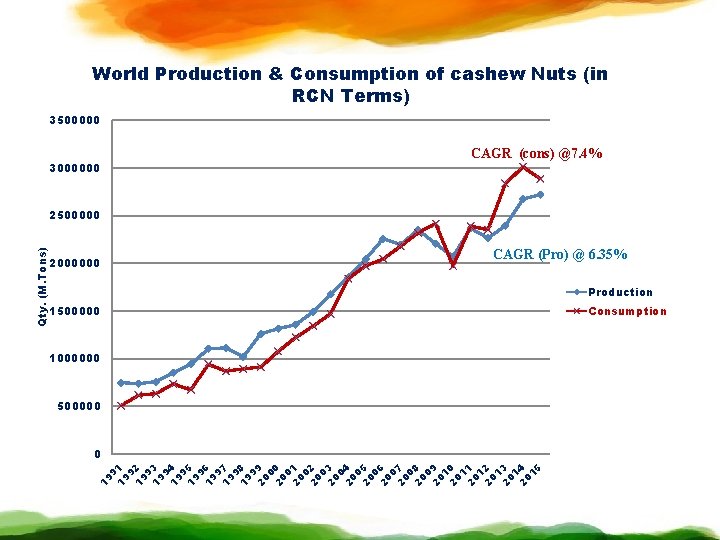
World Production & Consumption of cashew Nuts (in RCN Terms) 3500000 CAGR (cons) @7. 4% 3000000 CAGR (Pro) @ 6. 35% 2000000 Production 1500000 Consumption 1000000 500000 9 19 1 9 19 2 9 19 3 9 19 4 9 19 5 9 19 6 9 19 7 9 19 8 9 20 9 0 20 0 0 20 1 0 20 2 0 20 3 0 20 4 0 20 5 0 20 6 0 20 7 0 20 8 0 20 9 1 20 0 1 20 1 1 20 2 1 20 3 1 20 4 15 0 19 Qty. (M. Tons) 2500000
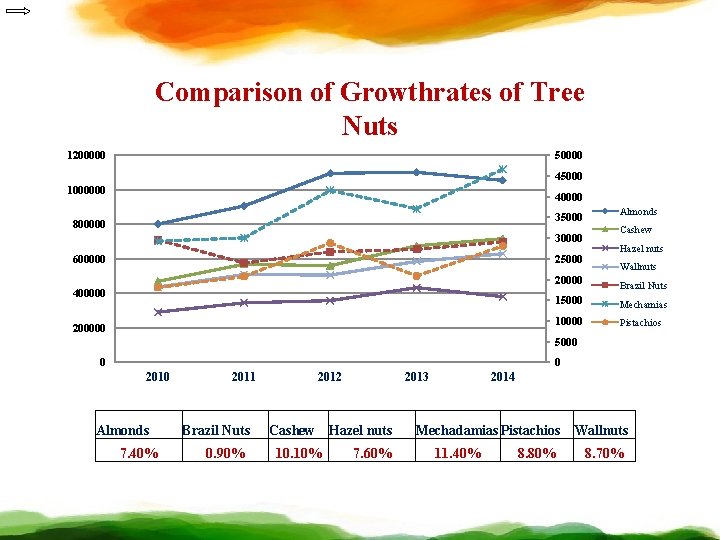
Comparison of Growthrates of Tree Nuts 1200000 50000 45000 1000000 40000 35000 800000 30000 600000 25000 20000 400000 200000 Almonds Cashew Hazel nuts Wallnuts Brazil Nuts 15000 Mechamias 10000 Pistachios 5000 0 0 2010 Almonds 7. 40% 2011 Brazil Nuts 0. 90% 2012 2013 Cashew Hazel nuts 10. 10% 7. 60% 2014 Mechadamias Pistachios Wallnuts 11. 40% 8. 80% 8. 70%
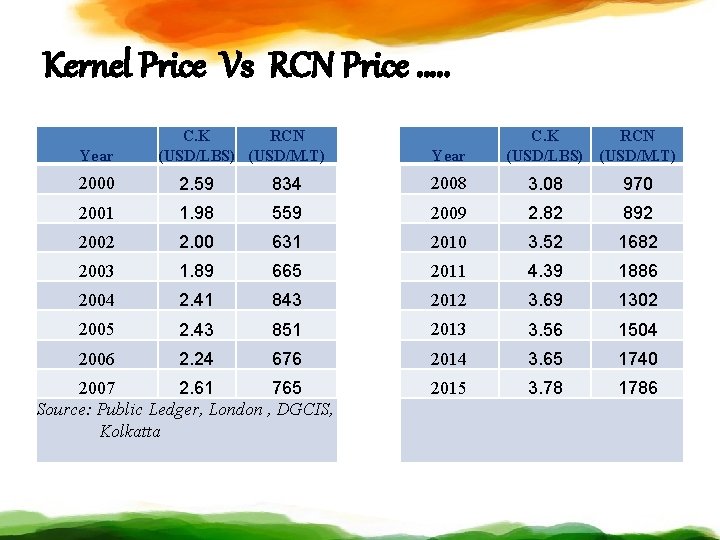
Kernel Price Vs RCN Price …. . Year C. K RCN (USD/LBS) (USD/M. T) 2000 2. 59 834 2008 3. 08 970 2001 1. 98 559 2009 2. 82 892 2002 2. 00 631 2010 3. 52 1682 2003 1. 89 665 2011 4. 39 1886 2004 2. 41 843 2012 3. 69 1302 2005 2. 43 851 2013 3. 56 1504 2006 2. 24 676 2014 3. 65 1740 2015 3. 78 1786 2007 2. 61 765 Source: Public Ledger, London , DGCIS, Kolkatta
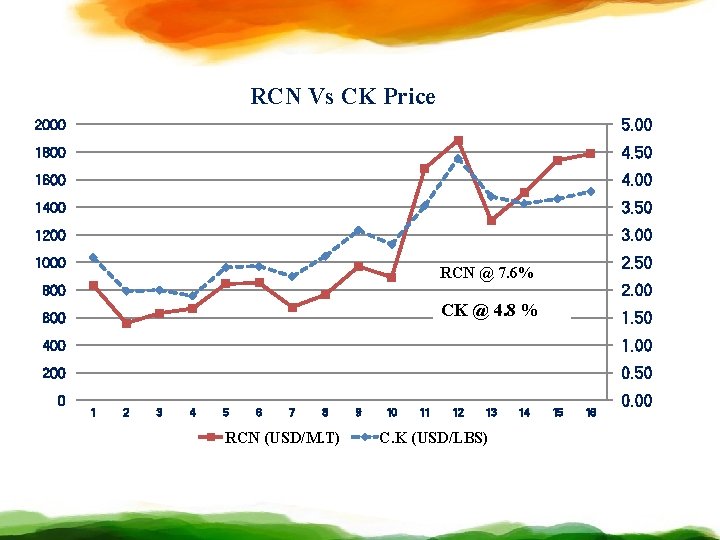
RCN Vs CK Price 2000 5. 00 1800 4. 50 1600 4. 00 1400 3. 50 1200 3. 00 1000 2. 50 RCN @ 7. 6% 2. 00 800 CK @ 4. 8 % 600 1. 50 400 1. 00 200 0. 50 0 1 2 3 4 5 6 7 8 RCN (USD/M. T) 9 10 11 12 13 C. K (USD/LBS) 14 15 16 0. 00
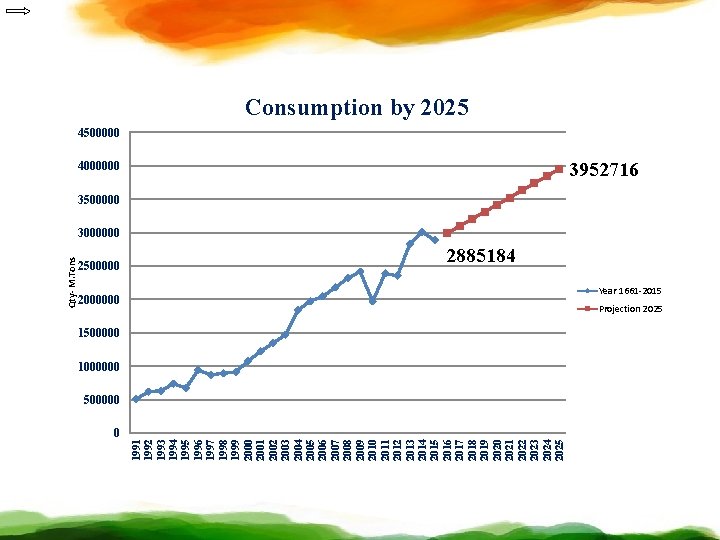
2500000 0 1991 1992 1993 1994 1995 1996 1997 1998 1999 2000 2001 2002 2003 2004 2005 2006 2007 2008 2009 2010 2011 2012 2013 2014 2015 2016 2017 2018 2019 2020 2021 2022 2023 2024 2025 Qty- M. Tons Consumption by 2025 4500000 4000000 3952716 3500000 3000000 2885184 2000000 Year 1661 -2015 Projection 2025 1500000 1000000 500000
Transitions… § The consumption has grown at un-imaginary levels that resulted in shortage/ high demand for Raw nuts. § The prospects of cashew consumption growth is restricted to the extent of raw nut produced. § There is a big pull by both emerging markets and existing markets of Raw nuts both in terms of quantity and the realisation. § This has resulted in the processors directly purchasing from producing countries
Transitions contd… § The producing countries started processing directly § The mechanisation has enhanced the processing capacities to exhaust almost all available quantities of RCN § Big Governmental supports in the Producing countries Vs reduced levels of Governmental supports in the processing countries § Restrictions imposed by the Producing countries in export of raw nuts § Low / Negative levels of returns in processing
The Result…. § Lack of proper quality control on Raw Nuts § Un-healthy competition and trade practices. § High price of RCN at non-parity levels with Kernel prices. § Processors to work with low processing costs that affected the income of workers. § Processors from processing countries setting up processing units in producing countries. § Imposition of heavy duties on export of raw nuts and low returns to farmers. § Ban / Controls on exports of raw nuts in producing countries.
Strength. ü Big processing capacities ü Well established global trade networks ü Mechanisation and Automisation in processing Weakness Shortage to cater to the demand Low productivity Wide price fluctuations Opportunities Ø Increasing consumption of Cashew nuts world over Ø Scope for Area Expansion Ø High / Early Yielding breeds of tree
Threats § Most of the yielding trees in West Africa /Vietnam planted in the late 1990’s are at its peak level of yield, which may come down in the coming years resulting in shortage of raw nuts. § Old and senile plantations in India and West Africa regions § Lack of proper Pre & Post Harvest Management § The productivity is almost stagnant § Lack of a pricing mechanism in rcn trade § Lack of regulatory body / arbitration in raw nut trade.
Action Plan Production point of View § Processing countries to concentrate more on Production of RCN § Producing countries to concentrate more on increasing the productivity § Adopt improved Pre & Post Harvesting Management § Area Expansion § Replanting Old & Senile Trees with Hybrid Varieties
Action Plan Trade point of View § Adopt suitable Price Control Mechanism § International Regulatory body for RCN Trade § International Arbitration for RCN Trade § Adoption of Uniform Customs & Practices (UCP) in RCN Trade Key Points § A well drafted contract solves most of the problems § The right parnters in your business brings down the risk factors.

The Best Approach Plan well before you start a deal. Follow the tailor & Carpenter theory: - “Measure Twice But Cut Once”
- Slides: 18