
RC Circuits Background Information Consider a circuit that
RC Circuits Background Information Consider a circuit that is composed of a resistor and a capacitor in series with a power supply. In series means that one wire connects the power supply to the resistor, another wire connects the other lead of the resistor to the capacitor, and one more wire connects the other lead of the capacitor back to the power supply completing the circuit. To understand how this circuit behaves, let's review Ohm's Law and what resistors and capacitors are. Copyright 2017 © by E. I. Horvath and E. A. Horvath
Voltage, Current, Resistance V represents voltage measured in units of Volts. For example, V = 5 V. I represents current measured in units of Amperes. The Ampere represents a very large amount of current, larger than any current encountered in most electronics labs which is why current is usually measured in units of milli. Amperes. For example, I = 16 m. A. R represents resistance measured in units of Ohms. Typical resistance values used in these projects range from several hundred to several thousand. For example, R = 470 ohms. The unit of the ohm is often written as the capital Greek letter omega.
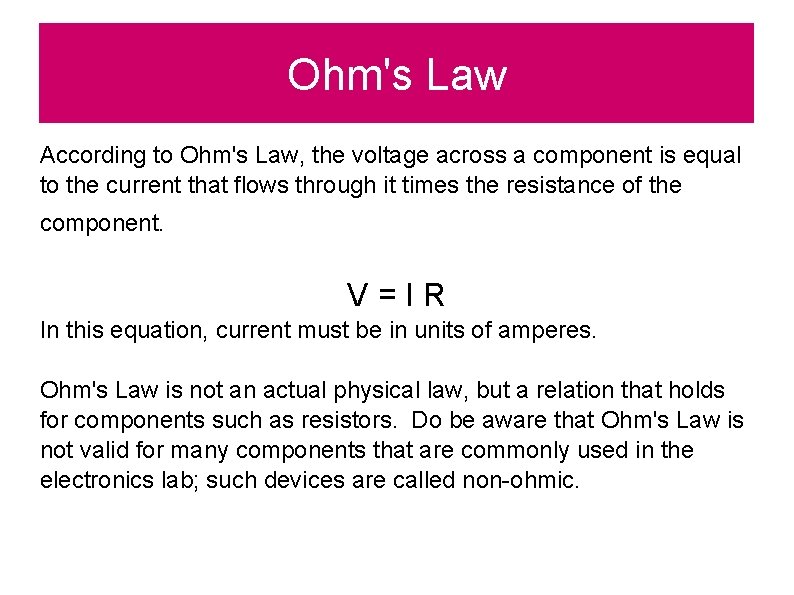
Ohm's Law According to Ohm's Law, the voltage across a component is equal to the current that flows through it times the resistance of the component. V=IR In this equation, current must be in units of amperes. Ohm's Law is not an actual physical law, but a relation that holds for components such as resistors. Do be aware that Ohm's Law is not valid for many components that are commonly used in the electronics lab; such devices are called non-ohmic.
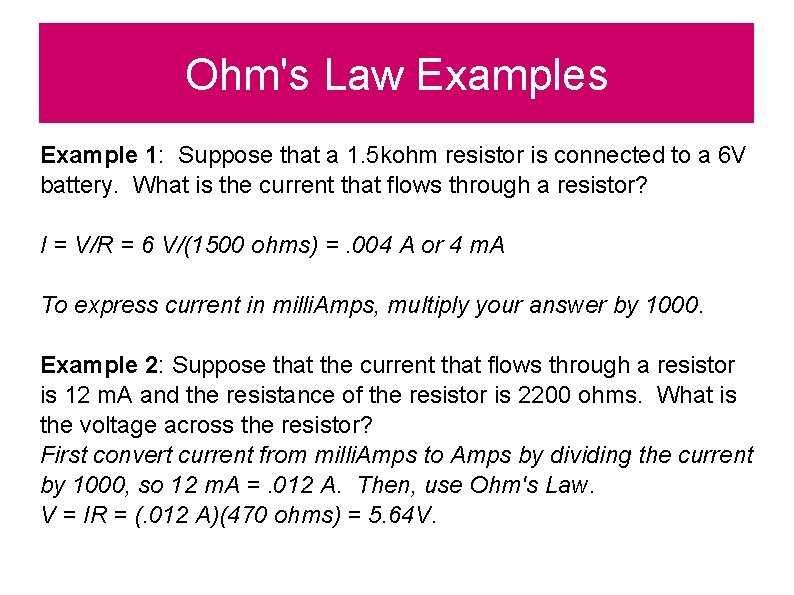
Ohm's Law Examples Example 1: Suppose that a 1. 5 kohm resistor is connected to a 6 V battery. What is the current that flows through a resistor? I = V/R = 6 V/(1500 ohms) =. 004 A or 4 m. A To express current in milli. Amps, multiply your answer by 1000. Example 2: Suppose that the current that flows through a resistor is 12 m. A and the resistance of the resistor is 2200 ohms. What is the voltage across the resistor? First convert current from milli. Amps to Amps by dividing the current by 1000, so 12 m. A =. 012 A. Then, use Ohm's Law. V = IR = (. 012 A)(470 ohms) = 5. 64 V.
Capacitance A capacitor stores charge, and capacitance is a measure of a component's capacity for storing charge. Capacitance is defined as charge divided by voltage. Expressed mathematically, this is C = Q/V In this equation, C represents capacitance, Q represents charge, and V represents voltage. Capacitance is measured in units of Farads, V is measured in units of Volts, and Q is measured in units of Coulombs. Most of the capacitors you'll be using will be on the order of 1 micro. Farad or 0. 1 micro. Farad, which is 10 to the minus 6 Farads.
The RC Circuit Let's suppose a resistor and an uncharged capacitor are connected in series and are then hooked up to a power supply. The capacitor builds up charge exponentially until the voltage across the capacitor is equal to the voltage of the power supply. After this point, no more current flows. How fast this process takes place depends on the resistance of the resistor and the capacitance of the capacitor. The product of resistance and capacitance gives the RC time constant for the circuit. t = RC, measured in seconds The mathematics of this circuit lie beyond the scope of this class, but it suffices for our purposes to know how to calculate the time.
- Slides: 6