
RBM A LifeCycle Approach in 10 Steps STEP

RBM: A Life-Cycle Approach in 10 Steps STEP 10. REPORT ON YOUR RESULTS AND LEARNING STEP 9. IMPLEMENT, MONITOR, EVALUATE AND ADJUST YOUR INTERVENTION STEP 1: TAKE A PARTICIPATORY & SYSTEMS APPROACH STEP 2. ASSESS THE ISSUE(S) YOU WANT TO ADDRESS STEP 3. ANALYSE KEY STAKEHOLDERS RBM life-cycle approach STEP 4. SET YOUR STRATEGIC PRIORITIES STEP 8. WRITE UP YOUR THEORY OF CHANGE STEP 5. DEFINE YOUR EXPECTED RESULTS STEP 7. ASSESS THE RISKS FOR ACHIEVING YOUR RESULTS STEP 6. PLAN HOW YOU WILL MONITOR THOSE RESULTS 2

Situating UNICEF’s RBM Life-Cycle Situating the RBM Life-Cycle within the National PFM/Policy Cycle Situation Analysis Monitoring & Evaluation STEP 10. REPORT ON YOUR RESULTS AND LEARNING STEP 9. IMPLEMENT, MONITOR, EVALUATE AND ADJUST YOUR INTERVENTION Implementation STEP 8. WRITE UP YOUR THEORY OF CHANGE STEP 7. ASSESS THE RISKS FOR ACHIEVING YOUR RESULTS Budget STEP 1: TAKE A PARTICIPATOR Y & SYSTEMS APPROACH STEP 2. ASSESS THE ISSUE(S) YOU WANT TO ADDRESS STEP 3. ANALYSE KEY STAKEHOLDERS RBM life-cycle National Policy STEP 4. SET YOUR STRATEGIC PRIORITIES STEP 5. DEFINE YOUR EXPECTED RESULTS STEP 6. PLAN HOW YOU WILL MONITOR THOSE RESULTS Planning: Setting Priorities and Outcomes 3

The Three stages, ten steps and sixteen tools of RBM for policy results Three Stages, 10 Steps and 10 Tools of RBM STAGE 1: ANALYSIS STEP 1: TAKE A PARTICIPATORY & SYSTEMS APPROACH Tool 1: Reflection guide for a participatory & systems approach STEP 2: ASSESS THE ISSUE(S) YOU WANT TO ADDRESS Tool 2: Situation Analysis (Convention Article scan / card sort) STAGE 2: PLANNING Tool 3: Problem-Focused Causality Analysis Tool 4: 10 Determinants Framework Tool 5: Asset-Based Analysis STEP 3: ANALYSE KEY STAKEHOLDERS STAGE 3: MANAGEMENT Tool 6: Stakeholder Identification: (a) circles & (b) matrix Tool 7: Stakeholder Role & Capacity Analysis STEP 4: SET YOUR STRATEGIC PRIORITIES Tool 8: Policy Effectiveness and Public Financial Management – Tool 9: Assessment of intervention areas Capacity Checklist STEP 5: DEFINE YOUR EXPECTED RESULTS STEP 9: IMPLEMENT, MONITOR, EVALUATE AND ADJUST YOUR INTERVENTION Tool 10: Logic Model Tool 13: Monitoring Plan Tool 14: Risk Register Tool 15: Theory of Change Narrative STEP 10: REPORT ON YOUR RESULTS AND LEARNING Tool 16: Results-Based Reporting Format Tool 10: Logic Model Tool 11: Funding requirements Tool 12: Estimation of UNICEF’s financial resources STEP 6: PLAN HOW YOU WILL MONITOR RESULTS Tool 13: Monitoring Plan STEP 7: ASSESS THE RISKS TO ACHIEVING YOUR RESULTS Tool 14: Risk Register STEP 8: RITE UP YOUR THEORY OF CHANGE Tool 15: Theory of Change Narrative 4
Step 1. Take a participatory and systems approach 5
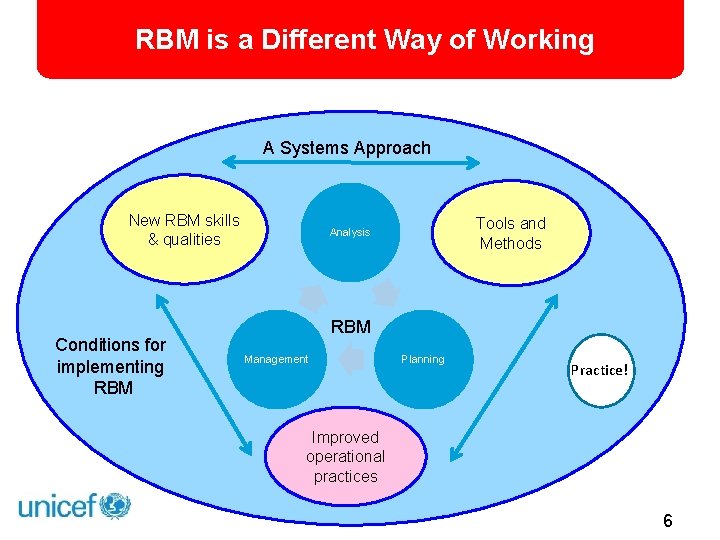
RBM is a Different Way of Working A Systems Approach New RBM skills & qualities Conditions for implementing RBM Tools and Methods Analysis RBM Management Planning Practice! Improved operational practices 6
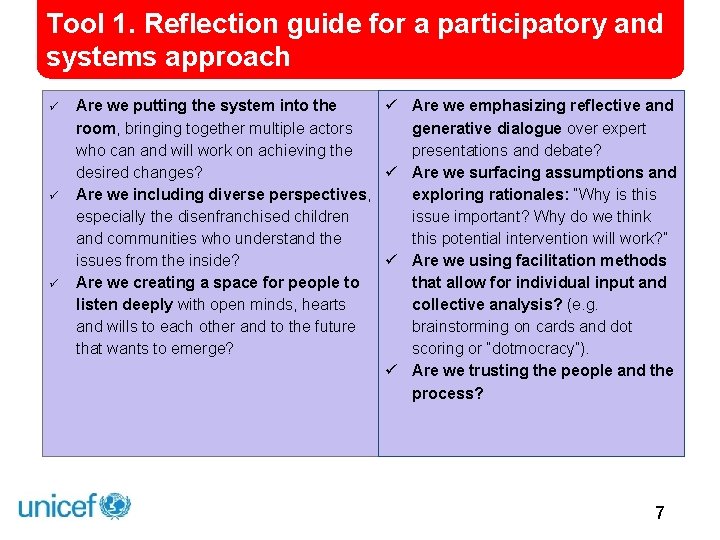
Tool 1. Reflection guide for a participatory and systems approach Are we putting the system into the Are we emphasizing reflective and room, bringing together multiple actors generative dialogue over expert who can and will work on achieving the presentations and debate? desired changes? Are we surfacing assumptions and Are we including diverse perspectives, exploring rationales: “Why is this especially the disenfranchised children issue important? Why do we think and communities who understand the this potential intervention will work? ” issues from the inside? Are we using facilitation methods Are we creating a space for people to that allow for individual input and listen deeply with open minds, hearts collective analysis? (e. g. and wills to each other and to the future brainstorming on cards and dot that wants to emerge? scoring or “dotmocracy”). Are we trusting the people and the process? 7
Step 2. Assess the issue(s) you want to address 8
Tool 2. Situation Analysis: Convention Article Scan / Card Sort Print and laminate a deck of cards, with a summary of one Convention article on each card (see Annex 3). With key stakeholders (6 -8 stakeholders in a group) take 15 -30 minutes to sort through the deck and identify which of the articles most need to be addressed in your country and for which particular groups of children. If a key issue has already been chosen (such as Social Exclusion or Poverty), then identify the articles most relevant to that issue. Refer to the full text of the Convention as needed. Record your findings on the template summary sheet provided in Annex 4, Tool 1. Variation: Scan the most recent Concluding Observations of the UN Committee on the Rights of the Child on your country and identify the most relevant articles and recommendations. Take advantage of the expert situation analysis the Committee has already carried out! End Product: Write a problem statement that identifies the condition(s) for children you want to help change (i. e. the child rights you want to help realize) 9
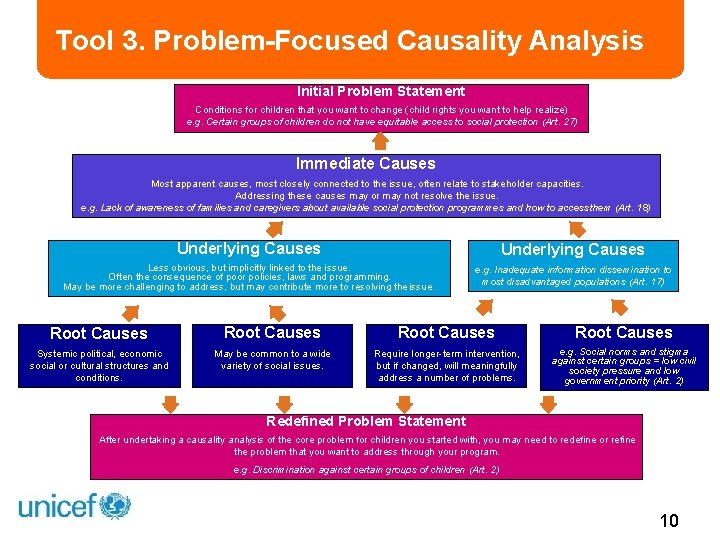
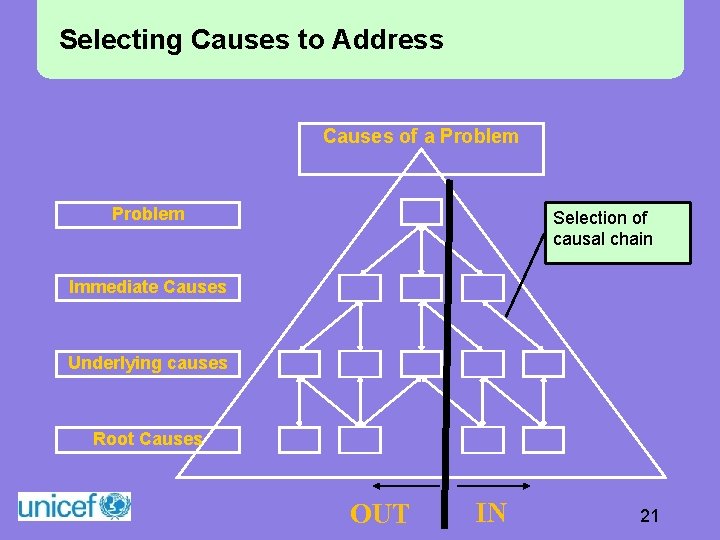
Tool 3. Problem-Focused Causality Analysis Initial Problem Statement Conditions for children that you want to change (child rights you want to help realize) e. g. Certain groups of children do not have equitable access to social protection (Art. 27) Immediate Causes Most apparent causes, most closely connected to the issue, often relate to stakeholder capacities. Addressing these causes may or may not resolve the issue. e. g. Lack of awareness of families and caregivers about available social protection programmes and how to accessthem (Art. 18) Underlying Causes Less obvious, but implicitly linked to the issue. Often the consequence of poor policies, laws and programming. May be more challenging to address, but may contribute more to resolving the issue. e. g. Inadequate information dissemination to most disadvantaged populations (Art. 17) Root Causes Systemic political, economic social or cultural structures and conditions. May be common to a wide variety of social issues. Require longer-term intervention, but if changed, will meaningfully address a number of problems. e. g. Social norms and stigma against certain groups = low civil society pressure and low government priority (Art. 2) Redefined Problem Statement After undertaking a causality analysis of the core problem for children you started with, you may need to redefine or refine the problem that you want to address through your program. e. g. Discrimination against certain groups of children (Art. 2) 10
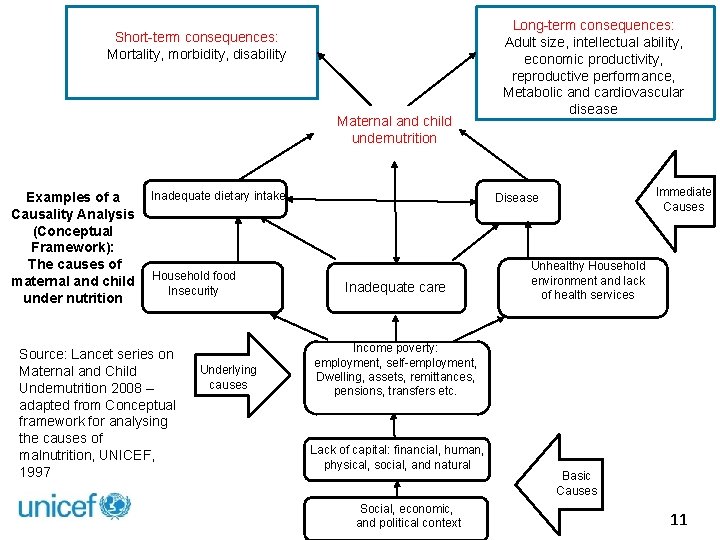
Short-term consequences: Mortality, morbidity, disability Maternal and child undernutrition Inadequate dietary intake Examples of a Causality Analysis (Conceptual Framework): The causes of maternal and child Household food Insecurity under nutrition Source: Lancet series on Maternal and Child Undernutrition 2008 – adapted from Conceptual framework for analysing the causes of malnutrition, UNICEF, 1997 Underlying causes Long-term consequences: Adult size, intellectual ability, economic productivity, reproductive performance, Metabolic and cardiovascular disease Immediate Causes Disease Inadequate care Unhealthy Household environment and lack of health services Income poverty: employment, self-employment, Dwelling, assets, remittances, pensions, transfers etc. Lack of capital: financial, human, physical, social, and natural Social, economic, and political context Basic Causes 11
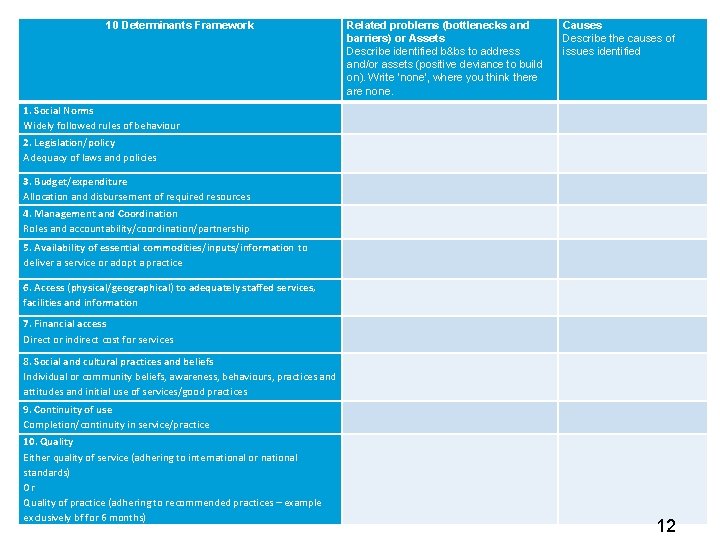
10 Determinants Framework Related problems (bottlenecks and barriers) or Assets Describe identified b&bs to address and/or assets (positive deviance to build on). Write ‘none’, where you think there are none. Causes Describe the causes of issues identified 1. Social Norms Widely followed rules of behaviour 2. Legislation/policy Adequacy of laws and policies 3. Budget/expenditure Allocation and disbursement of required resources 4. Management and Coordination Roles and accountability/coordination/partnership 5. Availability of essential commodities/inputs/information to deliver a service or adopt a practice 6. Access (physical/geographical) to adequately staffed services, facilities and information 7. Financial access Direct or indirect cost for services 8. Social and cultural practices and beliefs Individual or community beliefs, awareness, behaviours, practices and attitudes and initial use of services/good practices 9. Continuity of use Completion/continuity in service/practice 10. Quality Either quality of service (adhering to international or national standards) Or Quality of practice (adhering to recommended practices – example exclusively bf for 6 months) 12 12
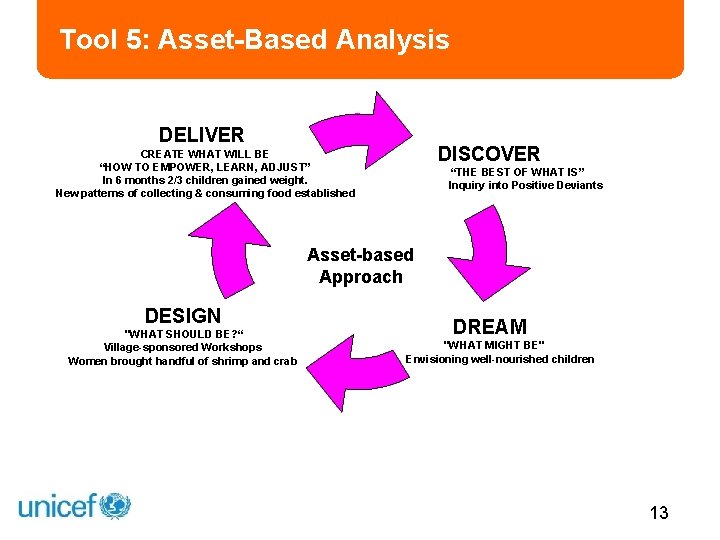
Tool 5: Asset-Based Analysis DELIVER CREATE WHAT WILL BE “HOW TO EMPOWER, LEARN, ADJUST” In 6 months 2/3 children gained weight. New patterns of collecting & consuming food established DISCOVER “THE BEST OF WHAT IS” Inquiry into Positive Deviants Asset-based Approach DESIGN "WHAT SHOULD BE? “ Village-sponsored Workshops Women brought handful of shrimp and crab DREAM "WHAT MIGHT BE" Envisioning well-nourished children 13
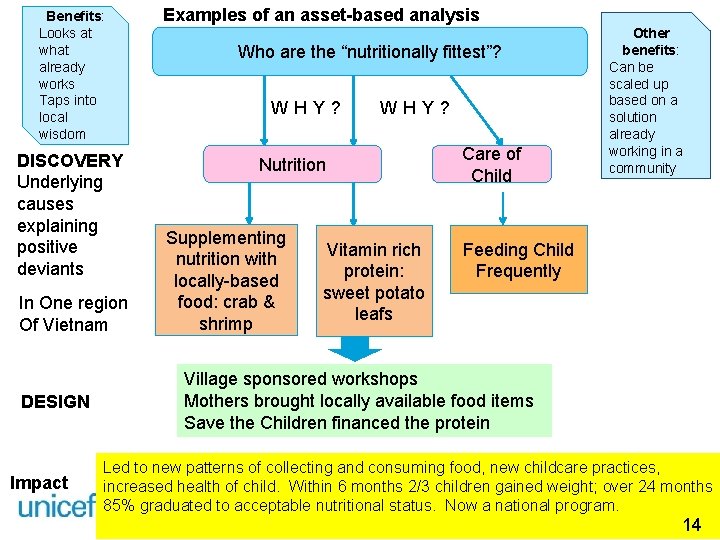
Benefits: Looks at what already works Taps into local wisdom DISCOVERY Underlying causes explaining positive deviants In One region Of Vietnam DESIGN Impact Examples of an asset-based analysis Who are the “nutritionally fittest”? WHY? Nutrition Supplementing nutrition with locally-based food: crab & shrimp Vitamin rich protein: sweet potato leafs Care of Child Other benefits: Can be scaled up based on a solution already working in a community Feeding Child Frequently Village sponsored workshops Mothers brought locally available food items Save the Children financed the protein Led to new patterns of collecting and consuming food, new childcare practices, increased health of child. Within 6 months 2/3 children gained weight; over 24 months 85% graduated to acceptable nutritional status. Now a national program. 14
Step 3. Analyse key stakeholders 15
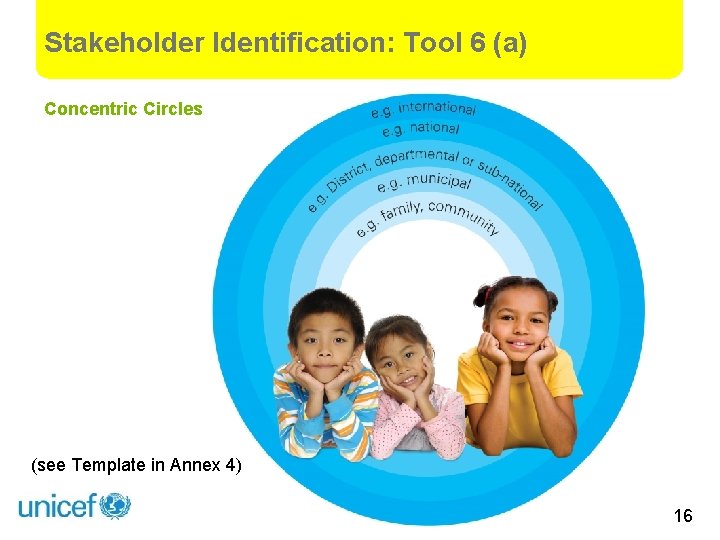
Stakeholder Identification: Tool 6 (a) Concentric Circles (see Template in Annex 4) 16 16
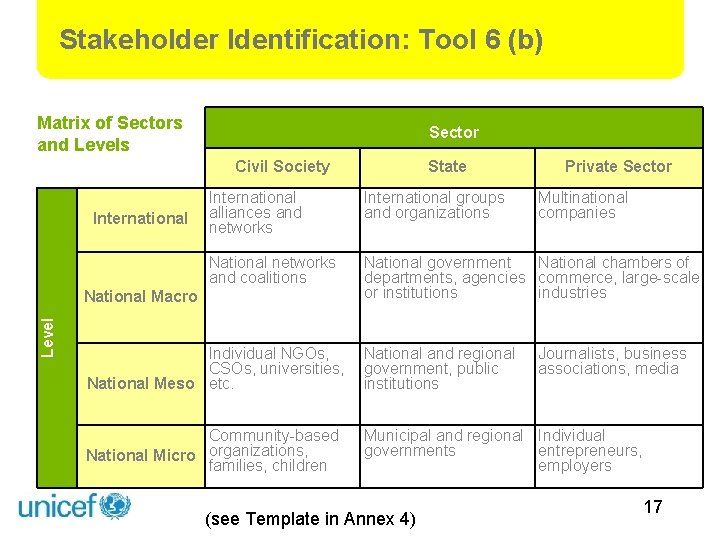
Stakeholder Identification: Tool 6 (b) Matrix of Sectors and Levels Sector Civil Society International alliances and networks National networks and coalitions Level National Macro State International groups and organizations Multinational companies National government National chambers of departments, agencies commerce, large-scale or institutions industries Individual NGOs, National and regional CSOs, universities, government, public National Meso etc. institutions Community-based National Micro organizations, families, children Private Sector Journalists, business associations, media Municipal and regional Individual governments entrepreneurs, employers (see Template in Annex 4) 17
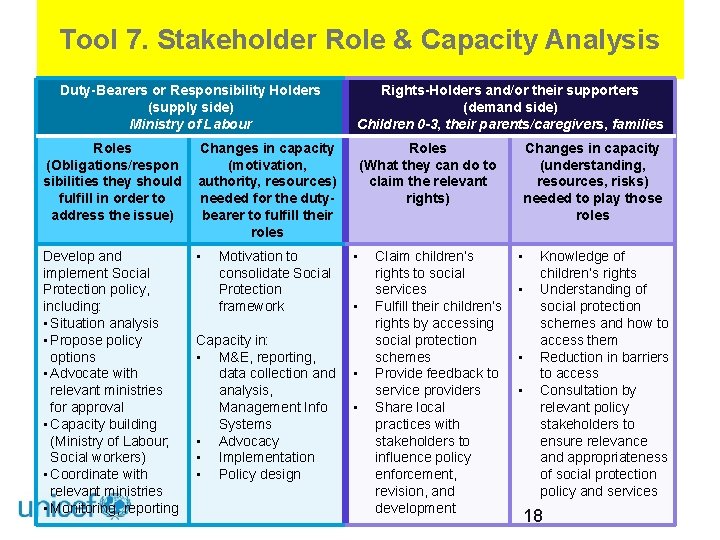
Tool 7. Stakeholder Role & Capacity Analysis Duty-Bearers or Responsibility Holders (supply side) Ministry of Labour Rights-Holders and/or their supporters (demand side) Children 0 -3, their parents/caregivers, families Roles Changes in capacity (Obligations/respon (motivation, sibilities they should authority, resources) fulfill in order to needed for the dutyaddress the issue) bearer to fulfill their roles Develop and implement Social Protection policy, including: • Situation analysis • Propose policy options • Advocate with relevant ministries for approval • Capacity building (Ministry of Labour; Social workers) • Coordinate with relevant ministries • Monitoring, reporting • Motivation to consolidate Social Protection framework Roles (What they can do to claim the relevant rights) • • Capacity in: • M&E, reporting, data collection and • analysis, Management Info • Systems • Advocacy • Implementation • Policy design Claim children’s rights to social services Fulfill their children’s rights by accessing social protection schemes Provide feedback to service providers Share local practices with stakeholders to influence policy enforcement, revision, and development Changes in capacity (understanding, resources, risks) needed to play those roles • • Knowledge of children’s rights Understanding of social protection schemes and how to access them Reduction in barriers to access Consultation by relevant policy stakeholders to ensure relevance and appropriateness of social protection policy and services 18
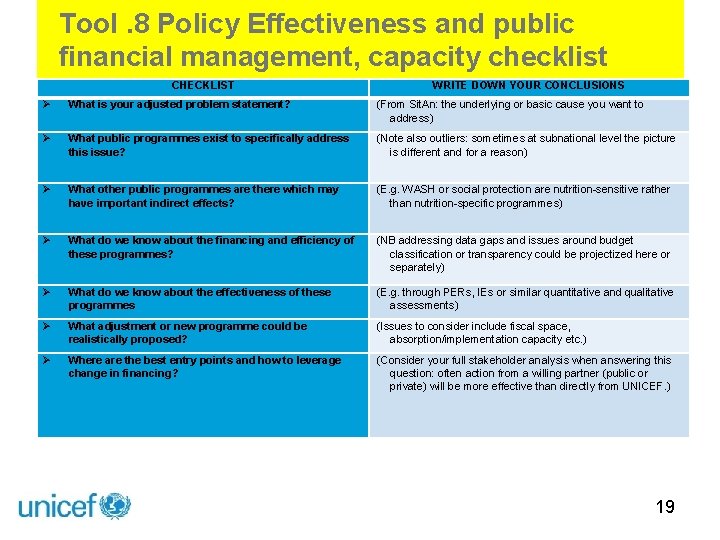
Tool. 8 Policy Effectiveness and public financial management, capacity checklist CHECKLIST WRITE DOWN YOUR CONCLUSIONS What is your adjusted problem statement? (From Sit. An: the underlying or basic cause you want to address) What public programmes exist to specifically address this issue? (Note also outliers: sometimes at subnational level the picture is different and for a reason) What other public programmes are there which may have important indirect effects? (E. g. WASH or social protection are nutrition-sensitive rather than nutrition-specific programmes) What do we know about the financing and efficiency of these programmes? (NB addressing data gaps and issues around budget classification or transparency could be projectized here or separately) What do we know about the effectiveness of these programmes (E. g. through PERs, IEs or similar quantitative and qualitative assessments) What adjustment or new programme could be realistically proposed? (Issues to consider include fiscal space, absorption/implementation capacity etc. ) Where are the best entry points and how to leverage change in financing? (Consider your full stakeholder analysis when answering this question: often action from a willing partner (public or private) will be more effective than directly from UNICEF. ) 19
Step 4. Set your strategic priorities 20
Selecting Causes to Address Causes of a Problem Selection of causal chain Immediate Causes Underlying causes Root Causes OUT IN 21
Tool 9: Assessment of Intervention Areas Major national challenge/ opportunity for children 3 2 1 Agency’s capacity & comparative advantage 4 Alignment and support of state and other key actors 1. 2. 3. 4. “Low hanging fruits”: high impact & actionable now Requires negotiation/consensus building to seek alignment Requires building UNICEF capacity; may duplicate others Easy but won’t contribute significantly to change for children 22
Step 5. Define your expected results 23
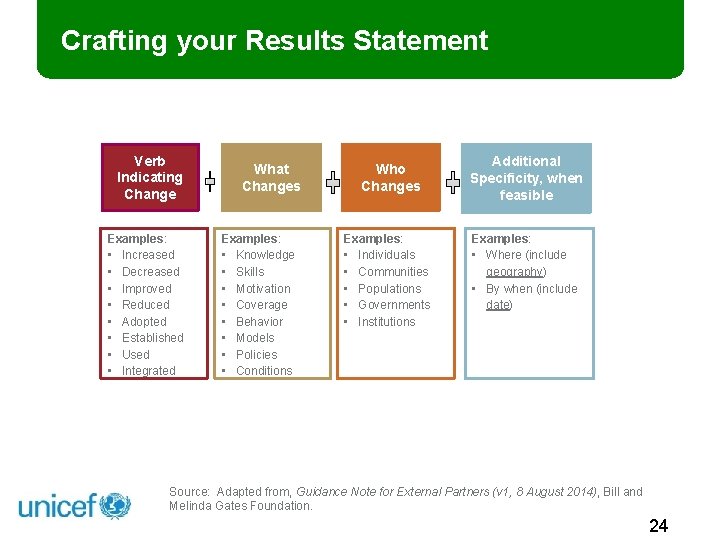
Crafting your Results Statement Verb Indicating Change Examples: • Increased • Decreased • Improved • Reduced • Adopted • Established • Used • Integrated What Changes Examples: • Knowledge • Skills • Motivation • Coverage • Behavior • Models • Policies • Conditions Who Changes Examples: • Individuals • Communities • Populations • Governments • Institutions Additional Specificity, when feasible Examples: • Where (include geography) • By when (include date) Source: Adapted from, Guidance Note for External Partners (v 1, 8 August 2014), Bill and Melinda Gates Foundation. 24
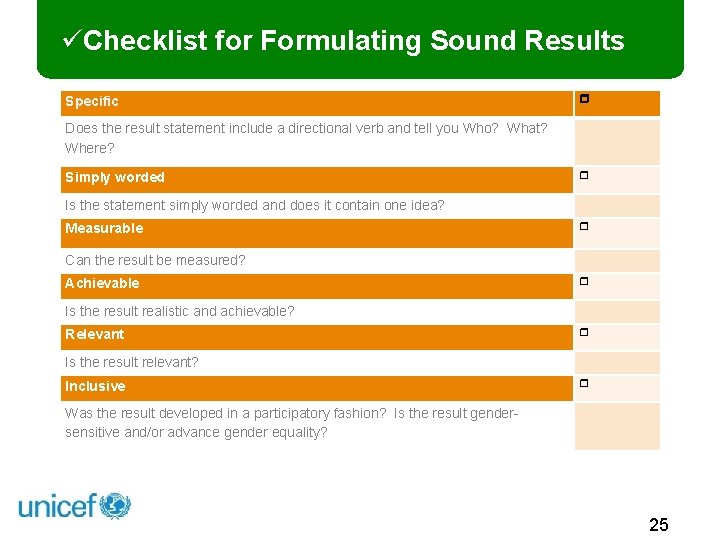
Checklist for Formulating Sound Results Specific Does the result statement include a directional verb and tell you Who? What? Where? Simply worded Is the statement simply worded and does it contain one idea? Measurable Can the result be measured? Achievable Is the result realistic and achievable? Relevant Is the result relevant? Inclusive Was the result developed in a participatory fashion? Is the result gendersensitive and/or advance gender equality? 25
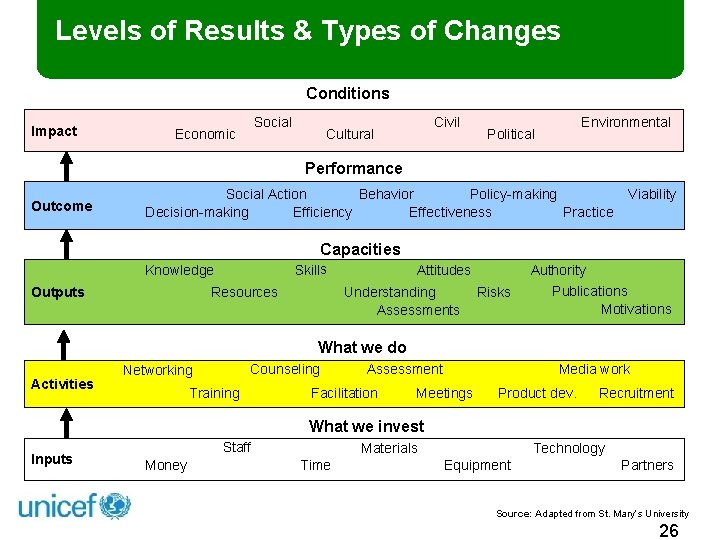
Levels of Results & Types of Changes Conditions Impact Social Economic Civil Cultural Environmental Political Performance Outcome Social Action Behavior Policy-making Efficiency Decision-making Effectiveness Practice Viability Capacities Skills Knowledge Outputs Resources Attitudes Understanding Assessments Authority Risks Publications Motivations What we do Activities Counseling Networking Training Assessment Facilitation Media work Meetings Product dev. Recruitment What we invest Inputs Staff Money Materials Time Technology Equipment Partners Source: Adapted from St. Mary’s University 26
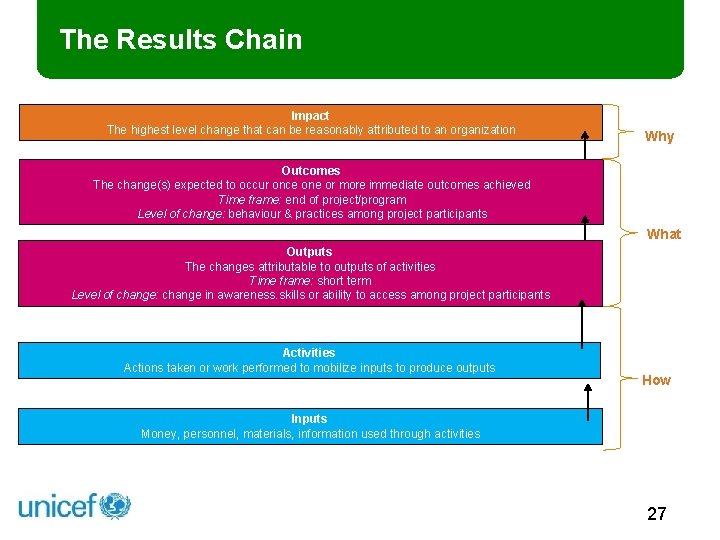
The Results Chain Impact The highest level change that can be reasonably attributed to an organization Why Outcomes The change(s) expected to occur once one or more immediate outcomes achieved Time frame: end of project/program Level of change: behaviour & practices among project participants What Outputs The changes attributable to outputs of activities Time frame: short term Level of change: change in awareness. skills or ability to access among project participants Activities Actions taken or work performed to mobilize inputs to produce outputs How Inputs Money, personnel, materials, information used through activities 27
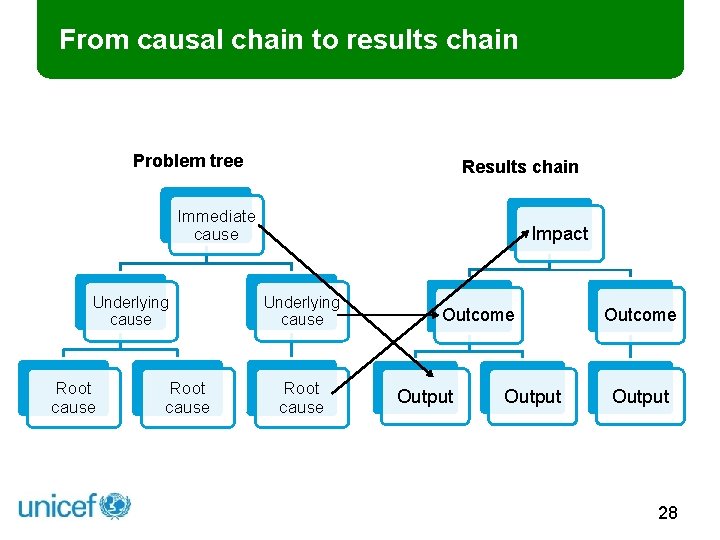
From causal chain to results chain Problem tree Results chain Immediate cause Underlying cause Root cause Impact Underlying cause Root cause Outcome Output 28
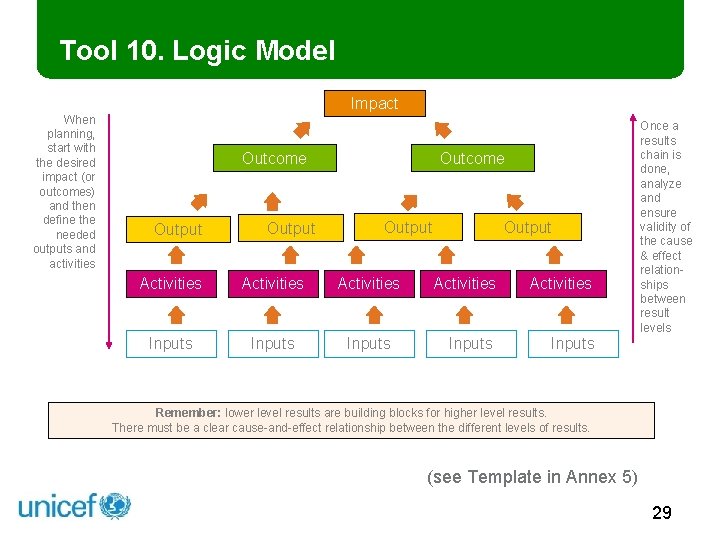
Tool 10. Logic Model Impact When planning, start with the desired impact (or outcomes) and then define the needed outputs and activities Outcome Output Activities Inputs Output Activities Inputs Once a results chain is done, analyze and ensure validity of the cause & effect relationships between result levels Remember: lower level results are building blocks for higher level results. There must be a clear cause-and-effect relationship between the different levels of results. (see Template in Annex 5) 29
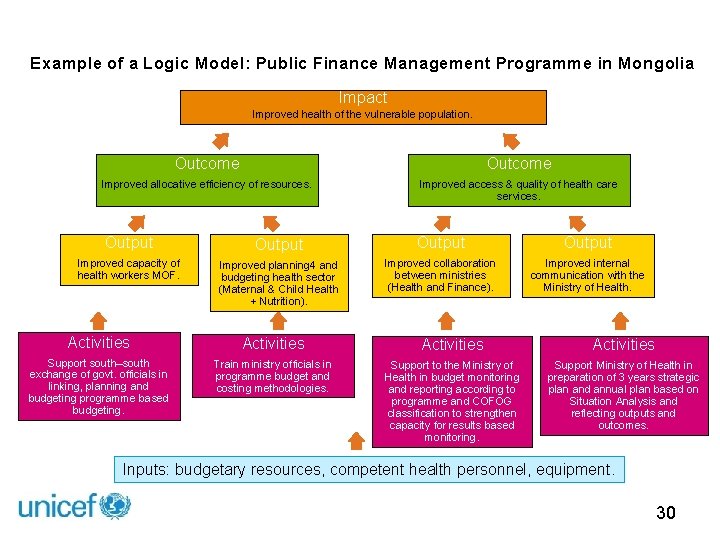
Example of a Logic Model: Public Finance Management Programme in Mongolia Impact Improved health of the vulnerable population. Outcome Improved allocative efficiency of resources. Improved access & quality of health care services. Output Improved capacity of health workers MOF. Improved planning 4 and budgeting health sector (Maternal & Child Health + Nutrition). Improved collaboration between ministries (Health and Finance). Improved internal communication with the Ministry of Health. Activities Support south–south exchange of govt. officials in linking, planning and budgeting programme based budgeting. Train ministry officials in programme budget and costing methodologies. Support to the Ministry of Health in budget monitoring and reporting according to programme and COFOG classification to strengthen capacity for results based monitoring. Support Ministry of Health in preparation of 3 years strategic plan and annual plan based on Situation Analysis and reflecting outputs and outcomes. Inputs: budgetary resources, competent health personnel, equipment. 30
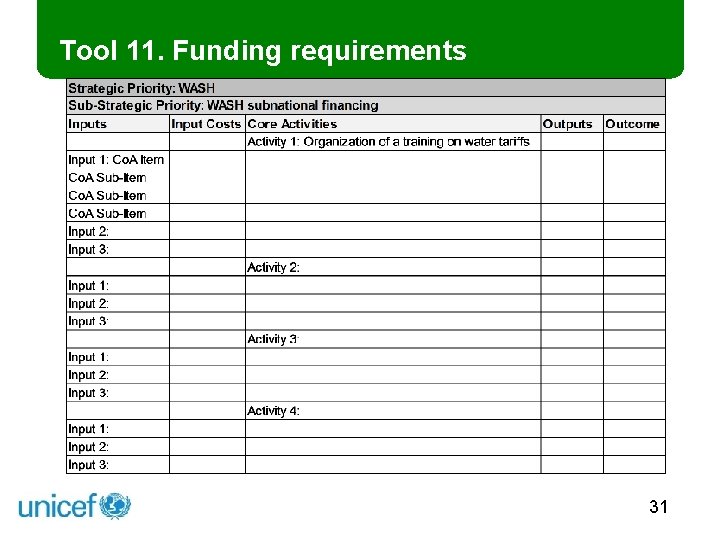
Tool 11. Funding requirements 31
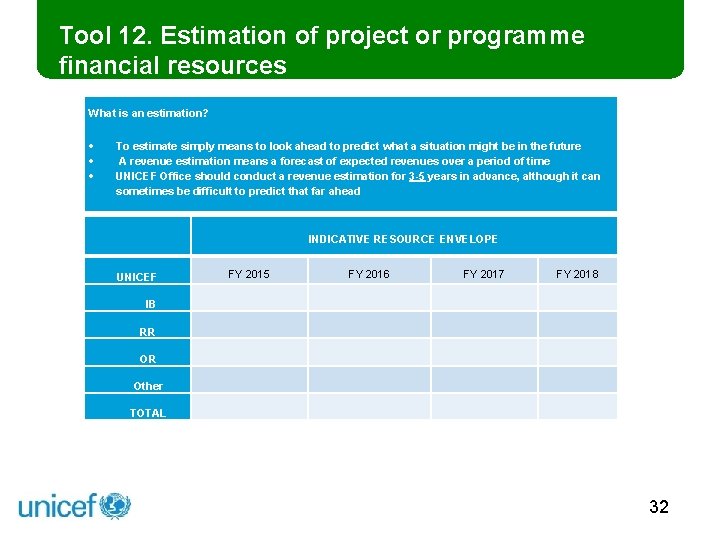
Tool 12. Estimation of project or programme financial resources What is an estimation? To estimate simply means to look ahead to predict what a situation might be in the future A revenue estimation means a forecast of expected revenues over a period of time UNICEF Office should conduct a revenue estimation for 3 -5 years in advance, although it can sometimes be difficult to predict that far ahead INDICATIVE RESOURCE ENVELOPE FY 2015 UNICEF IB FY 2016 FY 2017 FY 2018 RR Other TOTAL 32
Step 6. Plan how you will monitor those results 33
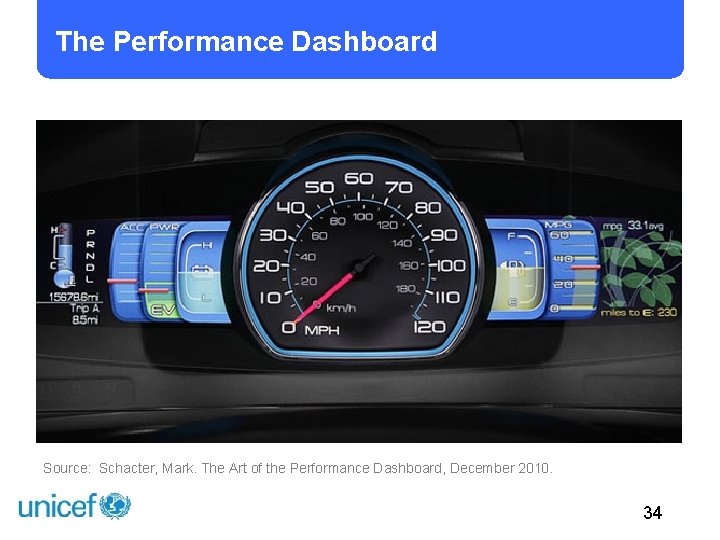
The Performance Dashboard Source: Schacter, Mark. The Art of the Performance Dashboard, December 2010. 34
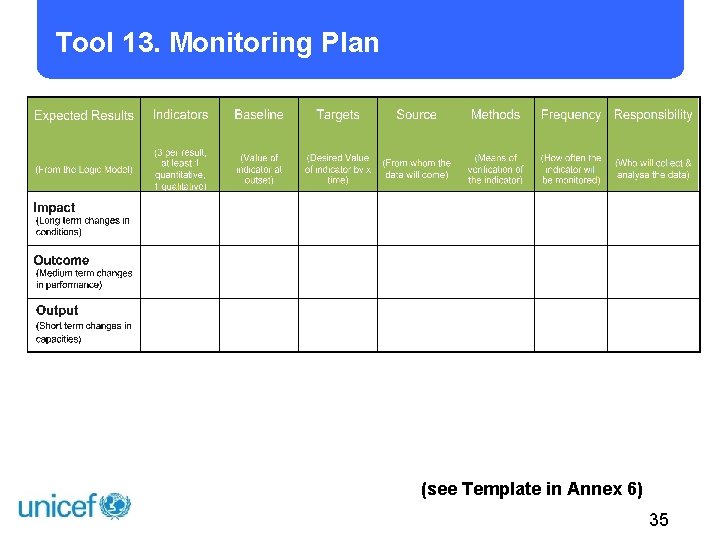
Tool 13. Monitoring Plan (see Template in Annex 6) 35
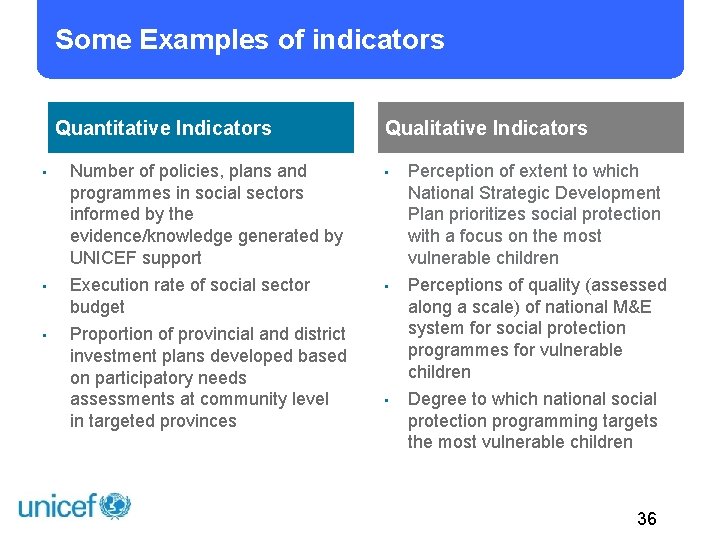
Some Examples of indicators Quantitative Indicators • • • Number of policies, plans and programmes in social sectors informed by the evidence/knowledge generated by UNICEF support Execution rate of social sector budget Proportion of provincial and district investment plans developed based on participatory needs assessments at community level in targeted provinces Qualitative Indicators • • • Perception of extent to which National Strategic Development Plan prioritizes social protection with a focus on the most vulnerable children Perceptions of quality (assessed along a scale) of national M&E system for social protection programmes for vulnerable children Degree to which national social protection programming targets the most vulnerable children 36
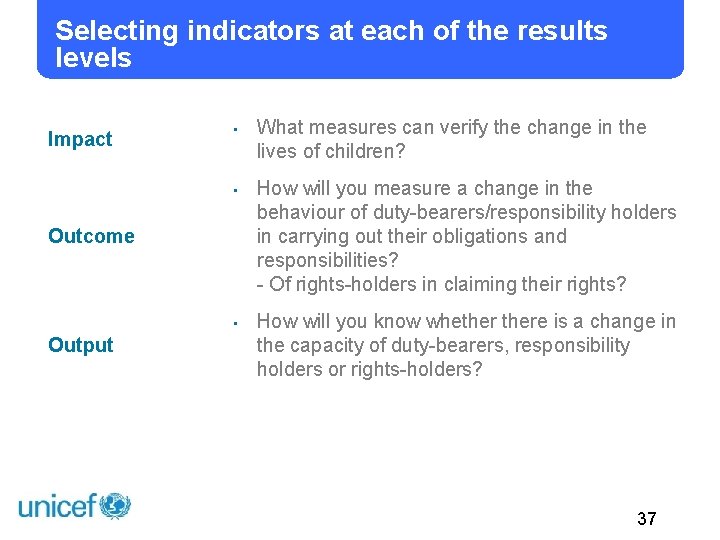
Selecting indicators at each of the results levels Impact • • Outcome • Output What measures can verify the change in the lives of children? How will you measure a change in the behaviour of duty-bearers/responsibility holders in carrying out their obligations and responsibilities? - Of rights-holders in claiming their rights? How will you know whethere is a change in the capacity of duty-bearers, responsibility holders or rights-holders? 37
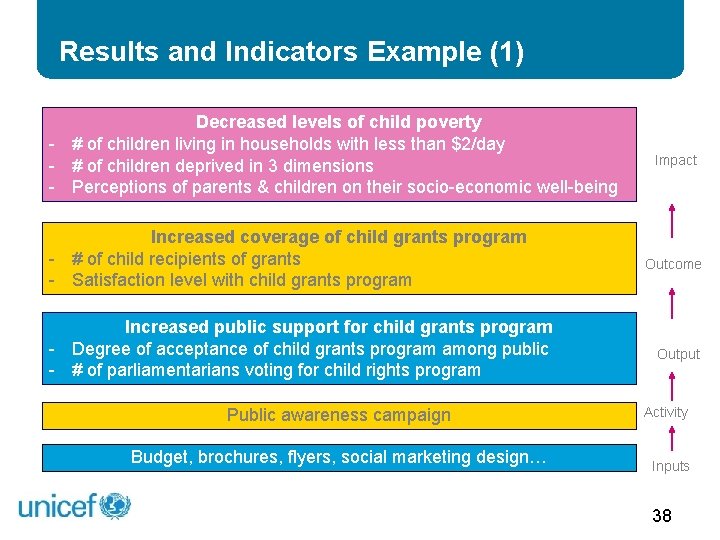
Results and Indicators Example (1) Decreased levels of child poverty - # of children living in households with less than $2/day - # of children deprived in 3 dimensions - Perceptions of parents & children on their socio-economic well-being Increased coverage of child grants program - # of child recipients of grants - Satisfaction level with child grants program Increased public support for child grants program - Degree of acceptance of child grants program among public - # of parliamentarians voting for child rights program Public awareness campaign Budget, brochures, flyers, social marketing design… Impact Outcome Output Activity Inputs 38
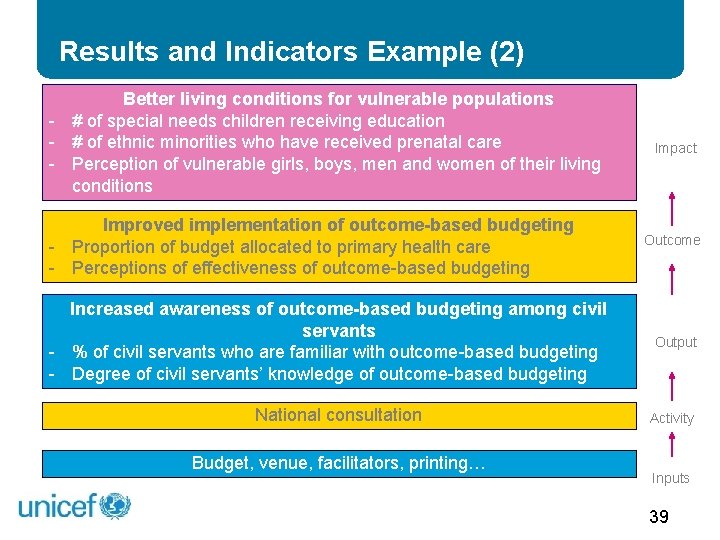
Results and Indicators Example (2) Better living conditions for vulnerable populations - # of special needs children receiving education - # of ethnic minorities who have received prenatal care - Perception of vulnerable girls, boys, men and women of their living conditions Improved implementation of outcome-based budgeting - Proportion of budget allocated to primary health care - Perceptions of effectiveness of outcome-based budgeting Increased awareness of outcome-based budgeting among civil servants - % of civil servants who are familiar with outcome-based budgeting - Degree of civil servants’ knowledge of outcome-based budgeting National consultation Budget, venue, facilitators, printing… Impact Outcome Output Activity Inputs 39
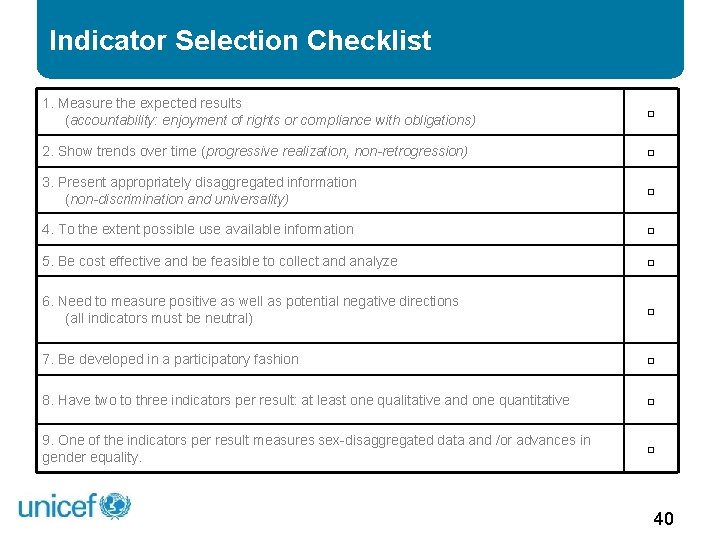
Indicator Selection Checklist 1. Measure the expected results (accountability: enjoyment of rights or compliance with obligations) □ 2. Show trends over time (progressive realization, non-retrogression) □ 3. Present appropriately disaggregated information (non-discrimination and universality) □ 4. To the extent possible use available information □ 5. Be cost effective and be feasible to collect and analyze □ 6. Need to measure positive as well as potential negative directions (all indicators must be neutral) □ 7. Be developed in a participatory fashion □ 8. Have two to three indicators per result: at least one qualitative and one quantitative □ 9. One of the indicators per result measures sex-disaggregated data and /or advances in gender equality. □ 40
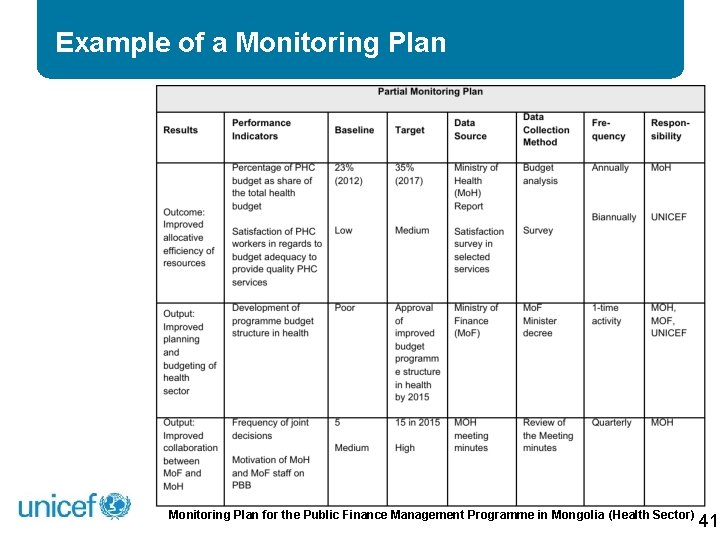
Example of a Monitoring Plan for the Public Finance Management Programme in Mongolia (Health Sector) 41
Step 7. Assess the risks to achieving your results 42
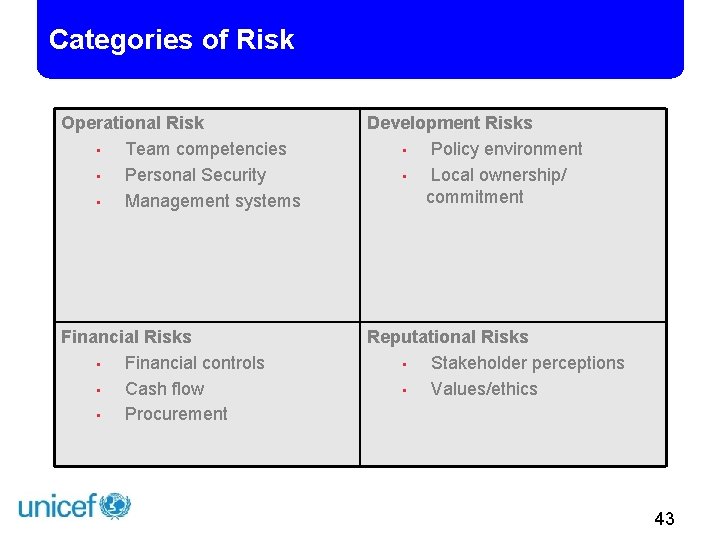
Categories of Risk Operational Risk • Team competencies • Personal Security • Management systems Development Risks • Policy environment • Local ownership/ commitment Financial Risks • Financial controls • Cash flow • Procurement Reputational Risks • Stakeholder perceptions • Values/ethics 43
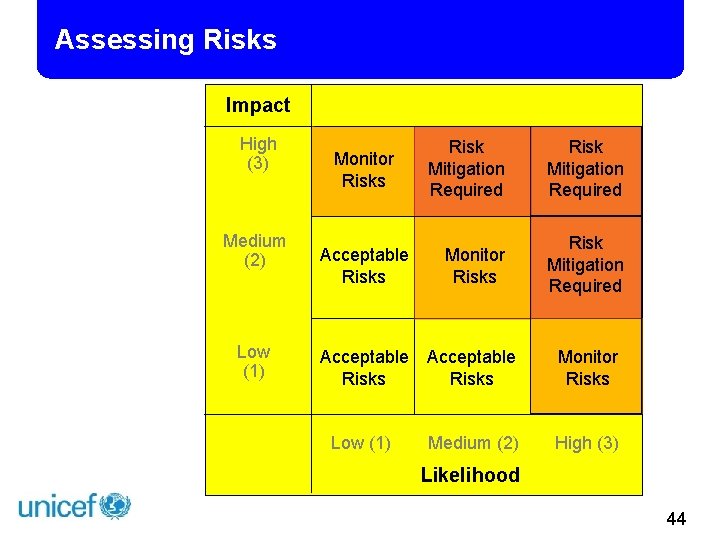
Assessing Risks Impact High (3) Medium (2) Low (1) Monitor Risks Acceptable Risks Risk Mitigation Required Monitor Risks Risk Mitigation Required Acceptable Risks Low (1) Medium (2) Monitor Risks High (3) Likelihood 44
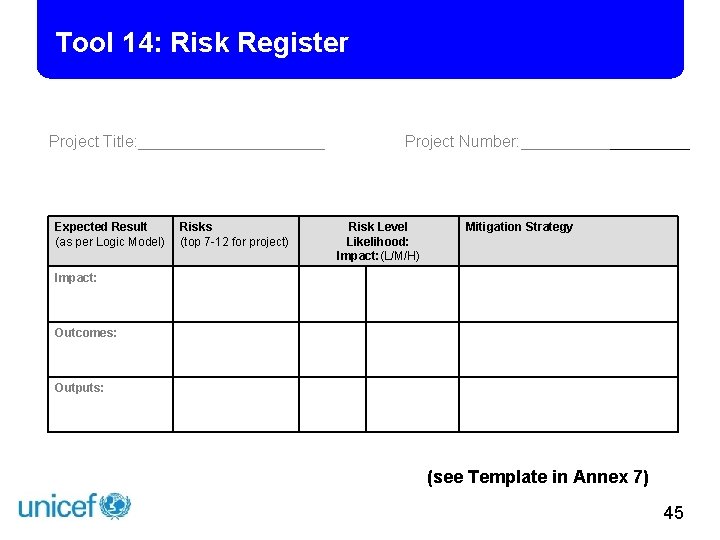
Tool 14: Risk Register Project Title: ___________ Project Number: __________ Expected Result (as per Logic Model) Risks (top 7 -12 for project) Risk Level Mitigation Strategy Likelihood: Impact: (L/M/H) Impact: Outcomes: Outputs: (see Template in Annex 7) 45
Step 8. Write up your theory of change 46
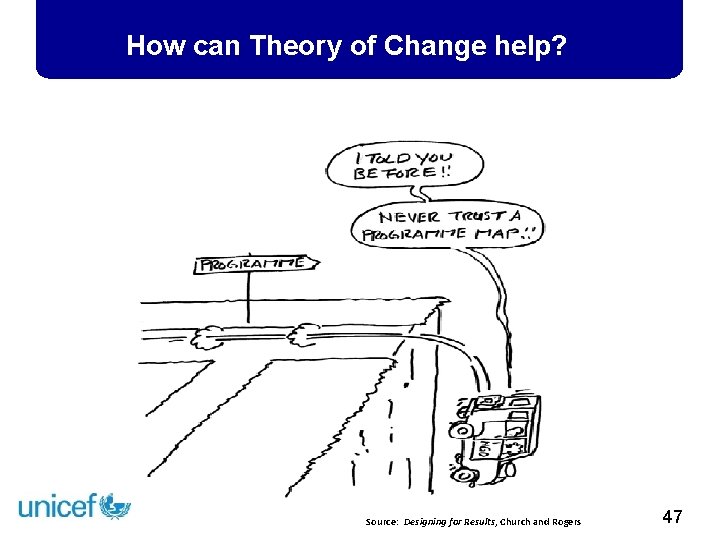
How can Theory of Change help? Source: Designing for Results, Church and Rogers 47
Tool 15: Theory of Change Narrative 1. Referring to your logic model, identify your desired impact. 2. Map backwards how your outputs and outcomes are contributing to the next level of results. Make explicit your theories about how change one level will lead to change at the next (e. g. training will lead to increased skills in policy-making which in turn will lead to improved policies and programmes, which will improve children’s lives). 3. Identify your assumptions. What else are you assuming is in place so that you can achieve your desired results? Refer back to your causality analysis to help you identify your assumptions (See step 4, Figure 5. ). There are causes you are not addressing, and you may be assuming that someone else is addressing them, or that they do not need to be addressed for you to effect meaningful change through your programme. 4. Identify the key interventions that your initiative will undertake and the pathways of change they will enable. 5. Highlight the indicators you will use to assess the performance of your initiative. 6. Write a narrative as above to explain your theory of change. 48
Example of a To. C Narrative (1) In 2015, UNICEF and Government of Mongolia will work together to improve health sector financing methodologies in order to achieve better outcome for the most vulnerable children. This result will be reached by improving programme-based budgeting which will lead to increased budget for primary health care and maternal and child health care programmes. An increased budget for primary health care will improve access and coverage of high impact and low cost MCH interventions. By choosing four main pathways of improving planning and budgeting of health sector, strengthening capacity of health workers, enhancing collaboration between Ministry of Health and Ministry of Finance and promoting the internal coordination within the Ministry of Health, we aim to achieve the most efficient use of allocated resources. We assume that the legal environment for programme-based budgeting is in place and the political commitment is maintained for more efficient health budget allocations in favour of primary health care. Taking into consideration UNICEF’s comparative advantage in promoting child rights and equity focus, we will bring technical expertise in programme-based budgeting, support south-south exchange and equip relevant government officials with necessary PBB tools. Our result will be demonstrated by at least one-third of the total health budget to be allocated to the primary health care followed by satisfaction of health workers in budget adequacy. Source: RBM & To. C workshop in Mongolia, April 14 -17, 2015 49
Example of a To. C Narrative (2) As part of the 2017 -2021 UNICEF Country Programme, UNICEF’s Social Policy and Governance Programme has been supporting the Government of Viet Nam to develop a child-sensitive Social Economic Development Plan (SEDP) at the national and sub-national levels. The key identified impact is reduced multi-dimensional child poverty by 2020 which can be achieved through 2 major outcomes: i) improved prioritization of children’s issues in the SEDP and ii) effectively and efficiently allocated and utilized public financial resources. The key outputs contributing to the above mentioned outcomes include generation of analysis and evidence on children’s priorities; increased public awareness and dialogues on child-sensitive SEDP and public finance for children; increased institutional commitment and motivation of policy makers and National Assembly members on children’s issues. This To. C is based on the assumption that policy makers remain committed to the realization of child rights and priorities. Another assumption is that the Government continues to improve their transparency and accountabilities in public finance management. Taking into consideration good practices at the sub-national level, UNICEF will conduct analysis and provide evidence on the situation of children rights as well as on budget allocation and utilization. In addition, UNICEF will support the development of child-sensitive SEDP guidelines and facilitate dialogues and consultation with various stakeholders for the adoption and application of this guideline. UNICEF’s support will also focus on strengthening the capacity of various stakeholders in child-sensitive SEDP at national and sub-national levels to ensure their ownership. Source: RBM & To. C workshop in Viet Nam, April 21 -24, 2015 50
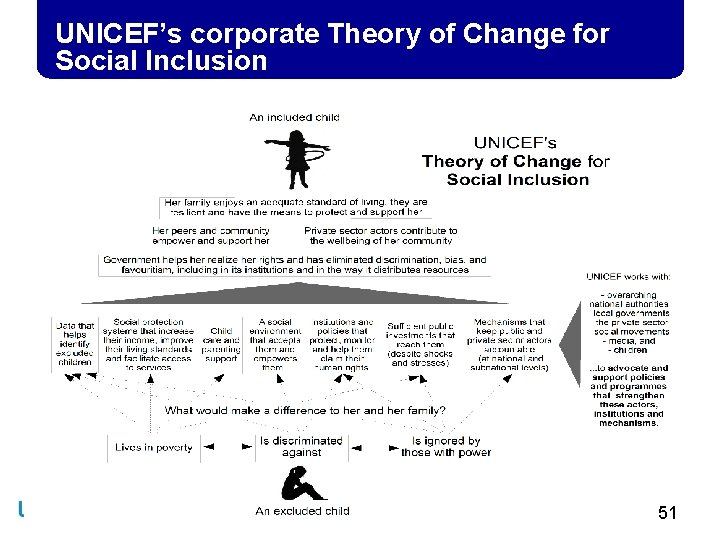
UNICEF’s corporate Theory of Change for Social Inclusion 51
Step 9. Implement, monitor, evaluate and adjust your programme 52
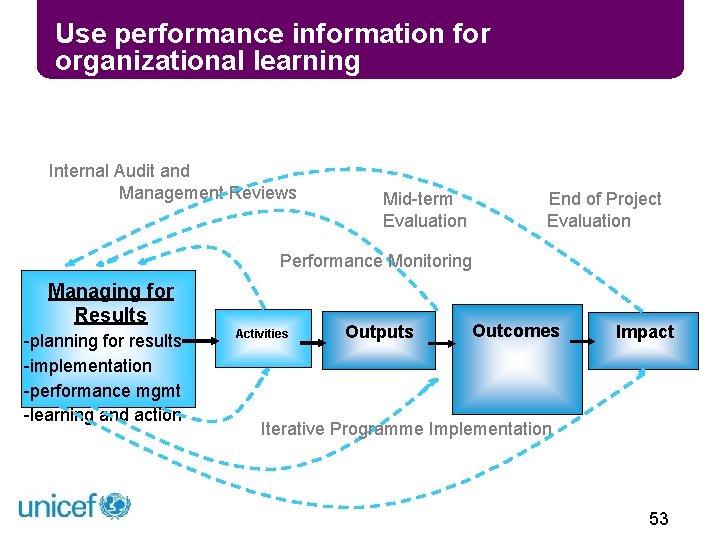
Use performance information for organizational learning Internal Audit and Management Reviews Mid-term End of Project Evaluation Evaluation Performance Monitoring Managing for Results -planning for results -implementation -performance mgmt -learning and action Activities Outputs Outcomes Impact Iterative Programme Implementation 53
Step 10. Report on your results and learning 54
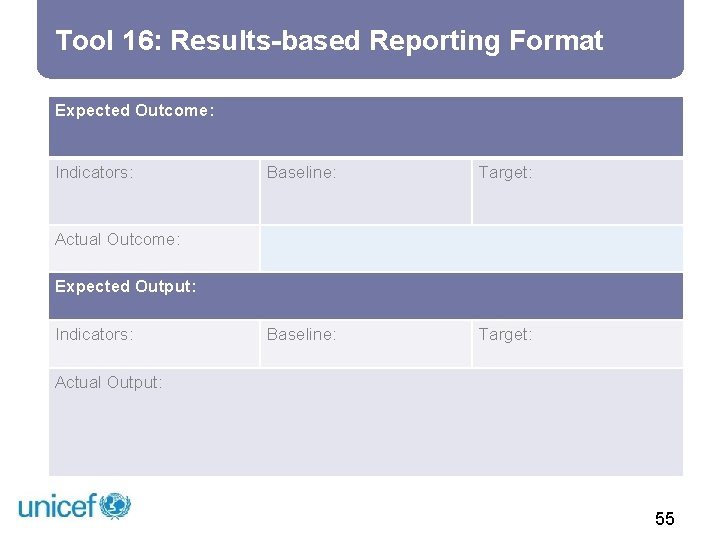
Tool 16: Results-based Reporting Format Expected Outcome: Indicators: Baseline: Target: Actual Outcome: Expected Output: Indicators: Actual Output: 55
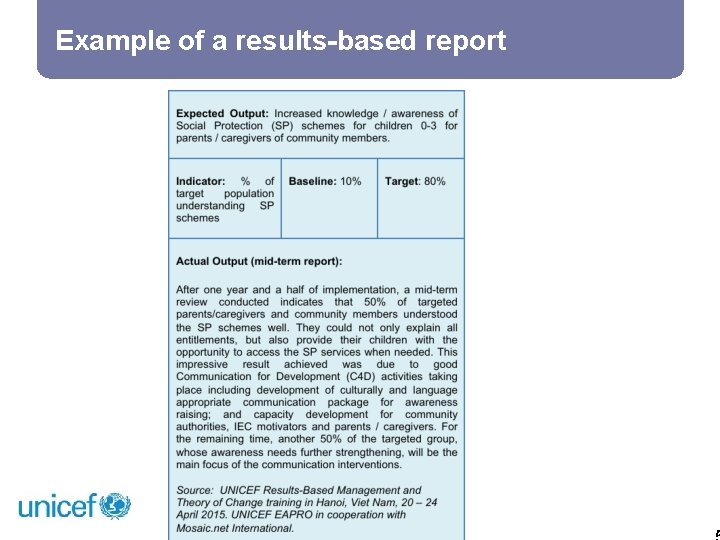
Example of a results-based report
- Slides: 56