
Rayat Shikshan Sansthas Y C Institute of Science

- Slides: 34
Rayat Shikshan Sanstha’s Y. C. Institute of Science, Satara. Biology Department Presents PPT of PHOTOSYNTHESIS By-Mrs. Jadhav M. R.
Content at a glance � 6. 1 � 6. 2 � 6. 3 � 6. 4 � 6. 5 � 6. 6 Site of photosynthesis Photosynthetic pigments & their role. Light dependent reactions Light independent reactions. Significance of photosynthesis. Factors affecting photosynthesis.
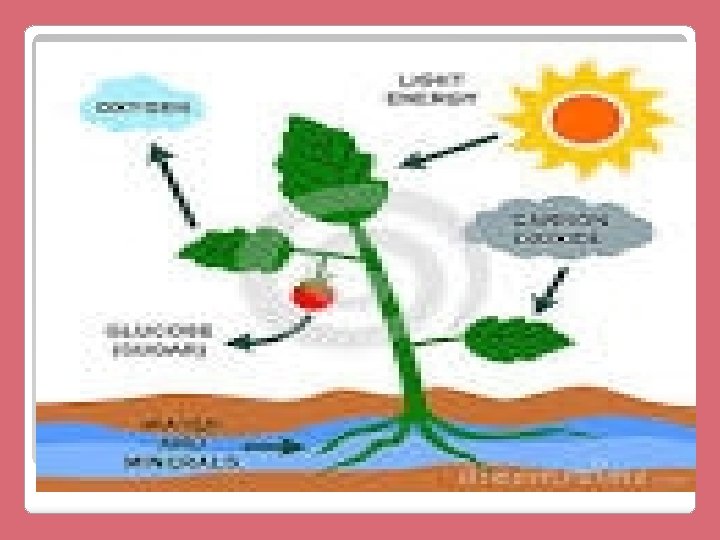
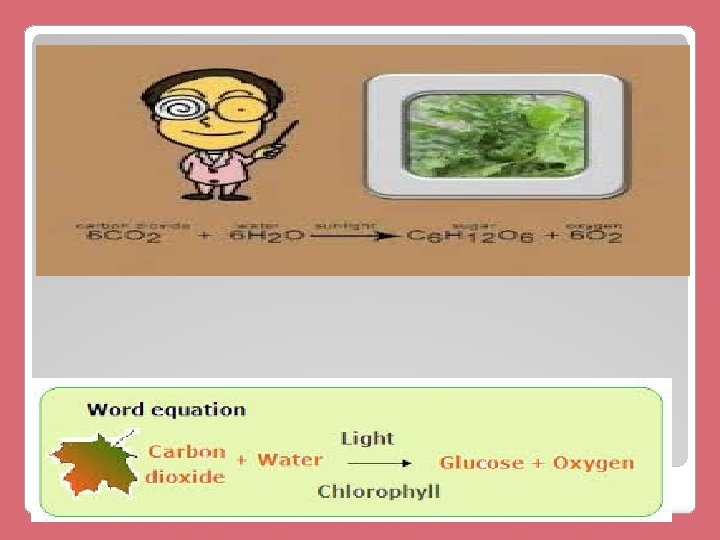
6. 1)Definition �Photosynthesis is an intracellular , anabolic, energy trapping process in which glucose is synthesized from simple inorganic substances like Co 2 &H 2 o in presence of sunlight &with the help of chlorophyll.
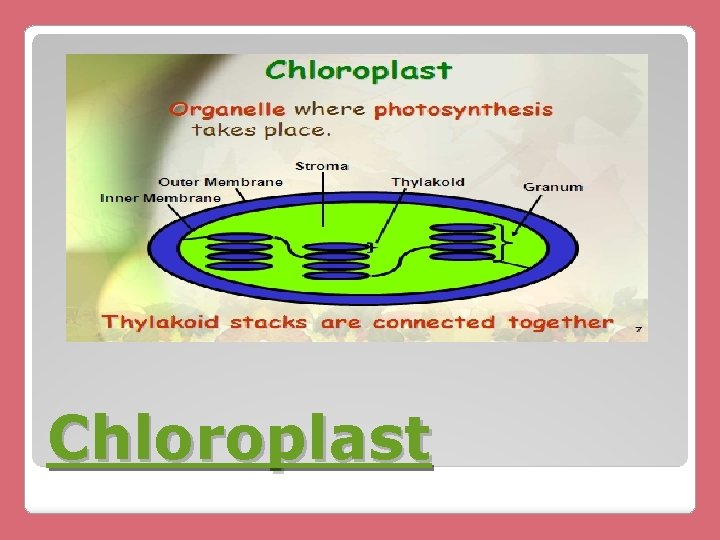
Chloroplast
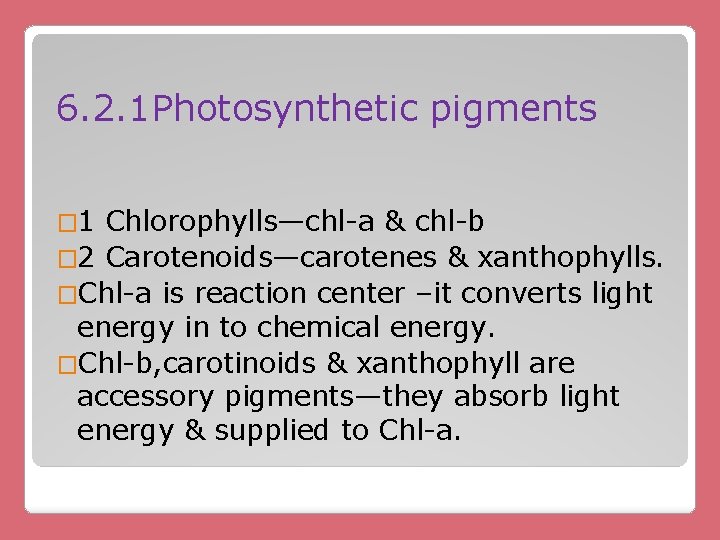
6. 2. 1 Photosynthetic pigments � 1 Chlorophylls—chl-a & chl-b � 2 Carotenoids—carotenes & xanthophylls. �Chl-a is reaction center –it converts light energy in to chemical energy. �Chl-b, carotinoids & xanthophyll are accessory pigments—they absorb light energy & supplied to Chl-a.
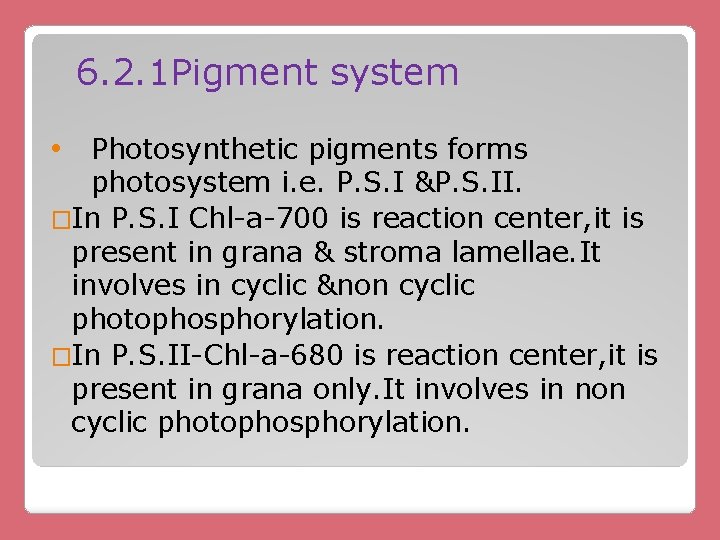
6. 2. 1 Pigment system • Photosynthetic pigments forms photosystem i. e. P. S. I &P. S. II. �In P. S. I Chl-a-700 is reaction center, it is present in grana & stroma lamellae. It involves in cyclic &non cyclic photophosphorylation. �In P. S. II-Chl-a-680 is reaction center, it is present in grana only. It involves in non cyclic photophosphorylation.
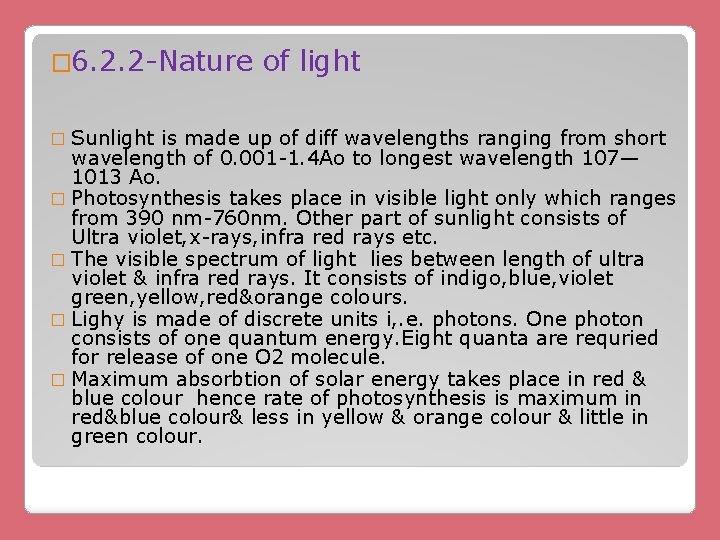
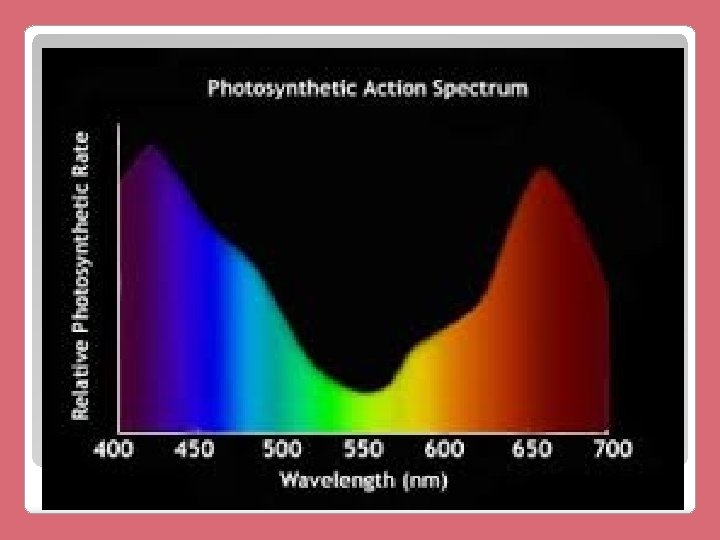
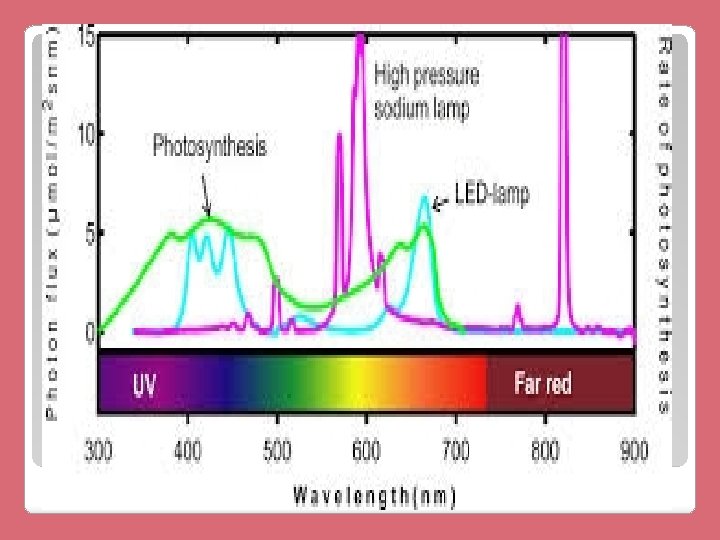
� 6. 2. 2 -Nature � Sunlight of light is made up of diff wavelengths ranging from short wavelength of 0. 001 -1. 4 Ao to longest wavelength 107— 1013 Ao. � Photosynthesis takes place in visible light only which ranges from 390 nm-760 nm. Other part of sunlight consists of Ultra violet, x-rays, infra red rays etc. � The visible spectrum of light lies between length of ultra violet & infra red rays. It consists of indigo, blue, violet green, yellow, red&orange colours. � Lighy is made of discrete units i, . e. photons. One photon consists of one quantum energy. Eight quanta are requried for release of one O 2 molecule. � Maximum absorbtion of solar energy takes place in red & blue colour hence rate of photosynthesis is maximum in red&blue colour& less in yellow & orange colour & little in green colour.
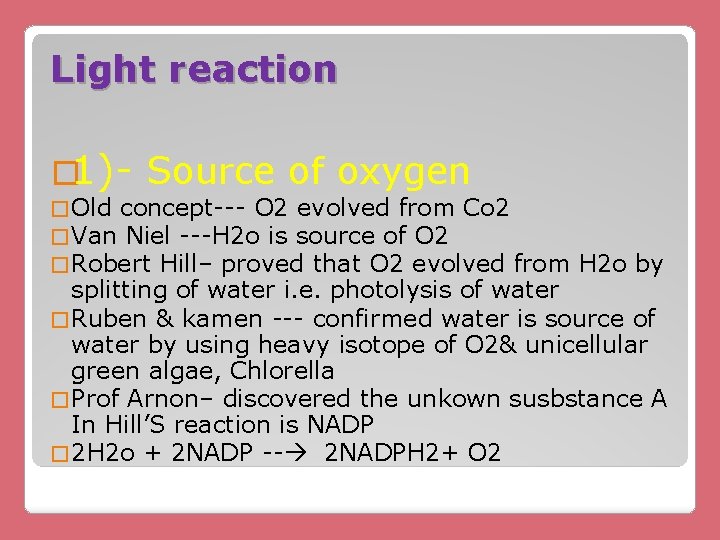
Light reaction � 1)- Source of oxygen � Old concept--- O 2 evolved from Co 2 � Van Niel ---H 2 o is source of O 2 � Robert Hill– proved that O 2 evolved from H 2 o by splitting of water i. e. photolysis of water � Ruben & kamen --- confirmed water is source of water by using heavy isotope of O 2& unicellular green algae, Chlorella � Prof Arnon– discovered the unkown susbstance A In Hill’S reaction is NADP � 2 H 2 o + 2 NADP -- 2 NADPH 2+ O 2
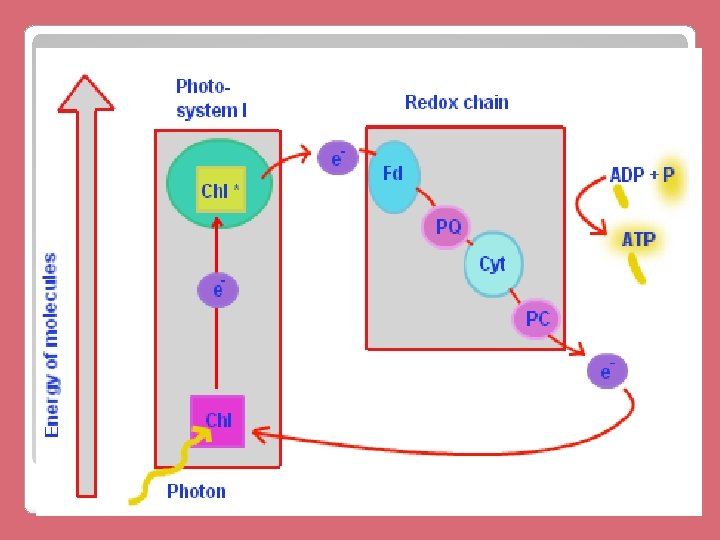
Photophosphrylation Synthesis of ATP from ADP &H 3 PO 4 in presence of sunlight. 1)Cyclic photophosphorylation. 2) Non cyclic photophosphorylation.
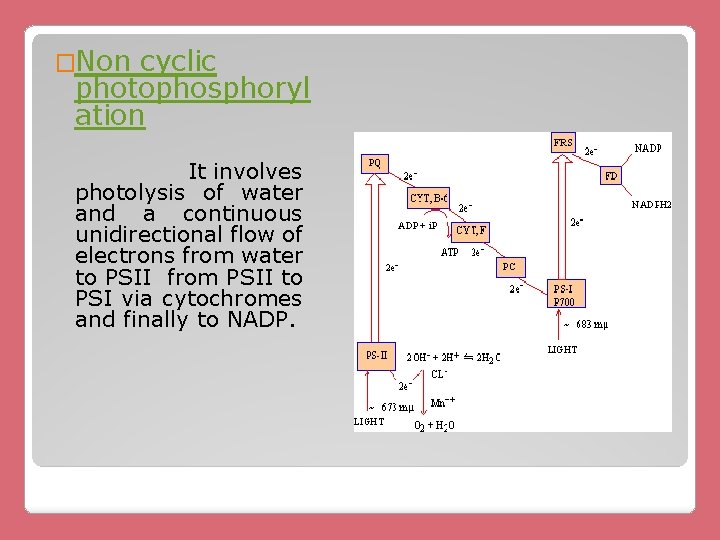
�Non cyclic photophosphoryl ation It involves photolysis of water and a continuous unidirectional flow of electrons from water to PSII from PSII to PSI via cytochromes and finally to NADP.
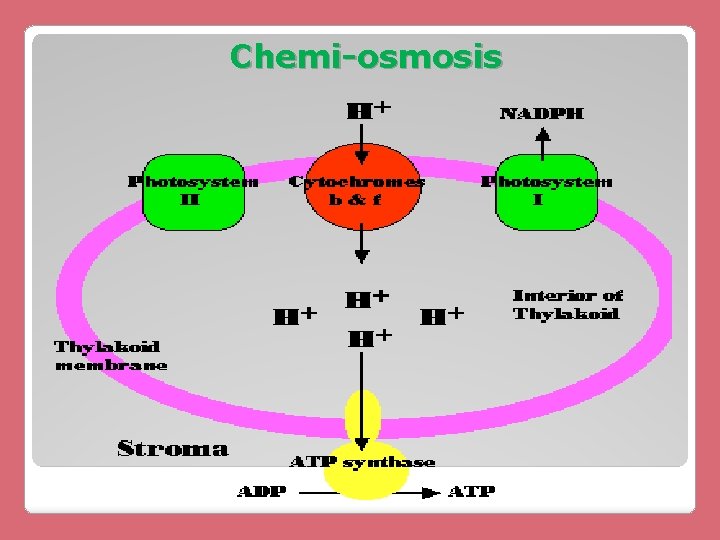
� 6. 3. 2 �Dr. Chemiosmotic hypothesis Peter Mitchell-1961 , explained ATP synthesis by chemiosmotic theory. He was awarded Nobel prize in 1978 for this in chemistry. He proposed that ATP synthesis occurs due to flow of H+ ions through a membrane during cellular respiration in mitochondria & during photosynthesis in chloroplast.
Chemi-osmosis
� 6. 4 �It Light independent reaction (Dark reaction) is biochemical phase in which Co 2 is fixed or reduced to glucose. �It takes place in stroma of chloroplast. �It is independent of light, hence called dark reaction. �The assimilatory power i. e. ATP & NADPH 2 are used here.
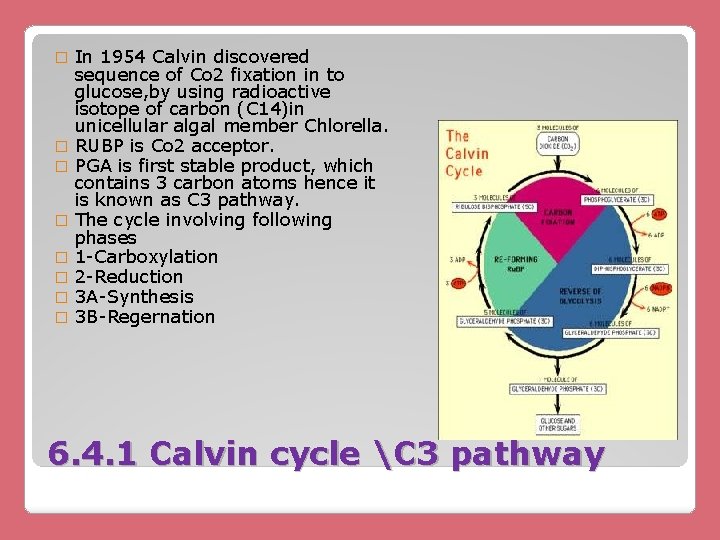
� � � � In 1954 Calvin discovered sequence of Co 2 fixation in to glucose, by using radioactive isotope of carbon (C 14)in unicellular algal member Chlorella. RUBP is Co 2 acceptor. PGA is first stable product, which contains 3 carbon atoms hence it is known as C 3 pathway. The cycle involving following phases 1 -Carboxylation 2 -Reduction 3 A-Synthesis 3 B-Regernation 6. 4. 1 Calvin cycle C 3 pathway
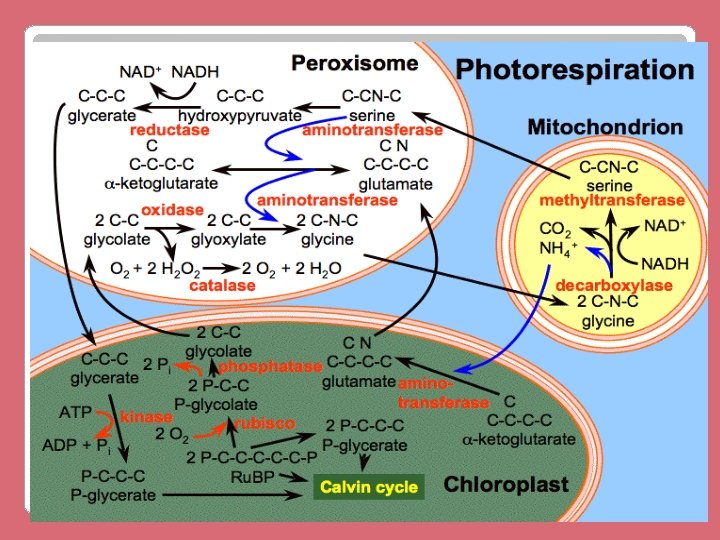
� 6. 4. 3 photorespiration DEFINITION—the process of respiration that is initiated in the chloroplast and takes place during day.
What happens there?
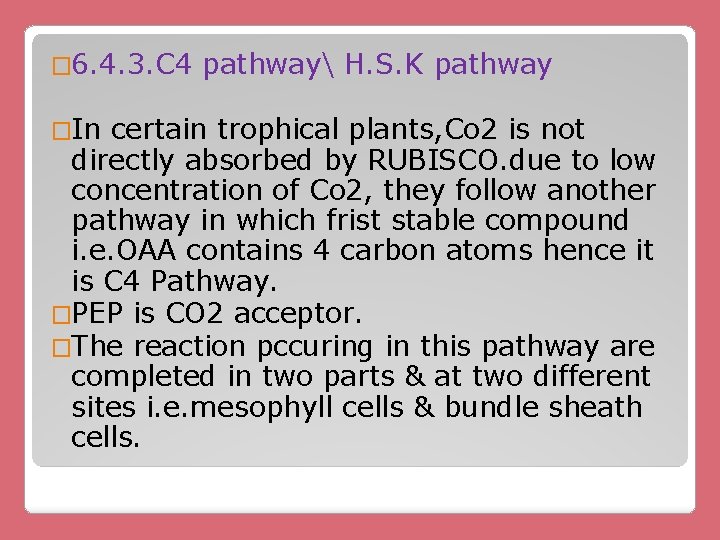
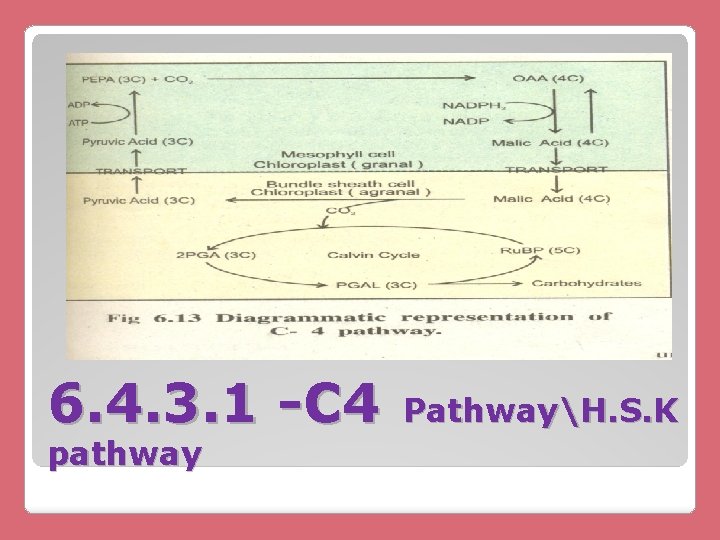
� 6. 4. 3. C 4 �In pathway H. S. K pathway certain trophical plants, Co 2 is not directly absorbed by RUBISCO. due to low concentration of Co 2, they follow another pathway in which frist stable compound i. e. OAA contains 4 carbon atoms hence it is C 4 Pathway. �PEP is CO 2 acceptor. �The reaction pccuring in this pathway are completed in two parts & at two different sites i. e. mesophyll cells & bundle sheath cells.
6. 4. 3. 1 -C 4 pathway PathwayH. S. K
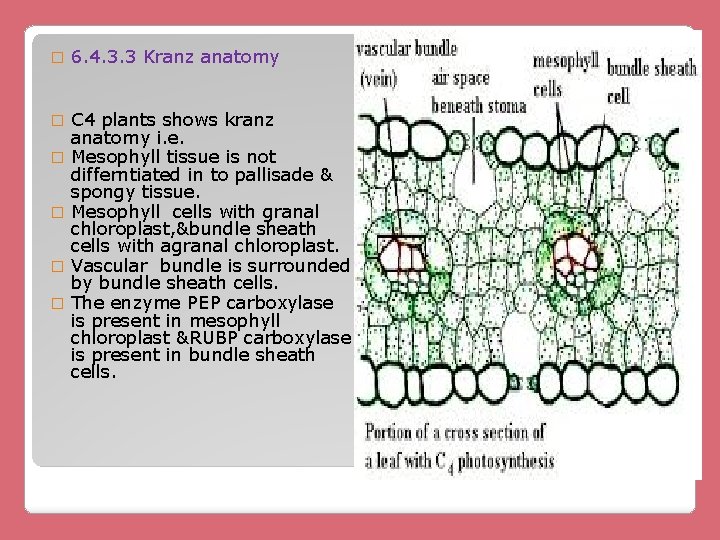
� 6. 4. 3. 3 Kranz anatomy � C 4 plants shows kranz anatomy i. e. Mesophyll tissue is not differntiated in to pallisade & spongy tissue. Mesophyll cells with granal chloroplast, &bundle sheath cells with agranal chloroplast. Vascular bundle is surrounded by bundle sheath cells. The enzyme PEP carboxylase is present in mesophyll chloroplast &RUBP carboxylase is present in bundle sheath cells. � �
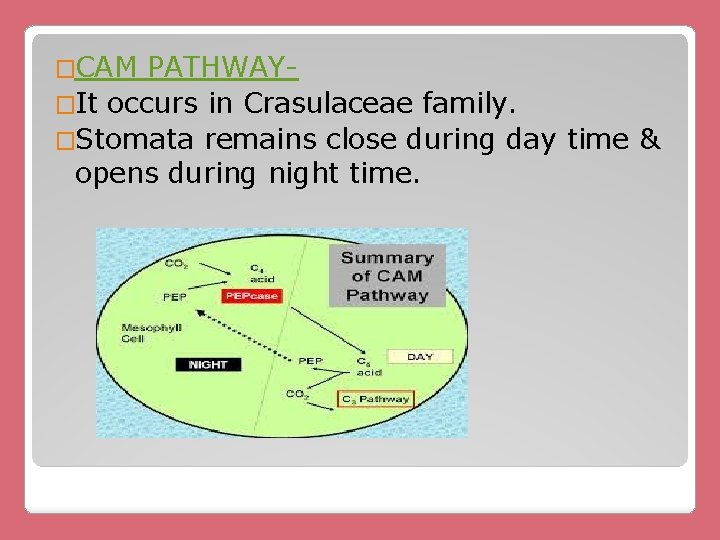
�CAM PATHWAY�It occurs in Crasulaceae family. �Stomata remains close during day time & opens during night time.
� 6. 5 Significance of photosynthesis 1)Light energy is converted in to chemical energy. � 2)Synthesis of food � 3)It release O 2 � 4)Fossil fuels like coal , petrolium etc are products of photosynthesis. � 5)Timber, gums, steroids, rubber etc are products of photosynthesis.
�Factors affecting rate of photosynthesis � 1) Light � 2)Temperature � 3) Co 2 conc. � 4)Water
� 6. 6. 5 �If Law of limiting factors a biochemical process is affected by more than one factors , then the rate will be determined by the factor , which is nearest to its minimal value. It is the factor which directly affects the rate , if its quality is changed. �Example– If optimum Co 2 & temp is available but light is very low then the rate of photosynthesis will be controlled by light.
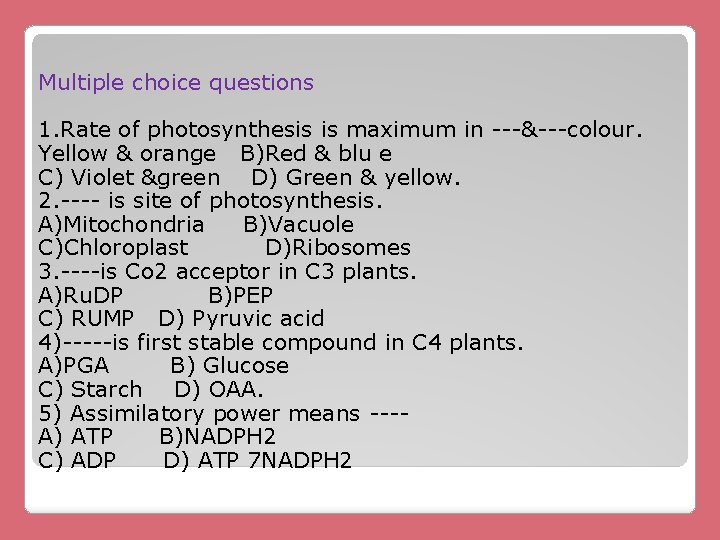
Multiple choice questions 1. Rate of photosynthesis is maximum in ---&---colour. Yellow & orange B)Red & blu e C) Violet &green D) Green & yellow. 2. ---- is site of photosynthesis. A)Mitochondria B)Vacuole C)Chloroplast D)Ribosomes 3. ----is Co 2 acceptor in C 3 plants. A)Ru. DP B)PEP C) RUMP D) Pyruvic acid 4)-----is first stable compound in C 4 plants. A)PGA B) Glucose C) Starch D) OAA. 5) Assimilatory power means ---A) ATP B)NADPH 2 C) ADP D) ATP 7 NADPH 2
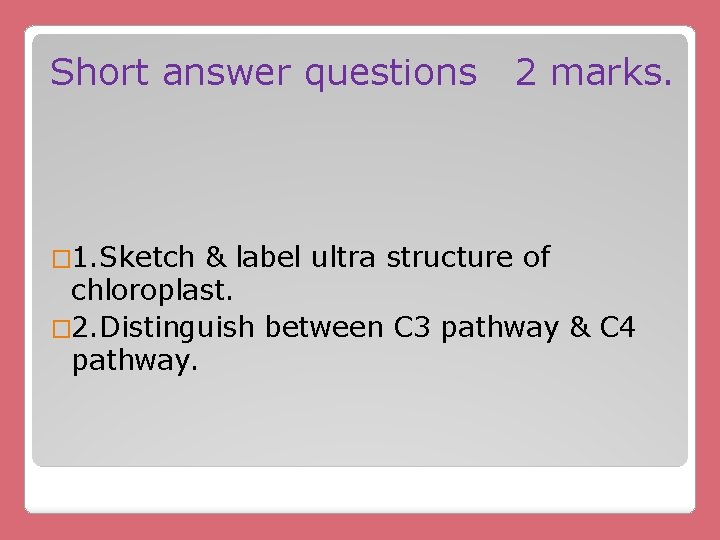
Short answer questions � 1. Sketch 2 marks. & label ultra structure of chloroplast. � 2. Distinguish between C 3 pathway & C 4 pathway.
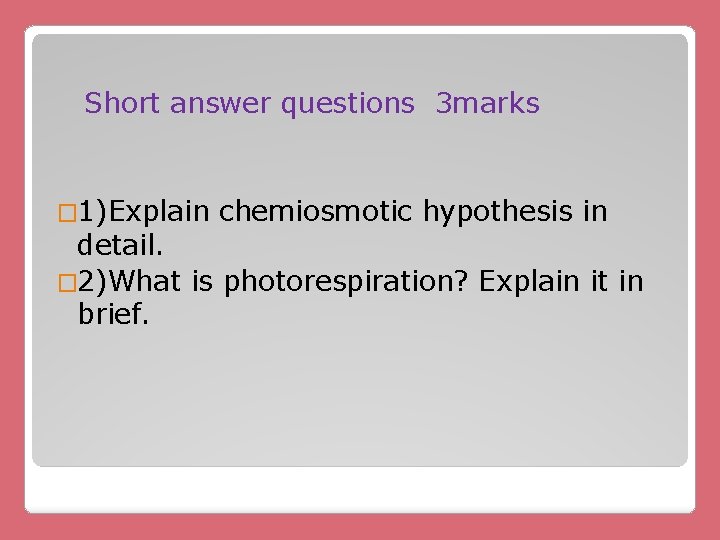
Short answer questions 3 marks � 1)Explain chemiosmotic hypothesis in detail. � 2)What is photorespiration? Explain it in brief.
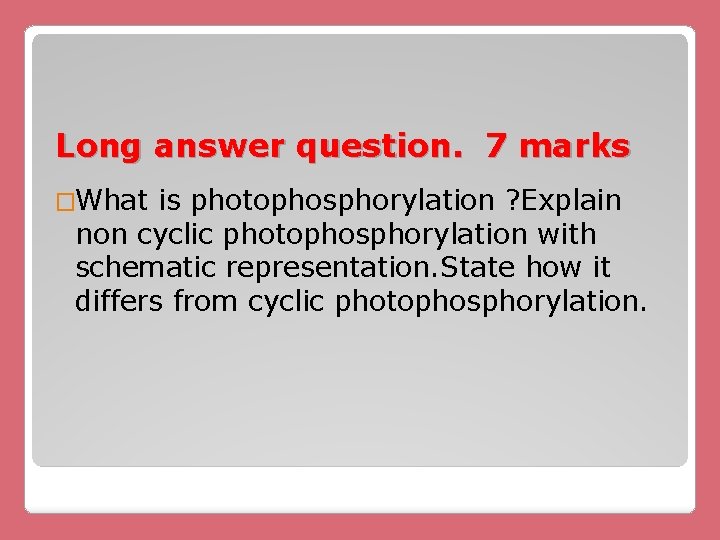
Long answer question. 7 marks �What is photophosphorylation ? Explain non cyclic photophosphorylation with schematic representation. State how it differs from cyclic photophosphorylation.
Reference books �BIOLOGY-A text book for XI by Shveta Uppal , Shashi Chadha. NCERT 2006. �Physiology-Robort M Devlin, Van Nastrand REINHOLD Company New Yark.
THANK YOU