
Ray Theory of Light A simple theory of
- Slides: 11
Ray Theory of Light A simple theory of light uses rays as a representation of how light behaves. n This theory is very useful in describing how lenses and mirrors work. n Unfortunately, it is wrong ! n
Wave Theory of Light A much more accurate theory represents light as a wave motion. n It is much more difficult than ray theory to apply. n We won’t use this theory in this presentation. n
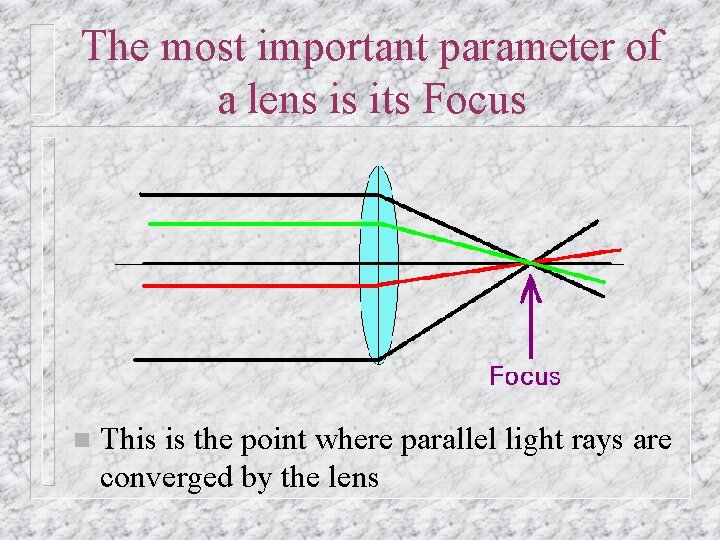
The most important parameter of a lens is its Focus n This is the point where parallel light rays are converged by the lens
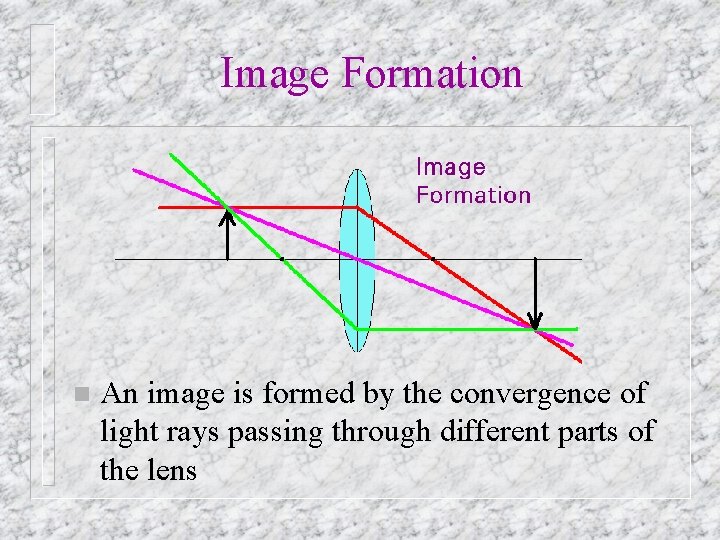
Image Formation n An image is formed by the convergence of light rays passing through different parts of the lens
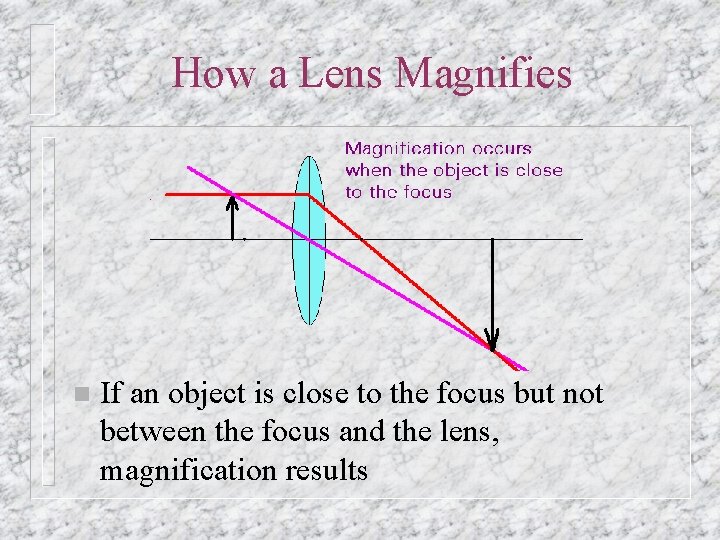
How a Lens Magnifies n If an object is close to the focus but not between the focus and the lens, magnification results
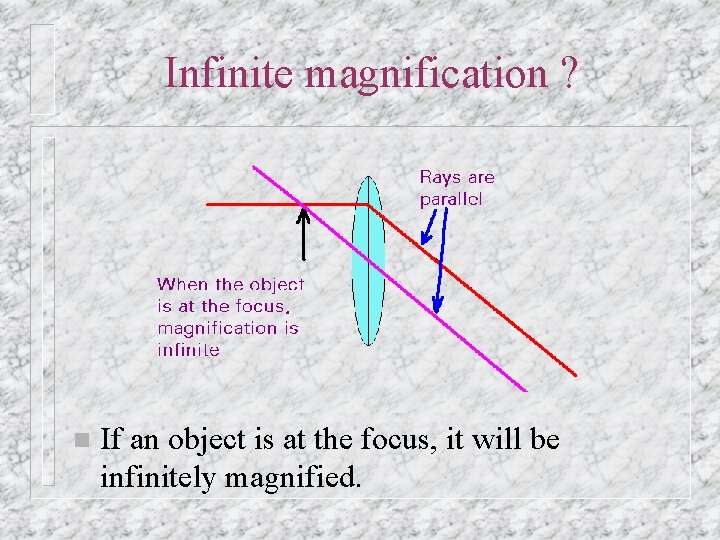
Infinite magnification ? n If an object is at the focus, it will be infinitely magnified.
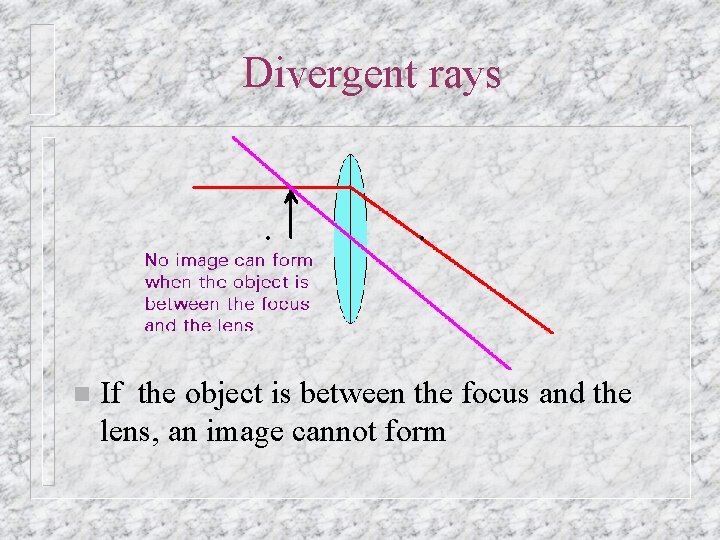
Divergent rays n If the object is between the focus and the lens, an image cannot form
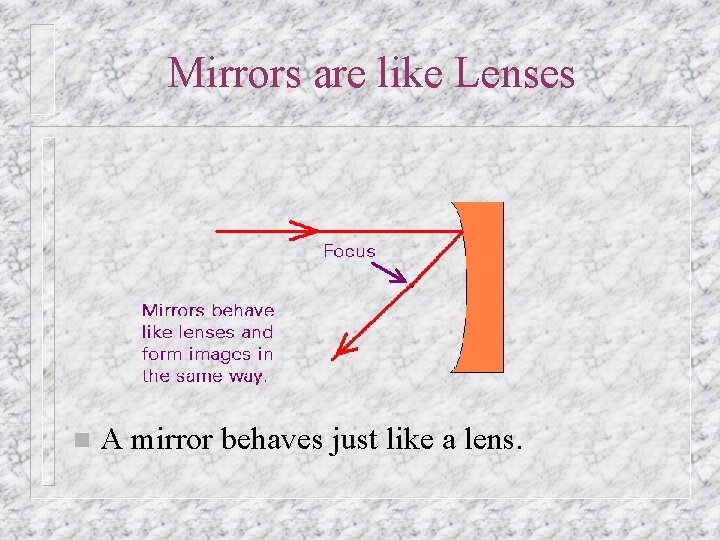
Mirrors are like Lenses n A mirror behaves just like a lens.
Apertures The behaviour of light as it passes through an aperture (a hole) cannot be described by ray theory. n We must use wave theory. n This gives rise to Fresnel optics, Fraunhoffer optics, diffraction theory, interference theory and others. n
What are all these names ? They are all the same thing. n A complete theory is called Fourier Optics. n This makes use of the Fourier Transform. n This is easy to apply AND gives the correct answers, not only in optics, but in many branches of science. n
Want to know More ? n Fourier optics is the subject of another presentation. n You will just have to wait !