
Ratios Rates and Conversions Section 2 6 Goals

- Slides: 31
Ratios, Rates, and Conversions Section 2 -6
Goals Goal Rubric • To find ratios and rates. • To convert units and rates. Level 1 – Know the goals. Level 2 – Fully understand the goals. Level 3 – Use the goals to solve simple problems. Level 4 – Use the goals to solve more advanced problems. Level 5 – Adapts and applies the goals to different and more complex problems.
Vocabulary • • • Ratio Rate Unit Rate Conversion Factor Unit Analysis
Definition • Ratio – is a comparison of two quantities by division. The ratio of a to b can be written a: b or , where b ≠ 0. – Ratios that name the same comparison are said to be equivalent. – Order is important! • Part: Part • Part: Whole • Whole: Part • Example: – Suppose the ratio of the number of boys to the number of girls in a class is 2 : 1. This means the number of boys is two times the number of girls.
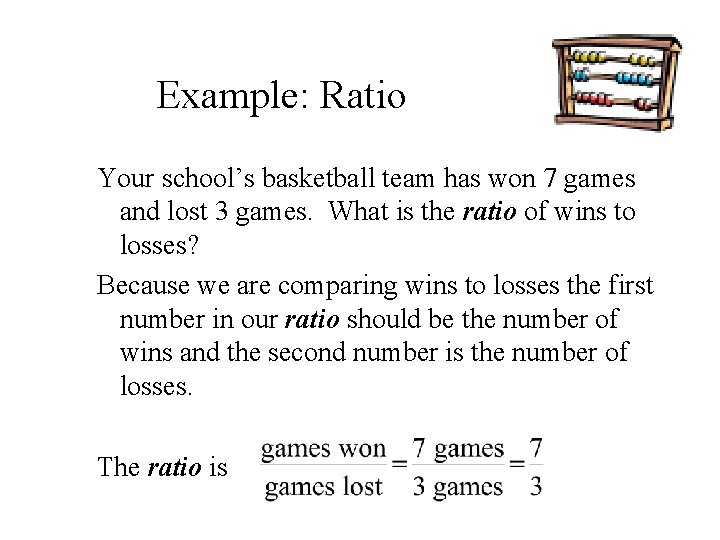
Example: Ratio Your school’s basketball team has won 7 games and lost 3 games. What is the ratio of wins to losses? Because we are comparing wins to losses the first number in our ratio should be the number of wins and the second number is the number of losses. The ratio is
Ratio • Ratios are usually expressed in simplified form. – For instance, the ratio of 6: 8 is usually simplified to 3: 4. – Divide out common factors between the numerator and the denominator.
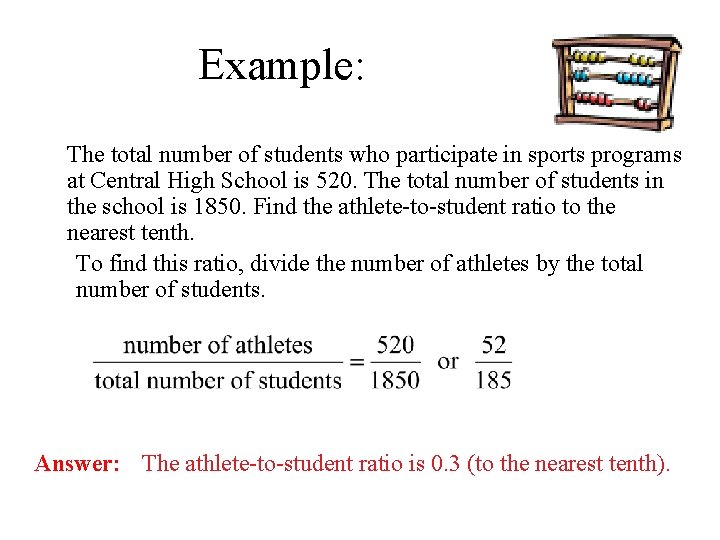
Example: The total number of students who participate in sports programs at Central High School is 520. The total number of students in the school is 1850. Find the athlete-to-student ratio to the nearest tenth. To find this ratio, divide the number of athletes by the total number of students. Answer: The athlete-to-student ratio is 0. 3 (to the nearest tenth).
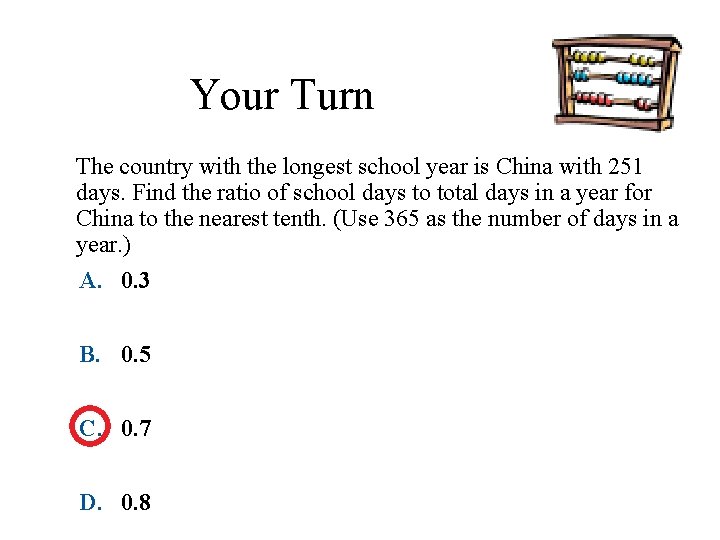
Your Turn The country with the longest school year is China with 251 days. Find the ratio of school days to total days in a year for China to the nearest tenth. (Use 365 as the number of days in a year. ) A. 0. 3 B. 0. 5 C. 0. 7 D. 0. 8
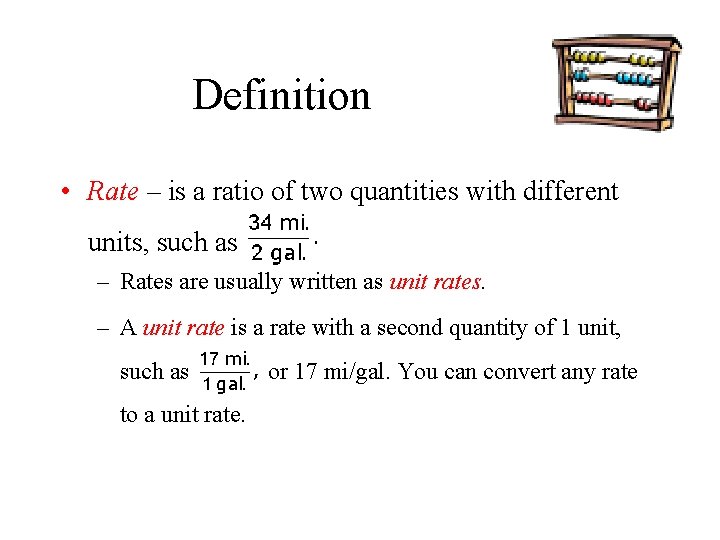
Definition • Rate – is a ratio of two quantities with different units, such as – Rates are usually written as unit rates. – A unit rate is a rate with a second quantity of 1 unit, such as to a unit rate. or 17 mi/gal. You can convert any rate
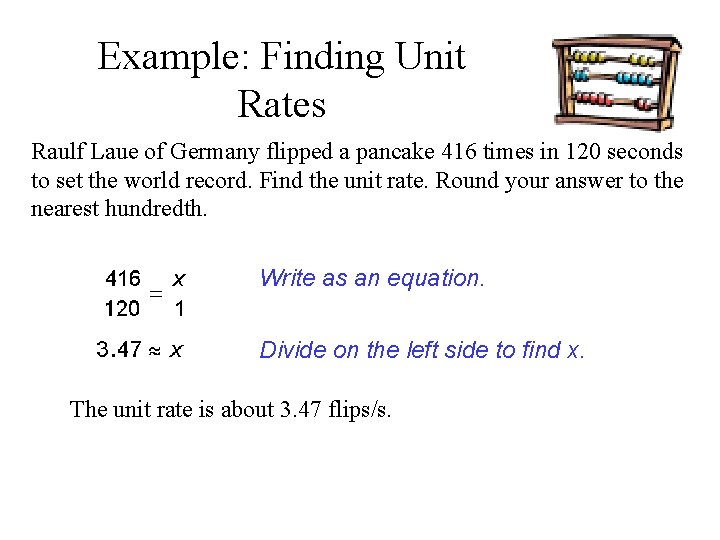
Example: Finding Unit Rates Raulf Laue of Germany flipped a pancake 416 times in 120 seconds to set the world record. Find the unit rate. Round your answer to the nearest hundredth. Write as an equation. Divide on the left side to find x. The unit rate is about 3. 47 flips/s.
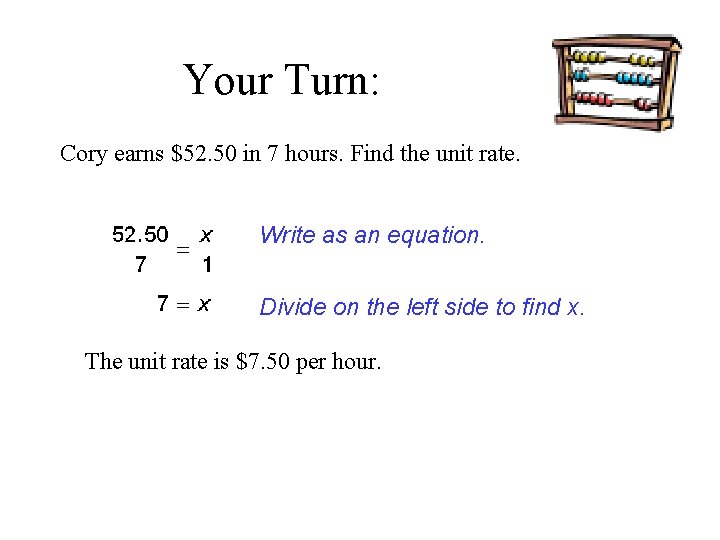
Your Turn: Cory earns $52. 50 in 7 hours. Find the unit rate. Write as an equation. Divide on the left side to find x. The unit rate is $7. 50 per hour.
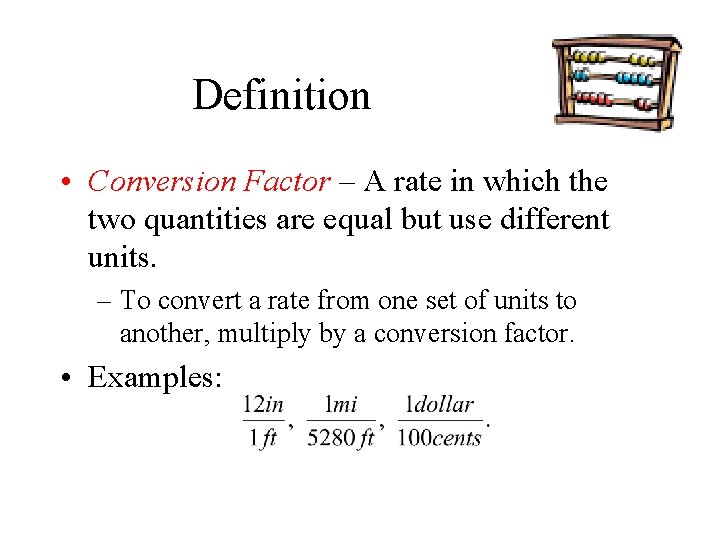
Definition • Conversion Factor – A rate in which the two quantities are equal but use different units. – To convert a rate from one set of units to another, multiply by a conversion factor. • Examples:
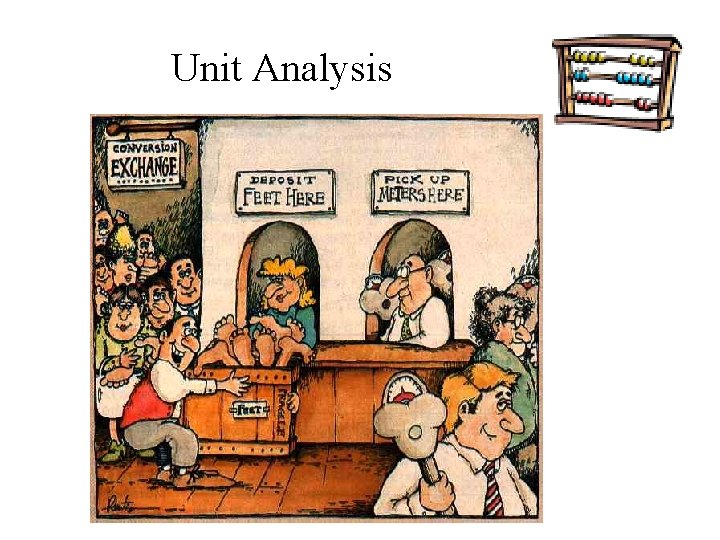
Unit Analysis
Unit Analysis • A procedure to convert from one unit of measurement to another. • Uses conversion factors. • Two properties of conversion factors : – Numerator and denominator contain different units. – Value of the conversion factor is 1. • To convert a measurement to a different unit: – Multiply by a conversion factor. – Given unit of measurement should appear in the denominator so it cancels upon multiplication. – Unit of measurement being changed to should appear in the numerator so that this unit is retained upon multiplication.
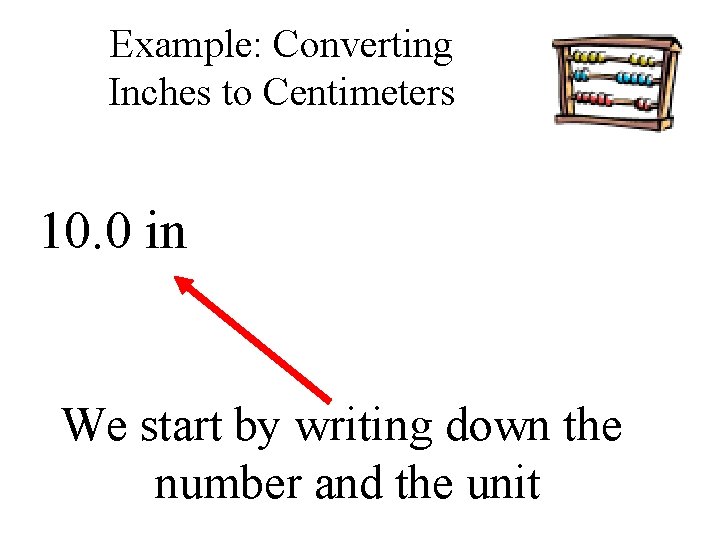
Example: Converting Inches to Centimeters 10. 0 in We start by writing down the number and the unit
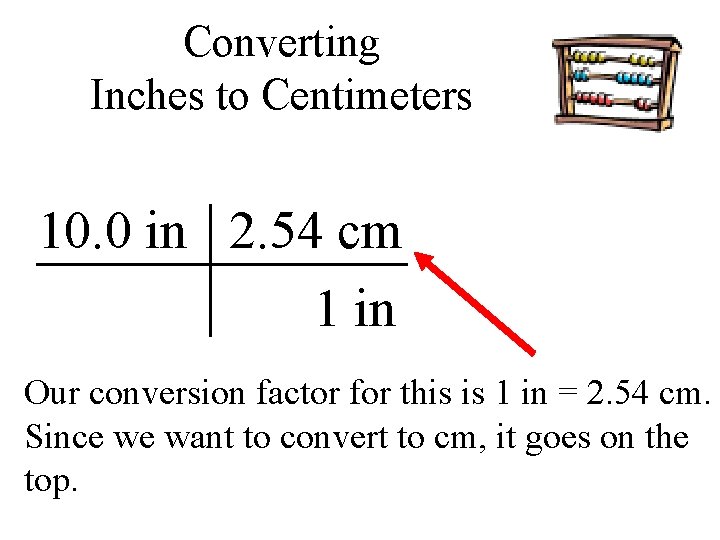
Converting Inches to Centimeters 10. 0 in 2. 54 cm 1 in Our conversion factor for this is 1 in = 2. 54 cm. Since we want to convert to cm, it goes on the top.
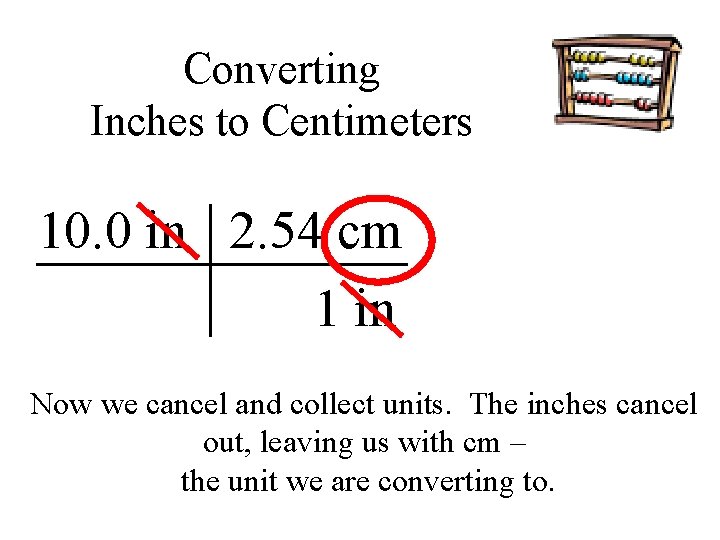
Converting Inches to Centimeters 10. 0 in 2. 54 cm 1 in Now we cancel and collect units. The inches cancel out, leaving us with cm – the unit we are converting to.
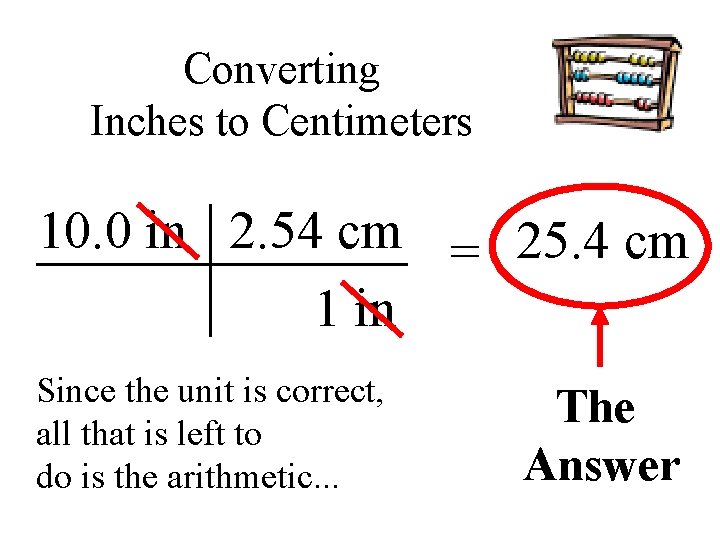
Converting Inches to Centimeters 10. 0 in 2. 54 cm = 25. 4 cm 1 in Since the unit is correct, all that is left to do is the arithmetic. . . The Answer
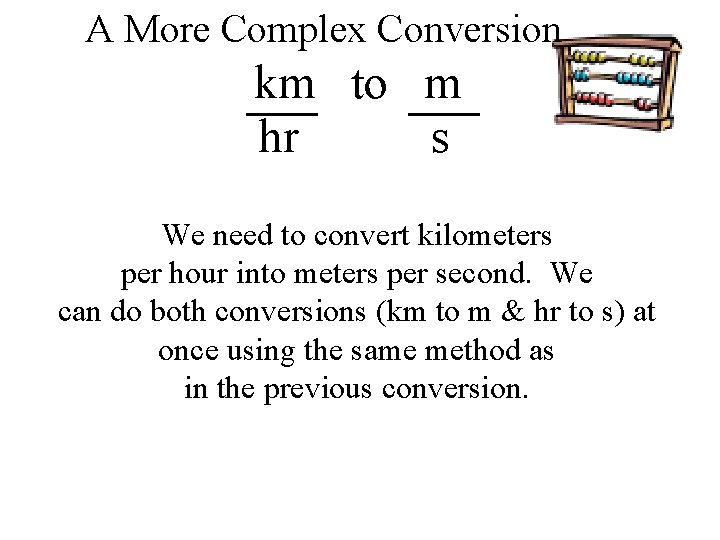
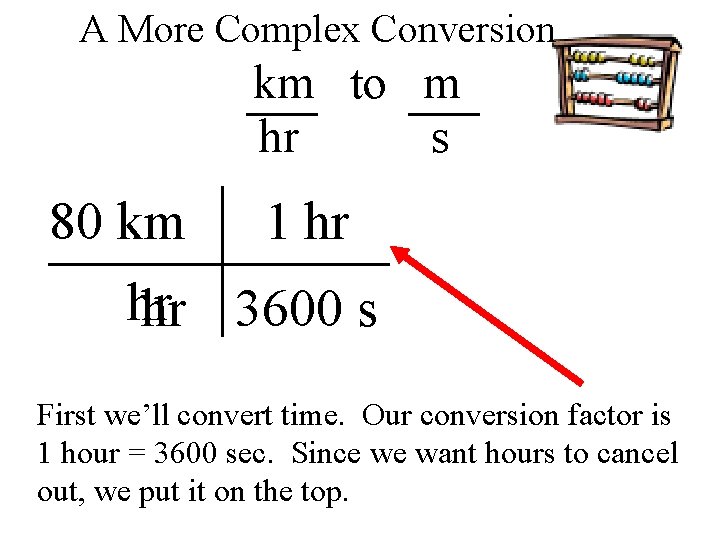
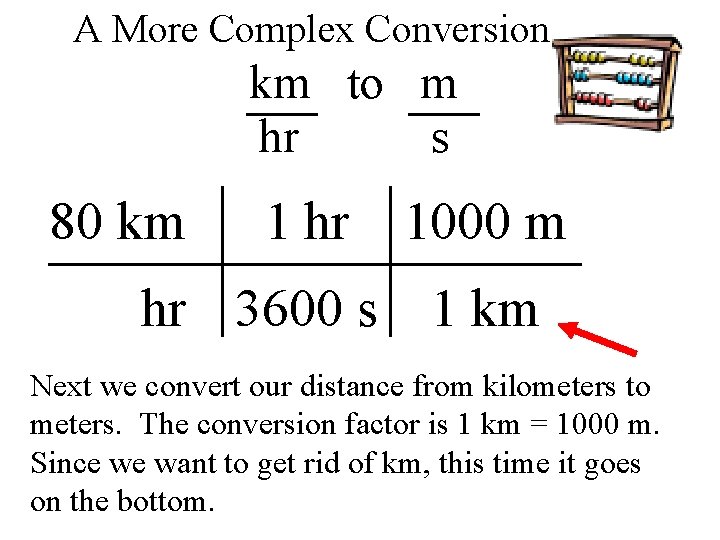
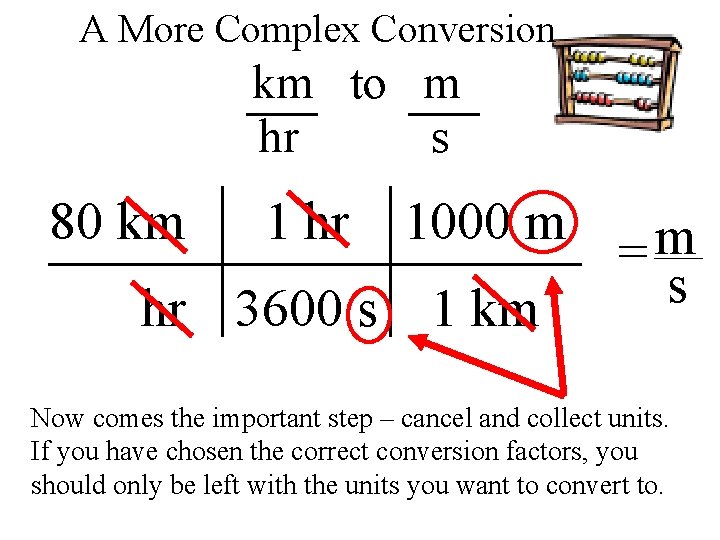
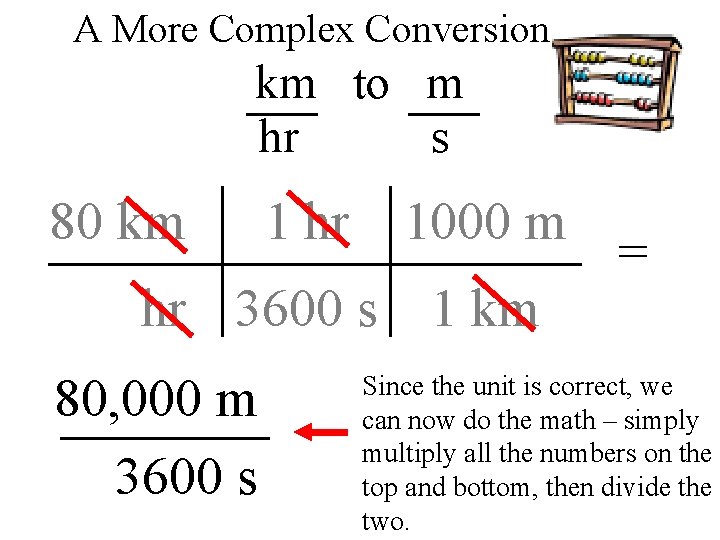
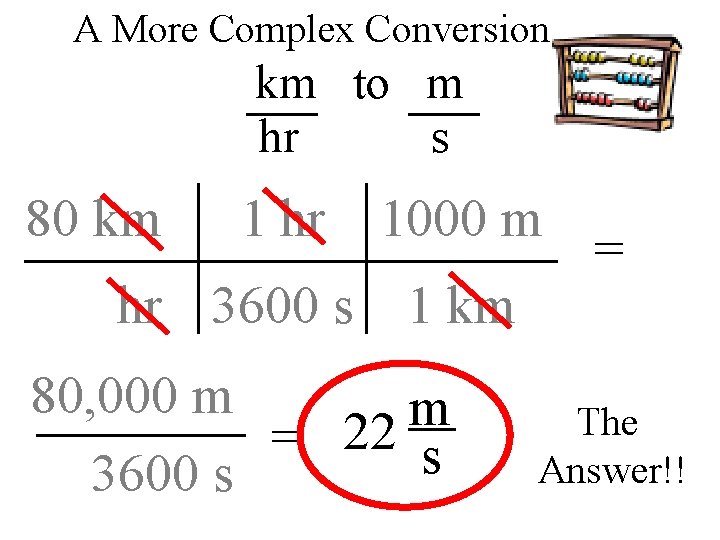
A More Complex Conversion km to m hr s We need to convert kilometers per hour into meters per second. We can do both conversions (km to m & hr to s) at once using the same method as in the previous conversion.
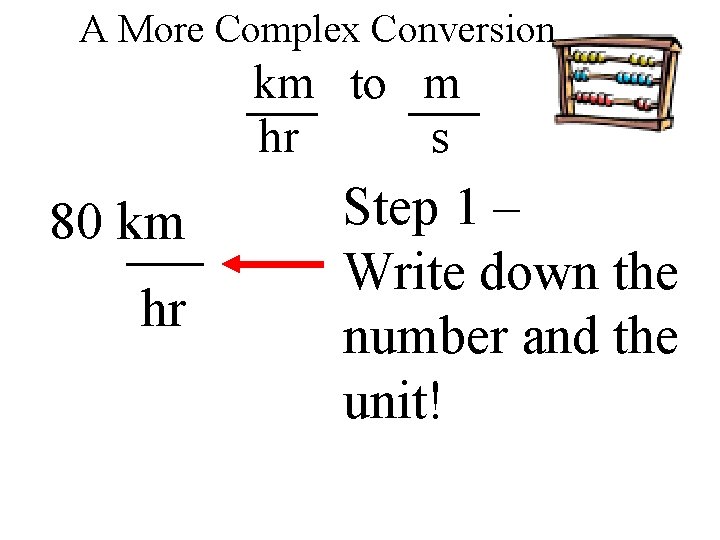
A More Complex Conversion km to m hr s 80 km hr Step 1 – Write down the number and the unit!
A More Complex Conversion km to m hr s 80 km 1 hr hr hr 3600 s First we’ll convert time. Our conversion factor is 1 hour = 3600 sec. Since we want hours to cancel out, we put it on the top.
A More Complex Conversion km to m hr s 80 km 1 hr 1000 m hr 3600 s 1 km Next we convert our distance from kilometers to meters. The conversion factor is 1 km = 1000 m. Since we want to get rid of km, this time it goes on the bottom.
A More Complex Conversion km to m hr s 80 km 1 hr 1000 m hr 3600 s 1 km m = s Now comes the important step – cancel and collect units. If you have chosen the correct conversion factors, you should only be left with the units you want to convert to.
A More Complex Conversion km to m hr s 80 km 1 hr 1000 m hr 3600 s 1 km 80, 000 m 3600 s = Since the unit is correct, we can now do the math – simply multiply all the numbers on the top and bottom, then divide the two.
A More Complex Conversion km to m hr s 80 km 1 hr 1000 m hr 3600 s 1 km 80, 000 m m = 22 s 3600 s = The Answer!!
Summary • The previous problem was not that hard. • In other words, you probably could have done it just as fast using a different method. • However, for harder problems Unit Analysis is easiest.
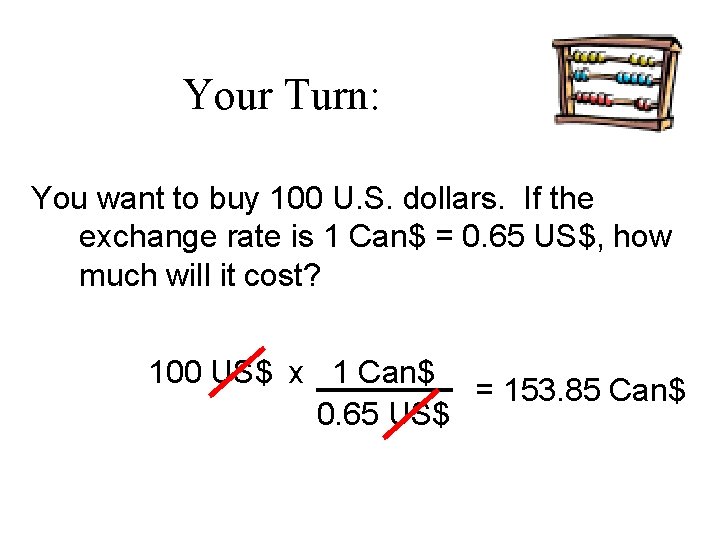
Your Turn: You want to buy 100 U. S. dollars. If the exchange rate is 1 Can$ = 0. 65 US$, how much will it cost? 100 US$ x 1 Can$ = 153. 85 Can$ 0. 65 US$
Your Turn: There are 12 inches in a foot, 0. 394 inches in a centimeter, and 3 feet in a yard. How many cm are in one yard? 1 yd x 3 ft x 12 in x 1 cm = 91. 37 cm 1 yd 1 ft 0. 394 in
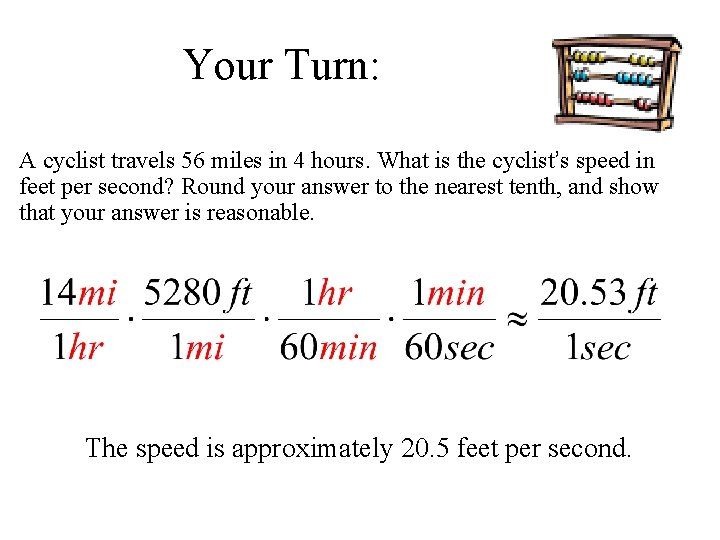
Your Turn: A cyclist travels 56 miles in 4 hours. What is the cyclist’s speed in feet per second? Round your answer to the nearest tenth, and show that your answer is reasonable. The speed is approximately 20. 5 feet per second.
Joke Time • What did the confused bee say? • To bee or not to bee! • How do crazy people go through the forest? • They take the psycho path. • What do you call a boomerang that doesn't work? • A stick.
Assignment 2. 6 Exercises Pg. 133 – 135: #10 – 50 even