
RATIOS 4 5 GRADE 12 ACCOUNTING MODULE 5
- Slides: 8
RATIOS 4 &5 GRADE 12 ACCOUNTING MODULE 5 LESSON 3
4. DEBT EQUITY RATIO Gives an indication of how a BUSINESS is financed PG 217/8 Capital can either be financed By the owners and /or Borrowing money has a finance cost = interest on loan Put the BUSINESS under financial risk If profits drop the loan & interest will still need to be paid If relying on shareholders to fund = low risk Capital is not repaid to shareholders even if profits drop
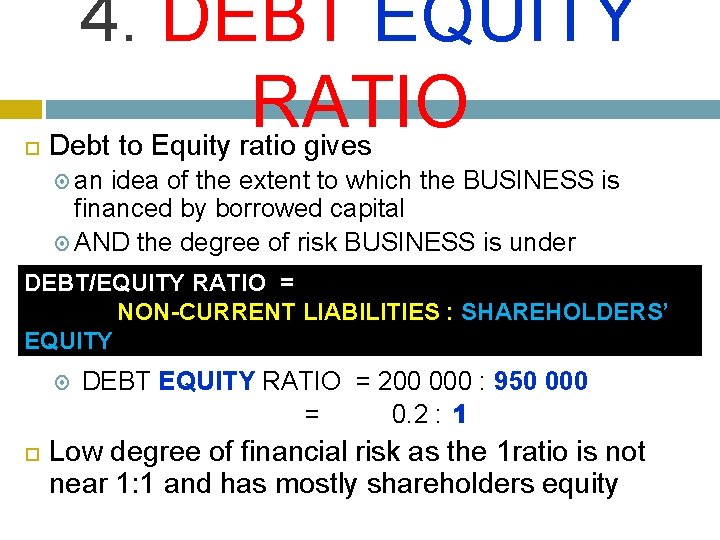
4. DEBT EQUITY RATIO Debt to Equity ratio gives an idea of the extent to which the BUSINESS is financed by borrowed capital AND the degree of risk BUSINESS is under DEBT/EQUITY RATIO = NON-CURRENT LIABILITIES : SHAREHOLDERS’ EQUITY EXAMPLE PG 217 DEBT EQUITY RATIO = 200 000 : 950 000 = 0. 2 : 1 Low degree of financial risk as the 1 ratio is not near 1: 1 and has mostly shareholders equity
4. DEBT EQUITY RATIO It is good to borrow money when: Interest rate on long-term loans is lower than the return that can be earned by the BUSINESS using those funds This is called GEARING Example 1: (more example on page 218 -219) If the interest on loans is 17% and ABC ltd can use those funds at a return of 25% The returns earned by the shareholders is being ‘geared upwards’ or positively geared Favourable gearing effect applies when funds are borrowed at a relatively low interest rate in order to earn a relatively higher return (converse negatively
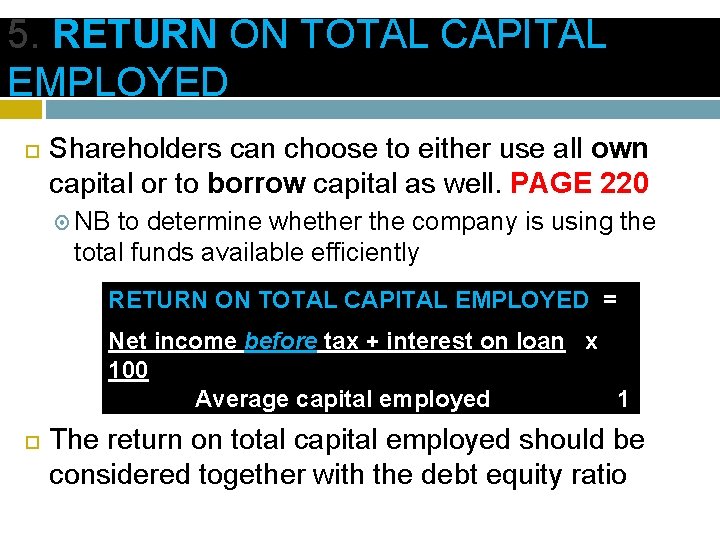
5. RETURN ON TOTAL CAPITAL EMPLOYED Shareholders can choose to either use all own capital or to borrow capital as well. PAGE 220 NB to determine whether the company is using the total funds available efficiently RETURN ON TOTAL CAPITAL EMPLOYED = Net income before tax + interest on loan x 100 Average capital employed 1 The return on total capital employed should be considered together with the debt equity ratio
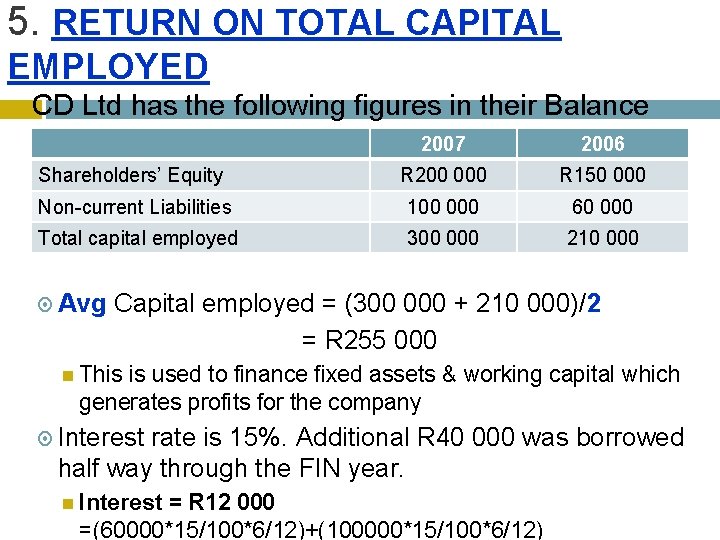
5. RETURN ON TOTAL CAPITAL EMPLOYED CD Ltd has the following figures in their Balance sheet: 2007 2006 Shareholders’ Equity R 200 000 R 150 000 Non-current Liabilities 100 000 60 000 Total capital employed 300 000 210 000 Avg Capital employed = (300 000 + 210 000)/2 = R 255 000 This is used to finance fixed assets & working capital which generates profits for the company Interest rate is 15%. Additional R 40 000 was borrowed half way through the FIN year. Interest = R 12 000 =(60000*15/100*6/12)+(100000*15/100*6/12)
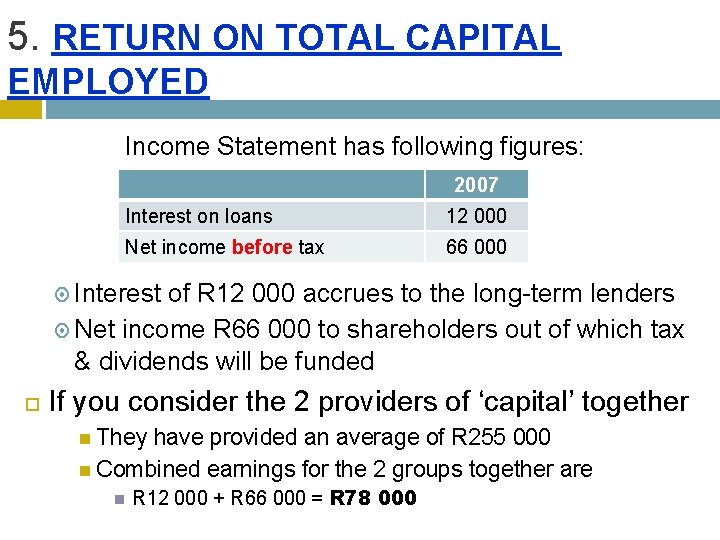
5. RETURN ON TOTAL CAPITAL EMPLOYED Income Statement has following figures: 2007 Interest on loans 12 000 Net income before tax 66 000 Interest of R 12 000 accrues to the long-term lenders Net income R 66 000 to shareholders out of which tax & dividends will be funded If you consider the 2 providers of ‘capital’ together They have provided an average of R 255 000 Combined earnings for the 2 groups together are R 12 000 + R 66 000 = R 78 000
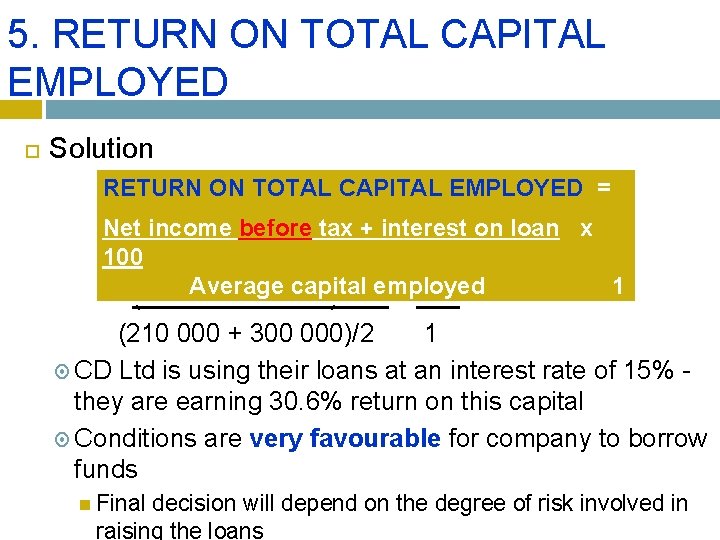
5. RETURN ON TOTAL CAPITAL EMPLOYED Solution RETURN ON TOTAL CAPITAL EMPLOYED = Net income before tax + interest on loan x 100 Average capital employed (66 000 + 12 000) x 100 = 30. 6%1 (210 000 + 300 000)/2 1 CD Ltd is using their loans at an interest rate of 15% they are earning 30. 6% return on this capital Conditions are very favourable for company to borrow funds Final decision will depend on the degree of risk involved in raising the loans