
Rationalising Biodiversity Conservation in Dynamic Ecosystems www rubicode
Rationalising Biodiversity Conservation in Dynamic Ecosystems www. rubicode. net (RUBICODE) How trait linkages within and across trophic levels underlie the response of ecosystem functioning to environmental change For further information contact Sandra Lavorel (email: sandra. lavorel@ujf-grenoble. fr) Funded under the European Commission Sixth Framework Programme Contract Number: 036890
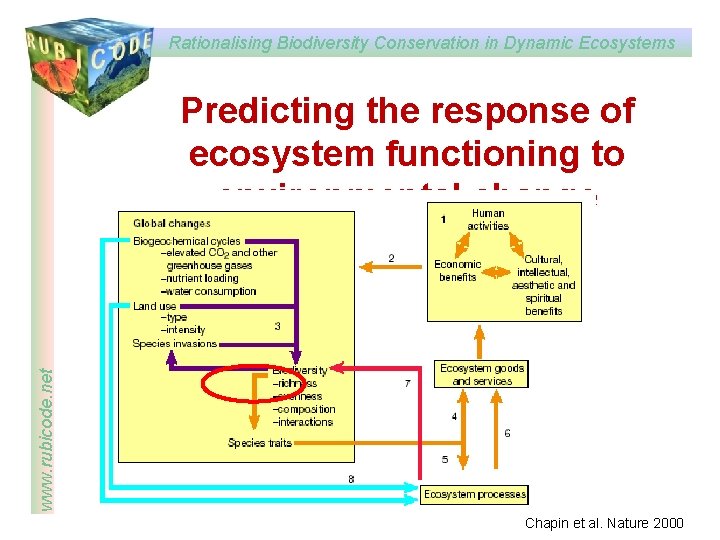
Rationalising Biodiversity Conservation in Dynamic Ecosystems www. rubicode. net Predicting the response of ecosystem functioning to environmental change Chapin et al. Nature 2000
Rationalising Biodiversity Conservation in Dynamic Ecosystems Key challenges • Taking into account biotic variability into projections of ecosystem functioning – at different scales – Linking biotic responses and changes in ecosystem functioning www. rubicode. net • Biodiversity – ecosystem functioning relationships – Original question: does biodiversity affect ecosystem functioning? • 1990 – 2000 : Biodiversity can matter (Loreau et al. 2001, Balvanera et al. 2006) – Current question: which components of biodiversity affect ecosystem functioning and through which
Rationalising Biodiversity Conservation in Dynamic Ecosystems www. rubicode. net Presentation outline • Functional traits and prediction of ecosystem functioning: some basics • Going dynamic: linking organisms responses and ecosystem effects through functional traits (the ‘Holy Grail’) • Going multi-trophic : a new framework for the understanding and projection of ecosystem functions determined by multiple trophic levels using functional traits (the next Holy Grail) • Framework applications and challenges
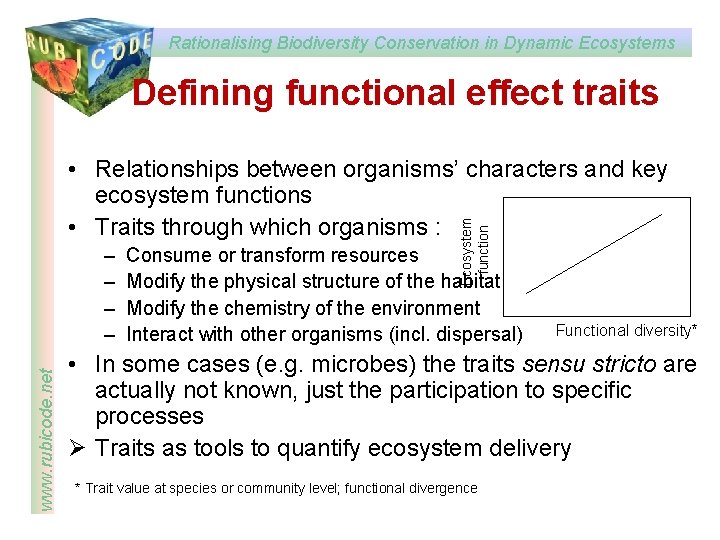
Rationalising Biodiversity Conservation in Dynamic Ecosystems Defining functional effect traits www. rubicode. net – – Ecosystem function • Relationships between organisms’ characters and key ecosystem functions • Traits through which organisms : Consume or transform resources Modify the physical structure of the habitat Modify the chemistry of the environment Interact with other organisms (incl. dispersal) Functional diversity* • In some cases (e. g. microbes) the traits sensu stricto are actually not known, just the participation to specific processes Ø Traits as tools to quantify ecosystem delivery * Trait value at species or community level; functional divergence
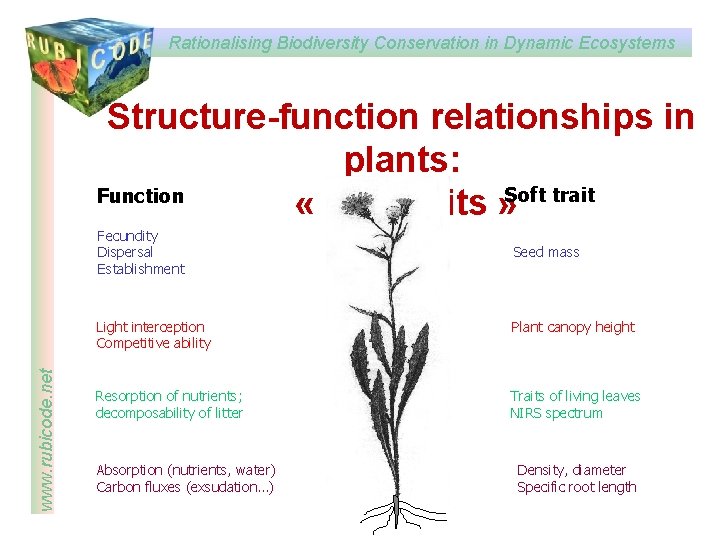
Rationalising Biodiversity Conservation in Dynamic Ecosystems Structure-function relationships in plants: Function « soft traits » Soft trait www. rubicode. net Fecundity Dispersal Establishment Seed mass Light interception Competitive ability Plant canopy height Resorption of nutrients; decomposability of litter Traits of living leaves NIRS spectrum Absorption (nutrients, water) Carbon fluxes (exsudation…) Density, diameter Specific root length
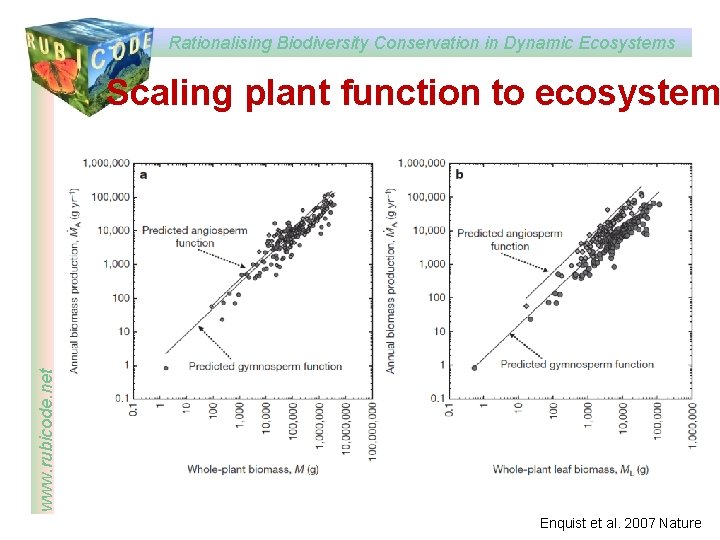
Rationalising Biodiversity Conservation in Dynamic Ecosystems www. rubicode. net Scaling plant function to ecosystem Enquist et al. 2007 Nature
Rationalising Biodiversity Conservation in Dynamic Ecosystems Functional traits in other organisms • Morphological characteristics: – Body size, feeding apparatus, wings… • Life history • Diet and feeding behaviour • Ecosystem effects – e. g. microbial activities www. rubicode. net • And… – Taxonomic groups with specific functions – Habitat • Key point: characteristics of individuals that can be related to mechanisms through which they are affected by environmental factors and/or they affect ecosystem functioning
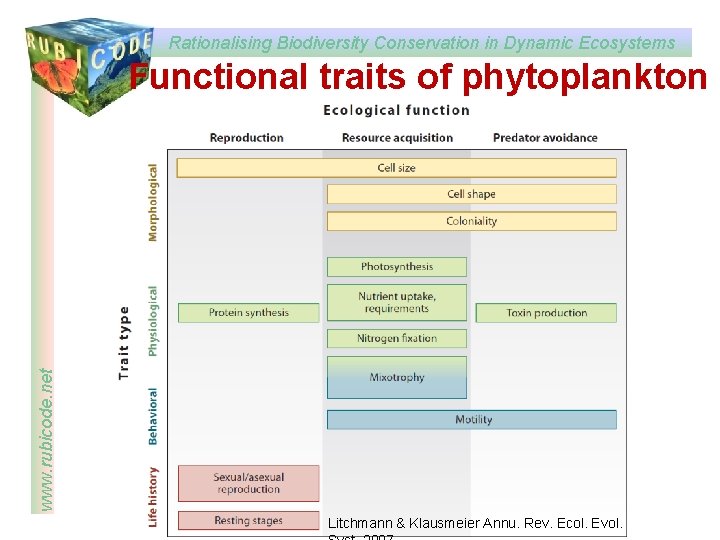
Rationalising Biodiversity Conservation in Dynamic Ecosystems www. rubicode. net Functional traits of phytoplankton Litchmann & Klausmeier Annu. Rev. Ecol. Evol.
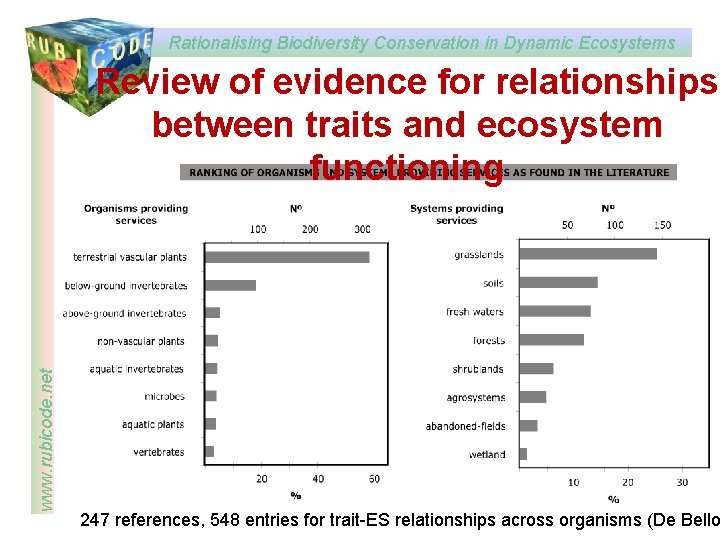
Rationalising Biodiversity Conservation in Dynamic Ecosystems www. rubicode. net Review of evidence for relationships between traits and ecosystem functioning 247 references, 548 entries for trait-ES relationships across organisms (De Bello
Abiotic factors Ecosystem processes and services Relative abundance Functional diversity Range of trait values Particular trait values Weighted mean CWM Trait values
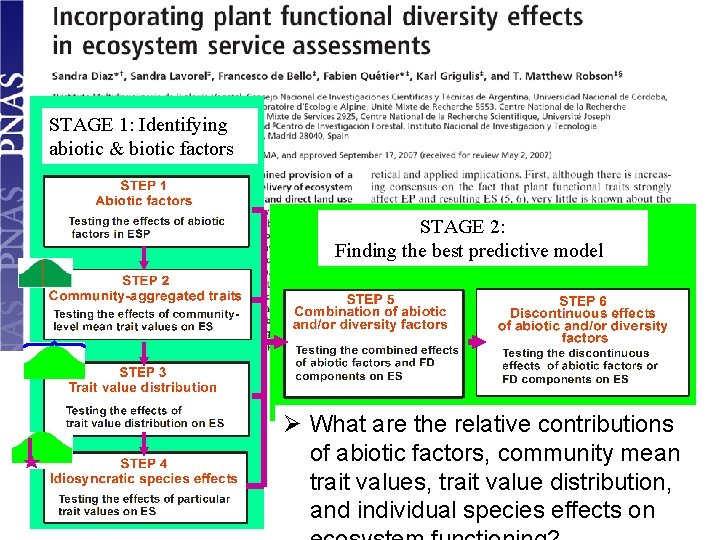
STAGE 1: Identifying abiotic & biotic factors STAGE 2: Finding the best predictive model Ø What are the relative contributions of abiotic factors, community mean trait values, trait value distribution, and individual species effects on
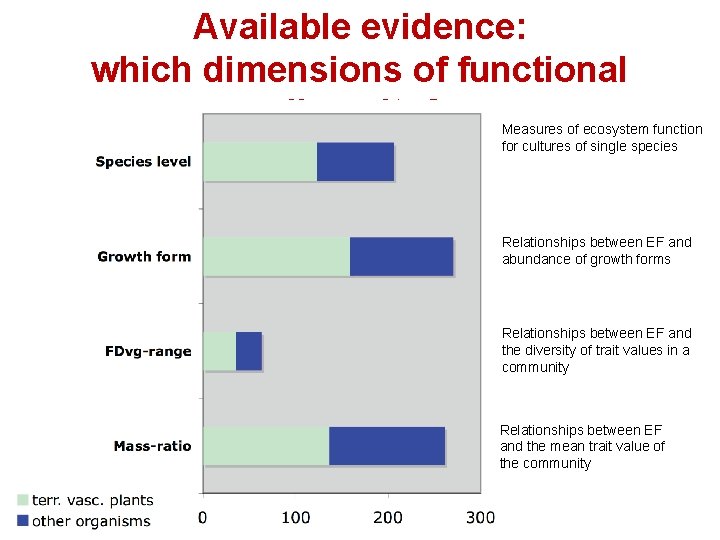
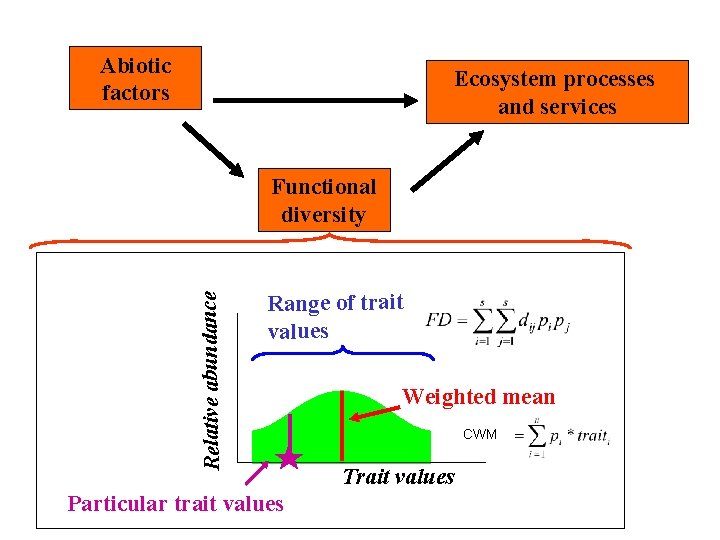
Available evidence: which dimensions of functional diversity? Measures of ecosystem function for cultures of single species Relationships between EF and abundance of growth forms Relationships between EF and the diversity of trait values in a community Relationships between EF and the mean trait value of the community
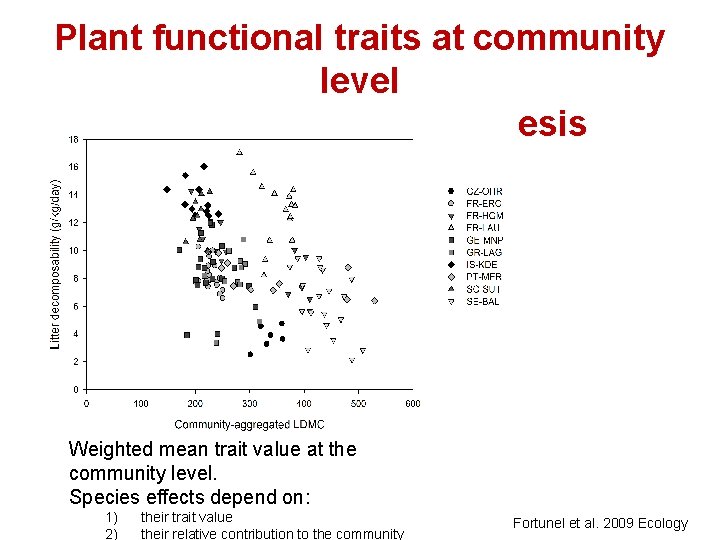
Plant functional traits at community level The mass-ratio hypothesis Weighted mean trait value at the community level. Species effects depend on: 1) 2) their trait value their relative contribution to the community Fortunel et al. 2009 Ecology
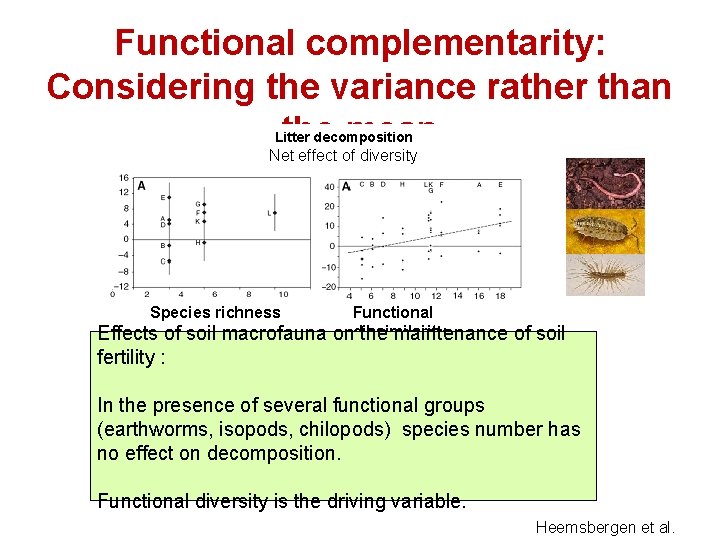
Functional complementarity: Considering the variance rather than the mean Litter decomposition Net effect of diversity Species richness Effects of soil macrofauna fertility : Functional ondissimilarity the maintenance of soil In the presence of several functional groups (earthworms, isopods, chilopods) species number has no effect on decomposition. Functional diversity is the driving variable. Heemsbergen et al.
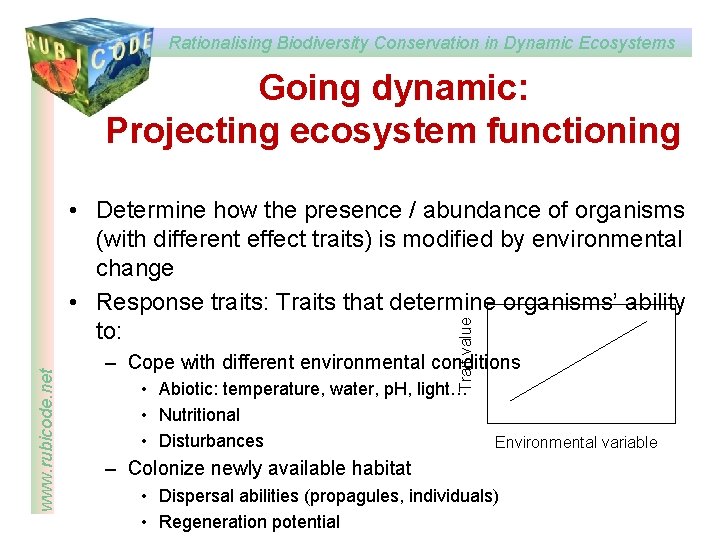
Rationalising Biodiversity Conservation in Dynamic Ecosystems Going dynamic: Projecting ecosystem functioning Trait value www. rubicode. net • Determine how the presence / abundance of organisms (with different effect traits) is modified by environmental change • Response traits: Traits that determine organisms’ ability to: – Cope with different environmental conditions • Abiotic: temperature, water, p. H, light… • Nutritional • Disturbances Environmental variable – Colonize newly available habitat • Dispersal abilities (propagules, individuals) • Regeneration potential
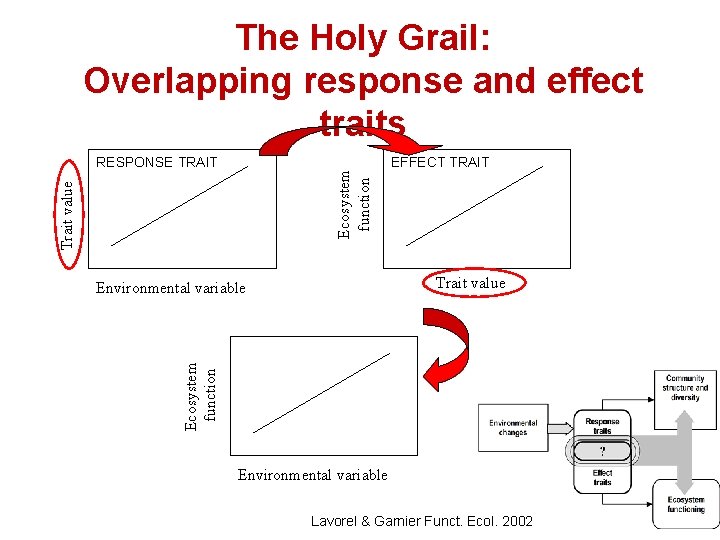
The Holy Grail: Overlapping response and effect traits Trait value Ecosystem function RESPONSE TRAIT EFFECT TRAIT Trait value Ecosystem function Environmental variable Lavorel & Garnier Funct. Ecol. 2002
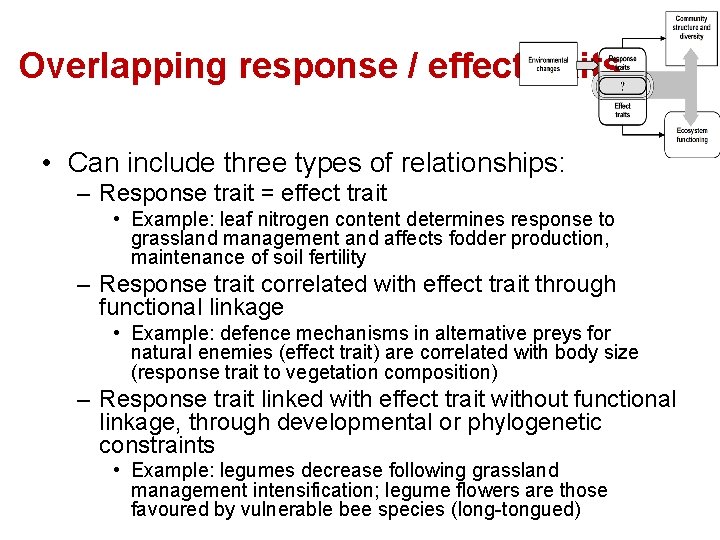
Overlapping response / effect traits • Can include three types of relationships: – Response trait = effect trait • Example: leaf nitrogen content determines response to grassland management and affects fodder production, maintenance of soil fertility – Response trait correlated with effect trait through functional linkage • Example: defence mechanisms in alternative preys for natural enemies (effect trait) are correlated with body size (response trait to vegetation composition) – Response trait linked with effect trait without functional linkage, through developmental or phylogenetic constraints • Example: legumes decrease following grassland management intensification; legume flowers are those favoured by vulnerable bee species (long-tongued)
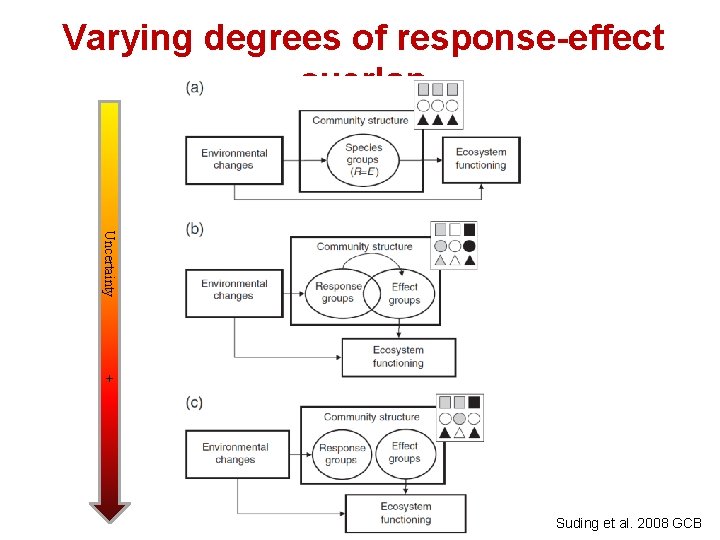
Varying degrees of response-effect overlap Uncertainty + Suding et al. 2008 GCB
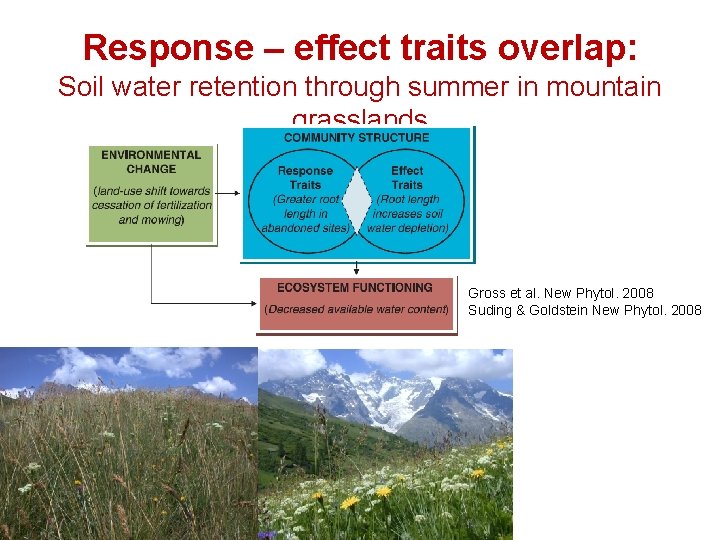
Response – effect traits overlap: Soil water retention through summer in mountain grasslands Gross et al. New Phytol. 2008 Suding & Goldstein New Phytol. 2008
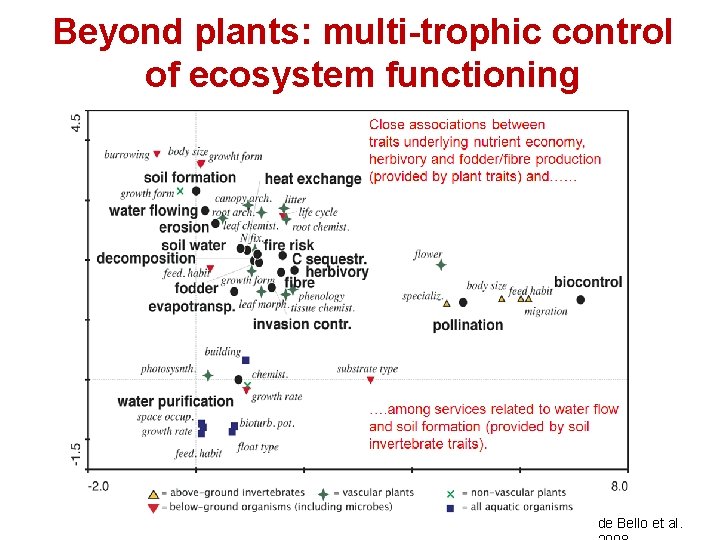
Beyond plants: multi-trophic control of ecosystem functioning de Bello et al.
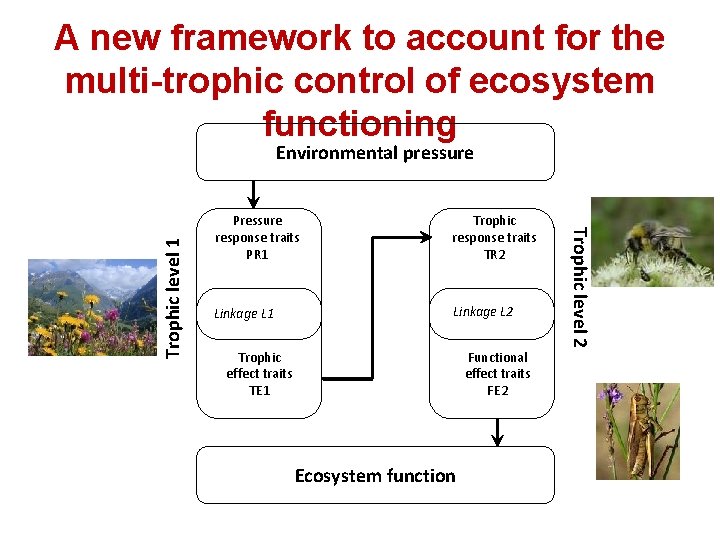
A new framework to account for the multi-trophic control of ecosystem functioning Pressure response traits PR 1 Trophic response traits TR 2 Linkage L 1 Linkage L 2 Trophic effect traits TE 1 Functional effect traits FE 2 Ecosystem function Trophic level 2 Trophic level 1 Environmental pressure
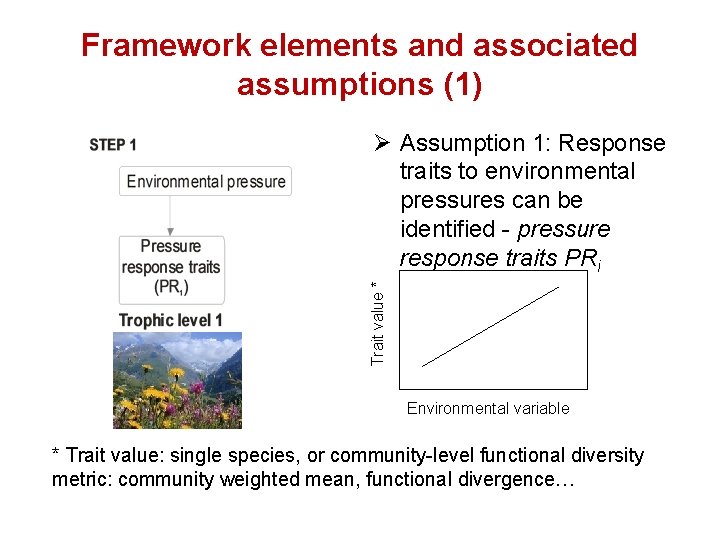
Framework elements and associated assumptions (1) Trait value * Ø Assumption 1: Response traits to environmental pressures can be identified - pressure response traits PRi Environmental variable * Trait value: single species, or community-level functional diversity metric: community weighted mean, functional divergence…
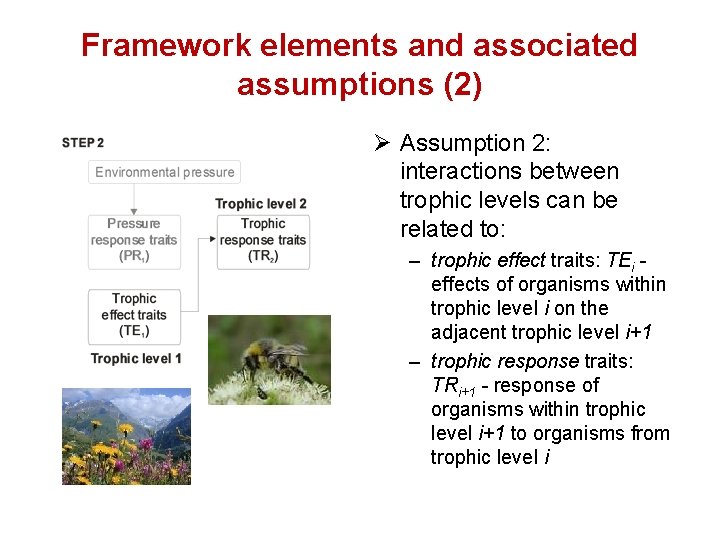
Framework elements and associated assumptions (2) Ø Assumption 2: interactions between trophic levels can be related to: – trophic effect traits: TEi effects of organisms within trophic level i on the adjacent trophic level i+1 – trophic response traits: TRi+1 - response of organisms within trophic level i+1 to organisms from trophic level i
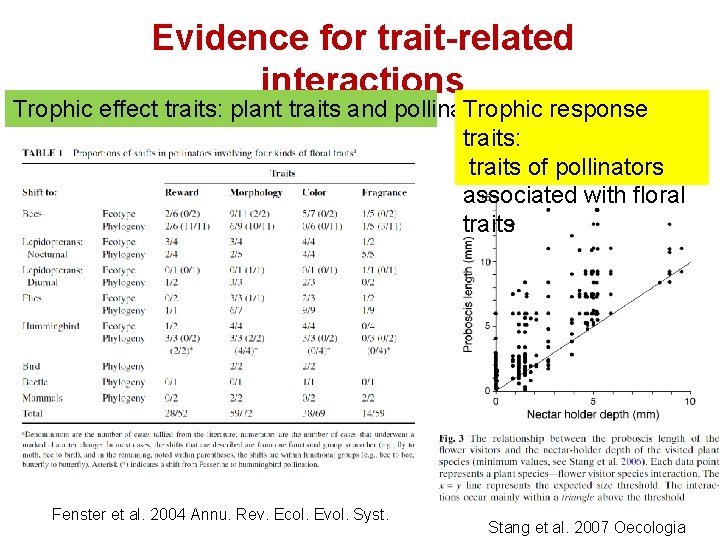
Evidence for trait-related interactions Trophic response Trophic effect traits: plant traits and pollinators traits: traits of pollinators associated with floral traits Fenster et al. 2004 Annu. Rev. Ecol. Evol. Syst. Stang et al. 2007 Oecologia
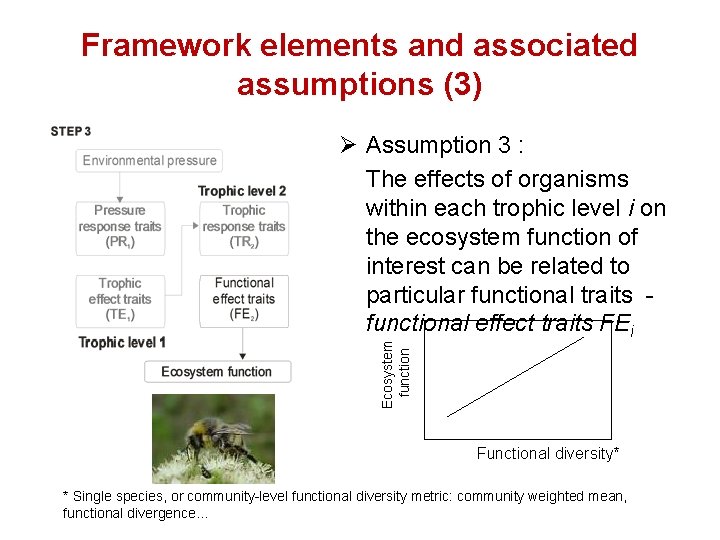
Framework elements and associated assumptions (3) Ecosystem function Ø Assumption 3 : The effects of organisms within each trophic level i on the ecosystem function of interest can be related to particular functional traits functional effect traits FEi Functional diversity* * Single species, or community-level functional diversity metric: community weighted mean, functional divergence…
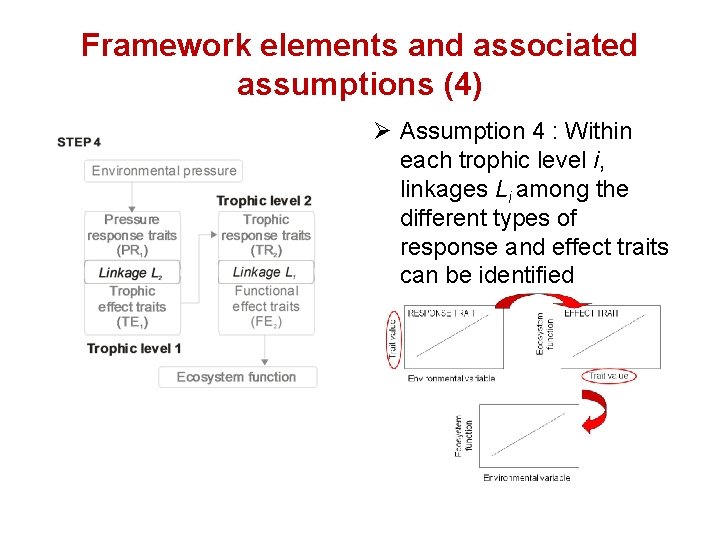
Framework elements and associated assumptions (4) Ø Assumption 4 : Within each trophic level i, linkages Li among the different types of response and effect traits can be identified
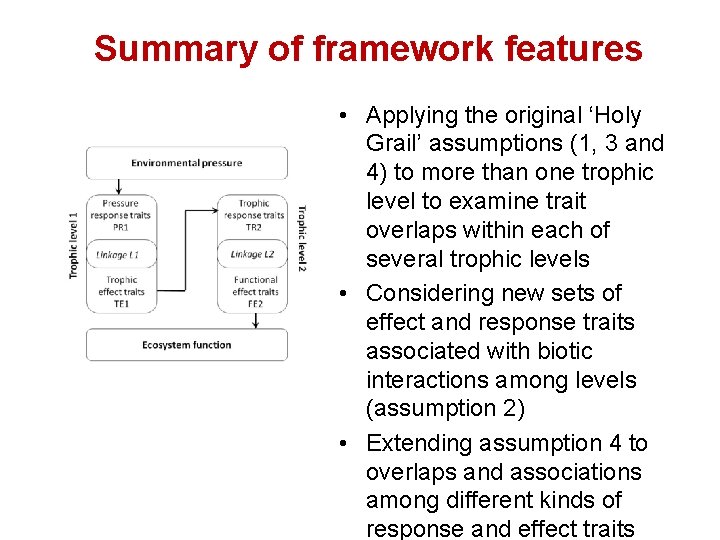
Summary of framework features • Applying the original ‘Holy Grail’ assumptions (1, 3 and 4) to more than one trophic level to examine trait overlaps within each of several trophic levels • Considering new sets of effect and response traits associated with biotic interactions among levels (assumption 2) • Extending assumption 4 to overlaps and associations among different kinds of response and effect traits
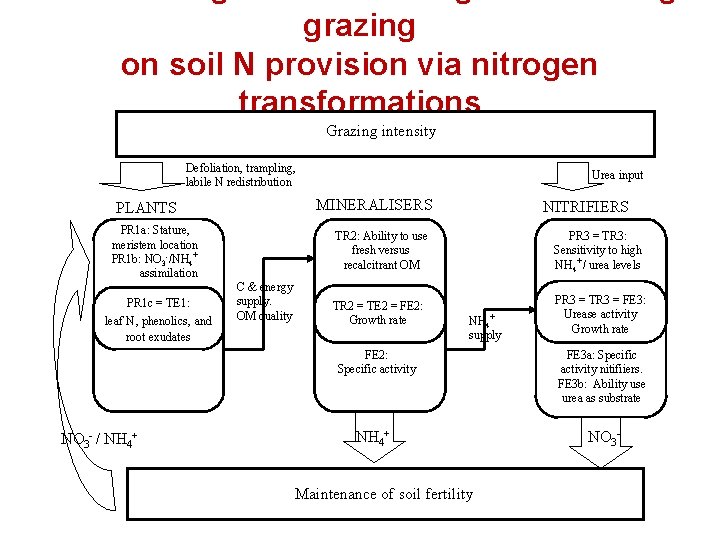
grazing on soil N provision via nitrogen transformations Grazing intensity Defoliation, trampling, labile N redistribution MINERALISERS PLANTS PR 1 a: Stature, meristem location PR 1 b: NO 3 -/NH 4+ assimilation PR 1 c = TE 1: leaf N, phenolics, and root exudates NO 3 - / NH 4+ Urea input C & energy supply. OM quality NITRIFIERS TR 2: Ability to use fresh versus recalcitrant OM PR 3 = TR 3: Sensitivity to high NH 4+/ urea levels TR 2 = TE 2 = FE 2: Growth rate PR 3 = TR 3 = FE 3: Urease activity Growth rate NH 4+ supply FE 2: Specific activity FE 3 a: Specific activity nitifiiers. FE 3 b: Ability use urea as substrate NH 4+ NO 3 - Maintenance of soil fertility
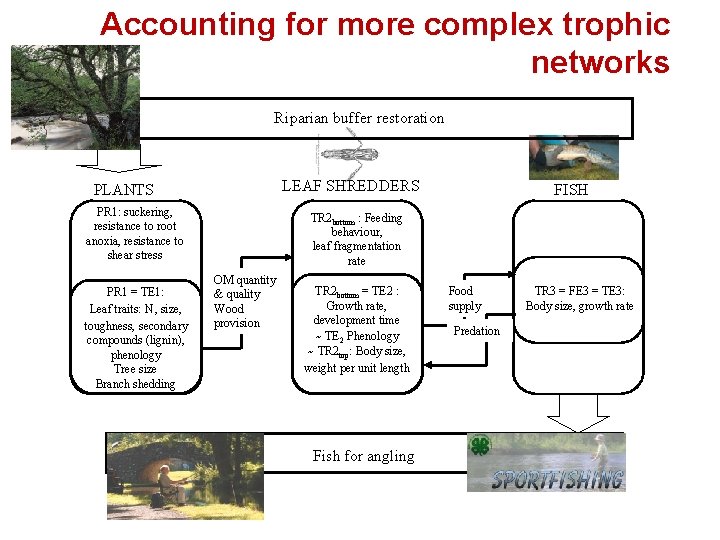
Accounting for more complex trophic networks Riparian buffer restoration LEAF SHREDDERS PLANTS PR 1: suckering, resistance to root anoxia, resistance to shear stress PR 1 = TE 1: Leaf traits: N , size, toughness, secondary compounds (lignin), phenology Tree size Branch shedding FISH TR 2 bottom : Feeding behaviour, leaf fragmentation rate OM quantity & quality Wood provision TR 2 bottom = TE 2 : Growth rate, development time ~ TE 2 Phenology ~ TR 2 top: Body size, weight per unit length Fish for angling Food supply Predation TR 3 = FE 3 = TE 3: Body size, growth rate
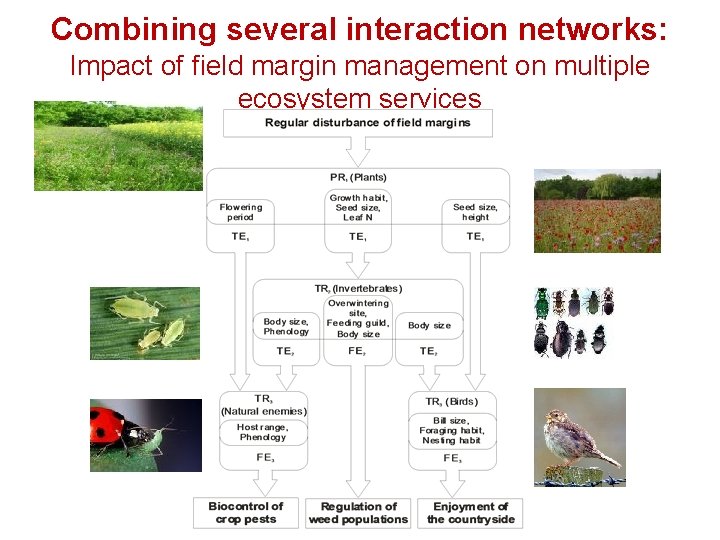
Combining several interaction networks: Impact of field margin management on multiple ecosystem services
Rationalising Biodiversity Conservation in Dynamic Ecosystems A framework for functional biodiversity research www. rubicode. net • A heuristic tool to summarise existing knowledge, test hypotheses, and identify knowledge and data gaps on biotic relationships and processes that underpin different ecosystem functions • Flexbility of the framework: – – – Number and arrangement of trophic levels Types of biotic interactions : trophic but not only Diversity of possible configurations Using trait syndromes rather than traits Comparing implementations under different contexts (climate, fertility. . . ) • Main current limitations : – Knowledge and data availability for traits in many organisms
Rationalising Biodiversity Conservation in Dynamic Ecosystems www. rubicode. net Challenges: Analysing complex dynamics underlying ecosystem functioning • Do stronger linkages between response and effect traits lead to more predictable effects of environmental change on ecosystem services? • When do feedbacks to environmental pressures or between trophic levels enhance or reduce predictability of ecosystem services? • Do trait effects on ecosystem functioning weaken with increasing trophic levels, scales, and with multiple driver interactions?
Rationalising Biodiversity Conservation in Dynamic Ecosystems www. rubicode. net Applications • Quantitative assessments of the effects of environmental change on ecosystem services provided by biodiversity • Indication of ecosystem services • Guiding ecological engineering through the choice of plant trait assemblages that promote the recovery of a multi-trophic community most likely to provide the desired ecosystem services
- Slides: 34