
Rational Vs Irrational Making sense of rational and
- Slides: 16
Rational Vs. Irrational Making sense of rational and Irrational numbers
Today’s Topic Differentiate between rational and irrational numbers.
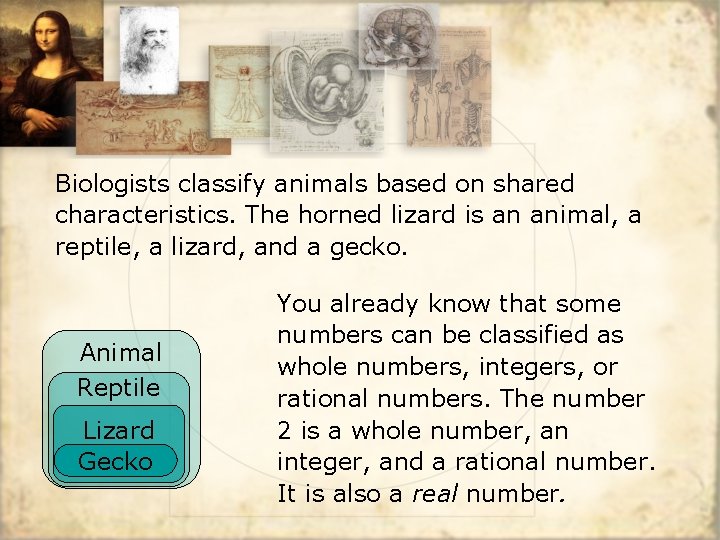
Biologists classify animals based on shared characteristics. The horned lizard is an animal, a reptile, a lizard, and a gecko. Animal Reptile Lizard Gecko You already know that some numbers can be classified as whole numbers, integers, or rational numbers. The number 2 is a whole number, an integer, and a rational number. It is also a real number.
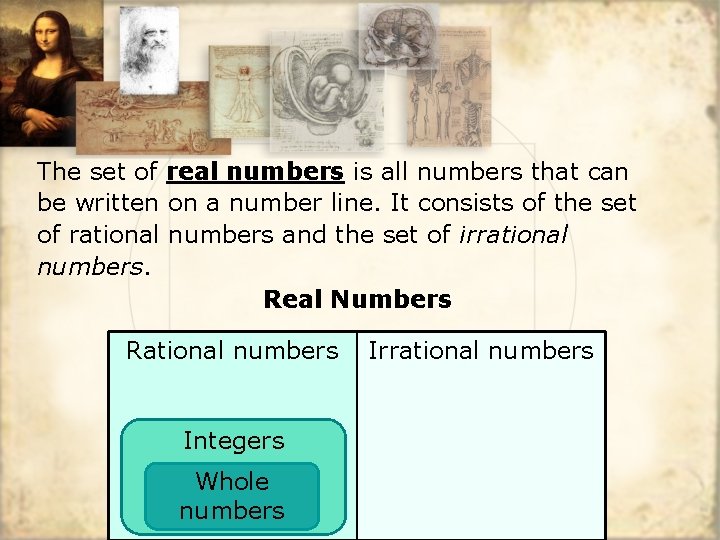
The set of real numbers is all numbers that can be written on a number line. It consists of the set of rational numbers and the set of irrational numbers. Real Numbers Rational numbers Integers Whole numbers Irrational numbers
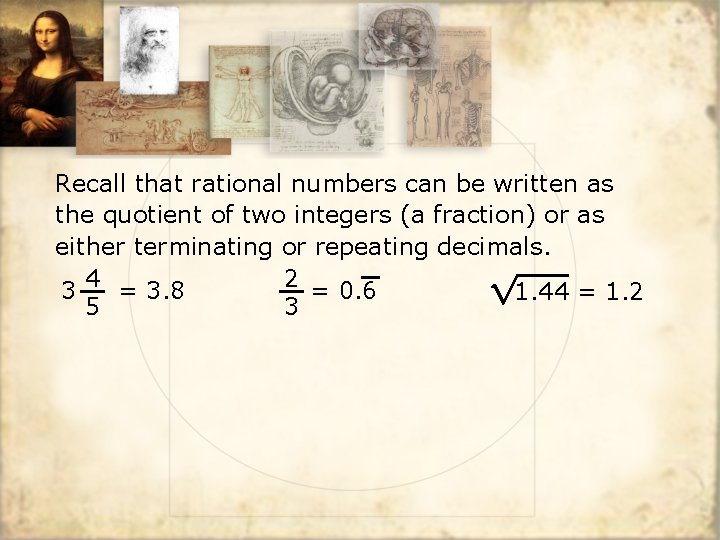
Recall that rational numbers can be written as the quotient of two integers (a fraction) or as either terminating or repeating decimals. 4 2 3 = 3. 8 = 0. 6 1. 44 = 1. 2 5 3
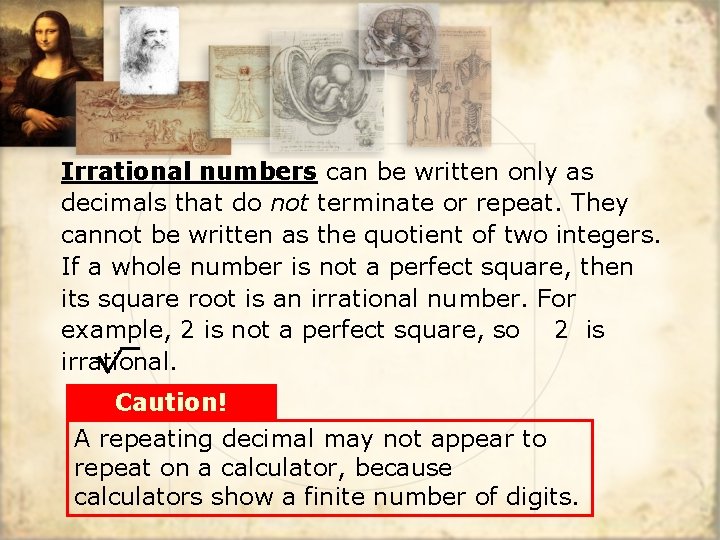
Irrational numbers can be written only as decimals that do not terminate or repeat. They cannot be written as the quotient of two integers. If a whole number is not a perfect square, then its square root is an irrational number. For example, 2 is not a perfect square, so 2 is irrational. Caution! A repeating decimal may not appear to repeat on a calculator, because calculators show a finite number of digits.
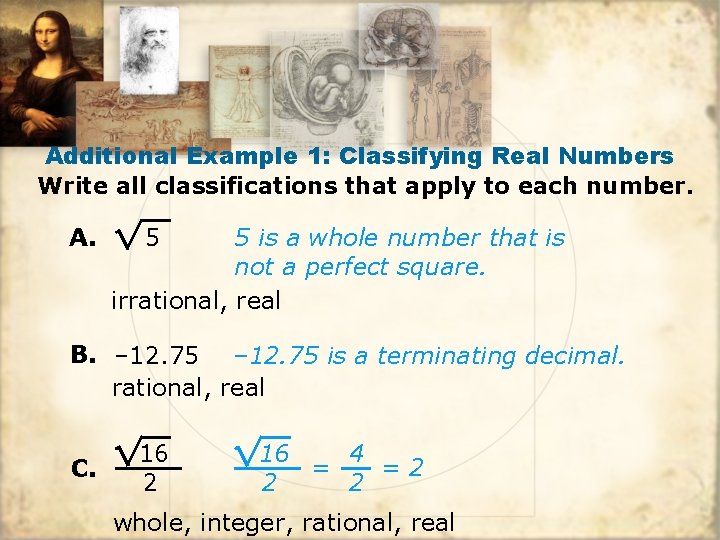
Additional Example 1: Classifying Real Numbers Write all classifications that apply to each number. A. 5 is a whole number that is not a perfect square. irrational, real 5 B. – 12. 75 is a terminating decimal. rational, real C. 16 2 16 4 = =2 2 2 whole, integer, rational, real
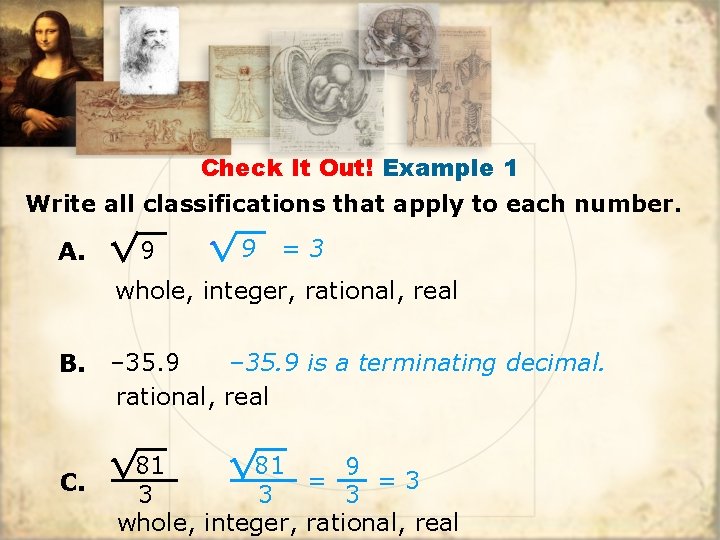
Check It Out! Example 1 Write all classifications that apply to each number. A. 9 9 =3 whole, integer, rational, real B. C. – 35. 9 is a terminating decimal. rational, real 81 81 9 = =3 3 whole, integer, rational, real
A fraction with a denominator of 0 is undefined because you cannot divide by zero. So it is not a number at all.
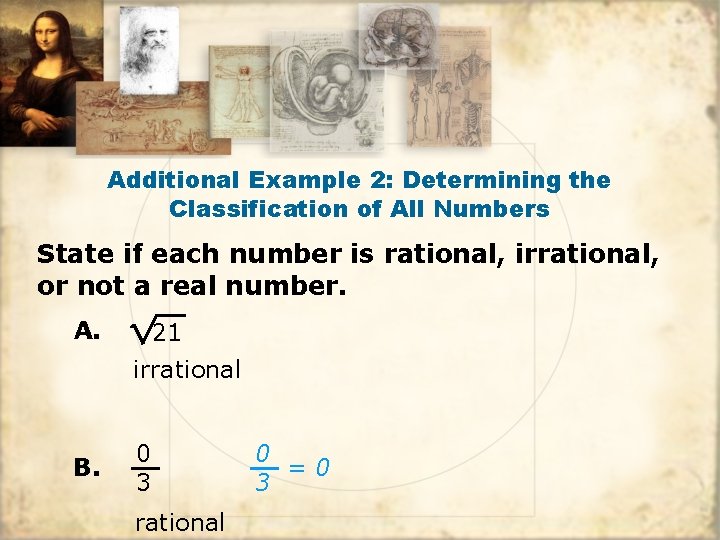
Additional Example 2: Determining the Classification of All Numbers State if each number is rational, irrational, or not a real number. A. 21 irrational B. 0 3 rational 0 =0 3
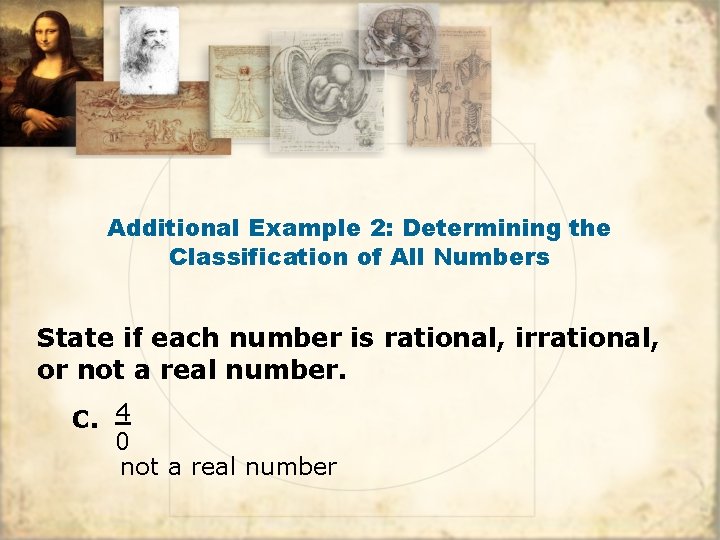
Additional Example 2: Determining the Classification of All Numbers State if each number is rational, irrational, or not a real number. C. 4 0 not a real number
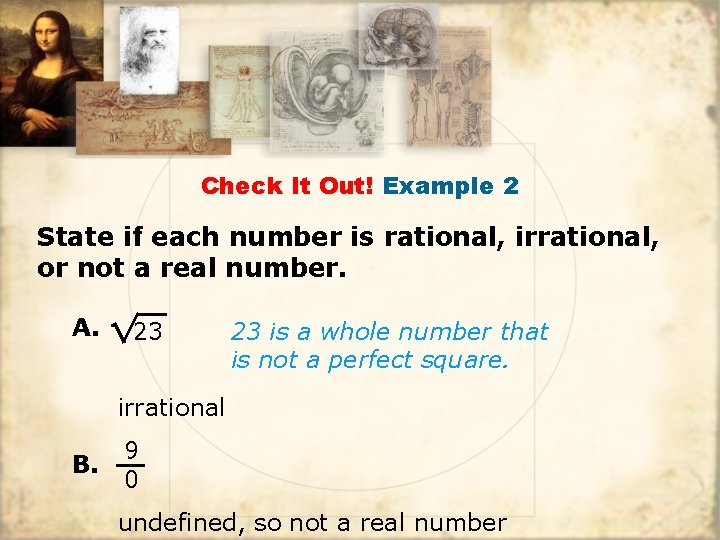
Check It Out! Example 2 State if each number is rational, irrational, or not a real number. A. 23 23 is a whole number that is not a perfect square. irrational B. 9 0 undefined, so not a real number
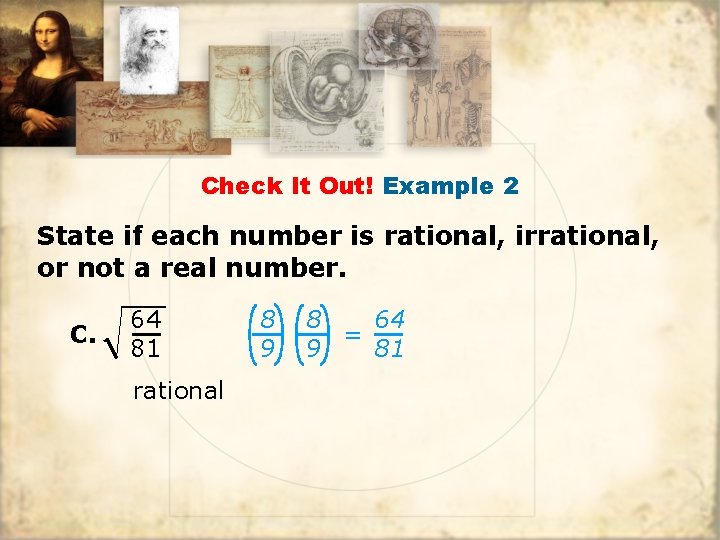
Check It Out! Example 2 State if each number is rational, irrational, or not a real number. C. 64 81 rational 8 9 8 64 = 9 81
Adding and Subtracting Rational Numbers We can add and subtract rational numbers by finding the square root and doing the order of operations
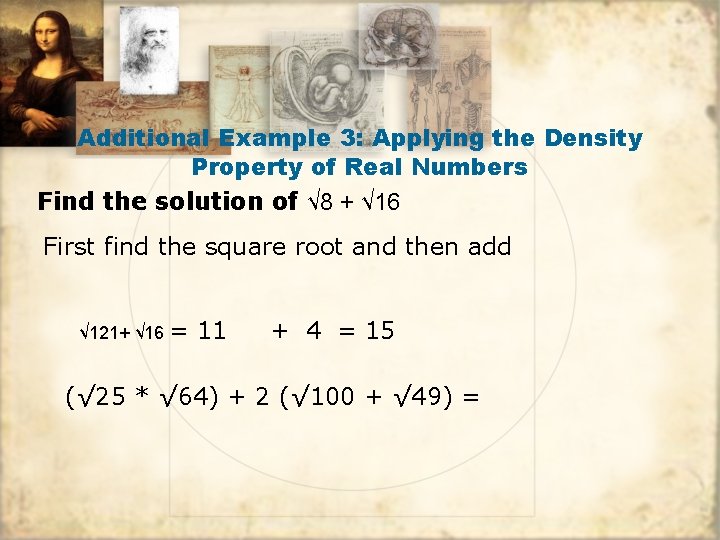
Additional Example 3: Applying the Density Property of Real Numbers Find the solution of √ 8 + √ 16 First find the square root and then add √ 121+ √ 16 = 11 + 4 = 15 (√ 25 * √ 64) + 2 (√ 100 + √ 49) =
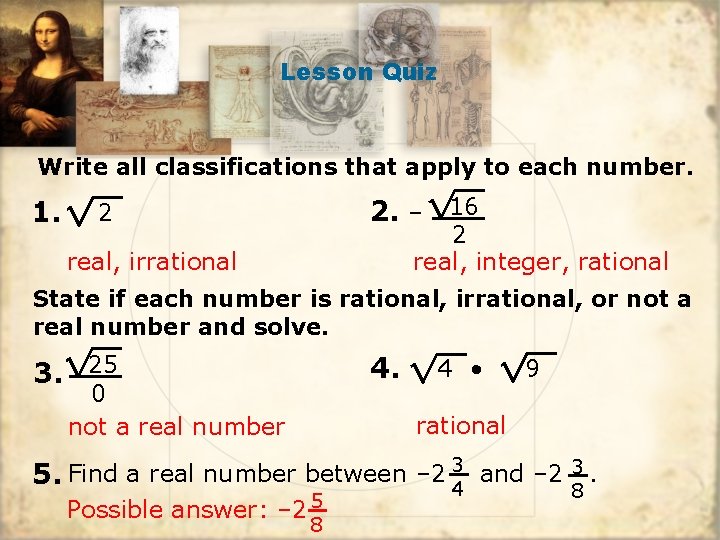
Lesson Quiz Write all classifications that apply to each number. 1. 2. – 16 2 2 real, integer, rational real, irrational State if each number is rational, irrational, or not a real number and solve. 3. 25 4. 0 not a real number 4 • 9 rational 5. Find a real number between – 2 34 and – 2 38. Possible answer: – 2 5 8