
Rational Root Division Factor and Remainder Theorems and

- Slides: 18
Rational Root, Division, Factor and Remainder Theorems and Synthetic Division PRESENTED BY: ANTHONY D. CORDERO
Introduction These theorems aid us in conducting polynomial division. Each of these theorems contribute to us beginning synthetic division. These theorems are critical in helping us find rational roots, and determine the solutions to a polynomial. This concept is introduced in Algebra II.
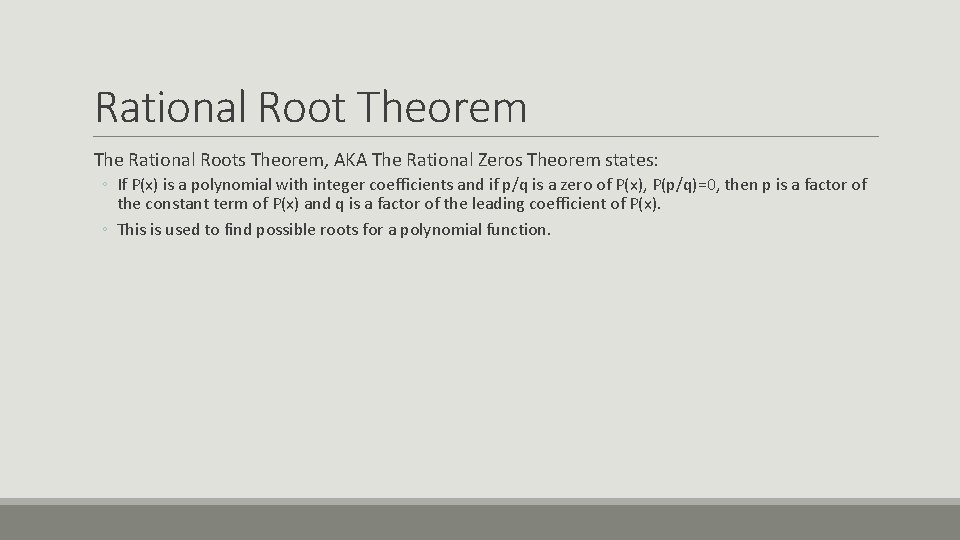
Rational Root Theorem The Rational Roots Theorem, AKA The Rational Zeros Theorem states: ◦ If P(x) is a polynomial with integer coefficients and if p/q is a zero of P(x), P(p/q)=0, then p is a factor of the constant term of P(x) and q is a factor of the leading coefficient of P(x). ◦ This is used to find possible roots for a polynomial function.
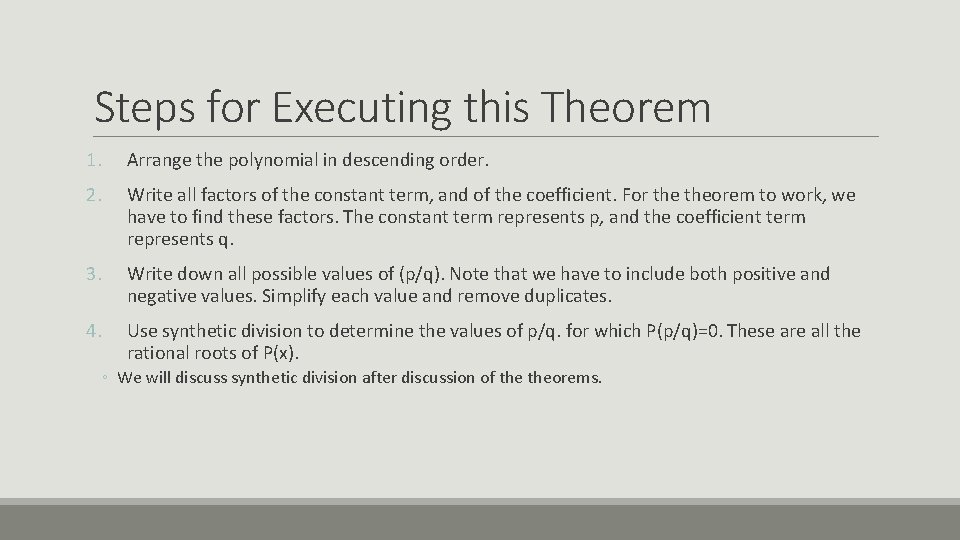
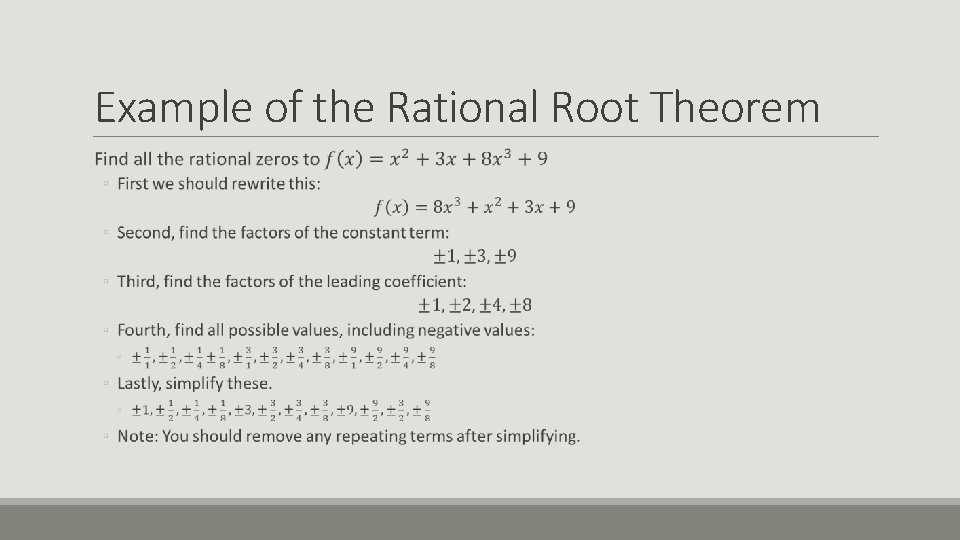
Steps for Executing this Theorem 1. Arrange the polynomial in descending order. 2. Write all factors of the constant term, and of the coefficient. For theorem to work, we have to find these factors. The constant term represents p, and the coefficient term represents q. 3. Write down all possible values of (p/q). Note that we have to include both positive and negative values. Simplify each value and remove duplicates. 4. Use synthetic division to determine the values of p/q. for which P(p/q)=0. These are all the rational roots of P(x). ◦ We will discuss synthetic division after discussion of theorems.
Example of the Rational Root Theorem
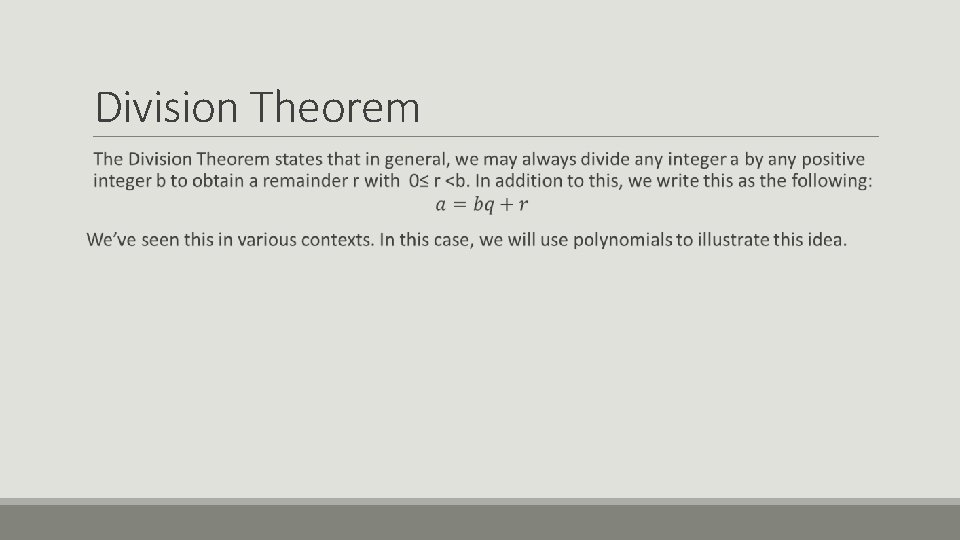
Division Theorem
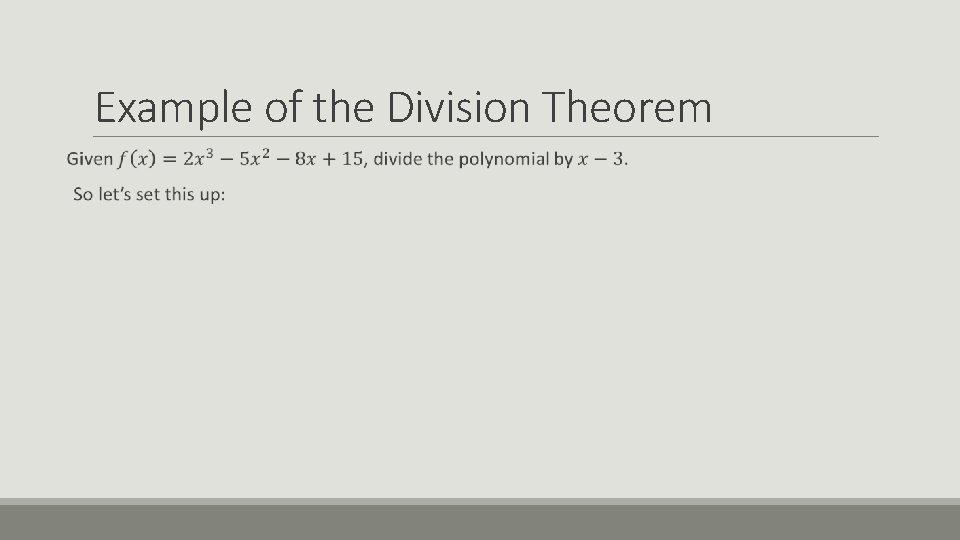
Example of the Division Theorem
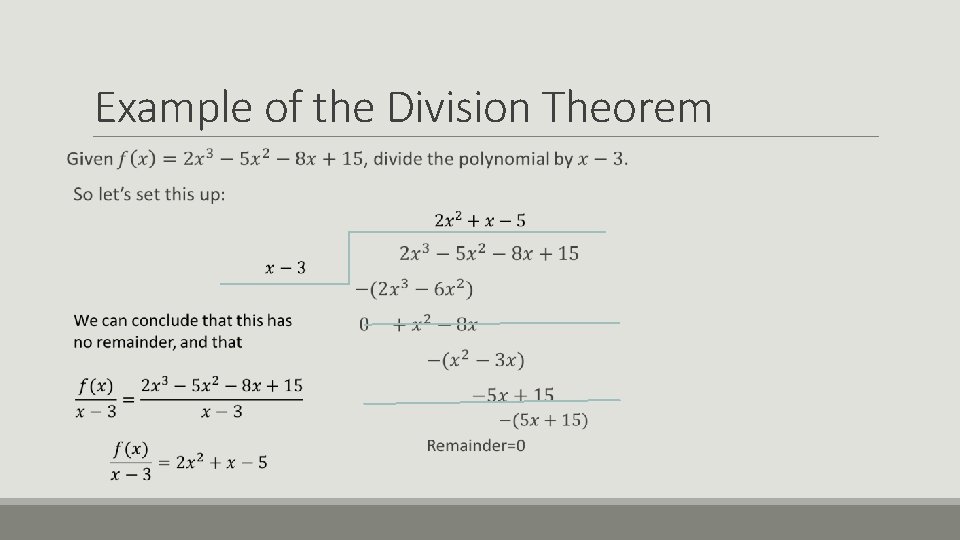
Example of the Division Theorem
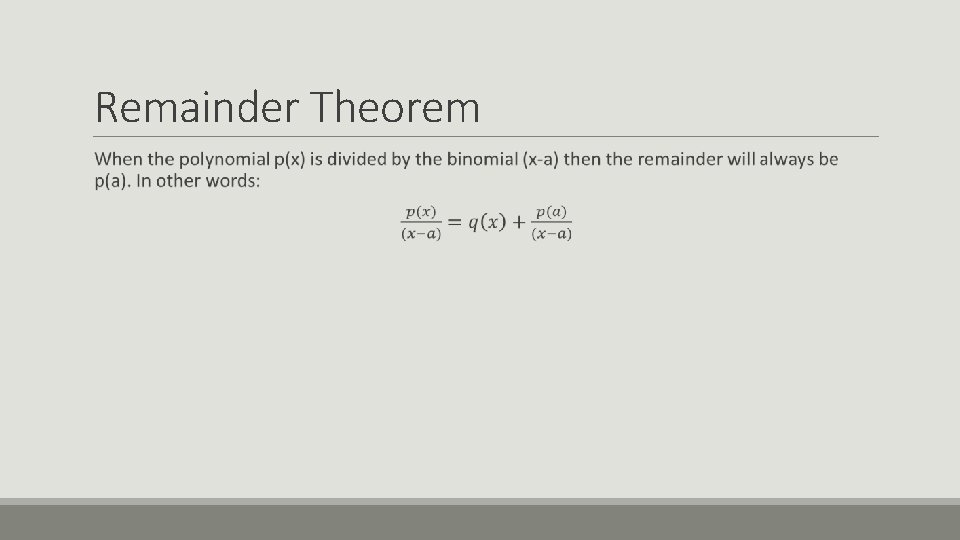
Remainder Theorem
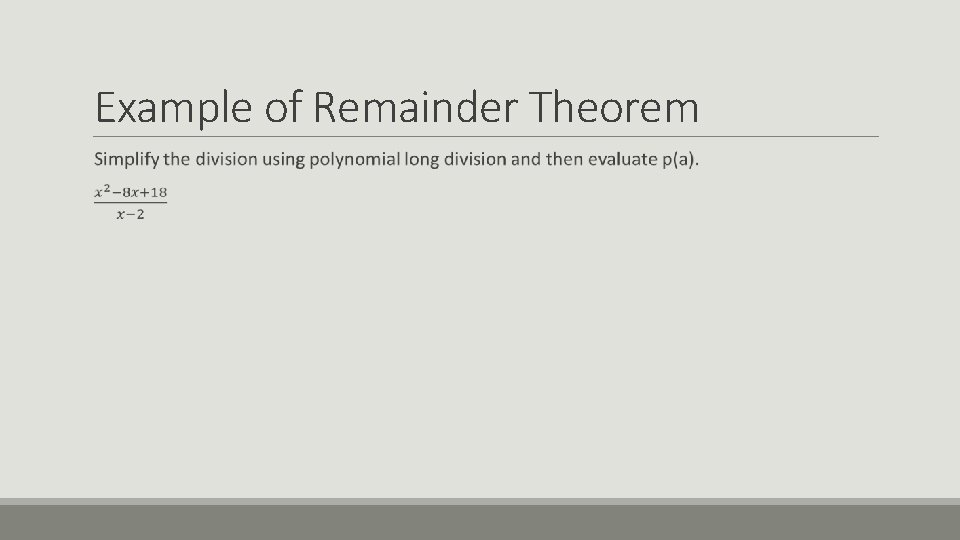
Example of Remainder Theorem
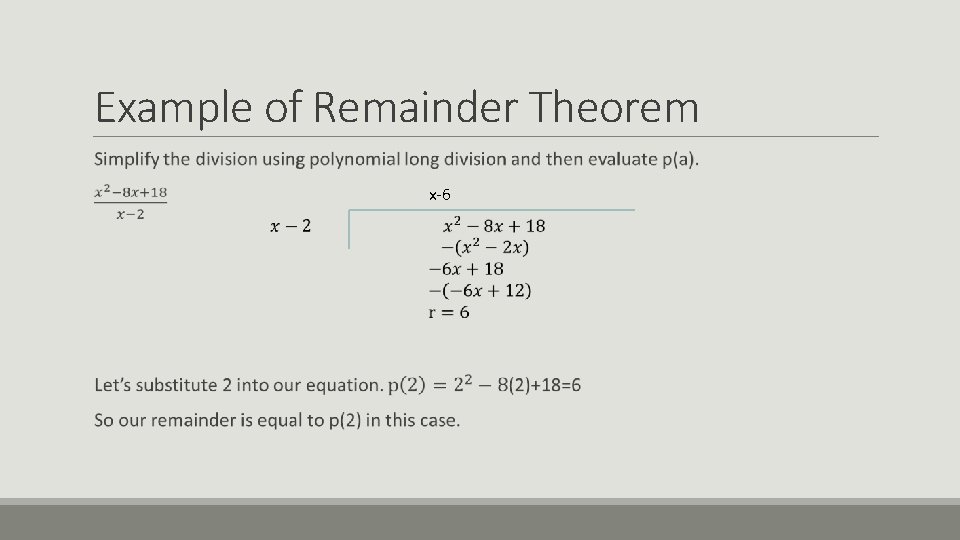
Example of Remainder Theorem x-6
Factor Theorem The factor theorem states that the real number c is a zero of p if and only if (x-c) is a factor of p(x). We use this theorem to test if a given equation is a factor of a given polynomial.
Synthetic Division All of these theorems go hand in hand when completing polynomial division, and often times will help us in conducting synthetic division. Synthetic division is a shorthand version of polynomial long division. To do synthetic division, we have to find possible factors for the polynomial. (This is the Rational Root Theorem) We can also find a factor by finding the solution of (x-c), where c is the constant term (This is the Remainder Theorem)
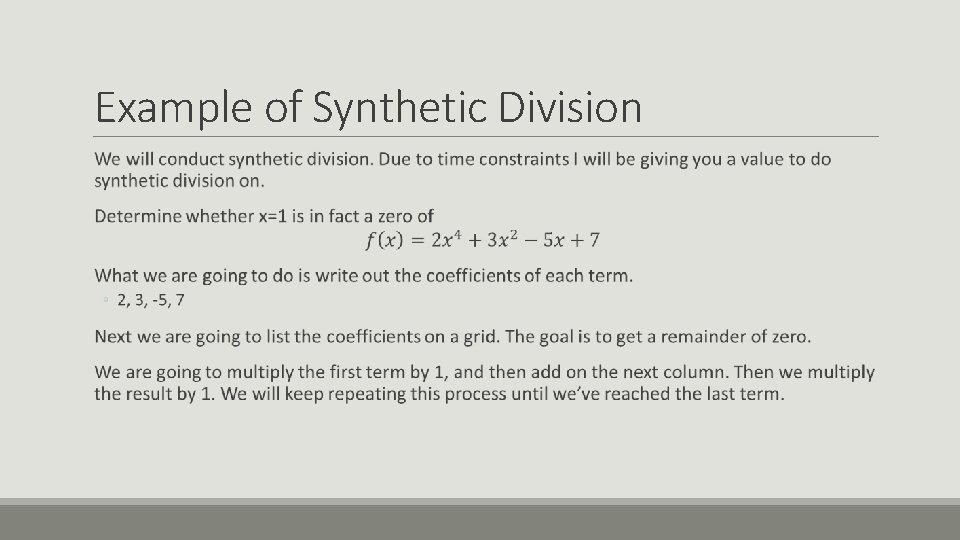
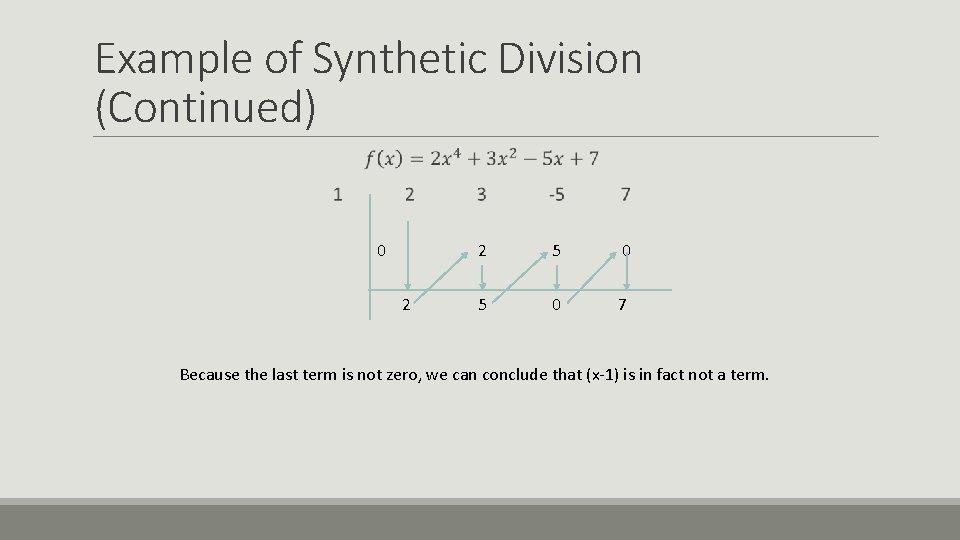
Example of Synthetic Division
Example of Synthetic Division (Continued) 0 2 2 5 0 7 Because the last term is not zero, we can conclude that (x-1) is in fact not a term.
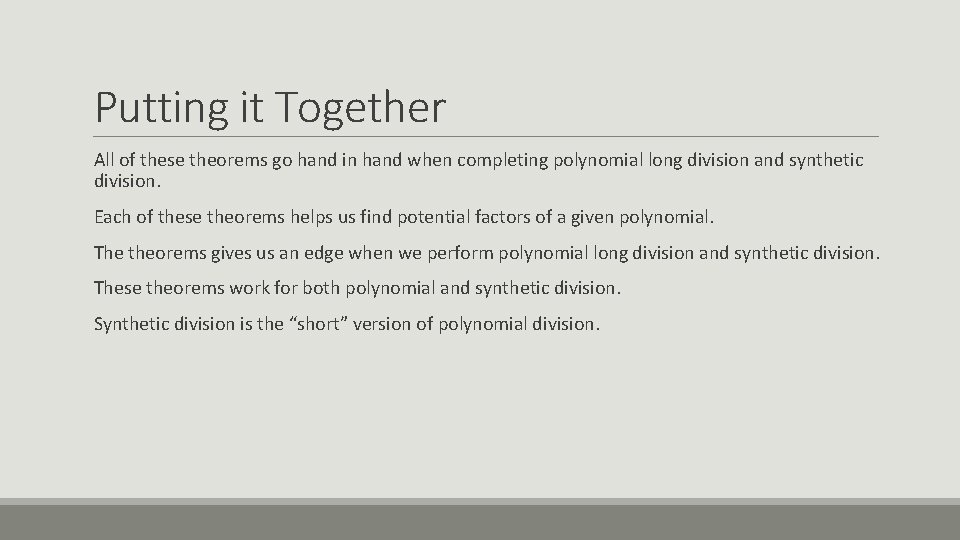
Putting it Together All of these theorems go hand in hand when completing polynomial long division and synthetic division. Each of these theorems helps us find potential factors of a given polynomial. The theorems gives us an edge when we perform polynomial long division and synthetic division. These theorems work for both polynomial and synthetic division. Synthetic division is the “short” version of polynomial division.
References: http: //www. sparknotes. com/math/algebra 2/polynomials/section 4/ http: //www. math. ucsd. edu/~benchow/Division. Theorem. pdf https: //www. shsu. edu/~kws 006/Precalculus/2. 3_Zeroes_of_Polynomials_files/S%26 Z%203. 2. pd f https: //www. mathsisfun. com/algebra/polynomials-remainder-factor. html http: //www. purplemath. com/modules/synthdiv. htm https: //emathinstruction. com/wp-content/uploads/2015/08/CCAlg. II-U 10 L 11 -The-Remainder. Theorem. pdf
Questions or Comments?