
Rational Numbers 5 2 Converting Decimals to Fractions
Rational Numbers 5 -2
Converting Decimals to Fractions • To convert a decimal to a fraction: 1) Determine where the decimal ends 2) Place the numerals after the decimal over the appropriate denominator If there is a whole number, it stays whole, just add it on at the end. 3) Simplify Let’s try one….

Converting Decimals to Fractions Convert 0. 3 to a fraction using the steps in the previous slide. 0 hs tho usa ndt s dre dth 3 hun ths ten CIM AL DE es on ten s PO INT Step 1: determine where the decimal ends Our decimal ends in the tenths place.

Converting Decimals to Fractions Convert 0. 3 to a fraction using the steps in the previous slide. Only 33 Step 2: place the numerals after the decimal point over the appropriate denominator. We discovered that our decimal ends in the tenths place. So our appropriate 10 denominator is 10.
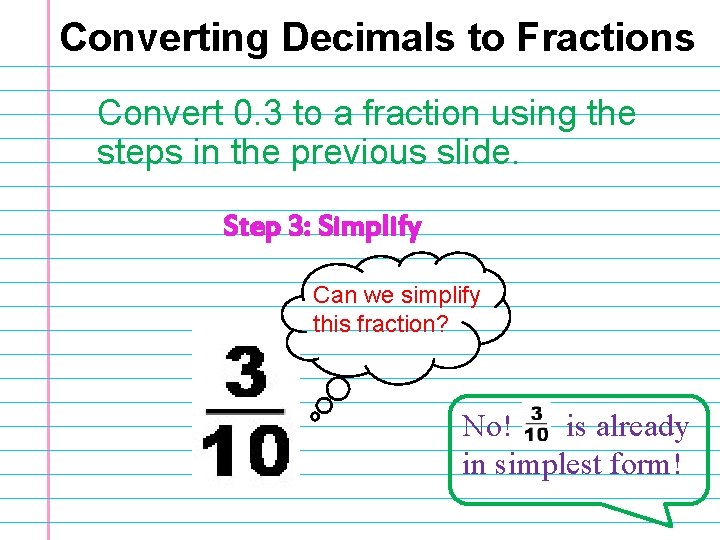
Converting Decimals to Fractions Convert 0. 3 to a fraction using the steps in the previous slide. Step 3: Simplify Can we simplify this fraction? No! is already in simplest form!
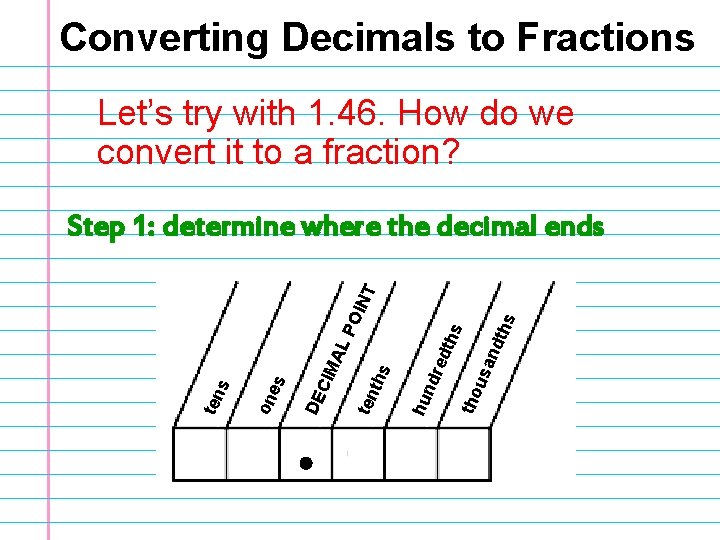
Converting Decimals to Fractions Let’s try with 1. 46. How do we convert it to a fraction? hs tho usa ndt s dth dre hun ths ten CIM AL DE es on ten s PO INT Step 1: determine where the decimal ends
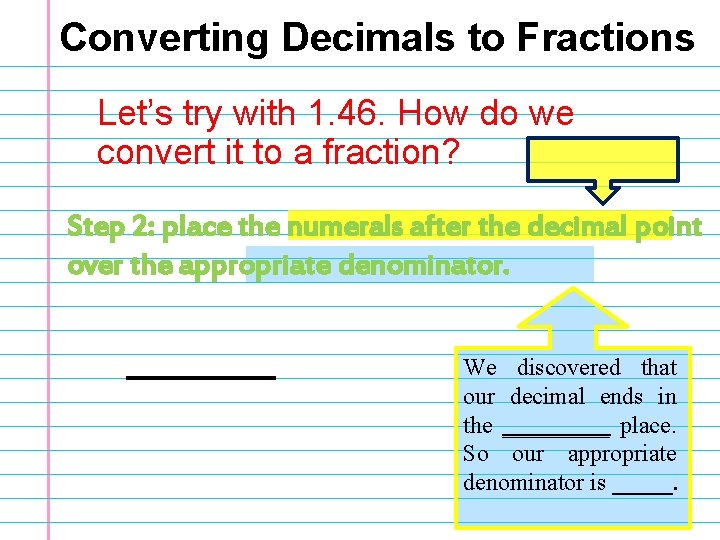
Converting Decimals to Fractions Let’s try with 1. 46. How do we convert it to a fraction? Step 2: place the numerals after the decimal point over the appropriate denominator. We discovered that our decimal ends in the _____ place. So our appropriate denominator is _____.
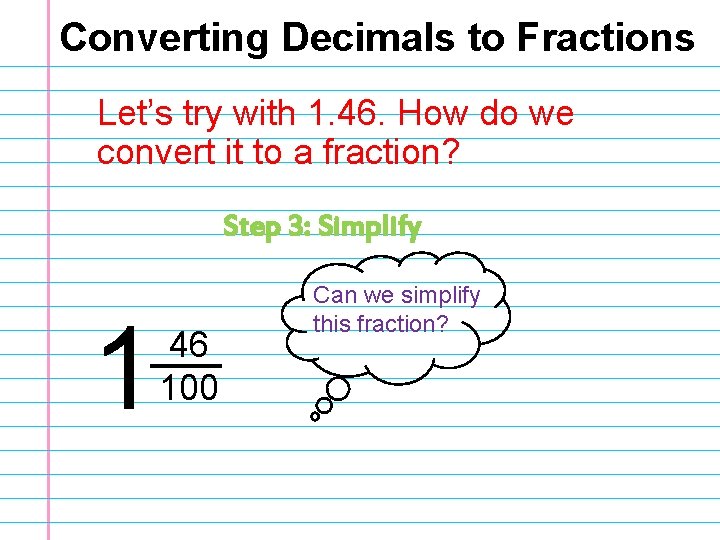
Converting Decimals to Fractions Let’s try with 1. 46. How do we convert it to a fraction? Step 3: Simplify 1 46 100 Can we simplify this fraction?

Converting Decimals to Fractions • When you have a repeating decimal, your appropriate denominator is a multiple of 9. 1) If the numerals after the decimal begin to repeat in the tenths place, our denominator is 9, if they begin to repeat in the hundredths place, our denominator is 99. Let’s try one….
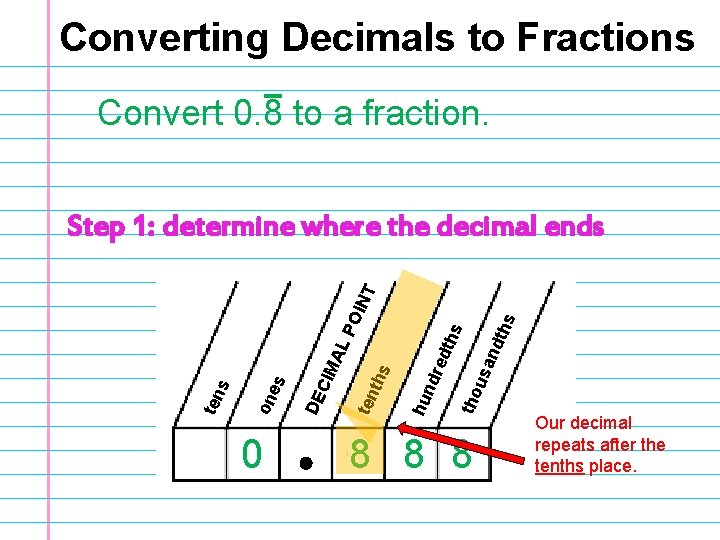
Converting Decimals to Fractions Convert 0. 8 to a fraction. 0 hs s tho usa ndt dth dre hun ths ten CIM AL DE es on ten s PO INT Step 1: determine where the decimal ends 8 8 8 Our decimal repeats after the tenths place.
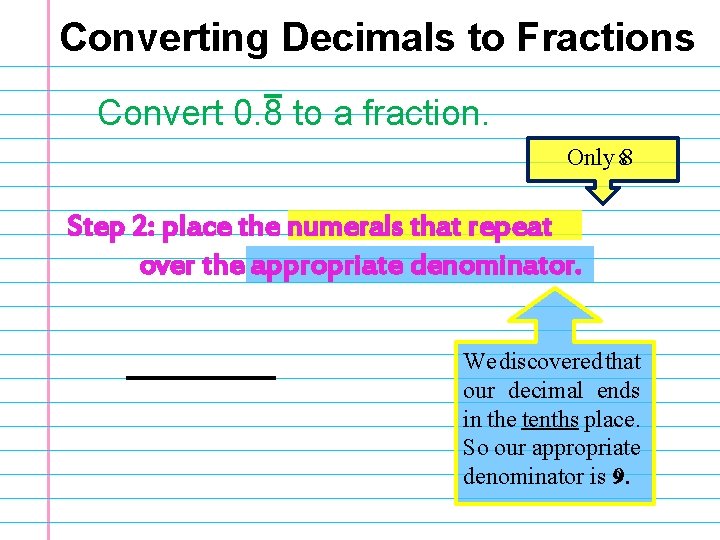
Converting Decimals to Fractions Convert 0. 8 to a fraction. Only 88 Step 2: place the numerals that repeat over the appropriate denominator. We discovered that our decimal ends in the tenths place. So our appropriate 9 denominator is 9.
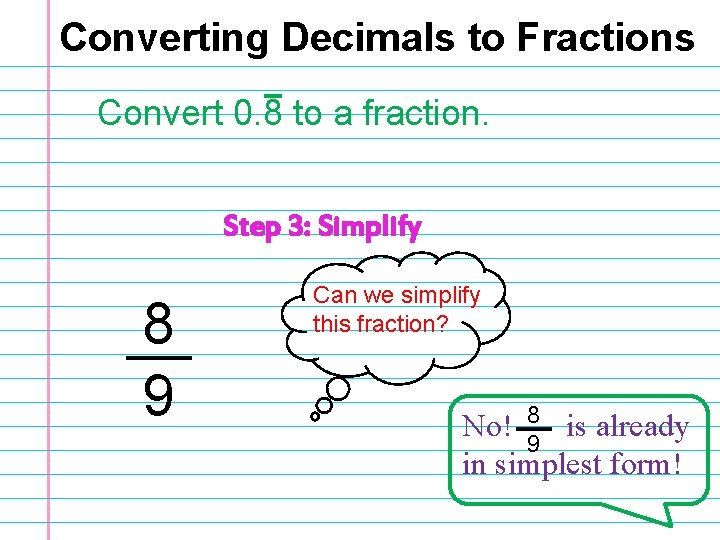
Converting Decimals to Fractions Convert 0. 8 to a fraction. Step 3: Simplify 8 9 Can we simplify this fraction? No! 89 is already in simplest form!
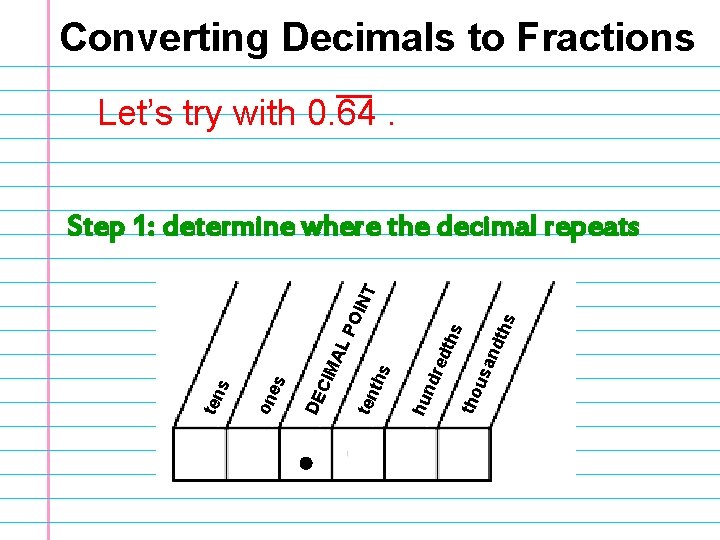
Converting Decimals to Fractions Let’s try with 0. 64. hs tho usa ndt s dth dre hun ths ten CIM AL DE es on ten s PO INT Step 1: determine where the decimal repeats
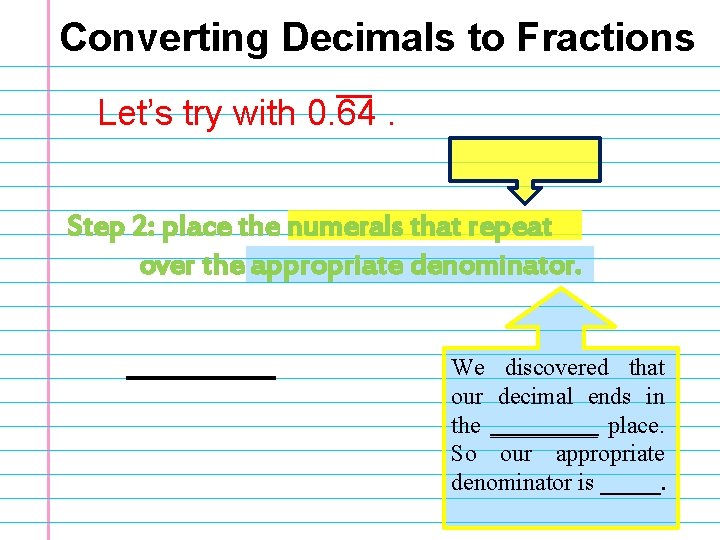
Converting Decimals to Fractions Let’s try with 0. 64. Step 2: place the numerals that repeat over the appropriate denominator. We discovered that our decimal ends in the _____ place. So our appropriate denominator is _____.
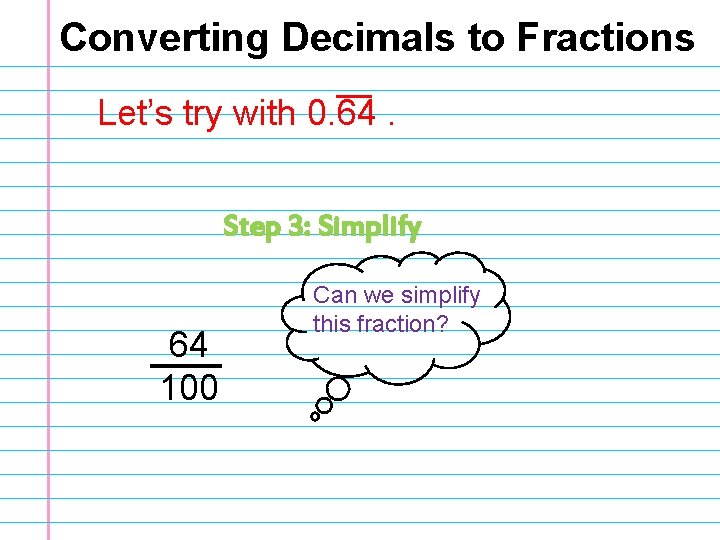
Converting Decimals to Fractions Let’s try with 0. 64. Step 3: Simplify 64 100 Can we simplify this fraction?

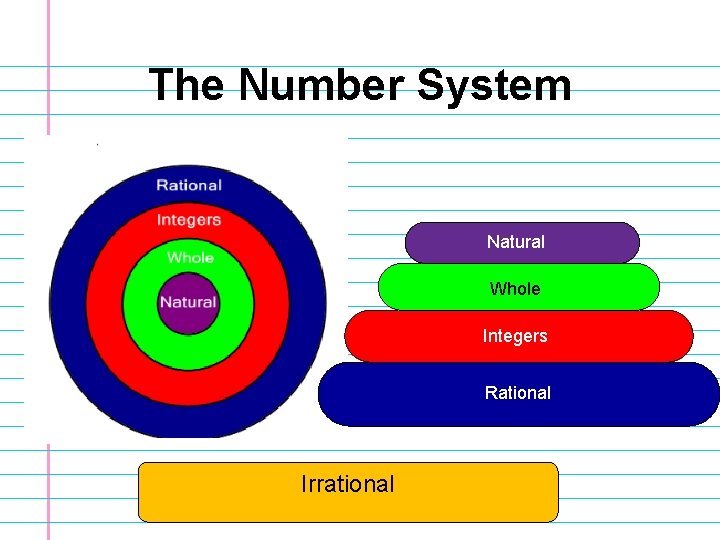
The Number System

Natural Numbers • Natural numbers are all positive whole numbers that are not zero. These are also called counting numbers. 859 14 9 1, 187 68
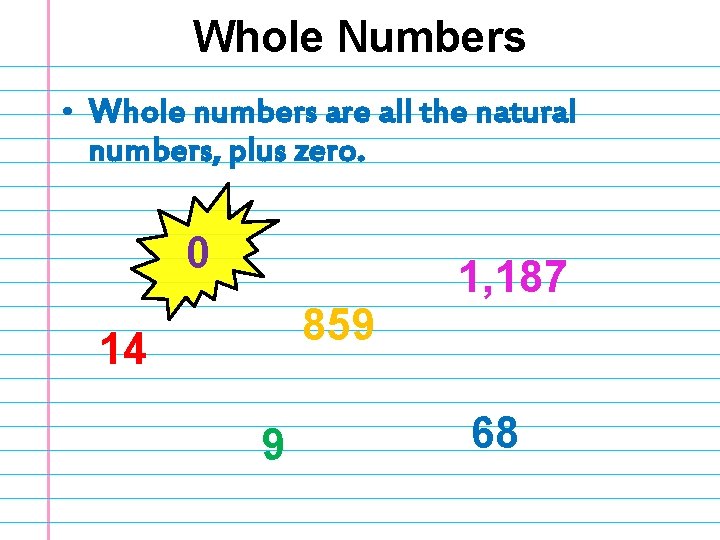
Whole Numbers • Whole numbers are all the natural numbers, plus zero. 0 859 14 9 1, 187 68
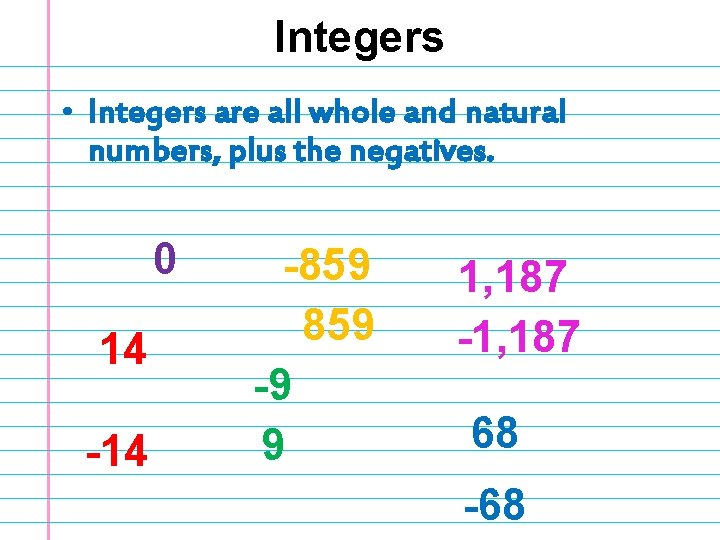
Integers • Integers are all whole and natural numbers, plus the negatives. 0 14 -859 -9 9 1, 187 -1, 187 68 -68
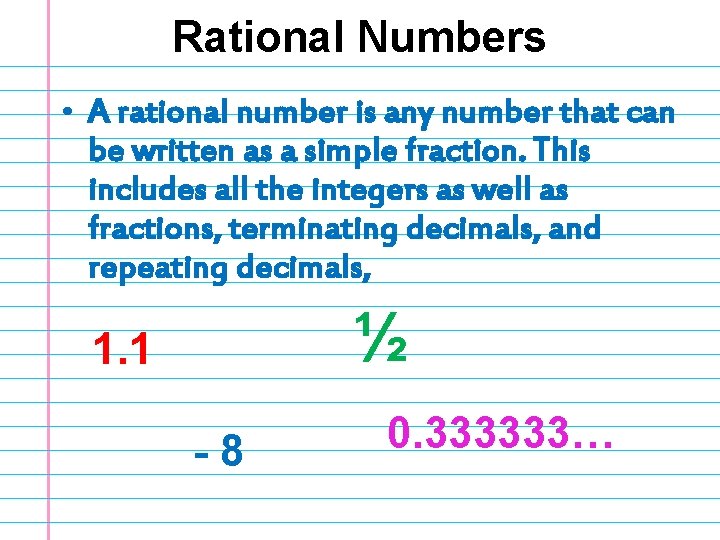
Rational Numbers • A rational number is any number that can be written as a simple fraction. This includes all the integers as well as fractions, terminating decimals, and repeating decimals, ½ 1. 1 -8 0. 333333…
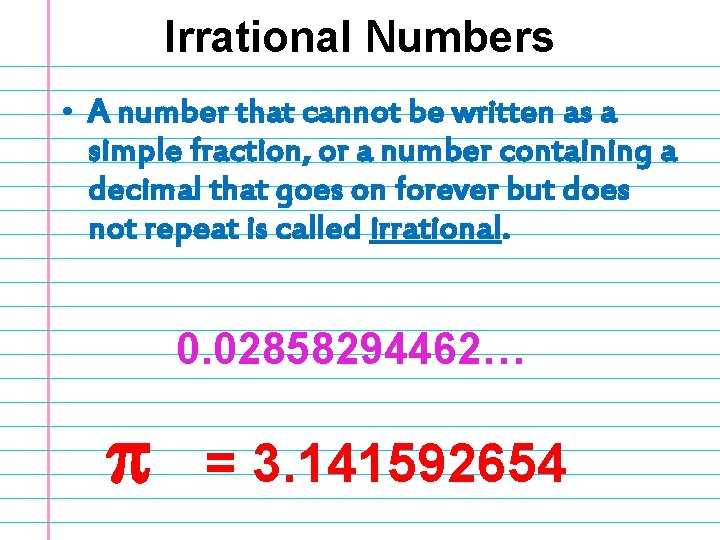
Irrational Numbers • A number that cannot be written as a simple fraction, or a number containing a decimal that goes on forever but does not repeat is called irrational. 0. 02858294462… = 3. 141592654

HOW ABOUT A SONG? http: //www. youtube. com/watch? v=m 94 WTZP 14 SA
The Number System Natural Whole Integers Rational Irrational

- Slides: 27