
Rational Game Design Workshop Presented by Jason Wiser
Rational Game Design Workshop Presented by Jason Wiser, with thanks to Alexis Jolis Desautels of Ubisoft and Susan Gold
Welcome to the Class! PRESENTATION FORMAT: This workshop is designed to be interactive. I hope you are ready to think and contribute! TOOLS: • We will use this Google Doc to share ideas (see link in Zoom chat) : https: //bit. ly/33 WQEh 7 • Depending on the number of attendees, we plan to use Zoom Breakout Rooms and the Annotate function (drawing on the screen– please find it now, and use when requested). • Please be fully present in this presentation: keep your video on! • Please keep your audio off unless you are speaking (hold spacebar to speak) • 3 ways to engage in this lecture: o Speak verbally o Type into the whiteboard o Type in to the chat
RATIONAL GAME DESIGN This talk is an interactive, 1 -hour presentation & exercises based on the April 2016 2 -day, 10 hour/day workshop at NU by Alexis Jolis Desautels, based on Ubisoft’s 9 -day, 8 hours/day intensive and secret RGD training program, leaked in the Gamasutra article “Rational Design: The Core of Rayman Origins” by Chris Mc. Entee… …so we can talk about it.
Presentation Format Let us start with the problem Rational Game Design seeks to address: What is a game you or someone you know has stopped playing because it suddenly got too hard, or too easy? In the class whiteboard (Google Doc), please type any answers. Why is it a potential problem if a game suddenly gets too hard, or too easy?
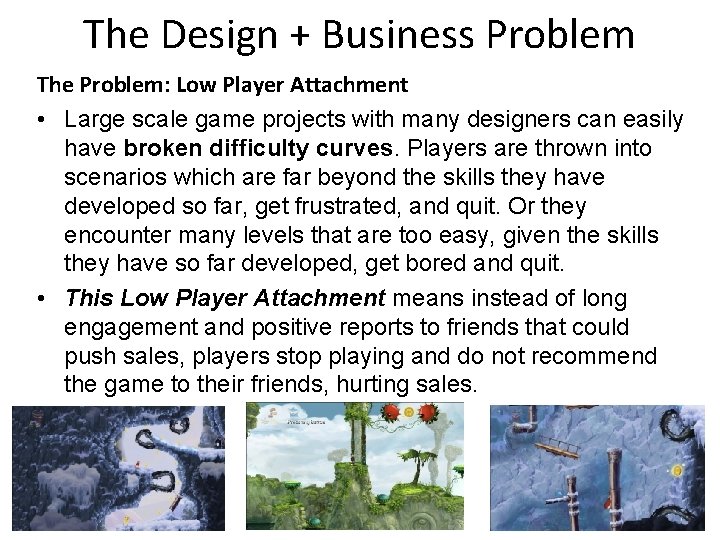
The Design + Business Problem The Problem: Low Player Attachment • Large scale game projects with many designers can easily have broken difficulty curves. Players are thrown into scenarios which are far beyond the skills they have developed so far, get frustrated, and quit. Or they encounter many levels that are too easy, given the skills they have so far developed, get bored and quit. • This Low Player Attachment means instead of long engagement and positive reports to friends that could push sales, players stop playing and do not recommend the game to their friends, hurting sales.
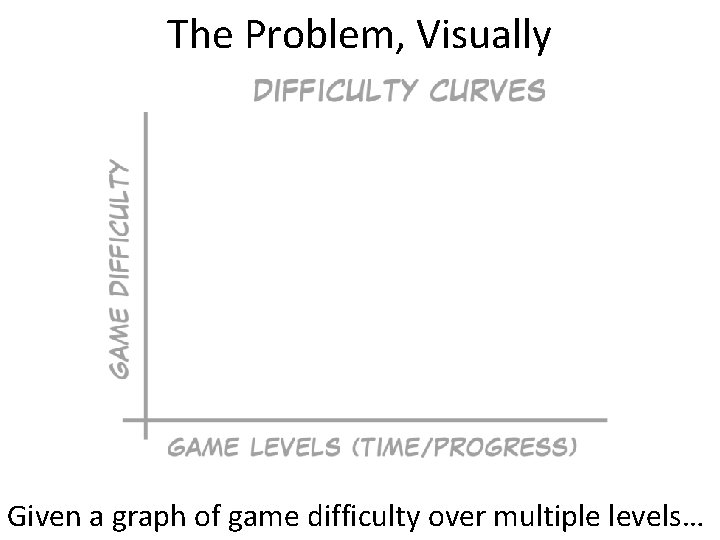
The Problem, Visually Given a graph of game difficulty over multiple levels…
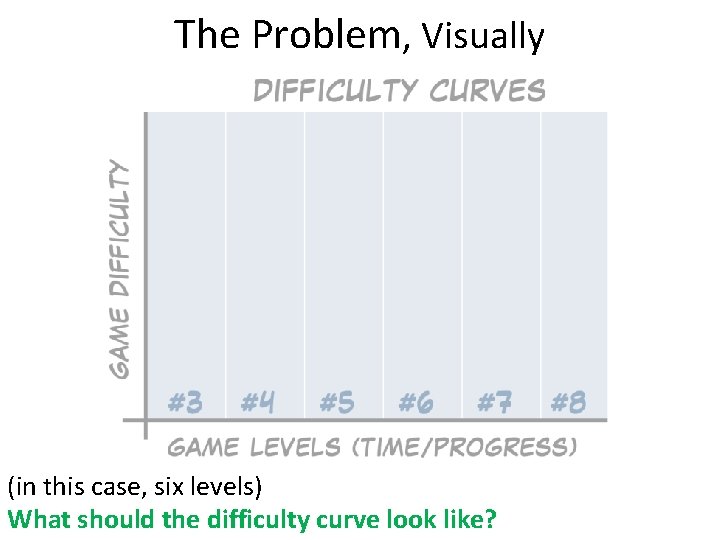
The Problem, Visually (in this case, six levels) What should the difficulty curve look like?
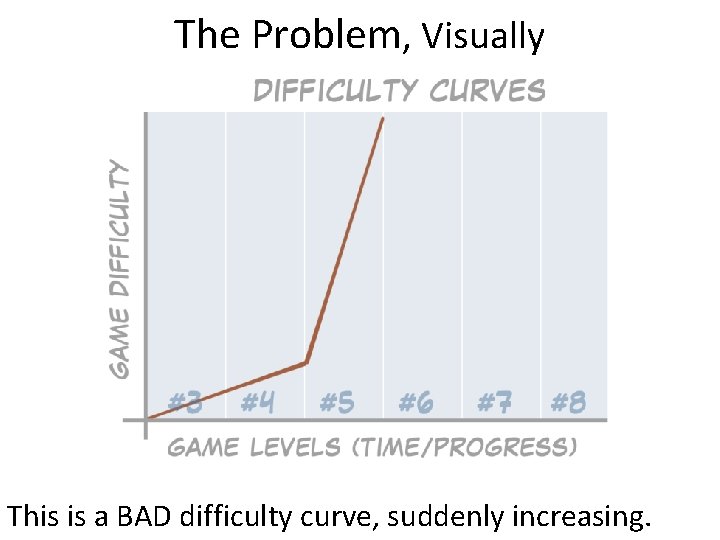
The Problem, Visually This is a BAD difficulty curve, suddenly increasing.
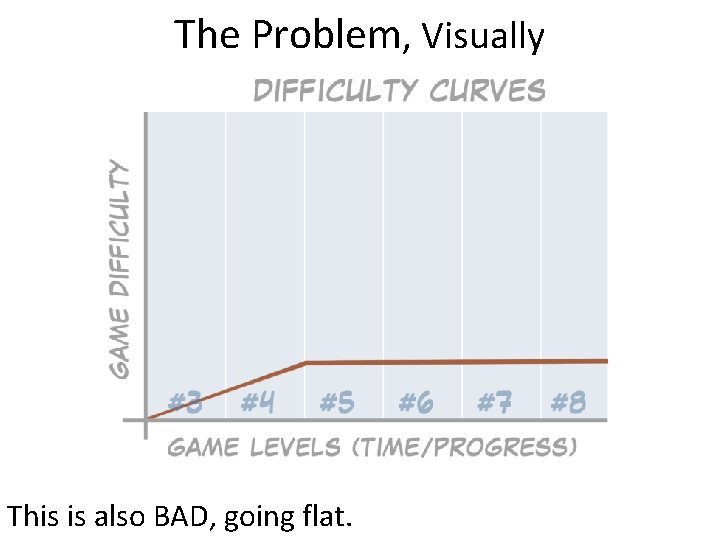
The Problem, Visually This is also BAD, going flat.
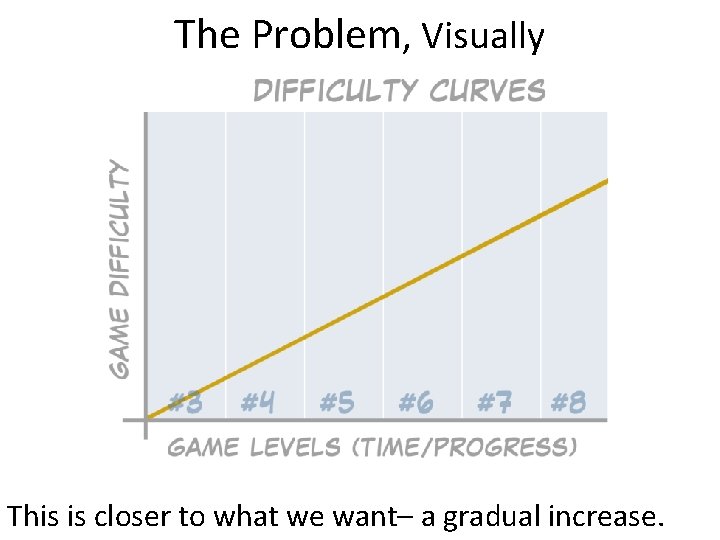
The Problem, Visually This is closer to what we want– a gradual increase.
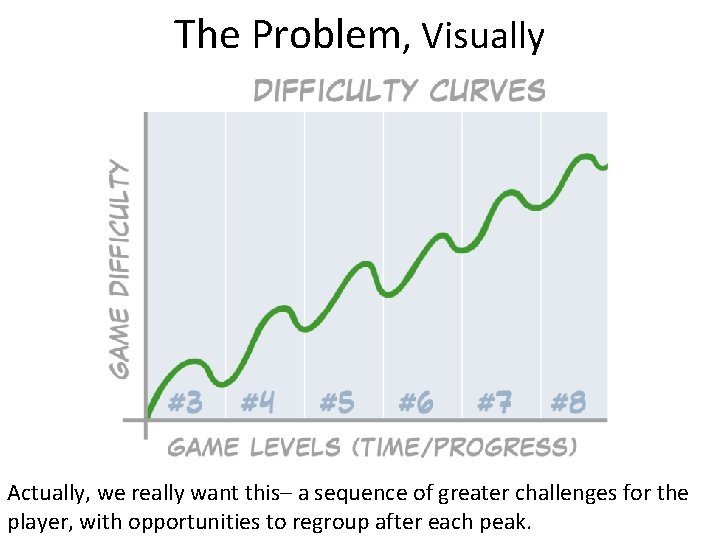
The Problem, Visually Actually, we really want this– a sequence of greater challenges for the player, with opportunities to regroup after each peak.
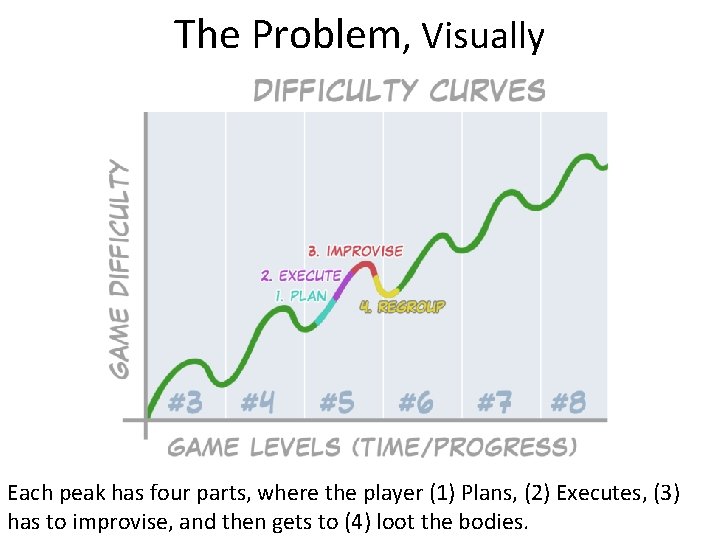
The Problem, Visually Each peak has four parts, where the player (1) Plans, (2) Executes, (3) has to improvise, and then gets to (4) loot the bodies.
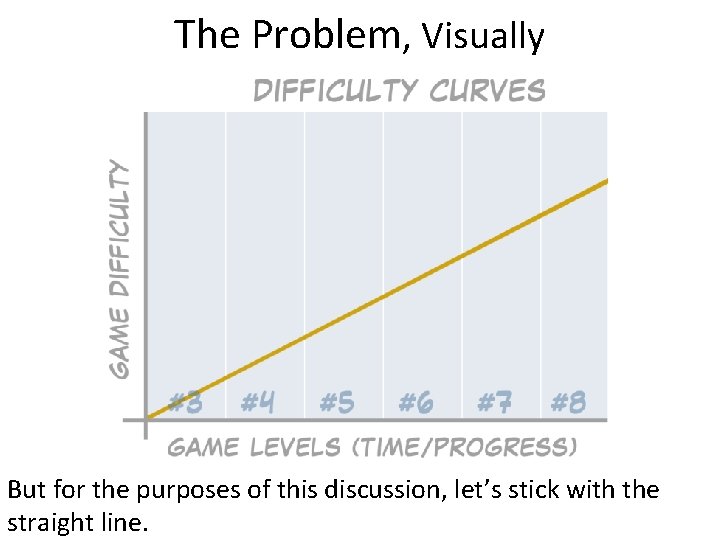
The Problem, Visually But for the purposes of this discussion, let’s stick with the straight line.
Rational Game Design: In a Nutshell DEFINITIONS: There are many ways to think of a game (as a way to inspire creative problem solving, or experience stories, etc), let us focus on one that defines DIFFICULTY: Games offer a system for players to gain MASTERY over a specific set of SKILLS. If we think of a game as a way for players to learn and gain mastery over skills, then a game’s difficulty curve is managed by how we pace the introduction of those skills (not all at once!), introduce easy challenges to test ability with those skills, and gradually increase the difficulty of challenges over multiple levels to both push and test progressive mastery of those skills. This may seem obvious, and many designers try to accomplish this with their intuitive feel over the game experience, and/or through large amounts of playtesting and revision. BUT, Ubisoft was losing money on many of their multi-million dollar projects using just these methods, and so they developed a concrete, visual, shareable method of planning what skills would be introduced, and when, and how to track the progressive difficulty of scenarios testing those skills.
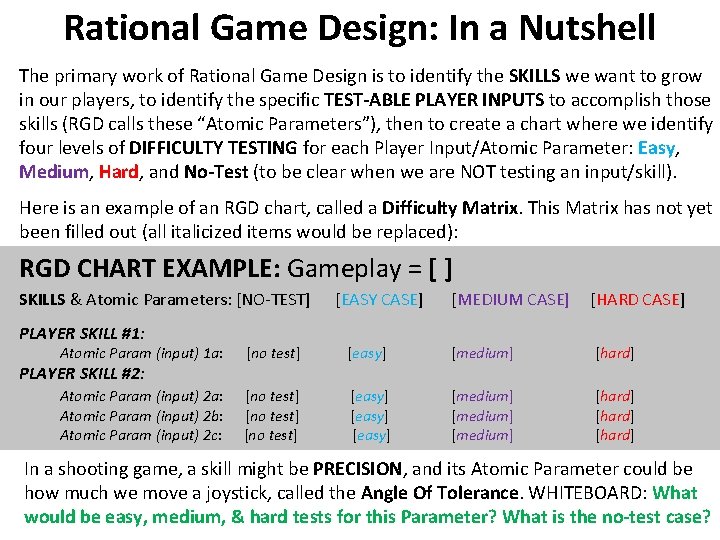
Rational Game Design: In a Nutshell The primary work of Rational Game Design is to identify the SKILLS we want to grow in our players, to identify the specific TEST-ABLE PLAYER INPUTS to accomplish those skills (RGD calls these “Atomic Parameters”), then to create a chart where we identify four levels of DIFFICULTY TESTING for each Player Input/Atomic Parameter: Easy, Medium, Hard, and No-Test (to be clear when we are NOT testing an input/skill). Here is an example of an RGD chart, called a Difficulty Matrix. This Matrix has not yet been filled out (all italicized items would be replaced): RGD CHART EXAMPLE: Gameplay = [ ] SKILLS & Atomic Parameters: [NO-TEST] PLAYER SKILL #1: [EASY CASE] [MEDIUM CASE] [HARD CASE] Atomic Param (input) 1 a: [no test] [easy] [medium] [hard] Atomic Param (input) 2 a: Atomic Param (input) 2 b: Atomic Param (input) 2 c: [no test] [easy] [medium] [hard] PLAYER SKILL #2: In a shooting game, a skill might be PRECISION, and its Atomic Parameter could be how much we move a joystick, called the Angle Of Tolerance. WHITEBOARD: What would be easy, medium, & hard tests for this Parameter? What is the no-test case?
![Rational Game Design: In a Nutshell RGD CHART EXAMPLE: Gameplay = [ ] SKILLS](http://slidetodoc.com/presentation_image_h2/1389846df4d415471823c3316f9893ef/image-16.jpg "Rational Game Design: In a Nutshell RGD CHART EXAMPLE: Gameplay = [ ] SKILLS")
Rational Game Design: In a Nutshell RGD CHART EXAMPLE: Gameplay = [ ] SKILLS & Atomic Parameters: [NO-TEST] SKILL #1: Atomic Param (input) 1 a: [no test] SKILL #2: Atomic Param (input) 2 a: Atomic Param (input) 2 b: Atomic Param (input) 2 c: [no test] [EASY CASE] [easy] [MEDIUM CASE] [HARD CASE] [medium] [hard] [medium] [hard] Once we have our CHART, we create combinations of inputs at varied difficulty, which RGD calls “PATTERNS”. For example: PATTERN 1: Introduce a player ability like jumping, then test just for Skill #2 (Timing), Parameter 2 a (input frequency), at easy difficulty (static object: player walks up and jumps over), with all other Atomic Parameter Input tests = “no-test. ” PATTERN 2: Have Parameter 2 a set to medium (moving object) and Parameter 2 b (predictablity) set to easy (constant, long, simple to predict pattern of movement). PATTERN 3: Have Parameter 2 a set to medium, and Parameter 2 b set to medium (two moving objects, or slightly less regular movement pattern), etc. These Patterns are then handed to Level Designers to create level scenarios, which fulfill these Patterns through SPACES with obstacles and enemies (what RGD calls “INGREDIENTS”).
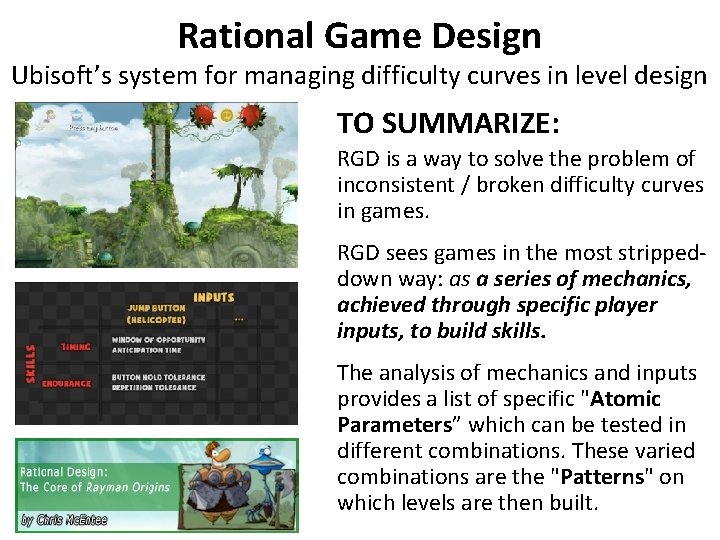
Rational Game Design Ubisoft’s system for managing difficulty curves in level design TO SUMMARIZE: RGD is a way to solve the problem of inconsistent / broken difficulty curves in games. RGD sees games in the most strippeddown way: as a series of mechanics, achieved through specific player inputs, to build skills. The analysis of mechanics and inputs provides a list of specific "Atomic Parameters” which can be tested in different combinations. These varied combinations are the "Patterns" on which levels are then built.
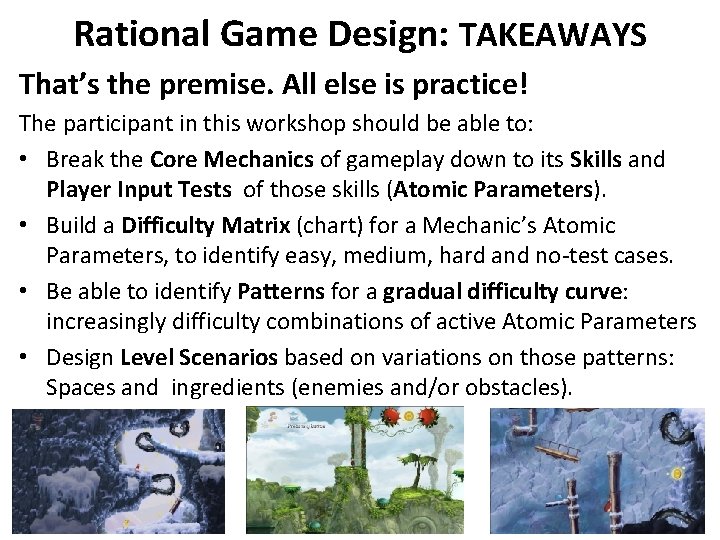
Rational Game Design: TAKEAWAYS That’s the premise. All else is practice! The participant in this workshop should be able to: • Break the Core Mechanics of gameplay down to its Skills and Player Input Tests of those skills (Atomic Parameters). • Build a Difficulty Matrix (chart) for a Mechanic’s Atomic Parameters, to identify easy, medium, hard and no-test cases. • Be able to identify Patterns for a gradual difficulty curve: increasingly difficulty combinations of active Atomic Parameters • Design Level Scenarios based on variations on those patterns: Spaces and ingredients (enemies and/or obstacles).
Rational Game Design: Subtraction Design levels by SUBTRACTING your Mechanics: A possible failure of some designers is to try and create gameplay VARIETY by constantly ADDING new and more abilities. This spreads the player thin learning many new mechanics without getting the chance to delve deeply and grow mastery. Deep Game and Level Design can be achieved when the player gets to explore just a few mechanics in great variation. These mechanics are driven by a limited number of potent obstacles or enemies, and the variety is created by SUBTRACTING enemy abilities in earlier levels, through the design of the scenario. If you have an enemy with 5 features, what happens when you turn off 4 at the start, and progress through multiple encounters to eventually encounter all 5? Occasionally, turn off some, given the level scenario, to focus on a deeper understanding of the others!
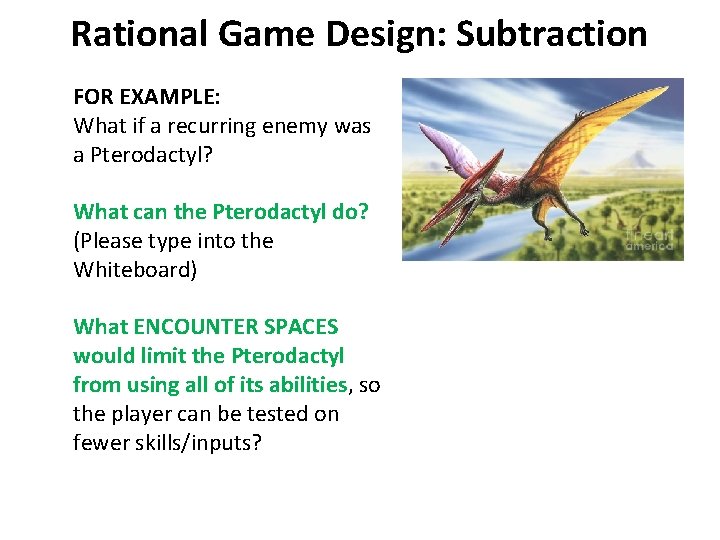
Rational Game Design: Subtraction FOR EXAMPLE: What if a recurring enemy was a Pterodactyl? What can the Pterodactyl do? (Please type into the Whiteboard) What ENCOUNTER SPACES would limit the Pterodactyl from using all of its abilities, so the player can be tested on fewer skills/inputs?
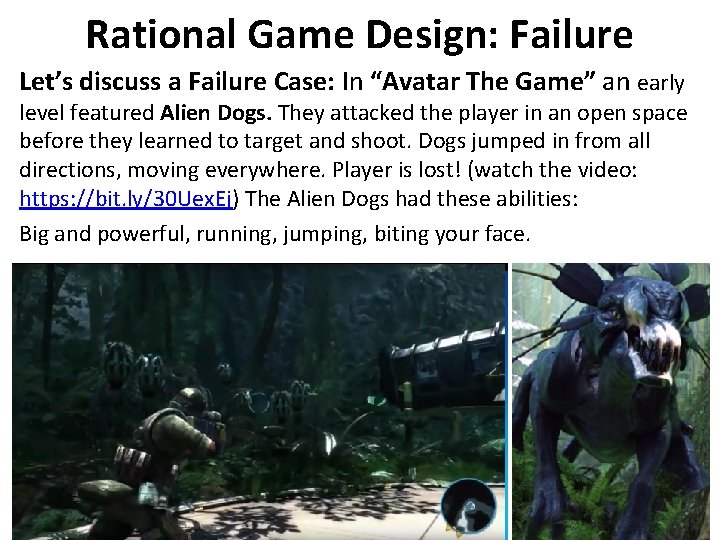
Rational Game Design: Failure Let’s discuss a Failure Case: In “Avatar The Game” an early level featured Alien Dogs. They attacked the player in an open space before they learned to target and shoot. Dogs jumped in from all directions, moving everywhere. Player is lost! (watch the video: https: //bit. ly/30 Uex. Ej) The Alien Dogs had these abilities: Big and powerful, running, jumping, biting your face.
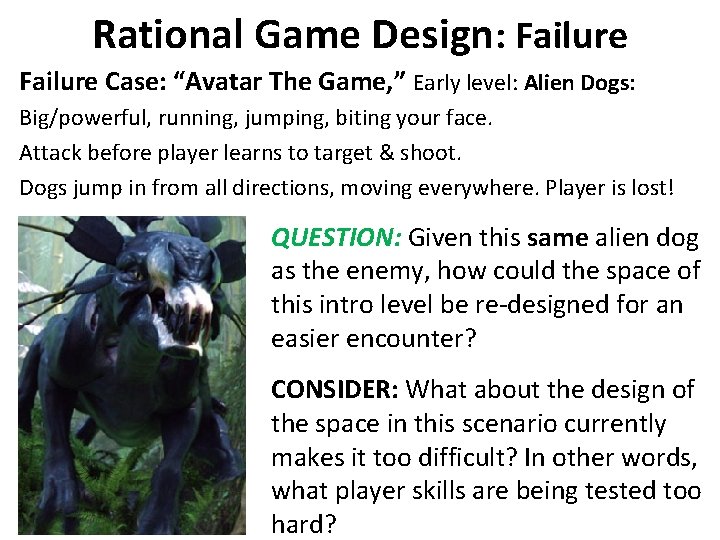
Rational Game Design: Failure Case: “Avatar The Game, ” Early level: Alien Dogs: Big/powerful, running, jumping, biting your face. Attack before player learns to target & shoot. Dogs jump in from all directions, moving everywhere. Player is lost! QUESTION: Given this same alien dog as the enemy, how could the space of this intro level be re-designed for an easier encounter? CONSIDER: What about the design of the space in this scenario currently makes it too difficult? In other words, what player skills are being tested too hard?
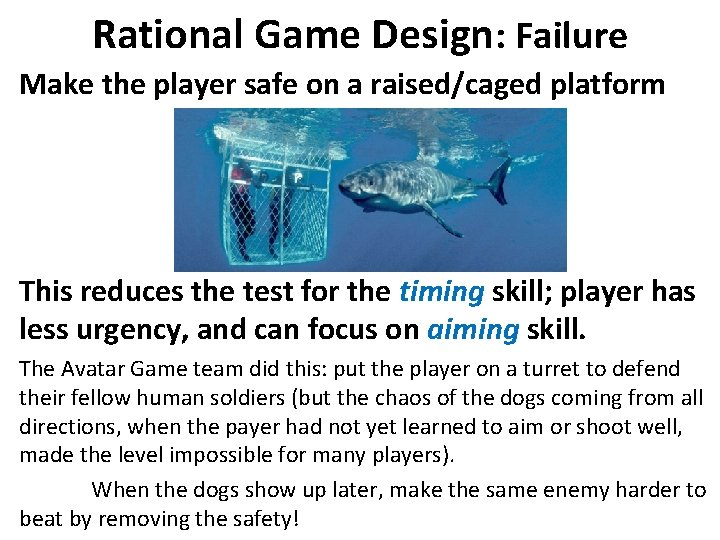
Rational Game Design: Failure Make the player safe on a raised/caged platform This reduces the test for the timing skill; player has less urgency, and can focus on aiming skill. The Avatar Game team did this: put the player on a turret to defend their fellow human soldiers (but the chaos of the dogs coming from all directions, when the payer had not yet learned to aim or shoot well, made the level impossible for many players). When the dogs show up later, make the same enemy harder to beat by removing the safety!
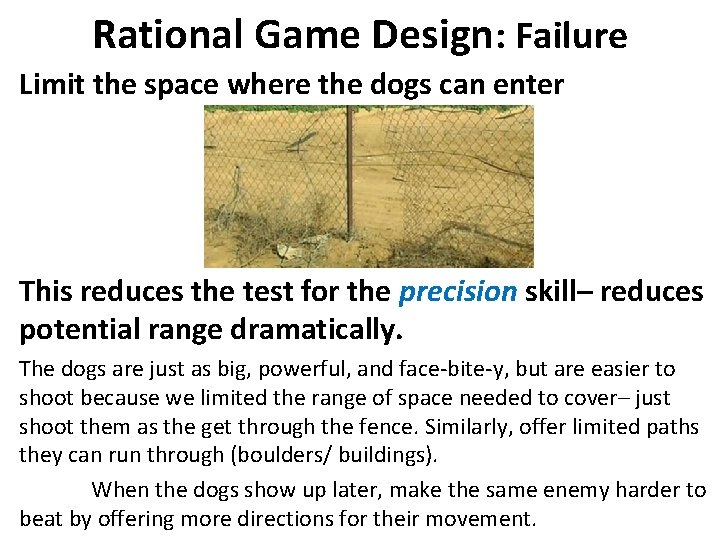
Rational Game Design: Failure Limit the space where the dogs can enter This reduces the test for the precision skill– reduces potential range dramatically. The dogs are just as big, powerful, and face-bite-y, but are easier to shoot because we limited the range of space needed to cover– just shoot them as the get through the fence. Similarly, offer limited paths they can run through (boulders/ buildings). When the dogs show up later, make the same enemy harder to beat by offering more directions for their movement.
Rational Game Design: Learning Playing Requires Skills to Solve the Game Mechanics Gaming = Gaining Mastery of a set of Skills How do players learn and master these skills? Consider this Progression of Learning for skills: 1. Tease (introduce the concept) 2. Learn (in a safe environment) 3. Practice (with increasing challenge, in varied scenarios) 4. Master (final test, higher pressure scenario) This is the access cycle for each mechanic, which progresses difficulty by considering player growth. Once the player learns a skill, they can combine it with others.
Rational Game Design: Skills Examples We will focus on Physical skills for now ( we’ll see Mental and Social a bit later) PLAYER SKILLS CATEGORIES: • PHYSICAL SKILLS: Precision, Timing, Reflexes, Measurement, Endurance, etc. ATOMIC PARAMETERS EXAMPLES (FROM DEVICE INPUT): Precision: Angle of Tolerance, Size on Screen Timing: Anticipation Time, Window of Opportunity (Wo. O), Obstacle Predictability, Input Change Frequency Measurement: Analogue Zone Size (physical joystick zone of tolerance), Analogue Zone Placement (Where joystick goes). RGD Asks: What are easy, med, hard tests for each parameter?
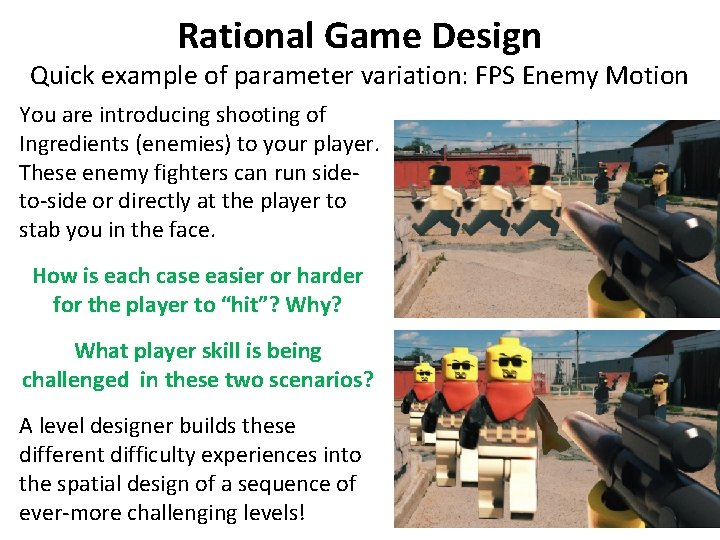
Rational Game Design Quick example of parameter variation: FPS Enemy Motion You are introducing shooting of Ingredients (enemies) to your player. These enemy fighters can run sideto-side or directly at the player to stab you in the face. How is each case easier or harder for the player to “hit”? Why? What player skill is being challenged in these two scenarios? A level designer builds these different difficulty experiences into the spatial design of a sequence of ever-more challenging levels!
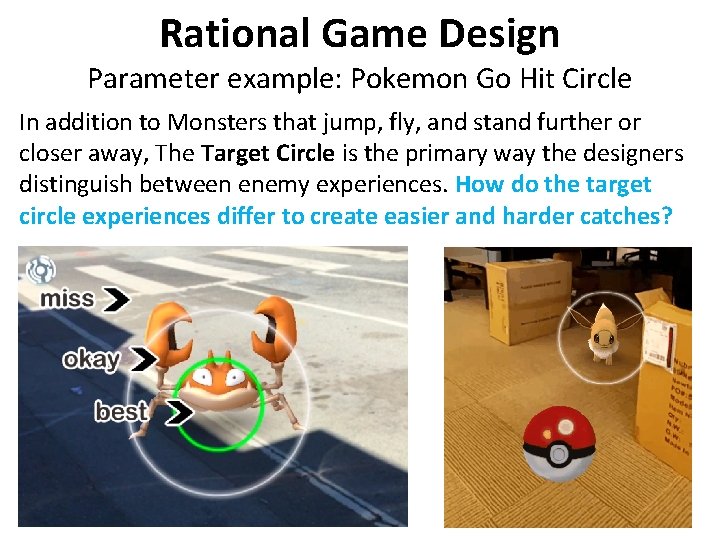
Rational Game Design Parameter example: Pokemon Go Hit Circle In addition to Monsters that jump, fly, and stand further or closer away, The Target Circle is the primary way the designers distinguish between enemy experiences. How do the target circle experiences differ to create easier and harder catches?
Rational Game Design Consider a mechanic: Aim-and-Shoot: Example of final game (Form): 1 st person shooter, highintensity alien bloodfest. Bare INPUTS for an FPS (Function): the skill of matching the position of two points (aiming) and validating (pulling the trigger and seeing the target react). Adjust Parameters on enemy access for different difficulty: (a) Size of the target shape on Screen (b) Movement Speed (c) Predictability (d) Window of Opportunity (Wo. O) etc.
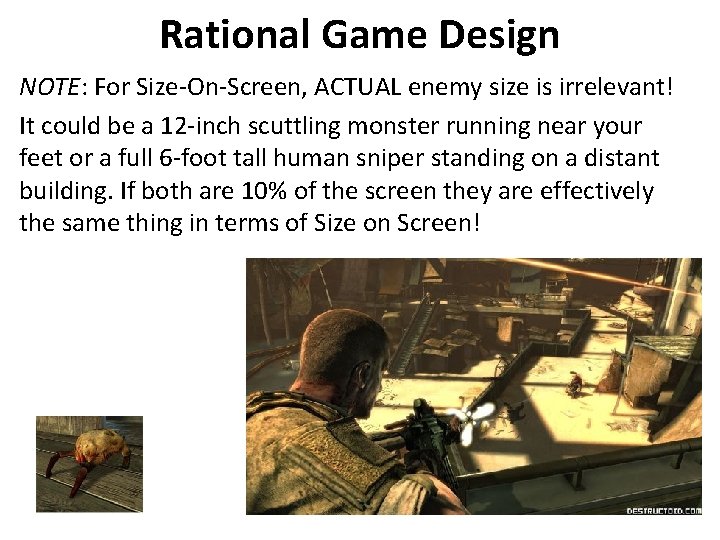
Rational Game Design NOTE: For Size-On-Screen, ACTUAL enemy size is irrelevant! It could be a 12 -inch scuttling monster running near your feet or a full 6 -foot tall human sniper standing on a distant building. If both are 10% of the screen they are effectively the same thing in terms of Size on Screen!
Rational Game Design PLAYER SKILLS CATEGORIES: • PHYSICAL: Timing, reflexes, measurement, precision, endurance, etc. • MENTAL: Concentration, choice, observation, management, strategy, tactical, cleverness, etc. • SOCIAL: Persuasion, leadership, etc. RGD Mental is harder to quantify than Physical (in terms of concrete progression of difficulty). WHY? What happens when the cost/benefit of a choice is too hard for players to decide? RGD Social challenges are enormously hard to manage. WHY? What happens when we provide social difficulty restrictions in games?
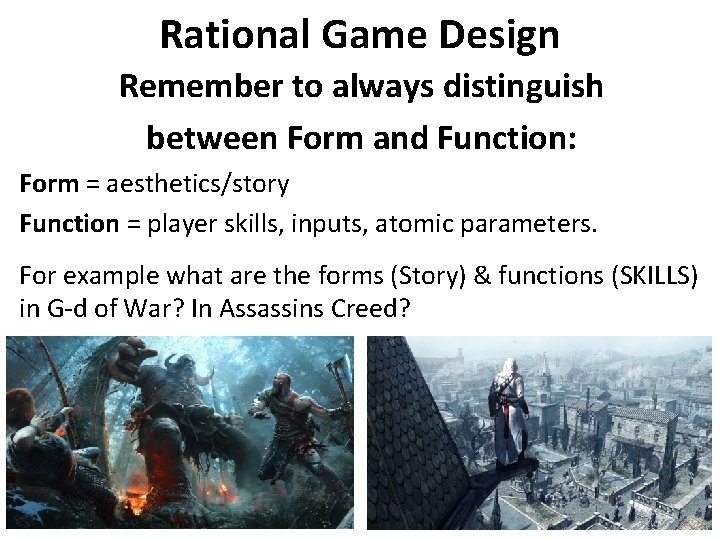
Rational Game Design Remember to always distinguish between Form and Function: Form = aesthetics/story Function = player skills, inputs, atomic parameters. For example what are the forms (Story) & functions (SKILLS) in G-d of War? In Assassins Creed?
![Rational Game Design The Deliverables for this process: IDENTIFY, IN ORDER: [1] Goal of](http://slidetodoc.com/presentation_image_h2/1389846df4d415471823c3316f9893ef/image-33.jpg "Rational Game Design The Deliverables for this process: IDENTIFY, IN ORDER: [1] Goal of")
Rational Game Design The Deliverables for this process: IDENTIFY, IN ORDER: [1] Goal of Gameplay [2] Mechanic [3] Needed Skills [4] Inputs (informs a LOT of design decisions) [5] Atomic Parameters (list them, provide easy, medium, hard, and "no case" examples) [6] Level Design (LD) Patterns (overall easy, medium, and hard patterns based on parameter combinations, ideally with drawn diagrams, which can then be creatively interpreted as story-rich level scenarios)
Rational Game Design Level Design (LD) Patterns: • Concrete LD situation extracted from Atomic Parameters • Allows us to create difficulty with a limited amount of well-conceived ingredients (enemies or obstacles). • Create LD patterns (variations) for each mechanic separately-- their combination is the level! ATOMIC PARAMETERS MUST be quantifiable (no case, easy, medium, hard) and validated through playtesting! THE VALUE OF THIS PROCESS: If you know your atomic parameters, you know what your changes will do to your game, and, especially, you can keep all elements within
Rational Game Design TIPS FOR ATOMIC PARAMETER SELECTION: • Set Atomic Parameters to FOCUS your game. Remove those you don't want to challenge, and set as constant those you don’t want to evolve. • Isolate Atomic Parameters for each Mechanic. • Think Skills and Inputs. • Eliminate minor Atomic Parameters.
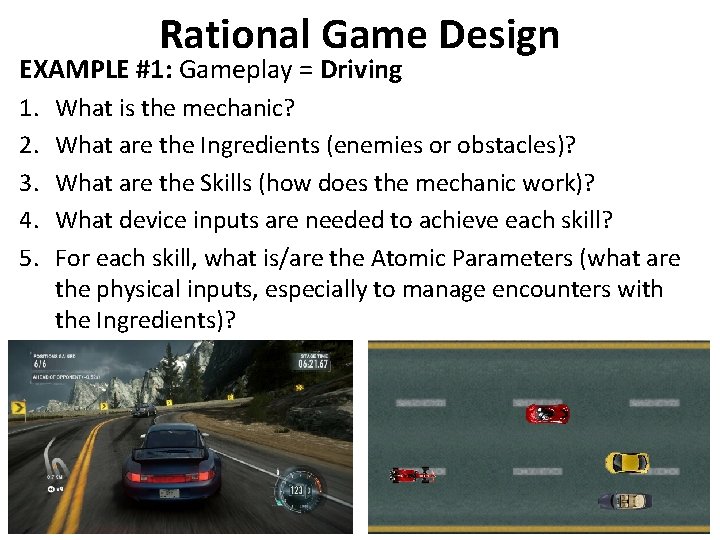
Rational Game Design EXAMPLE #1: Gameplay = Driving 1. 2. 3. 4. 5. What is the mechanic? What are the Ingredients (enemies or obstacles)? What are the Skills (how does the mechanic work)? What device inputs are needed to achieve each skill? For each skill, what is/are the Atomic Parameters (what are the physical inputs, especially to manage encounters with the Ingredients)?
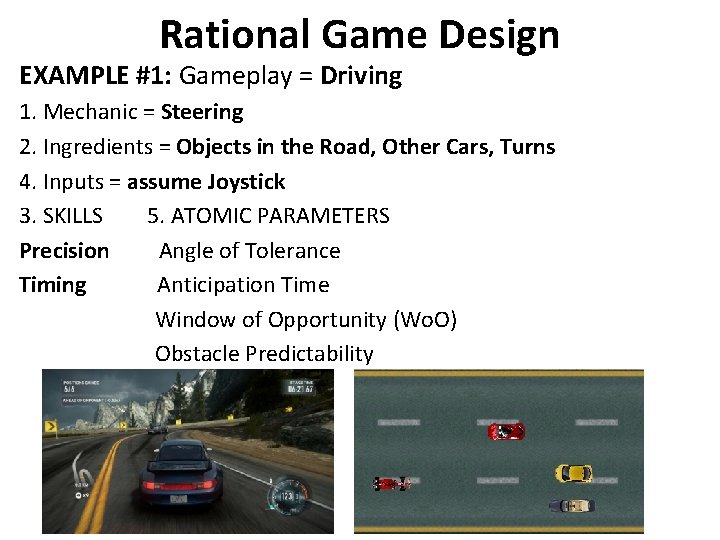
Rational Game Design EXAMPLE #1: Gameplay = Driving 1. Mechanic = Steering 2. Ingredients = Objects in the Road, Other Cars, Turns 4. Inputs = assume Joystick 3. SKILLS 5. ATOMIC PARAMETERS Precision Angle of Tolerance Timing Anticipation Time Window of Opportunity (Wo. O) Obstacle Predictability
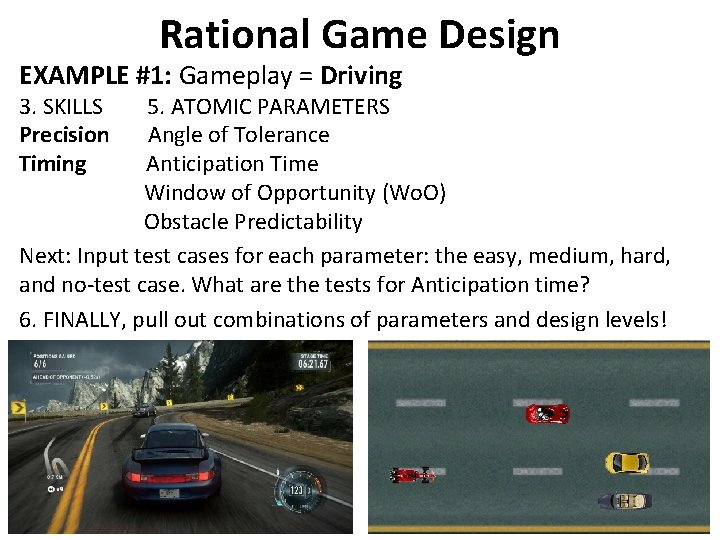
Rational Game Design EXAMPLE #1: Gameplay = Driving 3. SKILLS Precision Timing 5. ATOMIC PARAMETERS Angle of Tolerance Anticipation Time Window of Opportunity (Wo. O) Obstacle Predictability Next: Input test cases for each parameter: the easy, medium, hard, and no-test case. What are the tests for Anticipation time? 6. FINALLY, pull out combinations of parameters and design levels!
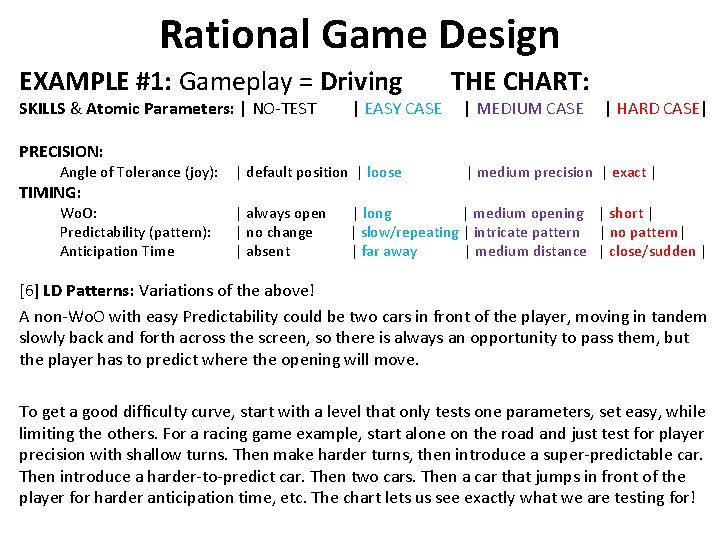
Rational Game Design EXAMPLE #1: Gameplay = Driving SKILLS & Atomic Parameters: | NO-TEST PRECISION: | EASY CASE Angle of Tolerance (joy): | default position | loose Wo. O: Predictability (pattern): Anticipation Time | always open | no change | absent TIMING: THE CHART: | MEDIUM CASE | HARD CASE| | medium precision | exact | | long | medium opening | short | | slow/repeating | intricate pattern | no pattern| | far away | medium distance | close/sudden | [6] LD Patterns: Variations of the above! A non-Wo. O with easy Predictability could be two cars in front of the player, moving in tandem slowly back and forth across the screen, so there is always an opportunity to pass them, but the player has to predict where the opening will move. To get a good difficulty curve, start with a level that only tests one parameters, set easy, while limiting the others. For a racing game example, start alone on the road and just test for player precision with shallow turns. Then make harder turns, then introduce a super-predictable car. Then introduce a harder-to-predict car. Then two cars. Then a car that jumps in front of the player for harder anticipation time, etc. The chart lets us see exactly what we are testing for!
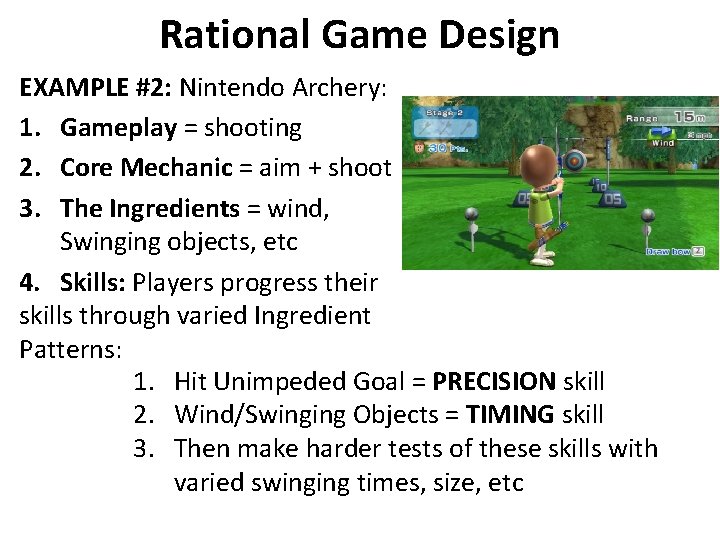
Rational Game Design EXAMPLE #2: Nintendo Archery: 1. Gameplay = shooting 2. Core Mechanic = aim + shoot 3. The Ingredients = wind, Swinging objects, etc 4. Skills: Players progress their skills through varied Ingredient Patterns: 1. Hit Unimpeded Goal = PRECISION skill 2. Wind/Swinging Objects = TIMING skill 3. Then make harder tests of these skills with varied swinging times, size, etc
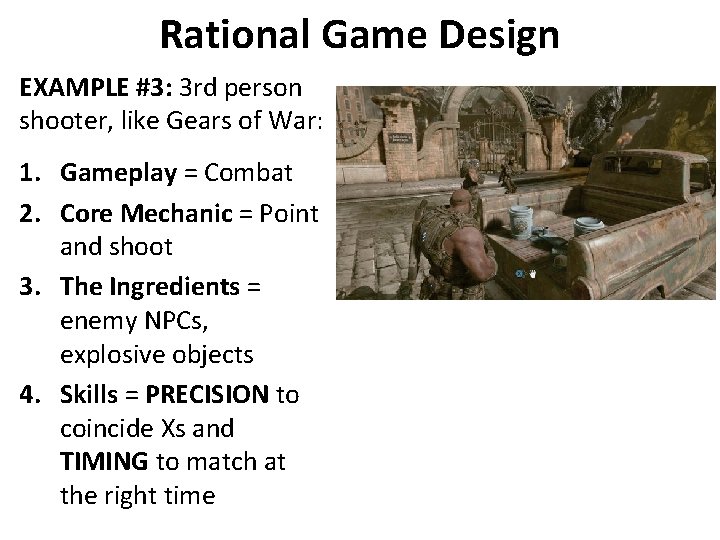
Rational Game Design EXAMPLE #3: 3 rd person shooter, like Gears of War: 1. Gameplay = Combat 2. Core Mechanic = Point and shoot 3. The Ingredients = enemy NPCs, explosive objects 4. Skills = PRECISION to coincide Xs and TIMING to match at the right time
![Rational Game Design EXAMPLE #4: Stealth mechanic (like in Splinter Cell): [1] Goal of](http://slidetodoc.com/presentation_image_h2/1389846df4d415471823c3316f9893ef/image-42.jpg "Rational Game Design EXAMPLE #4: Stealth mechanic (like in Splinter Cell): [1] Goal of")
Rational Game Design EXAMPLE #4: Stealth mechanic (like in Splinter Cell): [1] Goal of Gameplay: [2] Mechanic: [3] Skills: [4] Inputs: [5] Atomic Parameters: | No Case [6] LD Patterns: Variations of the above! | Easy | Medium | Hard |
![Rational Game Design EXAMPLE #4: Stealth mechanic (like in Splinter Cell): [1] Goal of](http://slidetodoc.com/presentation_image_h2/1389846df4d415471823c3316f9893ef/image-43.jpg "Rational Game Design EXAMPLE #4: Stealth mechanic (like in Splinter Cell): [1] Goal of")
Rational Game Design EXAMPLE #4: Stealth mechanic (like in Splinter Cell): [1] Goal of Gameplay: Reach destination without being detected [2] Mechanic: Move character and/or camera [3] Skills: Timing, Precision, Measurement (not Observation-- mental!) [4] Inputs: Move the joysticks with your thumbs [5] Atomic Parameters: | No Case | Easy | Medium PRECISION: TIMING: MEASUREMENT: [6] LD Patterns: Variations of the above! | Hard |
![Rational Game Design EXAMPLE #4: Stealth mechanic (like in Splinter Cell): [1] Goal of](http://slidetodoc.com/presentation_image_h2/1389846df4d415471823c3316f9893ef/image-44.jpg "Rational Game Design EXAMPLE #4: Stealth mechanic (like in Splinter Cell): [1] Goal of")
Rational Game Design EXAMPLE #4: Stealth mechanic (like in Splinter Cell): [1] Goal of Gameplay: Reach destination without being detected [2] Mechanic: Move character and/or camera [3] Skills: Timing, Precision, Measurement (not Observation-- mental!) [4] Inputs: Move the joysticks with your thumbs [5] Atomic Parameters: | No Case | Easy | Medium | Hard | PRECISION: Analogue (Joystick) Angle of Tolerance (direction): | loose angles | medium | exact | TIMING: Wo. O: | | long | medium | short | Predictability: | camera | guard, repeating pattern | long/intricate or no pattern | Anticipation Time | far away | medium | very close/sudden | Input Change Frequency | no change | 1 input/sec | 3 input/sec| 5 in/sec | MEASUREMENT (stick massaging): Analogue Zone Size (physical zone of tolerance) |80% |40% |10% | Analogue Zone Placement (where joystick goes) |0/100% (ends)|50% (mid)|25 or 75%| [6] LD Patterns: Variations of the above!
Rational Game Design NOTES: INPUTS AND PARAMETERS • Measurement on a keyboard = timing • A hard Wo. O (window of opportunity) means only occasionally available to hit: using cover or moving/rotating shielding elements. • Anticipation Time in a rhythm game starts Physical, but as the game gets harder and the player more skilled, they learn the song and offload the work to the Mental • Button mashing: frequency of input and duration of input (G-d of War)
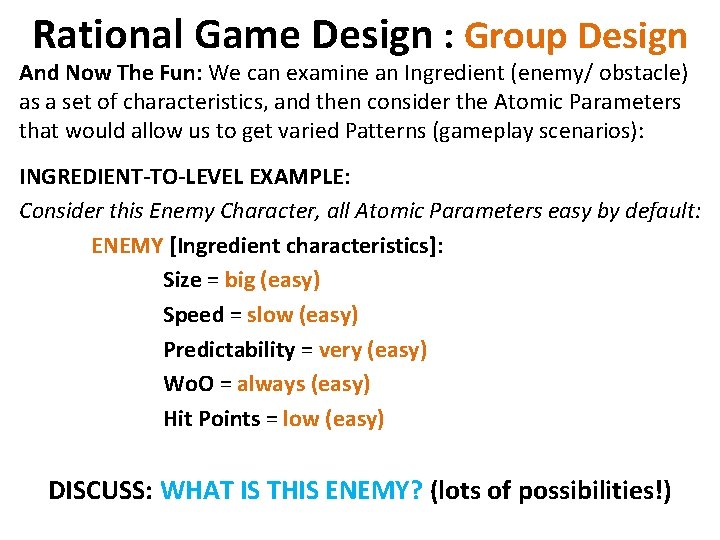
Rational Game Design : Group Design And Now The Fun: We can examine an Ingredient (enemy/ obstacle) as a set of characteristics, and then consider the Atomic Parameters that would allow us to get varied Patterns (gameplay scenarios): INGREDIENT-TO-LEVEL EXAMPLE: Consider this Enemy Character, all Atomic Parameters easy by default: ENEMY [Ingredient characteristics]: Size = big (easy) Speed = slow (easy) Predictability = very (easy) Wo. O = always (easy) Hit Points = low (easy) DISCUSS: WHAT IS THIS ENEMY? (lots of possibilities!)
![Rational Game Design : Group Design ENEMY [Ingredient characteristics]: Size = big (easy) Speed](http://slidetodoc.com/presentation_image_h2/1389846df4d415471823c3316f9893ef/image-47.jpg "Rational Game Design : Group Design ENEMY [Ingredient characteristics]: Size = big (easy) Speed")
Rational Game Design : Group Design ENEMY [Ingredient characteristics]: Size = big (easy) Speed = slow (easy) Predictability = very (easy) Wo. O = always (easy) Hit Points = low (easy) A Couple Possibilities That Fit These Characteristics:
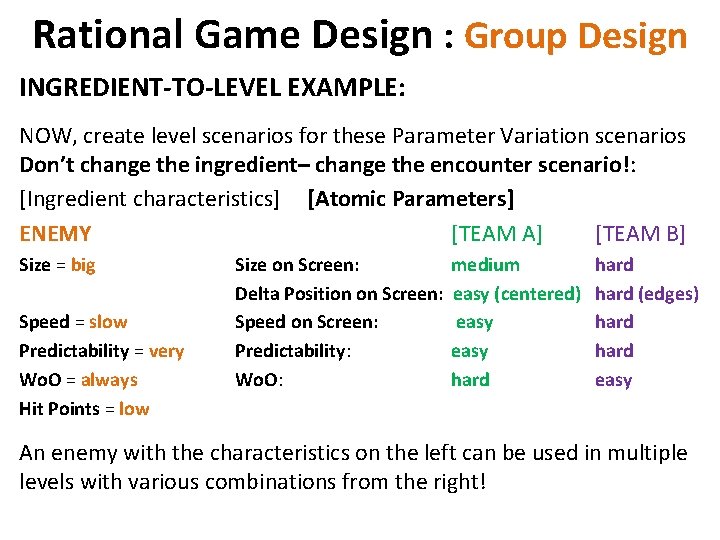
Rational Game Design : Group Design INGREDIENT-TO-LEVEL EXAMPLE: NOW, create level scenarios for these Parameter Variation scenarios Don’t change the ingredient– change the encounter scenario!: [Ingredient characteristics] [Atomic Parameters] ENEMY [TEAM A] [TEAM B] Size = big Speed = slow Predictability = very Wo. O = always Hit Points = low Size on Screen: Delta Position on Screen: Speed on Screen: Predictability: Wo. O: medium easy (centered) easy hard (edges) hard easy An enemy with the characteristics on the left can be used in multiple levels with various combinations from the right!
Rational Game Design SUMMARY: Don’t create lots of new monsters -create variations of access by changing the space where we encounter those monsters! The big idea here is to avoid constantly adding new mechanics to make the game “more interesting, ” but instead to allow a player to learn a few core mechanics more deeply through spatial variation that limits what the few ingredients can do. In other words, when doing level designs, instead of constantly adding new Monsters, design level spaces and scenarios that allow the same monsters to be presented where they function differently, by limiting what the monster can do. Change the level to change the way the same monsters work, making them ever more challenging as these spatial restrictions are lifted in progressive levels!
Rational Game Design FIXING A GAME WITH RGD: In addition to designing a game’s level sequence using this system, you can also FIX an existing design with RGD! For example, if you have to cancel level #6, levels 5 and 7 are screwed (in terms of difficulty curve) unless you go back to the matrix of mechanic parameters and tweak them together to fill the gap! (see following images)
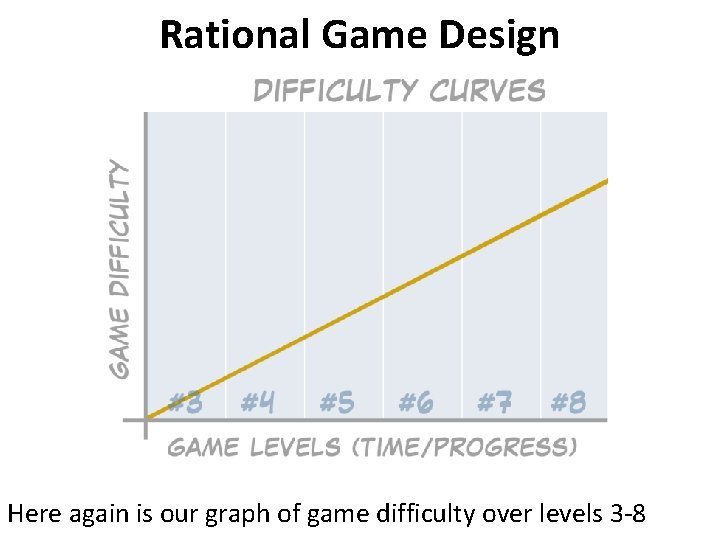
Rational Game Design Here again is our graph of game difficulty over levels 3 -8
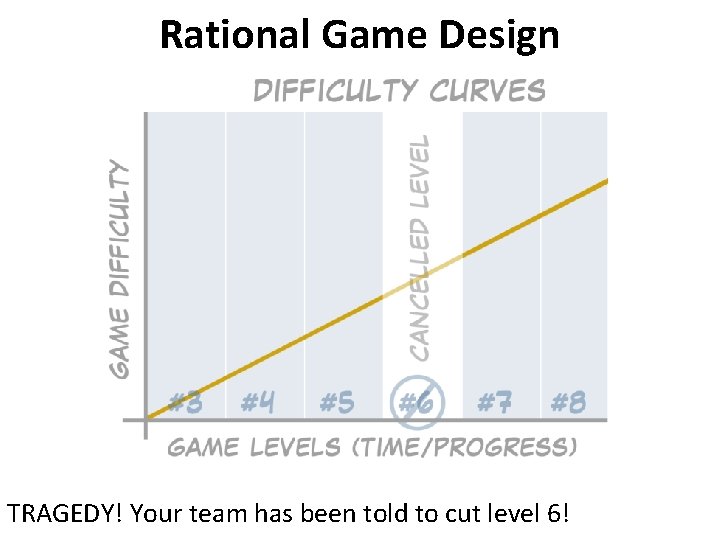
Rational Game Design TRAGEDY! Your team has been told to cut level 6!
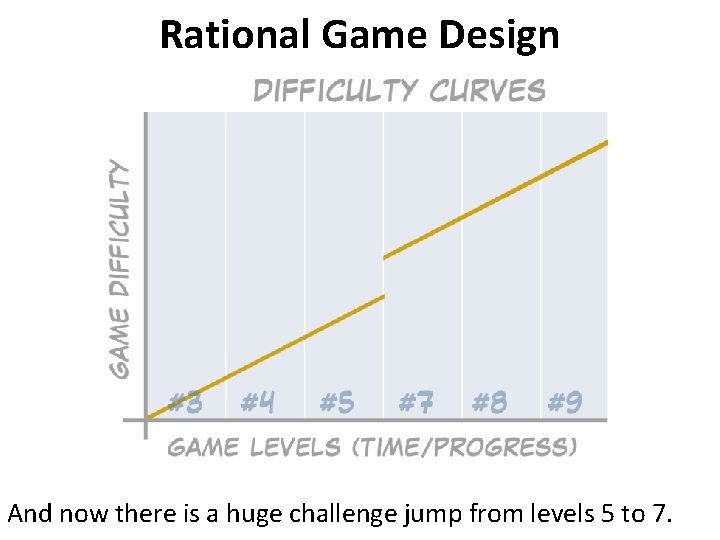
Rational Game Design And now there is a huge challenge jump from levels 5 to 7.
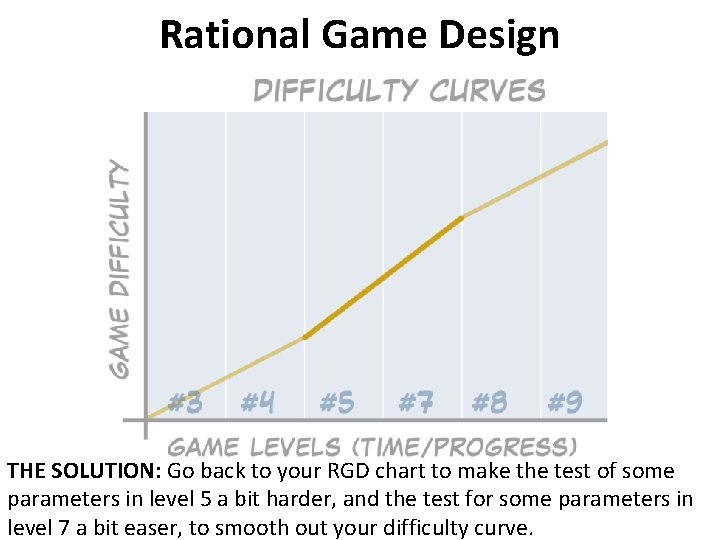
Rational Game Design THE SOLUTION: Go back to your RGD chart to make the test of some parameters in level 5 a bit harder, and the test for some parameters in level 7 a bit easer, to smooth out your difficulty curve.
Rational Game Design: Tutorializing Use this system to make better Difficulty Curves, and especially to support player on-ramping: Plan the tutorial sequence for your game: an initial set of levels or spaces that ease the player into their abilities, game obstacles, and goals using RGD, by designing spaces for specific skill difficulty. Consider this possible progression in a unique platformer: 1. First provide a space to learn and practice the new movement mechanic with static obstacles. 2. Then give a space where an enemy moves slowly. 3. Then give a space where the enemy moves quickly 4. Then give a space with 2 enemies, etc.

Thank you for participating! Jason Wiser Jason. Wiser. Art@gmail. com Madwomb. com Yaya. Play. com @Yaya. Play
- Slides: 56