
Rational Functions and Their Graphs Why Should You

- Slides: 33
Rational Functions and Their Graphs
Why Should You Learn This? Rational functions are used to model and solve many problems in the business world. n Some examples of real-world scenarios are: n ¨ Average speed over a distance (traffic engineers) ¨ Concentration of a mixture (chemist) ¨ Average sales over time (sales manager) ¨ Average costs over time (CFO’s)
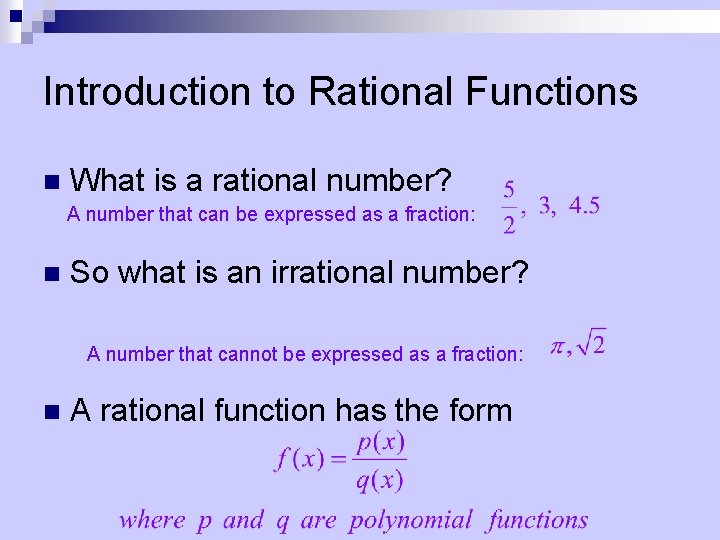
Introduction to Rational Functions n What is a rational number? A number that can be expressed as a fraction: n So what is an irrational number? A number that cannot be expressed as a fraction: n A rational function has the form
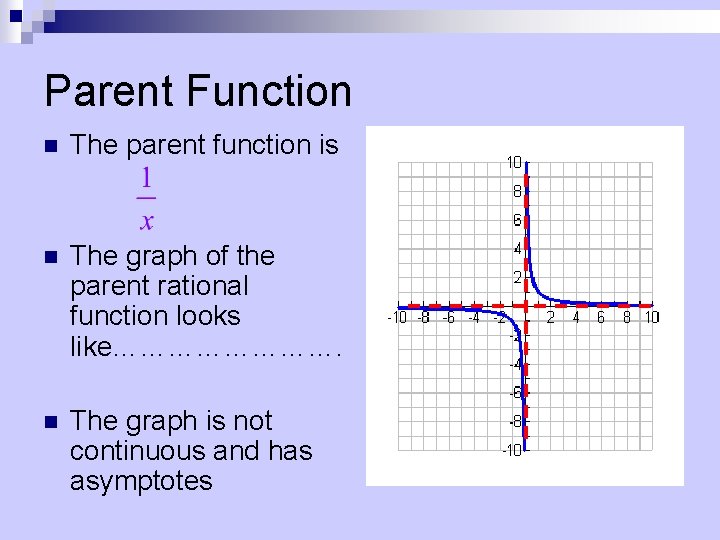
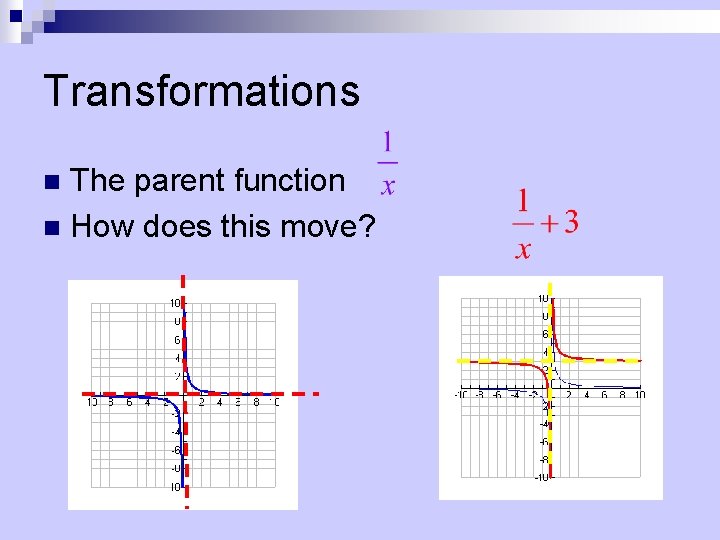
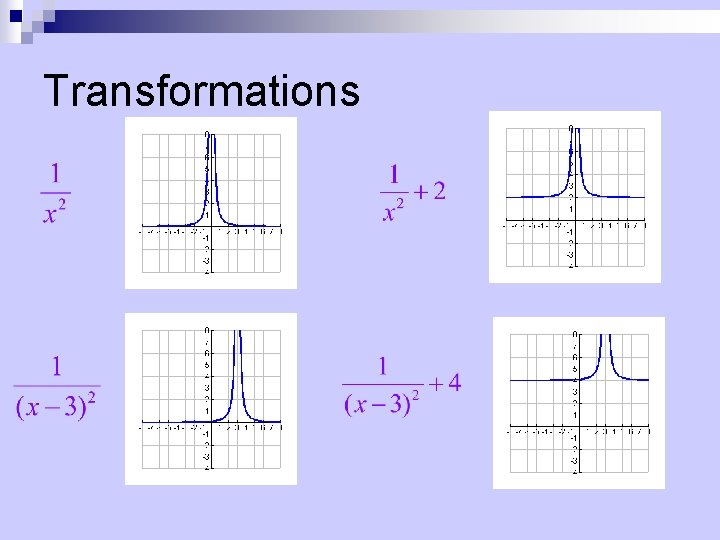
Parent Function n The parent function is n The graph of the parent rational function looks like…………. n The graph is not continuous and has asymptotes
Transformations The parent function n How does this move? n
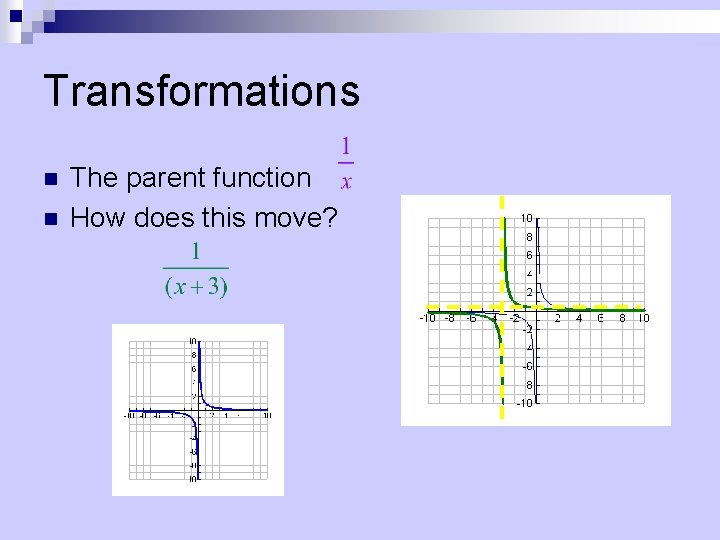
Transformations n n The parent function How does this move?
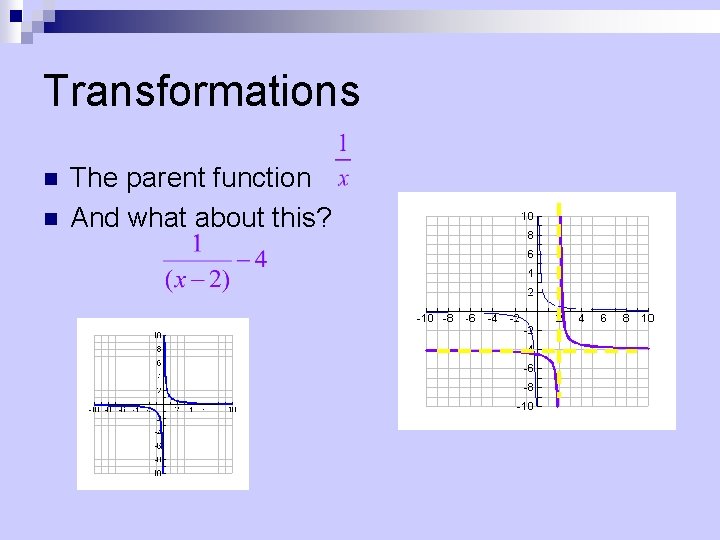
Transformations The parent function n And what about this? n
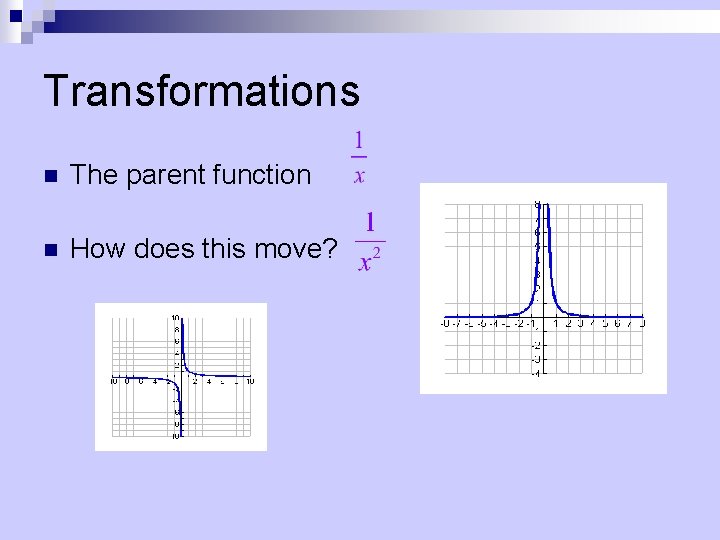
Transformations n The parent function n How does this move?
Transformations
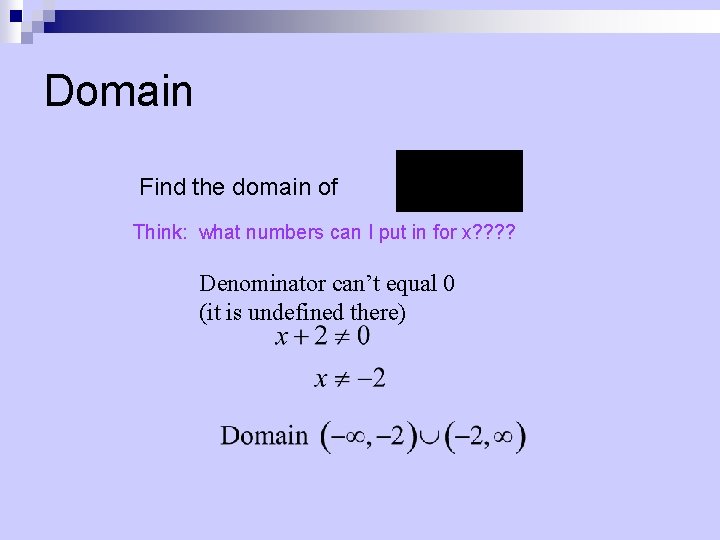
Domain Find the domain of Think: what numbers can I put in for x? ? Denominator can’t equal 0 (it is undefined there)
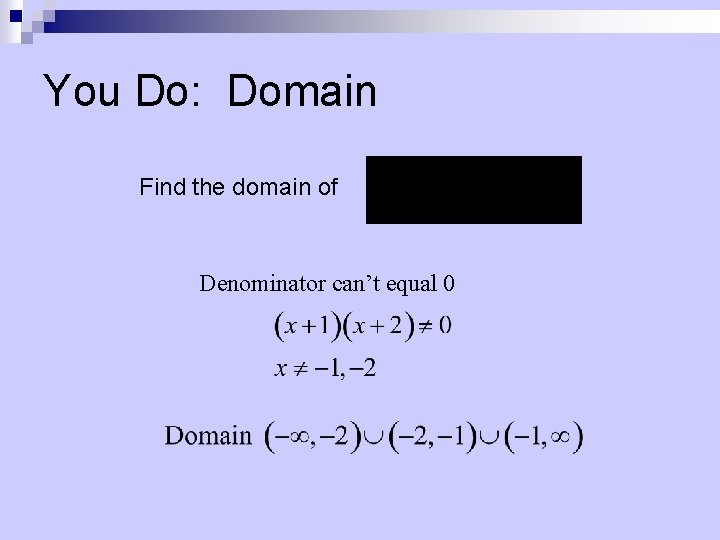
You Do: Domain Find the domain of Denominator can’t equal 0
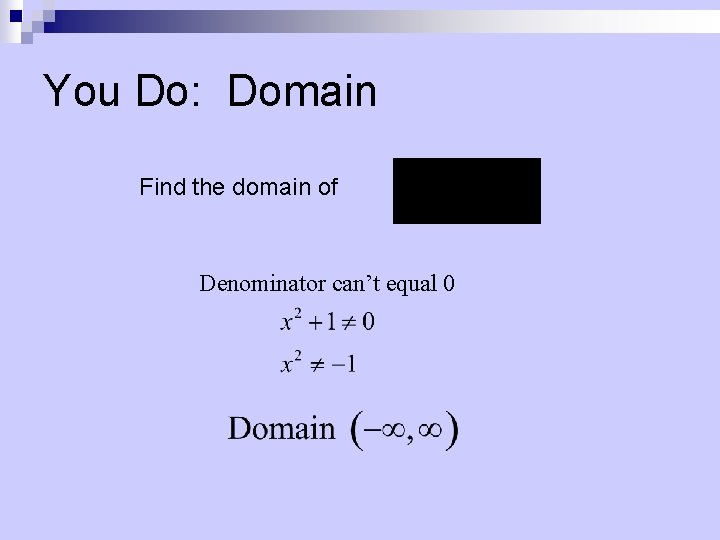
You Do: Domain Find the domain of Denominator can’t equal 0
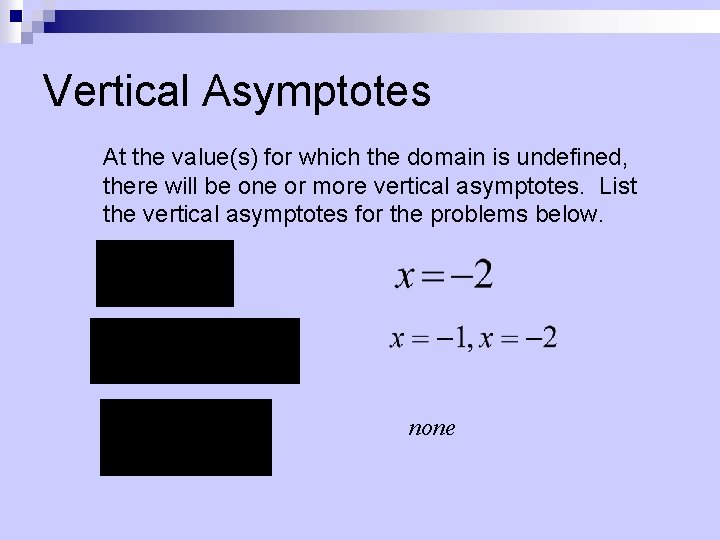
Vertical Asymptotes At the value(s) for which the domain is undefined, there will be one or more vertical asymptotes. List the vertical asymptotes for the problems below. none
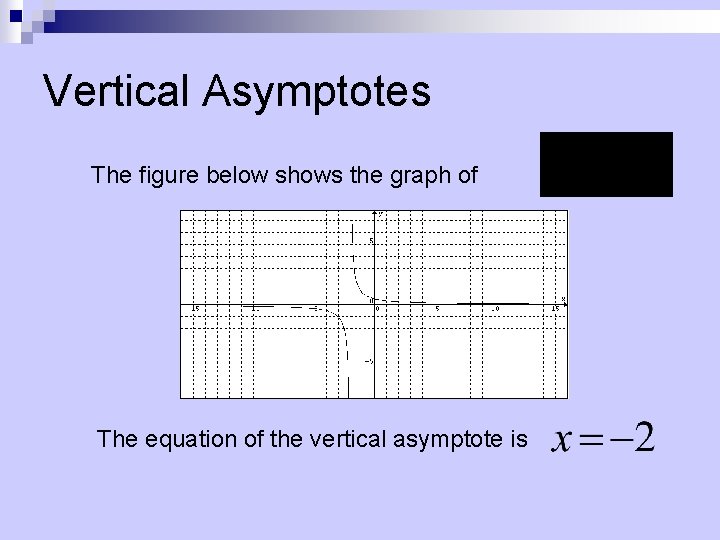
Vertical Asymptotes The figure below shows the graph of The equation of the vertical asymptote is
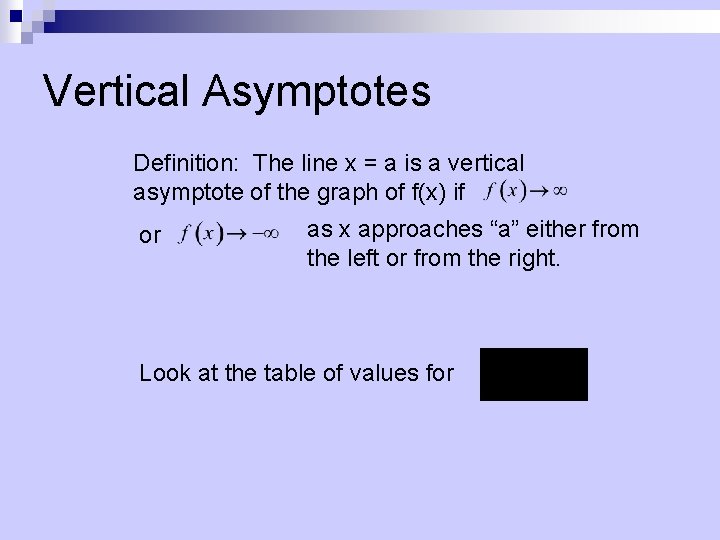
Vertical Asymptotes Definition: The line x = a is a vertical asymptote of the graph of f(x) if or as x approaches “a” either from the left or from the right. Look at the table of values for
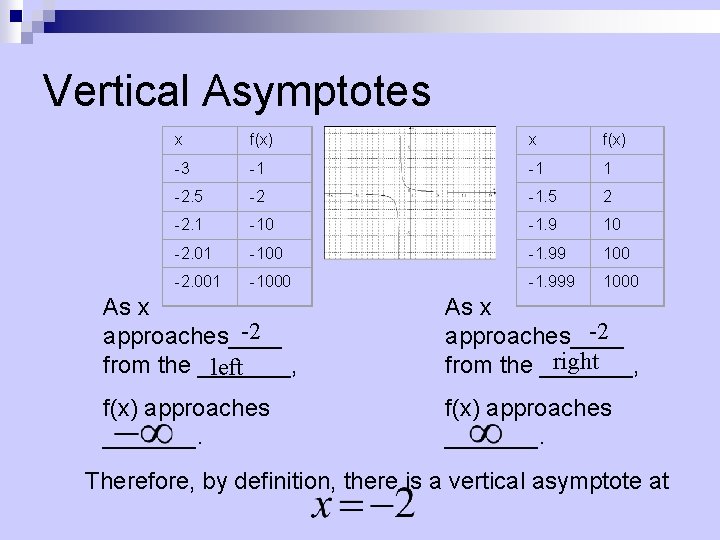
Vertical Asymptotes x f(x) -3 -1 -1 1 -2. 5 -2 -1. 5 2 -2. 1 -10 -1. 9 10 -2. 01 -100 -1. 99 100 -2. 001 -1000 -1. 999 1000 As x -2 approaches____ from the _______, left As x -2 approaches____ right from the _______, f(x) approaches _______. Therefore, by definition, there is a vertical asymptote at
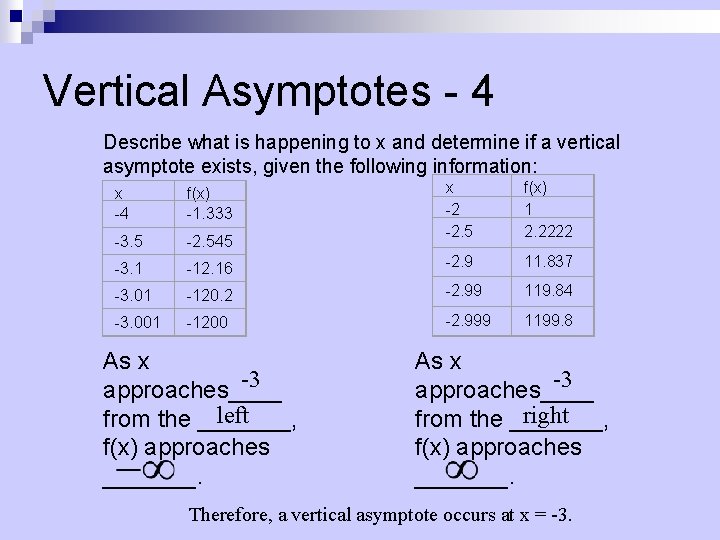
Vertical Asymptotes - 4 Describe what is happening to x and determine if a vertical asymptote exists, given the following information: x -2 -2. 5 f(x) 1 2. 2222 -12. 16 -2. 9 11. 837 -3. 01 -120. 2 -2. 99 119. 84 -3. 001 -1200 -2. 999 1199. 8 x -4 f(x) -1. 333 -3. 5 -2. 545 -3. 1 As x -3 approaches____ left from the _______, f(x) approaches _______. As x -3 approaches____ right from the _______, f(x) approaches _______. Therefore, a vertical asymptote occurs at x = -3.
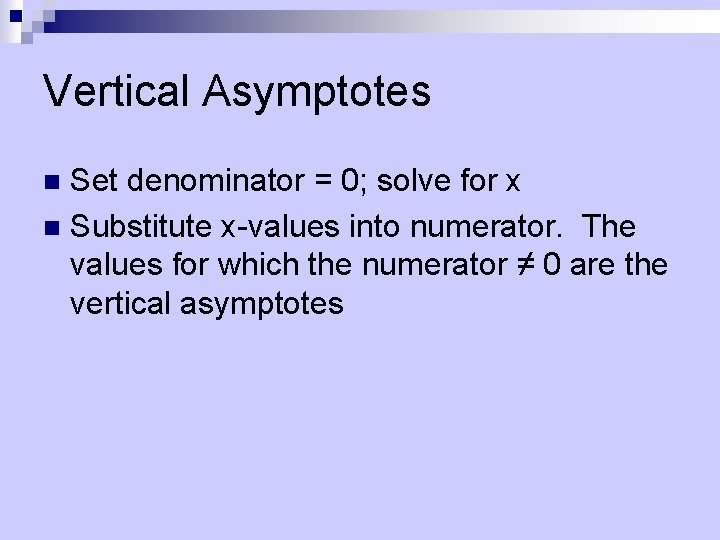
Vertical Asymptotes Set denominator = 0; solve for x n Substitute x-values into numerator. The values for which the numerator ≠ 0 are the vertical asymptotes n
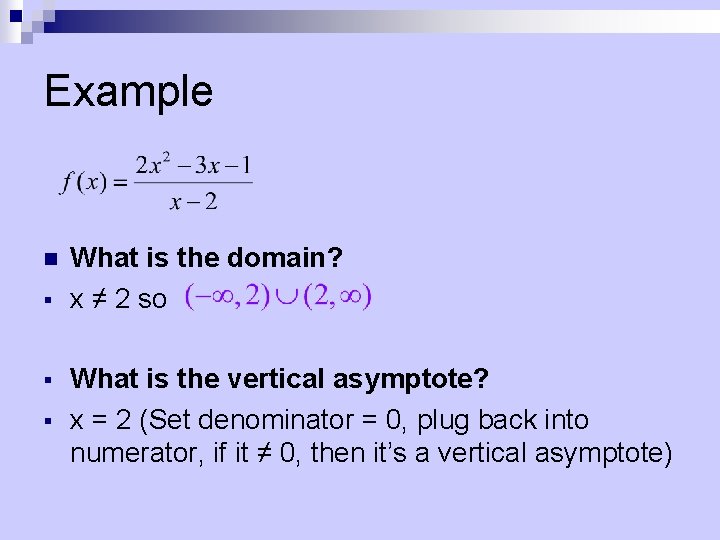
Example n § § § What is the domain? x ≠ 2 so What is the vertical asymptote? x = 2 (Set denominator = 0, plug back into numerator, if it ≠ 0, then it’s a vertical asymptote)
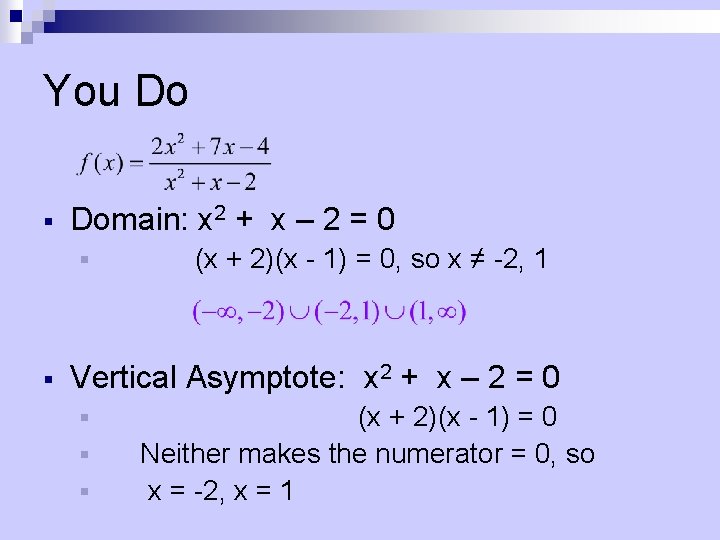
You Do § Domain: x 2 + x – 2 = 0 § § (x + 2)(x - 1) = 0, so x ≠ -2, 1 Vertical Asymptote: x 2 + x – 2 = 0 (x + 2)(x - 1) = 0 § Neither makes the numerator = 0, so § x = -2, x = 1 §
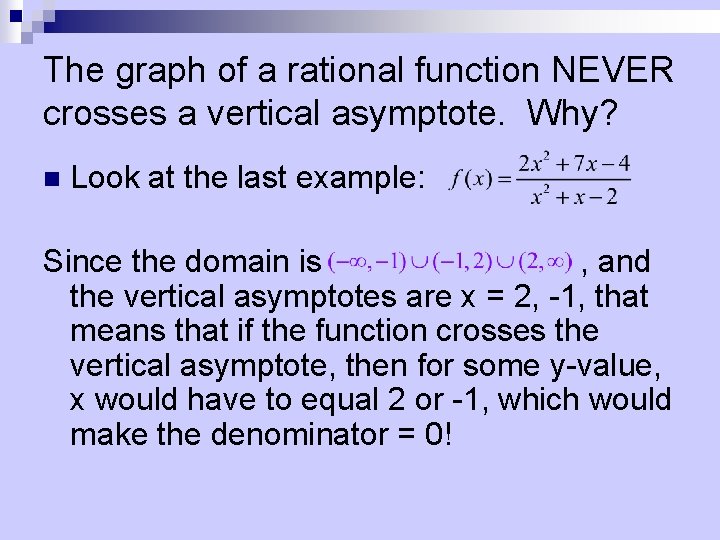
The graph of a rational function NEVER crosses a vertical asymptote. Why? n Look at the last example: Since the domain is , and the vertical asymptotes are x = 2, -1, that means that if the function crosses the vertical asymptote, then for some y-value, x would have to equal 2 or -1, which would make the denominator = 0!
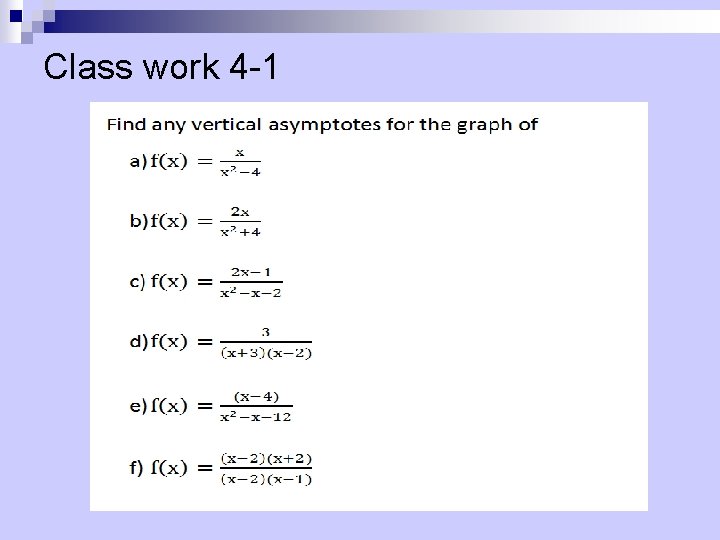
Class work 4 -1
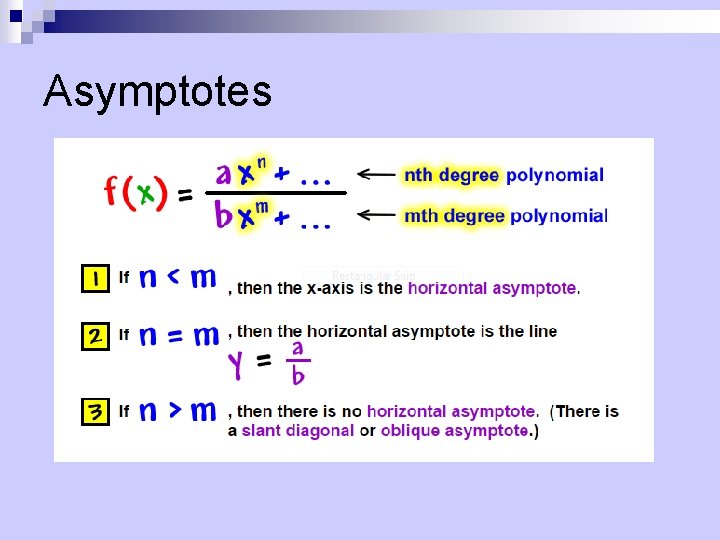
Asymptotes
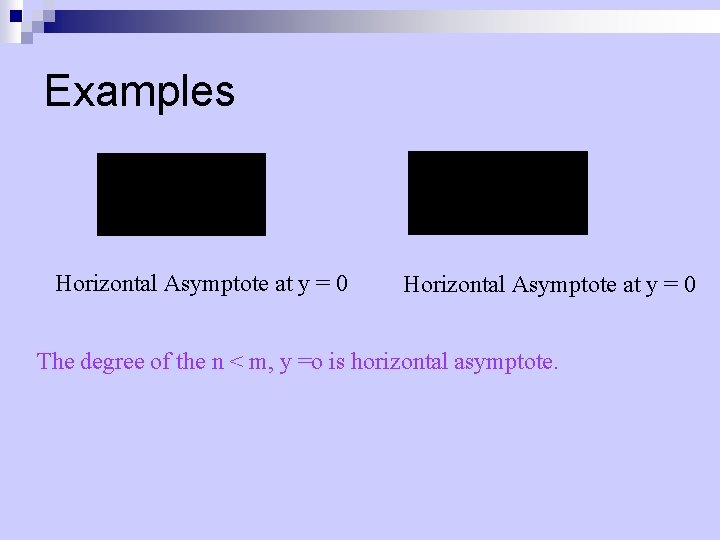
Examples Horizontal Asymptote at y = 0 The degree of the n < m, y =o is horizontal asymptote.
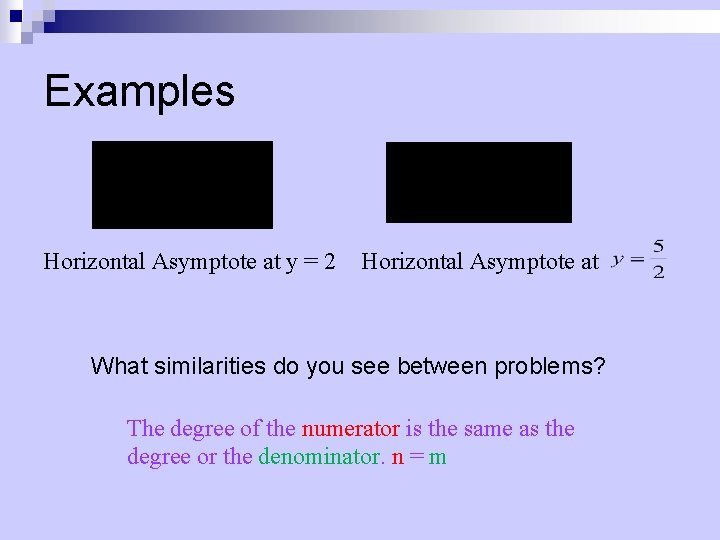
Examples Horizontal Asymptote at y = 2 Horizontal Asymptote at What similarities do you see between problems? The degree of the numerator is the same as the degree or the denominator. n = m
Examples No Horizontal Asymptote n >m No Horizontal Asymptote n>m
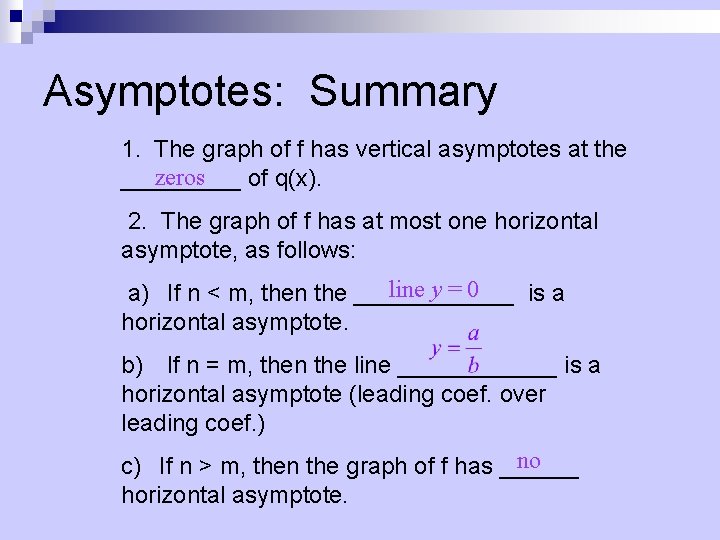
Asymptotes: Summary 1. The graph of f has vertical asymptotes at the zeros _____ of q(x). 2. The graph of f has at most one horizontal asymptote, as follows: line y = 0 a) If n < m, then the ______ is a horizontal asymptote. b) If n = m, then the line ______ is a horizontal asymptote (leading coef. over leading coef. ) no c) If n > m, then the graph of f has ______ horizontal asymptote.
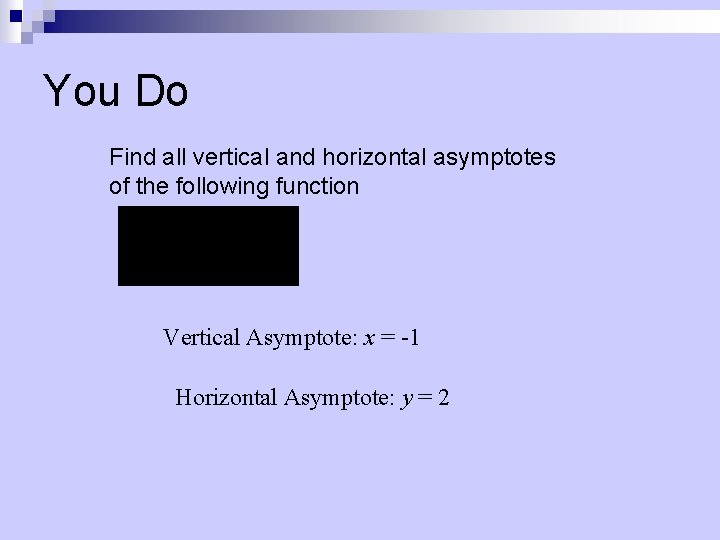
You Do Find all vertical and horizontal asymptotes of the following function Vertical Asymptote: x = -1 Horizontal Asymptote: y = 2
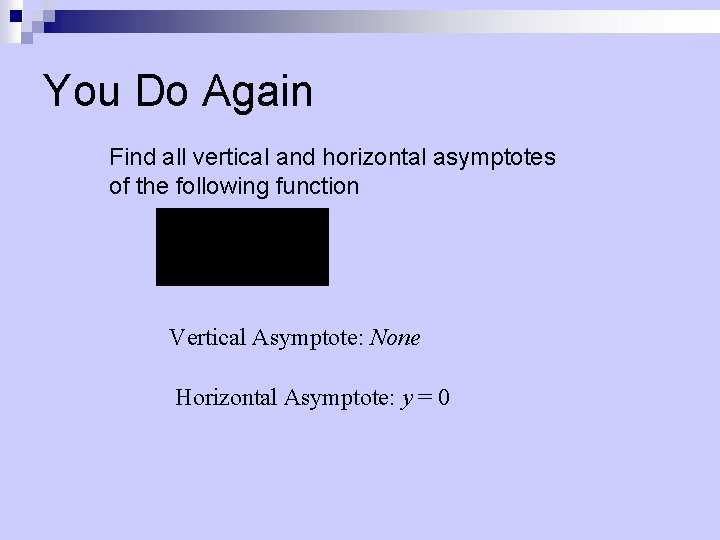
You Do Again Find all vertical and horizontal asymptotes of the following function Vertical Asymptote: None Horizontal Asymptote: y = 0
Oblique/Slant Asymptotes The graph of a rational function has a slant asymptote if the degree of the numerator is exactly one more than the degree of the denominator. Long division is used to find slant asymptotes. The only time you have an oblique asymptote is when there is no horizontal asymptote. You cannot have both. When doing long division, we do not care about the remainder.
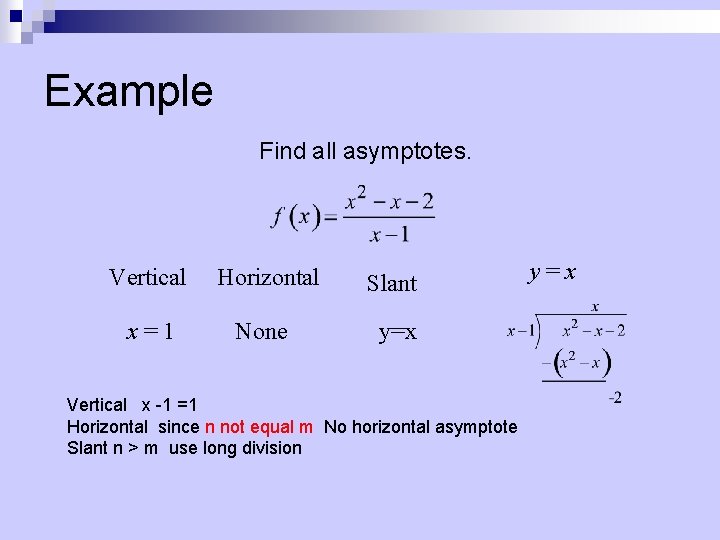
Example Find all asymptotes. Vertical x = 1 Horizontal None Slant y=x Vertical x -1 =1 Horizontal since n not equal m No horizontal asymptote Slant n > m use long division y = x
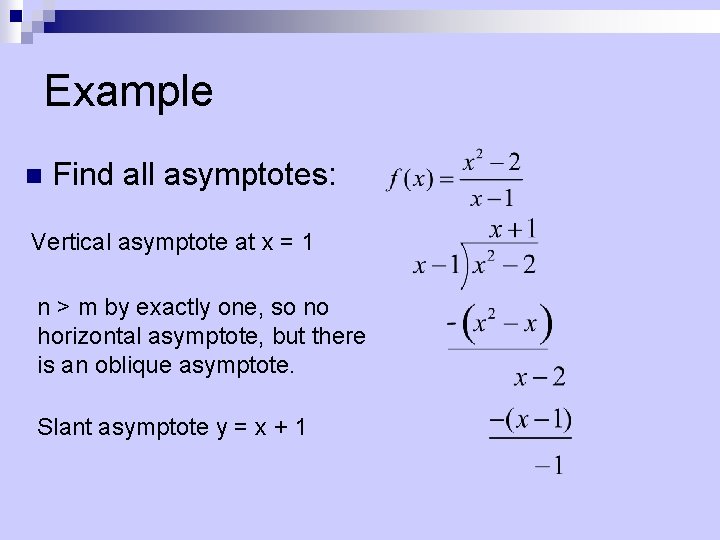
Example n Find all asymptotes: Vertical asymptote at x = 1 n > m by exactly one, so no horizontal asymptote, but there is an oblique asymptote. Slant asymptote y = x + 1
CW 4 -2