
Rational DNA Sequence Design for Molecular Nanotechnology Ion

![Cycle Packing Algorithm [MT 06] Experimental results for l=20 Partial c-token graph for c=4](https://slidetodoc.com/presentation_image_h2/7e4460b5d21a0c6d7e4bbcab29ef8c5e/image-4.jpg "Cycle Packing Algorithm [MT 06] Experimental results for l=20 Partial c-token graph for c=4")
- Slides: 4
Rational DNA Sequence Design for Molecular Nanotechnology Ion Mandoiu, CSE Department • DNA is well-known as the carrier of information in living organisms • Synthetic DNA is becoming a commodity • Custom oligonucleotides (up to 160 -200 bases) • Synthetic genes (<$1/bp, up to 45 Kb) • Synthetic genomes (M. genitalium 580 Kb) 1
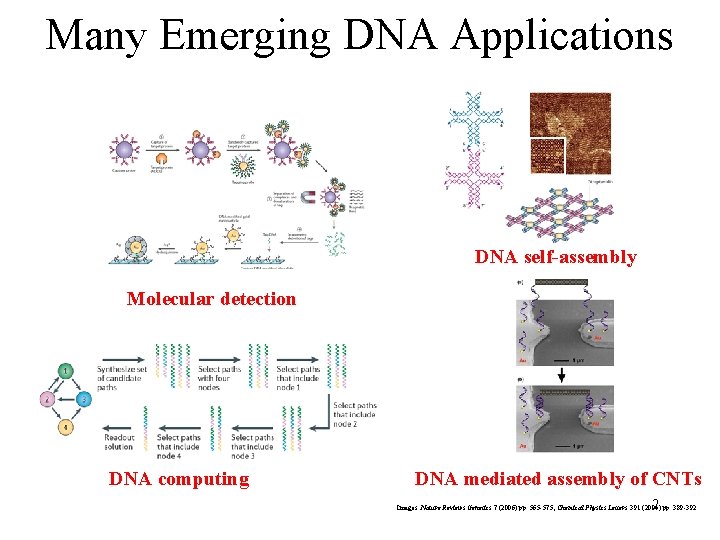
Many Emerging DNA Applications DNA self-assembly Molecular detection DNA computing DNA mediated assembly of CNTs 2 Images: Nature Reviews Genetics 7 (2006) pp. 565 -575, Chemical Physics Letters 391 (2004) pp. 389 -392
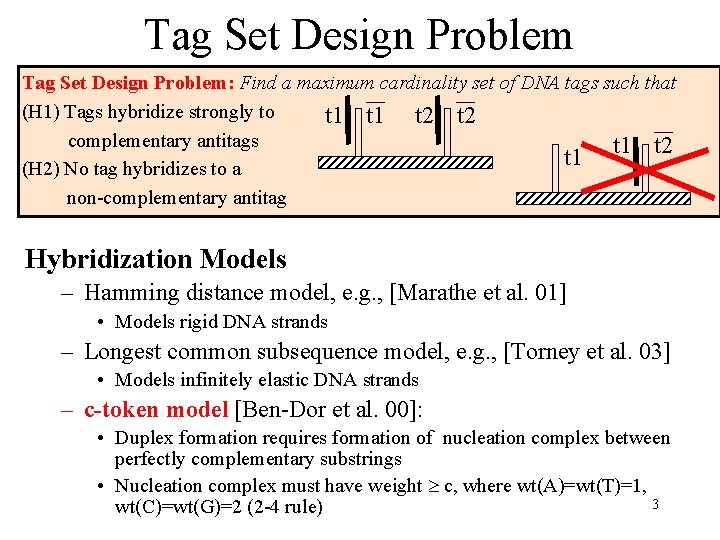
Tag Set Design Problem: Find a maximum cardinality set of DNA tags such that (H 1) Tags hybridize strongly to t 1 t 2 complementary antitags t 1 t 2 t 1 (H 2) No tag hybridizes to a non-complementary antitag Hybridization Models – Hamming distance model, e. g. , [Marathe et al. 01] • Models rigid DNA strands – Longest common subsequence model, e. g. , [Torney et al. 03] • Models infinitely elastic DNA strands – c-token model [Ben-Dor et al. 00]: • Duplex formation requires formation of nucleation complex between perfectly complementary substrings • Nucleation complex must have weight c, where wt(A)=wt(T)=1, 3 wt(C)=wt(G)=2 (2 -4 rule)
Cycle Packing Algorithm [MT 06] Experimental results for l=20 Partial c-token graph for c=4 1. Construct c-token factor graph G 2. T {} 3. For all cycles C defining periodic tags, in increasing order of cycle length, • Add to T the tag defined by C • Remove C from G 4. Perform an alphabetic tree search and add to T tags consisting of unused c-tokens 5. Return T c LP Approx Cycle Packing % Improvement 4 3 17 466% 5 9 40 344% 6 26 72 176% 7 75 178 137% 8 220 383 74% 9 641 961 49% 10 1854 2344 26% • Ongoing work: temperature programming, oligo design for gene synthesis • Acknowledgements: D. Trinca, UCONN Research Foundation, NSF CAREER Award IIS-0546457 4