
Rational Decision Making 8 step Process n n
- Slides: 18
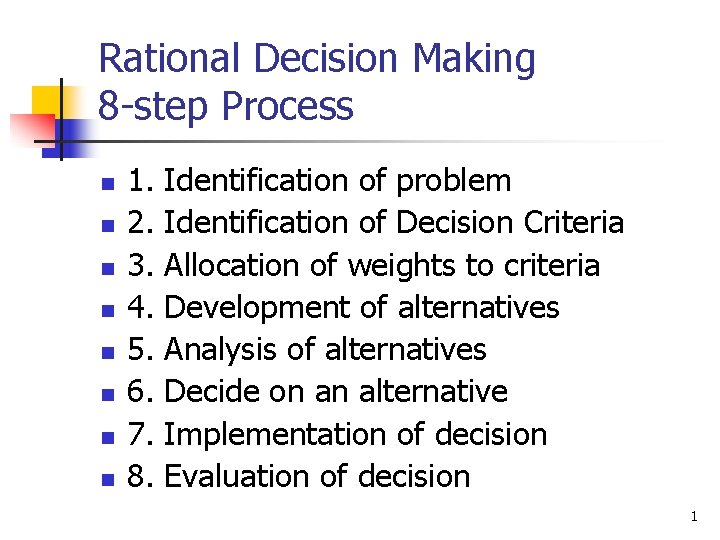
Rational Decision Making 8 -step Process n n n n 1. 2. 3. 4. 5. 6. 7. 8. Identification of problem Identification of Decision Criteria Allocation of weights to criteria Development of alternatives Analysis of alternatives Decide on an alternative Implementation of decision Evaluation of decision 1
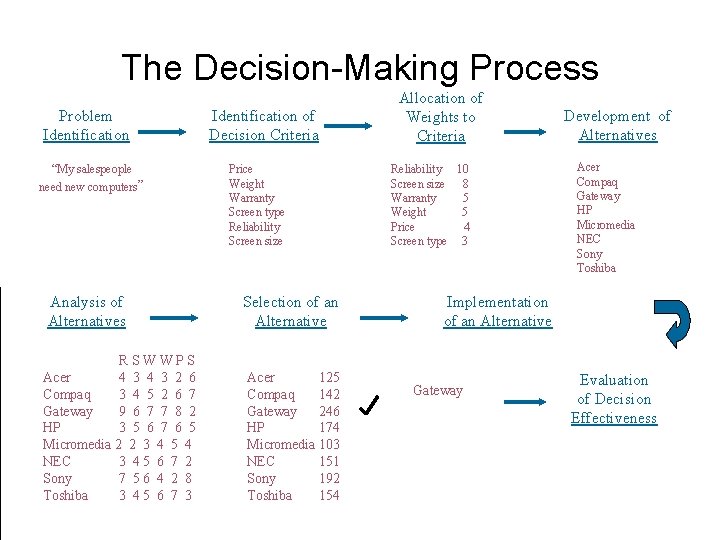
The Decision-Making Process Problem Identification “My salespeople need new computers” Analysis of Alternatives RSWWPS Acer 4 3 2 6 Compaq 3 4 5 2 6 7 Gateway 9 6 7 7 8 2 HP 3 5 6 7 6 5 Micromedia 2 2 3 4 5 4 NEC 3 45 6 7 2 Sony 7 56 4 2 8 Toshiba 3 45 6 7 3 Identification of Decision Criteria Price Weight Warranty Screen type Reliability Screen size Selection of an Alternative Acer 125 Compaq 142 Gateway 246 HP 174 Micromedia 103 NEC 151 Sony 192 Toshiba 154 Allocation of Weights to Criteria Reliability 10 Screen size 8 Warranty 5 Weight 5 Price 4 Screen type 3 Development of Alternatives Acer Compaq Gateway HP Micromedia NEC Sony Toshiba Implementation of an Alternative Gateway Evaluation of Decision Effectiveness 2
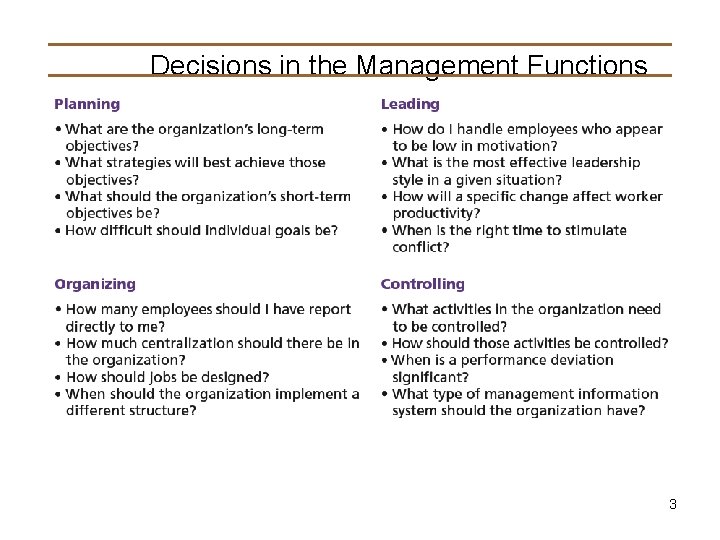
Decisions in the Management Functions 3
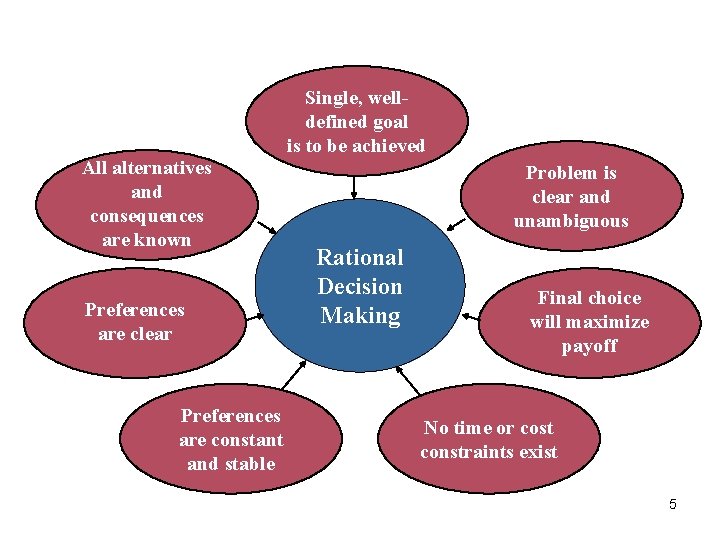
About Rational Decision Making n Is it always possible to make rational decisions? 4
All alternatives and consequences are known Preferences are clear Preferences are constant and stable Single, welldefined goal is to be achieved Problem is clear and unambiguous Rational Decision Making Final choice will maximize payoff No time or cost constraints exist 5
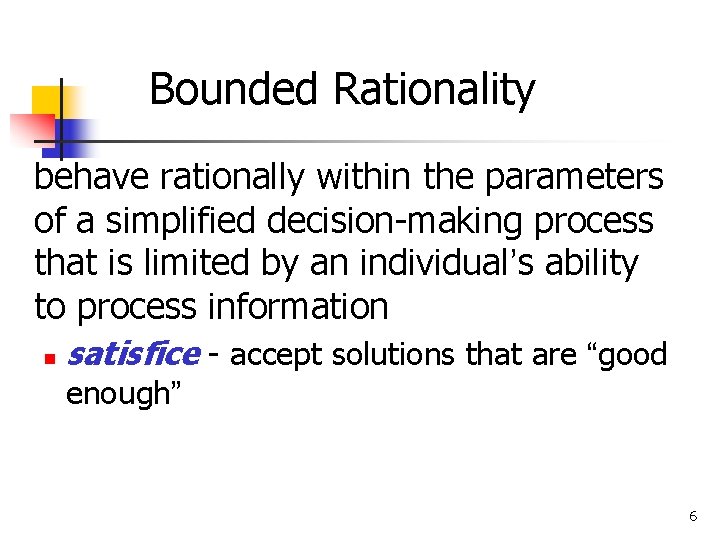
Bounded Rationality behave rationally within the parameters of a simplified decision-making process that is limited by an individual’s ability to process information n satisfice - accept solutions that are “good enough” 6
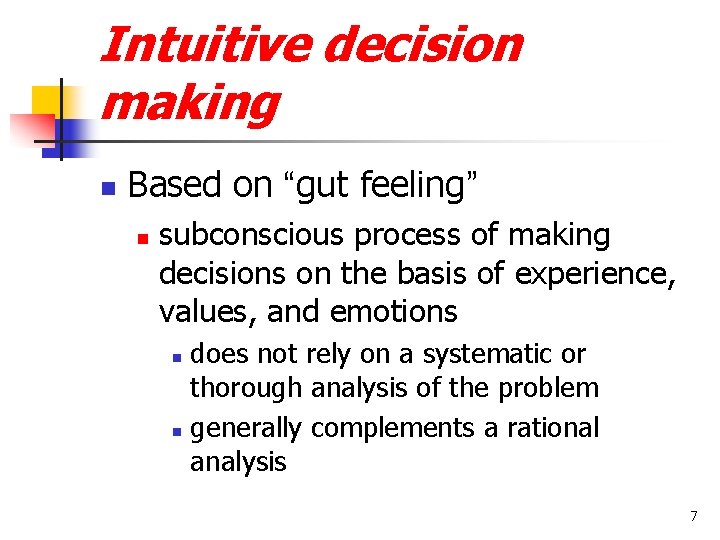
Intuitive decision making n Based on “gut feeling” n subconscious process of making decisions on the basis of experience, values, and emotions does not rely on a systematic or thorough analysis of the problem n generally complements a rational analysis n 7
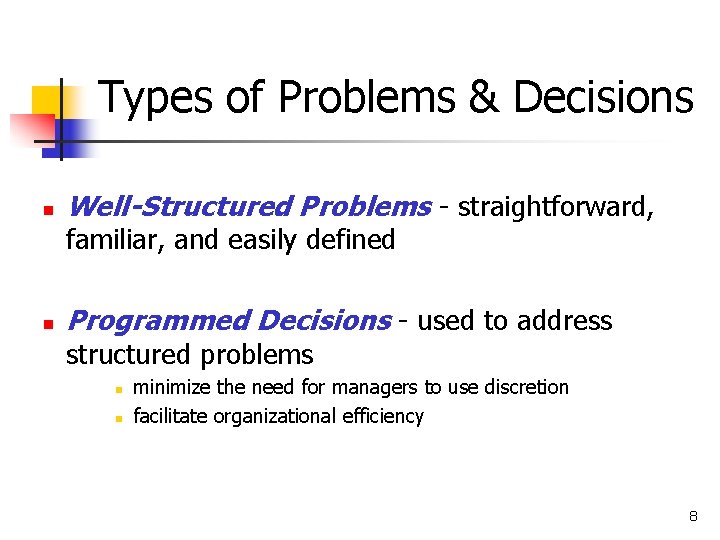
Types of Problems & Decisions n Well-Structured Problems - straightforward, familiar, and easily defined n Programmed Decisions - used to address structured problems n n minimize the need for managers to use discretion facilitate organizational efficiency 8
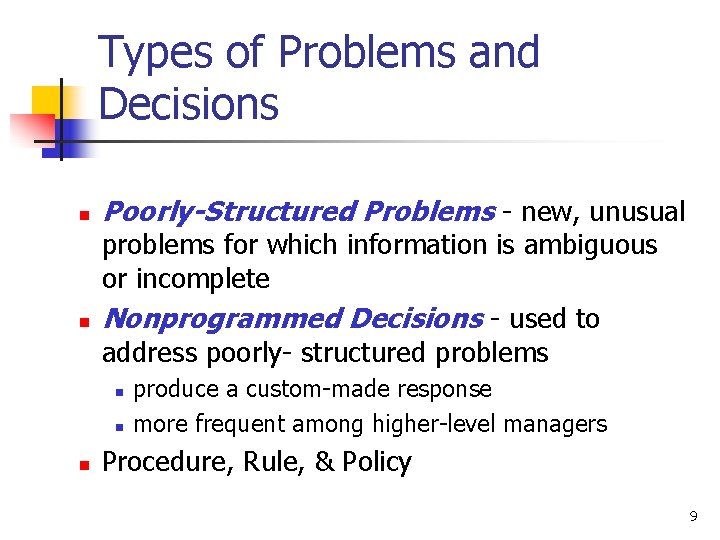
Types of Problems and Decisions n n Poorly-Structured Problems - new, unusual problems for which information is ambiguous or incomplete Nonprogrammed Decisions - used to address poorly- structured problems n n n produce a custom-made response more frequent among higher-level managers Procedure, Rule, & Policy 9
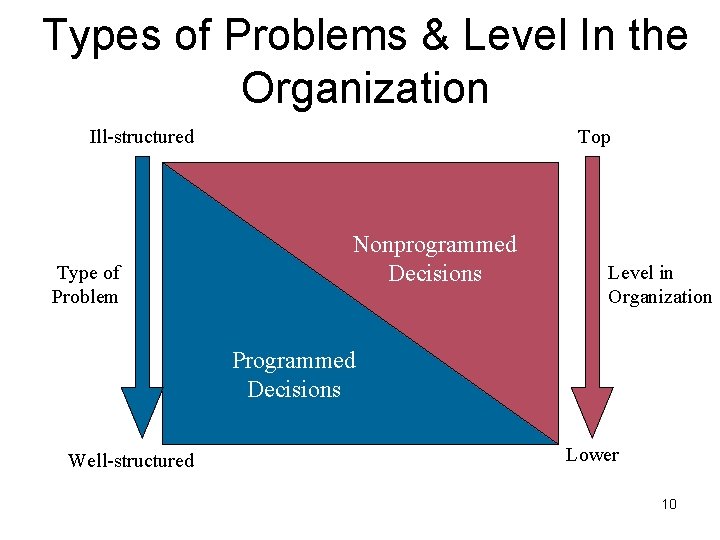
Types of Problems & Level In the Organization Ill-structured Type of Problem Top Nonprogrammed Decisions Level in Organization Programmed Decisions Well-structured Lower 10
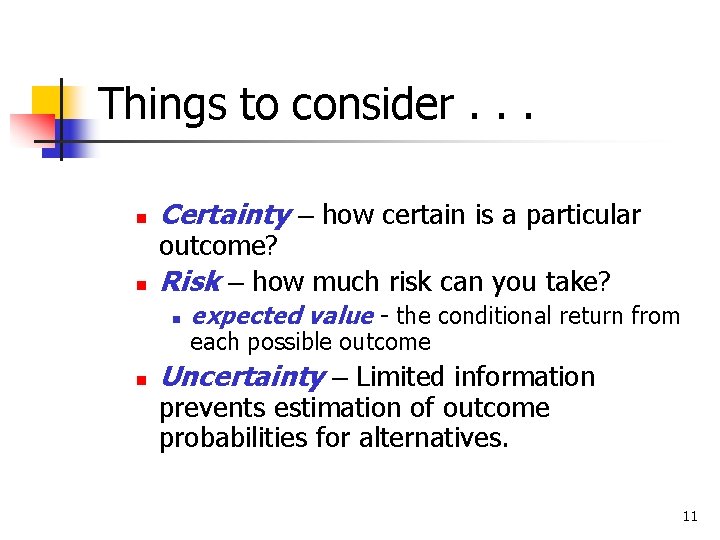
Things to consider. . . n n Certainty – how certain is a particular outcome? Risk – how much risk can you take? n n expected value - the conditional return from each possible outcome Uncertainty – Limited information prevents estimation of outcome probabilities for alternatives. 11
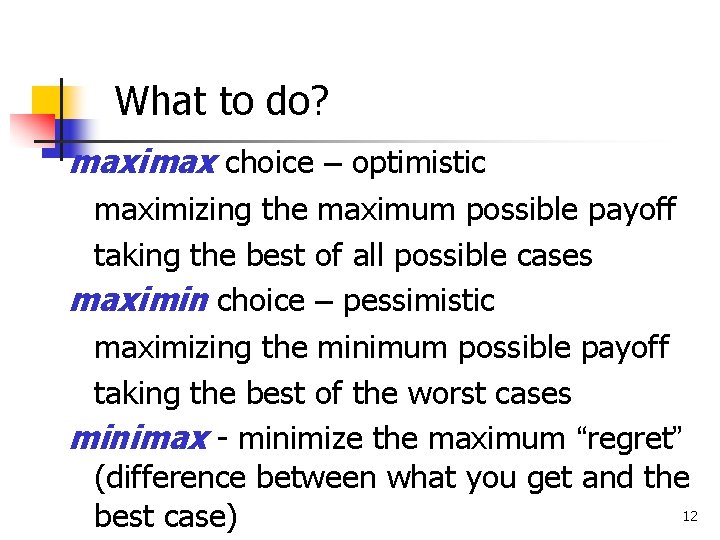
What to do? maximax choice – optimistic maximizing the maximum possible payoff taking the best of all possible cases maximin choice – pessimistic maximizing the minimum possible payoff taking the best of the worst cases minimax - minimize the maximum “regret” (difference between what you get and the 12 best case)
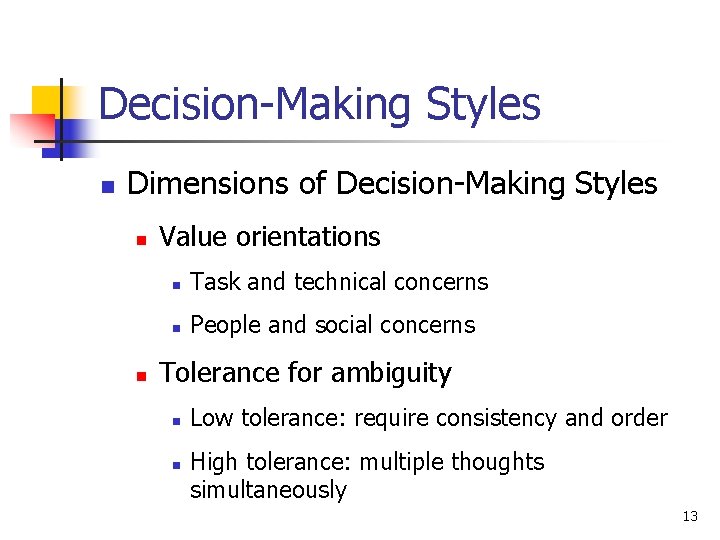
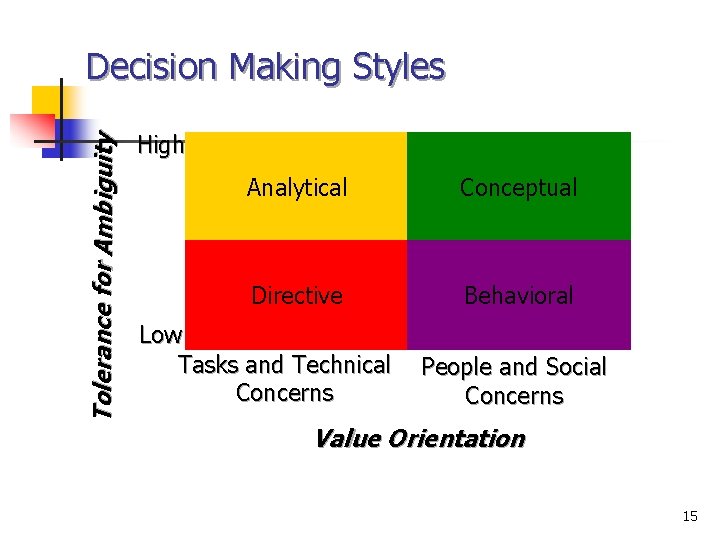
Decision-Making Styles n Dimensions of Decision-Making Styles n n Value orientations n Task and technical concerns n People and social concerns Tolerance for ambiguity n n Low tolerance: require consistency and order High tolerance: multiple thoughts simultaneously 13
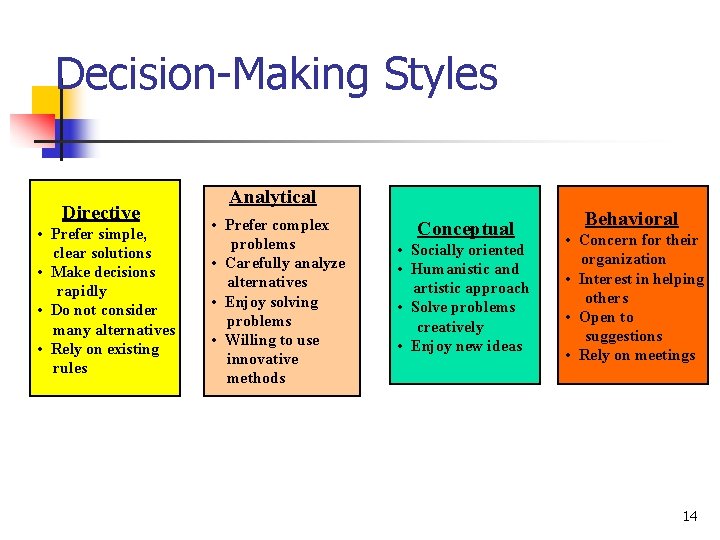
Decision-Making Styles Directive • Prefer simple, clear solutions • Make decisions rapidly • Do not consider many alternatives • Rely on existing rules Analytical • Prefer complex problems • Carefully analyze alternatives • Enjoy solving problems • Willing to use innovative methods Conceptual • Socially oriented • Humanistic and artistic approach • Solve problems creatively • Enjoy new ideas Behavioral • Concern for their organization • Interest in helping others • Open to suggestions • Rely on meetings 14
Tolerance for Ambiguity Decision Making Styles High Analytical Conceptual Directive Behavioral Low Tasks and Technical Concerns People and Social Concerns Value Orientation 15
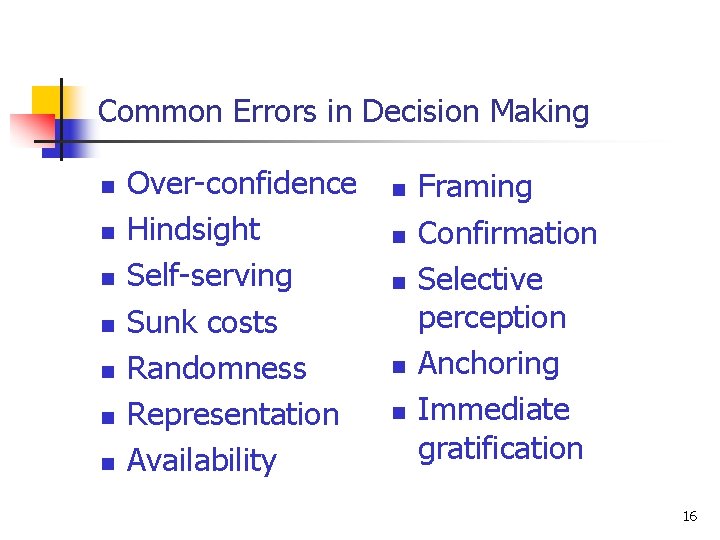
Common Errors in Decision Making n n n n Over-confidence Hindsight Self-serving Sunk costs Randomness Representation Availability n n n Framing Confirmation Selective perception Anchoring Immediate gratification 16
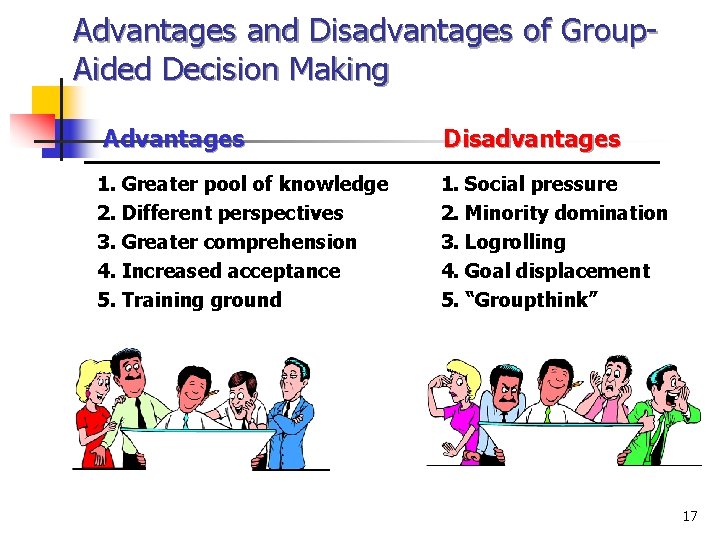
Advantages and Disadvantages of Group. Aided Decision Making Advantages 1. Greater pool of knowledge 2. Different perspectives 3. Greater comprehension 4. Increased acceptance 5. Training ground Disadvantages 1. Social pressure 2. Minority domination 3. Logrolling 4. Goal displacement 5. “Groupthink” 17
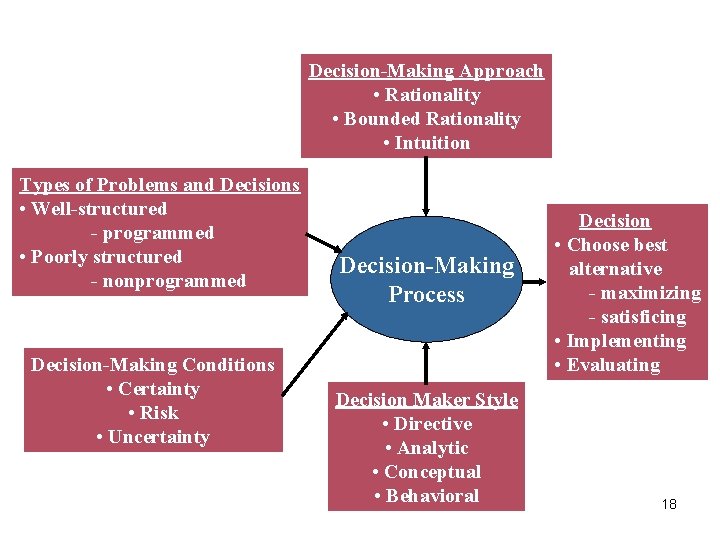
Decision-Making Approach • Rationality • Bounded Rationality • Intuition Types of Problems and Decisions • Well-structured - programmed • Poorly structured - nonprogrammed Decision-Making Conditions • Certainty • Risk • Uncertainty Decision-Making Process Decision Maker Style • Directive • Analytic • Conceptual • Behavioral Decision • Choose best alternative - maximizing - satisficing • Implementing • Evaluating 18