
Ratio Method of Solving Basic Gas Laws Boyles
Ratio Method of Solving Basic Gas Laws
Boyle’s Law Don’t hate me just because I’m beautiful Robert Boyle
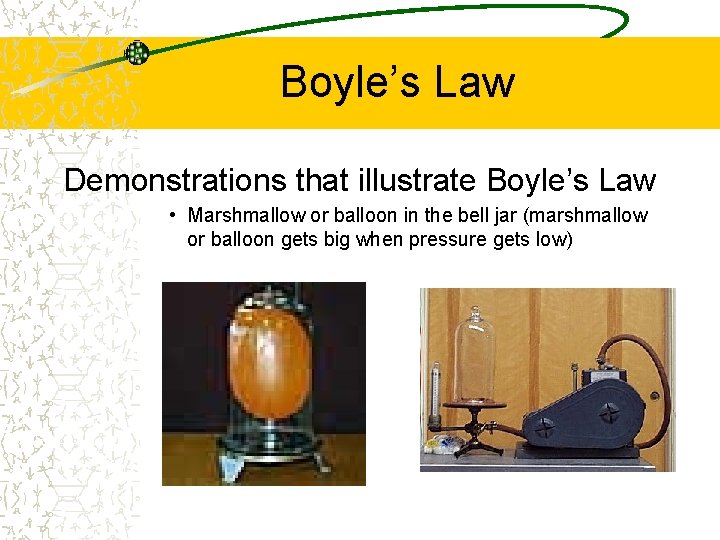
Boyle’s Law Demonstrations that illustrate Boyle’s Law • Marshmallow or balloon in the bell jar (marshmallow or balloon gets big when pressure gets low)
Boyle’s Law Volume is inversely related to Pressure If volume decreases, pressure increases If volume increases, pressure decreases (they move in opposite directions) You can see this relationship when temperature and moles of gas are held constant
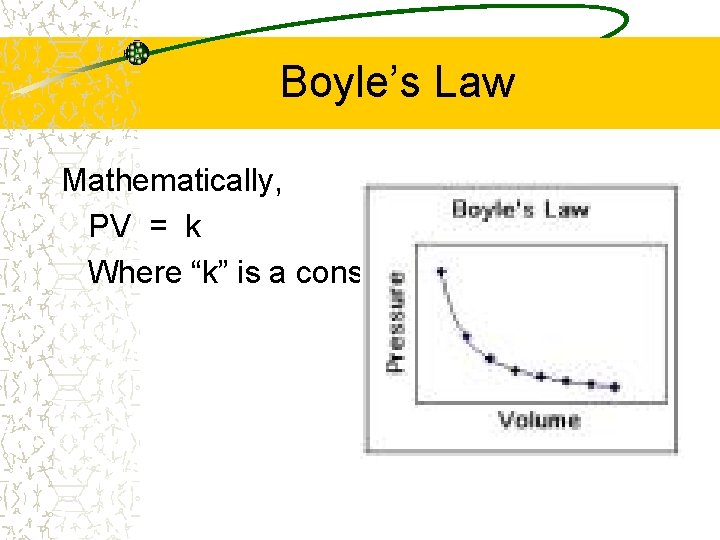
Boyle’s Law Mathematically, PV = k Where “k” is a constant
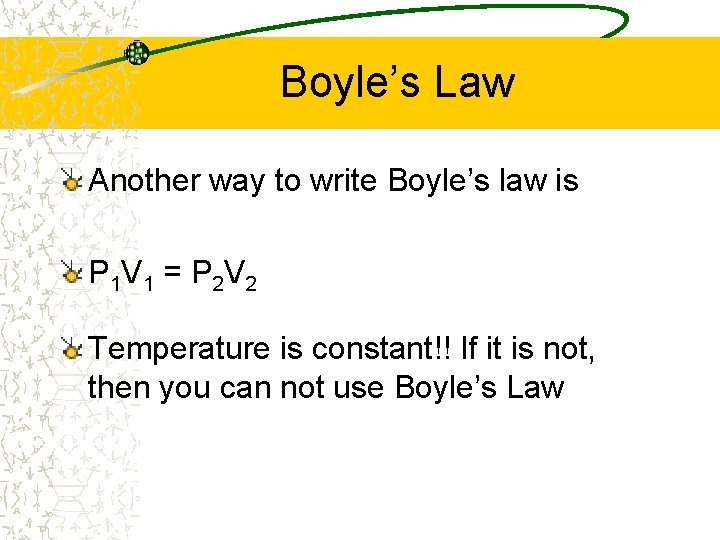
Boyle’s Law Another way to write Boyle’s law is P 1 V 1 = P 2 V 2 Temperature is constant!! If it is not, then you can not use Boyle’s Law
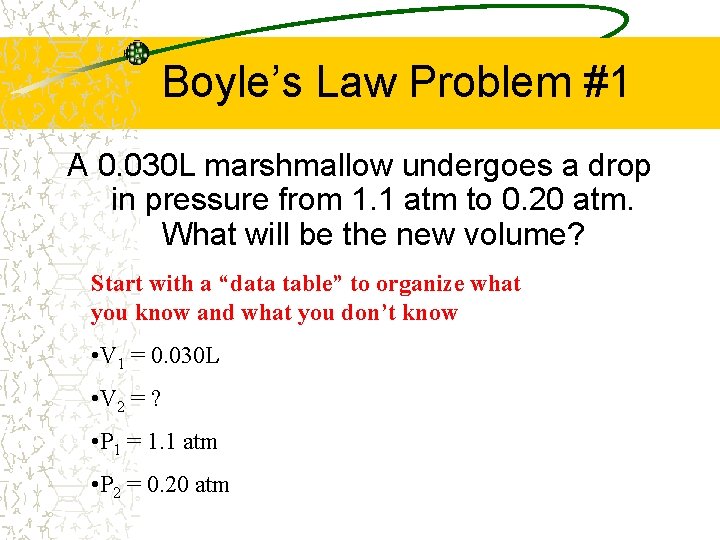
Boyle’s Law Problem #1 A 0. 030 L marshmallow undergoes a drop in pressure from 1. 1 atm to 0. 20 atm. What will be the new volume? Start with a “data table” to organize what you know and what you don’t know • V 1 = 0. 030 L • V 2 = ? • P 1 = 1. 1 atm • P 2 = 0. 20 atm
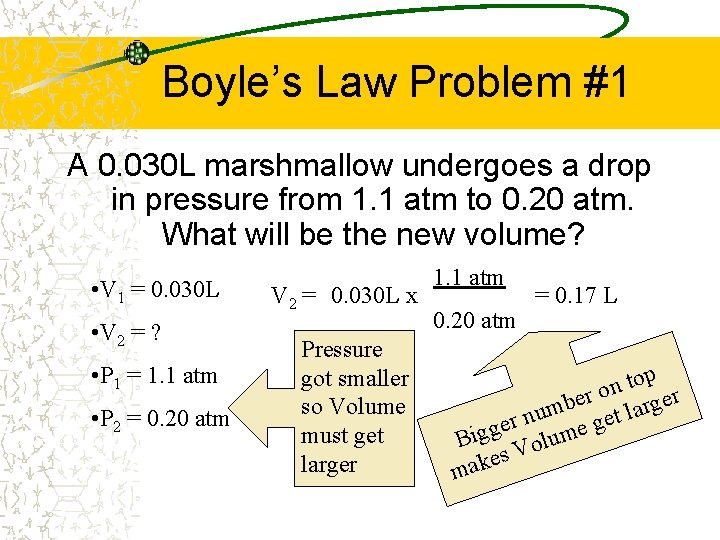
Boyle’s Law Problem #1 A 0. 030 L marshmallow undergoes a drop in pressure from 1. 1 atm to 0. 20 atm. What will be the new volume? • V 1 = 0. 030 L • V 2 = ? • P 1 = 1. 1 atm • P 2 = 0. 20 atm V 2 = 0. 030 L x Pressure got smaller so Volume must get larger 1. 1 atm 0. 20 atm = 0. 17 L p o t n r o rger e b m la u t n e r g e e g g m i u B l Vo s e mak
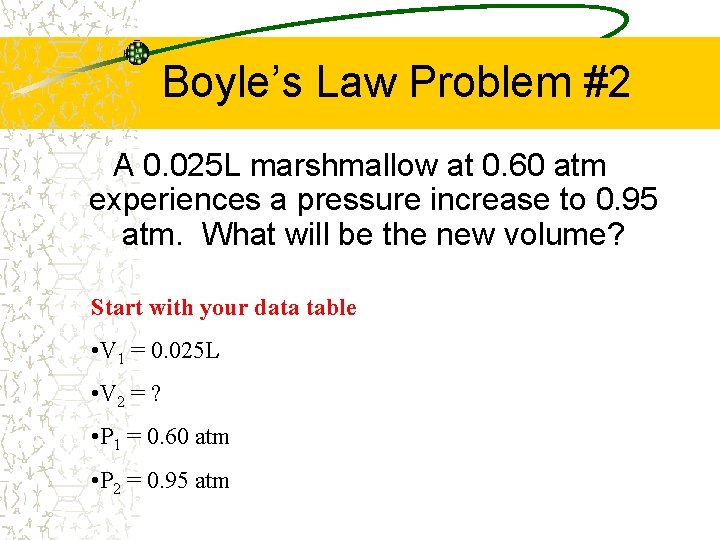
Boyle’s Law Problem #2 A 0. 025 L marshmallow at 0. 60 atm experiences a pressure increase to 0. 95 atm. What will be the new volume? Start with your data table • V 1 = 0. 025 L • V 2 = ? • P 1 = 0. 60 atm • P 2 = 0. 95 atm
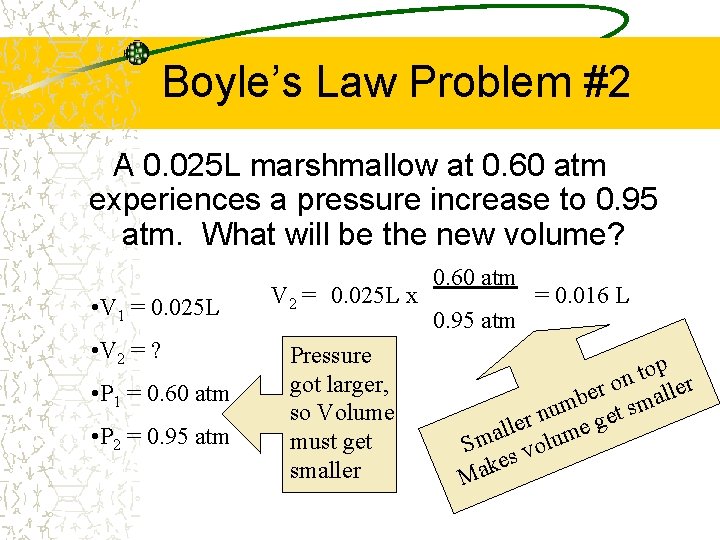
Boyle’s Law Problem #2 A 0. 025 L marshmallow at 0. 60 atm experiences a pressure increase to 0. 95 atm. What will be the new volume? • V 1 = 0. 025 L • V 2 = ? • P 1 = 0. 60 atm • P 2 = 0. 95 atm V 2 = 0. 025 L x Pressure got larger, so Volume must get smaller 0. 60 atm 0. 95 atm = 0. 016 L op t n o r ler l e a b um get sm n r le e l a m u Sm vol kes a M
Charles’ Law Hey Ladies!!!

Charles’ Law Demonstrations that illustrate Charles’ Law • Balloon on flask (heat the flask then the balloon expands)
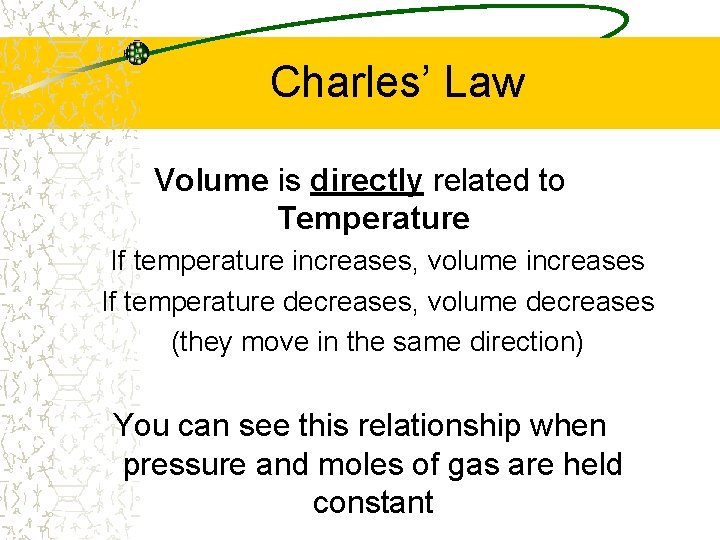
Charles’ Law Volume is directly related to Temperature If temperature increases, volume increases If temperature decreases, volume decreases (they move in the same direction) You can see this relationship when pressure and moles of gas are held constant
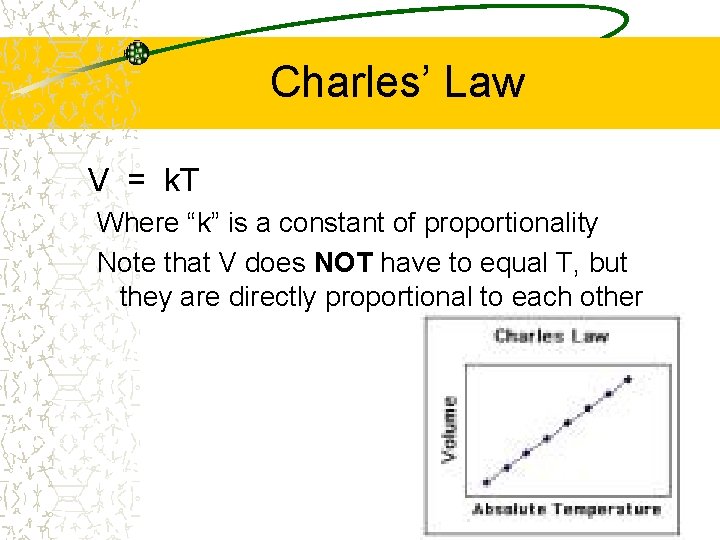
Charles’ Law V = k. T Where “k” is a constant of proportionality Note that V does NOT have to equal T, but they are directly proportional to each other
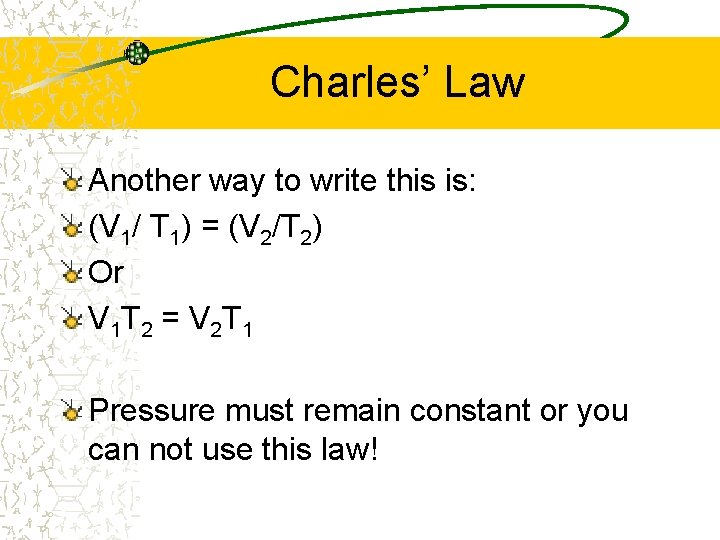
Charles’ Law Another way to write this is: (V 1/ T 1) = (V 2/T 2) Or V 1 T 2 = V 2 T 1 Pressure must remain constant or you can not use this law!
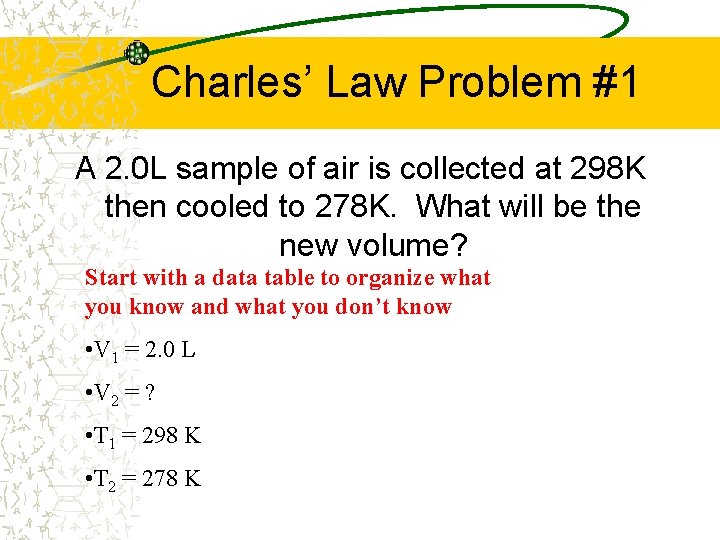
Charles’ Law Problem #1 A 2. 0 L sample of air is collected at 298 K then cooled to 278 K. What will be the new volume? Start with a data table to organize what you know and what you don’t know • V 1 = 2. 0 L • V 2 = ? • T 1 = 298 K • T 2 = 278 K
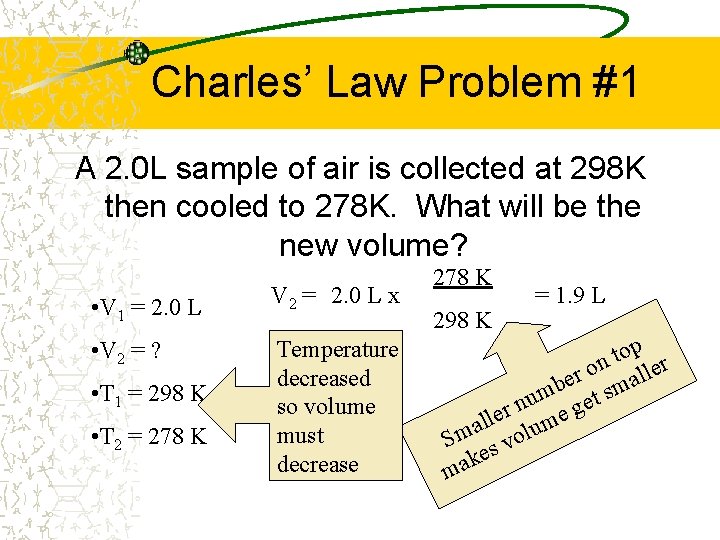
Charles’ Law Problem #1 A 2. 0 L sample of air is collected at 298 K then cooled to 278 K. What will be the new volume? • V 1 = 2. 0 L V 2 = 2. 0 L x • V 2 = ? Temperature decreased so volume must decrease • T 1 = 298 K • T 2 = 278 K 298 K = 1. 9 L p o t n ller o r e a b m m et s u n g r e e l al olum m S sv ke a m
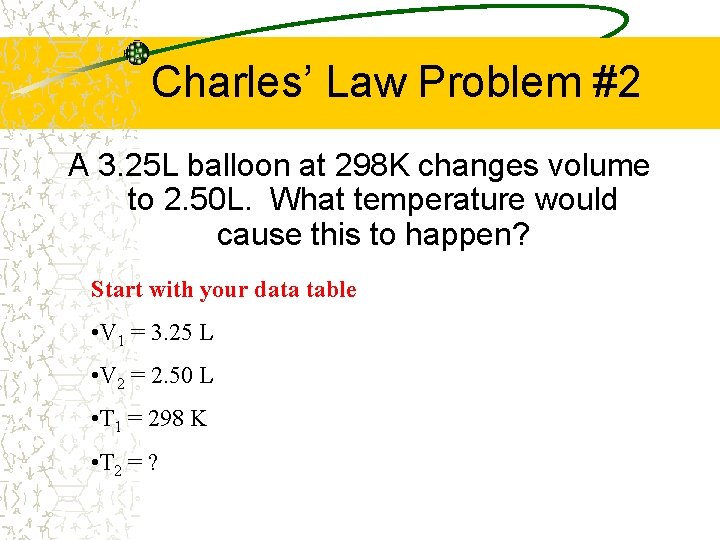
Charles’ Law Problem #2 A 3. 25 L balloon at 298 K changes volume to 2. 50 L. What temperature would cause this to happen? Start with your data table • V 1 = 3. 25 L • V 2 = 2. 50 L • T 1 = 298 K • T 2 = ?
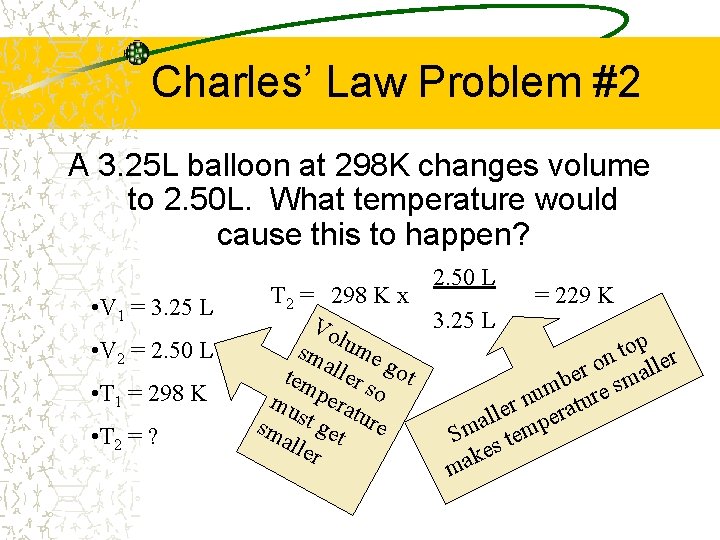
Charles’ Law Problem #2 A 3. 25 L balloon at 298 K changes volume to 2. 50 L. What temperature would cause this to happen? 2. 50 L • V 1 = 3. 25 L • V 2 = 2. 50 L • T 1 = 298 K • T 2 = ? T 2 = 298 K x = 229 K 3. 25 L Vo p o sm lume t n ller a g o l o r l tem er s t e sma b m re u n mu perat o tu r a e r l s u l a mpe sm t get re m S s te alle r ke a m
Gay-Lussac Law O. K. So I have a funny name. Go ahead get it out of your system so we may continue.
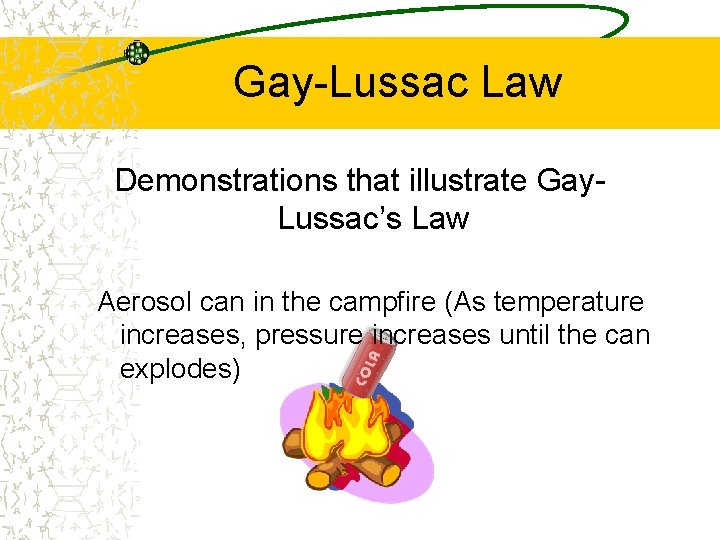
Gay-Lussac Law Demonstrations that illustrate Gay. Lussac’s Law Aerosol can in the campfire (As temperature increases, pressure increases until the can explodes)
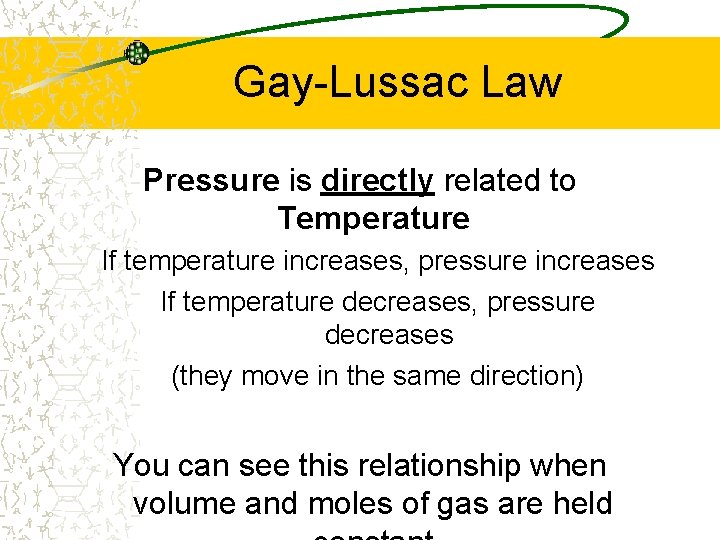
Gay-Lussac Law Pressure is directly related to Temperature If temperature increases, pressure increases If temperature decreases, pressure decreases (they move in the same direction) You can see this relationship when volume and moles of gas are held
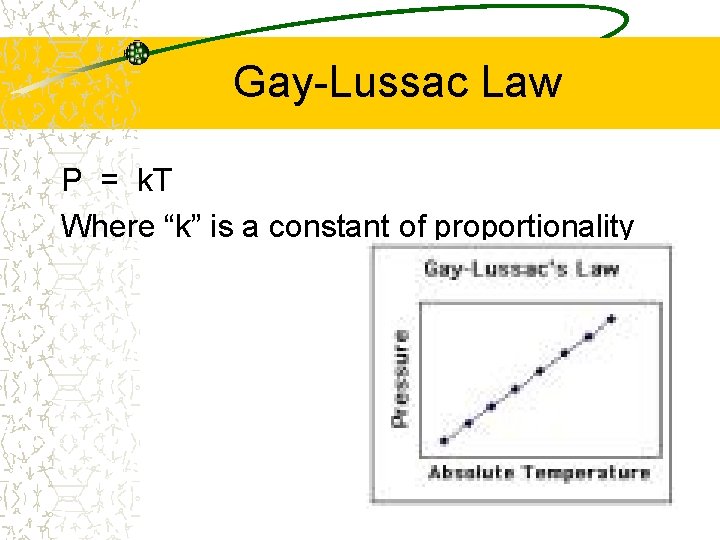
Gay-Lussac Law P = k. T Where “k” is a constant of proportionality
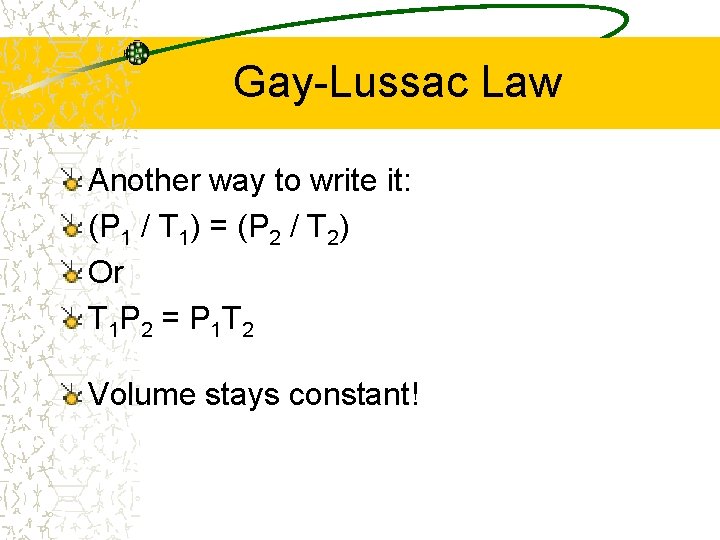
Gay-Lussac Law Another way to write it: (P 1 / T 1) = (P 2 / T 2) Or T 1 P 2 = P 1 T 2 Volume stays constant!
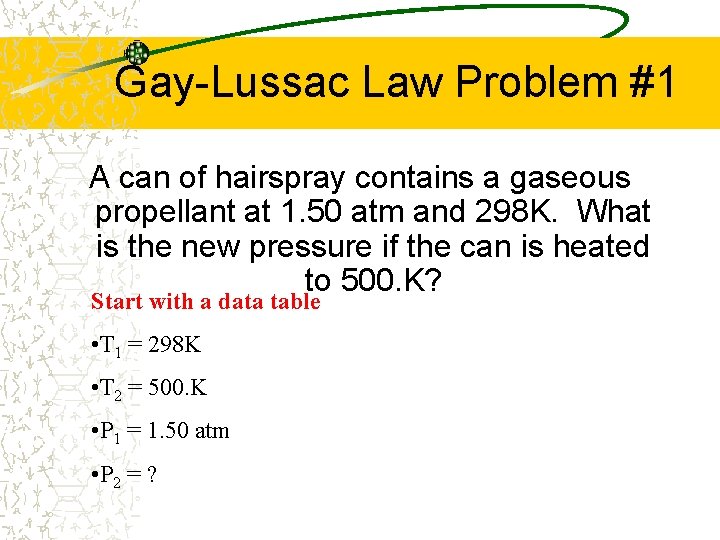
Gay-Lussac Law Problem #1 A can of hairspray contains a gaseous propellant at 1. 50 atm and 298 K. What is the new pressure if the can is heated to 500. K? Start with a data table • T 1 = 298 K • T 2 = 500. K • P 1 = 1. 50 atm • P 2 = ?
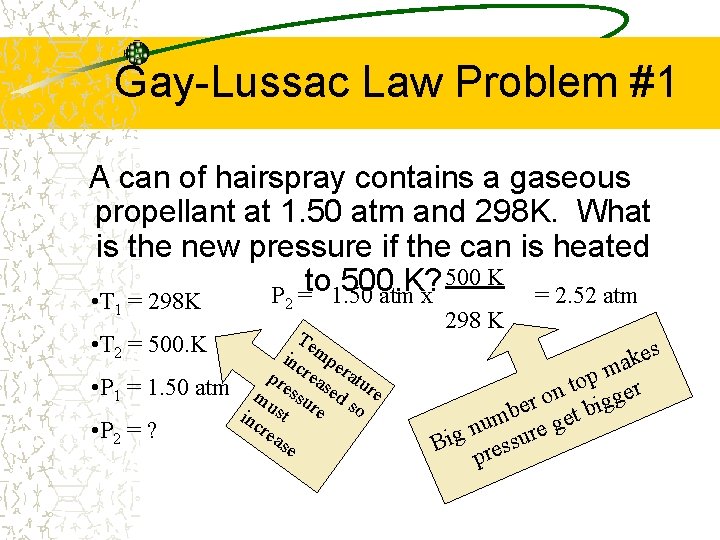
Gay-Lussac Law Problem #1 A can of hairspray contains a gaseous propellant at 1. 50 atm and 298 K. What is the new pressure if the can is heated 500 K to 500. K? P = 1. 50 atm x = 2. 52 atm • T 1 = 298 K • T 2 = 500. K • P 1 = 1. 50 atm • P 2 = ? 2 Te inc mpe pre reas ratu mu ssu ed s re o inc st re rea se 298 K es k a m p o t n er o g g r be et bi m u g n e r g Bi ressu p
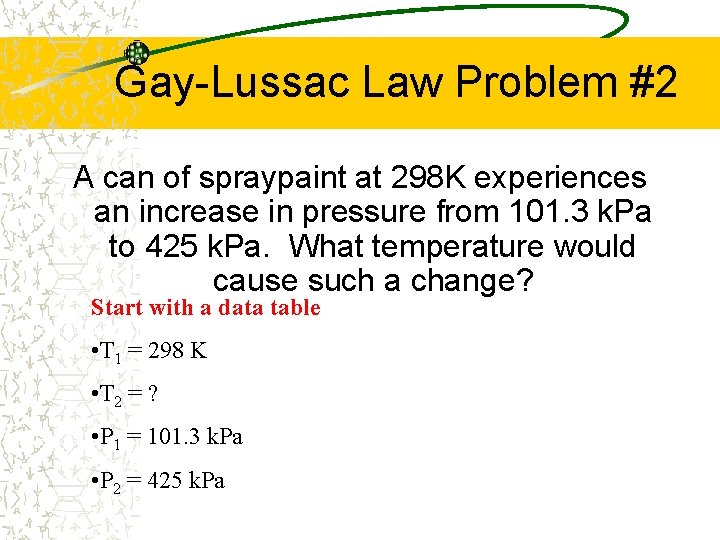
Gay-Lussac Law Problem #2 A can of spraypaint at 298 K experiences an increase in pressure from 101. 3 k. Pa to 425 k. Pa. What temperature would cause such a change? Start with a data table • T 1 = 298 K • T 2 = ? • P 1 = 101. 3 k. Pa • P 2 = 425 k. Pa
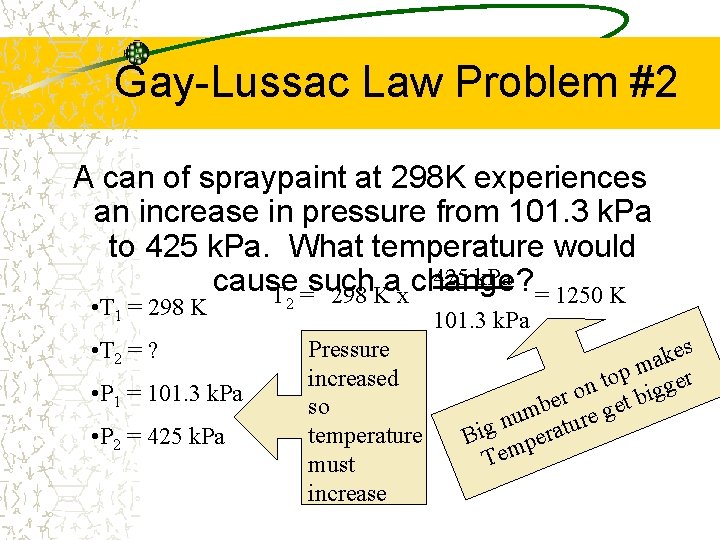
Gay-Lussac Law Problem #2 A can of spraypaint at 298 K experiences an increase in pressure from 101. 3 k. Pa to 425 k. Pa. What temperature would 425 k. Pa cause such a change? T = 298 K x = 1250 K • T 1 = 298 K • T 2 = ? • P 1 = 101. 3 k. Pa • P 2 = 425 k. Pa 2 101. 3 k. Pa Pressure increased so temperature must increase es k a m r p o t e g n g o i r b e t b e g m u re n u t g i a r B e p Tem
Avogadro’s Law I’m dead sexy and you know it!! Text me. You got my number.
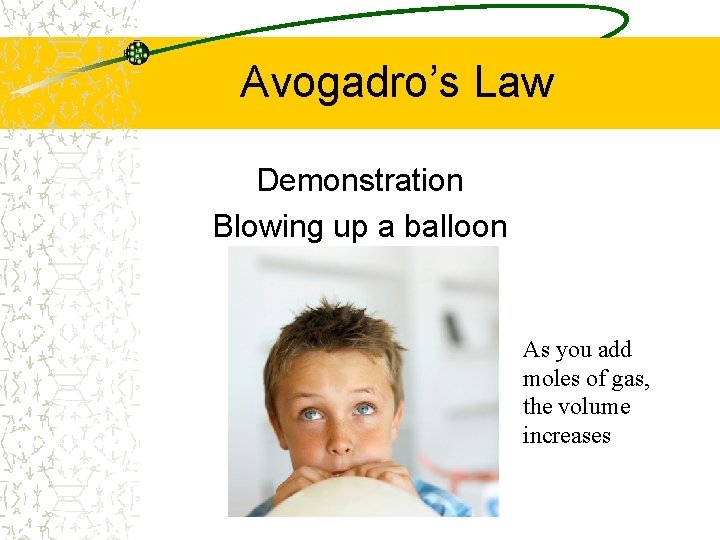
Avogadro’s Law Demonstration Blowing up a balloon As you add moles of gas, the volume increases
Avogadro’s Law Volume is directly related to Moles If moles of gas increases, volume increases If moles of gas decreases, volume decreases (they move in the same direction) You can see this relationship when temperature and pressure of gas are held constant
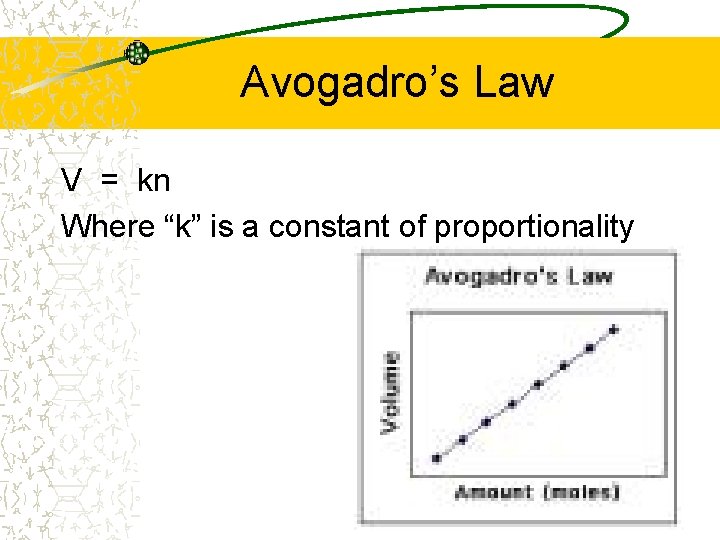
Avogadro’s Law V = kn Where “k” is a constant of proportionality
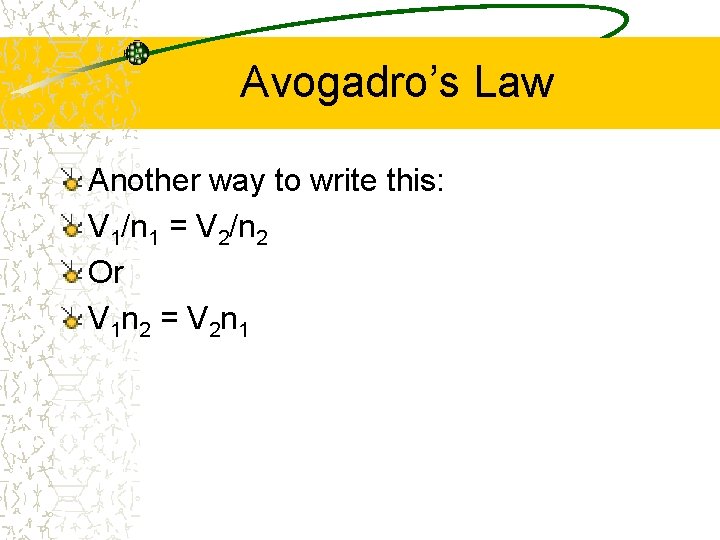
Avogadro’s Law Another way to write this: V 1/n 1 = V 2/n 2 Or V 1 n 2 = V 2 n 1
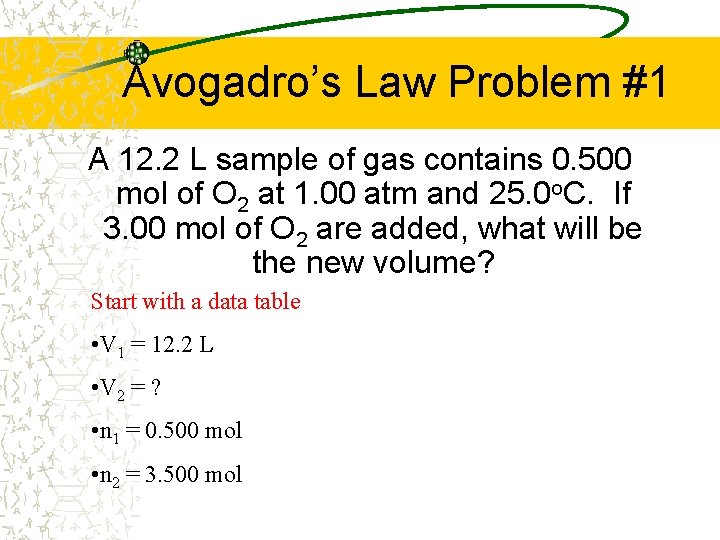
Avogadro’s Law Problem #1 A 12. 2 L sample of gas contains 0. 500 mol of O 2 at 1. 00 atm and 25. 0 o. C. If 3. 00 mol of O 2 are added, what will be the new volume? Start with a data table • V 1 = 12. 2 L • V 2 = ? • n 1 = 0. 500 mol • n 2 = 3. 500 mol
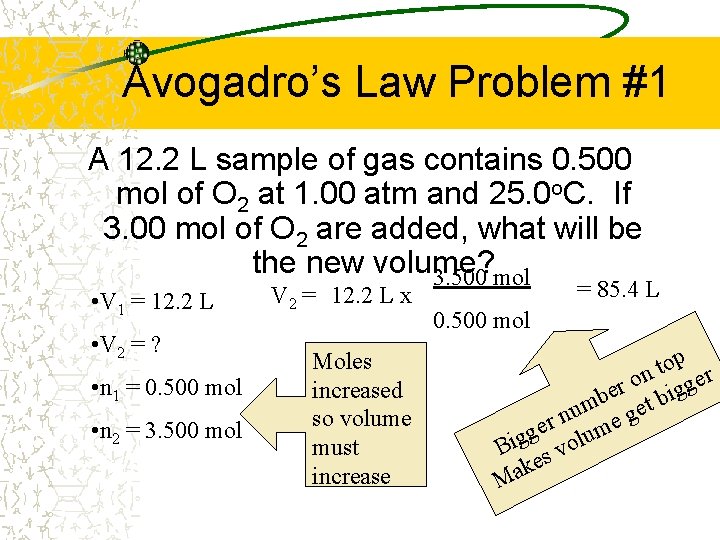
Avogadro’s Law Problem #1 A 12. 2 L sample of gas contains 0. 500 mol of O 2 at 1. 00 atm and 25. 0 o. C. If 3. 00 mol of O 2 are added, what will be the new volume? 3. 500 mol • V 1 = 12. 2 L • V 2 = ? • n 1 = 0. 500 mol • n 2 = 3. 500 mol V 2 = 12. 2 L x Moles increased so volume must increase = 85. 4 L 0. 500 mol p o t n ger o r g e i b b m get u n e r e m g u Big s vol ke a M
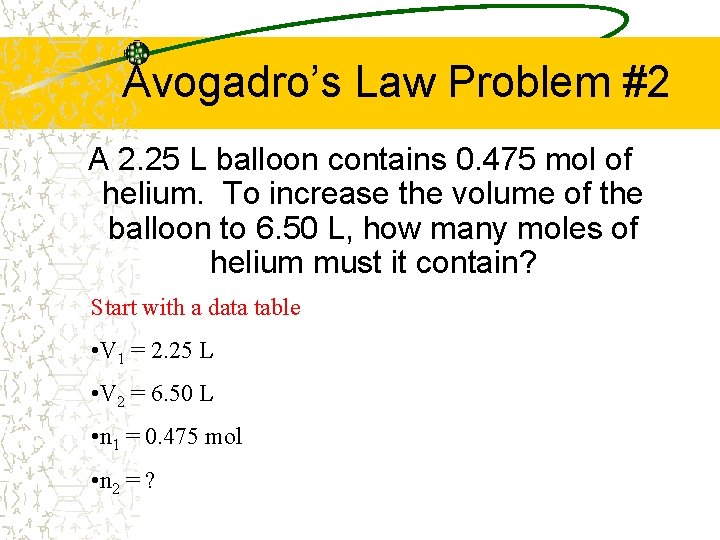
Avogadro’s Law Problem #2 A 2. 25 L balloon contains 0. 475 mol of helium. To increase the volume of the balloon to 6. 50 L, how many moles of helium must it contain? Start with a data table • V 1 = 2. 25 L • V 2 = 6. 50 L • n 1 = 0. 475 mol • n 2 = ?
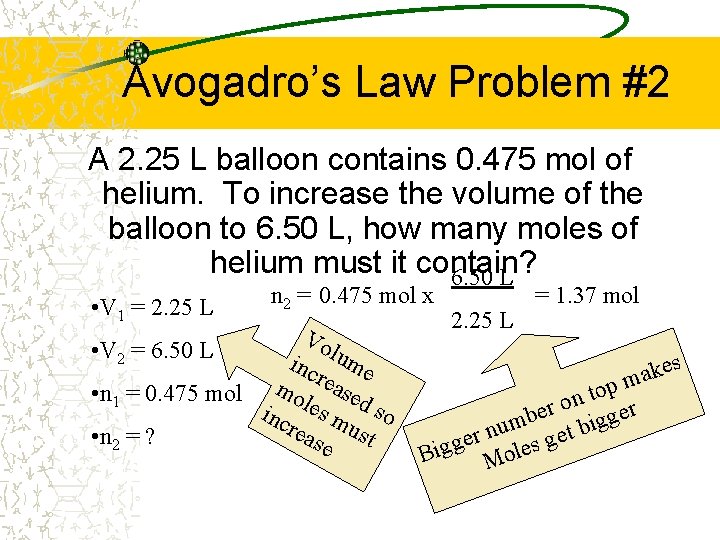
Avogadro’s Law Problem #2 A 2. 25 L balloon contains 0. 475 mol of helium. To increase the volume of the balloon to 6. 50 L, how many moles of helium must it contain? 6. 50 L • V 1 = 2. 25 L n 2 = 0. 475 mol x Vo • V 2 = 6. 50 L inc lume rea m • n 1 = 0. 475 mol ole sed inc s m so rea ust • n 2 = ? se 2. 25 L = 1. 37 mol es k a pm o t on er r e mb t bigg u n e r e g g s g e Bi Mol
- Slides: 37