
RATING AND BILLING Rating and Billing Module Objectives

RATING AND BILLING
Rating and Billing Module Objectives After you complete this module, you will be able to: • • • Explain the basics of rating and billing. Explain baling system components. Explain piling concept. Explain rating and billing flow. Explain credit control. Explain the various billing models. www. prolearninghub. com
What is a Billing System? Billing system is: • The heart of service provider's set of systems. • A system which defines the revenue model. • A system which bills the customer accurately in time with no over bill or no under bill. • Over bill leads to customer dissatisfaction. • Under bill leads to revenue loss. www. prolearninghub. com
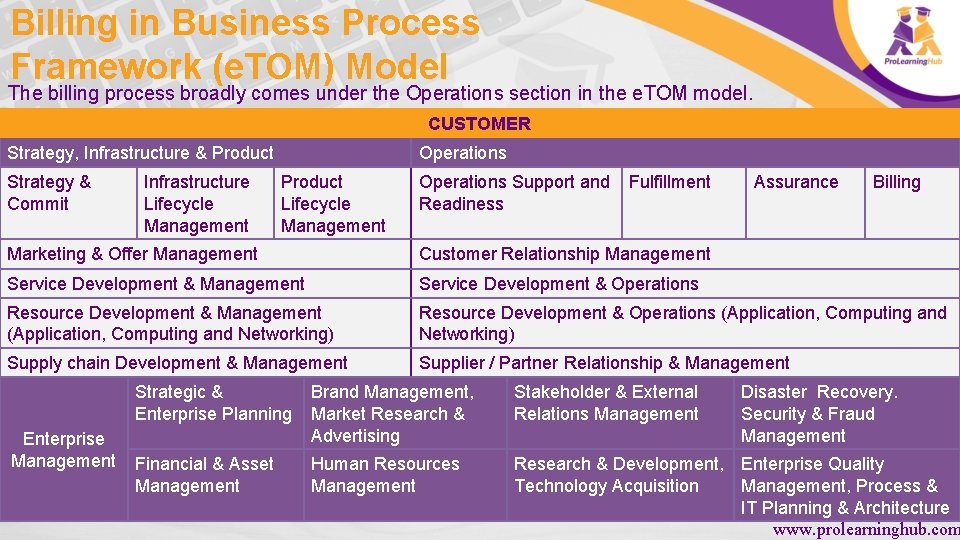
Billing in Business Process Framework (e. TOM) Model The billing process broadly comes under the Operations section in the e. TOM model. CUSTOMER Strategy, Infrastructure & Product Strategy & Commit Infrastructure Lifecycle Management Operations Product Lifecycle Management Operations Support and Readiness Fulfillment Assurance Billing Marketing & Offer Management Customer Relationship Management Service Development & Operations Resource Development & Management (Application, Computing and Networking) Resource Development & Operations (Application, Computing and Networking) Supply chain Development & Management Supplier / Partner Relationship & Management Enterprise Management Strategic & Enterprise Planning Brand Management, Market Research & Advertising Stakeholder & External Relations Management Disaster Recovery. Security & Fraud Management Financial & Asset Management Human Resources Management Research & Development, Enterprise Quality Technology Acquisition Management, Process & IT Planning & Architecture www. prolearninghub. com
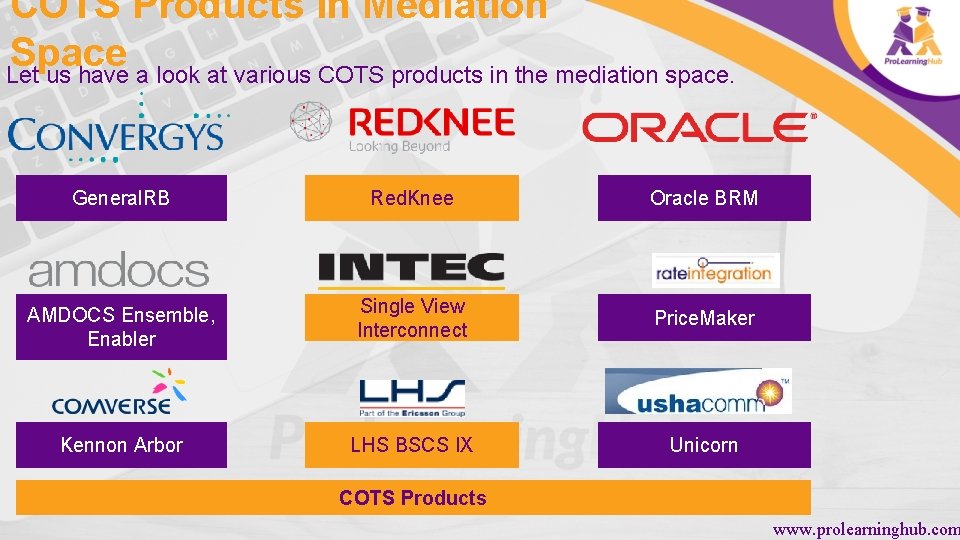
COTS Products in Mediation Space Let us have a look at various COTS products in the mediation space. General. RB Red. Knee Oracle BRM AMDOCS Ensemble, Enabler Single View Interconnect Price. Maker Kennon Arbor LHS BSCS IX Unicorn COTS Products www. prolearninghub. com
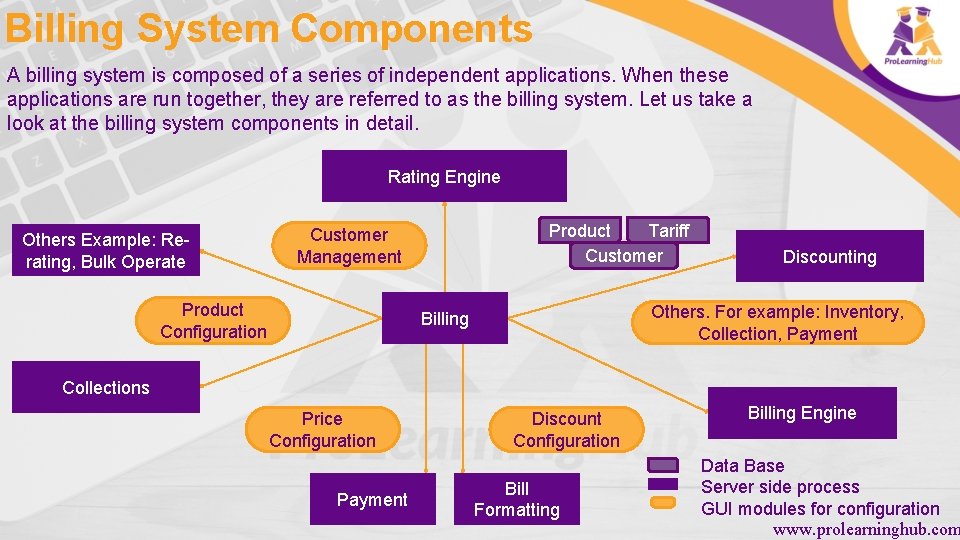
Billing System Components A billing system is composed of a series of independent applications. When these applications are run together, they are referred to as the billing system. Let us take a look at the billing system components in detail. Rating Engine Others Example: Rerating, Bulk Operate Product Tariff Customer Management Product Configuration Discounting Others. For example: Inventory, Collection, Payment Billing Collections Price Configuration Payment Discount Configuration Bill Formatting Billing Engine Data Base Server side process GUI modules for configuration www. prolearninghub. com
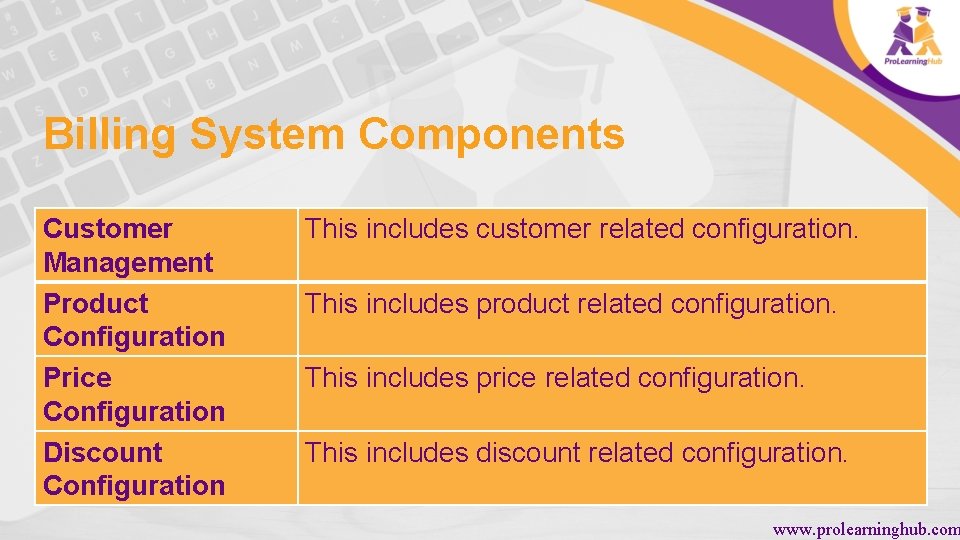
Billing System Components Customer Management Product Configuration Price Configuration Discount Configuration This includes customer related configuration. This includes product related configuration. This includes price related configuration. This includes discount related configuration. www. prolearninghub. com
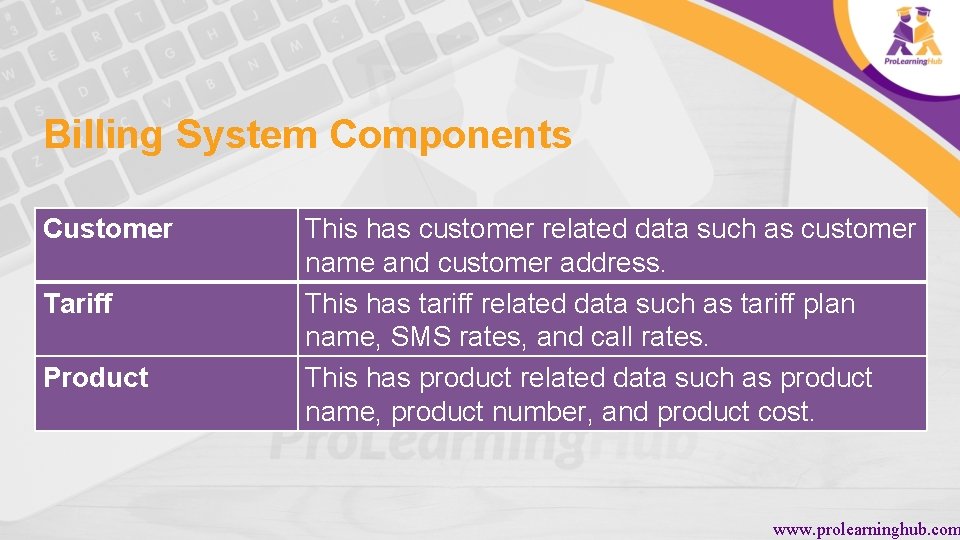
Billing System Components Customer Tariff Product This has customer related data such as customer name and customer address. This has tariff related data such as tariff plan name, SMS rates, and call rates. This has product related data such as product name, product number, and product cost. www. prolearninghub. com
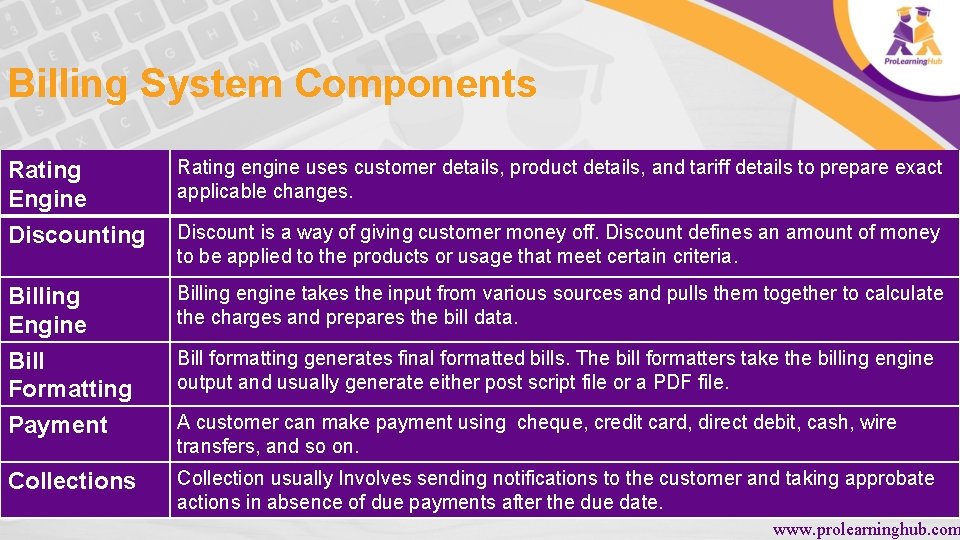
Billing System Components Rating Engine Rating engine uses customer details, product details, and tariff details to prepare exact applicable changes. Discounting Discount is a way of giving customer money off. Discount defines an amount of money to be applied to the products or usage that meet certain criteria. Billing Engine Billing engine takes the input from various sources and pulls them together to calculate the charges and prepares the bill data. Bill Formatting Payment Bill formatting generates final formatted bills. The bill formatters take the billing engine output and usually generate either post script file or a PDF file. Collections Collection usually Involves sending notifications to the customer and taking approbate actions in absence of due payments after the due date. A customer can make payment using cheque, credit card, direct debit, cash, wire transfers, and so on. www. prolearninghub. com
Rating and Billing Concept After learning about the billing components, let us explore the billing concepts in detail. We will consider Saurabh's example to understand these concepts. www. prolearninghub. com
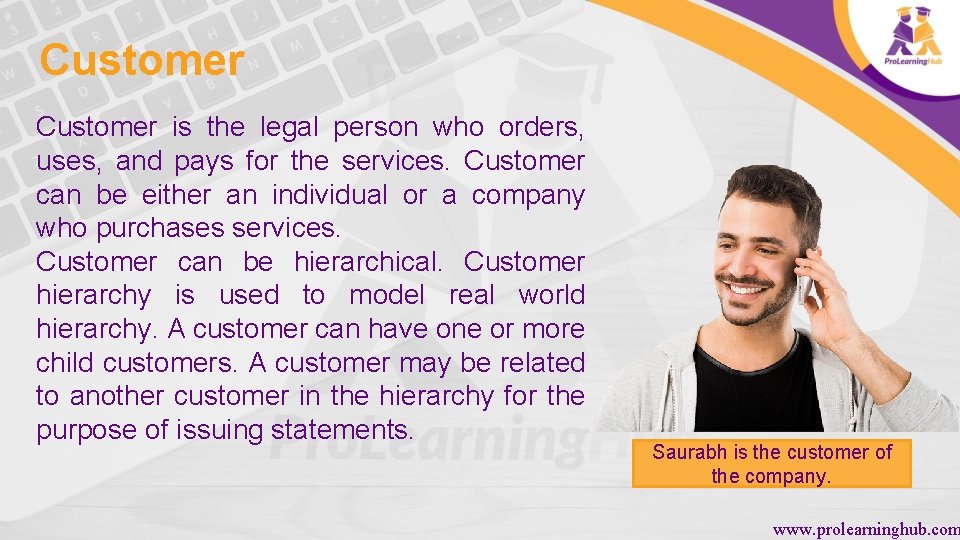
Customer is the legal person who orders, uses, and pays for the services. Customer can be either an individual or a company who purchases services. Customer can be hierarchical. Customer hierarchy is used to model real world hierarchy. A customer can have one or more child customers. A customer may be related to another customer in the hierarchy for the purpose of issuing statements. Saurabh is the customer of the company. www. prolearninghub. com
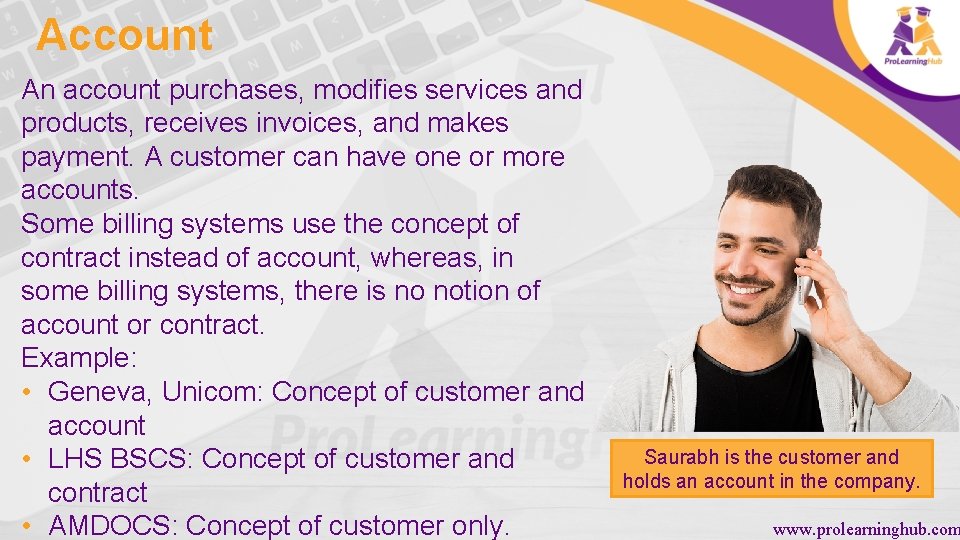
Account An account purchases, modifies services and products, receives invoices, and makes payment. A customer can have one or more accounts. Some billing systems use the concept of contract instead of account, whereas, in some billing systems, there is no notion of account or contract. Example: • Geneva, Unicom: Concept of customer and account • LHS BSCS: Concept of customer and contract • AMDOCS: Concept of customer only. Saurabh is the customer and holds an account in the company. www. prolearninghub. com
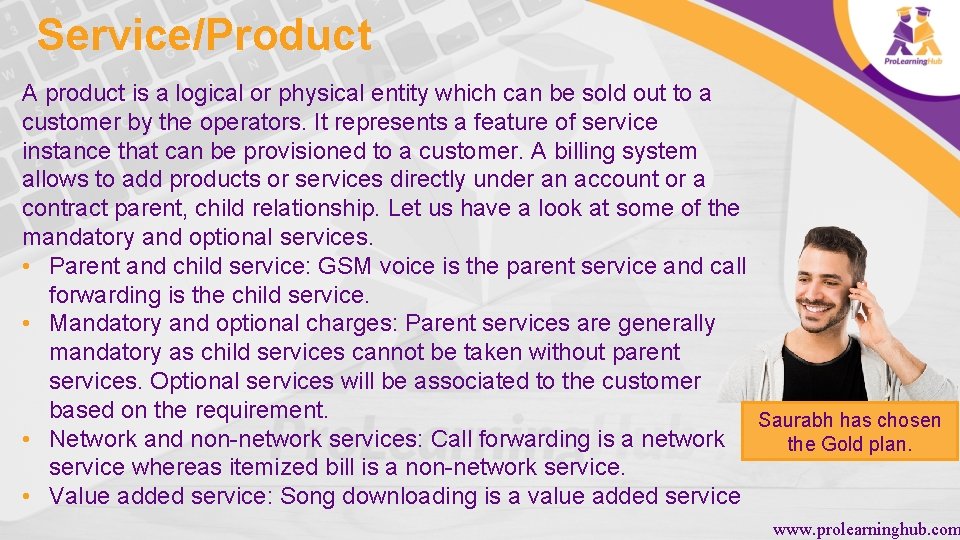
Service/Product A product is a logical or physical entity which can be sold out to a customer by the operators. It represents a feature of service instance that can be provisioned to a customer. A billing system allows to add products or services directly under an account or a contract parent, child relationship. Let us have a look at some of the mandatory and optional services. • Parent and child service: GSM voice is the parent service and call forwarding is the child service. • Mandatory and optional charges: Parent services are generally mandatory as child services cannot be taken without parent services. Optional services will be associated to the customer based on the requirement. Saurabh has chosen • Network and non-network services: Call forwarding is a network the Gold plan. service whereas itemized bill is a non-network service. • Value added service: Song downloading is a value added service www. prolearninghub. com
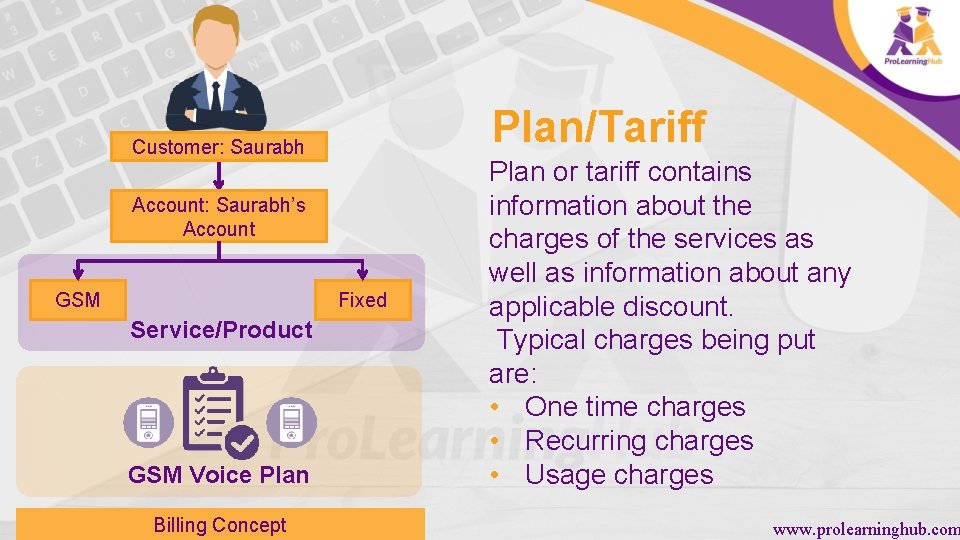
Plan/Tariff Customer: Saurabh Account: Saurabh’s Account GSM Fixed Service/Product GSM Voice Plan Billing Concept Plan or tariff contains information about the charges of the services as well as information about any applicable discount. Typical charges being put are: • One time charges • Recurring charges • Usage charges www. prolearninghub. com
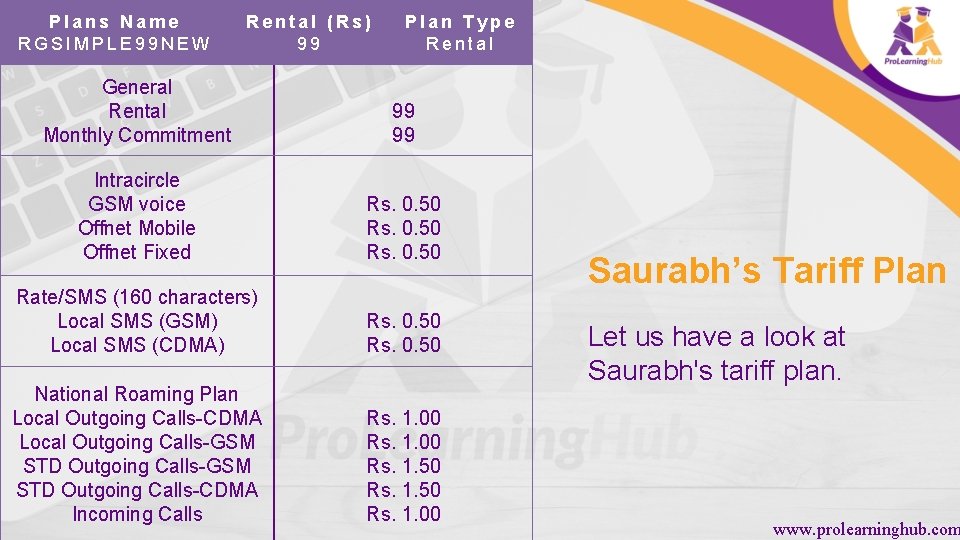
Plans Name RGSIMPLE 99 NEW Rental (Rs) 99 Plan Type Rental General Rental Monthly Commitment 99 99 Intracircle GSM voice Offnet Mobile Offnet Fixed Rs. 0. 50 Rate/SMS (160 characters) Local SMS (GSM) Local SMS (CDMA) Rs. 0. 50 National Roaming Plan Local Outgoing Calls-CDMA Local Outgoing Calls-GSM STD Outgoing Calls-CDMA Incoming Calls Rs. 1. 00 Rs. 1. 50 Rs. 1. 00 Saurabh’s Tariff Plan Let us have a look at Saurabh's tariff plan. www. prolearninghub. com
Rating and Billing We have already seen Saurabh's tariff plan details. Let us now understand how the tariff plan was made. The billing team lead, Prachi will explain the new billing team members all the tariff plan processes. Let us see whether the explanation answers cur queries. www. prolearninghub. com
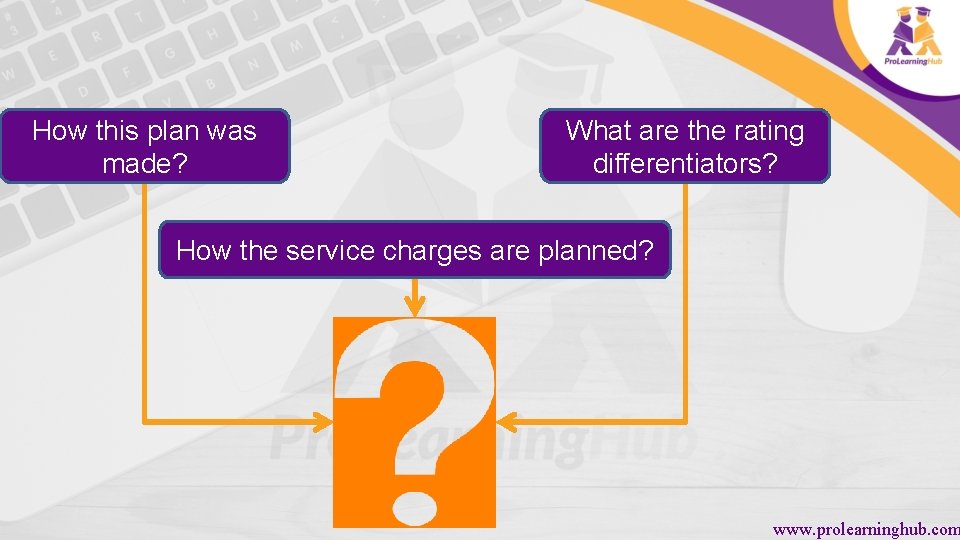
How this plan was made? What are the rating differentiators? How the service charges are planned? www. prolearninghub. com
Billing Hello everyone, we are here to discuss the tariff planning in detail. Service Tariff: Types of Charges. www. prolearninghub. com
Billing You all must be aware that, we apply some charges lo the services we provide. Service Tariff: Types of Charges. www. prolearninghub. com
Billing I will explain the details of tariff charges. Service Tariff: Types of Charges. Yes, but what are the types of charges? www. prolearninghub. com
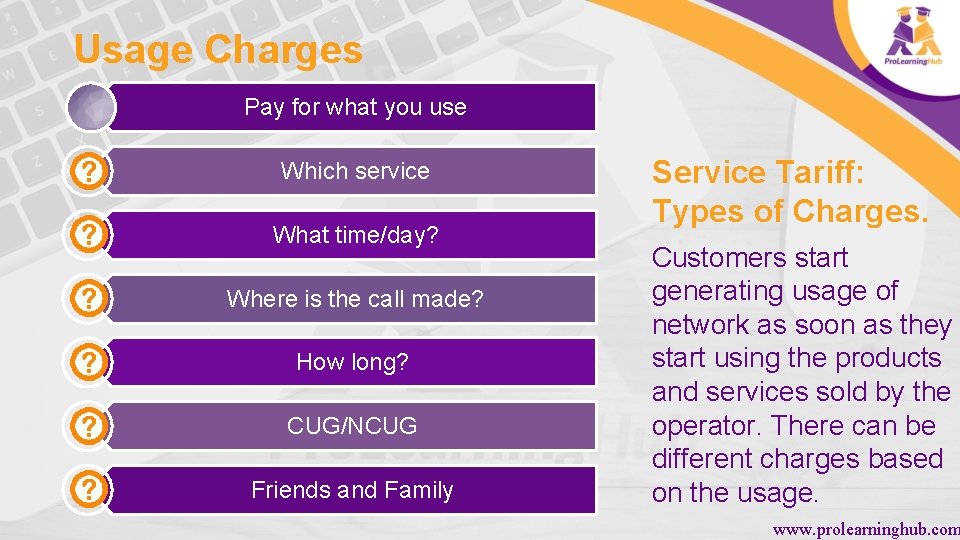
Usage Charges Pay for what you use Which service What time/day? Where is the call made? How long? CUG/NCUG Friends and Family Service Tariff: Types of Charges. Customers start generating usage of network as soon as they start using the products and services sold by the operator. There can be different charges based on the usage. www. prolearninghub. com
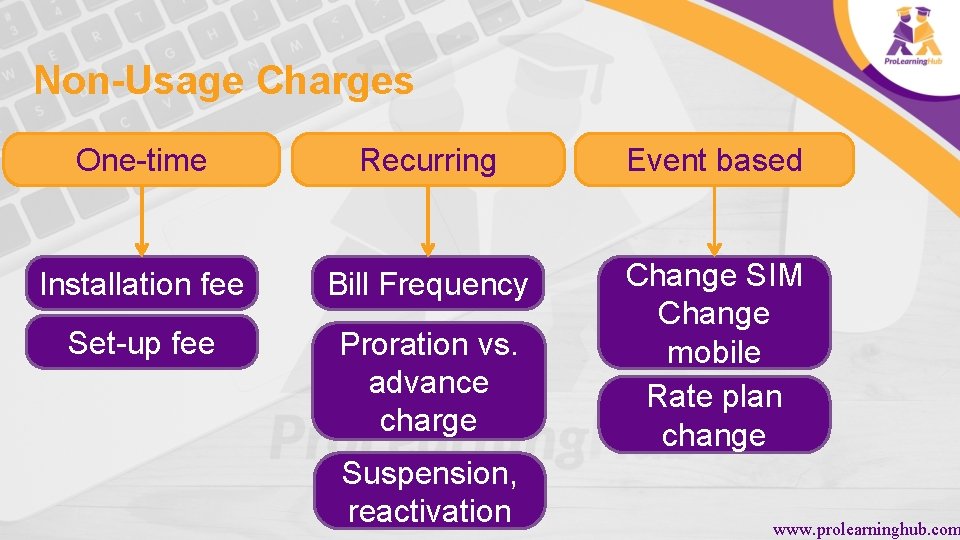
Non-Usage Charges One-time Recurring Event based Installation fee Bill Frequency Set-up fee Proration vs. advance charge Change SIM Change mobile Rate plan change Suspension, reactivation www. prolearninghub. com
Rating Differentiators We also have some other details with us which we need to consider while preparing any tariff plan. Let us also have a look at those details. Rating Differentiators www. prolearninghub. com
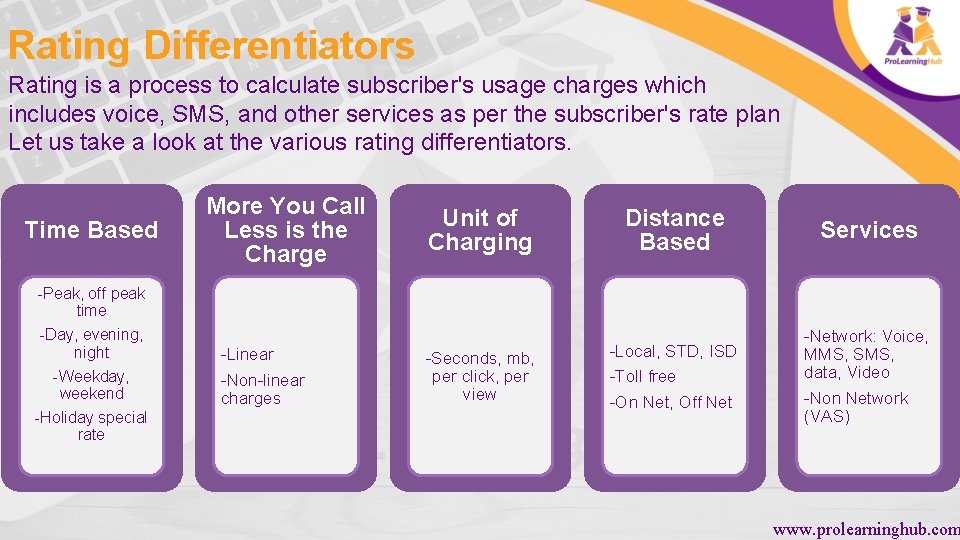
Rating Differentiators Rating is a process to calculate subscriber's usage charges which includes voice, SMS, and other services as per the subscriber's rate plan Let us take a look at the various rating differentiators. Time Based More You Call Less is the Charge Unit of Charging Distance Based Services -Local, STD, ISD -Toll free -On Net, Off Net -Network: Voice, MMS, SMS, data, Video -Non Network (VAS) -Peak, off peak time -Day, evening, night -Weekday, weekend -Holiday special rate -Linear -Non-linear charges -Seconds, mb, per click, per view www. prolearninghub. com
Discounts Did you understand how the plan was made? Discounts Yes. www. prolearninghub. com
Discounts Do you have any queries? Discounts I would like to ask one question. Do we provide any discount facility to our customers? www. prolearninghub. com
Discounts Yes. It is a powerful tool to attract and retain the customers. Discounts Ok. Can we discuss discount in detail? www. prolearninghub. com
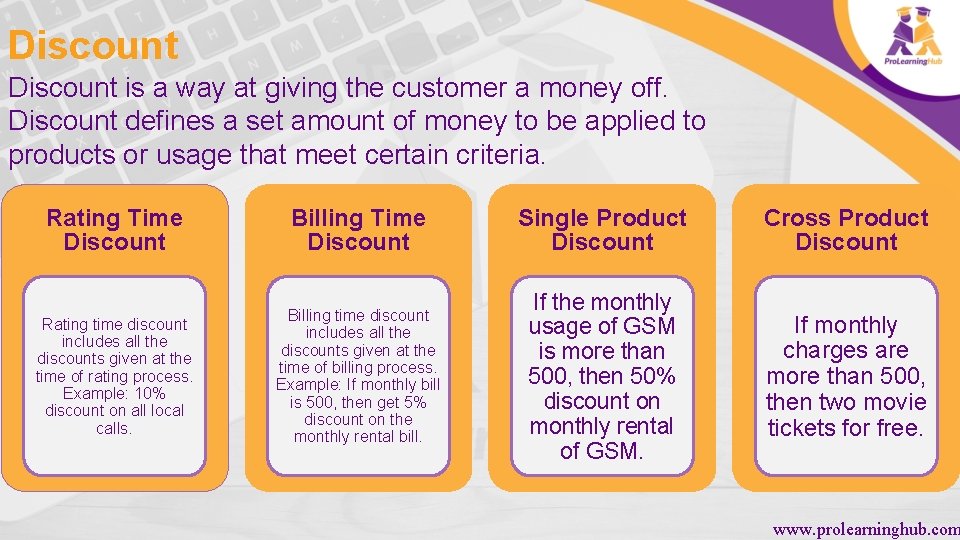
Discount is a way at giving the customer a money off. Discount defines a set amount of money to be applied to products or usage that meet certain criteria. Rating Time Discount Billing Time Discount Single Product Discount Cross Product Discount Rating time discount includes all the discounts given at the time of rating process. Example: 10% discount on all local calls. Billing time discount includes all the discounts given at the time of billing process. Example: If monthly bill is 500, then get 5% discount on the monthly rental bill. If the monthly usage of GSM is more than 500, then 50% discount on monthly rental of GSM. If monthly charges are more than 500, then two movie tickets for free. www. prolearninghub. com
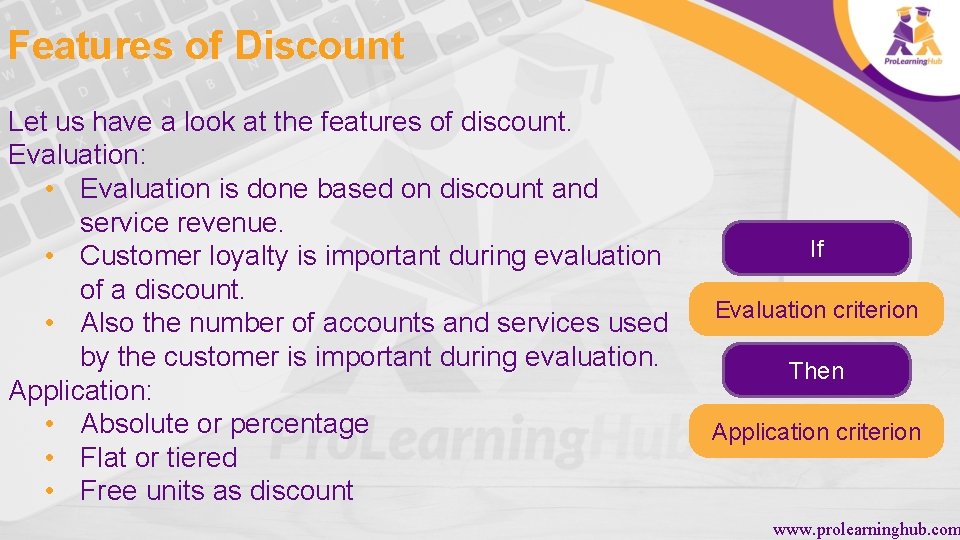
Features of Discount Let us have a look at the features of discount. Evaluation: • Evaluation is done based on discount and service revenue. • Customer loyalty is important during evaluation of a discount. • Also the number of accounts and services used by the customer is important during evaluation. Application: • Absolute or percentage • Flat or tiered • Free units as discount If Evaluation criterion Then Application criterion www. prolearninghub. com
Rating and Billing Flow Now Saurabh's plan has bean activated and he has started using the services. Let us now learn the rating and billing cycle of Saurabh's GSM plan service. This will help us to understand what happens at the backend, when Saurabh makes a call. www. prolearninghub. com
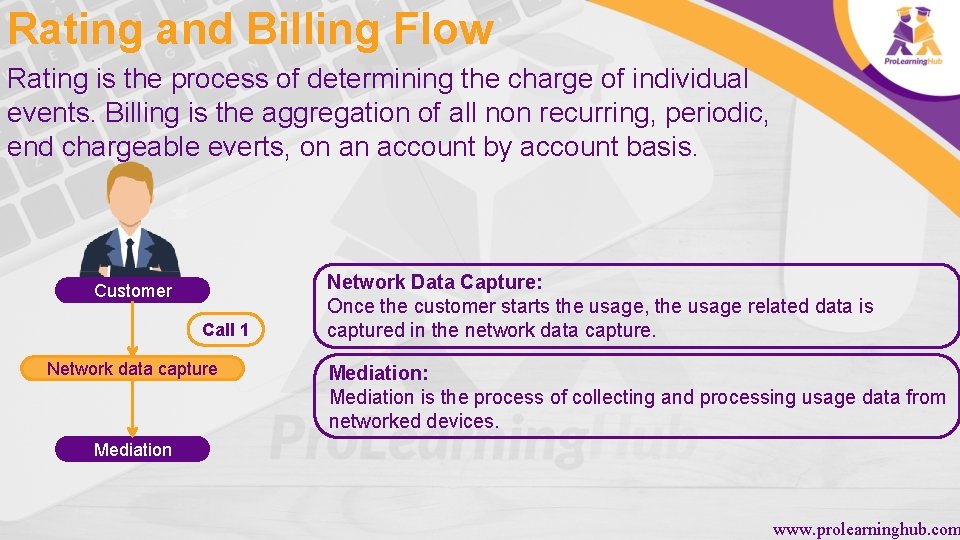
Rating and Billing Flow Rating is the process of determining the charge of individual events. Billing is the aggregation of all non recurring, periodic, end chargeable everts, on an account by account basis. Customer Call 1 Network data capture Network Data Capture: Once the customer starts the usage, the usage related data is captured in the network data capture. Mediation: Mediation is the process of collecting and processing usage data from networked devices. Mediation www. prolearninghub. com
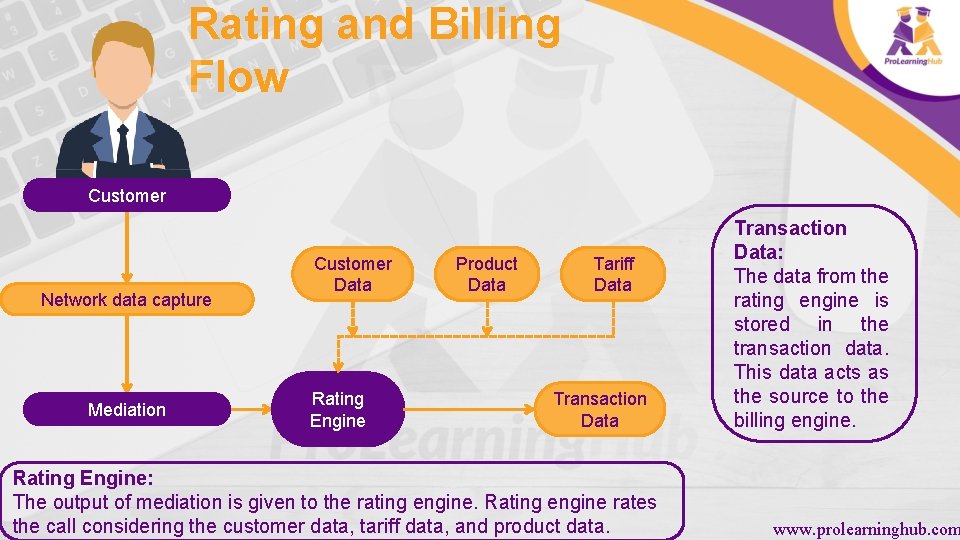
Rating and Billing Flow Customer Network data capture Mediation Customer Data Rating Engine Product Data Tariff Data Transaction Data Rating Engine: The output of mediation is given to the rating engine. Rating engine rates the call considering the customer data, tariff data, and product data. Transaction Data: The data from the rating engine is stored in the transaction data. This data acts as the source to the billing engine. www. prolearninghub. com
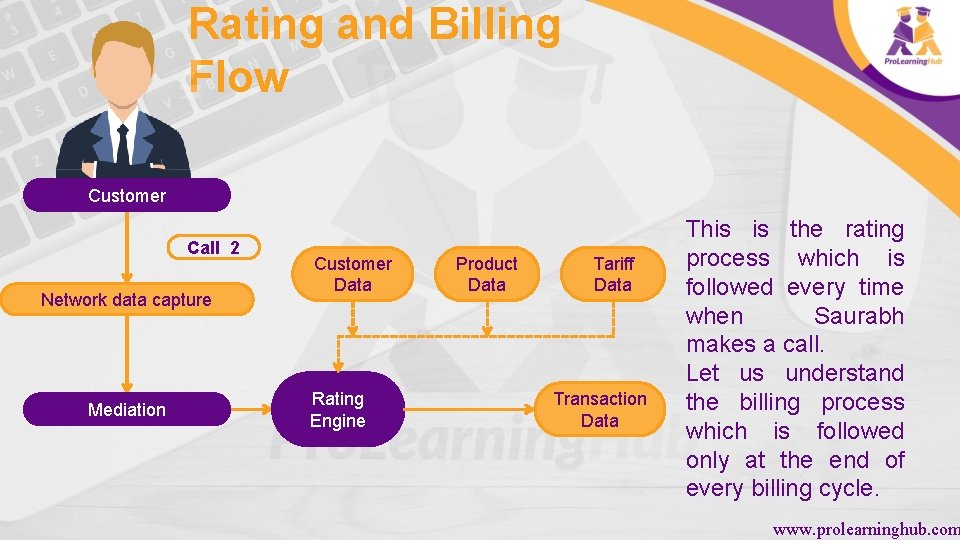
Rating and Billing Flow Customer Call 2 Network data capture Mediation Customer Data Rating Engine Product Data Tariff Data Transaction Data This is the rating process which is followed every time when Saurabh makes a call. Let us understand the billing process which is followed only at the end of every billing cycle. www. prolearninghub. com

Rating and Billing Flow Customer Network data capture Mediation Customer Data Rating Engine Product Data Tariff Data Transaction Data Billing Engine: It refers to the product, tariff, and customer delate to apply any other required charges like monthly or recurring charges and calculates the bill. www. prolearninghub. com
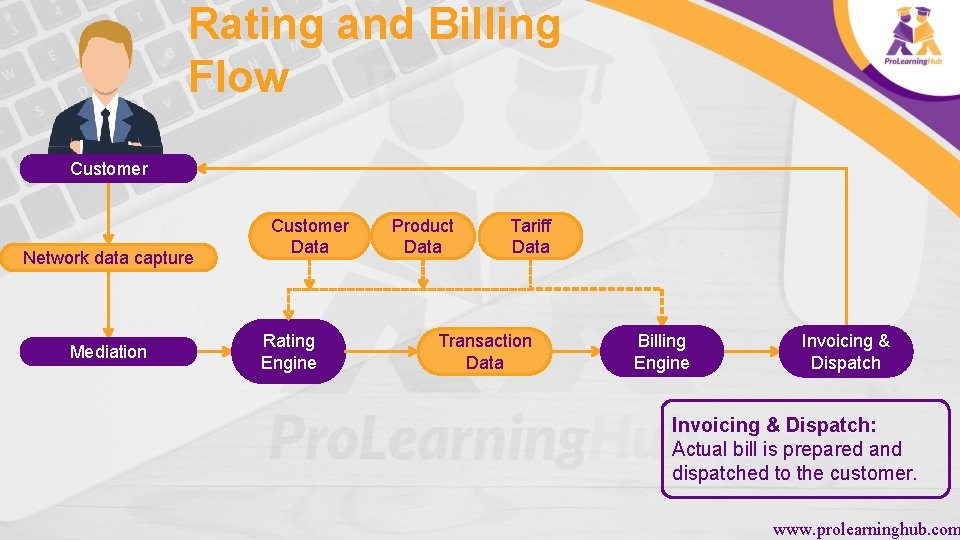
Rating and Billing Flow Customer Network data capture Mediation Customer Data Rating Engine Product Data Tariff Data Transaction Data Billing Engine Invoicing & Dispatch: Actual bill is prepared and dispatched to the customer. www. prolearninghub. com
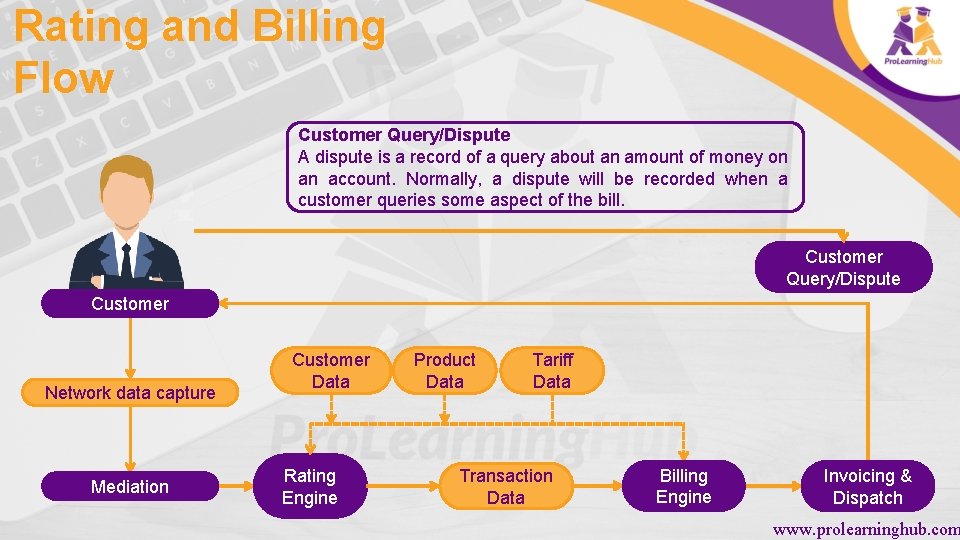
Rating and Billing Flow Customer Query/Dispute A dispute is a record of a query about an amount of money on an account. Normally, a dispute will be recorded when a customer queries some aspect of the bill. Customer Query/Dispute Customer Network data capture Mediation Customer Data Rating Engine Product Data Tariff Data Transaction Data Billing Engine Invoicing & Dispatch www. prolearninghub. com
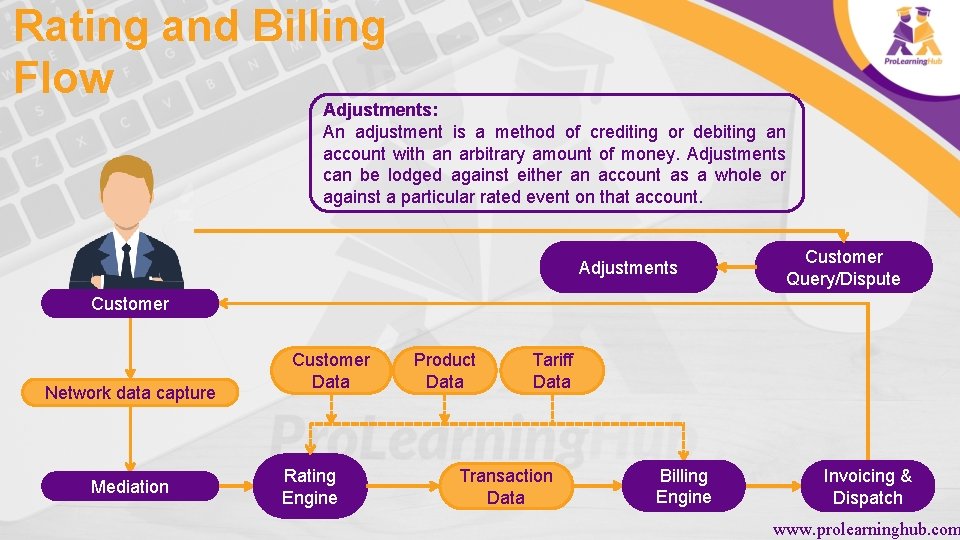
Rating and Billing Flow Adjustments: An adjustment is a method of crediting or debiting an account with an arbitrary amount of money. Adjustments can be lodged against either an account as a whole or against a particular rated event on that account. Adjustments Customer Query/Dispute Customer Network data capture Mediation Customer Data Rating Engine Product Data Tariff Data Transaction Data Billing Engine Invoicing & Dispatch www. prolearninghub. com
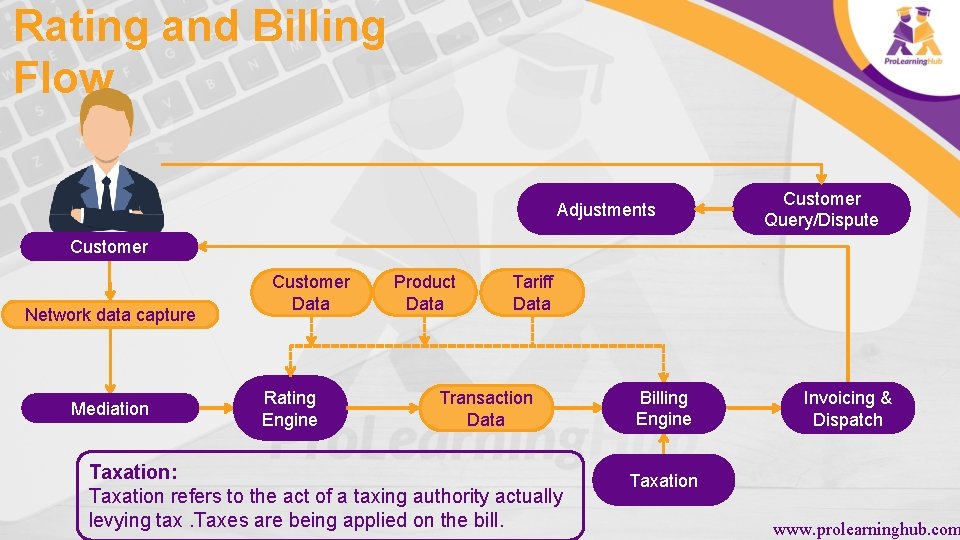
Rating and Billing Flow Adjustments Customer Query/Dispute Customer Network data capture Mediation Customer Data Rating Engine Product Data Tariff Data Transaction Data Taxation: Taxation refers to the act of a taxing authority actually levying tax. Taxes are being applied on the bill. Billing Engine Invoicing & Dispatch Taxation www. prolearninghub. com
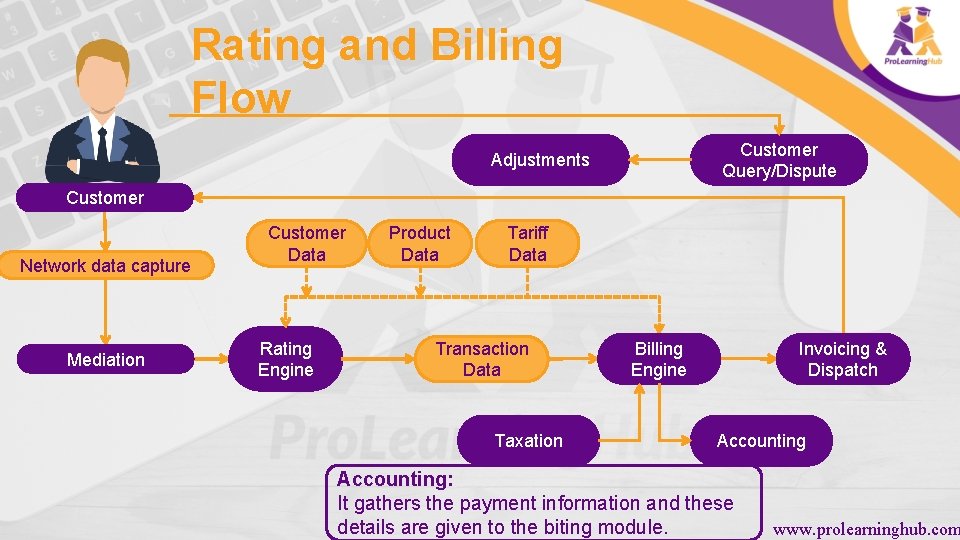
Rating and Billing Flow Customer Query/Dispute Adjustments Customer Network data capture Mediation Customer Data Rating Engine Product Data Tariff Data Transaction Data Taxation Billing Engine Invoicing & Dispatch Accounting: It gathers the payment information and these details are given to the biting module. www. prolearninghub. com
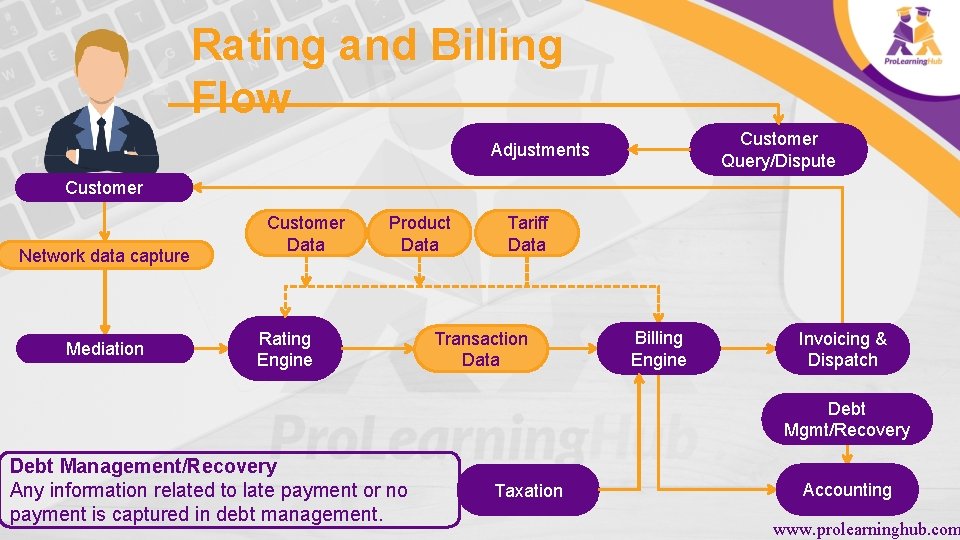
Rating and Billing Flow Customer Query/Dispute Adjustments Customer Network data capture Mediation Customer Data Product Data Rating Engine Tariff Data Transaction Data Billing Engine Invoicing & Dispatch Debt Mgmt/Recovery Debt Management/Recovery Any information related to late payment or no payment is captured in debt management. Taxation Accounting www. prolearninghub. com
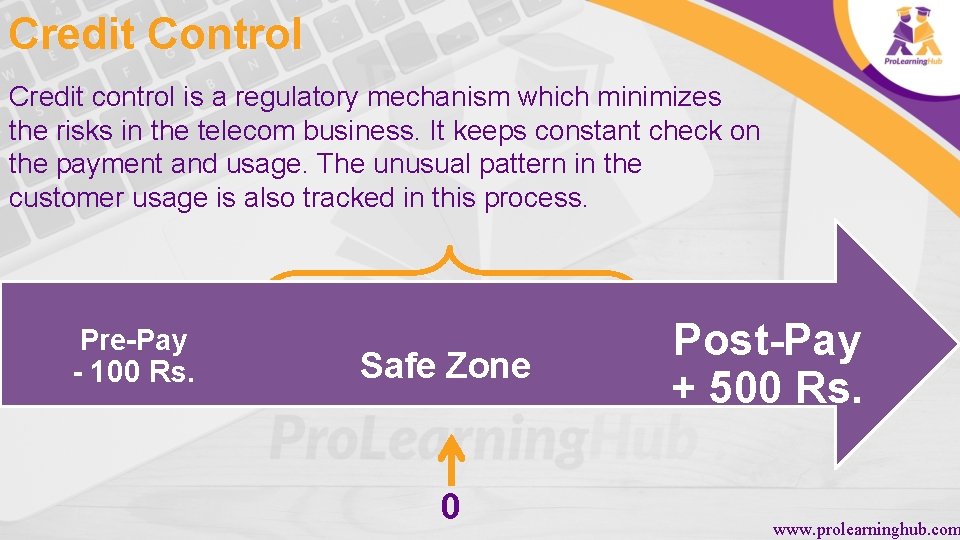
Credit Control Credit control is a regulatory mechanism which minimizes the risks in the telecom business. It keeps constant check on the payment and usage. The unusual pattern in the customer usage is also tracked in this process. Pre-Pay - 100 Rs. Safe Zone 0 Post-Pay + 500 Rs. www. prolearninghub. com
Credit Control Process. This process can be done either online or offline. Credit Control Actions The credit control members inform the customers if they are crossing their credit limit. If still the payment is not done, some operators ban the facilities. www. prolearninghub. com
Credit Control Classes There are three types of credit control classes. • VIP credit class: This can be assigned to VIP customers and would have very high value of credit limit. • General pubic class: This is the most common credit class and would have almost $100 or $200 credit limit. • Segment specific class: These classes can be defined based on different segments, like military or bank officers. www. prolearninghub. com
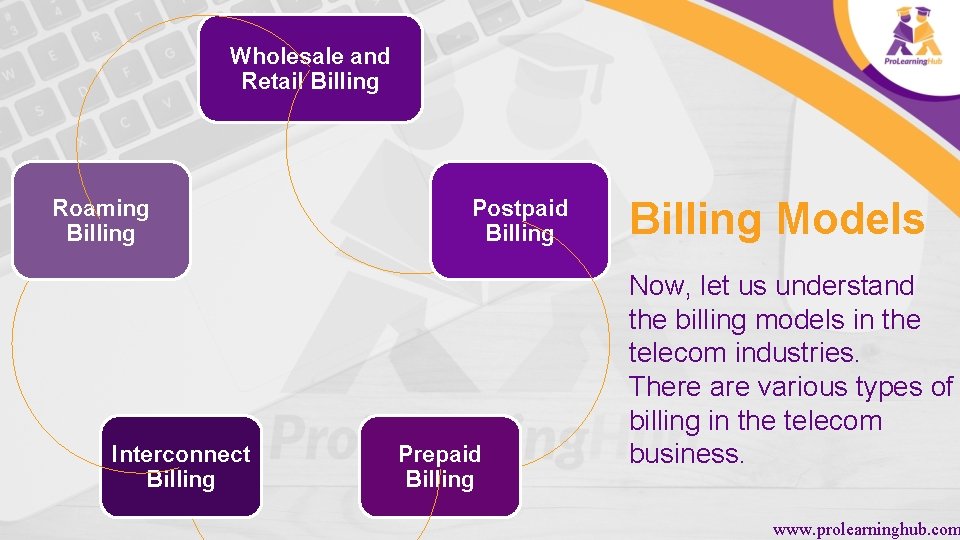
Wholesale and Retail Billing Roaming Billing Interconnect Billing Postpaid Billing Prepaid Billing Models Now, let us understand the billing models in the telecom industries. There are various types of billing in the telecom business. www. prolearninghub. com
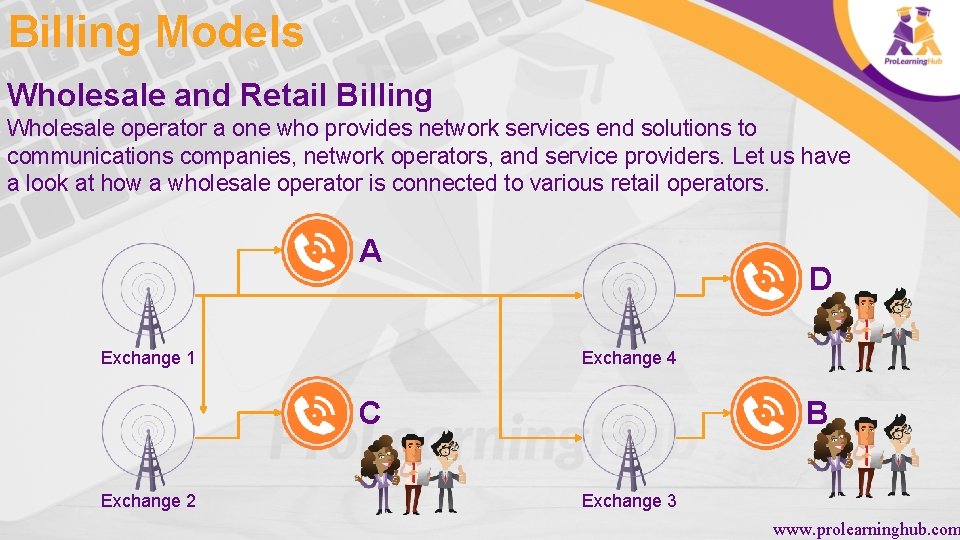
Billing Models Wholesale and Retail Billing Wholesale operator a one who provides network services end solutions to communications companies, network operators, and service providers. Let us have a look at how a wholesale operator is connected to various retail operators. A Exchange 1 D Exchange 4 B C Exchange 2 Exchange 3 www. prolearninghub. com
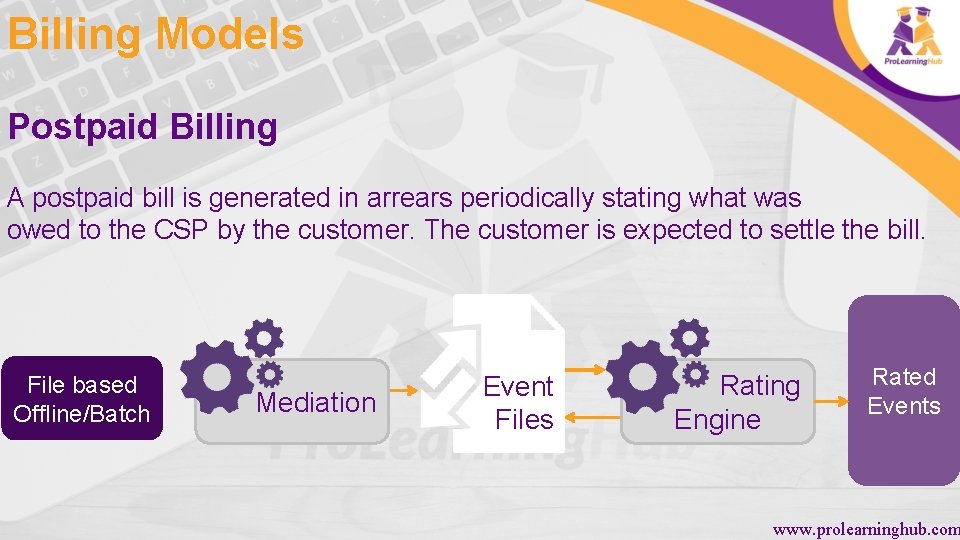
Billing Models Postpaid Billing A postpaid bill is generated in arrears periodically stating what was owed to the CSP by the customer. The customer is expected to settle the bill. File based Offline/Batch Mediation Event Files Rating Engine Rated Events www. prolearninghub. com
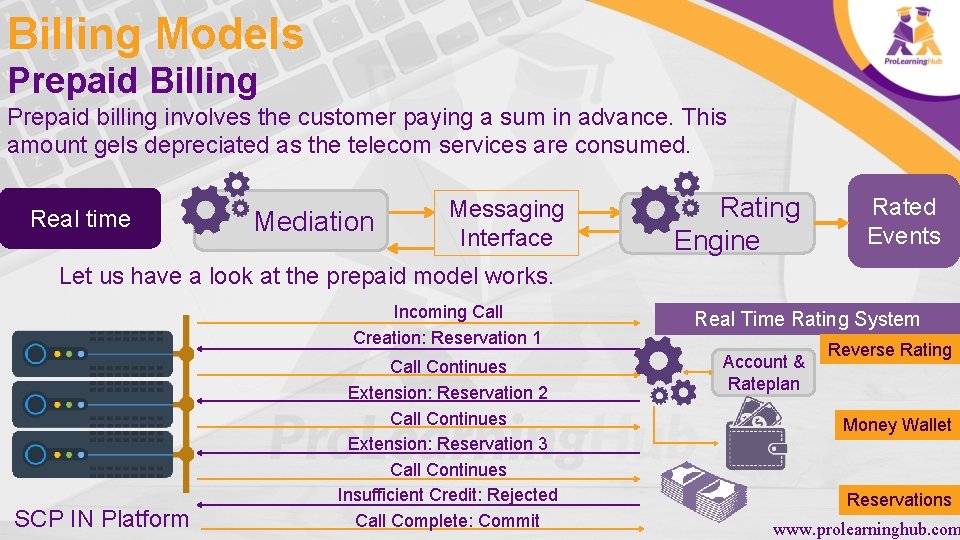
Billing Models Prepaid Billing Prepaid billing involves the customer paying a sum in advance. This amount gels depreciated as the telecom services are consumed. Real time Mediation Messaging Interface Rating Engine Rated Events Let us have a look at the prepaid model works. Incoming Call Creation: Reservation 1 SCP IN Platform Call Continues Extension: Reservation 2 Call Continues Extension: Reservation 3 Call Continues Insufficient Credit: Rejected Call Complete: Commit Real Time Rating System Account & Rateplan Reverse Rating Money Wallet Reservations www. prolearninghub. com
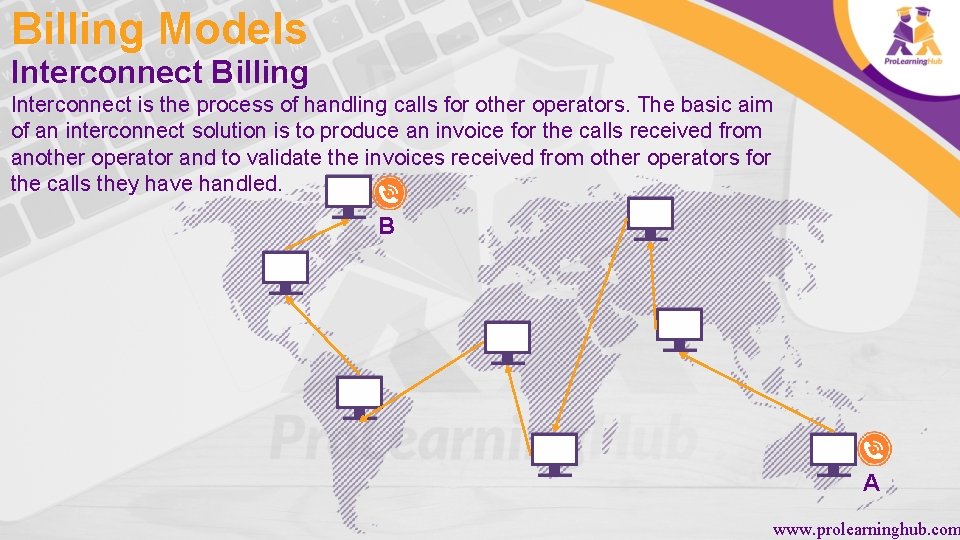
Billing Models Interconnect Billing Interconnect is the process of handling calls for other operators. The basic aim of an interconnect solution is to produce an invoice for the calls received from another operator and to validate the invoices received from other operators for the calls they have handled. B A www. prolearninghub. com

Billing Models Roaming Billing Roaming is the ability to use one device in the foreign network. Roaming is applied when a customer uses the available network which is other than the home network. In order to bill the customer, the roaming information is passed back to the customer's home network. The foreign network collects information on the usage from it’s switches and sends it to the home network. The roaming billing is done according to the usage. www. prolearninghub. com
Rating and Billing Flow Now we have learnt the basics of rating and billing, billing system components, the various billing concepts, rating arid billing flow, credit control, and the various billing models. Now let us have a quick knowledge check on this topic. www. prolearninghub. com

Knowledge Check Start www. prolearninghub. com

Which of the following leakage takes place in between mediation and rating and billing? Rating dimensions Rating differentiators Billing components e. TOM model www. prolearninghub. com
The normalization of CDR’s is done by rating and billing engine. True False www. prolearninghub. com
Which of the following is a billing model? Interim billing Transaction billing Interconnect billing Taxation billing www. prolearninghub. com
Which of the following is a credit control class? SIP credit class VIP credit class TIP credit class DIT credit class www. prolearninghub. com

The Results
- Slides: 56