
Ratification Module 3 Objective Understand the steps involved
Ratification Module 3
Objective § Understand the steps involved in ratifying the Convention on the Rights of Persons with Disabilities and its Optional Protocol Module flow § § § § § What is ratification? Who is involved in ratification? Factors influencing ratification Steps for national ratification Steps for international ratification International ratification Declarations and reservations Impact of ratification How can I support ratification?

What is ratification? Ratification is an act through which a State expresses its consent to be bound by the Convention. It usually involves: ü National acceptance of the Convention ü International acceptance of the Convention
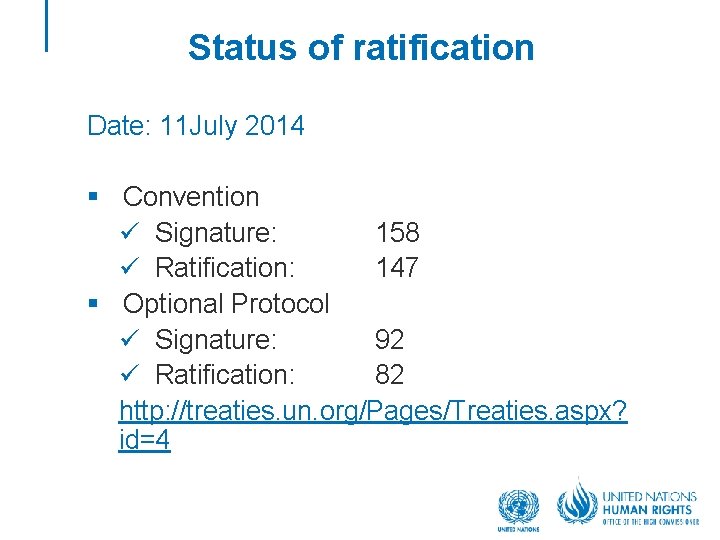
Status of ratification Date: 11 July 2014 § Convention ü Signature: 158 ü Ratification: 147 § Optional Protocol ü Signature: 92 ü Ratification: 82 http: //treaties. un. org/Pages/Treaties. aspx? id=4
Who is involved in ratification? ü Ministries ü Parliament ü Courts ü National human rights institutions ü Organizations of persons with disabilities (OPDs) ü Non-governmental organizations (NGOs) ü United Nations Office of Legal Affairs
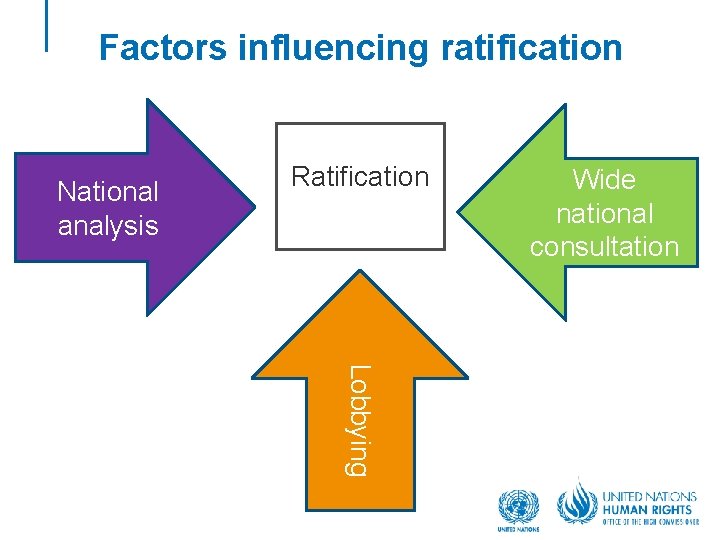
Factors influencing ratification National analysis Ratification Wide national consultation Lobbying
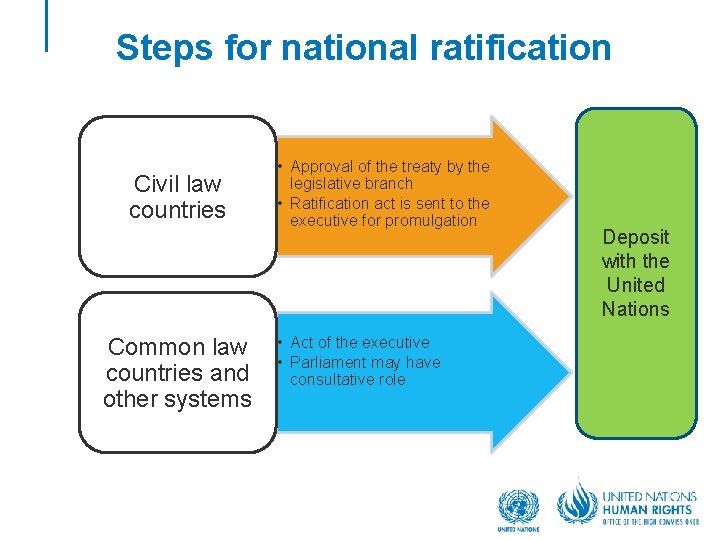
Steps for national ratification Civil law countries Common law countries and other systems • Approval of the treaty by the legislative branch • Ratification act is sent to the executive for promulgation • Act of the executive • Parliament may have consultative role Deposit with the United Nations
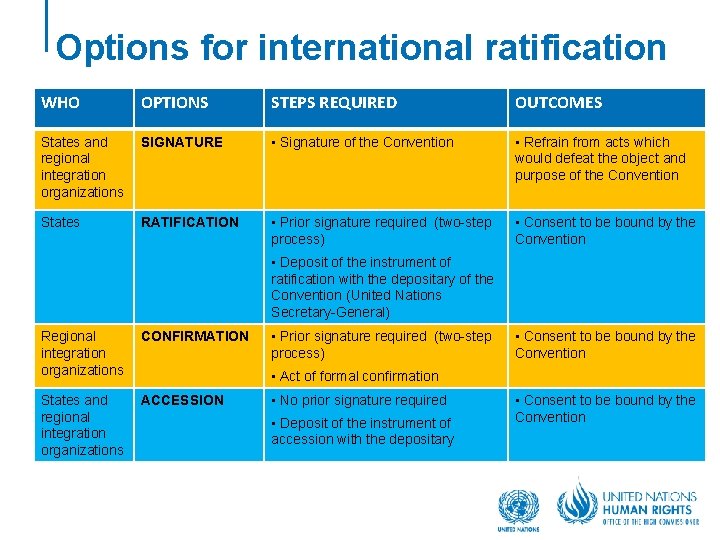
Options for international ratification WHO OPTIONS STEPS REQUIRED OUTCOMES States and regional integration organizations SIGNATURE • Signature of the Convention • Refrain from acts which would defeat the object and purpose of the Convention States RATIFICATION • Prior signature required (two-step process) • Consent to be bound by the Convention • Deposit of the instrument of ratification with the depositary of the Convention (United Nations Secretary-General) Regional integration organizations CONFIRMATION States and regional integration organizations ACCESSION • Prior signature required (two-step process) • Consent to be bound by the Convention • Act of formal confirmation • No prior signature required • Deposit of the instrument of accession with the depositary • Consent to be bound by the Convention
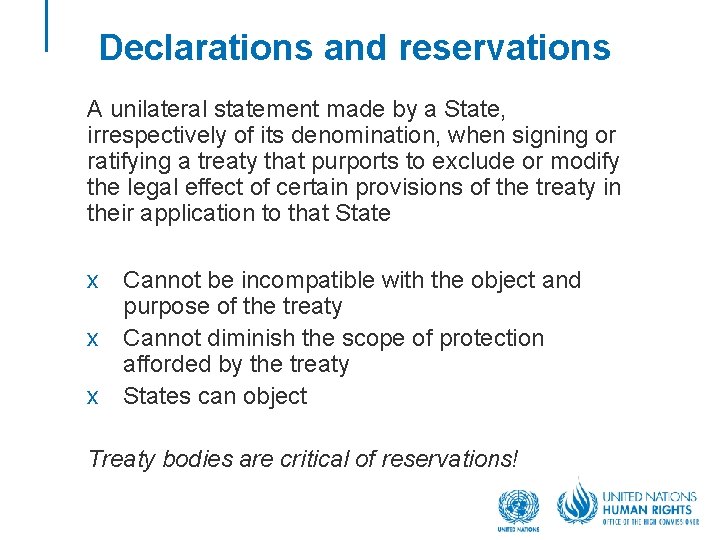
Declarations and reservations A unilateral statement made by a State, irrespectively of its denomination, when signing or ratifying a treaty that purports to exclude or modify the legal effect of certain provisions of the treaty in their application to that State x Cannot be incompatible with the object and purpose of the treaty x Cannot diminish the scope of protection afforded by the treaty x States can object Treaty bodies are critical of reservations!
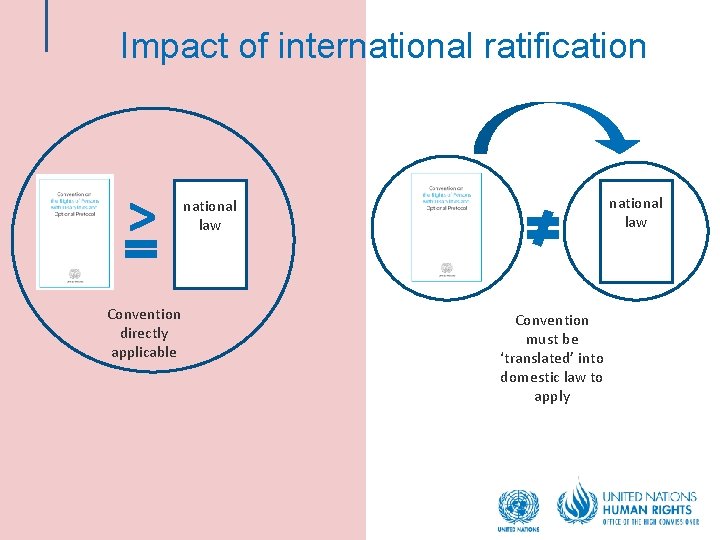
Impact of international ratification > Convention directly applicable national law Convention must be ‘translated’ into domestic law to apply
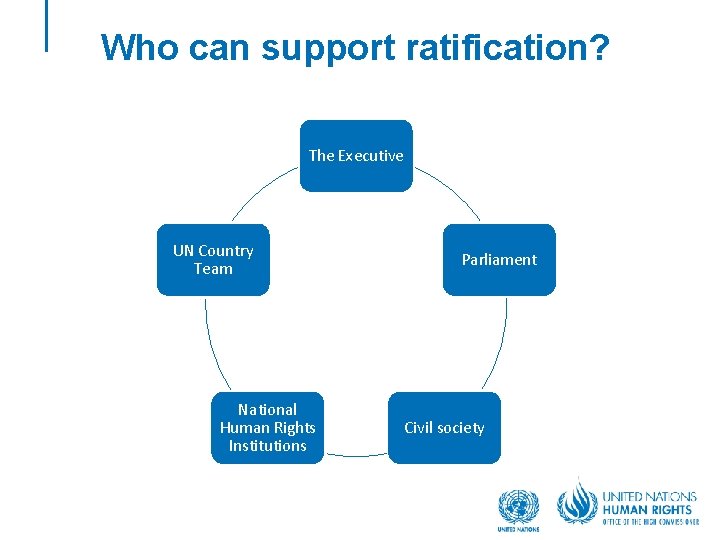
Who can support ratification? The Executive UN Country Team National Human Rights Institutions Parliament Civil society
GROUP DISCUSSION How can I support ratification?
How can I support ratification? Executive: ü Consult with line ministries ü Identify a focal point for ratification ü Hold a national consultation ü Review laws and policies ü Identify any gaps in protection ü Undertake a national interest analysis ü Make ratification a national objective ü Identify good practices in the region ü Request assistance from the United Nations ü Other steps?
How can I support ratification? Parliament: ü Check if the Government intends to ratify ü Use parliamentary procedure to encourage ratification, such as questions to the Minister ü Submit a private member’s bill ü Encourage parliamentary debate ü Mobilize public opinion ü Discourage reservations and declarations ü Raise awareness of the Convention and the ratification process ü Encourage ratification of the Convention and its Optional Protocol ü More?
How can I support ratification? Civil society: ü Form a coalition to support ratification ü Contact international civil society organizations ü Set out a timeline and lobbying strategy ü Launch a media awareness campaign ü Hold a national conference ü Develop and seek funding for a programme on ratification ü Meet representatives of parliament, line ministries, the national human rights institution, etc. ü Raise ratification with the donor community ü Ask what the United Nations is doing ü More?
How can I support ratification? National human rights institution (NHRI): ü Undertake research on the rights of persons with disabilities ü Review laws and policies ü Raise ratification in annual reports to parliament ü Issue press releases supporting ratification ü Raise awareness in the community ü Cooperate with OPDs on ratification ü Ensure your own capacity in relation to the Convention ü More?
How can I support ratification? United Nations country team: ü Discuss ratification with Government partners ü Compile good practice from the region ü Raise awareness about the Convention ü Provide expert advice to Government and civil society partners ü Assist national focal points and NHRIs through technical assistance ü Raise ratification with the international community ü Support ratification through media communications ü Develop a programme to support ratification ü Support and promote the participation of CSOs and OPDs ü More?
Sources § Convention on the Rights of Persons with Disabilities § A/HRC/10/48 § General comments and recommendations by treaty bodies www. ohchr. org/english/bodies/ § From Exclusion to Equality: Realizing the Rights of Persons with Disabilities—Handbook for Parliamentarians on the Convention on the Rights of Persons with Disabilities and its Optional Protocol (HR/PUB/07/6) § Convention on the Rights of Persons with Disabilities: Advocacy Tool Kit, Professional Training Series No. 15 (United Nations publication) § Human Rights Committee, general comment No. 24 (1994) on reservations to the Covenant § Landmine Survivors Network, Disability Rights Convention Ratification Campaign Handbook (2006)
- Slides: 18