
RATES RATIOS and PROPORTIONS RATIOS A ratio compares

- Slides: 48
RATES, RATIOS and PROPORTIONS
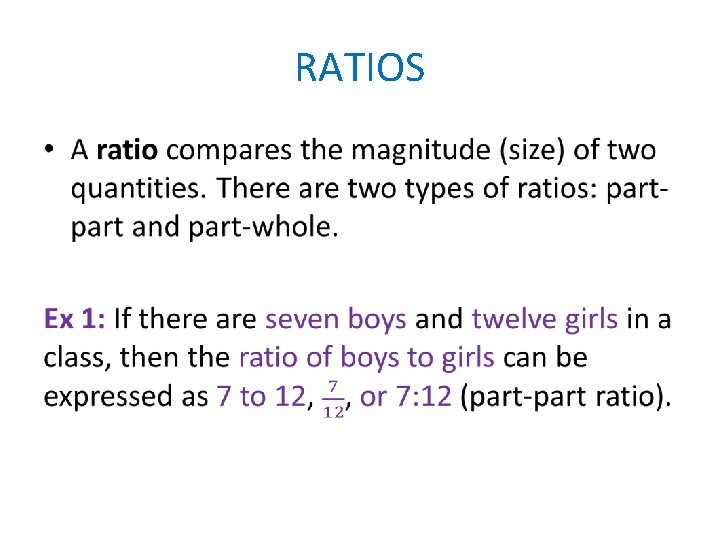
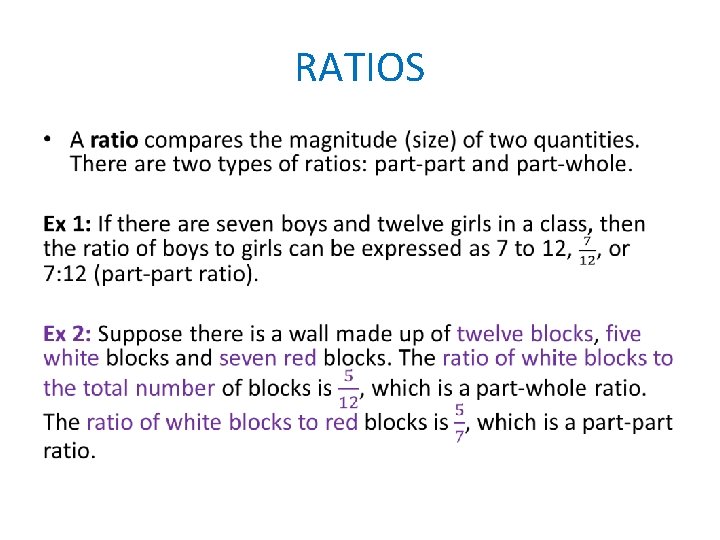
RATIOS • A ratio compares the magnitude (size) of two quantities. There are two types of ratios: part and part-whole.
RATIOS •
RATIOS •
RATES • When the quantities being compared have different dimensions (units), then the ratio is called a rate.
RATES • When the quantities being compared have different dimensions (units), then the ratio is called a rate. Ex 1: A phone company charges $0. 84 for 7 minutes of long distance. The rate is $ 0. 84/7 minutes, which is equal to $0. 12 per minute.
RATES • When the quantities being compared have different dimensions (units), then the ratio is called a rate. Ex 1: A phone company charges $0. 84 for 7 minutes of long distance. The rate is $ 0. 84/7 minutes, which is equal to $0. 12 per minute. Ex 2: A student reads 10 pages in 8 minutes. This rate is 10 pages/8 minutes, which is equal to 5 pages per 4 minutes.
RATES • When the quantities being compared have different dimensions (units), then the ratio is called a rate. Ex 1: A phone company charges $0. 84 for 7 minutes of long distance. The rate is $ 0. 84/7 minutes, which is equal to $0. 12 per minute. Ex 2: A student reads 10 pages in 8 minutes. This rate is 10 pages/8 minutes, which is equal to 5 pages per 4 minutes. Ex 3: If a 12 -ounce box of cereal sells for $2. 40, and a 16 ounce box sells for $2. 88, which is the better buy? The unit rate of the first box is $0. 20/ounce ($2. 40/12 ounces), and the unit rate of the second box is $0. 18/ounce ($ 2. 88/16 ounces). Therefore, the second box is a better buy.
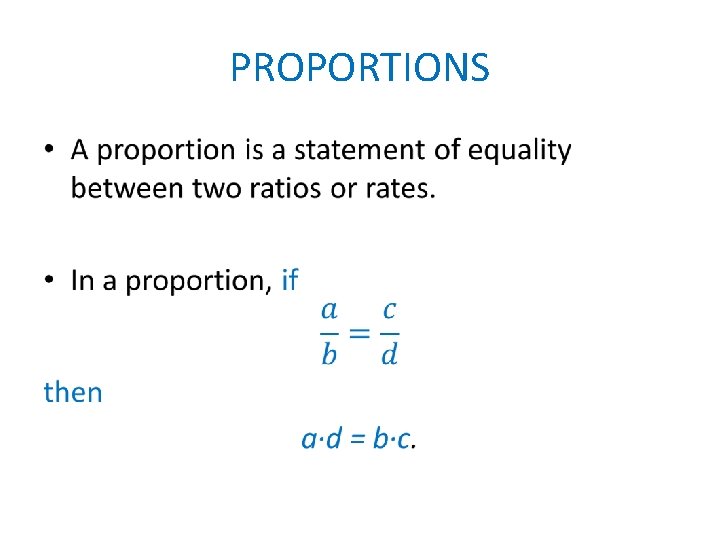
PROPORTIONS • A proportion is a statement of equality between two ratios or rates.
PROPORTIONS •
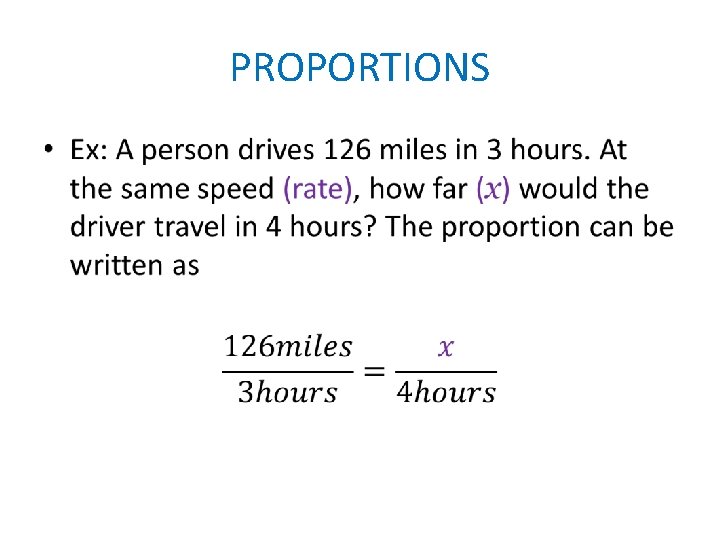
PROPORTIONS •
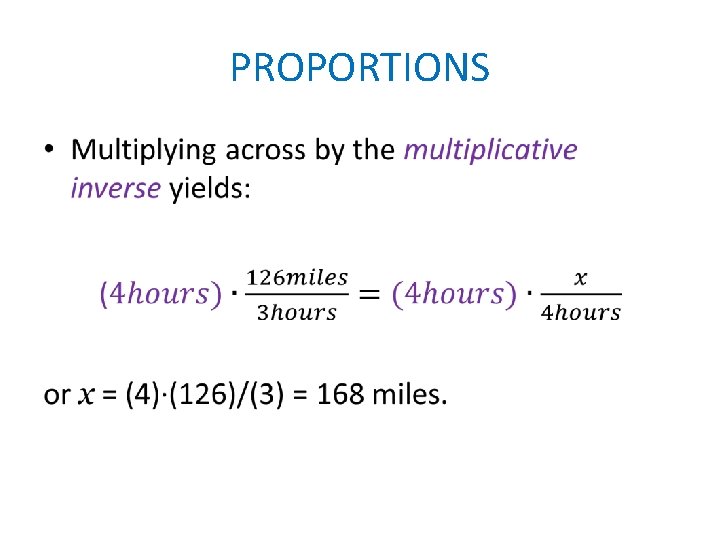
PROPORTIONS •
In summary… • … rate and proportion, together with ratio, are used for solving many real-world problems that involve comparing different quantities.
Let’s take a closer look at rates and ratios • Recall that rates are ratios in which the quantities being compared have different units (and thus, different dimensions).
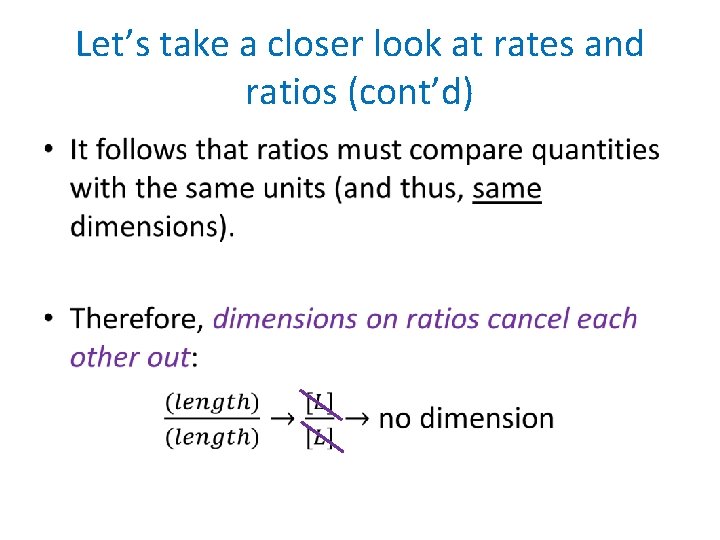
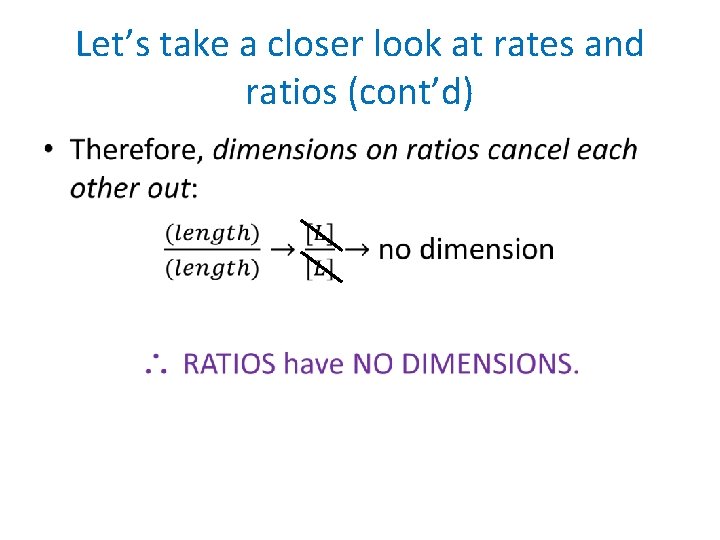
Let’s take a closer look at rates and ratios (cont’d) • Recall that rates are ratios in which the quantities being compared have different units (and thus, different dimensions). • It follows that ratios must compare quantities with the same units (and thus, same dimensions).
Let’s take a closer look at rates and ratios (cont’d) •
Let’s take a closer look at rates and ratios (cont’d) •
In Physics… … many physical quantities are RATIOS.
In Physics… … many physical quantities are RATIOS in Physics are so important, they have (as a class) a name: adimensional quantities.
In Physics… … many physical quantities are RATIOS in Physics are so important, they have (as a class) a name: adimensional quantities. This name comes from “a-” + “dimensional” (without) + “dimensional”
Adimensional Quantities • The prefix “a-” means “without”, such as in “adiabatic” (without change in pressure); “asymmetric” (without symmetry) and “asexual” (without gender).
Adimensional Quantities • The prefix “a-” means “without”, such as in “adiabatic” (without change in pressure); “asymmetric” (without symmetry) and “asexual” (without gender). • The suffix “-less” also means “without”, and can be used in the same way: “dimensionless”, “regardless” and “genderless”.
The “Brad Pitt”s and “Angelina Jolie”s of Physics • Famous rates: Density
The “Brad Pitt”s and “Angelina Jolie”s of Physics • Famous rates: Density Speed
The “Brad Pitt”s and “Angelina Jolie”s of Physics • Famous rates: Density Speed Velocity
The “Brad Pitt”s and “Angelina Jolie”s of Physics • Famous rates: Density Speed Velocity Acceleration
The “Brad Pitt”s and “Angelina Jolie”s of Physics • Famous rates: Density Speed Velocity Acceleration Field
The “Brad Pitt”s and “Angelina Jolie”s of Physics • Famous rates: Density Speed Velocity Acceleration Field Potential
The “Brad Pitt”s and “Angelina Jolie”s of Physics • Famous rates: Density Speed Velocity Acceleration Field Potential Coefficients of expansion
The “Brad Pitt”s and “Angelina Jolie”s of Physics • Famous adimensional quantities: 1. Trigonometric functions (sin, cos and tan)
The “Brad Pitt”s and “Angelina Jolie”s of Physics • Famous adimensional quantities: 1. Trigonometric functions (sin, cos and tan) 2. Magnification (glasses, lenses and mirrors)
The “Brad Pitt”s and “Angelina Jolie”s of Physics • Famous adimensional quantities: 1. Trigonometric functions (sin, cos and tan) 2. Magnification (glasses, lenses and mirrors) 3. Mach number (object’s speed relative to sound’s)
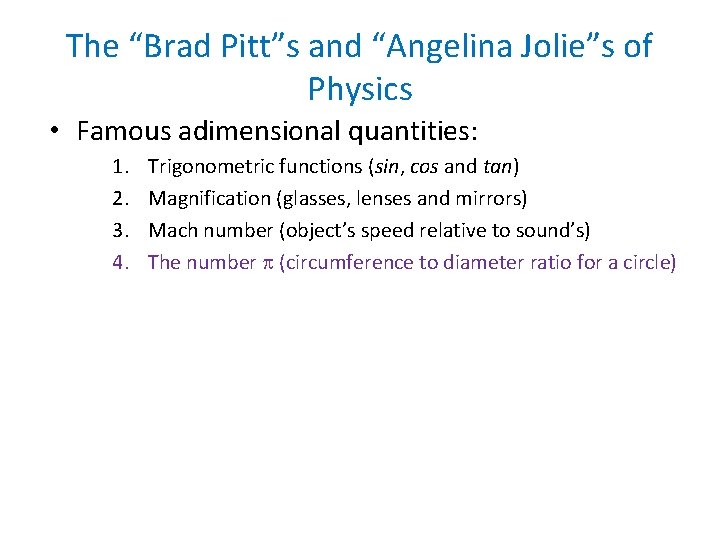
The “Brad Pitt”s and “Angelina Jolie”s of Physics • Famous adimensional quantities: 1. 2. 3. 4. Trigonometric functions (sin, cos and tan) Magnification (glasses, lenses and mirrors) Mach number (object’s speed relative to sound’s) The number (circumference to diameter ratio for a circle)
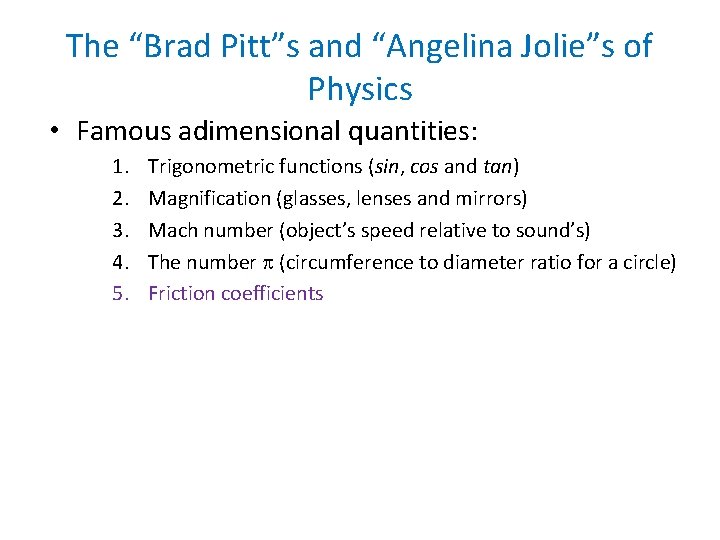
The “Brad Pitt”s and “Angelina Jolie”s of Physics • Famous adimensional quantities: 1. 2. 3. 4. 5. Trigonometric functions (sin, cos and tan) Magnification (glasses, lenses and mirrors) Mach number (object’s speed relative to sound’s) The number (circumference to diameter ratio for a circle) Friction coefficients
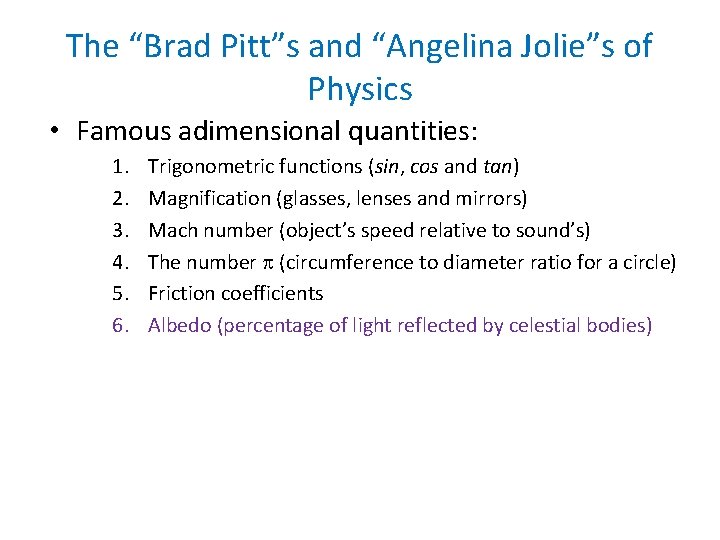
The “Brad Pitt”s and “Angelina Jolie”s of Physics • Famous adimensional quantities: 1. 2. 3. 4. 5. 6. Trigonometric functions (sin, cos and tan) Magnification (glasses, lenses and mirrors) Mach number (object’s speed relative to sound’s) The number (circumference to diameter ratio for a circle) Friction coefficients Albedo (percentage of light reflected by celestial bodies)
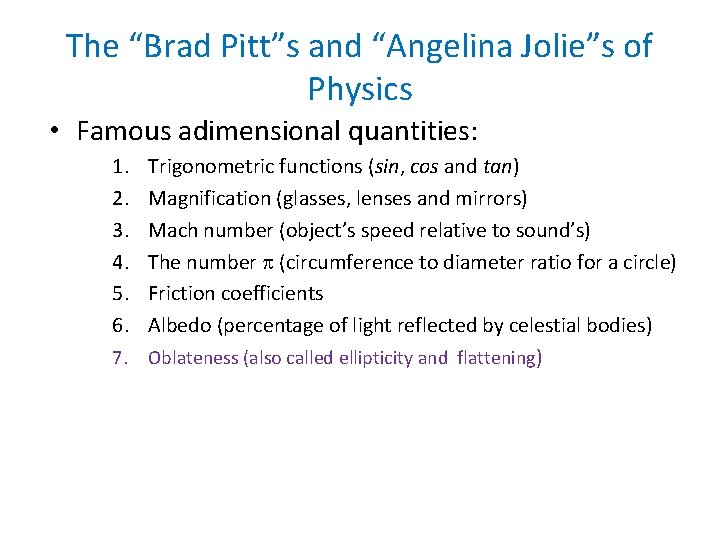
The “Brad Pitt”s and “Angelina Jolie”s of Physics • Famous adimensional quantities: 1. 2. 3. 4. 5. 6. Trigonometric functions (sin, cos and tan) Magnification (glasses, lenses and mirrors) Mach number (object’s speed relative to sound’s) The number (circumference to diameter ratio for a circle) Friction coefficients Albedo (percentage of light reflected by celestial bodies) 7. Oblateness (also called ellipticity and flattening)
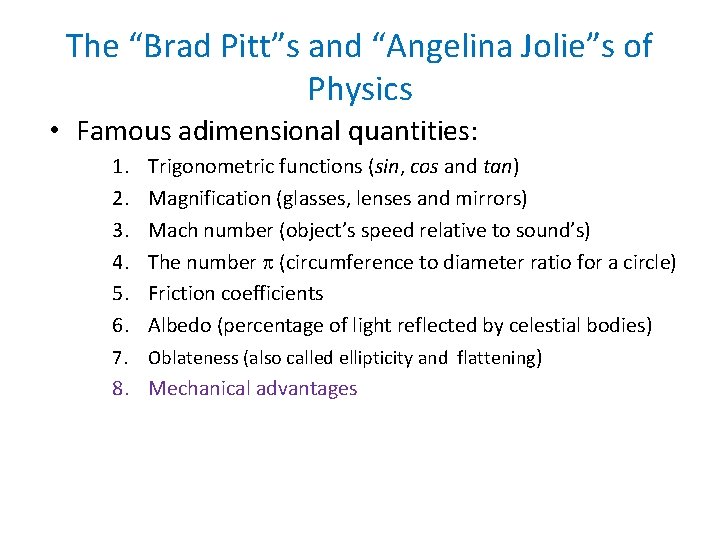
The “Brad Pitt”s and “Angelina Jolie”s of Physics • Famous adimensional quantities: 1. 2. 3. 4. 5. 6. Trigonometric functions (sin, cos and tan) Magnification (glasses, lenses and mirrors) Mach number (object’s speed relative to sound’s) The number (circumference to diameter ratio for a circle) Friction coefficients Albedo (percentage of light reflected by celestial bodies) 7. Oblateness (also called ellipticity and flattening) 8. Mechanical advantages
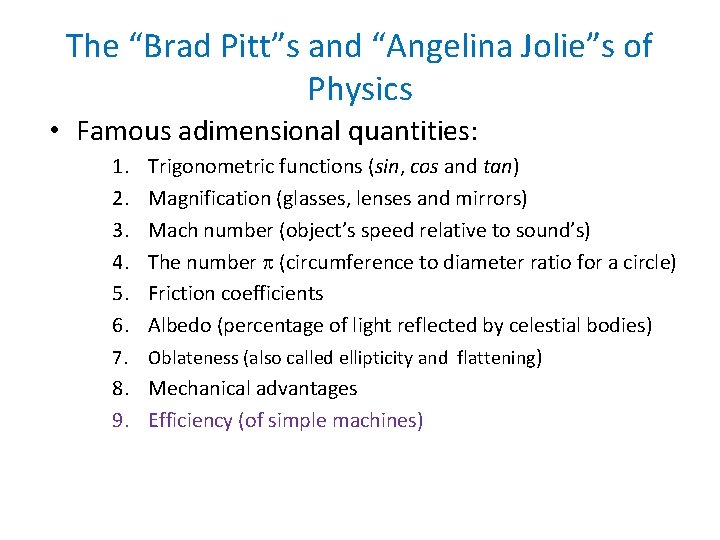
The “Brad Pitt”s and “Angelina Jolie”s of Physics • Famous adimensional quantities: 1. 2. 3. 4. 5. 6. Trigonometric functions (sin, cos and tan) Magnification (glasses, lenses and mirrors) Mach number (object’s speed relative to sound’s) The number (circumference to diameter ratio for a circle) Friction coefficients Albedo (percentage of light reflected by celestial bodies) 7. Oblateness (also called ellipticity and flattening) 8. Mechanical advantages 9. Efficiency (of simple machines)
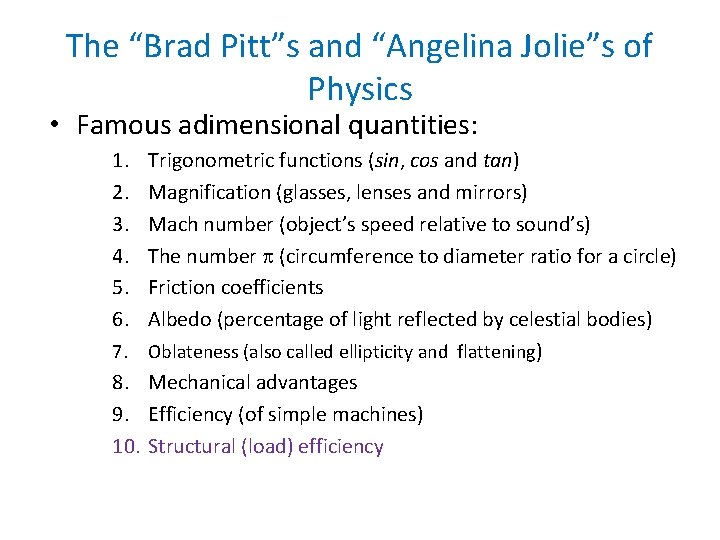
The “Brad Pitt”s and “Angelina Jolie”s of Physics • Famous adimensional quantities: 1. 2. 3. 4. 5. 6. 7. 8. 9. 10. Trigonometric functions (sin, cos and tan) Magnification (glasses, lenses and mirrors) Mach number (object’s speed relative to sound’s) The number (circumference to diameter ratio for a circle) Friction coefficients Albedo (percentage of light reflected by celestial bodies) Oblateness (also called ellipticity and flattening) Mechanical advantages Efficiency (of simple machines) Structural (load) efficiency
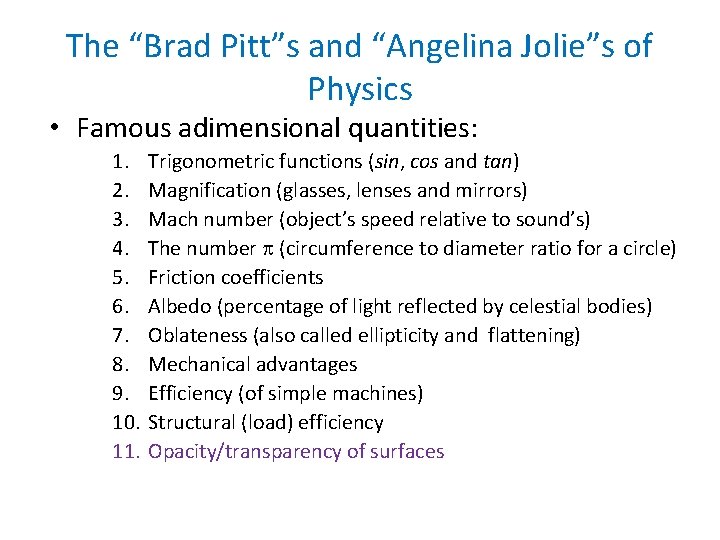
The “Brad Pitt”s and “Angelina Jolie”s of Physics • Famous adimensional quantities: 1. 2. 3. 4. 5. 6. 7. 8. 9. 10. 11. Trigonometric functions (sin, cos and tan) Magnification (glasses, lenses and mirrors) Mach number (object’s speed relative to sound’s) The number (circumference to diameter ratio for a circle) Friction coefficients Albedo (percentage of light reflected by celestial bodies) Oblateness (also called ellipticity and flattening) Mechanical advantages Efficiency (of simple machines) Structural (load) efficiency Opacity/transparency of surfaces
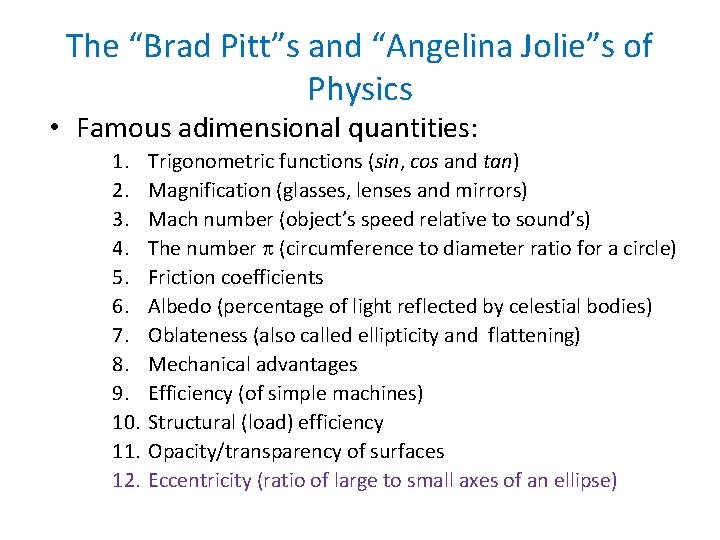
The “Brad Pitt”s and “Angelina Jolie”s of Physics • Famous adimensional quantities: 1. 2. 3. 4. 5. 6. 7. 8. 9. 10. 11. 12. Trigonometric functions (sin, cos and tan) Magnification (glasses, lenses and mirrors) Mach number (object’s speed relative to sound’s) The number (circumference to diameter ratio for a circle) Friction coefficients Albedo (percentage of light reflected by celestial bodies) Oblateness (also called ellipticity and flattening) Mechanical advantages Efficiency (of simple machines) Structural (load) efficiency Opacity/transparency of surfaces Eccentricity (ratio of large to small axes of an ellipse)
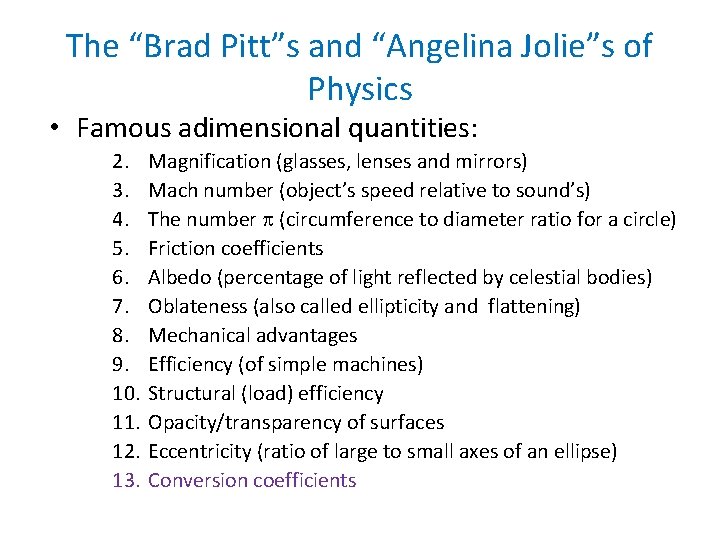
The “Brad Pitt”s and “Angelina Jolie”s of Physics • Famous adimensional quantities: 2. 3. 4. 5. 6. 7. 8. 9. 10. 11. 12. 13. Magnification (glasses, lenses and mirrors) Mach number (object’s speed relative to sound’s) The number (circumference to diameter ratio for a circle) Friction coefficients Albedo (percentage of light reflected by celestial bodies) Oblateness (also called ellipticity and flattening) Mechanical advantages Efficiency (of simple machines) Structural (load) efficiency Opacity/transparency of surfaces Eccentricity (ratio of large to small axes of an ellipse) Conversion coefficients
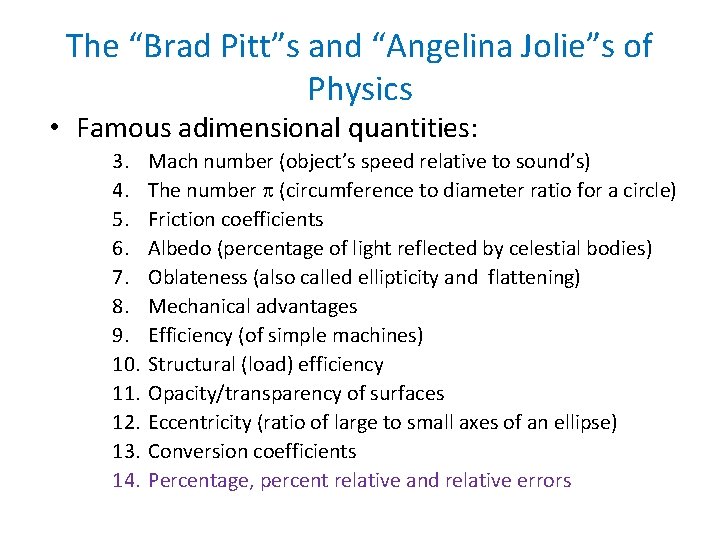
The “Brad Pitt”s and “Angelina Jolie”s of Physics • Famous adimensional quantities: 3. 4. 5. 6. 7. 8. 9. 10. 11. 12. 13. 14. Mach number (object’s speed relative to sound’s) The number (circumference to diameter ratio for a circle) Friction coefficients Albedo (percentage of light reflected by celestial bodies) Oblateness (also called ellipticity and flattening) Mechanical advantages Efficiency (of simple machines) Structural (load) efficiency Opacity/transparency of surfaces Eccentricity (ratio of large to small axes of an ellipse) Conversion coefficients Percentage, percent relative and relative errors
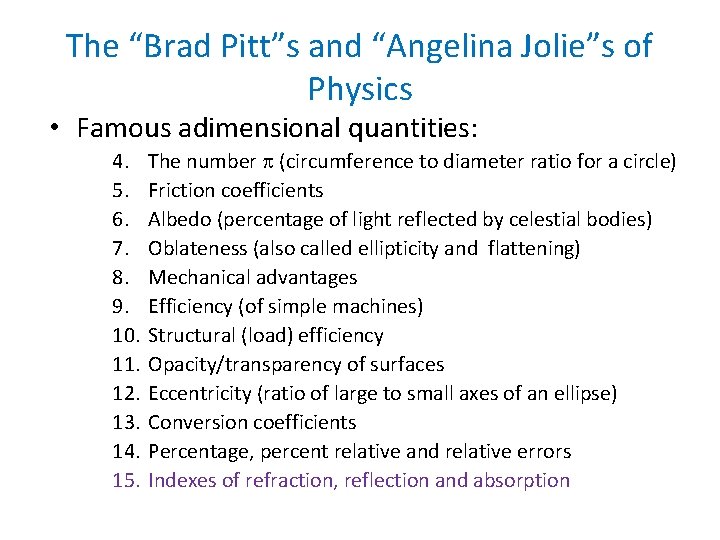
The “Brad Pitt”s and “Angelina Jolie”s of Physics • Famous adimensional quantities: 4. 5. 6. 7. 8. 9. 10. 11. 12. 13. 14. 15. The number (circumference to diameter ratio for a circle) Friction coefficients Albedo (percentage of light reflected by celestial bodies) Oblateness (also called ellipticity and flattening) Mechanical advantages Efficiency (of simple machines) Structural (load) efficiency Opacity/transparency of surfaces Eccentricity (ratio of large to small axes of an ellipse) Conversion coefficients Percentage, percent relative and relative errors Indexes of refraction, reflection and absorption
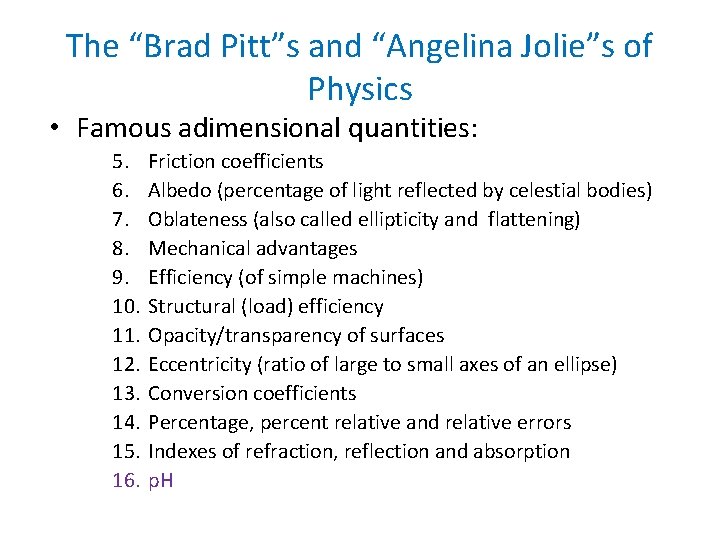
The “Brad Pitt”s and “Angelina Jolie”s of Physics • Famous adimensional quantities: 5. 6. 7. 8. 9. 10. 11. 12. 13. 14. 15. 16. Friction coefficients Albedo (percentage of light reflected by celestial bodies) Oblateness (also called ellipticity and flattening) Mechanical advantages Efficiency (of simple machines) Structural (load) efficiency Opacity/transparency of surfaces Eccentricity (ratio of large to small axes of an ellipse) Conversion coefficients Percentage, percent relative and relative errors Indexes of refraction, reflection and absorption p. H
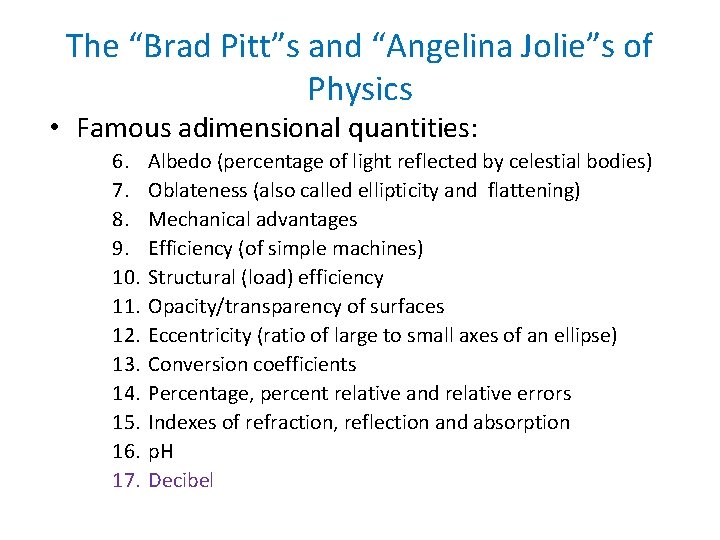
The “Brad Pitt”s and “Angelina Jolie”s of Physics • Famous adimensional quantities: 6. 7. 8. 9. 10. 11. 12. 13. 14. 15. 16. 17. Albedo (percentage of light reflected by celestial bodies) Oblateness (also called ellipticity and flattening) Mechanical advantages Efficiency (of simple machines) Structural (load) efficiency Opacity/transparency of surfaces Eccentricity (ratio of large to small axes of an ellipse) Conversion coefficients Percentage, percent relative and relative errors Indexes of refraction, reflection and absorption p. H Decibel
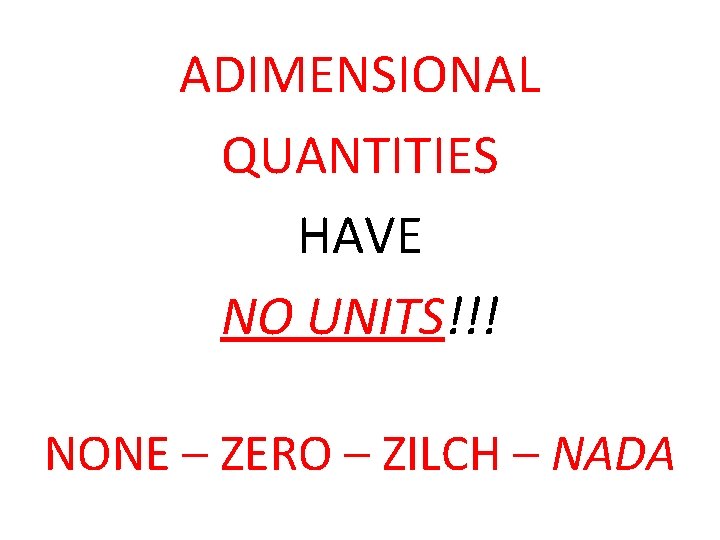
ADIMENSIONAL QUANTITIES HAVE NO UNITS!!! NONE – ZERO – ZILCH – NADA
THE END Lilian Wehner ©